User Guides
Reorder Sections
Learn how to reorder sections in your Rezi resume and discover the best resume section order for entry-level and experienced job seekers.
Published on
July 29, 2026
Updated on
July 29, 2026
Are you a recent graduate who wants to emphasize education? Or a more experienced professional who wants to put work history front and center? With Rezi, your resume layout isn’t set in stone. You can quickly rearrange your resume to match your background and the role you’re targeting.
In this guide, I’ll show you how to rearrange your resume sections in Rezi and explain the best section order based on your experience level.
Start building your sections with our free AI Resume Builder. We guide you through the process with AI tools and personalised feedback to create an ATS-friendly application.
You can also check out more of our advanced features:
And take a look at these useful guides with tips and examples:
Reordering Resume Sections
Rezi makes it easy to rearrange your resume sections so you can highlight your strongest qualifications first. But why does this matter? The right section order simply makes your resume easier to scan and helps skim-reading recruiters quickly find your most relevant qualifications.
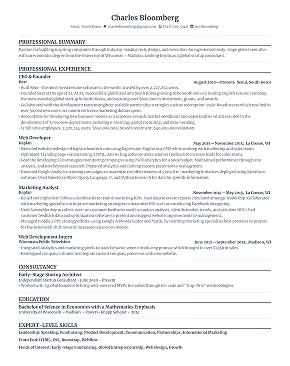
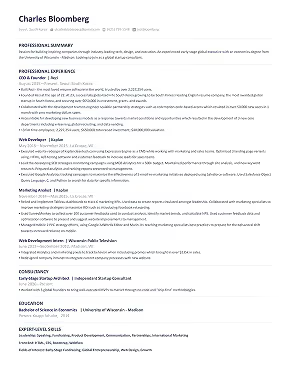
And it’s simple. Once you’ve finished adding your resume content, head to the Finish Up & Preview tab. From there, drag and drop your section headings into the order you want. It’s a small adjustment, but it helps recruiters see why you’re the right fit as soon as they open your resume.
How to Reorder Sections
Here’s a quick overview of how to reorder your resume sections with Rezi:
- Create your resume or upload your details, then use Target Your Resume to receive tailored suggestions, feedback, and keyword recommendations.
- Fill out your resume sections by completing the core sections first, then add optional sections if they’re relevant and use Rezi’s AI tools to strengthen your content.
- Reorder your resume sections in the Finish Up & Preview tab by dragging and dropping section headings into your preferred order.
Keep reading to get the full breakdown.
1. Create your resume or upload your details
Before you can reorder any sections, you’ll need to create a resume in Rezi. You have several ways to get started:
- Build a resume from scratch.
- Upload an existing resume.
- Import your LinkedIn profile with the Rezi Chrome Extension.
- Use the AI Resume Agent to create your resume through a guided conversation.
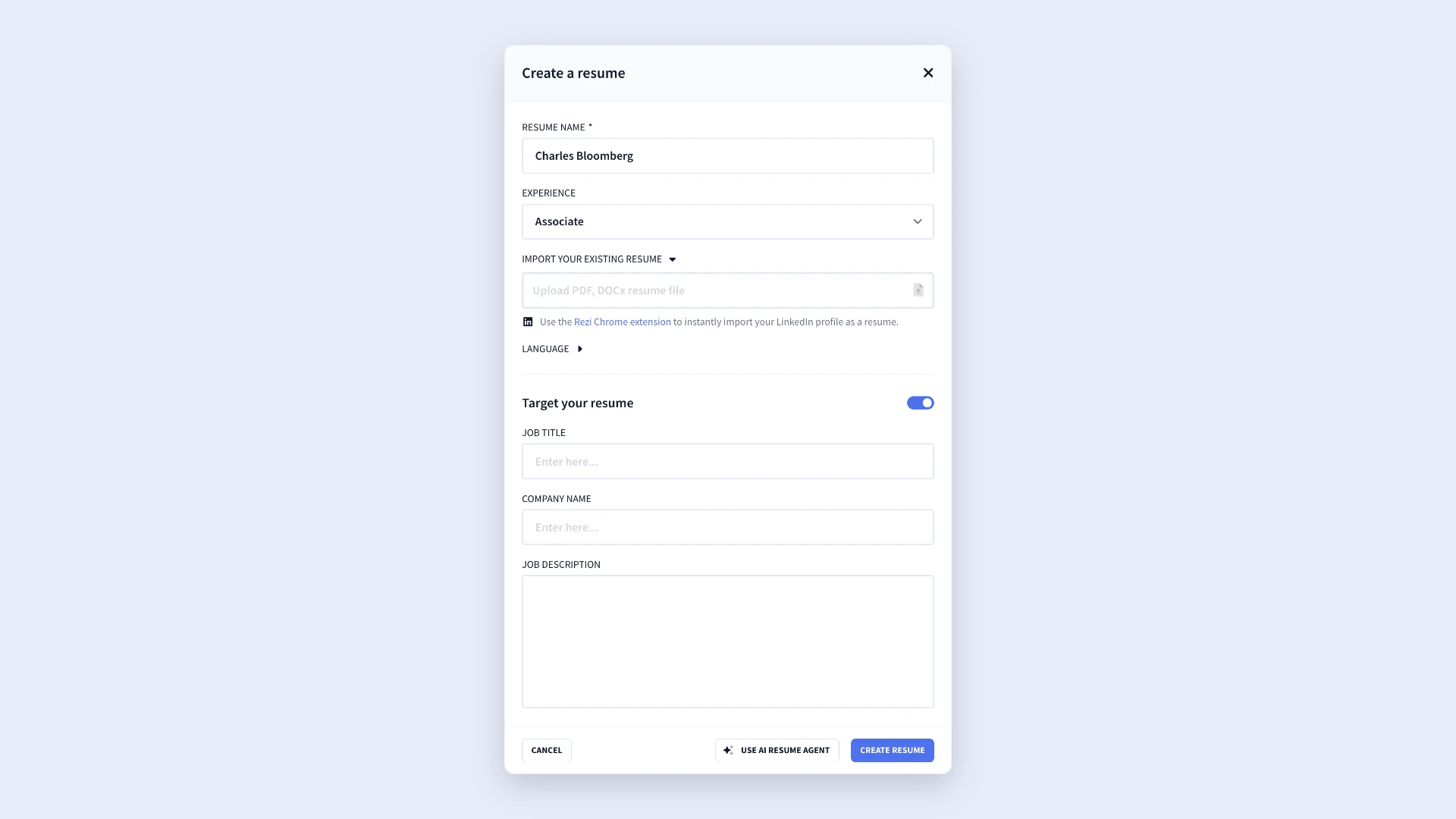
If you’re applying for a specific position, you can also use Rezi’s Target Your Resume feature. Enter the job title, company name, and job description, and Rezi will tailor its suggestions, feedback, and keyword recommendations to align your resume with the role.
2. Fill out your resume sections
After you’ve completed your resume, work through each section and add your information. You’ll begin with the must-have sections:
And if you need to include more or pad out your resume, just click the three-dot menu at the end of the section tabs to add extra sections, such as:
- Projects
- Certifications
- Coursework
- Involvement
- Awards and Honors
- Publications
- References (only include this section if an employer specifically asks for it)
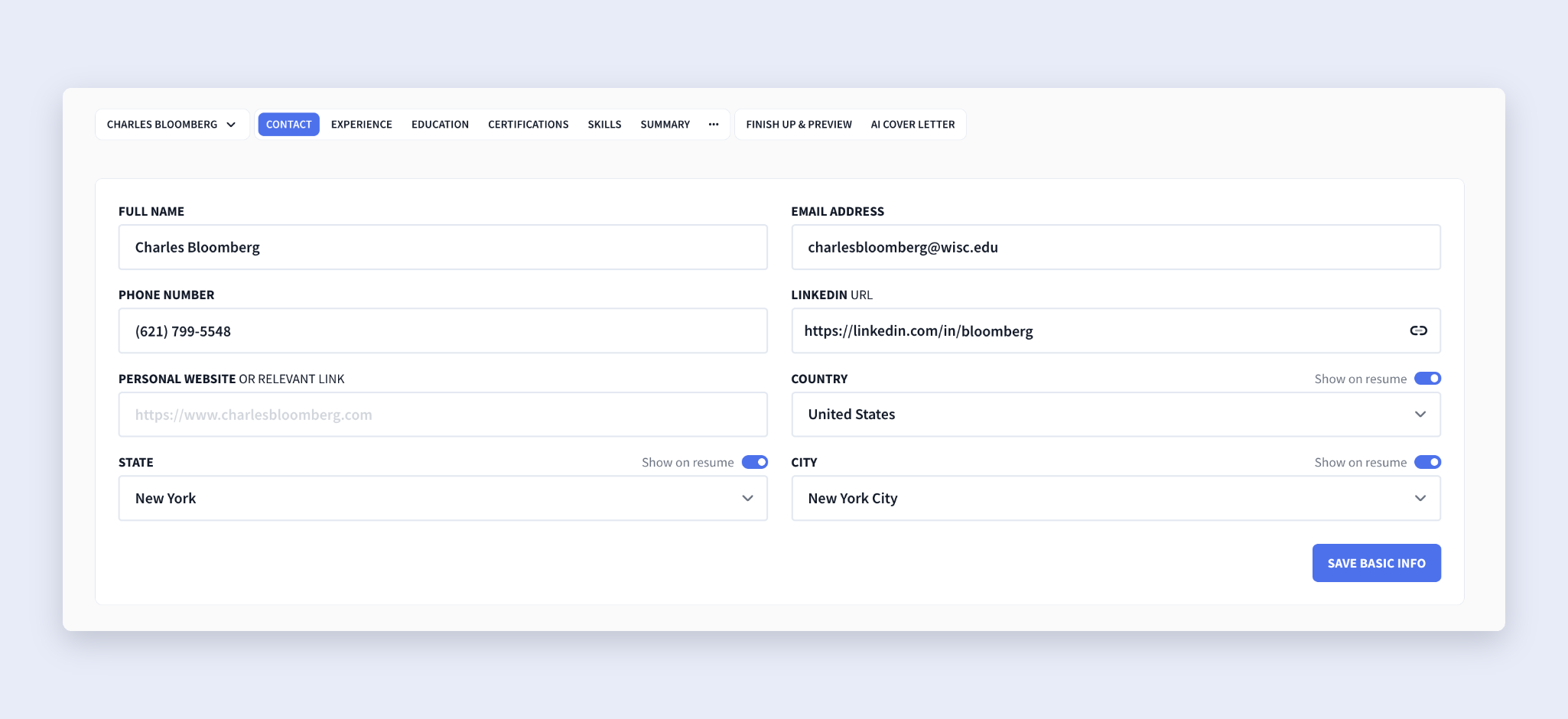
As you work your way through, take advantage of Rezi's AI features to save time and improve your resume. Tools like the AI Bullet Point Writer, AI Summary Generator, and AI Skills Explorer can help you write stronger content, show measurable results, and add relevant keywords.
Once you’ve finished adding your information, head to the Finish Up & Preview tab.
3. Reorder your resume sections
The Finish Up & Preview page is where you can change the order of your resume sections.
Here’s how to reorder them:
- Hover over the left side of a section heading until the up-and-down arrow (⬍) appears.
- Click and hold the section.
- Drag and drop it into your preferred position.

That’s it. You can quickly move your most relevant qualifications closer to the top of your resume, making it easier for recruiters to see your strongest selling points. You can also move specific entries within your work experience section with the same drag-and-drop tool.
While you’re in the Finish Up & Preview tab, it’s worth checking out the final optimization tools. You can use AI Keyword Targeting to compare your resume against a job description and add important keywords you might have missed. You’ll also see your Rezi Score along with personalized feedback, giving you one last opportunity to improve your resume.
How to Choose the Best Resume Section Order
The best section order depends on your career timeline. There’s no single layout that works for everyone, so think about what you prefer hiring managers to notice first, with your strongest selling points at the top.
Here are my recommendations for where to place your resume sections.
Entry-level resume
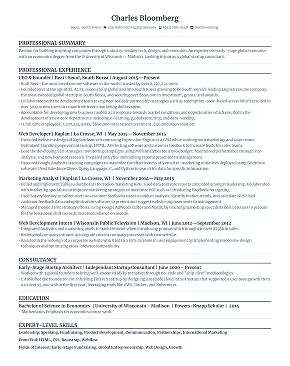
If you’re a student, recent graduate, or changing careers without much work experience, let your education and extra resume sections do more of the talking.
Drag your education section near the top of your resume, directly below your contact details and resume objective. This gives employers an immediate look at your academic background before they reach your work history.
You can also pack more of a punch with your education section by including details that reveal your potential, such as:
- Relevant coursework
- Academic awards or honors
- Strong GPA (if it’s worth highlighting)
- Class projects related to the role
As you build your career and gain more professional experience, your work history should become more valuable than your education. At that point, move your experience section above education and cut academic details that no longer add value.
Experienced professional resume
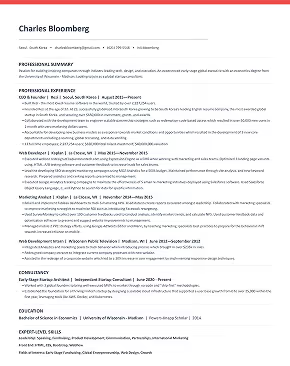
This is the most familiar and popular resume layout. If you’ve been working for several years, your professional experience should take center stage.
Place your work experience section immediately below your resume summary so recruiters can quickly see your most relevant accomplishments. Your education section can follow afterward, since employers will usually care more about your recent work than your academic background.
My advice for this section? As you write your resume bullet points, focus on accomplishments instead of generic responsibilities. Explain what you did, why it mattered, and the results you achieved.
It’s also smart to mirror the language and technical skills mentioned in the job description to show that your experience matches the employer’s needs.
Learn more about how to customize your application:
- How to Tailor Your Resume to a Job Description
- How to Tailor Your Resume to a Job Description With AI
Skills-based resume
I’ll be honest, a skills-based resume with your skills at the top isn’t the best choice for everyone. Some hiring managers actually view these types of resumes with caution because they can make it seem like you’re trying to hide your work history.
That said, a skills-based layout can work if you:
- Are changing careers
- Have limited professional experience
- Have experience that doesn’t directly relate to your target role
- Are applying for positions that place a strong emphasis on technical or specialized skills
Instead of leading with your work history, this format highlights your most relevant and transferable skills first, while still including a concise employment history afterward. It’s basically to help employers quickly connect your abilities to the position you’re targeting.
Just keep your skills section focused. If you repeat the same accomplishments in both your skills section and work experience, it just gets repetitive, and you may as well use the traditional format.
Summary
Here’s a breakdown of everything you need to know about reordering your resume sections:
- The best resume section order depends on your experience level, career goals, and the position you’re applying for; there isn’t a single layout that works for everyone.
- You should always place your most relevant qualifications near the top of your resume because recruiters typically spend just seconds scanning each application.
- If you’re a student, recent graduate, or have limited work experience, move your education section above your work experience to focus on your academic background.
- As you gain more professional experience, move your work experience section directly below your resume summary and place your education section underneath it.
- You can strengthen your resume by moving relevant sections such as projects, certifications, or publications higher on the page when they support the role.
- A skills-based resume can also work for career changers, candidates with limited relevant experience, or roles that emphasize technical skills.
- Rezi lets you reorder your resume sections in the Finish Up & Preview tab by simply dragging and dropping each section into your preferred position.
- After you’ve rearranged your sections, review your resume from top to bottom to make sure the information flows logically and presents your qualifications in the strongest way.
FAQ
Can you reorder sections without changing your resume content?
Yes. Reordering your resume sections only changes the way your information is presented, not the content itself. In Rezi, you can simply drag and drop your section headings in the Finish Up & Preview tab to rearrange your resume.
How do you decide which resume sections matter most?
The most important resume sections are the ones that demonstrate you’re qualified for the job. Think about what a hiring manager wants to see first, then move those sections closer to the top. For example, recent graduates often benefit from leading with their education, while experienced professionals should usually highlight their work history. Tailoring your section order to each application helps employers quickly find the qualifications that matter most.
Should you include every resume section?
No, your resume should only include sections that add value to your application. Everyone should include the essentials, such as your contact details, experience, education, and skills. Beyond that, only add sections like projects, certifications, awards, or publications if they’re relevant to the position or strengthen your application. A focused and concise resume is easier to read than one filled with unnecessary information.
What’s the best resume section order for a recent graduate?
If you’re a recent graduate or have limited work experience, shift the focus to your education by placing it near the top of your resume, below your contact information and resume summary or objective. You can also strengthen your application by including relevant coursework, academic achievements, projects, or certifications before moving to your work experience.
Where should you place certifications, projects, or awards on your resume?
Place these sections where they’ll have the biggest impact. If your certifications, projects, or awards directly relate to the role, consider moving them above less relevant sections so recruiters notice them sooner. If they simply support your qualifications, placing them below your experience and education sections usually works well.
Does the order of your resume sections affect ATS compatibility?
In most cases, no. Applicant Tracking Systems primarily scan your resume for information like skills, keywords, job titles, and dates rather than the order of your sections. However, a clear and logical structure still matters because recruiters will read your resume after it passes ATS screening.

Upload or drop your resume to get started
Upload your resume to get started
Score my resume

Lauren Bedford is a seasoned writer with a track record of helping thousands of readers find practical solutions over the past five years. She's tackled a range of topics, always striving to simplify complex jargon. At Rezi, Lauren crafts genuine and actionable content that guides readers in creating standout resumes to land their dream jobs.