
User Guides
Coursework
Not sure what to put in your coursework section? Learn how to add coursework in Rezi, choose the right courses, and make the section stand out.
Published on
July 30, 2026
Updated on
July 30, 2026
Your resume doesn’t need every course you’ve ever taken, just the ones that help prove you’re a strong fit for the job. Having a coursework section gives you the chance to highlight the classes, certifications, and training that truly add value to your application.
In this guide, I’ll show you how to add coursework in Rezi and share some tips to help you get the most out of this section.
Get started with our free AI Resume Builder. We guide you through the process with AI suggestions and tailored tips to help you deliver a professional application.
You can also check out more of our advanced tools:
And learn about other handy resume sections:
- How to List Awards on a Resume
- How to List Certifications on Your Resume
- How to List Your Best Projects on a Resume
Coursework Section
The coursework section lets you show off the knowledge and skills you’ve gained through your education, certifications, and training. For students, recent grads, or career changers, you can highlight relevant learning before you’ve built up years of experience.
Adding coursework in Rezi is easy, but don’t overdo it. Like every section on your resume, your coursework should earn its place. If it strengthens your application, keeps it focused, and makes it easy to connect with the role you want, then you get the green light.
But if you have plenty of work experience with the same skills, you can usually keep your coursework in your education section or leave it off entirely.
How to Fill Out the Coursework Section
Here’s a quick rundown of how to add coursework with Rezi:
- Create a resume in Rezi by building one from scratch, uploading an existing resume, importing your LinkedIn profile, or using the AI Resume Agent.
- Add the coursework section from the menu in the resume builder. If you’re only listing one or two courses, consider adding them under education instead of creating a separate section.
- Add your coursework details by including the course name, institution, completion date, up to three relevant skills, and a brief explanation of how you applied those skills.
- Review your resume and finalize the layout to improve your content, formatting, and ATS optimization, then position your coursework section based on your experience level.
Let’s get into the details.
1. Create a resume in Rezi
Before you add coursework, you’ll need to create a resume in Rezi. You can get started in whichever way works best for you:
- Build a resume from scratch
- Upload an existing resume
- Import your LinkedIn profile with the Rezi Chrome Extension
- Use the AI Resume Agent to create your resume through a guided conversation
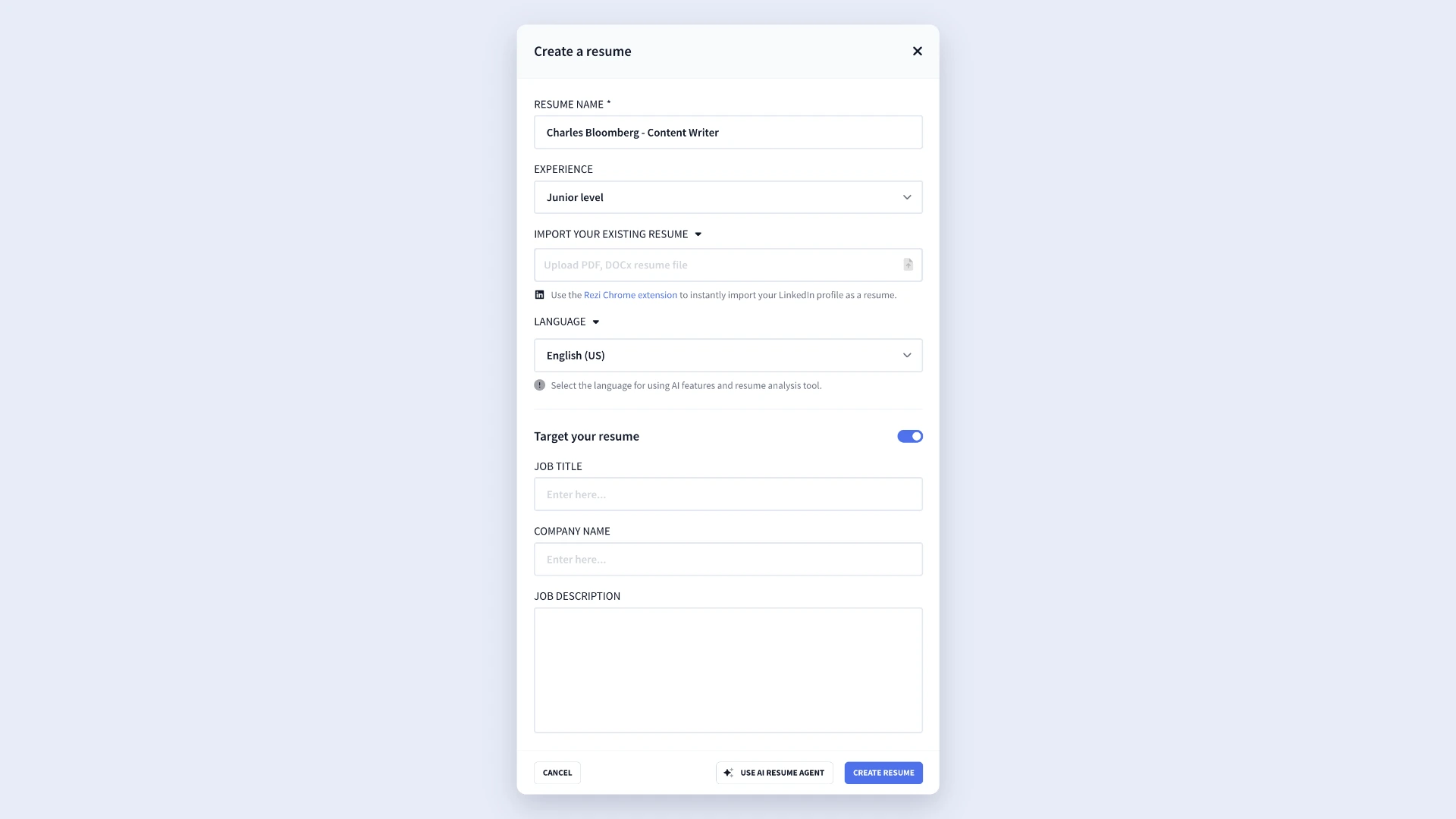
If you’re applying for a specific job, I suggest taking advantage of the Target Your Resume feature during setup. Just enter the job title, company name, and job description, and Rezi will give you more relevant suggestions and feedback as you build your resume.
2. Add the coursework section
Once you’re inside the resume builder, you’ll see all the standard sections, such as work experience, education, and skills. To add coursework:
- Click the three-dot menu at the end of the section tabs
- Select Add or Remove Section
- Enable Coursework
You’ll then see the coursework section along with your other resume sections.
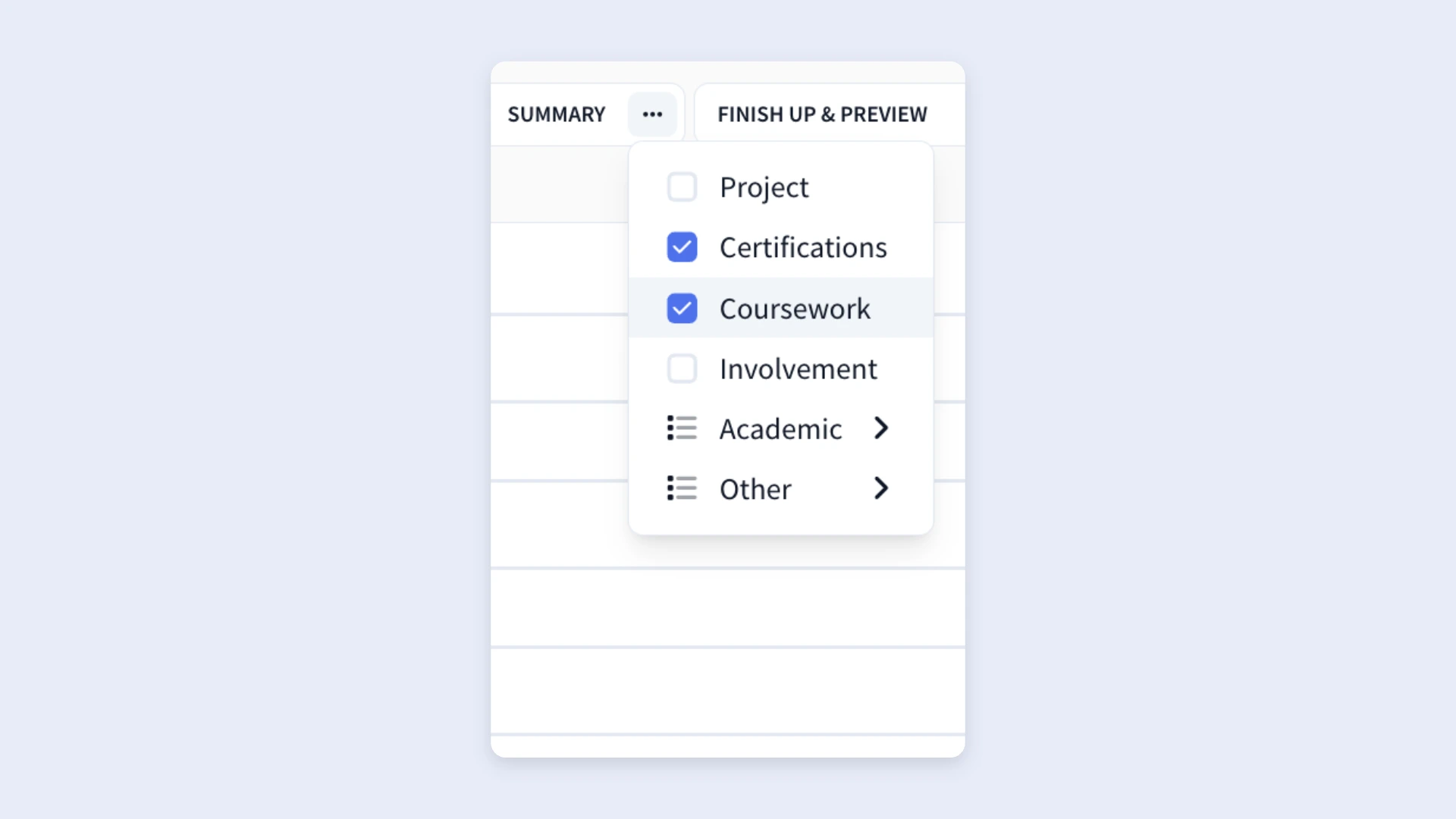
Just keep in mind that you don’t always need a dedicated coursework section. If you only want to mention one or two relevant courses, adding them under your education section usually keeps your resume more concise and organized.
In fact, you only need a separate coursework section when you’ve completed several job-relevant courses and want to give them more visibility, especially if you’re still building your professional experience and want to pad out your resume (more on that below).
3. Add your coursework details
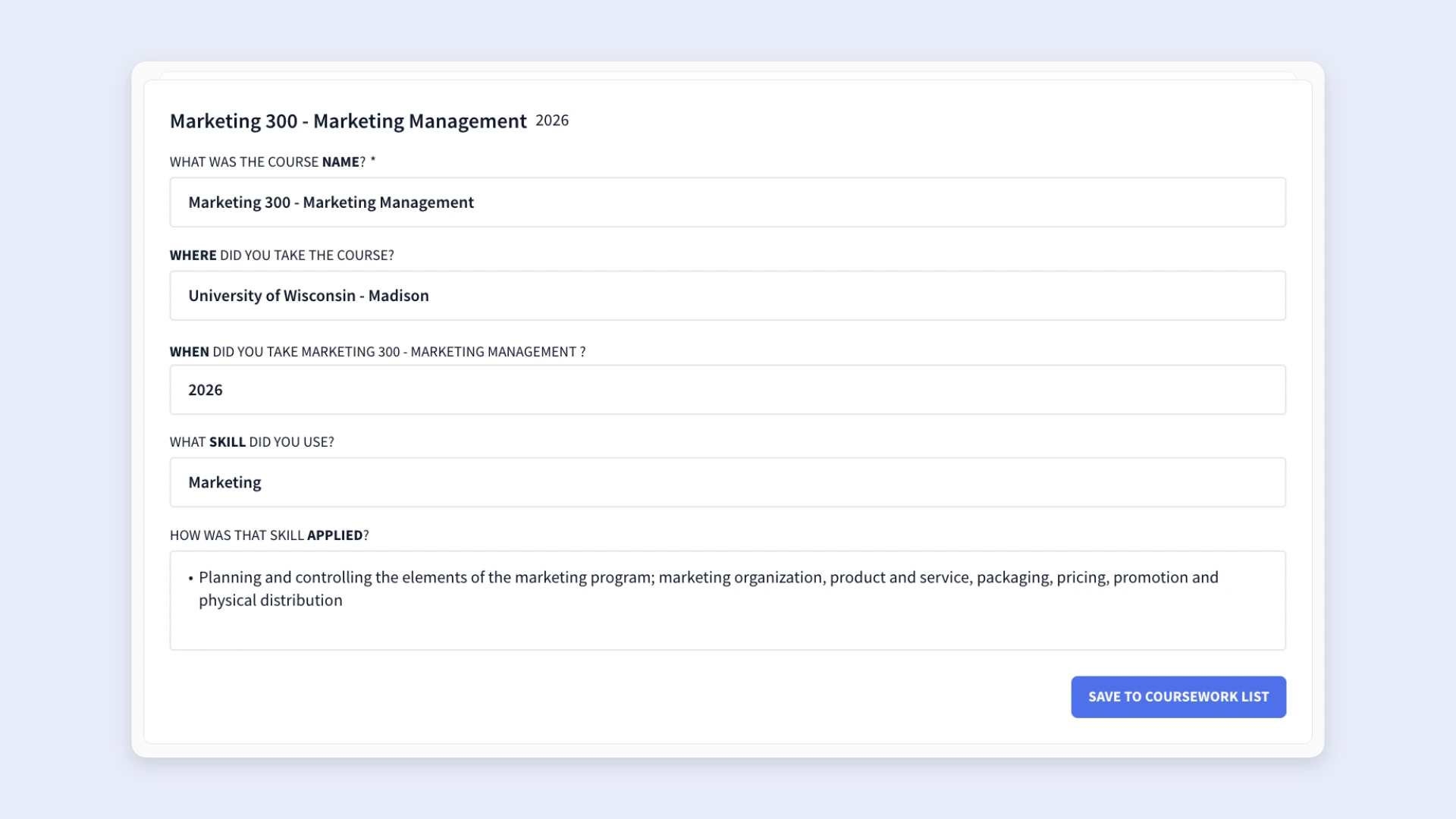
Open the coursework section and use the fields to fill out all the necessary information. Every entry should show employers what you learned and how you applied those skills.
For each course, you’ll complete these fields:
- Course name: Enter the course title. Common abbreviations are perfectly fine when they’re widely recognized, such as “AWS” instead of “Amazon Web Services.”
- Institution: List the organization that provided the course, whether that’s your university, Coursera, LinkedIn Learning, or another training provider.
- Date: Add the year you completed the course to show your knowledge is current and your commitment to continuous learning.
- Skills: Include up to three key skills you developed or used during the course.
- Application: Explain how you applied those skills through projects, assignments, research, or other practical work.
4. Review your resume and finalize the layout
After you’ve finished building your resume, head to the Finish Up & Preview tab. This is where you can check, tweak, and improve everything before you apply.
You’ll be able to:
- Review your resume for mistakes and clarity.
- Choose an ATS-friendly resume template.
- Adjust formatting and layout.
- Compare your resume against a job description with AI Keyword Targeting.
- Check your Rezi Score and apply any suggested improvements.
- Rename or reorder your resume sections.

If you’re swapping sections around, remember that the placement of your coursework section should reflect your experience level. If you’re a recent graduate, changing careers, or have limited work experience, place Education and Coursework above Work Experience so employers see your most relevant qualifications first.
How to Get the Best Results
Instead of treating your coursework section as a list of classes you’ve taken, use it to push why you’re a good fit for the role. Every course you include should answer a simple question: How does this make me a stronger candidate?
Here are my top tips to ensure your coursework section adds value to your resume.
Tailor your coursework to the job
A generic coursework section won’t do much for your application. But a tailored one goes a long way in helping to reinforce the skills and knowledge an employer wants to see.
Before you add any courses, review the job description and ask yourself:
- Which skills or qualifications does the employer emphasize?
- Which of my courses demonstrate those skills?
- Does this coursework strengthen my overall application?
When choosing between courses, prioritize advanced or specialized subjects over introductory ones. A course like “Advanced Machine Learning” says much more about your expertise than “Introduction to Programming”.
And no, you don’t need to rebuild your entire resume from scratch every time you apply. It’s much faster to keep a master resume with all your coursework and then customize it for each application by removing or copy-pasting the most relevant entries.
You can also speed up the process with Rezi MCP. Connect Rezi to Claude, Cursor, Codex, or Gemini, paste a job description, and ask the agent to tailor your resume.
Highlight what you accomplished
Don’t stop at listing course names. Give employers a better idea of what you actually learned and applied. For your strongest courses, add one to three bullet points that highlight:
- Projects you completed.
- Technical or professional skills you developed.
- Software, tools, or technologies you used.
- Notable achievements or outcomes.
Keep your descriptions concise and relevant. Recruiters don’t expect an extensive professional background from students or recent graduates, but it’s nice to see evidence that you can apply what you’ve learned in the real world.
New to the workplace? Find out more: How to Write a Resume With No Experience
Put your coursework in the right place
If you’re only mentioning a few relevant courses, adding them under your education section makes the most sense. This works well when you already have solid work experience or when resume space is limited.
If coursework is one of your strongest qualifications, create a separate coursework section directly below the education section. It’ll give your academic experience more visibility and make your resume easier to scan.
As your career progresses, let your professional accomplishments take center stage. Over time, move education and coursework lower on your resume, cut the amount of detail, and let your work experience section become the main focus.
Summary
Here’s an overview of all you need to know about the coursework section of your resume:
- The coursework section highlights relevant academic learning. Use it to emphasize courses, certifications, or training that strengthen your qualifications for a specific role.
- It’s most valuable early in your career. Students, recent graduates, career changers, and candidates with limited work experience benefit the most from including coursework.
- Include only the courses that support the job you’re applying for; a few targeted courses are way more effective than a long list of unrelated classes.
- You don’t always need a separate coursework section. If you’re only listing one or two courses, include them under your education section. Create a dedicated coursework section only when you have several relevant courses that deserve more attention.
- Provide context, not just course titles. When possible, explain what you learned or accomplished by highlighting skills, projects, tools, or practical applications.
- Tailor your coursework by reviewing the job description, identifying the key skills, and featuring the courses that best align with those requirements.
- If you need to choose between introductory and higher-level courses, lead with the ones that demonstrate deeper knowledge and more relevant expertise.
- Recent graduates and career changers can position coursework near the top of the resume, typically below education. Candidates with extensive work experience should move it lower or remove it if it no longer adds value.
- Keep the section concise and easy to scan. Aim for three to four relevant courses, avoid unnecessary detail, and make sure every entry contributes something unique.
FAQ
How many courses should you list on your resume?
There’s no fixed rule, but three to four relevant courses is usually enough. That gives employers enough information to understand your background without overwhelming them with a long list.
If you’re creating a dedicated coursework section, only include the courses that strengthen your application. And if you’re adding coursework under your education section, one to three standout courses are often enough. Remember, quality always beats quantity.
Should you include coursework if you already have work experience?
It depends on how much value your coursework adds. If you have several years of relevant work experience, your professional accomplishments should be the main focus. In most cases, employers care more about what you’ve done on the job than what you studied in class.
That said, coursework can still be worth including if it’s highly relevant to the role, shows specialized knowledge, or reveals recent training in an important area for the position. If it doesn’t add anything your work experience doesn’t already show, you’re better off using the space elsewhere.
How do you choose which courses to include?
Start with the job description. Look for the skills, knowledge, and qualifications the employer emphasizes, then choose courses that support those requirements.
When deciding between courses, prioritize advanced or specialized subjects over introductory ones. You should also think about what each course says about you. Does it demonstrate a valuable technical skill? Does it reinforce your expertise? If the answer is no, it’s probably not worth including.
What skills should you add to each course?
Focus on hard and technical skills you developed or used during the course, especially those that relate to the job you’re applying for. Rezi lets you add up to three skills for each course, so choose the ones with the biggest impact.
When should you remove the coursework section from your resume?
The coursework section is most useful at the beginning of your career. As you gain relevant work experience, internships, or industry projects, those accomplishments become much stronger evidence of your qualifications.
Once your professional experience tells the story employers need to see, consider removing the dedicated coursework section or moving any particularly relevant courses under your education section. Your resume should evolve with your career, so don’t feel like you need to keep every section forever.

Upload or drop your resume to get started
Upload your resume to get started
Score my resume

Lauren Bedford is a seasoned writer with a track record of helping thousands of readers find practical solutions over the past five years. She's tackled a range of topics, always striving to simplify complex jargon. At Rezi, Lauren crafts genuine and actionable content that guides readers in creating standout resumes to land their dream jobs.