User Guides
Rezi Score
Your Rezi Score holds valuable insights into the quality of your resume.

Published on
July 16, 2026
Updated on
July 16, 2026
Sending out countless resumes and hearing nothing back is beyond frustrating, especially when you’re not sure what’s going wrong. Maybe you’re missing experience, but more often than people realize, the problem comes down to small resume mistakes that hurt your chances with ATS and hiring managers.
The Rezi Score helps clear up some of this confusion. Instead of leaving you guessing, it gives you instant feedback on your resume based on ATS compatibility, formatting, content quality, resume best practices, and overall job readiness.
In this guide, we’ll explain how Rezi Score works, what affects your score, and how to use it to build a resume that gets noticed and makes a solid first impression.
If you’re curious about your score, check out our free AI Resume Builder for step-by-step guidance, customization options, and detailed feedback.
And check out our other AI tools to keep improving your resume:
Learn more with these relevant guides:
What is Rezi Score?
The Rezi Score provides a complete readiness check of your resume, giving you instant, AI-powered feedback on how prepared your document is before you submit an application.
You get a score between 1 and 100, which reflects how well your resume aligns with modern hiring expectations and whether it’s likely to work with Applicant Tracking Systems (ATS).
Rezi calculates your score based on five key areas:
- Content: Does your resume include enough relevant and meaningful information?
- Format: How well is your resume structured and organized?
- Optimization: Have you tailored your resume for keywords and ATS scanning?
- Best Practices: Are you following proven resume-writing standards?
- Application Ready: Is your resume ready to submit?
Here’s a general idea of what your score means:
- 90+ → Your resume is in strong shape, and you’re ready to apply.
- 50–89 → You have a solid foundation, but a few improvements could make a difference.
- Below 50 → It’s worth making some updates before sending applications.
Your Rezi Score updates in real time. As you write, edit, or tweak your resume, the score changes instantly through Rezi’s Real-Time Analysis tool. That immediate feedback makes it easier to spot weak areas and improve your resume without second-guessing yourself.
But let me be clear: real ATS systems don’t give your resume an official score. Recruiters won’t see the same percentage you see in Rezi, and there’s no universal “resume score” hiring teams use behind the scenes.
Still, the Rezi Score is incredibly useful as a guideline. It gives you practical feedback to help you catch mistakes, improve quality, and ensure your resume follows ATS-friendly standards.
Here’s what Jonah, one of our users, shared about his experience with Rezi Score:
Celine also shared how it added some fun to the resume-building process:
How to Use Rezi Score
Keen to get started? Here’s the quick version of how to use Rezi Score:
- Add a job description before you start writing so Rezi can tailor your resume with relevant keywords for ATS compatibility.
- Work through your resume sections while applying Rezi’s real-time suggestions to improve bullet points, wording, and measurable results.
- Explore your Rezi Score in the ‘Finish Up & Preview’ tab to understand how your resume performs across the five scoring categories.
- Make the necessary improvements by reviewing Rezi’s targeted feedback and editing specific sections or bullet points.
- Improve your Rezi Score by applying recommendations and tracking your progress as your score updates automatically.
Now, let’s get into the details on how to use Rezi Score step by step.
1. Add a job description
When you create a resume, Rezi first gives you the option to add a job description — don’t skip this step if you have a specific role in mind. Rezi uses this information to tailor your resume by identifying and adding relevant keywords, improving the Optimization category of your Rezi Score.
.webp)
Why does this matter? Recruiters often search and filter applicant databases using keywords related to skills, qualifications, tools, and experience listed in the job posting. If your resume reflects those terms, you improve your chances of being seen by a recruiter.
Learn more about how to use the Rezi MCP Toolkit to tailor your applications.
2. Work through your resume sections
As you complete resume sections like work experience, education, and skills, the platform updates your score instantly and offers suggestions to strengthen each part of your resume. No need to wait until the end to find out what needs fixing.
You might see feedback on things like:
- Bullet point length: Are your descriptions too short or overly detailed?
- Measurable results: Did you include numbers, impact, or achievements?
- Resume wording: Are you using strong language and avoiding personal pronouns?
And we don’t just dish out generic feedback. As well as your score, you also get specific guidance tied to individual entries, like a particular job entry or bullet point.
.webp)
And to keep you encouraged, Rezi also highlights what you’re doing well. That positive feedback helps you spot patterns so you can repeat these habits across every section (and get that much-needed motivational boost).
3. Explore your Rezi Score
After you finish building your resume, head to the Finish Up & Preview tab. This is where you’ll see your completed resume along with your current Rezi Score. From there, click Explore My Rezi Score to get a deeper breakdown.
Rezi separates your feedback into five scoring areas: Content, Format, Optimization, Best Practices, and Application Ready. These categories are there to help you understand exactly where your resume stands and what’s affecting your results.
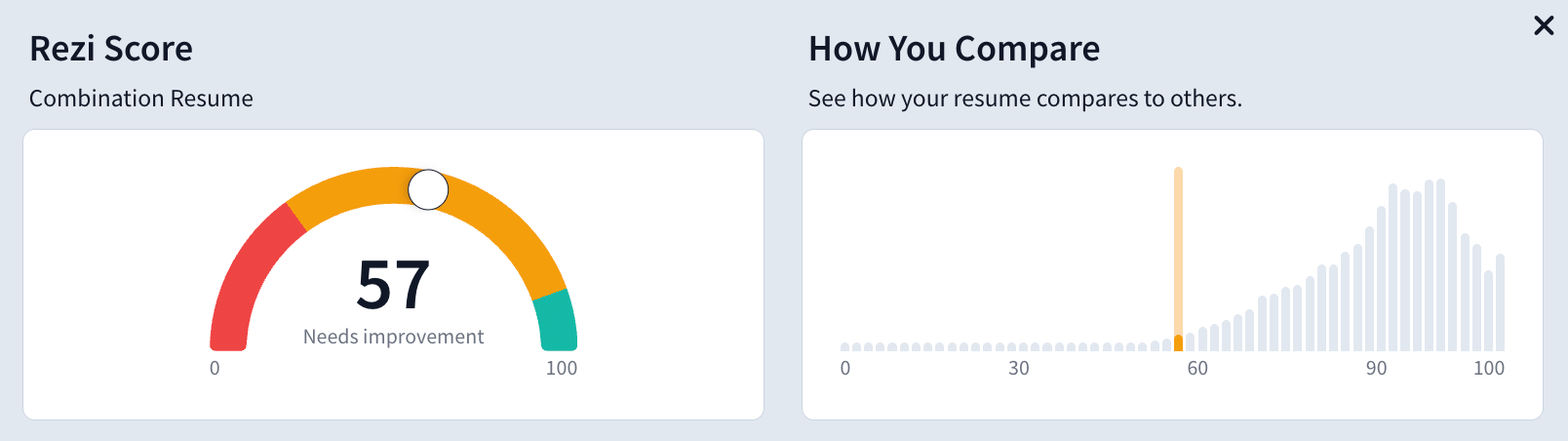
You also get a sense of how your score compares with other job seekers using the platform, which gives you a handy benchmark as you improve your application.
4. Make the necessary improvements
Rather than obsessing over the number itself, focus on the feedback behind it. Go through each category and review the suggestions. Some recommendations will be broad (resume length or formatting) while others are more targeted (single bullet points or specific wording).

And no, you don’t have to go back and forth when applying those suggestions. If feedback applies to a specific job entry, you simply click the link and jump directly back into the resume builder to make those edits.
5. Improve your Rezi Score
As you apply suggestions, your score updates automatically, so you can see your progress as you go. Just move through the builder section by section while keeping an eye on the score and recommendations panel.
As you complete recommendations, Rezi marks them with a green checkmark, so you’ll know exactly what you’ve fixed and what still needs attention.
.webp)
You can also edit your resume directly in preview mode to see how everything looks together. Your score will still refresh as you make changes, although you’ll need to jump back into Explore My Rezi Score to view detailed recommendations.
Rezi Score Breakdown
Rezi uses five categories to analyse your resume based on what’s most important to hiring managers and Applicant Tracking Systems (ATS). Let’s break them down.
Content
The Content category focuses on the quality of information in your resume. It’s about going beyond generic responsibilities and showing impact in a way that’s easy to understand.
Rezi checks for:
- Bullet points: Aim for 3 to 6 bullet points for each experience entry to provide enough detail without overwhelming the reader.
- Achievements: Show measurable outcomes whenever possible. Numbers, percentages, revenue growth, or team size help reveal the scale of your work.
- Context: Add enough detail so someone reading your resume understands why your work mattered and what you can bring to the company.
- Personal pronouns: Skip words like “I,” “me,” and “my.” Resume writing works best when you keep statements direct and concise.
Format
The Format section looks at how readable and organized your resume feels. Even strong experience can get overlooked if the layout creates confusion for recruiters.
Rezi pays attention to details like:
- Resume length: Try to keep your resume to one page, or two pages at most if you have more experience.
- Bullet point: Include at least three bullet points for each experience entry to give enough context.
- Font size: Stick with a font size between 8.5pt and 11pt to balance readability and spacing.
Optimization
The Optimization category focuses on tailoring your resume to the job. Rezi checks whether you’ve included keywords and phrases from the job description, so you can prove you have the right skills, tools, qualifications, and responsibilities.
Many companies use ATS software to filter resumes based on keyword relevance. While there’s no magic keyword formula, tailoring your resume improves your chances of showing recruiters you’re a strong fit for the role.
Best Practices
The Best Practices category covers the small yet important details that strengthen your resume and make it more ATS-friendly.
Rezi looks for things like:
- File naming: Use a professional format like “First Last Name – Job Title” so your resume is easy to identify.
- Skills organization: Group skills into categories (e.g, technical skills, tools, or soft skills) instead of creating one overwhelming list.
- Word count: Try to keep your resume between 400 and 1600 words so it stays detailed without becoming a wall of text.
- Date formatting: Write dates using a full month and year format, like January 2025.
- Buzzwords and filler language: Avoid vague phrases that sound impressive but don’t actually say much. Words like hardworking, team player, or results-driven work better when supported with proof.
- Passive voice: Strong resumes sound more confident when they use active language.
Application Ready
The Application Ready category looks at how well everything comes together across the rest of your score. It helps answer one important question: Is this resume ready to send?
At this stage, Rezi checks for missing details, inconsistencies, and whether your resume meets a solid overall standard. The stronger your performance across the other four categories, the better your Application Ready score will be.
How to Get the Best Results
Getting a high Rezi Score isn’t about chasing a “perfect number”. It’s better to focus on the feedback to create a stronger, more targeted resume. The best results usually come from making small improvements as you go instead of rushing to “finish” and hoping for the best.
Here are a few ways to get the most out of Rezi Score.
Tailor your resume to the job description
If there’s one thing that can quickly improve your Rezi Score and your overall chances of getting hired, it’s tailoring your resume to the specific job you want.
ATS systems are like search engines. Recruiters use them to scan and filter for exact keywords and phrases from a job posting. But don’t just stuff these words in. You can use our tools to naturally weave in keywords without sounding like you’ve copied the job ad word-for-word.
To improve your score and ATS compatibility:
- Look for repeated keywords: Scan the job description for repeated skills, tools, qualifications, certifications, and the job title itself. If a phrase appears multiple times, employers care about it.
- Match language naturally: Use the same terminology from the posting only where it genuinely reflects your experience.
- Show proof of experience: Back up keywords with real examples, resume achievements, certifications, volunteer work, or hands-on results.
If you’re unsure what’s missing, Rezi’s AI Keyword Targeting tool can help identify missing keywords and suggest ways to naturally include them in your bullet points.
Apply changes as you write
This is a personal preference, but it can save a lot of time (and frustration): make edits as you go. It’s much easier to improve your resume section by section than to wait until the end and redo everything all at once.
Since Rezi Score connects to our Real-Time Analysis tool, you’ll see suggestions update while you write. As you complete each section, Rezi highlights opportunities to strengthen bullet points, improve wording, or fix formatting issues.
Plus, you see your score improve automatically as you apply changes, which makes the whole process feel more manageable (and a nice motivator to keep you going).
Avoid vague statements and buzzwords
I’ve seen way too many people accidentally turn their resume into a job description by listing duties without explaining their impact. The problem? Recruiters already have an idea of what a role involves; they want to know why you’re unique and what you accomplished.
Compare these two statements:
- Helped clients with issues.
- Resolved 40+ inquiries weekly while maintaining a 95% client satisfaction rating.
The first one is essentially a job description, while the second version adds context, action, and measurable impact.
It also helps to avoid overused phrases and boring buzzwords like:
- Results-driven
- Detail-oriented
- Team player
- Proven ability
These resume buzzwords are seen everywhere and don’t actually prove anything. Instead, let your achievements speak for themselves.
Use proven methods to structure bullet points
Struggling to write strong points? Simple frameworks can give you some guidance while improving your Rezi Score. Hiring managers often prefer resume bullet points that show results, context, and measurable impact, so structured methods can help you avoid vague writing.
The STAR Method
The STAR method works well for turning responsibilities into stronger accomplishments. Use it to break down your experience like this:
- Situation: What challenge or context existed?
- Task: What responsibility did you own?
- Action: What steps did you take?
- Result: What happened because of your work?
The SMART Method
The SMART method helps make bullet points more concrete and results-focused. Here’s how you can use it to frame your achievements:
- Specific: Clear and focused (increased monthly orders by 25%)
- Measurable: Supported by numbers (generated 35% more subscriptions)
- Achievable: Based on realistic accomplishments
- Relevant: Connected to the role you want
- Time-bound: Framed within a timeline (within a quarter)
Check out another handy way to use this formula: How to Write SMART Goals
Focus on progress, not perfection
Don’t obsess over getting a perfect score. Recruiters won’t see your ATS score; they exist to give you valuable guidance and feedback on how to improve your application.
Sure, a perfect Rezi Score is helpful, but the real goal is using it as a guideline to create a resume that clearly communicates your experience and matches the role you’re applying for. If your score improves and your resume feels stronger with every edit, you’re moving in the right direction.
Summary
Here’s an overview of everything you need to know about using Rezi Score:
- Rezi Score rates your resume from 1 to 100 based on hiring standards, ATS compatibility, and overall application quality.
- Your score updates in real time as you write and edit, so you can immediately spot weaknesses, apply suggestions, and track improvements.
- Rezi Score evaluates five core categories: Content, Format, Optimization, Best Practices, and Application Ready.
- Adding a job description helps improve your score because Rezi can identify keywords, qualifications, and phrases that recruiters and ATS systems often filter for during hiring.
- Rezi Score helps improve ATS compatibility without keyword stuffing by encouraging you to naturally weave in relevant language from job descriptions.
- The feedback is specific, highlighting issues like weak bullet points, missing measurable achievements, poor wording, formatting inconsistencies, or overused phrases.
- You can apply the suggestions section by section instead of waiting until the end, making it easier to improve your resume gradually and avoid overwhelming rewrites.
- The score acts as a learning tool, not just a number. Repeated feedback helps you understand strong resume habits and better bullet point structure for future applications.
- Rezi includes a final quality check through the Application Ready category to make sure your resume looks complete, professional, ATS-friendly, and ready to send.
- The purpose of Rezi Score is to help you build a clearer, stronger, and more targeted resume with confidence.
FAQ
Is 70 a good ATS score?
Yes, a score of 70 is generally a solid starting point, especially if you’re still refining your resume. With Rezi Score, a 70 usually means your resume is in decent shape but still has room for improvement. You may need stronger bullet points, more measurable achievements, better keyword alignment, or small formatting fixes. That said, a well-tailored and relevant resume with a 70 can still outperform a generic resume with a higher score.
How to get a 100% ATS score?
The best way to improve your score is to tailor your resume to the job description, include relevant keywords, add measurable achievements, use simple formatting, and follow resume best practices. Tools like Rezi can help you identify missing keywords and weak areas, but relevance always matters more than a perfect score.
What ATS do companies use?
Some of the most common Applicant Tracking Systems (ATS) include Workday, Greenhouse, Lever, Taleo, and iCIMS. Large enterprises often choose enterprise systems, while startups and smaller companies may prefer simpler recruiting platforms. That said, companies use a wide range of systems, and there’s no single platform that every employer relies on.
Do ATS systems score resumes?
ATS systems don’t usually assign a universal “grade” like 82/100 that recruiters see. Instead, many systems rank or filter resumes based on keyword relevance, skills, job titles, qualifications, and how closely your experience matches the role. Recruiters may also search databases using specific terms. Resume tools like Rezi create scores to help guide optimization, but employers don’t see the same percentage you see in a resume builder.
Is the Rezi Score free?
You have limited access to the Rezi Resume Builder, Rezi Score, and other AI tools for free. For $29/month, you unlock unlimited scans and full access. There’s also a lifetime plan with a one-off payment of $149. It’s flexible, so you can try it for free, upgrade if you like, and cancel anytime.

Upload or drop your resume to get started
Upload your resume to get started
Score my resume

Lauren Bedford is a seasoned writer with a track record of helping thousands of readers find practical solutions over the past five years. She's tackled a range of topics, always striving to simplify complex jargon. At Rezi, Lauren crafts genuine and actionable content that guides readers in creating standout resumes to land their dream jobs.