User Guides
Real-Time Analysis
Learn how to use Rezi’s Real-Time Analysis feature to improve your resume instantly with actionable feedback on phrasing, keywords, and formatting.
Published on
August 20, 2022
Updated on
September 11, 2025
Rezi’s Real-Time Content Analysis is an instant resume improvement guide, built to help you create an application that stands out to both recruiters and Applicant Tracking Systems (ATS). As you write, you’ll get clear feedback on your content, phrasing, and keywords so that you can show your skills and experience without second-guessing.
Keep reading for a full breakdown on how to use this feature. This guide will include:
- How to use the Rezi Real-Time Content Analysis tool step-by-step.
- Our top tips to improve your resume and get noticed.
- What real users have to say about using this feature.
Curious to see how you can improve your resume? Get started with our AI Resume Builder to see what our Real-Time Content Analysis feature has to say about your job application.
What is Rezi Real-Time Content Analysis?
Our Real-Time Analysis feature is a resume reviewer that helps you catch and correct the small details that could prevent your resume from standing out or being processed by an ATS (Applicant Tracking System).
As you work on your bullet points, Rezi Real-Time Content Analysis checks for issues like missing punctuation, filler words that weaken your impact, and whether your bullets include measurable results. It also flags weak phrasing that can make your accomplishments sound vague.
And it doesn’t just highlight the problem. Real-Time Analysis tells you exactly what needs fixing and where, so you’re not left guessing what to change. Alongside these insights, you’ll also see your Rezi Score update in real time, so you can see how your resume is progressing as you apply each fix.
Here’s how the Real-Time Analysis works in action:
How to Use Rezi Real-Time Content Analysis
Here’s a quick breakdown of how to use the Rezi Real-Time Content Analysis feature:
- Build your resume from scratch, upload an existing one, or import directly from LinkedIn.
- Navigate through guided tabs for each resume section with fill-in-the-blank fields.
- Add your experiences and bullet points while receiving instant feedback.
- Apply the feedback to strengthen verbs, remove unnecessary fluff, and improve clarity.
- Watch your Rezi Score update in real time as you align your resume with content, formatting, optimization, and best resume practices.
Now, check out this complete step-by-step Rezi Real-Time Content Analysis guide with screenshots and examples:
1. Create or upload a resume
To get started, you can either build a resume from scratch or import your existing information. Rezi ensures you can copy all information over accurately to save you any hassle. You also have the option to import your resume directly from LinkedIn.
If you’re aiming for a specific position, you can also create a targeted resume by entering the job title, company name, and job description. This lets Rezi Real-Time Content Analysis tailor its suggestions to match the exact role you’re applying for, helping you build a resume that speaks directly to that job.

2. Navigate through the resume tabs
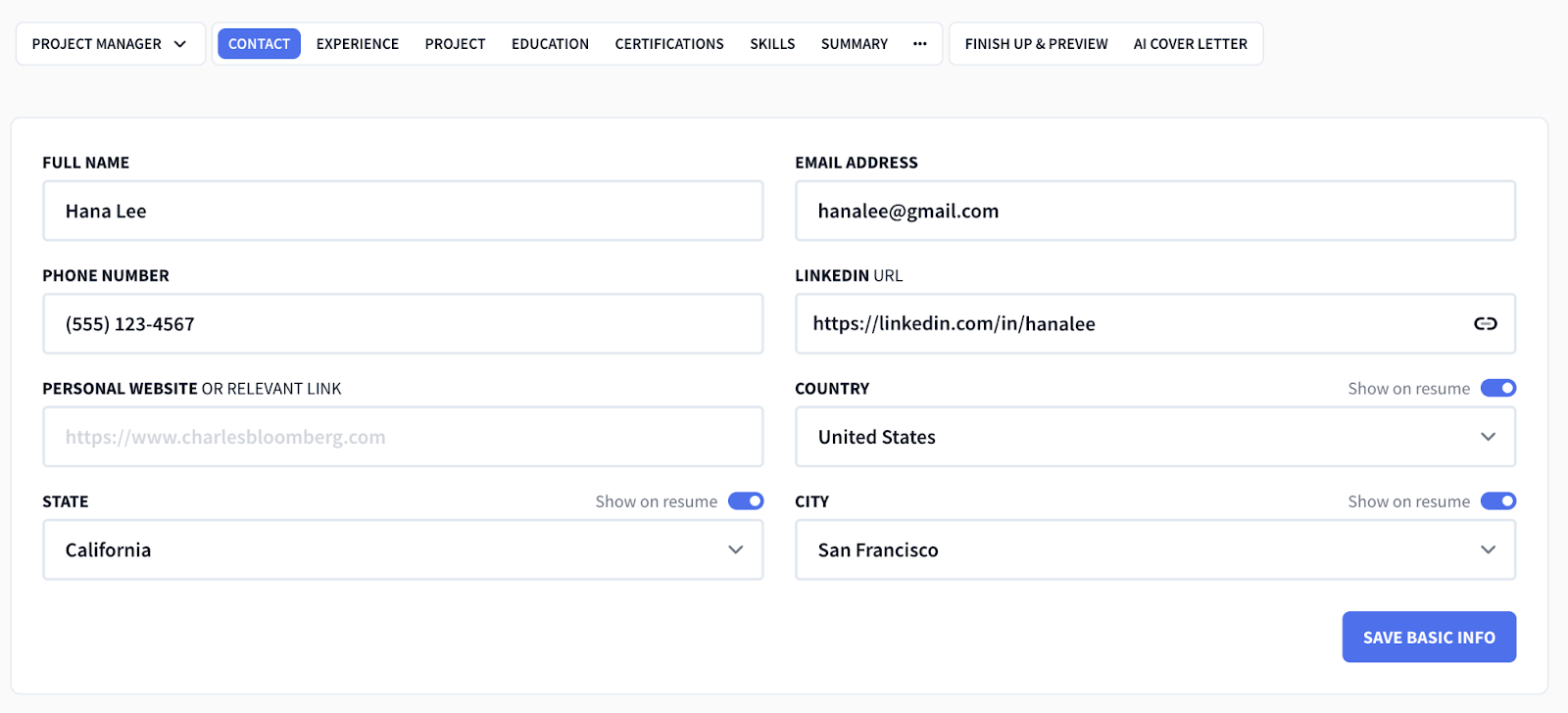
Building your resume is easy with Rezi’s guided tabs. Each tab corresponds to a section of your resume, for example:
- Contact
- Experience
- Education
- Skills
- Summary
If you want to add more depth, you can also include additional sections, such as:
- Projects
- Certifications
- Coursework
- Involvement
You’ll find fill-in-the-blank fields and suggestions within each section to help you know exactly what to include and how to phrase it.
3. Add content and bullet points
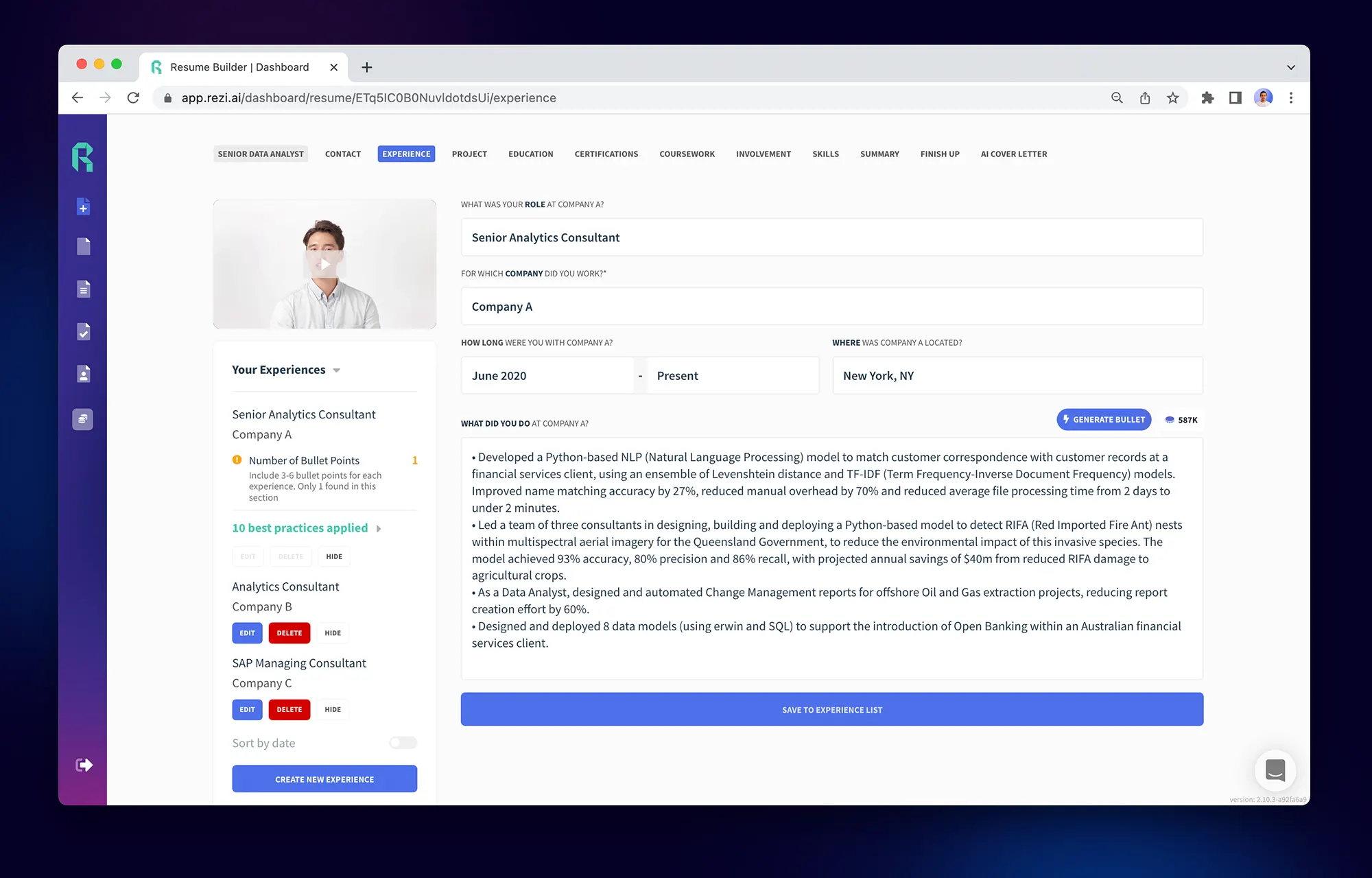
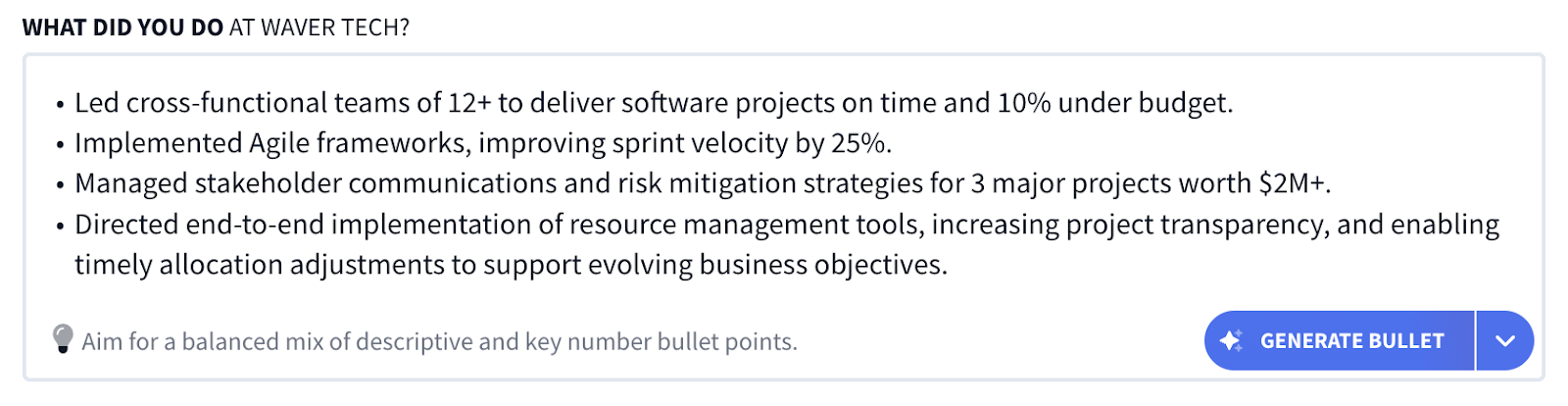
While you work through the tabs, you can start adding your professional background and experiences into the relevant fields. As you enter your resume bullet points, Real-Time Content Analysis will immediately begin providing feedback, helping you improve your language, content, and grammar.
Focus on achievements and measurable outcomes rather than just listing tasks. If you need inspiration, you can use Rezi AI Bullet Point Writer to generate bullet points based on your job title and job description, making sure they’re achievement-focused and aligned with the position.
4. Check and apply feedback
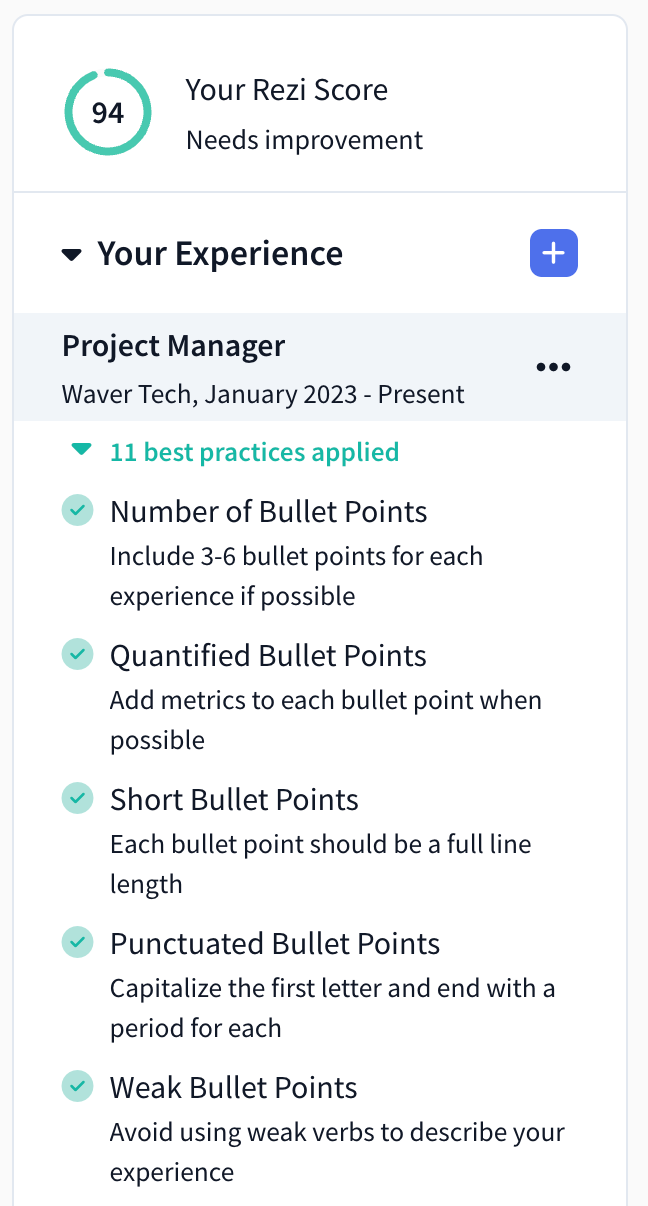
As you add content, Rezi’s Real-Time Analysis will flag areas for improvement and guide you on what to adjust. You’ll see clear, actionable prompts to help refine your bullet points, such as:
- Replace weak verbs to strengthen your impact.
- Remove personal pronouns for a professional tone.
- Avoid buzzwords that can dilute your message.
- Cut out filler words to keep your writing sharp.
- Switch from passive to active voice where needed.
We’ve designed each piece of feedback to help your resume become more ATS-compatible and recruiter-friendly. And for some much-needed encouragement, our feature also tells you all the things you’ve done right.
5. Aim to increase your Rezi score
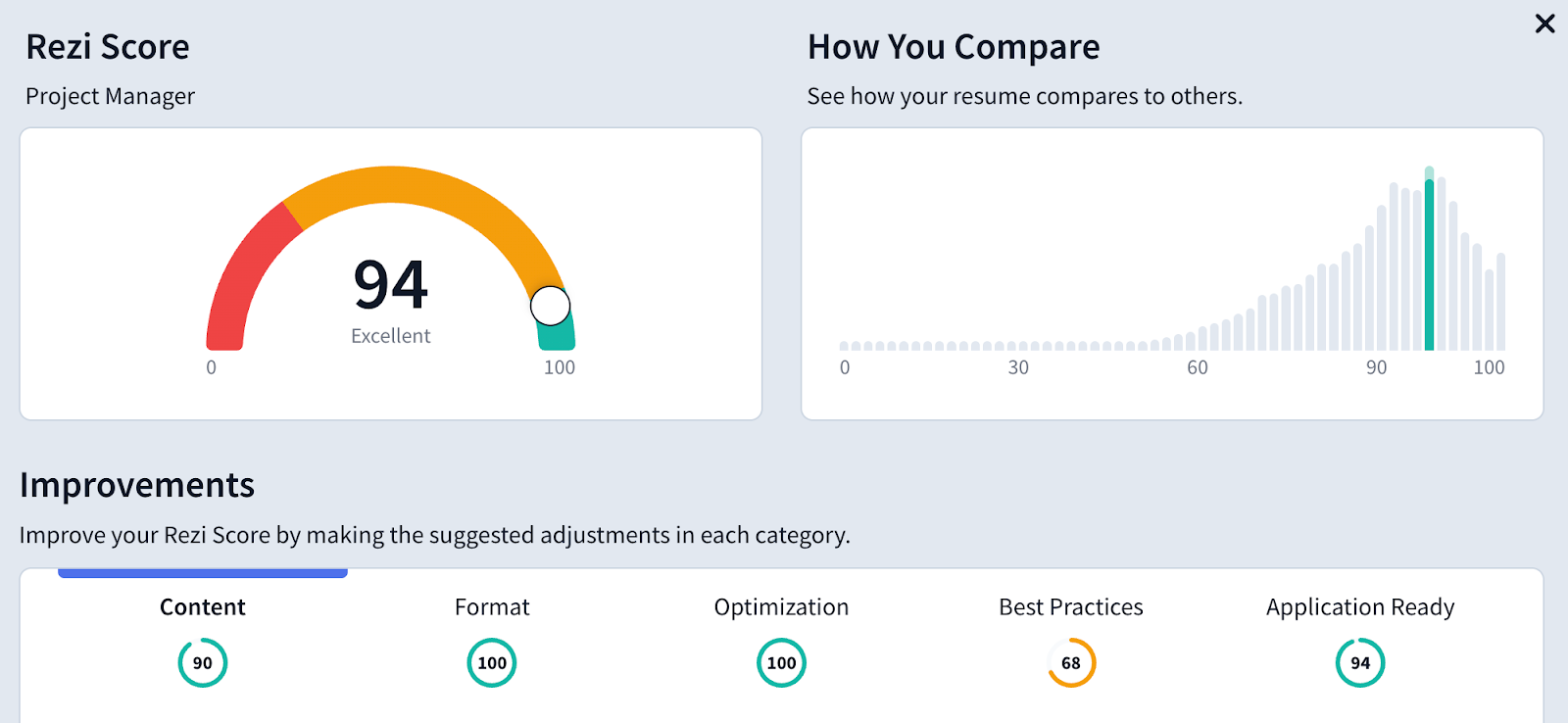
Our recommendation is to aim for a Rezi score of 90. Alongside Real-Time Analysis, you’ll see your Rezi Score update as you make changes. This score reflects a detailed audit across four essential areas:
- Content
- Formatting
- Optimization
- Best practices
Within these categories, Rezi checks 23 key details that hiring managers care about to help your resume align with industry standards and maximize your chances of passing ATS filters.
The Best Ways to Improve Your Resume
While Rezi’s Real-Time Analysis offers strong suggestions, knowing more about what makes a resume stand out will help you understand why this feedback matters. Once you’re clear on what a great resume looks like, you’ll feel confident making the right tweaks to ensure your resume reflects your unique strengths.
Here are our expert tips to take your resume to the next level:
Include tailored job titles
Your resume should signal to both recruiters and ATS that you’re a great match. This doesn’t mean stretching the truth, but framing your experience in a way that connects to the role. The best way to do that? Spell it out for them.
If your past job titles already align with your target position, highlight them prominently in your work experience headings. If your titles don’t directly match, consider adding a professional headline at the top of your resume to bridge the gap and clarify your focus.
These small tweaks can help human readers and ATS instantly see the connection between your experience and the role, boosting your chances of moving forward in the hiring process.
Learn more about tailoring your job application: How to Tailor a Resume to a Job Posting
Lead points with strong action verbs
A solid resume should show how you made an impact, and this starts with using strong action verbs. They help make your resume sound less generic while giving more insight into what you accomplished and how you contributed to each role.
Examples of effective action verbs include:
- Achieved
- Collaborated
- Delivered
- Guided
- Led
- Negotiated
- Oversaw
- Planned
- Trained
- Transformed
Starting your bullet points with action verbs, especially in your work experience section, keeps your resume dynamic and direct. It also gives a more concrete picture of your role and achievements.
Check out the action verbs you should avoid: Top 30 Weakest Action Verbs
Use quantifiable achievements
Recruiters have read hundreds of resumes and already know the typical duties tied to your roles. They want to see what makes you different and how you can contribute to the company’s success. But don’t just add any old achievement to your resume.
Review the job description for your target role and identify the critical skills and requirements. Align your experience with these must-haves and use data to give your success stories more credibility, such as metrics, percentages, or specific outcomes.
Numbers make your contributions tangible and position you as a high achiever among other applicants. But no worries if you don’t have concrete figures. You can still highlight positive results, such as training a new employee or receiving excellent customer feedback.
Replace vague buzzwords with key phrases
Terms like “team player” or “hard worker” are overused buzzwords, just taking up space without adding real value. Instead, focus on using specific keywords from the job description that genuinely reflect your skills and experience.
Scan the job posting for key phrases, tools, and required skills, then integrate these naturally into your bullet points and other sections. Just don’t outright lie. Make sure the keywords are relevant to your actual experience, and avoid keyword stuffing, or it’ll sound too forced.
Keep your resume relevant and concise
You don’t want to spend hours writing a resume, only for the recruiter to skip the best parts in favor of that random job you had ten years ago. Hiring managers have limited time, so it doesn’t make sense to include details that aren’t connected to the position and industry.
Unless you’re a senior professional with 15+ years of experience, your resume should typically stick to one page. Focus on your most relevant work experiences and achievements tied to your target role. Remove outdated jobs, high school details, or unrelated extracurricular activities if they don’t directly support your application.
Find out more: How Long Should a Resume Be?
Why Job Seekers Love Rezi Real-Time Analysis
One of the worst things I remember about exams? Getting a bad grade and not knowing why or what to improve. But we’re not in school anymore (thankfully), and that’s certainly not an issue with Rezi. Instead of waiting days for feedback or second-guessing your phrasing, our Real-Time Analysis tool gives you instant insights while you write.
You’ll see exactly what to fix, such as improving clarity, strengthening phrasing, or ensuring your resume includes the right resume keywords for ATS scans. With actionable prompts, you can highlight the skills that matter most for your target role, making your resume stronger and more competitive in a fraction of the time.
Don’t just take my word for it.
Here’s what one of our users said about using the feature:
Another user also said how the feedback was a useful tool for encouragement:
Check out more honest customer reviews: Is Rezi Worth It?
FAQ
How much is the Real-Time Content Analysis feature?
You can access a limited version of Rezi’s Real-Time Content Analysis and the Rezi Score for free. Alternatively, you can get full access with the Pro Plan costing $29 a month, or the Lifetime Plan, which is a $149 one-off payment.
How do you make your resume look better?
Keep your resume professional and easy to read. Use a clean resume template, consistent formatting, a simple resume font, and enough white space so it doesn’t feel crowded. Structure your resume sections logically with clear headings and make sure your bullet points begin with strong action verbs. Avoid big blocks of text and clutter, as recruiters spend only a few seconds on each resume, so you want your achievements to pop immediately.
What’s the difference between Real-Time Analysis and the Rezi score?
Real-Time Analysis gives you instant, line-by-line feedback on your resume, flagging issues like weak verbs, filler words, or missing metrics so you can improve each section as you write. The Rezi Score is your overall resume health check, auditing your document across content, formatting, optimization, and best practices.
How far back should my resume go?
For most professionals, your resume should cover the past ten years of relevant experience. If you’re early in your career, include all relevant work, internships, or projects, but skip unrelated high school details. For senior professionals, it’s okay to summarize older roles if they add context, but keep the focus on your recent, impactful work to maintain clarity and relevance.
Read more: How Far Back Should a Resume Go?
How can you make your resume stronger?
Focus on achievements, not just duties. Start each bullet point with a strong action verb and quantify your results whenever possible to show impact. Tailor your resume to the job you’re applying for, using keywords from the job description naturally within your content. Keep your formatting clean, your wording clear, and your sections relevant. If you’re using Rezi, run your resume through Real-Time Analysis and aim to increase your Rezi Score to refine it further before you apply.

Upload or drop your resume to get started
Upload your resume to get started
Score my resume

Lauren Bedford is a seasoned writer with a track record of helping thousands of readers find practical solutions over the past five years. She's tackled a range of topics, always striving to simplify complex jargon. At Rezi, Lauren crafts genuine and actionable content that guides readers in creating standout resumes to land their dream jobs.