
Resume
How Many Pages Should a Resume Be? (By Experience)
How many pages should a resume be? Usually 1–2 pages. See the right resume length for your years of experience, when 2 pages is fine, and how to cut content.

Published on
September 5, 2026
Updated on
September 5, 2026
The number of pages your resume runs is one of the few formatting questions that can genuinely cost you an interview if you get it wrong, and for most candidates the answer is one page — move to two only when a decade or more of directly relevant experience fills it. Extend work history back roughly 10 to 15 years and keep it tight, because an overlong resume can clog ATS parsing and bury the keywords screeners scan for.
For the large majority of job seekers, a resume should be one to two pages . One page is standard for students, recent graduates, and anyone with fewer than about seven to ten years of experience. Two pages is appropriate and expected once you have a decade or more of relevant work, or a role deep enough that a single page forces you to leave out things a recruiter needs to see. Three pages is reserved for narrow cases, such as senior executives, and for academic or federal applications that follow entirely different conventions. The mistake is treating "one page" as a moral rule. It is a default, not a law. A recruiter spends only a short scan on the first pass, so the real goal is not the fewest pages but the fewest pages that still show you are qualified.
Here is how resume length maps to career stage:
| Situation | Recommended length |
|---|---|
| Student, intern, or fresher | 1 page |
| Entry-level (0–3 years) | 1 page |
| Mid-career (4–9 years) | 1–2 pages |
| Senior / 10+ years | 2 pages |
| Executive, or heavy publication/project history | 2–3 pages |
| Academic CV or US federal resume | 3+ pages (different rules) |
If you take one thing from this: don't pad a thin resume to look experienced, and don't cram a genuinely full career into one page because a blog told you to. The right length is the one that fits your relevant experience without white-space filler or a squeeze that makes the page unreadable.
One page, two pages, or three?
Once you know your experience level, the choice between one, two, and three pages comes down to whether every line still earns its place. Length is a symptom of content, so decide what belongs first and let the page count follow.
| Length | Best for | Watch out for |
|---|---|---|
| One page | Students, career changers, and anyone under ~7 years' experience | Cutting real, relevant achievements just to fit |
| Two pages | 10+ years, or dense technical/managerial roles | A second page less than half full, or padding to reach it |
| Three pages | Executives, academics, federal applicants | Using it for an ordinary role, where it won't be read |
So is a two-page resume acceptable? Yes, when the experience justifies it. And is a three-page resume too long? For a standard corporate or technical job, yes, unless you are a senior executive. If you are weighing the trade-offs in detail, it is worth reading the case for keeping a resume to one page alongside the argument for when a two-page resume is better, because the honest answer changes with your background.
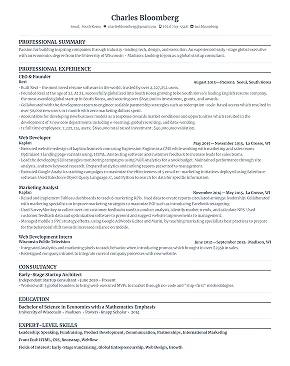
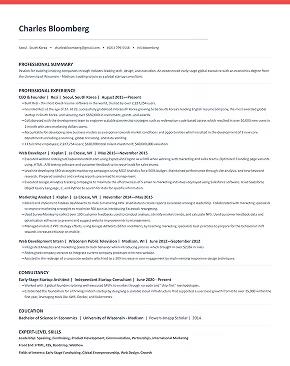
Here is what a strong single-page resume looks like when the content is tight:
A tight one-page resume where every line earns its place.
A one-page resume for a mid-level role: relevant experience only, achievement-led bullets, no filler.
How to shorten a resume that runs too long
Most resumes spill onto a second or third page not because the person has too much experience but because the writing is loose. Before you accept a longer resume, cut in this order and you will usually recover the space:
- Trim each role to 3 to 5 bullet points. Your most recent job can have more; roles from ten years ago need one or two lines at most.
- Remove experience older than about 10–15 years, or compress it into a short "Earlier experience" line.
- Cut anything not tied to the job description: unrelated jobs, hobbies, and skills that don't match the role.
- Delete the references line. "References available on request" wastes a whole line and is assumed.
- Tighten the layout: standard margins, a single readable font, and no oversized headers or logos.
- Keep the summary short. If yours is long, see how brief a resume objective should be.
If you are close and just need the last few lines gone, there are more targeted tactics for fitting a resume on one page without shrinking the font to something no one can read.
Which experience to include, and how far back to go
The fastest way to control length is to be ruthless about relevance. Include the roles, and only the roles, that show you can do the job you are applying for now. As a general rule, go back no more than 10 to 15 years for professional experience. Older jobs can be summarized or dropped entirely, because a hiring manager cares far more about your most recent years of relevant work than a role from two decades ago.
Match what you keep to the job description. If a posting emphasizes project management, the projects you led should be prominent and the unrelated retail job from years ago should shrink or disappear. This is also the fix for resumes that read as a career autobiography: you are not documenting your life, you are making an argument for one specific role.
How long should a resume be by experience level (entry, mid, senior)?
When you're deciding how many pages your resume should be, your career stage is the fastest rule of thumb. Entry-level candidates (0–3 years) should stick to one page; mid-level professionals (4–10 years) can use one to two pages; and senior or executive candidates (10+ years) may run two pages, occasionally three for federal or academic roles. Match length to relevant depth, not tenure alone.
Write bullet points that show achievements, not duties
Length problems and weak content usually share a cause: bullets that describe responsibilities instead of results. "Responsible for managing social media" tells a recruiter your job title, which they already know. The stronger version says what changed because you were there, ideally with a number. Compare these two versions of the same line:
Weak: Responsible for managing the company's email newsletter.
Strong: Grew newsletter subscribers from 4,000 to 22,000 in 12 months by launching a weekly content series, lifting email-driven revenue 30%.
Achievement bullets are shorter to justify and easier to scan, so writing this way often solves the page-count question by itself. One vivid, quantified line replaces three vague ones.
Does resume length affect ATS screening?
Applicant tracking systems are where a lot of length anxiety comes from, so it is worth being precise: the number of pages is not what an applicant tracking system screens on. A clean two-page resume parses exactly as well as a one-page one. What actually breaks parsing is formatting the software cannot read reliably, and that has nothing to do with length.
To keep your resume readable by both software and people, use standard section headings such as "Work Experience" and "Education," a single-column layout, and a common font. Avoid tables, text boxes, columns, headshots, and graphics, because these are the elements that scramble in parsing. Mirror the language of the job description where it honestly applies, since that is how your relevant experience gets matched. If you want to check how your file scores before you send it, Rezi's resume length tools and the Rezi Score flag parsing and content issues against these exact criteria.
Resume length by specific situation
The general rules cover most people, but a few situations come up constantly and deserve a direct answer.
Freshers, students, and internships
One page, without exception. As a fresher or intern applicant you are not expected to have a long history, so a padded two-page resume signals the opposite of confidence. Lead with education, relevant coursework, projects, and any part-time or volunteer work that shows transferable skills.
2 years of experience
Still one page. Two years of professional experience fits comfortably on a single page, and stretching it to two suggests you are filling space rather than showing impact. Focus each role on outcomes.
7 years of experience
This is the genuine gray zone. Around seven years, one page is fine if your experience is focused, but two pages is fully acceptable if a single page forces you to drop relevant achievements. Let the content decide: never add a second page for the sake of it, and never cut real accomplishments to defend a one-page ideal.
Teachers
One to two pages. Early-career teachers fit on one page; experienced educators with certifications, grade-level specialisms, and measurable student outcomes reasonably run to two. Certifications and licensure belong prominently near the top.
Software engineers
One page for early-career engineers, up to two once you have several years plus a substantial project or open-source history. A skills section and links to a portfolio or repository often let you keep it to one page even with deep experience, because the work speaks for itself.
Graduate school applications
This is where the resume becomes a CV, and the rules invert. A graduate school or academic application uses a CV rather than a resume, which can run several pages and includes publications, research, presentations, and teaching. Length is expected there, not penalized.
How resume length compares to a CV
The confusion between "resume" and "CV" is behind a lot of bad length advice, and the difference depends on where you are. In the US and Canada, a resume is the short, one-to-two-page document described throughout this guide, while a CV means the long academic record used for research, faculty, and grad-school roles. In the UK, Ireland, and much of Europe, "CV" simply means what Americans call a resume, and the expected length is still short. A US resume and a UK CV follow the same one-to-two-page logic under different names. US federal resumes are the other exception: they routinely run three to five pages because the government asks for detail, such as hours worked and supervisor contacts, that a private-sector resume omits.
Wherever your job search takes you, the principle holds. Make your resume as long as your relevant experience requires and not one line longer, and every page you keep should be full of results a recruiter actually wants to read.
Frequently asked questions
Is a 4-page resume too long?
For almost every standard job application, yes. Four pages is only appropriate for an academic CV, a federal resume, or certain senior roles with extensive publications or projects. For a normal role, a recruiter will not read four pages, so condense it to one or two.
Does a two-page resume need to fill the second page completely?
A second page should be at least half to two-thirds full. A second page with only two or three lines looks unfinished, so either expand the content or tighten everything back onto a single page.
Does resume length hurt you with applicant tracking systems?
Length itself does not disqualify you; a well-formatted two-page resume parses just as cleanly as a one-page one. What breaks ATS parsing is layout, such as tables, text boxes, columns, and images, not the number of pages.
Should a two-page resume be printed double-sided?
Print single-sided, one page per sheet, and put your name at the top of the second page. Most resumes are reviewed on screen anyway, but if you hand over a printed copy, single-sided pages are easier for a recruiter to lay side by side.

Upload or drop your resume to get started
Upload your resume to get started
Score my resume