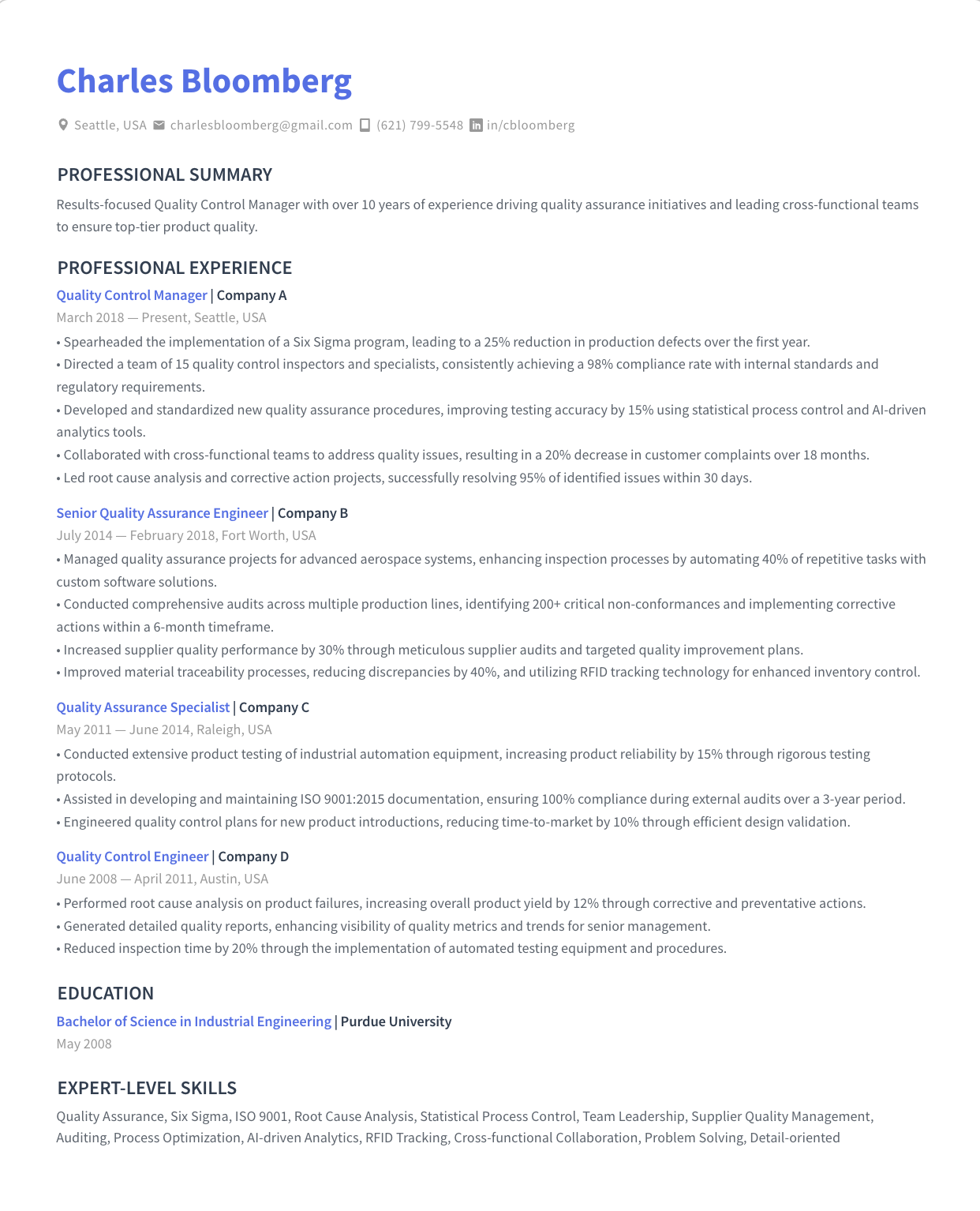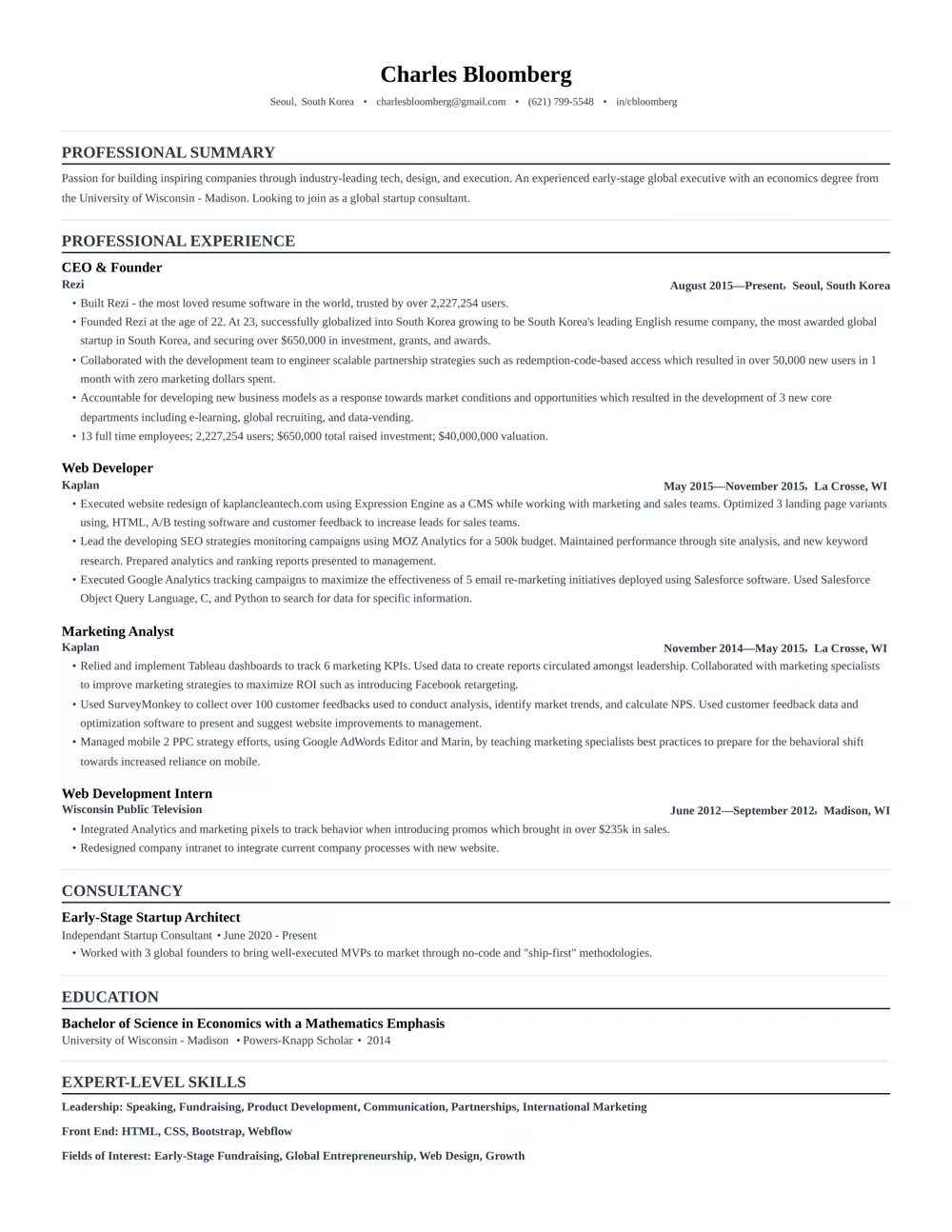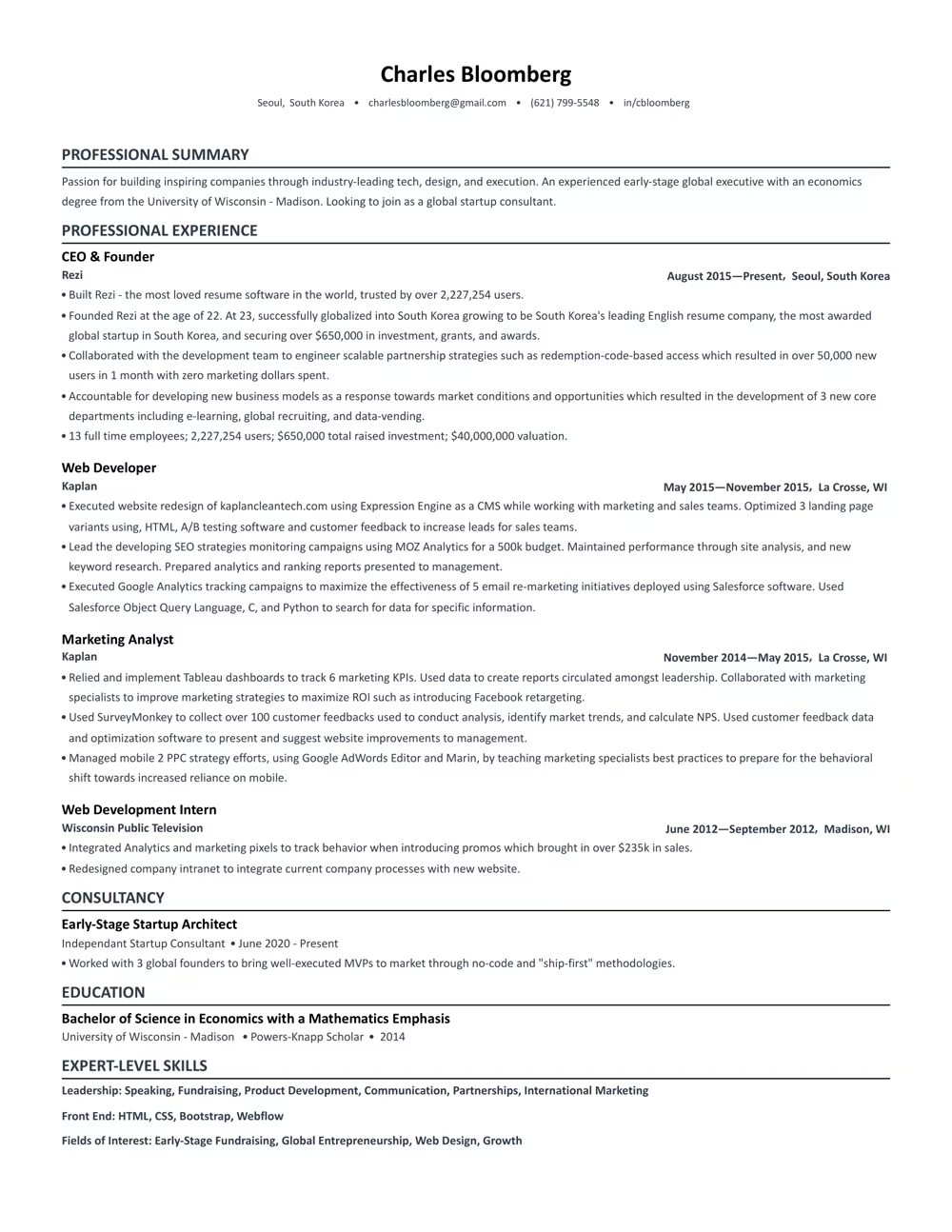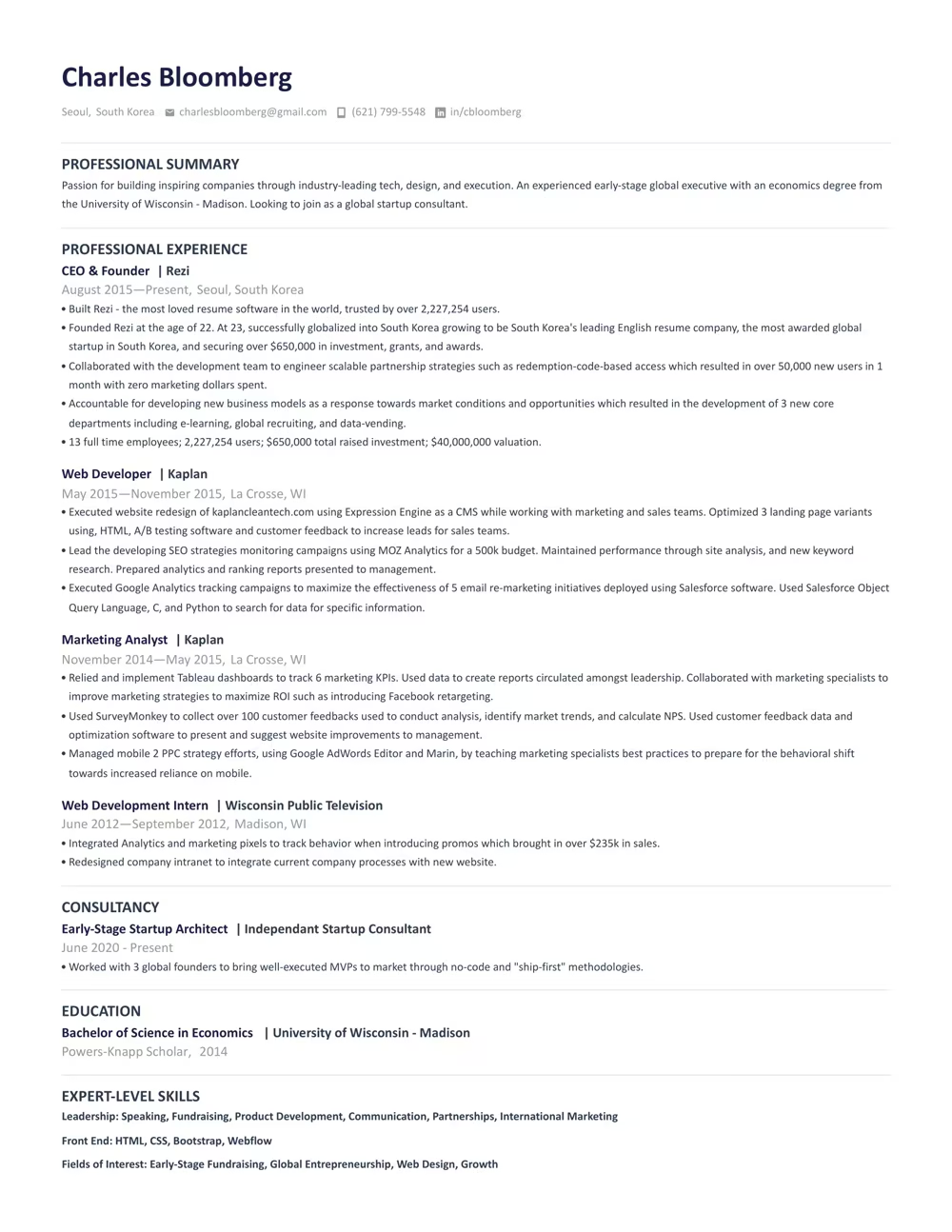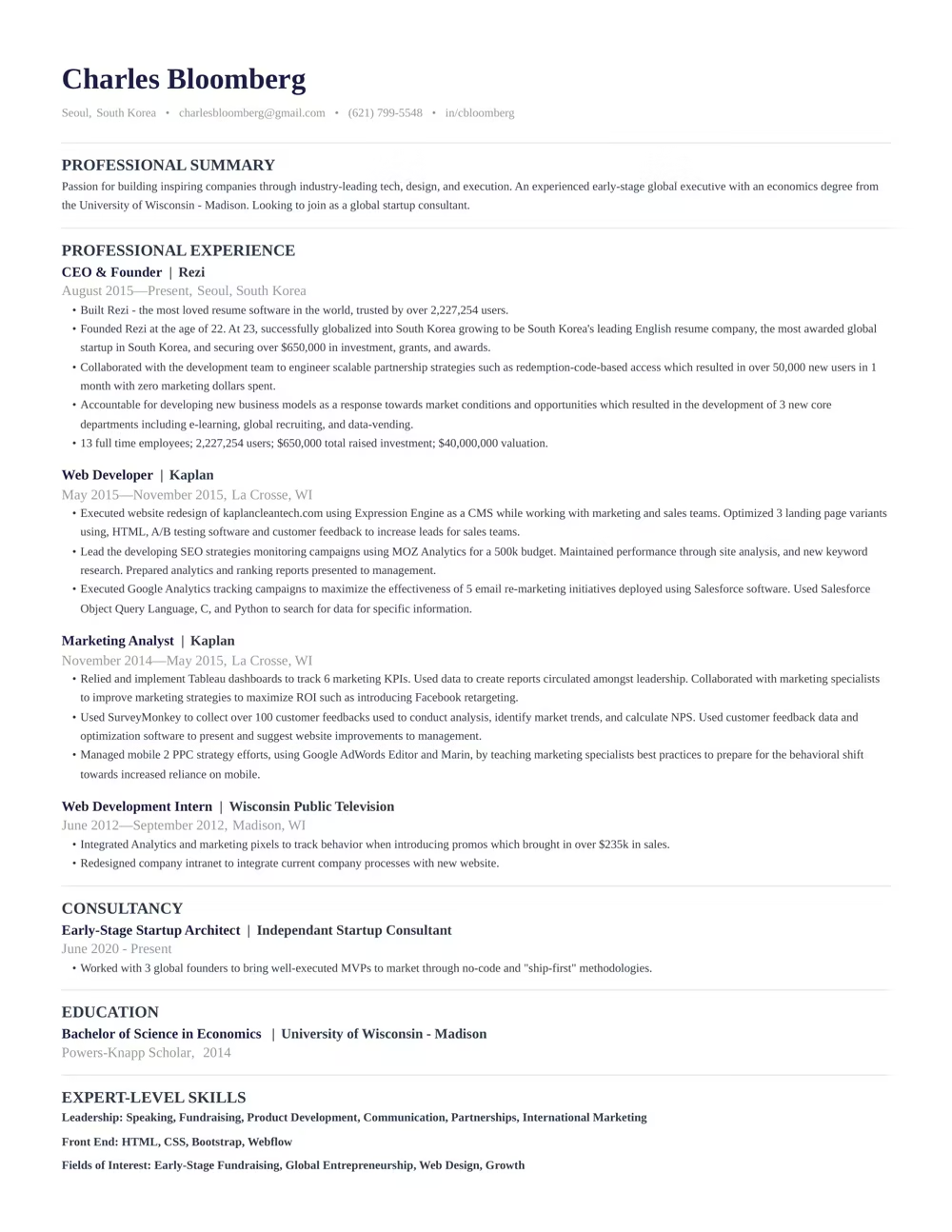

Here's the thing most quality control managers get wrong on their resumes: they list inspection tasks and testing procedures as if they're writing an SOP manual. The resume reads like a compliance checklist rather than a story about someone who actually improved quality outcomes, reduced defect rates, and built systems that prevented problems before they happened.
A strong quality control manager resume needs to show you're not just catching defects — you're driving a culture of quality. It should demonstrate how you've implemented standards, led audits, trained teams, analyzed data, and delivered measurable improvements to product quality and process efficiency.
And this is exactly what you'll learn from this article. Inside, you'll find:
- 9 quality control manager resume examples covering different industries, specializations, and seniority levels.
- Insider tips about what really matters to recruiters hiring for QC management roles.
- A step-by-step guide for building a quality control manager resume that actually lands interviews.
Sample Quality Control Manager Resumes
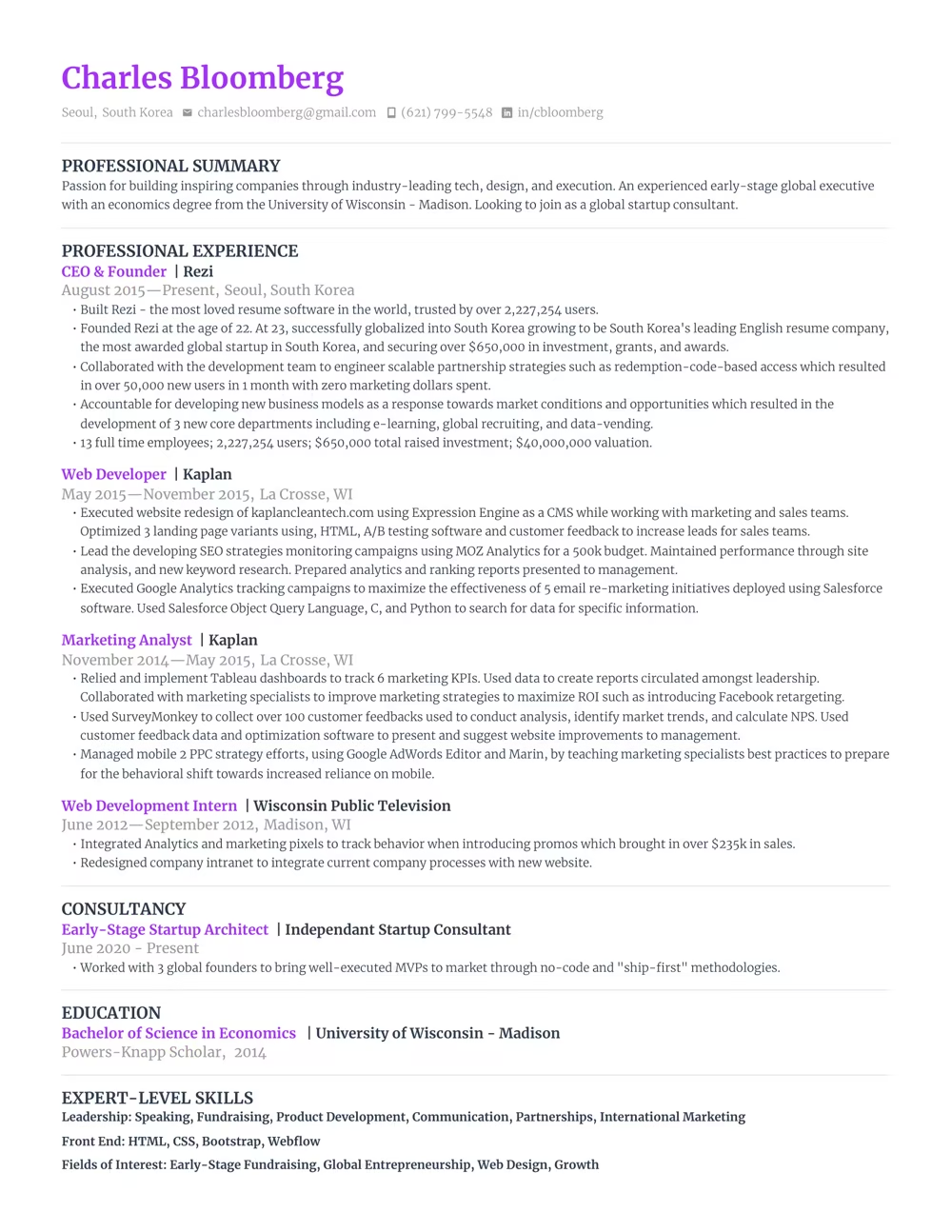
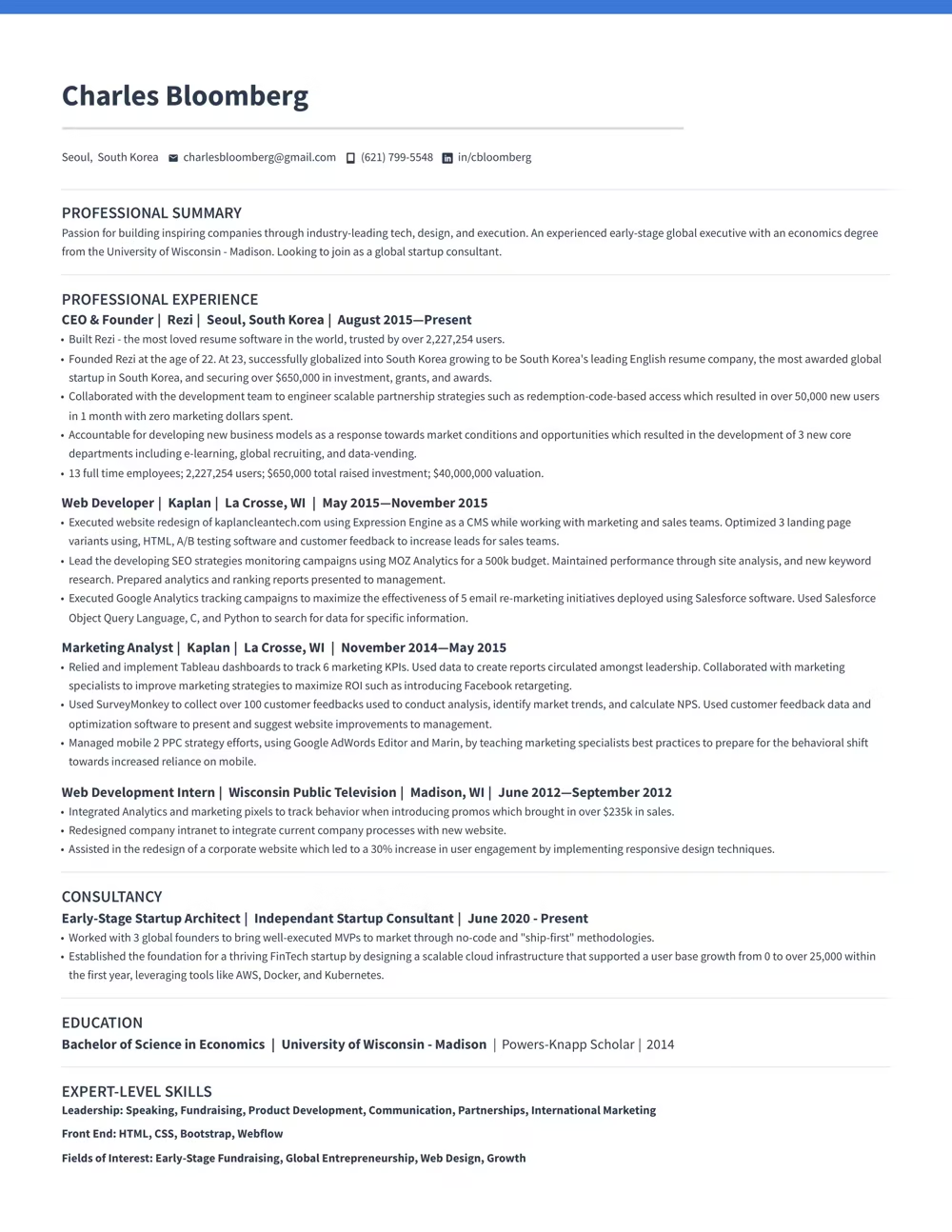
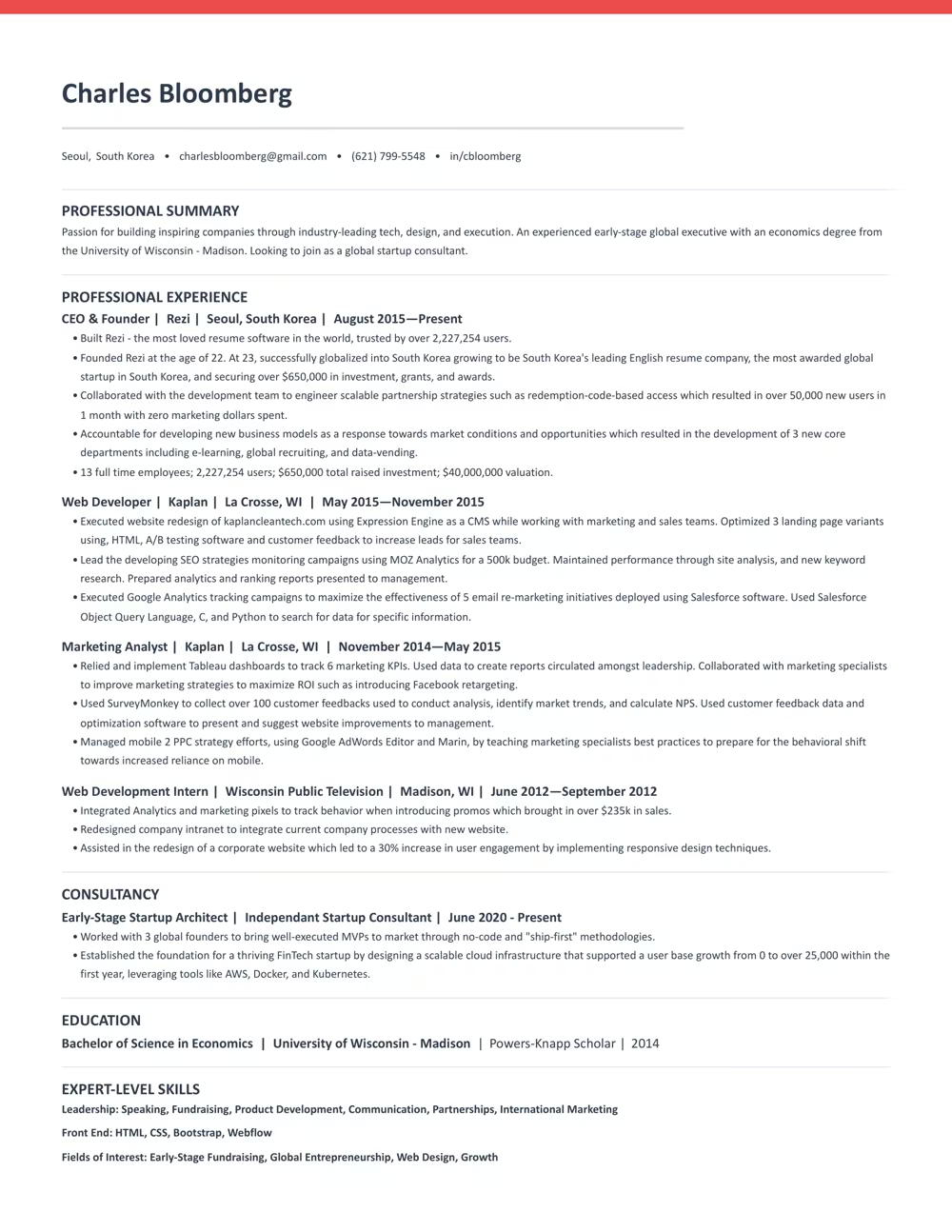
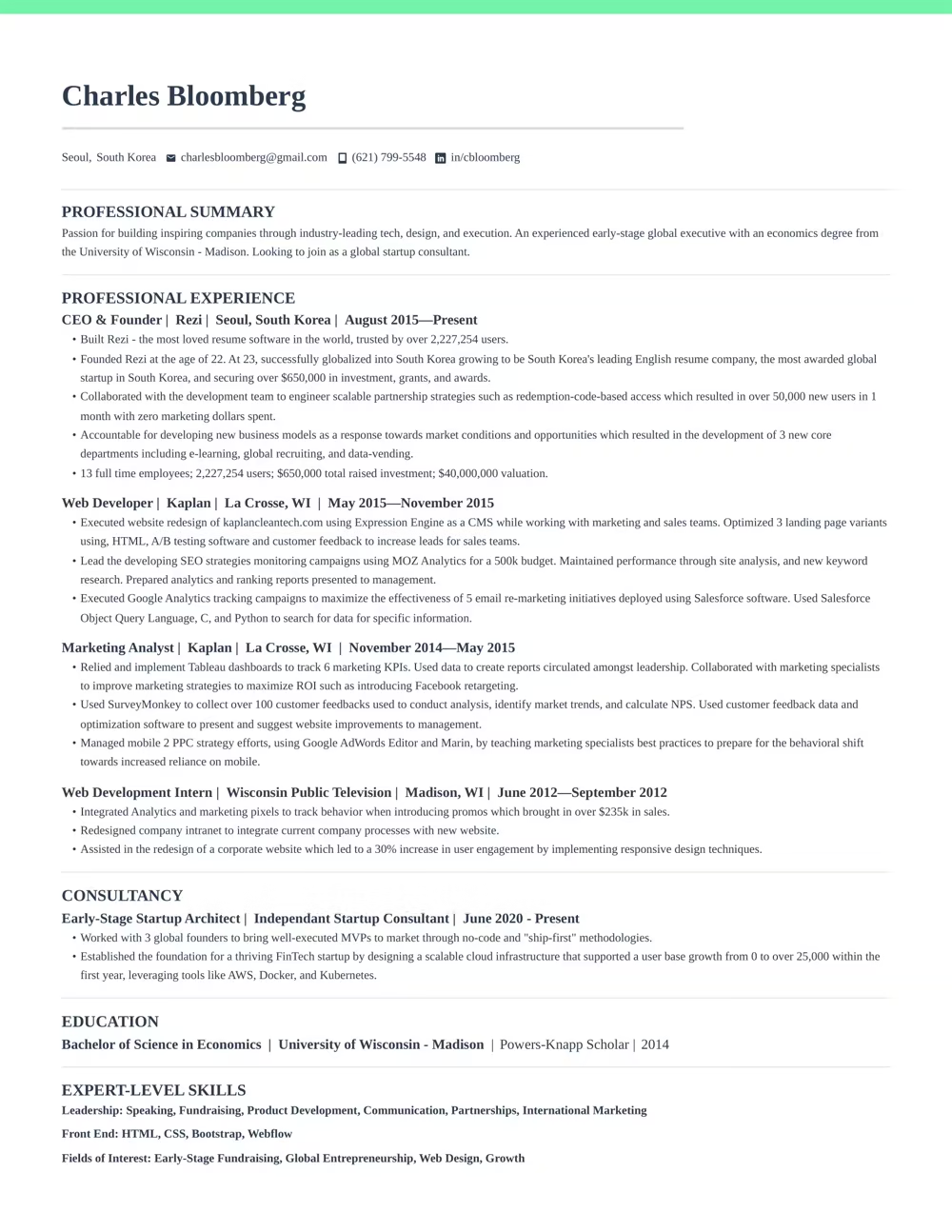
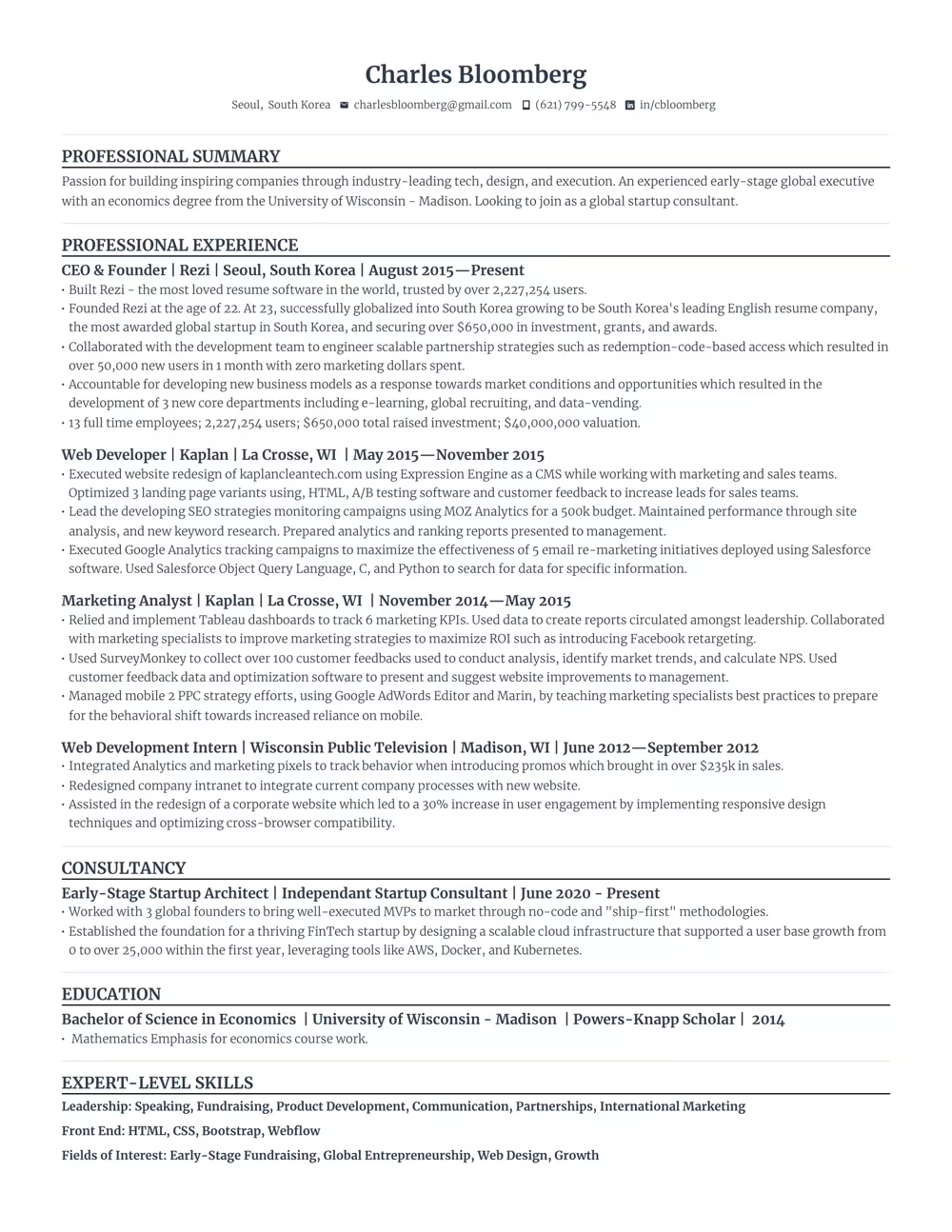
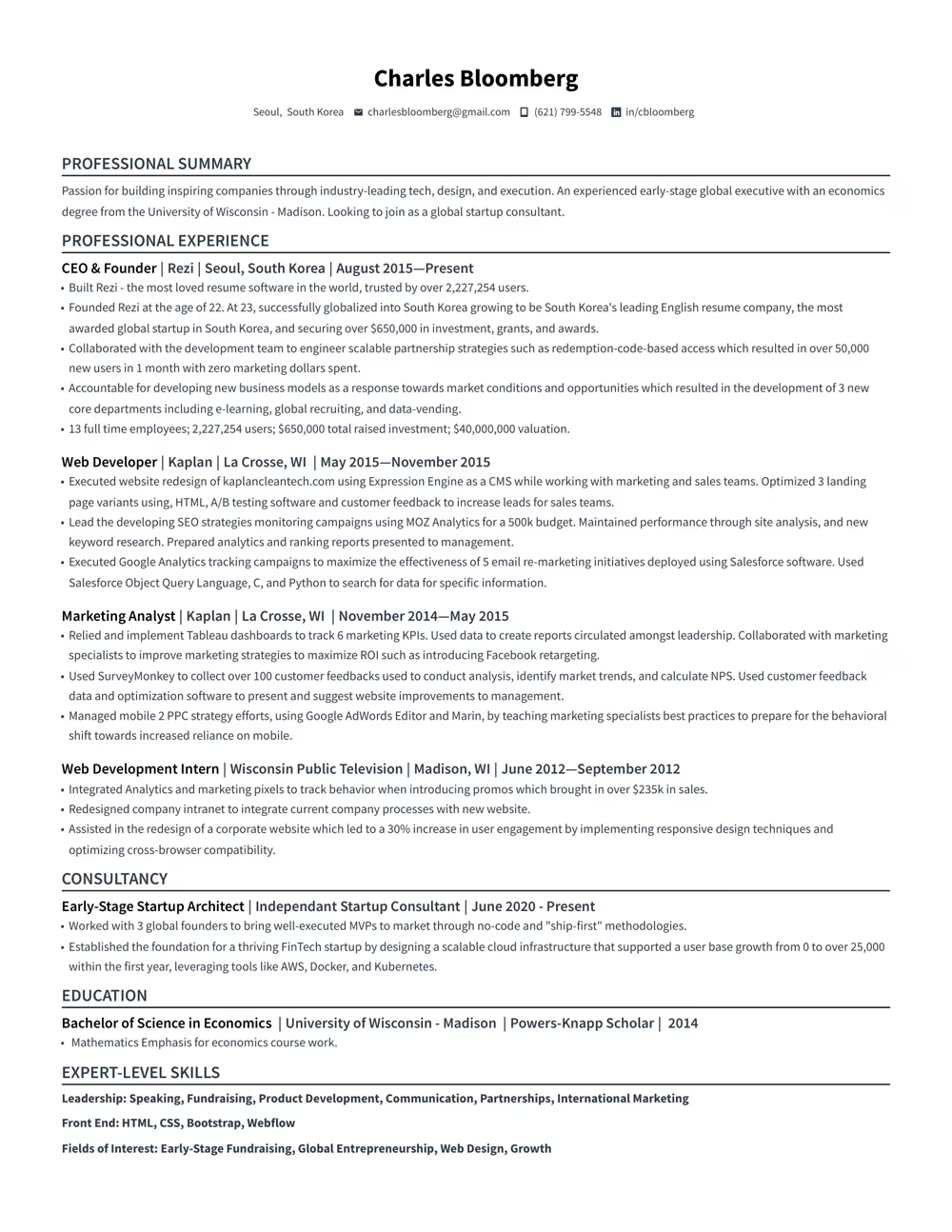
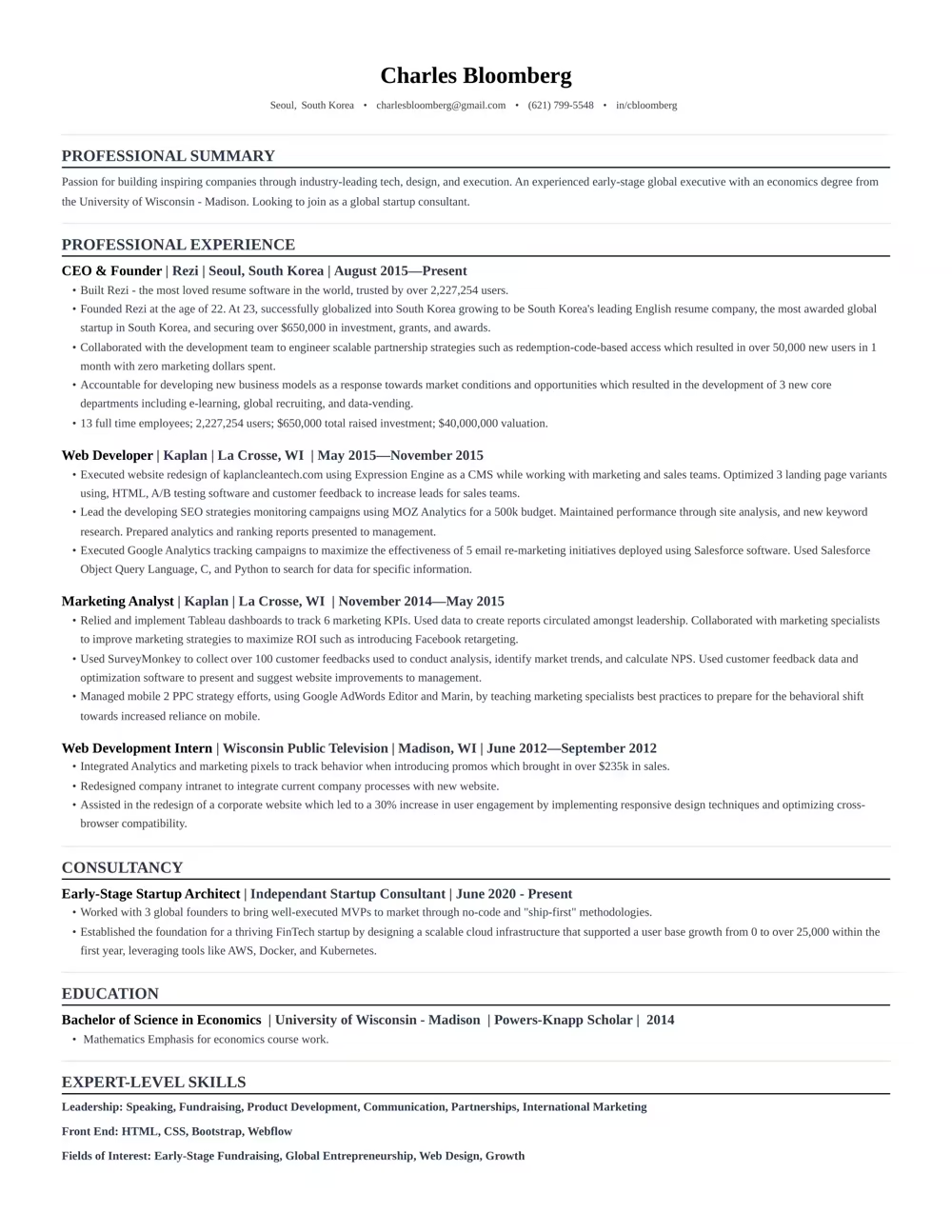
Take a look at some top-notch sample resumes for quality control managers across different industries and specializations. Find one that matches your profile and use it as a reference point (or feel free to steal it — just make sure to adjust the wording to reflect your own career journey).
Junior Quality Control Manager Resume
A Junior Quality Control Manager resume should emphasize foundational knowledge in quality systems, relevant coursework, internships, and any hands-on experience with inspections or testing protocols. Highlight your understanding of quality standards like ISO 9001, familiarity with basic statistical tools, and your eagerness to learn. Soft skills like attention to detail, communication, and willingness to take initiative matter a lot at this stage.
Mid-Level Quality Control Manager Resume
For a Mid-Level Quality Control Manager, your resume should demonstrate a solid track record of managing QC teams, conducting audits, and implementing corrective actions. Showcase your experience with root cause analysis, process improvement initiatives, and cross-functional collaboration. Quantify your impact — defect rate reductions, cost savings from fewer product recalls, or improvements in first-pass yield. Include any certifications like CQM or Six Sigma Green Belt.
Senior Quality Control Manager Resume
A Senior Quality Control Manager resume should demonstrate strategic leadership in quality management across multiple product lines or facilities. Emphasize your ability to develop quality policies, manage large teams, and drive enterprise-wide quality improvement programs. Highlight experience with regulatory audits, vendor quality management, and your track record of reducing cost of poor quality. Include advanced certifications and evidence of mentoring junior QC professionals.
Manufacturing Quality Control Manager Resume
For a Manufacturing Quality Control Manager, emphasize expertise in production-floor quality systems, SPC, lean manufacturing, and defect prevention strategies. Highlight your ability to work alongside production teams to reduce scrap rates, improve throughput, and maintain compliance with industry standards. Experience with FMEA, control plans, and PPAP processes should feature prominently. Mention specific manufacturing environments you've worked in, such as automotive, electronics, or aerospace.
Food Quality Control Manager Resume
A Food Quality Control Manager resume should spotlight your knowledge of food safety regulations like HACCP, FDA standards, and SQF or BRC certifications. Highlight experience managing microbiological and chemical testing programs, supplier quality audits, and sanitation protocols. Show how you've reduced contamination incidents, improved shelf-life consistency, or led successful regulatory inspections. Familiarity with allergen control and traceability systems adds strong value.
Pharmaceutical Quality Control Manager Resume
For a Pharmaceutical Quality Control Manager, your resume must showcase deep knowledge of GMP, FDA regulations, and pharmacopeia standards. Emphasize your experience managing analytical testing labs, overseeing stability studies, and handling deviations and CAPAs. Highlight successful regulatory inspection outcomes, your role in product release decisions, and any experience with validation protocols. Certifications in quality management or regulatory affairs strengthen your candidacy significantly.
Quality Assurance Manager Resume
A Quality Assurance Manager resume should focus on building and maintaining quality management systems rather than just end-of-line inspection. Emphasize your experience developing SOPs, leading internal and external audits, managing document control systems, and driving continuous improvement initiatives. Highlight your expertise in ISO standards, risk management, and supplier qualification programs. Show how your proactive QA strategies reduced defects and improved customer satisfaction.
Quality Control Supervisor Resume
For a Quality Control Supervisor, your resume should highlight hands-on team leadership — scheduling inspections, training inspectors, and ensuring daily quality targets are met. Show your ability to bridge the gap between floor-level operations and management-level quality goals. Emphasize experience with inspection equipment, non-conformance reporting, and real-time quality data analysis. Demonstrate how you've improved team performance and reduced rework through effective supervision.
Production Quality Manager Resume
A Production Quality Manager resume should demonstrate your ability to integrate quality control directly into the production process. Highlight experience with in-process inspections, statistical process control, and collaboration with production engineers to resolve quality issues at the source. Show how you've balanced quality standards with production efficiency, reduced scrap and rework costs, and improved overall equipment effectiveness. Lean and Six Sigma experience is highly valued here.
How to Write a Quality Control Manager Resume
Short answer:
Focus on your ability to build quality systems, lead teams, and deliver measurable improvements in product quality and regulatory compliance. Create a professional header with your name and contact details. Right below, write a 2–3 sentence resume summary outlining your most significant quality-related accomplishments. Describe your work history in reverse-chronological order, emphasizing quality outcomes, methodologies used, and standards maintained. Then, cover your education and professional certifications, list key skills, and add extra sections such as audit experience, publications, or professional memberships.
Include all the necessary sections in the correct order
Here's the correct order of sections for most quality control manager resumes:
- Header with contact information
- Resume summary or objective
- Work experience
- Education
- Skills
- Certifications
Depending on your current career situation, you can also throw in some additional sections. For instance:
- Audit history (especially if you've led major regulatory or third-party audits)
- Volunteer experience
- Conference participation or presentations
- Publications or industry articles
- Professional associations
Include everything that shows you're capable of doing what the job requires. Make every section count. If it doesn't clearly highlight your quality management skills, it doesn't belong on your resume.
If you have less than five years of relevant experience, keep your resume 1-page long. For more senior quality control managers, a two-page resume is fine.
More details here: What Sections to Include on Your Resume?
Now, I'll give you a high-level overview of how to write each section, going from top to bottom. Well… almost. The only exception is the resume summary section. While it comes right after your contact info, it's actually easier to write it last. More on that in a sec.
Create a professional resume header
- Start with your name and contact information. Include the basics: your full name, phone number, professional email address, location, and LinkedIn profile. A link to a professional portfolio or certifications page can also add credibility.
- Right below your name, clearly state your professional title (e.g., Senior Quality Control Manager). This sets expectations and asserts your position in the field.
For more information, see: How to Create a Resume Header
Describe your work history
- Use reverse-chronological order. List your positions starting with the current or the most recent one.
- In each entry, include your job title, company name, location, and dates of employment.
- Below each position, write 3–7 bullet points — the more recent the position, the more bullet points you should include. Describe your responsibilities and, more importantly, your accomplishments.
- Use action verbs and quantify your achievements (e.g., "Reduced product defect rate by 35% over 12 months by implementing a revised incoming materials inspection protocol across 3 production lines").
- If specific quality methodologies or frameworks were pivotal in your roles (e.g., Six Sigma, HACCP, ISO 9001), weave these details into your descriptions. This will also help you pass ATS scans.
Learn more about the best practices of this section with our detailed guide on how to describe your work experience on a resume.
List your degrees and detail professional learning
- In the education section, list your highest degree first, including the degree type, major, and institution.
- If you have relevant work experience, include only the name of your school and the degree you got. If you're an entry-level candidate, you can add more detail — list relevant coursework in quality engineering, statistics, or chemistry, plus extracurricular activities and academic achievements.
- If you have quality-related certifications (e.g., CQM, CQE, Six Sigma Black Belt), either include them in an "Education and Certifications" section, or create a separate "Certifications" section and place it right below.
For an in-depth guide on how to describe your education on a resume, see: How to List Education on a Resume
List your most relevant skills in the skills section
- Include a mix of technical skills (e.g., SPC software, testing instruments, quality management systems) and methodologies (e.g., Six Sigma, Lean, ISO standards) that you are proficient in.
- Add in some soft skills such as leadership, analytical thinking, and communication. Perhaps harder to quantify, but these demonstrate your capacity to lead QC teams and drive organizational change.
- You can use two separate subsections, one for hard skills, one for soft skills, or just list all the skills under one heading.
- Match your skills to the description of the job you're applying for. I'm not saying you should just dump all the skills the QC position requires (especially if you don't really have them), but highlight those areas of expertise where your knowledge overlaps with the job ad.
Need some inspiration to get started? Here are some good skills to feature on your quality control manager resume.
Software and tools for quality control resumes:
- Minitab
- SAP QM
- Microsoft Excel (advanced)
- JMP Statistical Software
- MasterControl
- ETQ Reliance
- InfinityQS
- LIMS (Laboratory Information Management Systems)
- ERP Systems (Oracle, SAP)
- Power BI / Tableau (for quality dashboards)
Quality methodologies and frameworks:
- Six Sigma (DMAIC)
- Lean Manufacturing
- ISO 9001 / ISO 13485 / ISO 22000
- Statistical Process Control (SPC)
- Root Cause Analysis (RCA)
- Failure Mode and Effects Analysis (FMEA)
- HACCP
- Good Manufacturing Practices (GMP)
- CAPA (Corrective and Preventive Actions)
- Total Quality Management (TQM)
Key soft skills for quality control managers:
- Attention to Detail
- Analytical Thinking
- Leadership
- Communication
- Problem-Solving
- Decision-Making
- Cross-Functional Collaboration
- Conflict Resolution
- Training and Mentoring
- Adaptability
For a full-blown guide on listing skills on a resume, visit: How to Put Skills on a Resume
Use additional sections as further proof of your fit
Additional sections add depth to your resume and back up your claimed expertise. Good examples of extra sections to add to a quality control manager resume are:
- Professional associations. Membership in organizations like ASQ (American Society for Quality) showcases your commitment to the field and ongoing professional development.
- Audit experience. A dedicated section listing major audits you've led or participated in — internal, regulatory, or third-party — provides concrete evidence of your expertise in action.
- Publications. If you've contributed to quality engineering journals, industry magazines, or company white papers on quality initiatives, definitely list them in a separate section.
- Conference attendance. This is ideal to include when you've given talks at quality or industry conferences. If you're at the beginning of your career, listing conferences you attended can show you're serious about your professional development.
Highlight the most relevant information in a resume summary
Once you're done writing your quality control manager resume, give it a full read. Pick the most relevant information and compile it into a summary paragraph. Place it right under the resume header.
- Be brief and to-the-point. In 3–4 sentences, sum up your career highlights, core competencies, and what you bring to the table. Consider this your chance to answer, "Why should you hire me?" Tailor this section to match the employer's needs outlined in the job description.
- Use value-oriented language. Focus on how you can add value to the potential employer, mentioning specific quality outcomes you've delivered or improvements you've driven in the past.
Once you've completed the core sections of your resume, you can use Rezi AI Resume Summary Generator to automatically create a powerful summary, tailored to the job you're applying for. All you need to do is add the position and skills you want to highlight. The AI writer will do the rest.
More information here: How to Write a Job-Winning Resume Summary (with Examples)
For finishing touches, make sure your resume looks professional
- Use a clean and tidy resume format. Ensure your QC resume is easily readable, with a professional font, consistent formatting, and clear section headings. Avoid overloading it with dense text or fancy design elements that could distract from the content and confuse resume screening software.
- Aim for a balance between detail and conciseness. If you're a junior or entry-level candidate, keep your resume to a single page. Experienced quality control managers can extend their resumes to two pages, but still need to make sure every word conveys value.
Learn more about proper resume formatting here: How to Format a Resume & What Standard Resume Format to Use
What Makes Quality Control Manager Resumes Different
In short: the emphasis on measurable quality outcomes, regulatory expertise, and a systematic approach to problem prevention.
This is also where many quality control managers stumble on their resumes. Hiring managers aren't impressed by a laundry list of "conducted inspections" and "reviewed test results." They need to see how your work directly impacted product quality, customer satisfaction, and the bottom line — so they can believe you'll deliver the same results for them.
Focus on quality metrics and measurable outcomes
Quality control is one of the most data-driven management roles out there. Your resume needs to reflect that. Vague statements about "maintaining quality standards" won't cut it when your competitors are listing exact defect rate reductions and cost savings.
What it means for you:
- Quantify your achievements wherever possible. Think defect rate reductions (e.g., "from 4.2% to 1.1%"), cost of poor quality savings, first-pass yield improvements, customer complaint reductions, or successful audit scores.
- Mention the scale and scope of your quality oversight — number of product lines, production volume, team size, or number of facilities managed. Context helps hiring managers understand the complexity of your work.
Focus on regulatory and compliance expertise
Unlike many management roles, quality control managers operate in a world of strict regulatory requirements. Your resume needs to demonstrate fluency in the standards and regulations that govern your industry — this is non-negotiable for most employers.
What it means for you:
- Explicitly name the standards and regulations you've worked with (ISO 9001, FDA 21 CFR, GMP, HACCP, IATF 16949, etc.). Don't assume the reader will infer this from your job titles.
- Highlight successful audit outcomes — both internal and external. If you led your facility through an FDA inspection with zero critical findings, that's resume gold. Say it clearly.
Focus on systems and prevention, not just detection
Any quality technician can find defects. What separates a quality control manager is the ability to build systems that prevent defects from happening in the first place. Hiring managers want to see this distinction on your resume.
What this means for you:
- Describe the quality systems, processes, and programs you've designed or improved — not just the inspections you've performed. Think CAPA programs, SPC implementation, supplier quality development, or training programs you built.
- Detail your expertise in specific quality tools and methodologies (FMEA, root cause analysis, DOE, control charts) and how you applied them to solve real problems. This shows your strategic and systematic approach to quality management.
Focus on cross-functional influence
Quality control managers don't work in isolation. You're constantly collaborating with production, engineering, procurement, and sometimes customers or regulators. Your resume should reflect your ability to influence quality outcomes across departments.
What this means for you:
- Highlight situations where you worked with cross-functional teams to resolve quality issues, implement process changes, or qualify new suppliers. Show that you can get buy-in and drive change beyond your own department.
- If you've been responsible for training production staff on quality procedures or leading quality review boards, call it out. It demonstrates leadership influence that extends beyond the QC lab or inspection floor.
Focus on career progression and growing responsibility
No worries if you're just starting out in the field, but if you have significant experience under your belt, your quality control resume should showcase your growth and development.
What this means for you:
- Highlight transitions from hands-on inspection roles to supervisory and then management positions. Show how experience as a Quality Technician or QC Inspector laid the groundwork for managing teams and quality systems.
- The easiest way to demonstrate growth is showing how the scope and complexity of your quality responsibilities expanded over time — from single production lines to entire facilities or multiple sites.
Bonus Resources for Quality Control Managers
This isn't going to be a game-changer for you if you need a resume now. But —
I want you to treat your career holistically. These resources will help you up your quality management game, add some juice to your future resumes and, generally, keep you up to date with new developments in the QC field.
Professional associations and networks
American Society for Quality (ASQ)
ASQ is the leading global organization for quality professionals. It offers certifications (CQM, CQE, Six Sigma), training, publications, and local section networking opportunities. Membership signals serious commitment to the profession and gives you access to a vast knowledge base.
International Society for Pharmaceutical Engineering (ISPE)
If you work in pharmaceutical or biotech quality, ISPE provides industry-specific guidance, technical documents, and networking events focused on manufacturing and quality best practices in regulated environments.
Institute of Quality Assurance (IQA) / CQI
The Chartered Quality Institute, based in the UK, offers professional registration, qualifications, and a strong international community for quality professionals looking to advance their careers and credentials.
Online learning platforms
Coursera & edX
Both platforms offer quality management courses covering Six Sigma, lean manufacturing, statistical quality control, and ISO standards. Many courses are developed by top universities, making them ideal for building knowledge and adding credentials to your resume.
LinkedIn Learning
With a focus on professional development, LinkedIn Learning provides numerous courses on quality management systems, root cause analysis, auditing techniques, and leadership skills tailored to quality professionals.
ASQ Training and Certification Prep
ASQ offers both self-paced and instructor-led courses designed to prepare you for professional certifications like CQM, CQE, and Six Sigma. These are directly recognized by employers and carry significant weight on a resume.
Publications
ASQ Quality Progress Magazine
This monthly publication covers quality management trends, case studies, tools, and professional development advice. It's a go-to resource for staying current with best practices across industries.
Quality Magazine
Quality Magazine covers inspection, testing, measurement, and quality management topics with a manufacturing focus. It offers practical articles, product reviews, and industry news relevant to QC managers.
Journal of Quality Technology
A peer-reviewed journal published by ASQ, offering in-depth research on statistical methods, quality engineering, and process improvement — ideal for quality managers who want to deepen their technical knowledge.
Tools and software reviews
Capterra & G2
Both websites provide extensive reviews and comparisons of quality management software (QMS), helping you choose the right tools based on features, pricing, and user feedback — whether you need CAPA management, document control, or audit tracking.
Minitab Blog
Minitab's blog offers practical guides on statistical analysis, SPC, and quality improvement techniques. It's a great resource for sharpening the data analysis skills that make quality control managers effective.
Summary
Here's what you need to know about writing a quality control manager resume:
- Structure your quality control manager resume with essential sections in this order: Header, Resume Summary or Objective, Work Experience, Education, Skills, and Certifications. If relevant in your case, add extra sections like Audit Experience or Professional Associations.
- Include a professional header with your name, contact information, and professional title.
- Describe your work history in reverse-chronological order, emphasizing quality outcomes with quantifiable metrics like defect rate reductions, cost savings, and audit results.
- In the education section, list your highest degree at the top. You can list quality certifications either in the education section or under a separate heading.
- Highlight a mix of technical skills, quality methodologies, and soft skills, tailoring them to the job description.
- Explicitly name the regulatory standards and frameworks you've worked with — don't make the reader guess.
- Emphasize systems you've built and improvements you've driven, not just inspections you've performed.
- Use additional sections to further showcase your expertise and commitment to the field.
- Once done writing the resume, compile the key information into a brief, value-oriented resume summary at the top.
- Make your resume professional in appearance, aim for conciseness without sacrificing detail.
Thanks for reading! Got any questions? Feel free to reach out to me on LinkedIn. (Or check out the FAQs first, maybe your question is answered there.)
FAQ
What keywords should I use on my quality control manager resume?
Use specific quality management terminologies and software names relevant to your experience, such as Six Sigma, SPC, root cause analysis, CAPA, ISO 9001, GMP, Minitab, and SAP QM. Highlight certifications like CQM, CQE, Six Sigma Black Belt, or Lead Auditor. Mirror the language used in the job posting — if they say "non-conformance management," use that exact phrase rather than a synonym.
How do I tailor my quality control manager resume to the job description?
Identify the key standards, industries, and responsibilities mentioned in the job description and reflect these in your resume. If the posting emphasizes FDA compliance and pharmaceutical experience, lead with those details in your summary and work history. Align your achievements and skill lists with the employer's stated priorities.
What's the most common mistake on quality control manager resumes?
Listing inspection tasks without outcomes. "Performed quality inspections" tells the reader nothing about your impact. Instead, write something like "Reduced customer complaint rate by 42% by redesigning incoming material inspection protocols and implementing supplier scorecards." Every bullet point should answer the question: "So what?"
Should I include industry-specific certifications even if the job posting doesn't mention them?
Absolutely. Certifications like ASQ's CQM, CQE, Six Sigma Black Belt, or HACCP certification signal credibility and professional investment. Even if a specific job ad doesn't list them as requirements, they differentiate you from candidates who lack formal quality credentials. Place them prominently on your resume.
Which resume format is the best for quality control manager resumes?
The reverse-chronological format is recommended for quality control manager resumes. It highlights your career progression, growing scope of responsibility, and quality achievements, making it easy for employers to see your trajectory from hands-on QC roles to management positions.
I'm transitioning into quality control management from a different field. How should I approach my resume?
Focus on transferable skills like process improvement, data analysis, team leadership, compliance management, and attention to detail. If you've managed any aspect of quality, safety, or regulatory compliance in your previous roles — even informally — highlight those experiences. Include any relevant certifications or courses (Six Sigma, ISO auditing, ASQ credentials) to demonstrate your commitment to the quality profession.
How do I handle experience across multiple industries on a QC resume?
Cross-industry experience is actually a strength in quality management — it shows adaptability and a broad understanding of different quality systems. Tailor your resume to emphasize the standards and methodologies most relevant to the role you're targeting, but don't hide your diverse background. Many employers value QC managers who bring fresh perspectives from other regulated industries.
Should I list every audit I've participated in?
No — focus on the most significant ones. Highlight audits where you played a lead role, audits with notable outcomes (zero findings, successful recertification), or audits from well-known regulatory bodies (FDA, ISO registrars, major customers). If auditing is a major part of your experience, consider creating a brief dedicated section rather than burying this information in bullet points.