
Here's the thing most records manager resumes get wrong: they read like a list of filing tasks. "Maintained records." "Organized documents." "Ensured compliance." That's not a resume — that's a job description you could copy off any posting on Indeed.
The records managers who land interviews are the ones whose resumes tell a story about protecting organizational assets, driving information governance strategy, navigating complex regulatory landscapes, and transforming how companies handle their most critical data. Your resume needs to show you're not just storing documents — you're safeguarding institutional knowledge and enabling business operations.
And this is exactly what you'll learn from this article. Inside, you'll find:
- Examples of 9 records manager resumes, covering different industries and specializations.
- Insider tips about what really matters to recruiters hiring for records management roles.
- A step-by-step guide for putting together a records management resume that simply lands jobs.
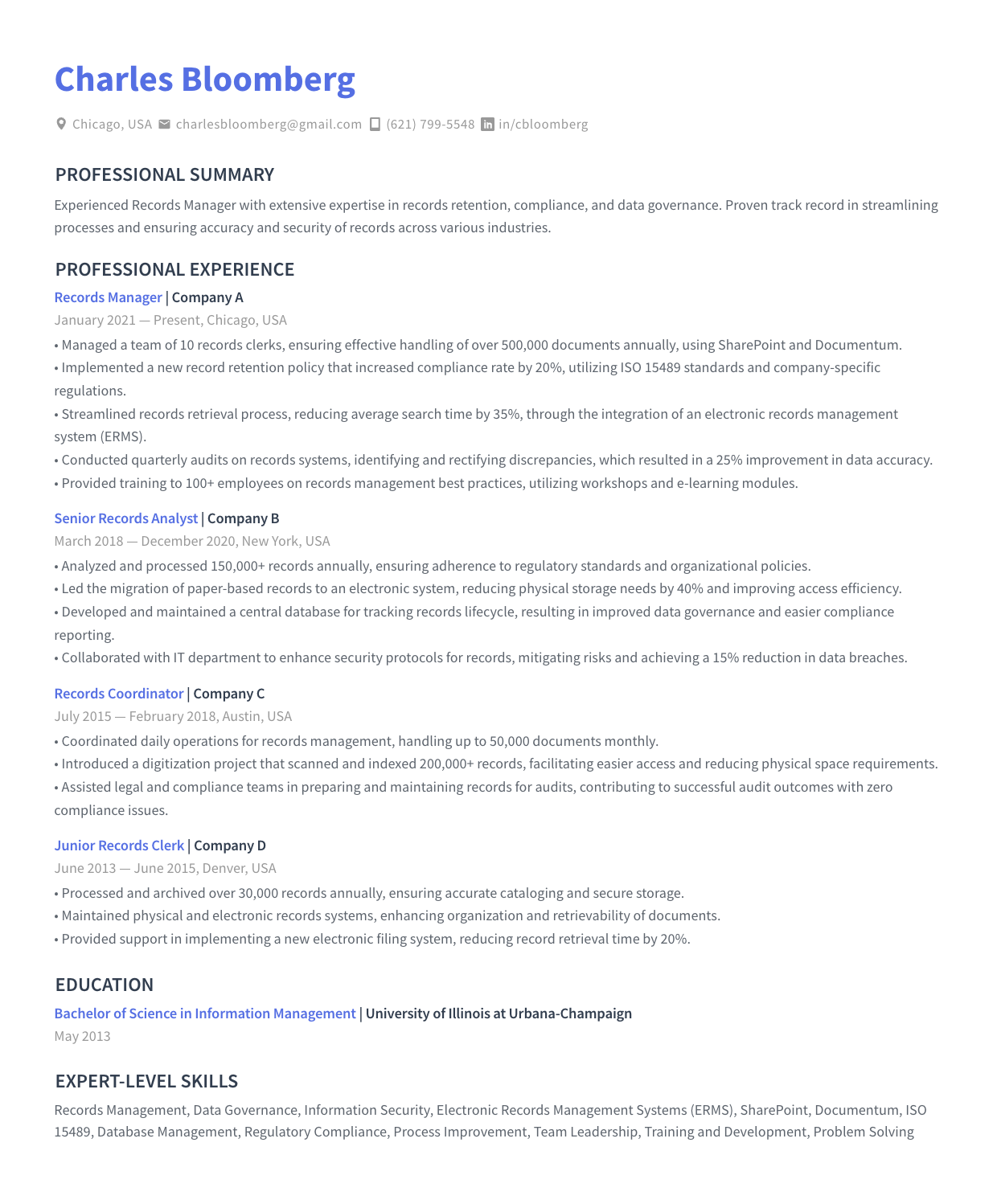
Sample Records Manager Resumes
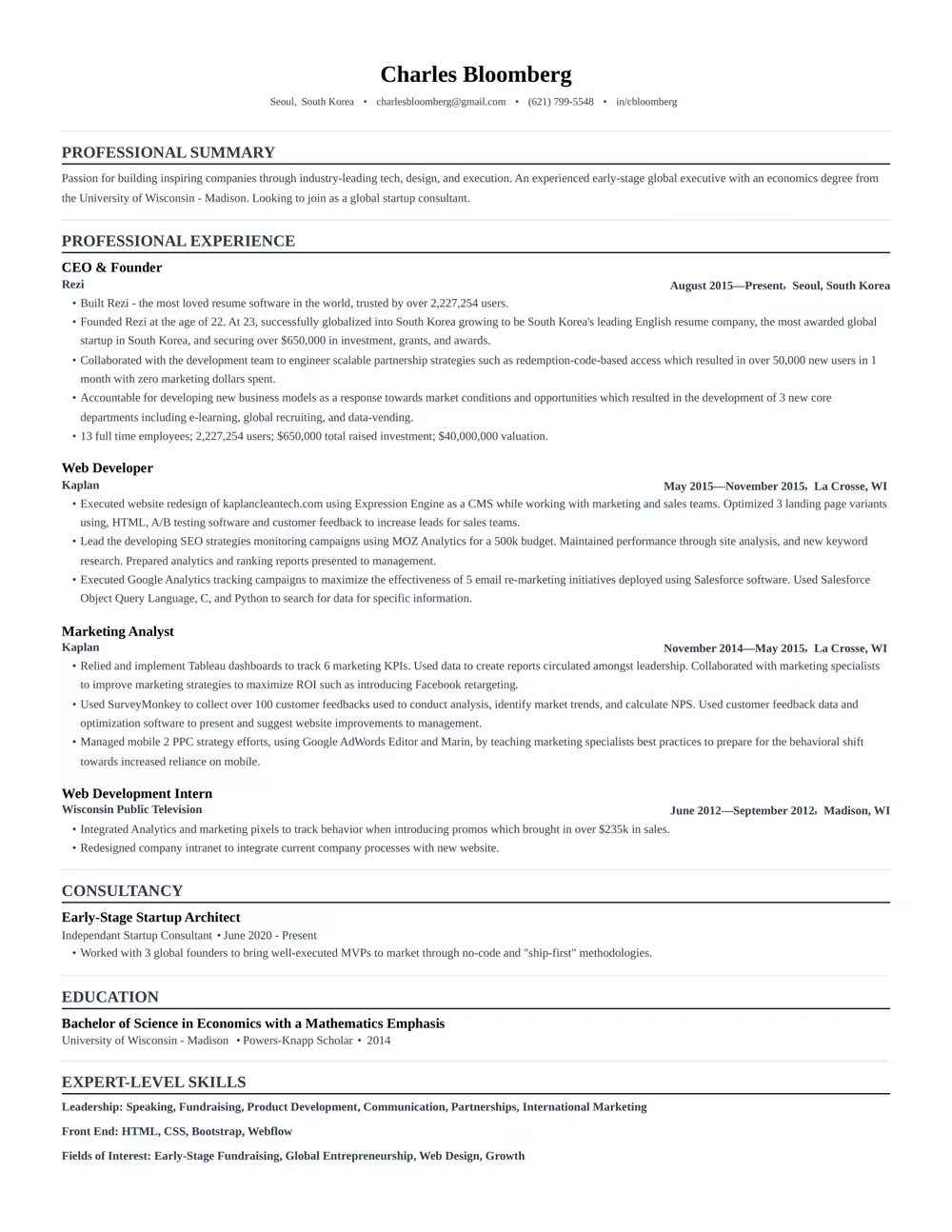
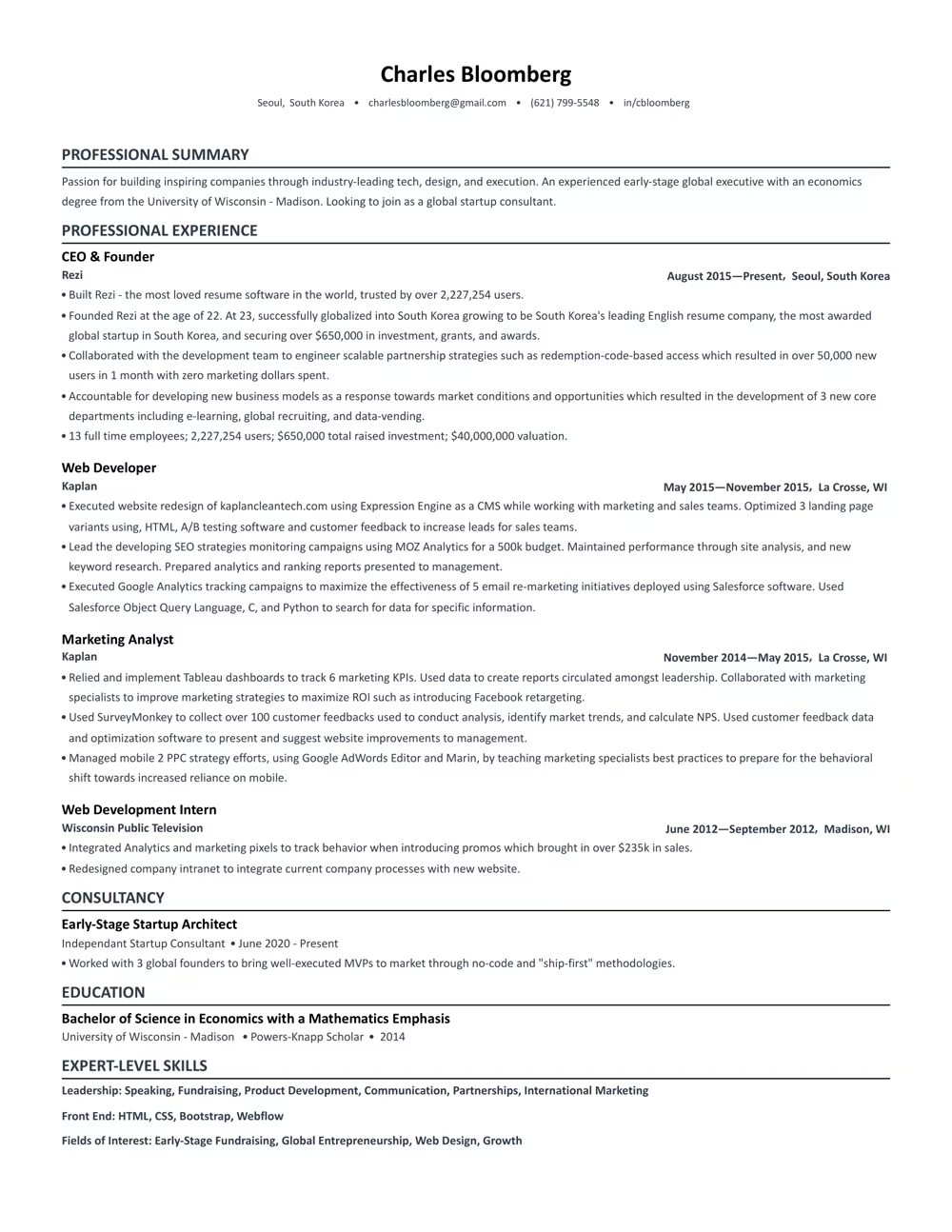
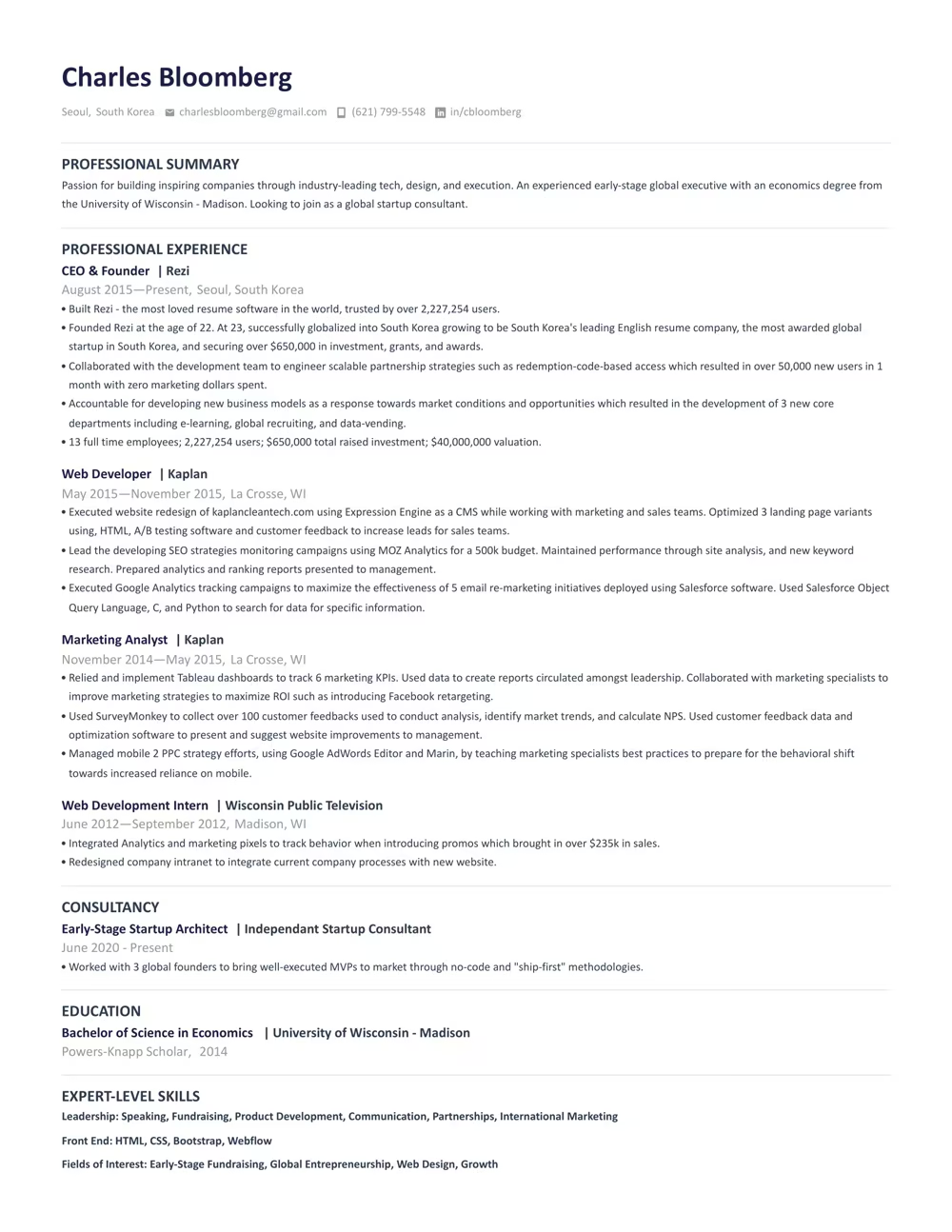
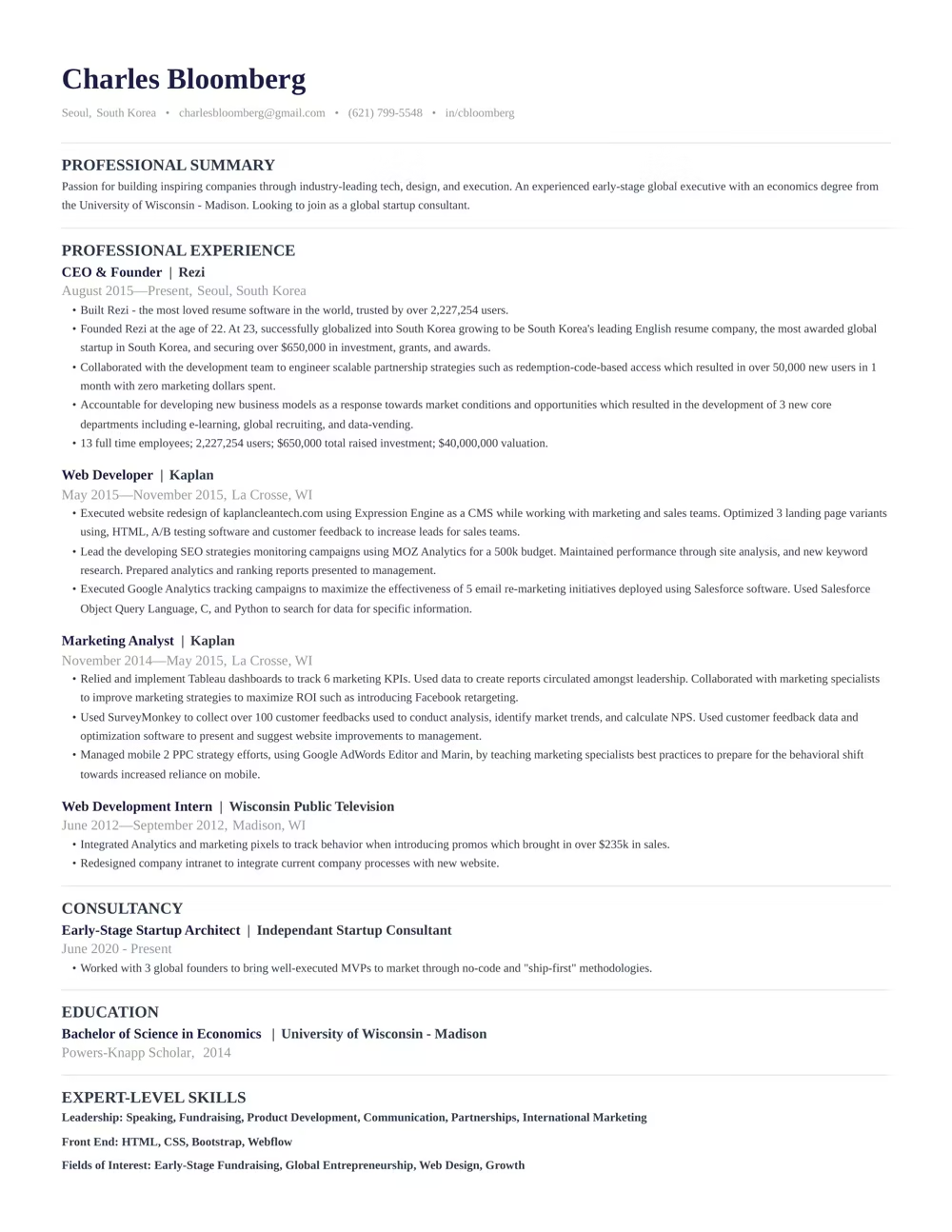
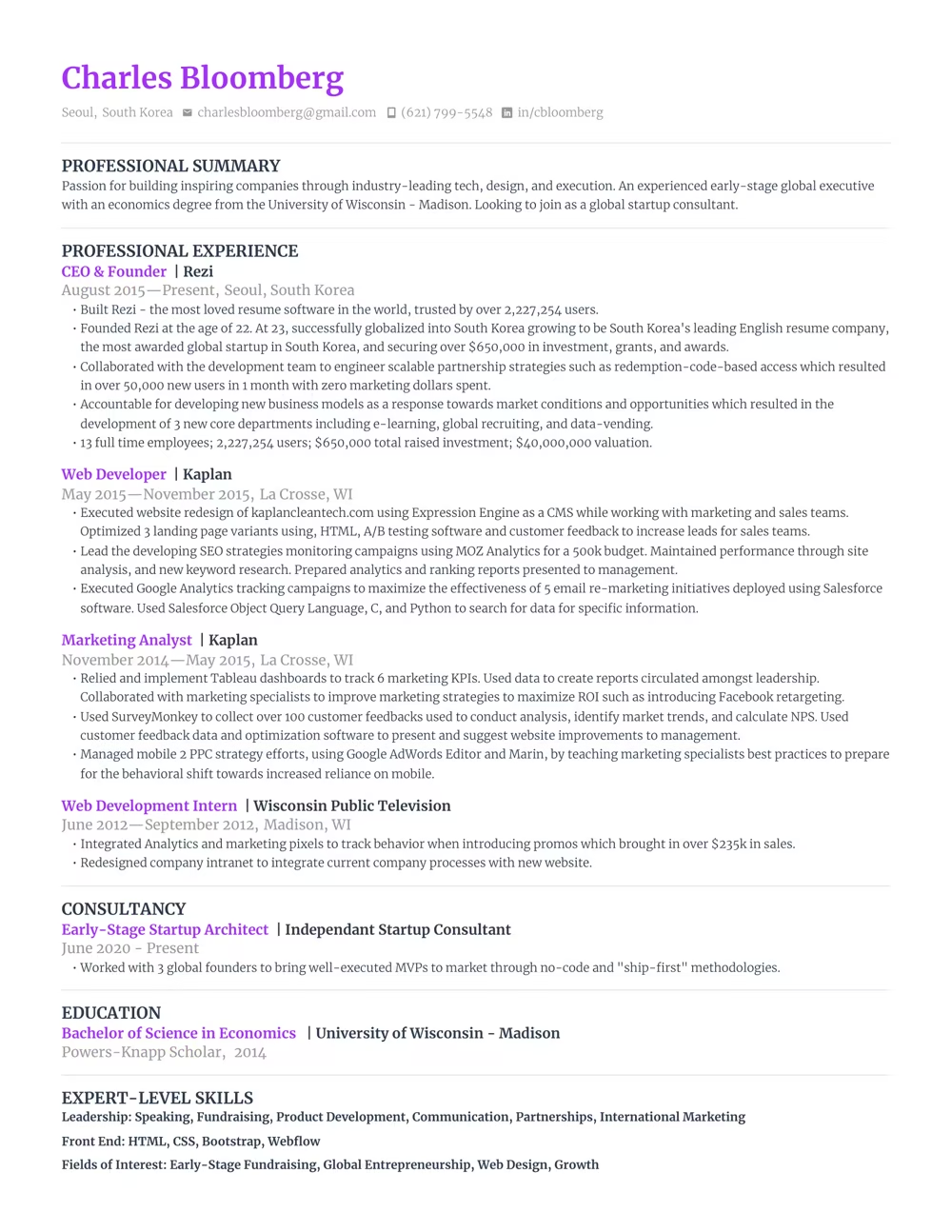
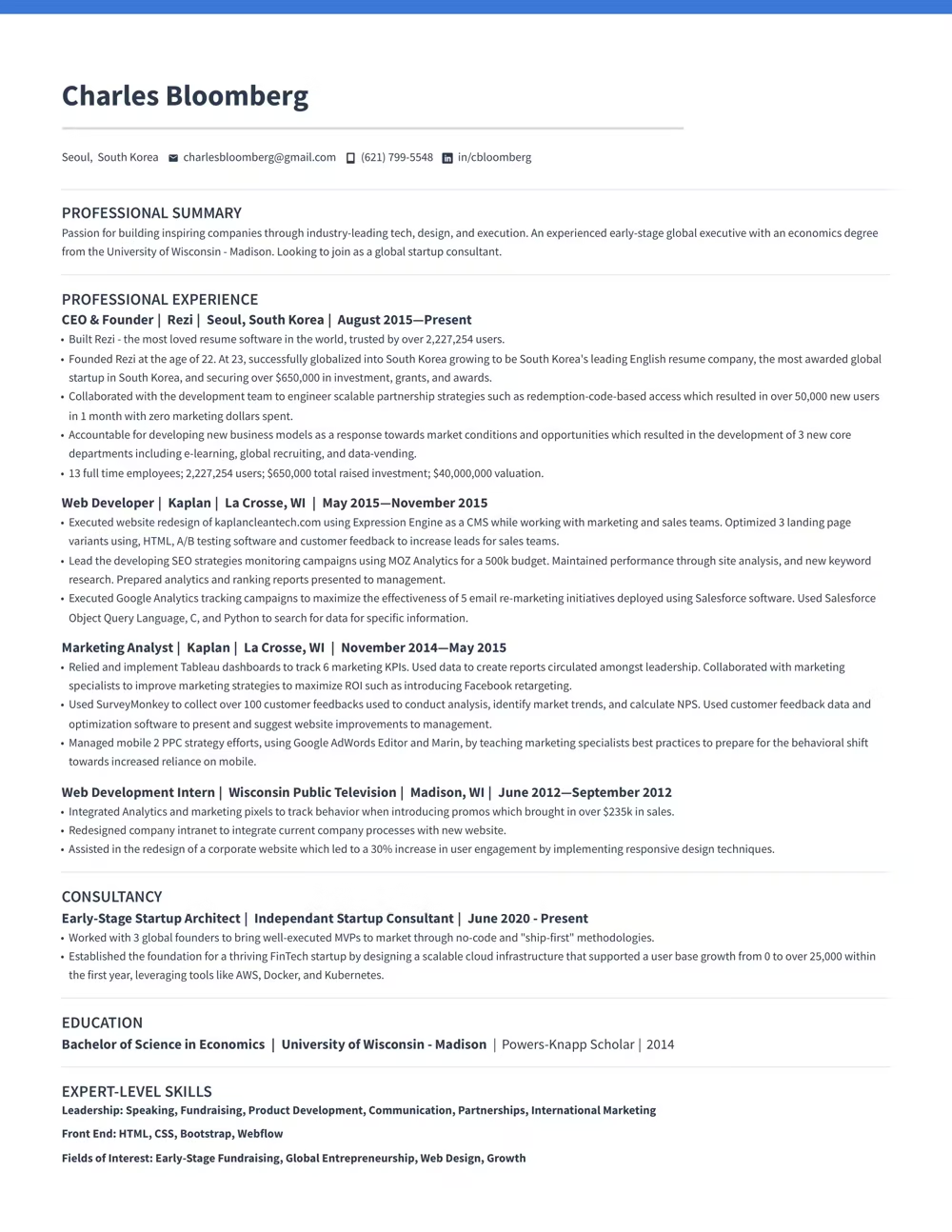
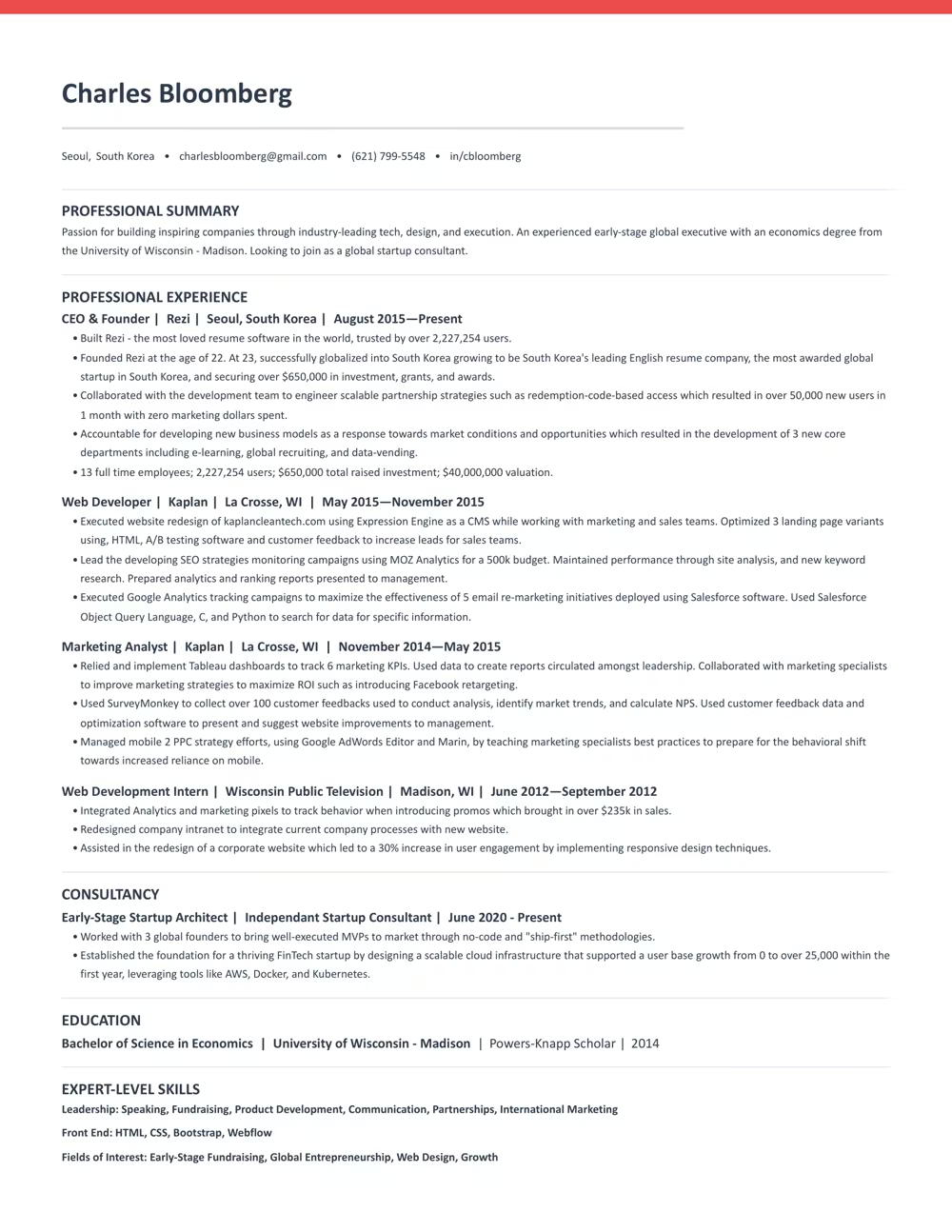
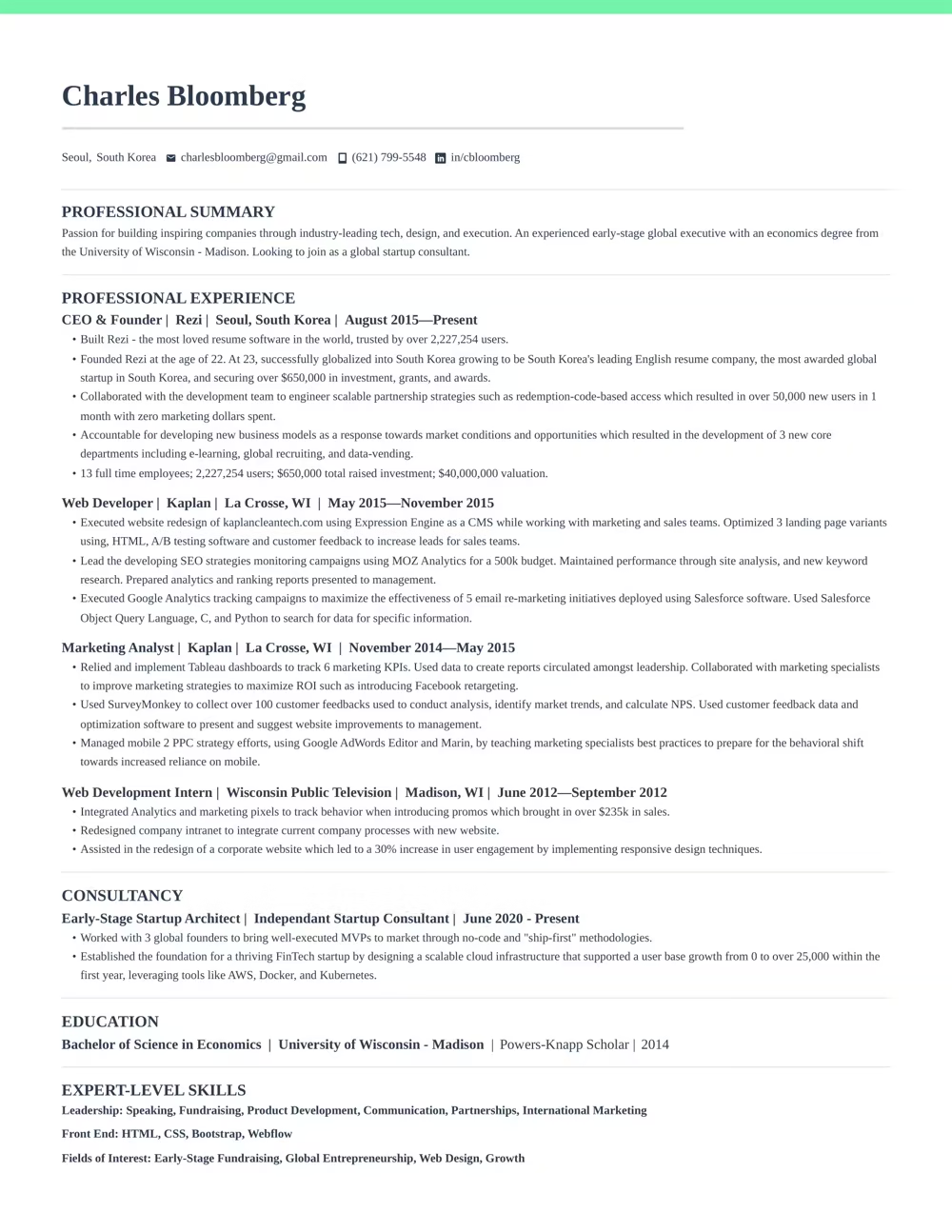
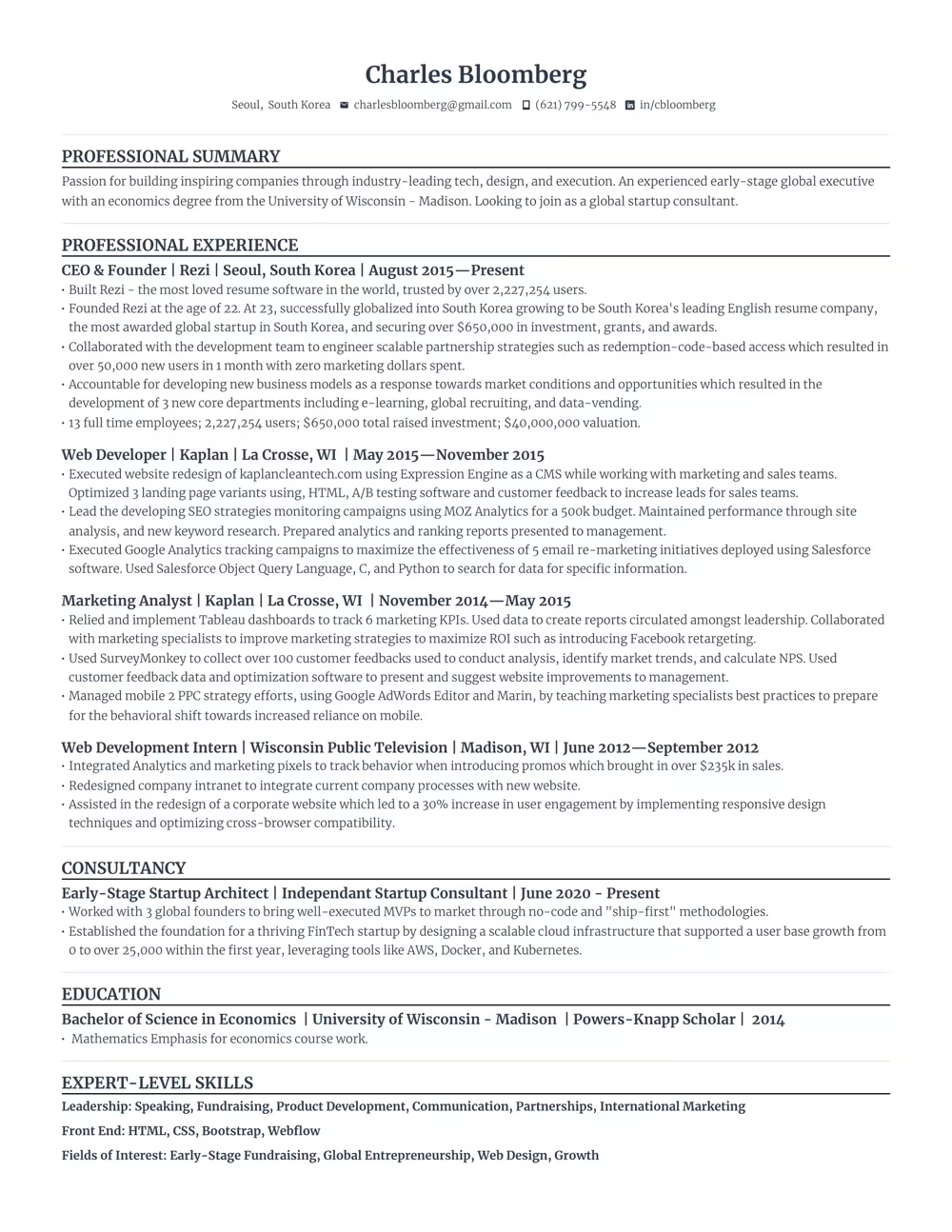
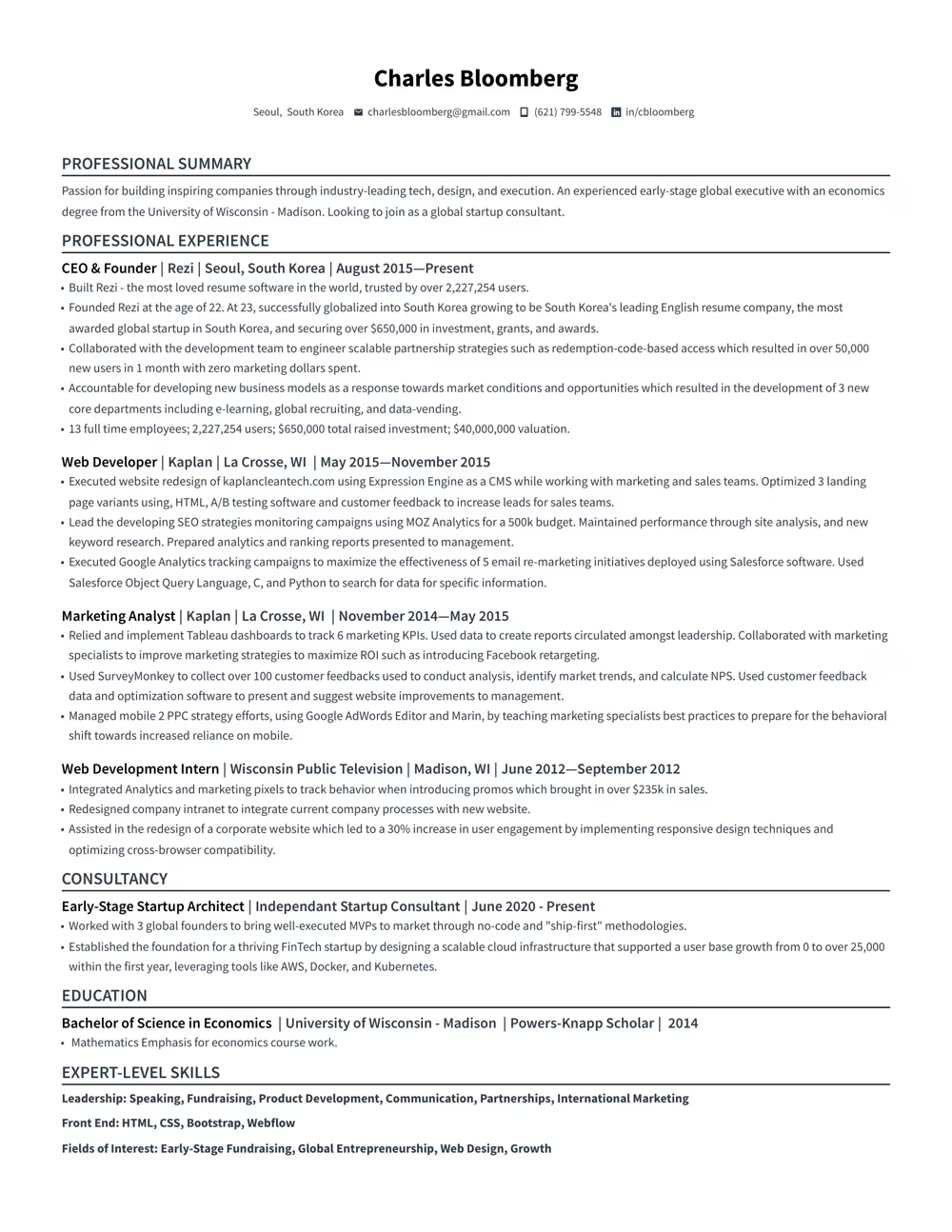
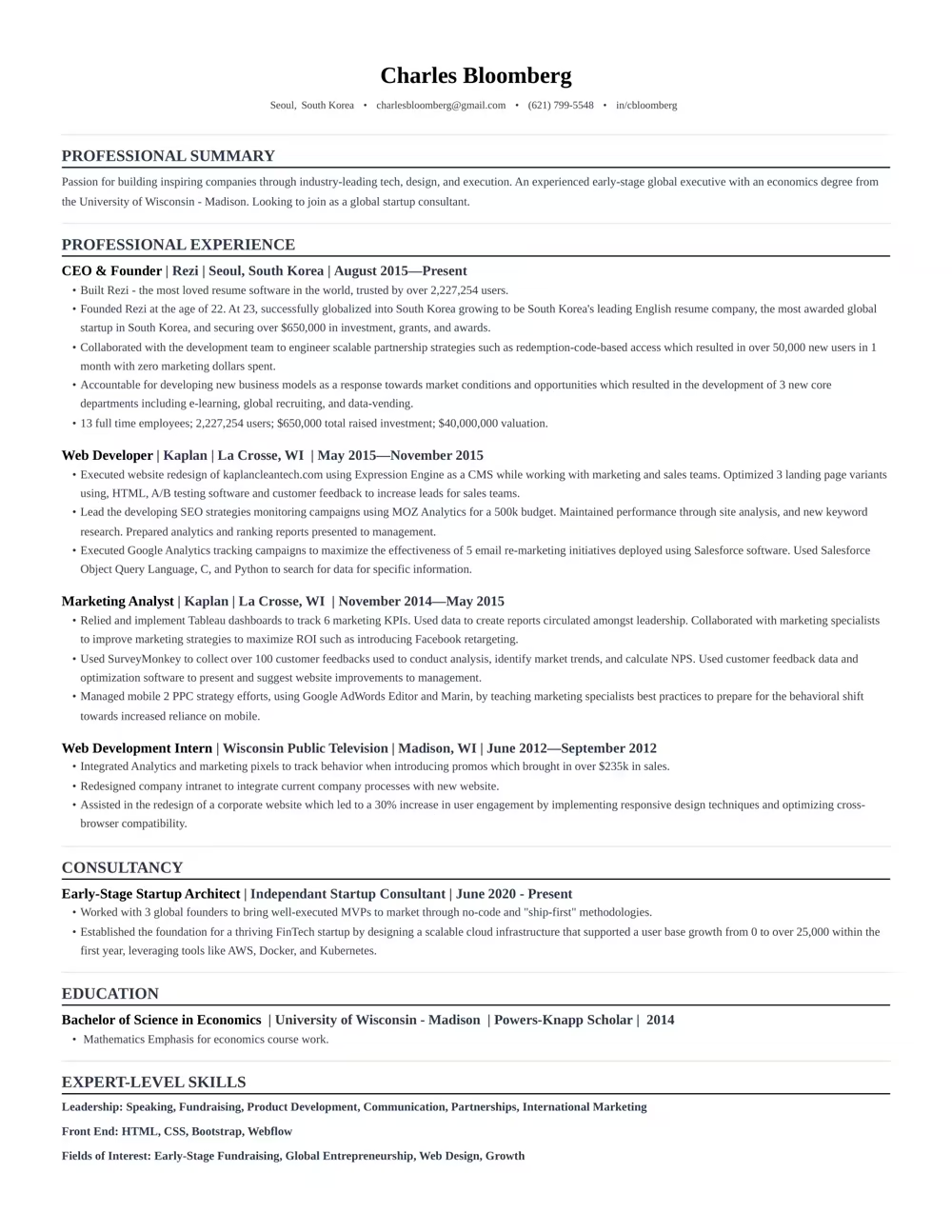
Take a look at some top-notch sample resumes for records managers across different industries and specializations. Find one that matches your profile and use it as a reference point (or feel free to steal it, just make sure to adjust the wording to reflect your career journey).
Junior Records Manager
A Junior Records Manager resume should spotlight your educational background, any records management coursework or internships, and foundational knowledge of retention schedules and filing systems. Highlight familiarity with records management software, attention to detail, and eagerness to learn regulatory frameworks. Even small wins — like digitizing a department's paper files or assisting with an audit — show initiative and practical skill that employers value at this stage.
Mid-Level Records Manager
For a Mid-Level Records Manager, your resume should demonstrate growing responsibility and independent management of records programs. Emphasize your experience developing retention schedules, conducting records audits, and training staff on compliance procedures. Show how you've improved processes — perhaps by reducing retrieval times or cutting storage costs. Include any certifications earned and your proficiency with enterprise content management systems that reflect your deepening expertise.
Senior Records Manager
A Senior Records Manager resume should demonstrate a track record of leading enterprise-wide records governance programs. Emphasize strategic planning, policy development, and cross-departmental leadership. Highlight your experience managing large teams, overseeing multi-million-dollar information management budgets, and navigating complex regulatory environments. Showcase measurable outcomes like audit pass rates, litigation readiness improvements, and cost savings from optimized retention programs. Advanced certifications like CRM are essential here.
Electronic Records Manager
An Electronic Records Manager resume should focus on your expertise in digital preservation, metadata standards, and electronic document management systems. Highlight your experience with digital migration projects, cloud-based records platforms, and cybersecurity awareness as it relates to information assets. Show your proficiency with tools like SharePoint, OpenText, or Laserfiche. Demonstrate how you've ensured the integrity, authenticity, and accessibility of electronic records throughout their lifecycle.
Medical Records Manager
For a Medical Records Manager, emphasize your deep understanding of HIPAA regulations, health information management standards, and EHR systems like Epic or Cerner. Your resume should highlight experience managing patient records, ensuring privacy compliance, and coordinating with clinical staff. Showcase any HIM certifications like RHIA or RHIT. Metrics around audit accuracy rates, compliance scores, and process improvements in health information workflows will strengthen your resume significantly.
Corporate Records Manager
A Corporate Records Manager resume should showcase your ability to develop and enforce company-wide records retention policies, manage litigation holds, and support regulatory compliance across business units. Highlight your experience working with legal, finance, and operations departments to classify and protect business-critical information. Demonstrate ROI through storage cost reductions, streamlined workflows, and successful regulatory audits. Proficiency in enterprise content management platforms is a must.
Legal Records Manager
For a Legal Records Manager, your resume should emphasize expertise in managing case files, litigation hold processes, legal discovery, and court-mandated retention requirements. Highlight your understanding of attorney-client privilege as it applies to records handling, and your experience with legal document management systems. Show your ability to coordinate with legal teams under tight deadlines. Any paralegal training or legal industry certifications add significant credibility to your candidacy.
Information Records Manager
An Information Records Manager resume should focus on your expertise in information governance, data classification, and knowledge management across both physical and digital environments. Highlight your ability to design taxonomy structures, implement metadata schemas, and develop information lifecycle management strategies. Show proficiency with content management platforms and data analytics tools. Demonstrate how your work has improved information accessibility, reduced redundancy, and strengthened organizational decision-making capabilities.
Government Records Manager
A Government Records Manager resume should highlight your knowledge of NARA guidelines, Freedom of Information Act (FOIA) requirements, and federal or state records retention mandates. Emphasize your experience managing classified or sensitive records, conducting compliance audits, and training government staff on records procedures. Familiarity with government-specific systems and security clearances should be prominently featured. Showcase your ability to navigate bureaucratic processes while maintaining strict regulatory compliance.
How to Write a Records Manager Resume
Short answer:
Focus on your information governance expertise, compliance achievements, and the specific frameworks and systems you've used to manage records throughout their lifecycle. Create a professional header with your name and contact details. Right below, write a 2–3 sentence resume summary outlining your most significant accomplishments. Describe your work history in reverse-chronological order, focusing on records program outcomes and regulatory compliance. Then, cover your education, including professional certifications, list key skills, and add extra sections such as professional associations, publications, or volunteer work.
Include all the necessary sections in the correct order
Here's the correct order of sections for most records manager resumes:
- Header with contact information
- Resume summary or objective
- Work experience
- Education
- Skills
- Certifications
Depending on your current career situation, you can also throw in some additional sections. For instance:
- Professional associations (ARMA International, AIIM, etc.)
- Volunteer experience
- Conference presentations
- Publications
- Special projects or initiatives
Include everything that shows you're capable of doing what the job requires. Make every section count. If it doesn't clearly highlight your skills, it doesn't belong on your resume.
If you have less than five years of relevant experience, keep your resume 1-page long. For more senior records managers, a two-page resume is fine.
More details here: What Sections to Include on Your Resume?
Now, I'll give you a high-level overview of how to write each section, going from top to bottom. Well… almost. The only exception is the resume summary section. While it comes right after your contact info, it's actually easier to write it last. More on that in a sec.
Create a professional resume header
- Start with your name and contact information. Include the basics: your full name, phone number, professional email address, location, and LinkedIn profile. A link to your professional portfolio or personal website can also add credibility and help you make a more professional first impression.
- Right below your name, clearly state your professional title (e.g., Senior Records Manager or Certified Records Manager). This sets expectations and asserts your position in the field.
For more information, see: How to Create a Resume Header
Describe your work history
- Use reverse-chronological order. List your positions starting with the current or the most recent one.
- In each entry, include your job title, company name, location, and dates of employment.
- Below each position, write 3–7 bullet points — the more recent the position, the more bullet points you should include. Describe your responsibilities and, more importantly, your accomplishments.
- Use action verbs and quantify your achievements (e.g., "Developed and implemented a retention schedule covering 500+ record series, reducing off-site storage costs by 30% within 18 months").
- If specific records management frameworks or standards were pivotal in your roles (e.g., ISO 15489, NARA guidelines, HIPAA), weave these details into your descriptions. This will also help you pass ATS scans.
Learn more about the best practices of this section with our detailed guide on how to describe your work experience on a resume.
List your degrees and detail professional learning
- In the education section, list your highest degree first, including the degree type, major, and institution. Degrees in library science, information management, business administration, or related fields are particularly relevant.
- If you have some relevant work experience, include only the name of your school and the degree you got. If you're an entry-level candidate, you can add some more detail to your education section — list relevant coursework, extracurricular activities, and academic achievements.
- If you have records management certifications (e.g., CRM, IGP, CIGO), either include them in an "Education and Certifications" section, or create a separate "Certifications" section and place it right below.
For an in-depth guide on how to describe your education on a resume, see: How to List Education on a Resume
List your most relevant skills in the skills section
- Include a mix of technical skills (e.g., records management software, database administration) and frameworks (e.g., ISO 15489, information lifecycle management) that you are proficient in.
- Add in some soft skills such as attention to detail, communication, and organizational leadership. Perhaps harder to quantify, but these demonstrate your capacity to manage programs and lead teams successfully.
- You can use two separate subsections, one for hard skills, one for soft skills, or just list all the skills under one heading.
- Match your skills to the description of the job you're applying for. I'm not saying you should just dump all the skills the position requires (especially if you don't really have them), but highlight those areas of expertise where your knowledge overlaps with the job ad.
Need some inspiration to get started? Here are some good skills to feature on your records management resume.
Software and tools for records management resumes:
- SharePoint
- OpenText
- Laserfiche
- IBM FileNet
- Microsoft 365 Compliance Center
- Hyland OnBase
- TRIM / Content Manager (Micro Focus)
- Iron Mountain Connect
- SAP Document Management
- Alfresco
Records management frameworks and standards:
- ISO 15489 (Records Management)
- Information Lifecycle Management (ILM)
- NARA Records Management Guidelines
- HIPAA Privacy and Security Rules
- GDPR Data Management
- Sarbanes-Oxley (SOX) Compliance
- Freedom of Information Act (FOIA)
- Generally Accepted Recordkeeping Principles (GARP)
- DoD 5015.02 Standard
- ARMA Information Governance Framework
Key soft skills for records managers:
- Attention to Detail
- Organizational Skills
- Communication
- Analytical Thinking
- Problem-Solving
- Leadership
- Policy Development
- Training and Mentoring
- Cross-functional Collaboration
- Adaptability
For a full-blown guide on listing skills on a resume, visit: How to Put Skills on a Resume
Use additional sections as further proof of your fit
Additional sections add depth to your resume and back up your claimed expertise. Good examples of extra sections to add to a records manager resume are:
- Professional associations. Membership in organizations like ARMA International, AIIM, or NAGARA can showcase your commitment to the field and ongoing professional development.
- Special projects. A resume section dedicated to significant initiatives you've led — such as a large-scale digitization project, a records management system migration, or a compliance overhaul — can provide concrete examples of your expertise in action.
- Publications. If you've contributed to industry journals, information governance blogs, or ARMA publications, definitely list them in a separate section.
- Conference presentations. This is ideal to include when you've given talks at conferences like ARMA InfoCon or AIIM Conference. If you're at the beginning of your career, listing industry conferences you attended can show you're serious about your career development.
Highlight the most relevant information in a resume summary
Once you're done writing your records management resume, give it a full read. Pick the most relevant information and compile it into a summary paragraph. Place it right under the resume header.
- Be brief and to-the-point. In 3–4 sentences, sum up your career highlights, core competencies, and what you bring to the table. Consider this your chance to answer, "Why should you hire me?" Tailor this section to match the employer's needs outlined in the job description.
- Use value-oriented language. Focus on how you can add value to the potential employer, mentioning specific outcomes you hope to deliver or achievements you've driven in the past.
Once you've completed the core sections of your resume, you can use Rezi AI Resume Summary Generator to automatically create a powerful summary, tailored to the job you're applying for. All you need to do is add the position and skills you want to highlight. The AI writer will do the rest.
More information here: How to Write a Job-Winning Resume Summary (with Examples)
For finishing touches, make sure your resume looks professional
- Use a clean and tidy resume format. Ensure your records manager resume is easily readable, with a professional font, consistent formatting, and clear section headings. Avoid overloading it with dense text or fancy design elements that could distract from the content and confuse resume screening software.
- Aim for a balance between detail and conciseness. If you're a junior or entry-level candidate, keep your resume to a single page. Experienced records managers can extend their resumes to two pages, but still need to make sure every word conveys value.
Learn more about proper resume formatting here: How to Format a Resume & What Standard Resume Format to Use
What Makes Records Management Resumes Different
In short: the emphasis on regulatory compliance, information governance, and the ability to manage records across their entire lifecycle.
This is also what many records managers get wrong on their resumes. Hiring decision-makers won't be impressed with descriptions of routine filing and storage tasks. They need to see how your work protected the organization, reduced risk, and enabled better business operations — this way, they'll be more likely to believe you can translate past success into future results.
Focus on compliance and risk mitigation
Records managers exist, in large part, to keep organizations out of legal and regulatory trouble. Unlike many other roles, your resume needs to clearly demonstrate your understanding of the regulatory landscape and how you've applied it.
What it means for you:
- Highlight specific regulations and standards you've worked with (HIPAA, GDPR, SOX, NARA guidelines, state retention laws). Name them explicitly — vague references to "compliance" don't carry the same weight.
- Quantify your compliance track record. Mention audit results, successful litigation hold executions, or the number of record series you brought into compliance. Hiring managers want proof that you reduce organizational risk, not just a promise.
Focus on lifecycle management, not just storage
Anyone can file a document. What sets a strong records manager apart is the ability to manage information from creation through disposition. Your resume needs to reflect this end-to-end thinking.
What it means for you:
- Describe your experience across the full records lifecycle: creation, classification, retention, retrieval, and disposition. Show that you think strategically about when records should be kept and when they should be destroyed.
- Highlight retention schedule development and implementation. Detail the scope — how many record series, departments, or business units your schedules covered — and the outcomes, such as reduced storage costs or improved audit readiness.
Focus on technology and digital transformation
Records management has shifted dramatically from physical filing cabinets to enterprise content management systems and cloud-based platforms. Employers need to see that you're not stuck in the paper era.
What this means for you:
- Showcase your proficiency with specific EDRMS platforms (SharePoint, OpenText, Laserfiche, etc.) and any migration or implementation projects you've led. Technology skills are often the differentiator between candidates.
- If you've led or contributed to digital transformation initiatives — scanning projects, workflow automation, or cloud migrations — describe the scope, the challenges, and the measurable results.
Focus on cross-departmental influence
Records management touches every corner of an organization. Unlike roles confined to a single department, your resume should demonstrate that you can work across silos and get buy-in from people who may not initially care about records policies.
What this means for you:
- Highlight your experience training staff, developing policies adopted organization-wide, and collaborating with legal, IT, compliance, and operations teams. This shows you're a leader, not just a technician.
- Describe how you drove cultural change around information governance. Getting an entire organization to follow retention policies is a leadership achievement worth featuring prominently.
Bonus Resources for Records Managers
This isn't going to be a game-changer for you if you need a resume now. But —
I want you to treat your career holistically. These resources will help you up your records management game, add some juice to your future resumes and, generally, keep you up to date with new developments in the information governance field.
Professional associations and networks
ARMA International
The leading professional association for records managers and information governance professionals. ARMA offers the Certified Records Manager (CRM) designation pathway, professional development resources, webinars, and a strong global community through local chapters.
AIIM (Association for Intelligent Information Management)
AIIM focuses on the broader information management landscape, offering certifications like the Certified Information Professional (CIP), training courses, and resources on digital transformation, content services, and intelligent automation.
NAGARA (National Association of Government Archives and Records Administrators)
For those working in or aspiring to government records roles, NAGARA offers networking, training, and resources specifically tailored to managing public-sector records and archives.
Institute of Certified Records Managers (ICRM)
The certifying body for the CRM credential, ICRM provides exam preparation resources, continuing education tracking, and a professional community of certified records management practitioners.
Online learning platforms
Coursera & edX
Both platforms offer courses in information management, data governance, and digital preservation, often developed by university professors or industry experts. These are excellent for building foundational knowledge or expanding into adjacent areas like data privacy.
LinkedIn Learning
With a focus on professional development, LinkedIn Learning provides courses on records management fundamentals, compliance, SharePoint administration, and information governance strategies tailored to enhance your career prospects.
NARA Records Management Training
The National Archives and Records Administration offers free online training modules covering federal records management principles, electronic records, and records scheduling — invaluable for government records professionals and anyone wanting to understand federal standards.
Publications
Information Management (ARMA Magazine)
ARMA's flagship publication offers articles on current trends, best practices, and case studies in records management and information governance, written by practitioners and industry leaders.
Records Management Journal
A peer-reviewed journal offering in-depth research articles on records management theory, practice, and emerging trends in the field.
Information Governance Initiative (IGI)
IGI publishes annual benchmark reports and practical resources on the state of information governance, helping records professionals stay current with industry trends and organizational maturity models.
Tools and software reviews
Capterra & G2
Both websites provide extensive reviews and comparisons of records management and document management software, helping you choose the right tools based on features, pricing, and user feedback.
Laserfiche Resource Center
Laserfiche offers a robust library of guides, webinars, and case studies on electronic records management, workflow automation, and digital transformation — useful whether or not you use their platform.
Summary
Here's what you need to know about writing a records management resume:
- Structure your records manager resume with essential sections in this order: Header, Resume Summary or Objective, Work Experience, Education, Skills, and Certifications. If relevant in your case, add extra sections like Professional Associations or Special Projects.
- Include a professional header with your name, contact information, and professional title.
- Describe your work history in reverse-chronological order, emphasizing responsibilities and achievements with quantifiable outcomes — especially around compliance, cost savings, and process improvements.
- In the education section, list your highest degree at the top. You can list records management certifications (CRM, IGP, CIP) either in the education section or under a separate heading.
- Highlight a mix of technical skills, regulatory frameworks, and soft skills, tailoring them to the job description.
- Use additional sections to further showcase your expertise and commitment to the information governance field.
- Once done writing the resume, compile the key information into a brief, value-oriented resume summary at the top.
- Make your resume professional in appearance, aim for conciseness without sacrificing detail.
- Showcase compliance expertise, lifecycle management capabilities, and cross-departmental leadership effectively.
- Emphasize technology proficiency — particularly with EDRMS platforms and digital transformation projects — to demonstrate you're current with the evolution of the field.
Thanks for reading! Got any questions? Feel free to reach out to me on LinkedIn. (Or check out the FAQs first, maybe your question is answered there.)
FAQ
What keywords should I use on my records manager resume?
Use specific records management terminologies and software names relevant to your experience, such as retention schedules, information governance, records lifecycle management, SharePoint, Laserfiche, litigation hold, and regulatory compliance. Highlight certifications like CRM, IGP, or CIP if you possess them. Also include the names of specific regulations you've worked with — HIPAA, GDPR, SOX, FOIA — as these are frequent ATS filter terms.
How do I tailor my records management resume to the job description?
Identify key skills and responsibilities in the job description and reflect these in your resume by aligning your accomplishments and experiences with them. If the role emphasizes electronic records, front-load your EDRMS experience. If it's a government position, lead with your knowledge of NARA guidelines and FOIA. Use similar language and phrases when describing your skills and achievements to match the employer's expectations.
What's the most common mistake on records management resumes?
The most common mistake is making the role sound purely administrative. Records managers who describe their work as "filing documents" and "maintaining databases" without showing strategic impact will get overlooked. Instead, quantify your achievements: "Developed retention schedules covering 400+ record series across 12 departments, resulting in 25% reduction in off-site storage costs and 100% compliance during annual audit."
I'm transitioning from a library science or administrative background into records management. How should I approach my resume?
Focus on transferable skills like information organization, taxonomy development, metadata standards, and attention to detail. Highlight any experience with classification systems, database management, or compliance procedures. If you've managed any kind of document collection — even in an archival or library context — describe it using records management terminology. Include any relevant certifications or coursework you've completed to demonstrate your commitment to the transition.
Should I include my CRM or other certifications even if the job listing doesn't mention them?
Absolutely. A Certified Records Manager (CRM) designation, Information Governance Professional (IGP) certification, or Certified Information Professional (CIP) credential signals serious commitment and expertise. Even when not explicitly required, these certifications differentiate you from other candidates and often carry weight with hiring managers who understand the field. Always include them prominently.
Which resume format is best for records manager resumes?
The reverse-chronological format is recommended for records management resumes. It highlights your career progression and growing responsibility, making it easy for employers to see how you've advanced from managing basic filing systems to leading enterprise-wide information governance programs. This format also works best with ATS software.
How do I handle the fact that records management work is often behind-the-scenes and hard to quantify?
It's more quantifiable than you think — you just need to look in the right places. Track metrics like: number of record series managed, percentage of departments brought into compliance, storage cost reductions, retrieval time improvements, audit results, volume of records migrated during digital transformation projects, or training sessions delivered. If you prevented a problem (like a compliance violation), that's worth mentioning too — risk avoidance is a measurable outcome.