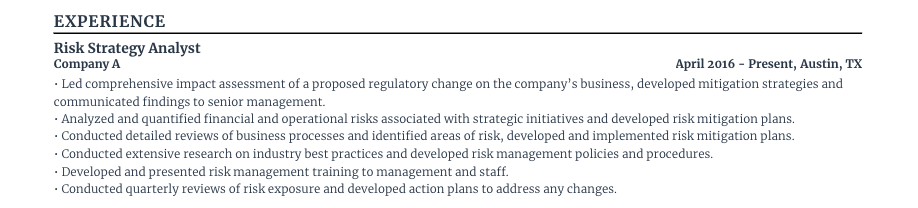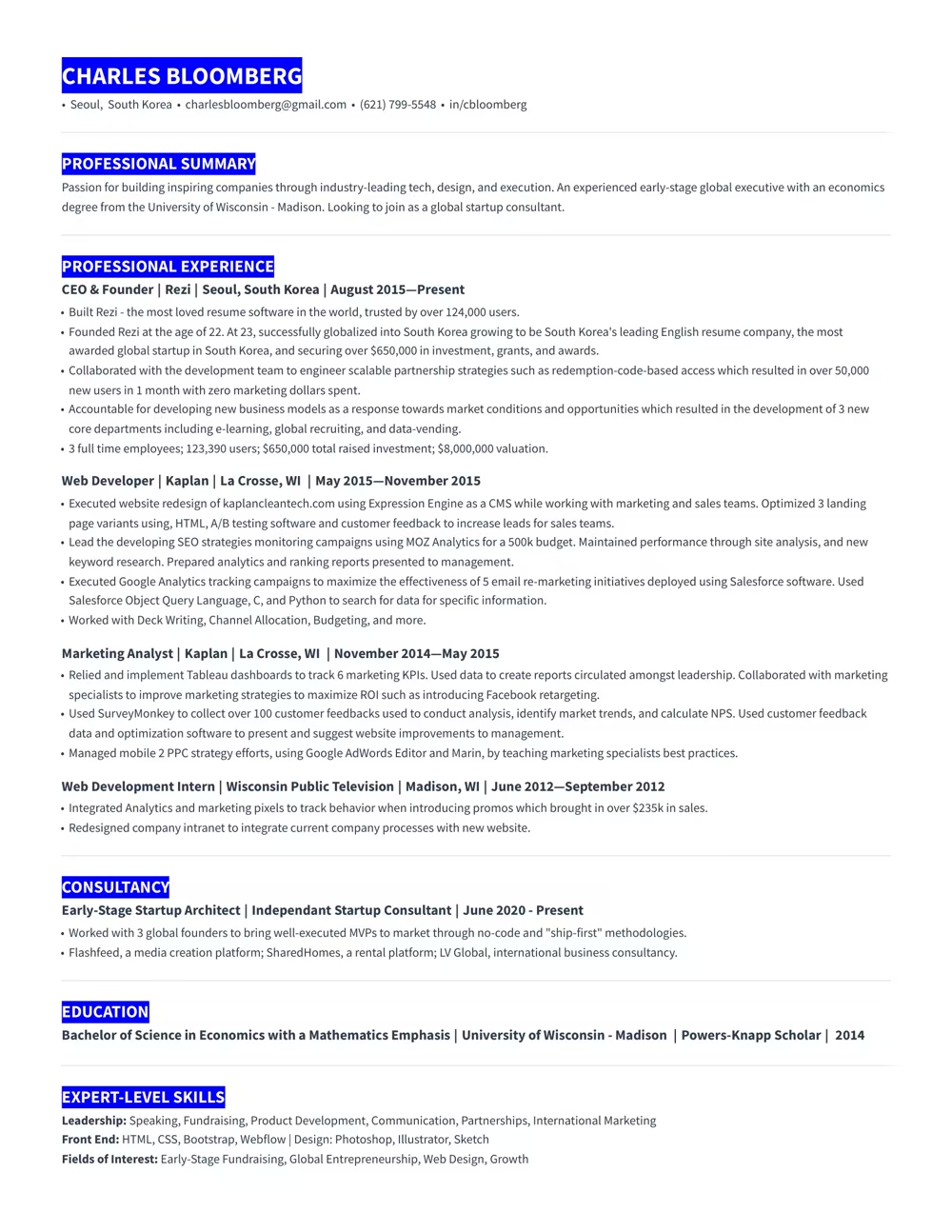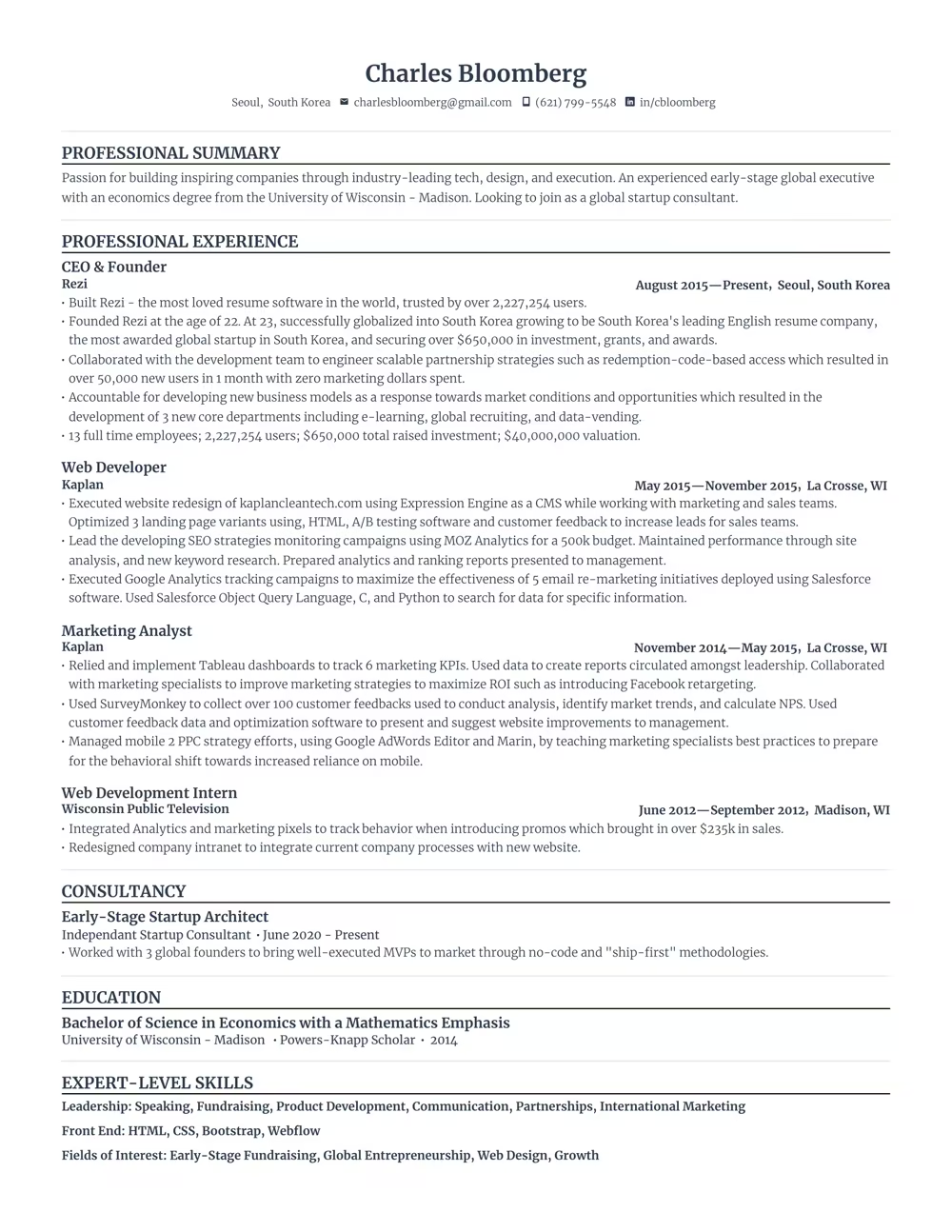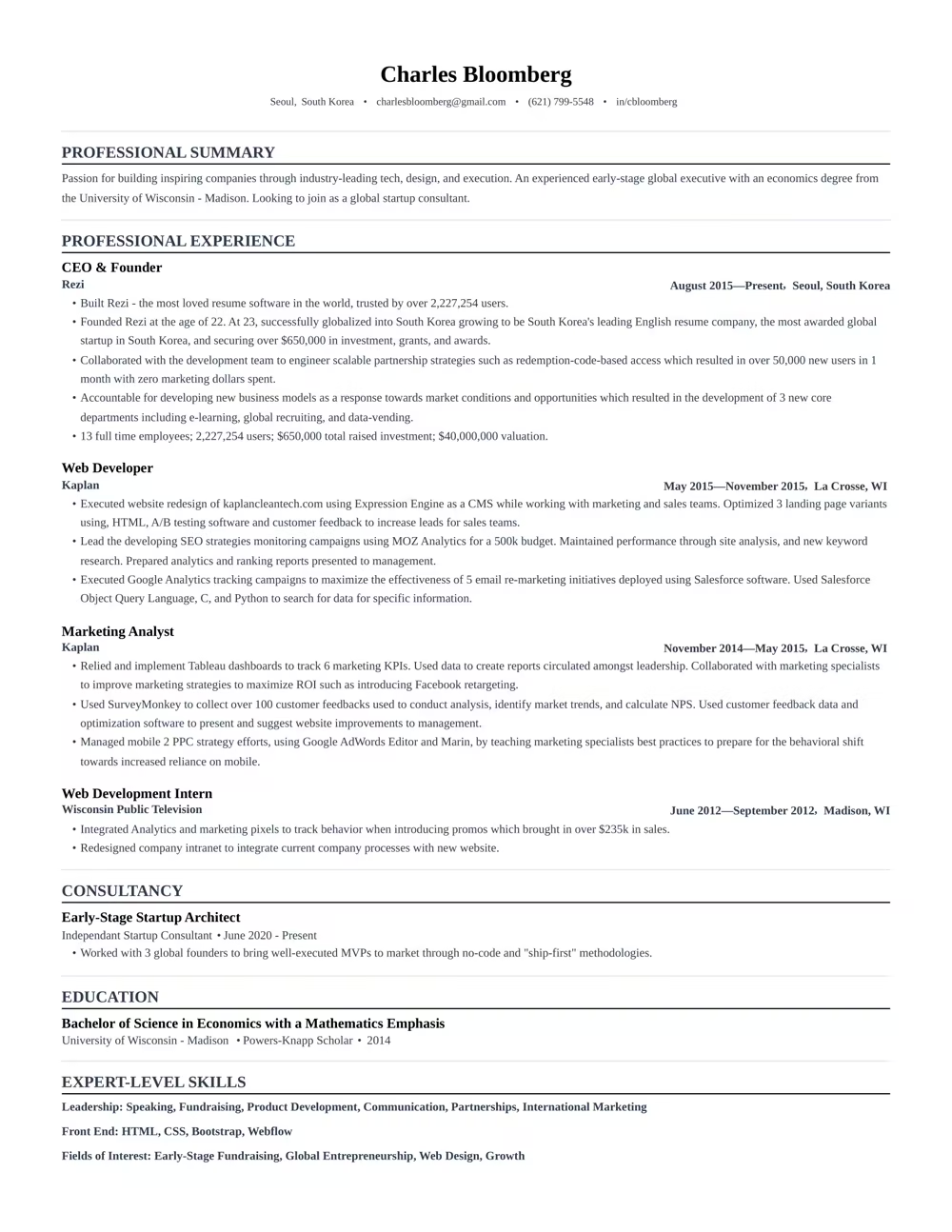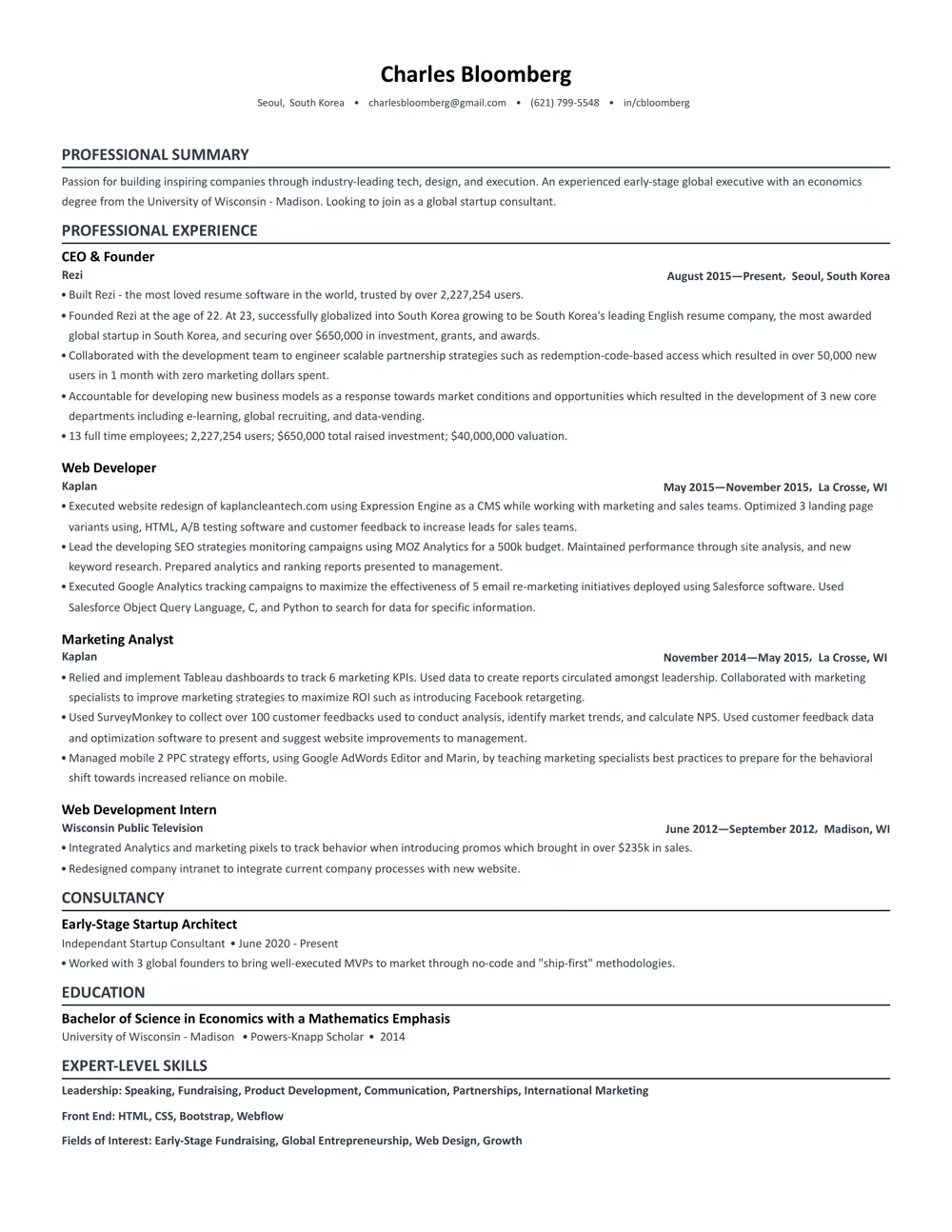
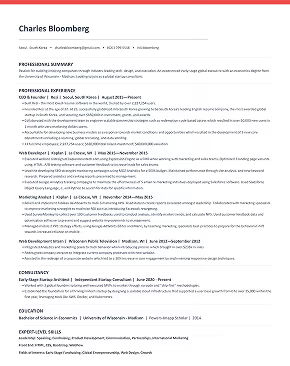

Here's the most common problem I see on risk strategy analyst resumes: they read like generic data analyst resumes with the word "risk" sprinkled in. There's no clear narrative about how you actually identified, quantified, and mitigated risk — or how your strategic recommendations changed business outcomes.
A strong risk strategy analyst resume needs to tell a specific story. It should show how you built risk models, developed policy frameworks, analyzed portfolio performance, and translated complex data into actionable strategies that protected revenue or reduced losses.
And this is exactly what you'll learn from this article. Inside, you'll find:
- Examples of 9+ risk strategy analyst resumes, covering different specializations and seniority levels.
- Insider tips about what really matters to hiring managers recruiting for risk strategy roles.
- A step-by-step guide for building a risk strategy analyst resume that actually gets callbacks.
Sample Risk Strategy Analyst Resumes
Take a look at some top-notch sample resumes for risk strategy analysts across different specializations and experience levels. Find one that matches your profile and use it as a starting point — just make sure to adjust everything to reflect your own career journey and accomplishments.
Note: these examples cover different risk specializations and career stages. Find the one closest to your situation.
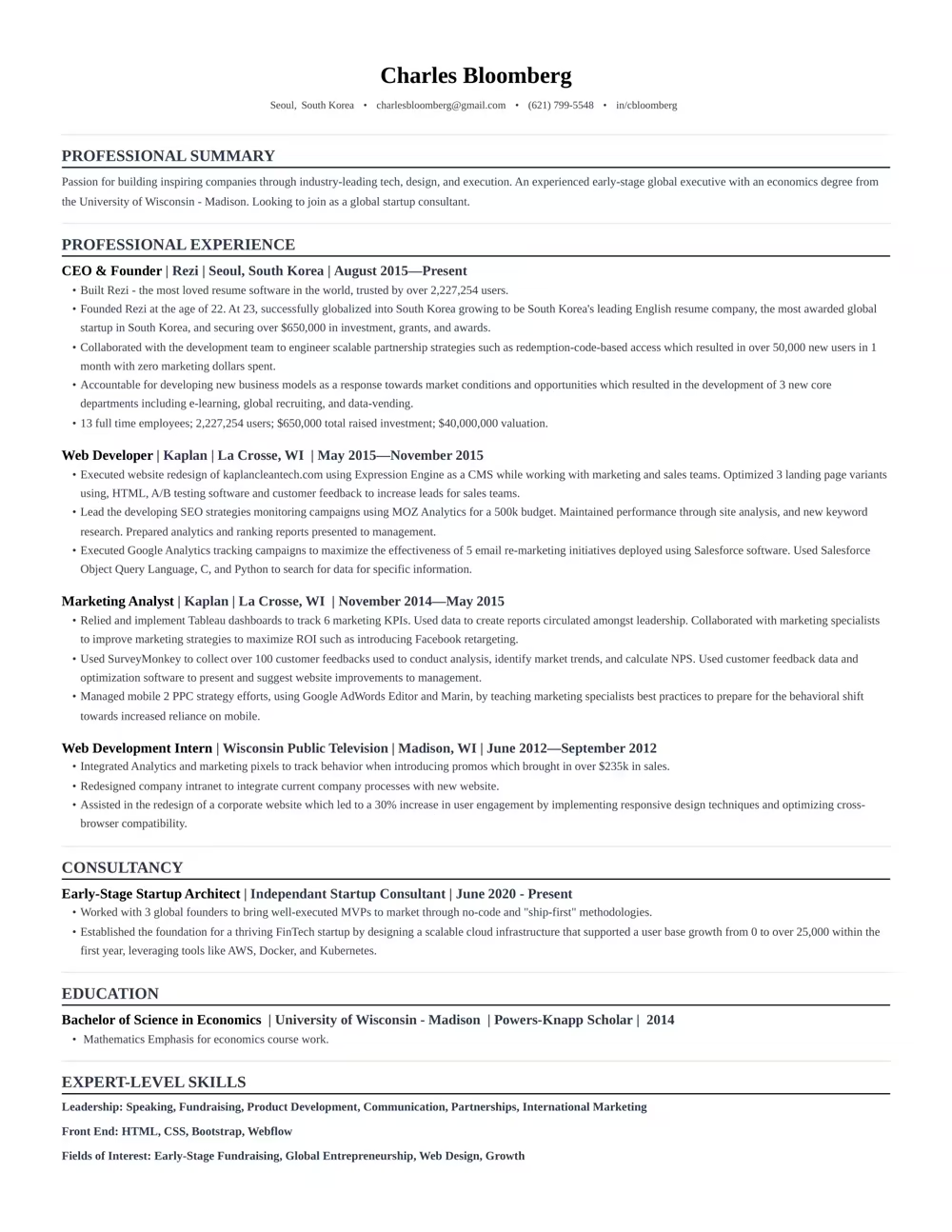
Junior Risk Strategy Analyst Resume
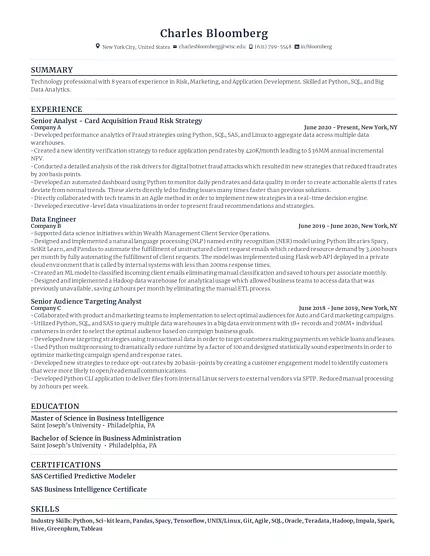
A Junior Risk Strategy Analyst resume should emphasize your educational background, analytical coursework, and any internship or early-career experience with data analysis or risk assessment. Highlight your proficiency in SQL, Excel, and statistical tools. Showcase relevant academic projects, case competitions, or coursework in statistics, finance, or risk modeling that demonstrate your foundational understanding of risk concepts and quantitative reasoning.
Charles Bloomberg
charlesbloomberg@gmail.com
PROFESSIONAL SUMMARY
Detail-oriented Junior Risk Strategy Analyst with a solid grounding in risk management frameworks and quantitative analysis. Proven ability to support strategic initiatives and ensure risk compliance in dynamic environments.
PROFESSIONAL Experience
Junior Risk Strategy Analyst | Company A
March 2022 — Present, Austin, USA
• Collaborated with senior analysts to assess and mitigate risks in a $500 million portfolio, resulting in a risk reduction of 15% within 18 months.
• Conducted detailed quantitative analysis using R and Python, enhancing risk models by 20% in predictive accuracy.
• Developed and implemented risk management procedures across 5 departments, achieving compliance standards and reducing oversight discrepancies by 25%.
• Produced monthly reports using SQL and Tableau, providing actionable insights that informed strategic decision-making for executive management.
• Spearheaded a cross-functional project that integrated risk frameworks with emerging market trends, driving efficiency improvements by 30%.
Risk Management Intern | Company B
June 2021 — February 2022, Austin, USA
• Assisted in creating risk assessment models that improved risk identification accuracy by 20% across multiple business units.
• Monitored real-time data for 10,000+ transactions daily to detect fraud, achieving a 40% increase in detection rate using machine learning algorithms.
• Collaborated with the IT department to enhance data security protocols, minimizing potential breaches by 15% within 6 months.
• Streamlined risk reporting processes by designing automated dashboards, reducing reporting time by 35%.
Business Analyst Intern | Company C
January 2020 — May 2021, Austin, USA
• Conducted market research and analysis that supported strategic planning and risk mitigation efforts, contributing to a 10% revenue growth.
• Formulated risk assessments for client portfolios, identifying key vulnerabilities and proposing actionable strategies.
• Produced detailed reports for stakeholders, synthesizing complex data into comprehensible insights which improved client satisfaction by 25%.
Research Assistant | Company D
June 2018 — December 2019, Austin, USA
• Organized and analyzed large datasets to support research projects, reducing data processing time by 30% through efficient coding practices.
• Contributed to the development of research proposals, leading to a 20% increase in successful grant applications.
• Engaged in qualitative research initiatives to explore industry trends, empowering the team with insightful data-driven conclusions.
Education
Bachelor of Science in Finance | The University of Texas at Austin
May 2018
Expert-Level Skills
Risk Management, Quantitative Analysis, R Programming, Python, SQL, Data Analysis, Machine Learning, Tableau, Risk Mitigation, Strategic Planning, Data Security, Financial Reporting, Communication, Problem Solving
Mid-Level Risk Strategy Analyst Resume
A Mid-Level Risk Strategy Analyst resume should showcase your growing ownership of risk strategies and model development. Emphasize projects where you independently built or refined segmentation strategies, loss forecasting models, or policy rules. Highlight cross-functional collaboration with credit, collections, or product teams and quantify your impact — such as reduction in default rates, improved approval rates, or portfolio loss savings achieved through your recommendations.
Charles Bloomberg
charlesbloomberg@gmail.com
PROFESSIONAL SUMMARY
Mid-Level Risk Strategy Analyst with over 5 years of experience in financial risk assessment and mitigation strategies. Skilled in quantitative analysis and risk modeling to optimize risk management frameworks.
PROFESSIONAL Experience
Mid-Level Risk Strategy Analyst | Company A
January 2022 — Present, Seattle, USA
• Developed and implemented an advanced risk assessment model using Python and R, which improved risk prediction accuracy by 25%.
• Managed a risk analysis team, conducting over 200 risk assessments per quarter, ensuring thorough evaluation of financial portfolios valued at over $500 million.
• Led cross-functional teams to enhance risk management strategies, reducing potential financial exposure by $20 million.
• Collaborated with senior executives to redesign risk mitigation processes, driving a 15% increase in operational efficiency.
• Spearheaded the integration of machine learning algorithms into risk models, increasing predictive power and reducing error margins by 30%.
Risk Strategy Analyst | Company B
March 2019 — December 2021, Seattle, USA
• Engineered a risk analytics framework that accurately identified potential financial discrepancies, decreasing risk instances by 18%.
• Oversaw the analysis of market data trends, providing critical reports that informed risk-based decision-making processes for investments totaling $200 million.
• Implemented risk tracking systems utilizing SQL databases, enhancing data reliability and reducing reporting errors by 12%.
• Assisted in the execution of strategic risk audits, which led to the identification and correction of high-impact variabilities.
Junior Risk Analyst | Company C
May 2015 — February 2019, Tampa, USA
• Analyzed daily financial data using VBA and Excel, enhancing accuracy and efficiency of risk reporting by 20%.
• Contributed to the development of a portfolio risk management system that facilitated a 10% increase in risk-adjusted returns.
• Tracked and processed over 1,000 financial transactions weekly, ensuring compliance with internal risk management practices.
Risk Management Associate | Company D
June 2013 — April 2015, Austin, USA
• Provided comprehensive risk analysis support, contributing to a 15% reduction in unexpected financial losses.
• Researched and formulated risk mitigation strategies for emerging market sectors, improving overall portfolio stability.
• Collaborated with risk management teams to prepare detailed reports on fiscal risk assessments, enhancing understanding of firm-wide risk exposure.
Education
Bachelor of Science in Finance | University of Washington
May 2013
Expert-Level Skills
Risk Assessment, Financial Modeling, Risk Mitigation, Quantitative Analysis, Python, R, SQL, VBA, Risk Management Frameworks, Machine Learning Integration, Team Leadership, Detail-Oriented, Problem Solving, Communication
Senior Risk Strategy Analyst Resume
A Senior Risk Strategy Analyst resume should demonstrate strategic leadership and a track record of driving significant business outcomes. Highlight your experience designing end-to-end risk frameworks, mentoring junior analysts, and presenting recommendations to executive stakeholders. Showcase the scale and complexity of portfolios you've managed, advanced modeling techniques you've deployed, and measurable results like multi-million-dollar loss reductions or optimized risk-return tradeoffs across product lines.
Charles Bloomberg
charlesbloomberg@gmail.com
PROFESSIONAL SUMMARY
Seasoned Senior Risk Strategy Analyst with over a decade of experience in financial risk modeling and strategy development. Proven track record of enhancing risk management frameworks and driving strategic risk initiatives using in-depth analytical methodologies.
PROFESSIONAL Experience
Senior Risk Strategy Analyst | Company A
January 2020 — Present, New York, USA
• Spearheaded the development of risk management frameworks, resulting in a 30% reduction in risk exposure for a portfolio worth over $500 million.
• Analyzed complex market data using Python, R, and SAS to accurately predict risk trends, leading to a 15% increase in predictive accuracy across a 12-month period.
• Led a cross-functional team of 10 analysts to implement a new credit risk monitoring system, enhancing data-driven decision-making processes by 25%.
• Reduced operational risk incidents by 20% through the implementation of a comprehensive risk control assessment protocol across 50 business units.
• Developed strategic recommendations that optimized capital allocation processes, resulting in a 10% increase in capital efficiency within 18 months.
Risk Analyst Lead | Company B
March 2016 — December 2019, Chicago, USA
• Conducted in-depth risk assessments on financial products leading to a 25% decrease in unexpected loss occurrences over two years.
• Managed a team of 8 risk analysts, streamlining risk reporting workflows and improving report delivery times by 40%.
• Collaborated with the IT department to upgrade the risk management system, improving data accuracy and reporting efficiency by 50%.
• Pioneered a risk-awareness training program that increased risk literacy among 200 employees, resulting in a 15% drop in compliance issues.
Junior Risk Analyst | Company C
June 2013 — February 2016, San Francisco, USA
• Conducted quantitative analysis on risk factors for over 100 financial instruments, improving risk prediction models by 10%.
• Assisted in the formulation of risk mitigation strategies that reduced credit default risk by 20% within a year.
• Provided critical insights into market volatility trends, aiding in actionable risk control measures for 30 client portfolios.
Risk Management Intern | Company D
June 2012 — May 2013, Boston, USA
• Supported senior analysts in conducting risk assessments, processing over 200 data sets monthly with 98% accuracy.
• Engineered an Excel-based tool for streamlined risk data entry, reducing data processing times by 20%.
• Conducted research and presented findings on emerging risk factors to senior management, influencing strategic decision-making.
Education
Bachelor of Science in Finance | University of Pennsylvania
May 2012
Expert-Level Skills
Risk Modeling, Financial Analysis, Strategic Risk Management, Predictive Analytics, Credit Risk Assessments, Python, R, SAS, VBA, Data-driven Decision Making, Leadership, Cross-functional Team Collaboration, Problem Solving, Communication Skills
Credit Risk Strategy Analyst Resume
For a Credit Risk Strategy Analyst resume, focus on your experience with credit decisioning, underwriting policy development, and portfolio performance monitoring. Highlight your work with credit scorecards, bureau data, and account management strategies such as line management or re-pricing. Quantify outcomes like delinquency rate reductions, approval rate optimization, or loss mitigation results. Proficiency in SAS, Python, or R for credit modeling is essential to feature prominently.
Charles Bloomberg
charlesbloomberg@gmail.com
PROFESSIONAL SUMMARY
Dynamic Credit Risk Strategy Analyst with extensive experience in credit risk assessment and portfolio management. Proven track record of optimizing credit strategies by leveraging advanced analytical techniques to drive risk mitigation and business growth.
PROFESSIONAL Experience
Credit Risk Strategy Analyst | Company A
February 2021 — Present, Dallas, USA
• Developed and implemented a risk assessment model using Python, reducing average credit loss forecasts by 12% across $4 billion in loan portfolios.
• Led a team to restructure credit evaluation processes, resulting in a 30% reduction in report production time using machine learning algorithms.
• Managed risk analytics for multiple high-value accounts, identified potential default patterns, and mitigated over $2 million in potential losses through timely interventions.
• Analyzed and improved the accuracy of credit scoring techniques, enhancing predictive power by 18% through advanced statistical modeling and data visualization using Tableau.
• Collaborated with cross-functional teams to streamline data integration using SQL, improving data retrieval speed by 25% for critical risk assessment reports.
Credit Risk Analyst | Company B
May 2018 — January 2021, Dallas, USA
• Designed credit risk strategies that resulted in a 15% decrease in non-performing loans across a $750 million portfolio.
• Conducted in-depth risk evaluations and stress testing of the credit portfolio, utilizing R and SAS, improving forecasting accuracy by 10%.
• Spearheaded the transition to a new risk management software, training over 50 team members and reducing operational costs by 20%.
• Successfully communicated risk factors and strategic recommendations to senior management, driving informed decision-making and policy adjustments.
Risk Management Associate | Company C
August 2015 — April 2018, Austin, USA
• Engineered risk assessment frameworks, leading to a refinement of existing models and a 14% increase in accuracy across mid-market credit loans.
• Assisted in quarterly risk evaluation initiatives, categorizing $500 million worth of assets into risk segments using VBA and Excel analytics.
• Developed comprehensive risk mitigation strategies, reducing high-risk credit lines by 8%, strengthening the overall credit profile.
Junior Credit Analyst | Company D
June 2013 — July 2015, Houston, USA
• Handled the review and assessment of 250+ individual credit applications monthly, enhancing approval efficiency by 17%.
• Worked closely with senior analysts to evaluate creditworthiness, thereby identifying early signs of risk and preventing $600k in potential defaults.
• Researched emerging credit trends and compiled risk reports, enhancing department knowledge and strategy refinement.
Education
Bachelor of Science in Finance | University of Texas at Austin
May 2013
Expert-Level Skills
Credit Risk Assessment, Statistical Modeling, Python, SQL, R, SAS, Machine Learning, Data Analysis, Tableau, Risk Mitigation, Portfolio Management, Effective Communication, Team Leadership
Financial Risk Strategy Analyst Resume
A Financial Risk Strategy Analyst resume should highlight your expertise in assessing financial exposures across credit, liquidity, and capital adequacy. Emphasize your experience with stress testing, scenario analysis, and regulatory frameworks like Basel III or CECL. Showcase your ability to translate complex financial risk data into strategic recommendations for senior leadership. Include proficiency in financial modeling tools, VBA, Python, or specialized risk platforms used in your analyses.
Charles Bloomberg
charlesbloomberg@gmail.com
PROFESSIONAL SUMMARY
Dynamic Financial Risk Strategy Analyst with 8+ years of experience in delivering insightful analysis and strategic risk management solutions, leveraging advanced quantitative methods and cross-functional leadership in Fortune 500 settings.
PROFESSIONAL Experience
Financial Risk Strategy Analyst | Company A
March 2020 — Present, New York City, USA
• Developed advanced risk assessment models using Python and R, increasing predictive accuracy by 25% across a $50 billion portfolio.
• Led a team of 5 in optimizing risk management processes, reducing risk exposure by 30% over an 18-month period through innovative use of machine learning algorithms.
• Implemented a financial stress testing framework, ensuring compliance with regulatory requirements like Dodd-Frank, enhancing the bank's resilience to market fluctuations.
• Collaborated with cross-functional teams to design a risk reporting dashboard, reducing reporting time by 40% and enhancing decision-making for senior executives.
• Conducted in-depth analysis of market trends and credit risk metrics, providing actionable insights that mitigated potential losses by $10 million annually.
Risk Management Analyst | Company B
June 2015 — February 2020, Jacksonville, USA
• Implemented a comprehensive risk analysis protocol using SAS, increasing the detection of risk indicators by 35% across diverse asset classes.
• Executed strategic risk mitigation strategies, which resulted in a 20% decrease in operational losses over a 2-year period.
• Spearheaded a project to enhance the efficiency of the risk reporting process, cutting monthly reporting time from 5 days to 3 days.
• Formulated and maintained risk management policies ensuring adherence to SOX compliance, achieving a 100% pass rate in audits over 4 consecutive years.
Financial Analyst | Company C
January 2013 — May 2015, Austin, USA
• Designed financial forecasting models, improving accuracy in predicting quarterly revenues by 15%, instrumental for strategic planning and forecasting initiatives.
• Conducted qualitative and quantitative research to support risk assessments for potential mergers and acquisitions, facilitating informed executive decisions.
• Collaborated with stakeholders to develop risk-adjusted return metrics, aligning investment strategies with company’s risk appetite and growth objectives.
Junior Financial Analyst | Company D
July 2010 — December 2012, Orlando, USA
• Analyzed market data and economic indicators, contributing to risk assessment reports used in strategic investment meetings.
• Assisted in developing risk management training programs, enhancing team knowledge and competency with a 95% satisfaction rate in post-training surveys.
• Provided analytical support in the evaluation of portfolio performance, identifying underperforming assets and recommending strategic adjustments.
Education
Bachelor of Science in Finance | University of California, Berkeley
May 2010
Expert-Level Skills
Risk Assessment, Financial Modeling, Quantitative Analysis, Regulatory Compliance, Python, R, SAS, Stress Testing, Machine Learning, Cross-functional Leadership, Decision Making, Data Analysis, Reporting, Strategic Planning, Teamwork, Communication
Market Risk Analyst Resume
A Market Risk Analyst resume should emphasize your experience measuring and managing exposure to market fluctuations including interest rates, foreign exchange, equities, and commodities. Highlight your proficiency with Value-at-Risk models, sensitivity analysis, and mark-to-market processes. Showcase your understanding of derivatives pricing and hedging strategies. Detail your work with risk reporting systems and your ability to communicate market risk exposures clearly to trading desks and senior risk committees.
Charles Bloomberg
charlesbloomberg@gmail.com
PROFESSIONAL SUMMARY
Detail-oriented Market Risk Analyst with over 8 years of experience utilizing quantitative analysis and financial modeling to assess and mitigate risks. Proven expertise in executing risk management strategies within high-pressure environments.
PROFESSIONAL Experience
Market Risk Analyst | Company A
June 2019 — Present, New York, USA
• Developed and executed risk assessment models using Python and R for over 50 financial instruments, resulting in a 20% improvement in forecasting accuracy.
• Led a team of 5 in designing risk mitigation strategies, reducing potential losses by $10 million within two quarters.
• Implemented a real-time risk reporting system using Tableau, which improved decision-making speed by 30% for senior management.
• Collaborated with cross-functional teams to back-test risk models, achieving a confidence level increase from 95% to 98%.
• Analyzed complex datasets to identify market trends and advised traders, leading to a 15% increase in profit margins.
Risk Management Specialist | Company B
April 2016 — May 2019, Chicago, USA
• Engineered risk management tools using SQL and VBA, facilitating a 30% reduction in data processing time.
• Conducted in-depth risk analysis for a portfolio worth $500 million, ensuring compliance with regulatory standards.
• Enhanced the accuracy of risk models by 25% through rigorous scenario analysis and stress testing.
• Presented quarterly risk assessments to the executive board, effectively communicating complex financial insights.
Junior Market Risk Analyst | Company C
January 2014 — March 2016, Dallas, USA
• Assisted in the development of Monte Carlo simulations to evaluate market risk, resulting in a 10% risk reduction.
• Processed and analyzed daily risk exposure reports for over 100 assets, ensuring accuracy and compliance.
• Collaborated with senior analysts to refine VaR models, achieving a 95% accuracy rate in risk predictions.
Risk Analysis Intern | Company D
June 2013 — December 2013, San Francisco, USA
• Conducted market research and compiled financial reports that contributed to risk modeling improvement by 15%.
• Supported the lead analyst in performing hedge effectiveness tests, producing bi-weekly risk summary reports.
• Aided in developing data visualization dashboards in Excel for easier interpretation of complex datasets.
Education
Bachelor of Science in Finance | University of California, Berkeley
May 2013
Expert-Level Skills
Risk Assessment, Financial Modeling, Python, R, SQL, VBA, Tableau, Monte Carlo Simulation, VaR, Data Analysis, Cross-functional Collaboration, Communication, Leadership
Operational Risk Analyst Resume
An Operational Risk Analyst resume should showcase your experience identifying, assessing, and mitigating risks stemming from internal processes, systems, and human error. Highlight your work with risk and control self-assessments (RCSAs), loss event tracking, and key risk indicators. Emphasize your role in developing risk mitigation plans and ensuring regulatory compliance. Experience with frameworks like Basel II/III operational risk requirements and tools for incident management will strengthen your resume.
Charles Bloomberg
charlesbloomberg@gmail.com
PROFESSIONAL SUMMARY
Detail-oriented Operational Risk Analyst with over 8 years of experience in risk assessment, mitigation strategies, and regulatory compliance. Proven expertise in improving organizational risk frameworks through data-driven insights and strategic planning.
PROFESSIONAL Experience
Operational Risk Analyst | Company A
January 2019 — Present, New York, USA
• Conducted over 50 comprehensive risk assessments annually, utilizing qualitative and quantitative analysis, resulting in a 25% reduction in operational losses.
• Implemented and managed the enterprise risk management system, increasing efficiency in processing risk reports from 5 days to 2 days.
• Developed strategic mitigation plans for high-risk activities, collaborating with cross-functional teams, which led to a 30% decrease in annual financial irregularities.
• Spearheaded the integration of risk indicators into business operations, enhancing early warning systems and reducing incident reporting time by 40%.
• Provided ongoing training sessions for 100+ staff members, improving risk awareness and compliance adherence by 20% across the organization.
Risk Management Associate | Company B
June 2016 — December 2018, Chicago, USA
• Assisted in the development of a new risk assessment process which improved identification accuracy by 30% and reduced assessment time by 15%.
• Analyzed risk data for over 200 business units, providing actionable insights that enhanced decision-making processes and mitigated potential losses.
• Monitored regulatory changes daily, ensuring the company remained compliant with SEC and CFTC regulations, thus avoiding non-compliance penalties.
• Collaborated with IT to design a risk dashboard that increased data visualization clarity, leading to faster risk identification and response.
Junior Risk Analyst | Company C
March 2014 — May 2016, Miami, USA
• Analyzed financial and operational data from over 150 client projects, contributing to the team’s ability to preemptively identify and mitigate risks.
• Built and maintained a comprehensive risk database which increased the accessibility and accuracy of historical risk information by 40%.
• Provided analytical support for quarterly risk assessments, enhancing the precision of risk forecasting by utilizing advanced statistical techniques.
Risk Assessment Intern | Company D
June 2013 — February 2014, San Diego, USA
• Assisted senior analysts in conducting weekly data validation checks, ensuring data integrity with an accuracy improvement of 95%.
• Conducted research on industry risk trends, contributing insights to the development of monthly client risk reports.
• Supported the creation of risk training modules, facilitating increased understanding of risk processes and policies among junior staff.
Education
Bachelor of Science in Finance | University of California, Berkeley
May 2013
Expert-Level Skills
Risk Assessment, Regulatory Compliance, Risk Mitigation Strategies, Data Analysis, Risk Management Frameworks, Financial Modeling, Statistical Analysis, Cross-Functional Collaboration, Risk Reporting, Attention to Detail, Problem Solving
Enterprise Risk Analyst Resume
For an Enterprise Risk Analyst resume, emphasize your ability to take a holistic view of risk across an entire organization. Highlight experience with enterprise risk management (ERM) frameworks, risk appetite statements, and cross-functional risk aggregation. Showcase your skills in risk reporting to board-level audiences and your work integrating multiple risk types — credit, market, operational, strategic — into a unified view that informs organizational decision-making and capital allocation.
Charles Bloomberg
charlesbloomberg@gmail.com
PROFESSIONAL SUMMARY
Detail-oriented Enterprise Risk Analyst with a proven record of implementing advanced risk management frameworks and reducing operational risk across multi-million dollar projects. Expertise in data analysis and regulatory compliance.
PROFESSIONAL Experience
Enterprise Risk Analyst | Company A
April 2021 — Present, Phoenix, USA
• Developed and implemented risk assessment frameworks that reduced operational risk by 30% across $500M projects using risk management tools and methodologies.
• Conducted over 200 risk evaluations annually, analyzing data sets to identify and mitigate risks using SQL and Power BI, ensuring regulatory compliance with industry standards.
• Collaborated with cross-functional teams to integrate risk management practices into business processes, resulting in a 20% improvement in risk response times.
• Led a team of 5 risk analysts in executing over 50 risk audits in a year, enhancing efficiency and reducing audit discrepancies by 15%.
• Created comprehensive risk reports and dashboards for senior management using Tableau, providing insights on potential risks and mitigation strategies.
Senior Risk Analyst | Company B
January 2018 — March 2021, Charlotte, USA
• Spearheaded the design and implementation of a risk monitoring system that improved risk detection capabilities by 25% company-wide.
• Managed a portfolio of $300M in assets, conducting risk analysis and ensuring compliance with financial regulations, improving asset quality by 10%.
• Engineered over 150 policy and procedure reviews annually, effectively addressing risk gaps and ensuring alignment with regulatory requirements.
• Drove risk management strategy sessions that enhanced risk communication clarity and reduced reporting errors by 20%.
Risk Analyst | Company C
June 2014 — December 2017, Cleveland, USA
• Researched and analyzed market trends to identify potential external risks, providing actionable insights that improved risk preparedness by 15%.
• Implemented a risk identification and assessment model that accelerated risk analysis processes by 30%.
• Assisted in developing over 40 training programs on risk policies and procedures, resulting in increased awareness and a 25% decrease in risk incidents.
Junior Risk Analyst | Company D
August 2012 — May 2014, Denver, USA
• Conducted quantitative risk assessments for client portfolios, enhancing risk identification accuracy by 12%.
• Formulated risk mitigation strategies through detailed data analysis and stakeholder engagement, reducing client risk exposure by 18%.
• Collaborated with risk management team to optimize reporting tools, achieving a 15% improvement in data visualization effectiveness.
Education
Bachelor of Science in Finance | University of Arizona
May 2012
Expert-Level Skills
Risk assessment, Regulatory compliance, Data analysis, SQL, Power BI, Tableau, Risk management frameworks, Cross-functional collaboration, Audit management, Risk reporting, Analytical thinking, Problem-solving, Communication
Risk Management Analyst Resume
A Risk Management Analyst resume should highlight your experience supporting the broader risk management lifecycle — from identification and assessment through monitoring and reporting. Emphasize your work maintaining risk registers, conducting risk assessments, and supporting audit or compliance functions. Show proficiency in risk management software, data visualization tools, and your ability to collaborate across departments to implement risk controls and improve organizational resilience.
Charles Bloomberg
charlesbloomberg@gmail.com
PROFESSIONAL SUMMARY
Detail-oriented Risk Management Analyst with over 7 years of experience in identifying, assessing, and mitigating risks to enhance organizational security and compliance. Proven track record in utilizing data-driven insights to improve risk processes and lower financial exposures.
PROFESSIONAL Experience
Risk Management Analyst | Company A
May 2020 — Present, Seattle, WA, USA
• Analyzed risk assessments for over 1000 corporate projects annually, ensuring a 30% reduction in potential exposure using advanced statistical models like Monte Carlo simulations.
• Implemented compliance procedures and protocols leading to a 25% decrease in policy violations across multiple departments within a year.
• Developed comprehensive risk management frameworks using AWS data warehousing solutions, improving risk identification and response times by 35%.
• Collaborated with cross-functional teams to design and execute risk mitigation strategies for 5 major projects, resulting in a 20% increase in process efficiency.
• Conducted bi-weekly risk analysis workshops utilizing Tableau for visual risk reports to assist senior management in decision-making processes.
Risk Management Associate | Company B
January 2017 — May 2020, New York, NY, USA
• Assisted in the assessment and prioritization of over 150 corporate risk categories annually, utilizing industry-standard risk assessment tools like RSA Archer.
• Spearheaded the development of an automated risk reporting system, reducing report generation time by 40% and improving accuracy.
• Conducted in-depth quantitative and qualitative analyses of risk data, contributing to a 15% reduction in annual financial loss.
• Developed and delivered training programs for 200+ employees on risk identification and reporting, enhancing awareness and compliance by 50%.
Risk Analyst Intern | Company C
June 2015 — December 2016, Houston, TX, USA
• Researched and analyzed market trends and risk factors to support the risk management team in 10+ client consultations per month.
• Assisted in the preparation of risk assessment reports, contributing to a 10% increase in risk evaluation efficiency through data consolidation and analysis.
• Contributed to the development of risk management strategies, resulting in a 5% risk reduction across selected investment portfolios.
Junior Risk Analyst | Company D
July 2013 — June 2015, Denver, CO, USA
• Conducted financial risk analysis and data collection for small to medium-sized enterprises, resulting in a 15% increase in client satisfaction ratings.
• Monitored daily risk metrics and reported irregularities within a 24-hour window, aiding in prompt risk mitigation measures.
• Assisted senior analysts in modeling and simulation of risk scenarios, improving project risk evaluations by 20%.
Education
Bachelor of Science in Finance | University of Wisconsin-Madison
May 2013
Expert-Level Skills
Risk Assessment, Monte Carlo Simulation, Compliance Management, Data Analysis, Risk Mitigation Strategies, Tableau, AWS, RSA Archer, Quantitative Analysis, Process Improvement, Cross-functional Collaboration, Analytical Thinking, Communication, Problem Solving
How to Write a Risk Strategy Analyst Resume
Short answer:
Focus on your analytical skills, risk modeling expertise, and the measurable business impact of your strategic recommendations. Create a professional header with your name and contact details. Right below, write a 2–3 sentence resume summary highlighting your most significant accomplishments. Describe your work history in reverse-chronological order, emphasizing risk strategies you developed and their outcomes. Then, cover your education including relevant certifications, list key technical and soft skills, and add extra sections such as publications, professional memberships, or relevant projects.
Include all the necessary sections in the correct order
Here's the correct order of sections for most risk strategy analyst resumes:
- Header with contact information
- Resume summary or objective
- Work experience
- Education
- Skills
- Certifications
Depending on your current career situation, you can also throw in some additional sections. For instance:
- Key projects (especially if you've built notable risk models or frameworks)
- Publications or research
- Professional associations
- Conference presentations
- Volunteer experience
Include everything that demonstrates your ability to analyze risk and develop strategies that drive business decisions. If a section doesn't clearly highlight your analytical capabilities or domain expertise, it doesn't belong on your resume.
If you have less than five years of relevant experience, keep your resume 1-page long. For more senior risk strategy analysts, a two-page resume is fine.
More details here: What Sections to Include on Your Resume?
Now, I'll give you a high-level overview of how to write each section, going from top to bottom. Well… almost. The only exception is the resume summary section. While it comes right after your contact info, it's actually easier to write it last. More on that in a sec.
Create a professional resume header
- Start with your name and contact information. Include the basics: your full name, phone number, professional email address, location, and LinkedIn profile. A link to a GitHub profile or personal portfolio showcasing risk models or analytical projects can also add credibility.
- Right below your name, clearly state your professional title (e.g., Senior Risk Strategy Analyst). This immediately tells the reader what kind of role you're targeting.
For more information, see: How to Create a Resume Header
Describe your work history
- Use reverse-chronological order. List your positions starting with the current or most recent one.
- In each entry, include your job title, company name, location, and dates of employment.
- Below each position, write 3–7 bullet points — the more recent the position, the more bullet points you should include. Describe your responsibilities and, more importantly, your accomplishments.
- Use action verbs and quantify your achievements (e.g., "Developed credit line management strategy that reduced charge-off rates by 18% across a $500M portfolio").
- If specific risk methodologies, models, or regulatory frameworks were central to your roles (e.g., logistic regression, CECL, Basel III), weave these details into your descriptions. This will also help you pass ATS scans.
Learn more about the best practices of this section with our detailed guide on how to describe your work experience on a resume.
List your degrees and detail professional learning
- In the education section, list your highest degree first, including the degree type, major, and institution. Degrees in finance, economics, statistics, mathematics, or data science are particularly relevant.
- If you have some relevant work experience, include only the name of your school and the degree you got. If you're an entry-level candidate, you can add more detail — list relevant coursework in risk management, econometrics, or machine learning, along with academic achievements.
- If you have risk-related certifications (e.g., FRM, PRM, CFA), either include them in an "Education and Certifications" section, or create a separate "Certifications" section and place it right below.
For an in-depth guide on how to describe your education on a resume, see: How to List Education on a Resume
List your most relevant skills in the skills section
- Include a mix of technical skills (e.g., programming languages, statistical tools, risk platforms) and domain-specific knowledge (e.g., credit risk, regulatory compliance) that you are proficient in.
- Add some soft skills such as stakeholder communication, problem-solving, and attention to detail. These demonstrate your ability to translate analytical findings into business recommendations.
- You can use two separate subsections — one for hard skills, one for soft skills — or just list everything under one heading.
- Match your skills to the description of the job you're applying for. Don't just dump every skill from the job listing onto your resume (especially if you don't actually have them), but highlight areas where your expertise overlaps with the job requirements.
Need some inspiration to get started? Here are some good skills to feature on your risk strategy analyst resume.
Technical & analytical skills for risk strategy analyst resumes:
- SQL
- Python
- R
- SAS
- Excel (advanced, including VBA)
- Tableau / Power BI
- MATLAB
- Hadoop / Spark (big data)
- Bloomberg Terminal
- Moody's Analytics / RiskCalc
Risk frameworks & methodologies:
- Logistic regression & scorecard development
- Value-at-Risk (VaR)
- Stress testing & scenario analysis
- CECL / IFRS 9
- Basel II / Basel III
- Monte Carlo simulation
- Decision tree & segmentation analysis
- Loss forecasting
- Champion-challenger testing
- Enterprise Risk Management (ERM)
Key soft skills for risk strategy analysts:
- Analytical thinking
- Stakeholder communication
- Problem-solving
- Attention to detail
- Cross-functional collaboration
- Strategic thinking
- Presentation skills
- Adaptability
- Intellectual curiosity
- Business acumen
For a full-blown guide on listing skills on a resume, visit: How to Put Skills on a Resume
Use additional sections as further proof of your fit
Additional sections add depth to your resume and back up your claimed expertise. Good examples of extra sections to add to a risk strategy analyst resume are:
- Professional associations. Membership in organizations like GARP (Global Association of Risk Professionals) or PRMIA can demonstrate your commitment to the field.
- Key projects. A resume section dedicated to significant projects — like building a new credit scorecard, designing a fraud detection framework, or leading a stress testing initiative — can provide concrete proof of your expertise.
- Publications & research. If you've authored white papers, contributed to risk journals, or published analytical findings, list them in a separate section.
- Conference presentations. Presenting at industry events like GARP's annual convention or RiskMinds signals thought leadership. If you're early in your career, listing conferences you've attended still shows initiative.
Highlight the most relevant information in a resume summary
Once you're done writing your risk strategy analyst resume, give it a full read. Pick the most relevant information and compile it into a summary paragraph. Place it right under the resume header.
- Be brief and to-the-point. In 3–4 sentences, sum up your career highlights, core competencies, and what you bring to the table. Consider this your chance to answer, "Why should you hire me?" Tailor this section to match the employer's needs outlined in the job description.
- Use value-oriented language. Focus on how you can add value to the potential employer, mentioning specific outcomes like loss reductions, model performance improvements, or policy optimizations you've achieved in the past.
Once you've completed the core sections of your resume, you can use Rezi AI Resume Summary Generator to automatically create a powerful summary, tailored to the job you're applying for. All you need to do is add the position and skills you want to highlight. The AI writer will do the rest.
More information here: How to Write a Job-Winning Resume Summary (with Examples)
For finishing touches, make sure your resume looks professional
- Use a clean and tidy resume format. Ensure your risk strategy analyst resume is easily readable, with a professional font, consistent formatting, and clear section headings. Avoid overloading it with dense text or fancy design elements that could distract from the content and confuse resume screening software.
- Aim for a balance between detail and conciseness. If you're a junior or entry-level candidate, keep your resume to a single page. Experienced risk strategy analysts can extend their resumes to two pages, but still need to make sure every word conveys value.
Learn more about proper resume formatting here: How to Format a Resume & What Standard Resume Format to Use
What Makes Risk Strategy Analyst Resumes Different
In short: the intersection of quantitative rigor and strategic business impact.
This is also where many risk strategy analysts stumble. Hiring managers don't want to see a resume that's just a list of tools you've used or datasets you've touched. They need to see how your analysis directly influenced risk decisions — and what happened to the portfolio as a result.
Focus on quantified business impact
Risk strategy is one of those fields where every recommendation you make should be traceable to a business outcome. Vague statements about "analyzing data" or "supporting risk initiatives" won't cut it.
What it means for you:
- Quantify the impact of your strategies wherever possible. Think: percentage reduction in loss rates, dollar value of portfolio managed, approval rate lift achieved, or reduction in false positive rates for fraud models.
- Mention the scale of portfolios you worked with — including portfolio size, number of accounts, and the type of risk (credit, market, operational). Scope signals seniority and trustworthiness.
Focus on your analytical methodology
Risk strategy roles are deeply technical. Hiring managers want to understand how you arrived at your recommendations — not just what the outcomes were. Your methodology matters as much as your results.
What this means for you:
- Describe the models and techniques you used — logistic regression, decision trees, champion-challenger tests, segmentation strategies, or simulation methods. Be specific.
- Mention the tools and languages you used (SAS, Python, SQL, R, Tableau) within the context of actual projects. Don't just list them in your skills section — weave them into your experience bullets so reviewers can see how you applied them.
Focus on the strategy, not just the analysis
This is the word many candidates overlook in the job title: strategy. You're not just a data cruncher. You're someone who turns data into decisions. Your resume needs to reflect that.
What this means for you:
- Show that you didn't just build models — you recommended actions, influenced policy changes, or designed new decision frameworks based on your analysis.
- Highlight collaboration with cross-functional teams (credit policy, collections, product, compliance) to demonstrate that your work extended beyond your desk and into real business strategy.
Focus on regulatory and industry awareness
Risk strategy doesn't happen in a vacuum. It sits at the intersection of business objectives and regulatory requirements. Demonstrating that you understand the regulatory landscape sets you apart from generic analyst candidates.
What this means for you:
- Reference specific regulatory frameworks you've worked within — Basel III, CECL, IFRS 9, Dodd-Frank, OCC guidance, or fair lending requirements.
- If you've supported regulatory exams, internal audits, or model validation processes, mention it. This signals maturity and reliability to hiring managers in regulated industries.
Focus on career progression
No worries if you're just starting out, but if you have meaningful experience, your resume should clearly show your growth from executing analyses to owning strategies.
What this means for you:
- Highlight transitions from support roles (data analyst, junior analyst) to strategy ownership positions where you designed risk policies or led model development.
- Show how the complexity and scope of your work expanded over time — from running reports to building models to influencing portfolio-level decisions.
Bonus Resources for Risk Strategy Analysts
This isn't going to be a game-changer if you need a resume right now. But —
I want you to think about your career as a long game. These resources will help you sharpen your risk strategy skills, add more substance to future resumes, and keep you current with industry developments.
Professional associations and networks
GARP is the leading professional organization for risk managers worldwide. It offers the FRM (Financial Risk Manager) certification, hosts conferences, and provides extensive research and educational resources across all risk disciplines.
PRMIA offers the PRM certification, local chapter events, webinars, and a global network of risk professionals. It's a strong community for networking and staying current with risk management best practices.
RIMS focuses on enterprise risk management and provides resources, certifications, conferences, and a professional community for risk practitioners across industries.
Online learning platforms
Both platforms offer risk management, financial engineering, and data science courses developed by top universities. Look for programs from NYU, Columbia, MIT, or the University of Michigan covering credit risk, quantitative finance, and machine learning for risk.
With a focus on professional development, LinkedIn Learning provides courses on risk analysis, financial modeling, SQL, Python for finance, and data visualization — all directly applicable to risk strategy roles.
DataCamp offers hands-on courses in Python, R, SQL, and machine learning with finance-specific tracks. It's particularly useful for risk analysts looking to strengthen their programming and modeling skills through interactive exercises.
Publications
The go-to publication for risk professionals, covering quantitative finance, regulatory developments, credit risk, market risk, and operational risk with in-depth analysis and research.
GARP's editorial arm provides articles, interviews, and research on current risk management trends, regulatory changes, and emerging risks — essential reading for anyone in risk strategy.
A peer-reviewed journal focused specifically on credit risk modeling, measurement, and management. Ideal for credit risk strategy analysts looking to stay current with academic and practitioner research.
Tools and software reviews
Both websites provide extensive reviews and comparisons of risk management software and analytics platforms, helping you evaluate tools based on features, pricing, and user feedback from risk professionals.
While primarily a data science community, Kaggle offers datasets and competitions related to credit risk, fraud detection, and financial modeling. It's a great way to practice your skills and build portfolio pieces that strengthen your resume.
Summary
Here's what you need to know about writing a risk strategy analyst resume:
- Structure your resume with essential sections in this order: Header, Resume Summary or Objective, Work Experience, Education, Skills, and Certifications. Add extra sections like Key Projects or Professional Associations when they strengthen your candidacy.
- Include a professional header with your name, contact information, and professional title (e.g., Risk Strategy Analyst, Credit Risk Analyst).
- Describe your work history in reverse-chronological order, emphasizing risk strategies you developed and their measurable business impact.
- In the education section, list your highest degree first. List risk-related certifications (FRM, PRM, CFA) either in the education section or under a separate heading.
- Highlight a mix of technical skills (Python, SQL, SAS), risk methodologies (VaR, stress testing, scorecard development), and soft skills, tailoring them to the job description.
- Use additional sections to further showcase your expertise — key projects, publications, and professional memberships all signal depth.
- Once done writing the resume, compile the key information into a brief, value-oriented resume summary at the top.
- Keep your resume clean and professional. One page for junior analysts, two pages maximum for experienced professionals.
- Emphasize the strategy behind your analysis — show that you don't just crunch numbers, you drive decisions.
- Demonstrate awareness of the regulatory landscape relevant to your industry and risk domain.
Thanks for reading! Got any questions? Feel free to reach out to me on LinkedIn. (Or check out the FAQs first — your question might already be answered there.)
FAQ
What keywords should I use on my risk strategy analyst resume?
Use specific risk terminology and tools relevant to your experience, such as credit risk modeling, loss forecasting, segmentation strategy, champion-challenger testing, logistic regression, SQL, Python, SAS, and regulatory frameworks like Basel III or CECL. Include certifications like FRM, PRM, or CFA if you hold them. Mirror the language used in the job posting to improve your ATS match rate.
How do I tailor my risk strategy analyst resume to a specific job description?
Identify the key risk domain (credit, market, operational), tools, and regulatory requirements mentioned in the job description. Then align your bullet points to reflect matching experience. If the posting emphasizes credit loss forecasting and you've done that work, lead with it. Use similar language and phrases to describe your skills and achievements.
What's the most common mistake on risk strategy analyst resumes?
Being too vague about outcomes. Saying you "analyzed risk data" or "supported risk strategies" tells a hiring manager almost nothing. Instead, be specific: "Built segmentation model that reduced 30+ DPD roll rates by 12% across a $300M auto loan portfolio." Numbers and context are what make a risk resume compelling.
I'm transitioning from a data analyst or general finance role into risk strategy. How should I approach my resume?
Focus on transferable skills like statistical modeling, SQL/Python proficiency, data-driven decision-making, and stakeholder communication. Reframe past experiences through a risk lens — if you built predictive models, forecasted financial metrics, or analyzed customer behavior, those skills translate directly. Include any risk-related coursework, certifications (even in-progress, like FRM), or self-directed projects to show commitment.
Should I include my GPA on a risk strategy analyst resume?
Only if you're a recent graduate (within 1–2 years of finishing your degree) and your GPA is above 3.5. For quantitative fields like risk strategy, a strong GPA in statistics, mathematics, economics, or finance can signal analytical horsepower. Once you have a couple of years of professional experience, your work accomplishments should replace your GPA as proof of competence.
How technical should my resume be if I'm applying to a non-bank or fintech?
Fintechs often expect even more technical depth than traditional banks. Don't shy away from mentioning Python libraries (scikit-learn, pandas), machine learning techniques, or big data tools (Spark, Hadoop) if you've used them. That said, still frame everything around business impact. Fintechs care about moving fast and driving results — show you can do both.
Is the FRM certification necessary for a risk strategy analyst role?
It's not strictly required, but it's increasingly expected — especially at mid-to-senior levels and in financial services. The FRM signals a strong foundation in risk concepts and commitment to the profession. If you don't have it yet, listing it as "in progress" still adds value. For credit-heavy roles, practical modeling experience sometimes carries more weight than the certification itself.