
Here's the most common problem I see with science resumes: they read like a laundry list of lab techniques and coursework, but they fail to communicate what you actually discovered, built, or proved. Hiring managers in science don't just want to know you can run an HPLC or code in Python — they want to see the questions you asked, the experiments you designed, and the results that mattered.
To create a compelling science resume, you need to tell a story that connects your technical expertise to real outcomes: publications, grants secured, problems solved, data that changed a project's direction, or discoveries that moved the needle.
And this is exactly what you'll learn from this article. Inside, you'll find:
- Examples of 9 science resumes, covering different specializations and career stages.
- Insider tips about what really matters to hiring managers and PIs reviewing science resumes.
- A step-by-step guide for putting together a science resume that actually lands interviews.
Sample Science Resumes
Take a look at some top-notch sample resumes for scientists across different specializations. Find one that matches your profile and use it as a reference point (or feel free to steal it — just make sure to adjust the wording to reflect your own research and career journey).
Research Scientist Resume
A Research Scientist resume should foreground your ability to design and execute independent research. Highlight your publication record, grants you've contributed to or secured, and specific research methodologies you've mastered. Quantify outcomes wherever possible — number of experiments conducted, datasets analyzed, or findings that led to new research directions. Showcase your expertise in experimental design, statistical analysis, and peer-reviewed writing.
Charles Bloomberg
charlesbloomberg@gmail.com
PROFESSIONAL SUMMARY
Experienced Research Scientist with a robust background in molecular biology and data analysis, fostering innovation through advanced research methodologies.
PROFESSIONAL Experience
Research Scientist | Company A
March 2022 — Present, Dallas, USA
• Spearheaded research projects that increased understanding of gene expression, leading to 3 new publications in top-tier journals within 18 months.
• Developed innovative data analysis pipelines using Python and R, reducing data processing time by 40% across multiple projects.
• Supervised a team of 8 junior researchers in laboratory techniques, enhancing team productivity by 25% and ensuring adherence to safety regulations.
• Collaborated on interdisciplinary projects, employing CRISPR-Cas9 technology to successfully identify 5 new genetic markers of disease.
• Secured $1.5 million in research funding through innovative grant proposals and presentations to stakeholders.
Research Associate | Company B
September 2018 — February 2022, Cambridge, USA
• Managed research studies focused on drug discovery, contributing to the identification of 2 novel drug targets.
• Optimized experimental protocols that improved lab efficiency by 30% and enhanced the accuracy of results.
• Implemented robust data management systems using SQL, ensuring data integrity and facilitating seamless access for team members.
• Collaborated with academic partners and co-authored 4 research papers, increasing institutional collaboration by 50%.
Junior Research Scientist | Company C
May 2015 — August 2018, Boston, USA
• Assisted in the development of high-throughput screening assays, increasing the lab's throughput by 200%.
• Contributed to the successful completion of a research project that led to a patented biotechnology product.
• Conducted systematic literature reviews, synthesizing information that informed 5 experimental research designs.
Research Assistant | Company D
June 2013 — April 2015, New York, USA
• Conducted detailed data analysis using MATLAB, resulting in a 15% improvement in data interpretation accuracy across projects.
• Provided technical support in laboratory operations, maintaining equipment to reduce downtime by 10%.
• Organized and facilitated weekly research seminars, enhancing knowledge exchange and increasing attendance by 20%.
Education
Ph.D. in Molecular Biology | Harvard University
May 2013
Expert-Level Skills
Molecular Biology, Bioinformatics, Data Analysis, CRISPR, Python, R, SQL, High-Throughput Screening, Grant Writing, Team Leadership, Collaboration, Communication, Problem Solving
Laboratory Scientist Resume
For a Laboratory Scientist, your resume should emphasize hands-on technical proficiency and precision. Detail the instruments, assays, and protocols you're experienced with, and highlight your role in maintaining quality control and regulatory compliance. Showcase your ability to troubleshoot equipment, optimize procedures, and deliver accurate, reproducible results. Certifications like ASCP or experience with GLP/GMP standards strengthen your candidacy significantly.
Charles Bloomberg
charlesbloomberg@gmail.com
PROFESSIONAL SUMMARY
Results-oriented Laboratory Scientist with over 10 years of experience in biochemical analysis and molecular research. Adept at managing complex experiments, ensuring compliance with industry standards, and leveraging advanced lab technologies.
PROFESSIONAL Experience
Lead Laboratory Scientist | Company A
January 2020 — Present, San Francisco, USA
• Oversaw over 200 biochemical assays monthly, improving accuracy by 15% through innovative protocol optimization.
• Led a team of 8 scientists in the development and validation of molecular diagnostic tools, achieving a 20% enhancement in detection sensitivity.
• Managed laboratory budget, reducing costs by 12% by negotiating with suppliers and optimizing resource allocation.
• Conducted over 50 training sessions on advanced equipment and safety protocols, significantly increasing laboratory efficiency and compliance.
• Collaborated with cross-functional teams to complete a $2 million research project on time, securing future funding for the department.
Research Scientist | Company B
August 2016 — December 2019, Cambridge, USA
• Developed and implemented novel quantitative PCR assays, increasing throughput by 30% with high reproducibility.
• Coordinated over 100 clinical trial samples processing, ensuring meticulous documentation and adherence to GLP standards.
• Increased the laboratory's research output by 25% through collaborative efforts in grant writing and peer-reviewed publications.
• Spearheaded the integration of a LIMS system, cutting down data retrieval time by 40% and streamlining workflow.
Laboratory Technician | Company C
March 2014 — July 2016, Houston, USA
• Assisted in the analysis of over 500 molecular samples, ensuring precise results using state-of-the-art spectrometry techniques.
• Maintained laboratory equipment for optimal performance, reducing downtime by 10%.
• Supported the successful validation of 3 assays, contributing to the company's product pipeline expansion.
Junior Laboratory Analyst | Company D
June 2012 — February 2014, Austin, USA
• Executed routine sample analyses, processing approximately 150 tissue samples weekly with an error rate below 2%.
• Implemented database management strategies that improved data retrieval times by 25%.
• Provided essential support for senior scientists in conducting complex experiments that resulted in three published research papers.
Education
Bachelor of Science in Biology | University of California, Berkeley
May 2012
Expert-Level Skills
Biochemical Analysis, Molecular Diagnostics, Quantitative PCR, Spectrometry, LIMS Implementation, GLP Compliance, Protocol Optimization, Laboratory Budget Management, Safety Training, Cross-functional Collaboration, Analytical Thinking, Problem Solving, Communication
Environmental Scientist Resume
An Environmental Scientist resume should highlight fieldwork experience, regulatory knowledge, and data collection skills. Emphasize your familiarity with environmental impact assessments, remediation projects, and compliance with EPA or state-level regulations. Mention GIS proficiency, sampling techniques, and any reports or policy recommendations you've authored. Show how your work led to measurable environmental outcomes, such as reduced contamination levels or successful permit approvals.
Charles Bloomberg
charlesbloomberg@gmail.com
PROFESSIONAL SUMMARY
Environmental Scientist with over 8 years of expertise in environmental impact assessments, pollution control strategies, and sustainable resource management. Proven record of reducing waste by 30% and improving air quality indices using state-of-the-art technologies.
PROFESSIONAL Experience
Environmental Scientist | Company A
March 2019 — Present, Portland, USA
• Spearheaded a project to reduce industrial waste by 30% across 5 manufacturing facilities using advanced filtration technology, saving $1.2M annually.
• Conducted environmental impact assessments for over 20 large-scale construction projects, ensuring compliance with federal and state regulations.
• Led a team of 5 in monitoring air quality in urban areas, achieving a 15% improvement in air quality indexes using EPA-approved methodologies.
• Collaborated with public and private stakeholders to design sustainable resource management strategies, resulting in the creation of 3 successful sustainable urban models.
• Developed a predictive model using Python and ArcGIS, improving the accuracy of soil contamination detection by 40%.
Environmental Specialist | Company B
January 2015 — February 2019, Seattle, USA
• Implemented a pollution control plan for an industrial site that reduced emissions by 25% over 18 months with cost-effective solutions.
• Conducted weekly water quality testing in collaboration with municipal authorities, leading to a 20% reduction in harmful pollutants.
• Managed sustainability projects that decreased energy consumption by 18% within two years, leveraging energy audits and process optimization techniques.
• Assisted in the cleanup effort of a Superfund site, resulting in the safe removal of 15,000 tons of hazardous waste.
Junior Environmental Scientist | Company C
June 2012 — December 2014, Eugene, USA
• Conducted soil and water sampling for contamination assessment across 10 sites, providing data analysis that informed remediation efforts.
• Assisted in preparing technical reports and presentations for 12 clients, leading to increased stakeholder engagement and awareness.
• Tracked and reported environmental compliance across several projects, ensuring zero violations or fines over a 24-month period.
Environmental Technician | Company D
January 2010 — May 2012, Salem, USA
• Collected and analyzed environmental samples over 200 acres, contributing to comprehensive ecosystem assessments.
• Provided support in setting up environmental monitoring equipment, ensuring data accuracy and reliability.
• Documented and maintained records of environmental monitoring activities, enhancing data accessibility and use for scientific research.
Education
Bachelor of Science in Environmental Science | Oregon State University
2009
Expert-Level Skills
Environmental Impact Assessment, Pollution Control, Sustainable Resource Management, Air Quality Monitoring, Data Analysis, Python, ArcGIS, Technical Reporting, Stakeholder Management, Team Leadership
Data Scientist Resume
A Data Scientist resume should spotlight your programming skills, statistical modeling expertise, and ability to extract actionable insights from complex datasets. Highlight specific projects where your analysis influenced business decisions or research outcomes. Mention proficiency in Python, R, SQL, and machine learning frameworks. Quantify impact — revenue generated, accuracy improvements, or efficiency gains from your models. Include links to a GitHub portfolio or published analyses when possible.
Charles Bloomberg
charlesbloomberg@gmail.com
PROFESSIONAL SUMMARY
Results-driven Data Scientist with a proven track record of leveraging machine learning and statistical modeling to solve business problems and drive revenue growth. Expert in data analysis, predictive analytics, and data visualization using advanced computational tools.
PROFESSIONAL Experience
Senior Data Scientist | Company A
January 2022 — Present, Mountain View, USA
• Spearheaded the development of a predictive analytics model that increased customer retention rate by 15% by analyzing millions of user interaction logs and applying machine learning algorithms including random forest and gradient boosting.
• Managed a team of 5 data scientists in deploying scalable data processing pipelines using Apache Spark, reducing data processing time from 12 hours to 3 hours.
• Developed and implemented a real-time fraud detection system using Python and TensorFlow, successfully decreasing fraudulent transactions by 27% within six months.
• Collaborated with cross-functional teams to design and optimize A/B testing strategies that improved product features' success rate by 20%, utilizing statistical hypothesis testing in R.
• Presented insights and designed custom dashboards with Tableau to provide strategic recommendations to stakeholders, improving decision-making processes by 30%.
Data Scientist | Company B
August 2019 — December 2021, San Francisco, USA
• Engineered a recommendation system using collaborative filtering techniques, enhancing user engagement metrics by 18%.
• Conducted in-depth data analysis on guest and host interactions, identifying key patterns that led to a 12% increase in booking conversion rates.
• Developed automated reporting tools, reducing manual reporting time by 40% and enabling the analytics team to focus on high-value projects.
• Collaborated with data engineering teams to ensure data cleanliness and accuracy, improving data quality checks by 25%.
Junior Data Scientist | Company C
May 2016 — July 2019, Chicago, USA
• Assisted in designing machine learning models that identified customer churn predictors, achieving a 10% decrease in churn rate within a year.
• Optimized SQL queries which reduced data retrieval time by 30%, improving overall system efficiency.
• Provided actionable insights through comprehensive data visualization using matplotlib and seaborn, enhancing the interpretability of complex datasets.
Data Analyst Intern | Company D
June 2015 — April 2016, Austin, USA
• Conducted statistical analysis for market research projects, contributing to a 5% revenue increase through validated insights.
• Supported the development of data models with Excel, automating monthly report generation, which reduced report preparation time by 25%.
• Collaborated with senior analysts to exchange best practices in data cleaning and preprocessing, enhancing the team's analytical capabilities.
Education
Bachelor of Science in Computer Science | University of California, Berkeley
May 2015
Expert-Level Skills
Machine Learning, Predictive Analytics, Data Visualization, Python, R, SQL, Apache Spark, TensorFlow, Statistical Modeling, A/B Testing, Tableau, Cross-Functional Collaboration, Problem Solving
Biological Scientist Resume
For a Biological Scientist, focus on your expertise in areas like molecular biology, genetics, microbiology, or ecology. Highlight key experiments, techniques (PCR, cell culture, sequencing), and any discoveries or publications. Show your understanding of biological systems and your ability to design hypothesis-driven research. Mention experience with grant writing, IRB/IACUC protocols, and collaborative research across departments or institutions to demonstrate breadth.
Charles Bloomberg
charlesbloomberg@gmail.com
PROFESSIONAL SUMMARY
Experienced Biological Scientist with over 10 years specializing in molecular biology, genetics, and biotechnology. Strong track record in leading innovative research projects and contributing to groundbreaking discoveries in 2 prestigious labs.
PROFESSIONAL Experience
Senior Biological Scientist | Company A
February 2021 — Present, Thousand Oaks, USA
• Led a team of 5 in the development of CRISPR-Cas9 gene editing projects, achieving a 40% increase in target accuracy through rigorous experimentation over a period of 18 months.
• Implemented new protocols in RNA sequencing that reduced analysis time by 25%, enhancing data accuracy for over 50 samples per month.
• Spearheaded collaborations with cross-functional teams to design and optimize cell line development workflows, resulting in a 30% reduction in production cost.
• Authored 3 peer-reviewed publications in high-impact journals, contributing significant findings to the field of oncology.
• Conducted training workshops for over 50 researchers, enhancing lab skills and promoting safety within the department.
Biological Scientist | Company B
April 2017 — January 2021, San Francisco, USA
• Managed in vitro and in vivo studies to investigate novel therapies for neurological disorders, resulting in 2 drug candidates advancing to clinical trials.
• Developed a high-throughput screening protocol that increased experimental efficiency by 20% across 200 assays yearly.
• Collaborated with bioinformatics teams to integrate genomic data analysis, improving data interpretation speed by 35%.
• Engineered recombinant proteins, significantly improving the yield by 50% using advanced fermentation techniques.
Research Associate | Company C
January 2013 — March 2017, Boston, USA
• Optimized PCR protocols to enhance amplification efficiency, reducing reagent costs by 15% across 300 quarterly experiments.
• Assisted in the development of a patent-pending biosensor technology, achieving a 45% increase in sensitivity for pathogen detection.
• Trained and mentored 10 junior researchers, providing guidance on experimental techniques and data analysis tools.
Junior Biological Scientist | Company D
June 2009 — December 2012, Austin, USA
• Conducted laboratory assays to assay genetic material from over 500 specimens, contributing to environmental DNA surveillance projects.
• Built a robust in-house database to track experimental results, enhancing data management efficiency by 40%.
• Assisted in the preparation of grant proposals, securing $200k in research funding for plant genetic studies.
Education
Ph.D. in Molecular Biology | Harvard University
May 2009
Expert-Level Skills
Molecular Biology, CRISPR-Cas9, Gene Editing, RNA Sequencing, High-Throughput Screening, Bioinformatics, Protein Engineering, Data Analysis, Project Management, Team Leadership, Scientific Writing, Collaboration
Physical Scientist Resume
A Physical Scientist resume should emphasize your analytical skills and deep knowledge of physics, chemistry, or earth sciences. Highlight experience with computational modeling, spectroscopy, or other specialized techniques. Detail projects where you solved complex problems or developed new materials, methods, or theories. Quantify your contributions — cite publications, conference presentations, or patents. Government and national lab experience is particularly valued in this field.
Charles Bloomberg
charlesbloomberg@gmail.com
PROFESSIONAL SUMMARY
Dedicated Physical Scientist specializing in atmospheric research with over 10 years of experience improving analytical methodologies and innovating climate models to advance scientific knowledge. Proven track record in leveraging geospatial data and laboratory instrumentation to drive impactful environmental research.
PROFESSIONAL Experience
Senior Physical Scientist | Company A
March 2020 — Present, Boston, USA
• Led a team of 12 experts in pioneering atmospheric research, resulting in a 30% increase in accuracy for predictive climate models by employing advanced remote sensing techniques.
• Developed and integrated satellite data analysis tools using MATLAB and Python, augmenting the lab's data processing capabilities by 25%, significantly enhancing research efficiency.
• Engineered new algorithms to analyze chemical composition data from over 100,000 atmospheric samples, providing critical insights into global air quality trends.
• Collaborated with international research bodies on 15 high-impact projects, contributing to the development of global climate change mitigation strategies.
• Published 7 peer-reviewed papers over the last three years, influencing policy and sparking innovations in climate science methodologies.
Physical Scientist | Company B
January 2015 — February 2020, Silver Spring, USA
• Managed a laboratory budget of $1.5 million annually, optimizing resource allocation to ensure full support for ongoing scientific research initiatives.
• Implemented data visualization techniques using ArcGIS, improving report generation speed by 40% and enhancing stakeholder communication.
• Spearheaded a study involving over 200 data points to model seasonal weather patterns, achieving a 20% increase in prediction accuracy.
• Conducted comprehensive audits of atmospheric measurement tools that resulted in an upgrade of 60% of the existing equipment, enhancing data reliability.
Junior Physical Scientist | Company C
June 2012 — December 2014, Los Angeles, USA
• Assisted in the development of a patented atmospheric data analysis software, used by 50+ institutions to monitor climate changes effectively.
• Analyzed data sets from 30 different atmospheric monitoring stations, contributing to key publications that improved global warming assessments.
• Collaborated in a cross-functional team to optimize experimental procedures, reducing lab operating costs by 15%.
Research Associate | Company D
August 2010 — May 2012, Chicago, USA
• Conducted over 150 experimental trials per year to test hypotheses related to atmospheric pollution, enhancing the accuracy of research findings.
• Processed extensive datasets utilizing SPSS and R, facilitating the successful completion of three significant research projects.
• Provided critical support in writing grant proposals that secured over $500,000 in research funding.
Education
Master of Science in Environmental Science | Massachusetts Institute of Technology
May 2010
Expert-Level Skills
Remote Sensing, Satellite Data Analysis, MATLAB, Python, ArcGIS, Data Visualization, Atmospheric Chemistry, Climate Modeling, Laboratory Management, Instrumentation, SPSS, R, Analytical Thinking, Team Leadership, Scientific Communication
Materials Scientist Resume
For a Materials Scientist, your resume should showcase expertise in characterization techniques, synthesis methods, and materials testing. Highlight work with specific materials — polymers, ceramics, metals, or nanomaterials — and the applications you targeted. Mention proficiency with instruments like SEM, XRD, or TEM. Detail any patents filed, products developed, or manufacturing processes improved. Industry experience alongside academic research credentials makes for a particularly strong resume.
Charles Bloomberg
charlesbloomberg@gmail.com
PROFESSIONAL SUMMARY
Highly skilled Materials Scientist with over a decade of experience in developing advanced materials and improving material properties through innovative research methodologies. Adept in leveraging cutting-edge technologies and analytics for optimized material solutions.
PROFESSIONAL Experience
Senior Materials Scientist | Company A
March 2020 — Present, Rochester, USA
• Spearheaded the development of nanocomposite materials which led to a 20% enhancement in tensile strength and a 15% reduction in weight over a 24-month period, utilizing scanning electron microscopy and differential scanning calorimetry.
• Developed a novel polymer formulation that improved thermal stability by 30% in under 18 months, utilizing computational molecular design tools and optimizing synthesis protocols.
• Managed a team of 5 junior scientists in a high-throughput material screening project, increasing the efficiency of the material validation process by 45% within one year.
• Led the project to implement machine learning algorithms in predicting material performance, resulting in a 25% cost reduction over a series of 10 product iterations.
• Presented research findings at over 10 international materials science conferences, driving significant enhancements in polymer blend approaches.
Materials Scientist | Company B
August 2015 — February 2020, Wilmington, USA
• Led the synthesis and structural analysis of over 50 novel metallic alloys, achieving a 35% increase in corrosion resistance through innovative alloying techniques and heat treatment processes.
• Implemented spectroscopic analysis and X-ray diffraction techniques to streamline material testing processes, reducing testing times by 30%.
• Collaborated with cross-functional teams to enhance material performance, resulting in a 40% increase in product lifecycle for coating materials.
• Engineered biodegradable polymers that reduced environmental impact by 25%, utilizing green chemistry principles and lifecycle assessment tools.
Research Chemist | Company C
January 2012 — July 2015, Springfield, USA
• Designed and executed over 200 experiments focused on the development of transparent conductive polymers, resulting in a 15% increase in light transmission while maintaining structural integrity.
• Optimized synthesis pathways for nanoparticle-stabilized emulations, improving production efficiency by 20% and scalability for industrial application.
• Drafted technical reports and research papers with a focus on material properties and performance, contributing to a 50% rise in publication submissions in peer-reviewed journals.
Junior Materials Engineer | Company D
June 2009 — December 2011, Cincinnati, USA
• Assisted in developing protocols for the characterization of composite materials, increasing the accuracy of results by 25% through precision instrumentation.
• Conducted comprehensive literature reviews on nanomaterials, aiding in securing 3 major research grants totaling $500,000 over two years.
• Implemented quality control processes for experimental procedures, reducing sample rejection rates by 15%.
Education
Ph.D. in Materials Science and Engineering | Massachusetts Institute of Technology
June 2009
Expert-Level Skills
Nanocomposite Development, Polymer Chemistry, Material Analysis Techniques, Computational Molecular Design, Machine Learning Applications, Spectroscopic Analysis, X-ray Diffraction, Green Chemistry, Cross-functional Collaboration, Technical Documentation, Team Leadership
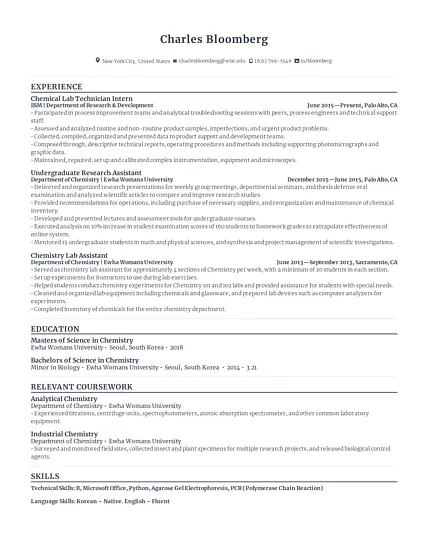
Entry Level Scientist Resume
An Entry Level Scientist resume should focus on your academic training, relevant coursework, and any research experience — including undergraduate projects, internships, or thesis work. Highlight laboratory techniques you've learned, software tools you're proficient in, and any co-authored publications or poster presentations. Soft skills like attention to detail, teamwork, and scientific writing are worth mentioning. Show eagerness to learn and a solid foundation in scientific methodology.
Charles Bloomberg
charlesbloomberg@gmail.com
PROFESSIONAL SUMMARY
Detail-oriented entry-level scientist with hands-on laboratory and analytical skills, specializing in biotechnology research. Passionate about scientific inquiry and data-driven results.
PROFESSIONAL Experience
Research Associate | Company A
April 2023 — Present, San Diego, USA
• Conducted over 150 genomic assays per month, utilizing next-generation sequencing technologies to support research and development initiatives.
• Collaborated with a cross-functional team of 10 scientists to analyze and interpret complex biological data using bioinformatics tools, enhancing project outcomes by 20%.
• Implemented a laboratory management system that improved sample throughput by 35%, reducing workflow bottlenecks.
• Authored technical reports and presentations to convey experimental results to stakeholders, leading to more informed decision-making and project planning.
• Maintained and calibrated laboratory equipment monthly, ensuring peak performance and compliance with safety standards.
Laboratory Technician | Company B
May 2021 — March 2023, New York, USA
• Performed routine cell culture and molecular biology techniques, including PCR and gel electrophoresis, contributing to the successful completion of 5 major projects.
• Assisted in the development of a high-throughput screening assay that boosted experimental efficiency by 40%, optimizing the drug discovery process.
• Managed inventory of laboratory materials, reducing supply costs by 15% through effective vendor negotiation and bulk purchasing strategies.
• Ensured compliance with SOPs and regulatory guidelines, enhancing laboratory safety and reliability of results.
Research Intern | Company C
June 2020 — April 2021, Rochester, USA
• Developed a novel protocol for DNA extraction from plant tissues, improving yield efficiency by 25% during a summer research project.
• Conducted over 200 assays to determine protein concentration levels using spectrophotometry, supporting findings in peer-reviewed publications.
• Presented research findings at internal symposiums, enhancing project visibility and fostering interdepartmental collaboration.
Lab Assistant | Company D
July 2019 — June 2020, Dayton, USA
• Provided technical support in conducting experiments related to environmental science research, processing 50 samples weekly.
• Calibrated analytical instruments and prepared reagents for daily experiments, ensuring data accuracy and reproducibility.
• Conducted field sampling trips, collecting and analyzing environmental samples to aid in ecological studies.
Education
Bachelor of Science in Biology | University of California, Los Angeles
May 2019
Expert-Level Skills
Genomic Assays, Next-Generation Sequencing, Bioinformatics Tools, Cell Culture Techniques, PCR, Gel Electrophoresis, High-Throughput Screening, Laboratory Management, Technical Writing, Data Analysis, SOP Compliance, Cross-Functional Collaboration, Communication Skills
Science Research Associate Resume
A Science Research Associate resume should highlight your ability to support and execute research under the direction of senior scientists or PIs. Emphasize your technical skills, data collection and analysis experience, and familiarity with lab protocols and safety standards. Showcase your reliability, organizational skills, and any contributions to publications or grant applications. Detail specific projects you supported and the tangible outcomes your work helped produce.
Charles Bloomberg
charlesbloomberg@gmail.com
PROFESSIONAL SUMMARY
Meticulous Science Research Associate with extensive expertise in experimental design, data analysis, and scientific reporting. Proven track record in pioneering research initiatives and delivering complex scientific projects using advanced methodologies and technologies.
PROFESSIONAL Experience
Science Research Associate | Company A
January 2022 — Present, Dallas, USA
• Led a team to conduct over 50 advanced molecular biology experiments utilizing techniques such as CRISPR, PCR, and western blotting resulting in a 30% increase in experimental throughput while maintaining a rigorous standard of quality and precision.
• Developed comprehensive data models using R and Python, which improved prediction accuracies by 25% across multiple research projects involving genetic variations.
• Collaborated with cross-functional teams to design and implement a laboratory protocol optimization project, reducing sample processing time by 20% and improving laboratory efficiency using Lean methodologies.
• Authored 10 peer-reviewed articles published in high-impact scientific journals, of which 3 received top citations within the first year of publication.
• Implemented laboratory automation systems using high-throughput robotic platforms, achieving a 15% reduction in human error and a 40% increase in sample processing capacity.
Research Scientist | Company B
July 2018 — December 2021, San Francisco, USA
• Spearheaded an interdisciplinary research project leading to the discovery of a novel biomarker for Alzheimer's disease, resulting in a provisional patent.
• Optimized and validated new assays for drug discovery, increasing screening accuracy by 18% by utilizing advanced spectroscopy and chromatography techniques.
• Managed a team of 5 laboratory technicians and post-doctoral researchers, improving project timelines by 15% through effective resource allocation and strategic planning.
• Drove the technological advancement of the laboratory by integrating machine learning algorithms to analyze data, significantly decreasing analysis time by 40%.
Junior Research Scientist | Company C
March 2015 — June 2018, Raleigh, USA
• Conducted comprehensive cancer research projects, leading to the development of 6 new therapeutic strategies with potential clinical applications.
• Improved laboratory workflow efficiency by 25% through the successful implementation of automated data entry tools, reducing the time spent on manual data management.
• Presented research findings at 3 international conferences, gaining recognition for contributions to oncology research and fostering partnerships with global research institutions.
Research Assistant | Company D
July 2012 — February 2015, Portland, USA
• Assisted in executing over 200 experimental assays, providing critical support in method validation and sample analysis with adherence to strict accreditation standards.
• Managed laboratory inventory and maintained equipment, ensuring operational capability and laboratory safety with zero incidents reported during the period.
• Processed and analyzed experimental data using statistical software, contributing to the successful completion of 4 major research publications.
Education
Master of Science in Molecular Biology | Johns Hopkins University
May 2012
Expert-Level Skills
Molecular Biology, CRISPR, PCR, Western Blotting, R, Python, Data Analysis, Laboratory Automation, Lean Methodologies, Spectroscopy, Chromatography, Machine Learning, Scientific Writing, Collaboration, Project Management
How to Write a Science Resume
Short answer:
Focus on your research contributions, technical expertise, and measurable outcomes from your work. Create a professional header with your name and contact details. Right below, write a 2–3 sentence resume summary outlining your most significant accomplishments and areas of specialization. Describe your work history in reverse-chronological order, emphasizing research outcomes and methodologies used. Then, cover your education (including degrees and relevant coursework), list key skills, certifications, and add extra sections such as publications, conference presentations, or grants.
Include all the necessary sections in the correct order
Here's the correct order of sections for most science resumes:
- Header with contact information
- Resume summary or objective
- Work experience (or research experience)
- Education
- Skills
- Certifications
Depending on your current career situation, you can also throw in some additional sections. For instance:
- Publications (peer-reviewed papers, book chapters)
- Conference presentations and posters
- Grants and fellowships
- Patents
- Professional affiliations
- Volunteer experience
Include everything that shows you're capable of doing what the job requires. Make every section count. If it doesn't clearly highlight your scientific expertise, it doesn't belong on your resume.
If you have less than five years of relevant experience, keep your resume 1-page long. For more senior scientists with extensive publication records and research portfolios, a two-page resume is perfectly acceptable.
More details here: What Sections to Include on Your Resume?
Now, I'll give you a high-level overview of how to write each section, going from top to bottom. Well… almost. The only exception is the resume summary section. While it comes right after your contact info, it's actually easier to write it last. More on that in a sec.
Create a professional resume header
- Start with your name and contact information. Include the basics: your full name, phone number, professional email address, location, and LinkedIn profile. A link to your Google Scholar profile, ORCID page, GitHub, or personal research website can also add credibility.
- Right below your name, clearly state your professional title (e.g., Environmental Scientist or Research Scientist — Molecular Biology). This sets expectations and asserts your position in the field.
For more information, see: How to Create a Resume Header
Describe your work history
- Use reverse-chronological order. List your positions starting with the current or the most recent one.
- In each entry, include your job title, organization name, location, and dates of employment.
- Below each position, write 3–7 bullet points — the more recent the position, the more bullet points you should include. Describe your responsibilities and, more importantly, your accomplishments.
- Use action verbs and quantify your achievements (e.g., "Designed and executed a 6-month study that identified 3 novel biomarkers, resulting in a first-author publication in a top-tier journal").
- If specific research methodologies, instruments, or analytical techniques were pivotal in your roles (e.g., CRISPR, mass spectrometry, machine learning), weave these details into your descriptions. This will also help you pass ATS scans.
Learn more about the best practices of this section with our detailed guide on how to describe your work experience on a resume.
List your degrees and detail professional learning
- In the education section, list your highest degree first, including the degree type, major/field of study, and institution.
- If you have relevant work experience, include only the name of your school and the degree you got. If you're an entry-level candidate, add more detail — list relevant coursework, thesis title, academic honors, and research lab affiliations.
- If you have science-related certifications (e.g., ASCP, CIH, Lean Six Sigma), either include them in an "Education and Certifications" section, or create a separate "Certifications" section and place it right below.
For an in-depth guide on how to describe your education on a resume, see: How to List Education on a Resume
List your most relevant skills in the skills section
- Include a mix of technical skills (e.g., laboratory instruments, programming languages, statistical software) and domain-specific knowledge (e.g., genomics, environmental remediation, materials characterization) that you are proficient in.
- Add in some soft skills such as scientific writing, collaboration, and critical thinking. These demonstrate your capacity to work effectively in research teams and communicate findings.
- You can use two separate subsections — one for hard skills, one for soft skills — or just list all the skills under one heading.
- Match your skills to the description of the job you're applying for. Don't just dump every skill from the job posting (especially if you don't really have them), but highlight those areas of expertise where your knowledge overlaps with the job ad.
Need some inspiration to get started? Here are some good skills to feature on your science resume.
Technical and laboratory skills for science resumes:
- PCR / qPCR
- Chromatography (HPLC, GC-MS)
- Spectroscopy (NMR, UV-Vis, IR, Mass Spec)
- Microscopy (SEM, TEM, Confocal)
- Cell Culture and Aseptic Technique
- Sample Preparation and Analysis
- Experimental Design
- GLP / GMP Compliance
- Environmental Sampling and Monitoring
- Materials Characterization (XRD, DSC, TGA)
Software and data analysis skills:
- Python
- R
- MATLAB
- SQL
- SPSS / SAS
- GraphPad Prism
- Tableau
- ArcGIS / QGIS
- JMP
- Microsoft Excel (Advanced)
Key soft skills for scientists:
- Critical Thinking
- Scientific Writing
- Attention to Detail
- Collaboration
- Problem-Solving
- Time Management
- Oral Presentation
- Adaptability
- Data Interpretation
- Intellectual Curiosity
For a full-blown guide on listing skills on a resume, visit: How to Put Skills on a Resume
Use additional sections as further proof of your fit
Additional sections add depth to your resume and back up your claimed expertise. Good examples of extra sections to add to a science resume are:
- Publications. This is often the single most important extra section for scientists. List peer-reviewed journal articles, book chapters, or preprints using a standard citation format. A strong publication record can be the deciding factor in your candidacy.
- Conference presentations and posters. Detail talks or poster sessions you've delivered at scientific conferences. Include the conference name, year, and presentation title.
- Grants and fellowships. If you've received research funding — even as a co-PI or contributor to a grant application — list it. Include the funding agency, award amount, and project title.
- Patents. If your research has led to intellectual property, a dedicated patents section signals real-world applicability of your work.
- Professional affiliations. Membership in organizations like ACS, AAAS, or ASM shows your engagement with the broader scientific community.
Highlight the most relevant information in a resume summary
Once you're done writing your science resume, give it a full read. Pick the most relevant information and compile it into a summary paragraph. Place it right under the resume header.
- Be brief and to-the-point. In 3–4 sentences, sum up your research expertise, core competencies, and what you bring to the table. Consider this your chance to answer, "Why should you hire me?" Tailor this section to match the employer's needs outlined in the job description.
- Use value-oriented language. Focus on how you can add value to the potential employer, mentioning specific research outcomes, technical specializations, or publications that demonstrate your impact.
Once you've completed the core sections of your resume, you can use Rezi AI Resume Summary Generator to automatically create a powerful summary, tailored to the job you're applying for. All you need to do is add the position and skills you want to highlight. The AI writer will do the rest.
More information here: How to Write a Job-Winning Resume Summary (with Examples)
For finishing touches, make sure your resume looks professional
- Use a clean and tidy resume format. Ensure your science resume is easily readable, with a professional font, consistent formatting, and clear section headings. Avoid overloading it with dense text or fancy design elements that could distract from the content and confuse resume screening software.
- Aim for a balance between detail and conciseness. If you're an entry-level candidate, keep your resume to a single page. Experienced scientists with extensive publication and research records can extend their resumes to two pages, but still need to make sure every word conveys value.
Learn more about proper resume formatting here: How to Format a Resume & What Standard Resume Format to Use
What Makes Science Resumes Different
In short: the emphasis on research contributions, technical depth, and demonstrated scientific impact.
This is also what many scientists get wrong on their resumes. Hiring managers and PIs aren't impressed by a wall of techniques or a vague description of "performed experiments." They need to see what your research actually achieved — and whether you have the scientific rigor and thinking to deliver results in their organization.
Focus on research impact, not just tasks
Science is ultimately about advancing knowledge or solving problems. Your resume needs to demonstrate that your work actually led somewhere meaningful — a publication, a patent, a new protocol, a dataset that informed decisions.
What it means for you:
- Quantify your research outcomes wherever possible. Mention the number of publications, citation counts, grants awarded, or efficiency improvements your work produced.
- Describe the significance of your findings. Don't just say you "analyzed samples" — explain that your analysis identified a contaminant source that led to a $500K remediation project, or that your gene expression study contributed to a paper cited 80+ times.
Focus on technical depth
Unlike many other professions, science roles require you to prove deep, specialized technical knowledge. A generic resume won't cut it. Reviewers want to see that you know the specific instruments, methodologies, and frameworks relevant to their work.
What it means for you:
- Name the exact techniques, instruments, and software you've used. Instead of writing "conducted laboratory experiments," specify "performed qPCR, Western blotting, and flow cytometry to characterize immune cell responses."
- Tailor your technical descriptions to the specific subfield. A materials science lab and a genomics lab speak different languages — make sure your resume speaks the right one for each application.
Focus on publications and presentations
In most scientific roles — especially in academia, government labs, and R&D — your publication record is one of the most scrutinized parts of your resume. This isn't true for most other professions.
What this means for you:
- List publications in a standard citation format (e.g., APA or journal-specific). Include all co-authors, journal name, year, and DOI or link when available.
- If you've presented at conferences, create a separate section for presentations and posters. Even if you're early in your career, poster presentations show active engagement with the scientific community.
Focus on collaboration and interdisciplinary work
Modern science is rarely a solo endeavor. Hiring managers want to see that you can work across teams, departments, and even institutions.
What this means for you:
- Highlight collaborative projects, especially those involving cross-functional or interdisciplinary teams. Mention co-PI relationships, industry-academic partnerships, or multi-site studies you contributed to.
- Describe your communication role — did you present findings to non-technical stakeholders, write sections of grant proposals, or train junior researchers? These details show you're more than just a bench scientist.
Focus on education and continuous learning
In science, your educational background carries more weight than in many other fields. Advanced degrees, specialized training, and ongoing certifications matter — especially early in your career.
What this means for you:
- If you hold a Ph.D. or M.S., your thesis or dissertation topic is worth mentioning. It signals your area of deep expertise.
- Include relevant workshops, certifications (e.g., biosafety training, radiation safety, data science bootcamps), and continuing education that show you stay current with evolving scientific methods and tools.
Bonus Resources for Scientists
This isn't going to be a game-changer if you need a resume right now. But —
I want you to treat your career holistically. These resources will help you sharpen your scientific expertise, add substance to future resumes, and keep you connected to developments in your field.
Professional associations and networks
One of the world's largest multidisciplinary scientific societies, AAAS offers career resources, networking opportunities, access to Science journal, and professional development programs for scientists at all career stages.
For chemists and chemical scientists, ACS provides career services, certification programs, job boards, and access to a vast library of peer-reviewed publications and conferences.
ASM serves microbiologists and life scientists with conferences, journals, career development resources, and a strong professional network focused on microbial sciences.
Beyond job listings, Nature Careers offers articles, advice columns, and resources specifically tailored to scientists navigating academic and industry career paths.
Online learning platforms
Both platforms offer a wide variety of science courses — from bioinformatics to environmental science to data analysis — developed by top universities. Great for filling skill gaps or pivoting into a new scientific specialization.
With courses on data analysis, lab management, scientific writing, and technical software, LinkedIn Learning provides practical professional development for scientists looking to broaden their skill set.
While geared toward foundational learning, Khan Academy's science content is excellent for brushing up on fundamentals or exploring adjacent disciplines — particularly useful for career changers.
Publications and journals
One of the most prestigious peer-reviewed journals in the world, covering breakthroughs across all scientific disciplines. Staying current with its publications keeps you informed and sharpens your scientific thinking.
Another flagship journal offering cutting-edge research, commentary, and career advice. Nature also publishes specialized journals across dozens of subfields.
A magazine focused on life science research, offering news, opinion pieces, career advice, and features on emerging trends — a great resource for staying connected to the broader scientific conversation.
Tools and software reviews
Both websites provide extensive reviews and comparisons of laboratory information management systems (LIMS), data analysis tools, and scientific software, helping you choose the right platforms for your work.
A cloud-based platform for life science R&D, Benchling is increasingly used in biotech and pharma. Familiarity with it — or similar electronic lab notebook tools — is a growing resume asset.
Summary
Here's what you need to know about writing a science resume:
- Structure your science resume with essential sections in this order: Header, Resume Summary or Objective, Work/Research Experience, Education, Skills, and Certifications. If relevant, add extra sections like Publications, Conference Presentations, Grants, or Patents.
- Include a professional header with your name, contact information, professional title, and links to your Google Scholar, ORCID, or GitHub profiles.
- Describe your work and research history in reverse-chronological order, emphasizing accomplishments and quantifiable outcomes — not just duties.
- In the education section, list your highest degree at the top. Include thesis topics for advanced degrees and relevant coursework for entry-level candidates.
- Highlight a mix of technical, software, and soft skills, tailoring them to the specific job description.
- Give your publications section serious attention — for many science roles, it's the most scrutinized part of your resume.
- Use additional sections to demonstrate engagement with the scientific community through conferences, grants, and professional affiliations.
- Once done writing the resume, compile the key information into a brief, value-oriented resume summary at the top.
- Make your resume professional in appearance and aim for conciseness without sacrificing the technical depth hiring managers expect.
- Showcase research impact, technical expertise, and your ability to collaborate across teams and disciplines.
Thanks for reading! Got any questions? Feel free to reach out to me on LinkedIn. (Or check out the FAQs first — maybe your question is answered there.)
FAQ
Should I use a resume or a CV for science jobs?
It depends on the role. Academic and government research positions typically expect a full CV with comprehensive publication lists, grants, and teaching experience. Industry positions — biotech, pharma, environmental consulting, data science — usually prefer a concise 1–2 page resume. When in doubt, follow the job posting's instructions. If it says "resume," keep it tight and focused.
How do I list publications on my science resume?
Use a standard citation format (APA, ACS, or the style common in your field). List publications in reverse-chronological order. Bold your name among the authors so it's immediately visible. If you have a long publication list, include only the most relevant papers on your resume and note "Selected Publications" as the section header, with a link to your full list on Google Scholar or ORCID.
What if I don't have publications yet?
That's completely fine, especially early in your career. Focus on research projects, poster presentations, and thesis work instead. You can create a "Research Projects" section that describes the questions you investigated, the methods you used, and the outcomes. Any manuscripts in preparation or under review can also be listed with a note indicating their status.
How technical should my resume be?
Match the audience. If you're applying to a specialized research lab, use precise technical terminology — they'll expect it. If you're applying to an industry role where HR screens resumes first, balance technical specifics with plain-language descriptions of your impact. A good rule: name the techniques and tools specifically, but describe your achievements in a way anyone with a science background can appreciate.
I'm transitioning from academia to industry. How should I approach my resume?
Reframe your academic experience in terms that resonate with industry. Instead of "conducted dissertation research," describe the project like a business problem you solved: define the objective, your approach, the timeline, and the measurable outcomes. Emphasize transferable skills like project management, data analysis, cross-functional collaboration, and deadline management. Drop academic jargon where possible and focus on results that translate to business value.
Should I include my GPA on a science resume?
If you're a recent graduate and your GPA is strong (generally 3.5+), include it. Once you have a few years of professional research experience, your GPA becomes far less relevant and can be removed to save space. What matters more at that point is your publication record, research outcomes, and technical skills.
How do I handle gaps in my research career?
Be honest but strategic. If you took time off for personal reasons, a brief explanation is fine — hiring managers in science understand that careers aren't always linear. If you were doing something productive during the gap (freelance consulting, online courses, volunteer research, teaching), include it. Frame the gap in terms of what you gained, not what you missed.