
9+ Security Operations Center (SOC) Analyst Resume Examples & Tips for 2026

Customize any of these resumes in minutes using our free AI-powered resume builder.
Use this sample—It's free
349 reviews (4.8 out of. 5)
Featured in:
In this article

Here's the problem I keep running into when reviewing SOC Analyst resumes: they read like a copy-paste of security tool documentation. A long list of platforms you've touched, maybe some vague references to "monitoring alerts" and "investigating incidents" — but nothing that tells a hiring manager how you actually think, triage, and respond when things go sideways.

A strong SOC Analyst resume needs to tell the story of how you detect, investigate, and respond to real threats — not just that you sat in front of a SIEM dashboard. It should convey your analytical thinking, your understanding of attack vectors, and the measurable impact of your work on the organization's security posture.

And this is exactly what you'll learn from this article. Inside, you'll find:

  • Examples of 9+ SOC Analyst resumes, covering different specializations and tiers.
  • Insider tips about what really matters to hiring managers and security leaders recruiting for SOC roles.
  • A step-by-step guide for building a SOC Analyst resume that gets you past ATS filters and into interviews.

Sample SOC Analyst Resumes

Take a look at some top-notch sample resumes for SOC Analysts across different specializations and experience levels. Find one that matches your profile and use it as a reference point (or feel free to steal it — just make sure to adjust the wording to reflect your own career journey).

Junior SOC Analyst

A Junior SOC Analyst resume should emphasize foundational cybersecurity knowledge, relevant coursework, lab experience, and any certifications like CompTIA Security+ or CySA+. Highlight your understanding of networking fundamentals, log analysis basics, and familiarity with SIEM tools even from training environments. Showcase eagerness to learn, attention to detail, and any hands-on experience from internships, capture-the-flag competitions, or home lab projects that demonstrate practical security skills.

Create Free Resume
Your resume is only 30 seconds away from being done.
Charles Bloomberg
Seattle, USA
charlesbloomberg@gmail.com
(621) 799-5548
in/cbloomberg
PROFESSIONAL SUMMARY
Detail-oriented Junior SOC Analyst with hands-on experience in monitoring security threats and handling security incidents. Proficient in enhancing system protections and maintaining incident response protocols.
PROFESSIONAL Experience
Junior SOC Analyst | Company A
January 2023 — Present, Seattle, USA
• Monitored over 200 security alerts daily using Splunk, enhancing detection accuracy by 30% within the first 6 months.
• Collaborated in a team of 12 to analyze network traffic and endpoint data, leading to a 15% reduction in false positives.
• Assisted in managing over 50 security incidents/month with a focus on containment and eradication processes, reducing response time by 20%.
• Implemented threat intelligence from multiple feeds, improving proactive threat identification by 25%.
• Developed and executed 10+ phishing simulations, increasing employee awareness and reducing incidents by 18%.
Security Operations Center Intern | Company B
May 2022 — December 2022, Redmond, USA
• Supported threat analysis and mitigation efforts for a SOC responsible for protecting over 5,000 systems.
• Conducted vulnerability assessments with Nessus, identifying and assisting in the remediation of 100+ critical vulnerabilities.
• Participated in creating a manual for incident escalation procedures, adopted by teams enterprise-wide.
• Increased incident detection rate by 10% through effective utilization of SIEM tools.
IT Security Assistant | Company C
August 2021 — April 2022, Tacoma, USA
• Provided support to security team by maintaining records of intrusion detection events month over month, exceeding accuracy benchmark by 5%.
• Aided in the configuration and monitoring of firewalls and IDS/IPS systems for 1,000+ endpoints.
• Contributed to the development of IT security policies distributed to 300 employees.
Information Security Intern | Company D
June 2020 — July 2021, Bellevue, USA
• Analyzed suspicious activity reports, discovering trends that informed weekly security briefings to senior staff.
• Communicated with IT to ensure compliance with security policies during system updates, impacting over 200 devices.
• Assisted in the administration of antivirus protection and updates, resulting in a 10% increase in malware resilience.
Education
Bachelor of Science in Cybersecurity | University of Washington
May 2020
Expert-Level Skills
Security Information and Event Management (SIEM), Splunk, Network Traffic Analysis, Incident Response, Threat Intelligence, Firewall Configuration, Vulnerability Assessment, Nessus, Security Awareness Training, Attention to Detail, Collaboration

Mid-Level SOC Analyst

For a Mid-Level SOC Analyst, your resume should demonstrate a solid track record of handling real-world security incidents from detection through resolution. Emphasize your proficiency with SIEM platforms, EDR tools, and threat intelligence feeds. Quantify your contributions — such as volume of alerts triaged, mean time to respond improvements, or false positive reduction rates. Highlight experience mentoring junior analysts and developing detection rules or playbooks.

Create Free Resume
Your resume is only 30 seconds away from being done.
Charles Bloomberg
San Jose, USA
charlesbloomberg@gmail.com
(621) 799-5548
in/cbloomberg
PROFESSIONAL SUMMARY
Dedicated SOC Analyst with over 5 years of experience in cybersecurity incident monitoring and response. Proven track record in threat analysis, intrusion detection, and vulnerability assessment in high-stakes environments. Skilled in leveraging advanced security tools to protect assets and ensure compliance.
PROFESSIONAL Experience
Mid-Level SOC Analyst | Company A
January 2022 — Present, San Jose, USA
• Developed and implemented incident response strategies, reducing incident response times by 30% through the efficient use of SIEM tools such as Splunk and QRadar.
• Monitored, analyzed, and responded to over 2,000 security alerts per month, identifying and mitigating potential threats with a 95% accuracy rate.
• Led a team of 4 SOC analysts in conducting threat hunting operations, discovering and neutralizing advanced persistent threats in client environments.
• Improved SOC processes and procedures by designing and deploying automated scripts, resulting in a 20% increase in operational efficiency.
• Provided in-depth analysis of network traffic and security alerts, using Wireshark and Snort, to protect highly sensitive data from unauthorized access.
SOC Analyst | Company B
April 2019 — December 2021, Santa Clara, USA
• Coordinated with cross-functional teams to manage and resolve an average of 50 security incidents per month, achieving a 99% resolution rate.
• Implemented SIEM solutions and performed root cause analyses on security events, utilizing tools such as Splunk and ArcSight.
• Conducted regular security assessments and vulnerability scans, leading to a 40% decrease in potential exploits through remedial actions.
• Enhanced client security posture by delivering tailored threat intelligence reports and recommending actionable mitigation strategies.
Junior SOC Analyst | Company C
June 2017 — March 2019, Phoenix, USA
• Assisted in monitoring and analyzing approximately 1,500 daily security alerts, contributing to the identification of 100+ critical threats.
• Played an integral role in the design and implementation of network security policies, which resulted in a 50% reduction in security breaches.
• Researched emerging threats and vulnerabilities, delivering weekly threat briefings to inform senior staff and align with industry best practices.
SOC Intern | Company D
January 2017 — May 2017, Austin, USA
• Supported the senior analyst team in daily monitoring activities, evaluating over 300 intrusion attempts monthly.
• Contributed to the development of incident response plans, enhancing preparedness against simulated attack scenarios.
• Collaborated with the IT department to ensure the timely update and patching of critical security systems.
Education
Bachelor of Science in Cybersecurity | University of Maryland, University College
May 2016
Expert-Level Skills
Incident Response, SIEM (Splunk, QRadar, ArcSight), Threat Analysis, Network Security, Vulnerability Assessment, Log Management, Intrusion Detection, Cyber Threat Intelligence, Scripting (Python, Bash), Strong Communication, Team Leadership

Senior SOC Analyst

A Senior SOC Analyst resume should showcase leadership within security operations, including designing incident response procedures, tuning detection logic, and driving SOC maturity improvements. Highlight experience leading complex investigations, coordinating cross-functional incident response, and mentoring team members. Include metrics around threat detection improvements, process optimizations, and any contributions to security strategy. Advanced certifications like GCIH, GCIA, or CISSP strengthen your profile significantly.

Create Free Resume
Your resume is only 30 seconds away from being done.
Charles Bloomberg
Seattle, USA
charlesbloomberg@gmail.com
(621) 799-5548
in/cbloomberg
PROFESSIONAL SUMMARY
Seasoned Senior SOC Analyst with over 8 years of experience in threat management and incident response, leveraging cutting-edge technologies to ensure robust cybersecurity. Proven track record in managing complex security issues and developing strategic solutions to protect organizational assets.
PROFESSIONAL Experience
Senior SOC Analyst | Company A
January 2020 — Present, Seattle, USA
• Developed advanced detection and response strategies, leading to a 40% reduction in false positive incidents over a period of 12 months through enhanced SIEM configurations.
• Led incident response for over 100 critical security incidents annually, utilizing Splunk and QRadar to effectively triage and resolve complex cybersecurity threats.
• Improved threat intelligence integration by implementing automated playbooks in Palo Alto Cortex XSOAR, which increased threat detection capabilities by 30%.
• Spearheaded a team of 5 SOC analysts, driving weekly threat hunting activities that identified and mitigated 200+ potential threats each month using MITRE ATT&CK Framework.
• Conducted over 50 security audits across cloud environments, ensuring compliance with industry standards and improving overall security posture by 25%.
SOC Analyst | Company B
July 2016 — December 2019, Redmond, USA
• Managed real-time security monitoring operations and incident responses, leading to a 25% increase in incident resolution speed through effective use of AlienVault USM.
• Collaborated with cross-functional teams to develop comprehensive security policies, enhancing organization-wide security awareness by training 200+ staff on best practices.
• Implemented network intrusion detection systems using Snort, improving threat detection and decreasing undetected intrusion attempts by 20% in one year.
• Engineered custom scripts for automatic log analysis, improving efficiency by reducing manual analysis time by 50% and providing rapid insights into security events.
Junior SOC Analyst | Company C
March 2014 — June 2016, Boise, USA
• Processed and analyzed security events, resulting in a 15% decrease in response times through improved use of Threat Intelligence Platforms.
• Assisted in the deployment of firewalls and security appliances, ensuring minimal downtime and enhancing network protection across 150+ endpoints.
• Researched and kept updated on evolving cyber threats, improving defensive tactics by applying new methodologies in weekly SOC team meetings.
Intern SOC Analyst | Company D
June 2013 — February 2014, Salt Lake City, USA
• Supported senior analysts in assessing security alerts, helping to fine-tune alert thresholds and reduce noise by 10%.
• Conducted vulnerability assessments on internal systems, categorizing and documenting over 300 vulnerabilities for remediation.
• Provided technical support in security tool implementations, facilitating smooth transitions and end-user training across various departments.
Education
Bachelor of Science in Computer Science | University of Washington
May 2013
Expert-Level Skills
Threat Management, Incident Response, SIEM (Splunk, QRadar), Threat Intelligence Platforms, Network Intrusion Detection, Security Policy Development, MITRE ATT&CK Framework, Palo Alto Cortex XSOAR, AlienVault USM, Snort, Team Leadership, Cybersecurity Audits, Strong Analytical Skills

Cybersecurity SOC Analyst

A Cybersecurity SOC Analyst resume should emphasize your breadth across the cybersecurity domain — not just monitoring, but also vulnerability management, threat hunting, and security architecture awareness. Highlight how you correlate data across multiple security tools to identify sophisticated threats. Showcase your understanding of frameworks like MITRE ATT&CK and NIST, and detail specific incidents where your analysis prevented or mitigated significant breaches or data loss events.

Create Free Resume
Your resume is only 30 seconds away from being done.
Charles Bloomberg
New York, USA
charlesbloomberg@gmail.com
(621) 799-5548
in/cbloomberg
PROFESSIONAL SUMMARY
Results-driven Cybersecurity SOC Analyst with over 8 years of experience in threat analysis and incident response, specializing in vulnerability management and cybersecurity operations. Adept in leveraging advanced security tools to mitigate cyber threats, ensuring optimal protection of network infrastructures.
PROFESSIONAL Experience
Senior SOC Analyst | Company A
March 2020 — Present, Armonk, USA
• Implemented detailed threat analysis procedures using tools like Splunk and QRadar, resulting in a 30% reduction in false positives over a span of 12 months.
• Spearheaded an incident response team of 5 analysts, achieving a 50% improvement in response time, reducing average response duration from 4 hours to 2 hours.
• Conducted over 200+ vulnerability assessments monthly, utilizing Nessus and Qualys to ensure comprehensive coverage of enterprise network assets.
• Enhanced SIEM logging and monitoring effectiveness by developing 15 custom parsers, increasing detection rates of potential security events by 25%.
• Collaborated with network and IT teams to resolve over 100 complex security incidents annually, ensuring robust protection against data breaches and unauthorized access.
SOC Analyst II | Company B
January 2017 — February 2020, San Jose, USA
• Developed and maintained correlation rules in SIEM to detect and alert on critical security threats, improving threat detection frequency by 35%.
• Led the deployment of an endpoint protection upgrade project affecting 15,000 devices, achieving a 20% boost in system resilience against malware.
• Conducted security training sessions bi-monthly for over 50 employees, increasing overall awareness and adherence to security protocols.
• Assisted in the deployment of a network segmentation solution that reduced the lateral movement of threats, decreasing internal risk exposure by 40%.
Cybersecurity Analyst | Company C
July 2014 — December 2016, Austin, USA
• Analyzed daily security logs and alerts, identifying and neutralizing 95% of threats before escalation.
• Engineered a customizable dashboard for real-time monitoring, decreasing incident identification times by 15%.
• Automated routine security checklists through Python scripting, reducing manual processing time by 10 hours weekly.
Junior SOC Analyst | Company D
August 2012 — June 2014, Miami, USA
• Assisted in monitoring security event management tool configurations, reducing false positive rates by 18%.
• Provided first-level support in incident management, addressing over 200 security incidents annually.
• Completed daily assessments on firewall and IDS/IPS configurations, ensuring compliance with security policies.
Education
Bachelor of Science in Cybersecurity | Johns Hopkins University
May 2012
Expert-Level Skills
Threat Analysis, Incident Response, Vulnerability Management, Splunk, QRadar, Nessus, Qualys, Network Segmentation, Firewall Configuration, Python Scripting, Security Training, Team Leadership, Problem Solving, Communication

SOC Security Analyst

For a SOC Security Analyst resume, focus on your dual strength in security monitoring and security engineering. Highlight experience configuring and maintaining security tools alongside your daily operational duties. Show your ability to translate security events into actionable intelligence for stakeholders. Detail your work with firewall logs, IDS/IPS alerts, and endpoint telemetry, and emphasize collaboration with IT teams to remediate identified vulnerabilities and harden the environment.

Create Free Resume
Your resume is only 30 seconds away from being done.
Charles Bloomberg
San Francisco, USA
charlesbloomberg@gmail.com
(621) 799-5548
in/cbloomberg
PROFESSIONAL SUMMARY
Detail-oriented SOC Security Analyst with over 8 years of experience in network security monitoring and incident response. Proficient in leveraging SIEM tools to enhance threat detection and maintain secure enterprise environments.
PROFESSIONAL Experience
SOC Security Analyst | Company A
March 2020 — Present, San Jose, USA
• Enhanced threat detection capabilities by configuring and optimizing Splunk SIEM, resulting in a 35% increase in the identification of security incidents over a 12-month period.
• Led proactive threat hunting activities, successfully identifying and containing over 150 malicious threats including APTs and ransomware, reducing potential data breaches across multiple client systems.
• Implemented automated security alert triage scripts that reduced response time to incidents by 22%, leveraging Python and REST API integrations.
• Conducted in-depth forensic analysis on compromised endpoints, utilizing EnCase and Autopsy, contributing to the resolution of 100+ incident cases annually.
• Collaborated with cross-functional teams to develop comprehensive incident response plans, decreasing incident resolution time by 40%.
SOC Security Analyst | Company B
August 2016 — February 2020, Armonk, USA
• Managed a team of 7 analysts, coordinating 24/7 security operations and overseeing security monitoring and incident handling activities across enterprise networks.
• Spearheaded a project to integrate advanced AI-driven threat intelligence feeds into the security operations pipeline, enhancing detection accuracy by 30%.
• Developed comprehensive security metrics and reporting dashboards in Power BI, providing actionable insights to executive management.
• Increased operational efficiency by 20% by refining alert classification and escalation procedures, ensuring prompt resolution of security threats.
Security Operations Analyst | Company C
May 2014 — July 2016, Detroit, USA
• Executed daily malware analysis and network traffic anomaly monitoring using Snort and Wireshark, detecting and mitigating security risks.
• Improved incident response processes and procedures, aligning them with NIST standards, leading to a 50% decrease in incident response time.
• Provided threat intelligence briefs to stakeholders, contributing to informed decision-making and strategic security improvements.
Cybersecurity Specialist | Company D
September 2011 — April 2014, Seattle, USA
• Developed cybersecurity training programs for over 200 staff members, increasing company-wide security awareness and reducing phishing incident rates by 60%.
• Conducted comprehensive vulnerability assessments using Nessus, identifying critical vulnerabilities and facilitating timely patch deployments.
• Assisted in the design and implementation of firewalls and intrusion detection systems, enhancing the overall security posture of client networks.
Education
Bachelor of Science in Cybersecurity | Northeastern University
May 2011
Expert-Level Skills
SIEM (Splunk, QRadar), Python, Incident Response, Threat Hunting, Malware Analysis, Network Security, Forensic Analysis, Vulnerability Assessment, Intrusion Detection Systems (IDS), Cyber Threat Intelligence, Cross-functional Collaboration, Communication, Problem Solving

Tier 1 SOC Analyst

A Tier 1 SOC Analyst resume should focus on your ability to monitor security alerts efficiently, perform initial triage, and escalate genuine threats accurately. Highlight your knowledge of common attack patterns, phishing identification, and basic malware analysis. Showcase your speed and accuracy in alert classification, your familiarity with ticketing systems, and your adherence to standard operating procedures. Any metrics around alert volume handled or escalation accuracy will make your resume stand out.

Create Free Resume
Your resume is only 30 seconds away from being done.
Charles Bloomberg
Miami, USA
charlesbloomberg@gmail.com
(621) 799-5548
in/cbloomberg
PROFESSIONAL SUMMARY
Experienced and vigilant Tier 1 SOC Analyst with a demonstrated history in cyber threat monitoring and incident response. Skilled in utilizing cutting-edge security technologies to safeguard organizational assets and minimize risk exposure.
PROFESSIONAL Experience
Tier 1 SOC Analyst | Company A
May 2022 — Present, Miami, USA
• Monitored security alerts via SIEM tools, analyzing over 1000 alerts per day using Splunk and QRadar, leading to 20% faster threat identification.
• Investigated security incidents, efficiently resolving 98% of incidents within agreed SLA timelines, ensuring organizational data integrity.
• Conducted in-depth log analysis across firewall, IDS/IPS, and endpoint security solutions, identifying trends and reducing false positives by 35%.
• Collaborated with cross-functional teams to enhance security incident response protocols, improving overall incident handling efficiency by 15%.
• Assisted in the development of playbooks for incident response processes, enhancing team readiness and alignment by 40%.
Tier 1 SOC Analyst | Company B
January 2020 — April 2022, Atlanta, USA
• Detected and reported 50+ security incidents monthly using Microsoft Sentinel, maintaining a secure operating environment.
• Managed and operated essential security tools, including antivirus programs, network intrusion detection systems and security scanning software.
• Formulated and executed security assessments and vulnerability scans, achieving a 30% reduction in exploitable vulnerabilities.
• Provided clear and comprehensive incident reports to senior SOC analysts, enhancing decision-making with valuable insights.
IT Security Officer | Company C
July 2018 — December 2019, Orlando, USA
• Built and managed security monitoring tools, leading to improved detection capabilities and 25% reduction in potential security breaches.
• Designed and implemented access control policies, resulting in a 15% reduction in unauthorized access attempts.
• Conducted over 30 security awareness trainings annually, increasing cybersecurity hygiene across the company by 20%.
Junior IT Technician | Company D
March 2016 — June 2018, Jacksonville, USA
• Provided technical support and troubleshooting for over 200 network and software issues monthly, achieving 95% first-time resolution rate.
• Oversaw hardware and software installations and upgrades, facilitating seamless transitions and minimizing downtime by 10%.
• Assisted in network security audits, revealing critical vulnerabilities and contributing to a 40% enhancement in security posture.
Education
Bachelor of Science in Information Security | Georgia Institute of Technology
May 2015
Expert-Level Skills
SIEM tools (Splunk, QRadar, Microsoft Sentinel), firewall/IDS/IPS, incident response, vulnerability assessment, log analysis, cybersecurity best practices, team collaboration, problem solving, technical support

Tier 2 SOC Analyst

For a Tier 2 SOC Analyst, your resume should demonstrate deeper investigative capabilities beyond initial triage. Emphasize your experience conducting root cause analysis, performing packet captures, analyzing malware behavior, and correlating events across multiple data sources. Highlight your role in developing and refining detection rules, writing incident reports, and coordinating containment efforts. Show proficiency with forensic tools and threat intelligence platforms that support advanced investigation workflows.

Create Free Resume
Your resume is only 30 seconds away from being done.
Charles Bloomberg
San Diego, USA
charlesbloomberg@gmail.com
(621) 799-5548
in/cbloomberg
PROFESSIONAL SUMMARY
Results-driven Tier 2 SOC Analyst with extensive experience in incident response and threat analysis. Proven track record in leveraging SIEM tools for cybersecurity enhancement, ensuring robust network security operations adhere to industry standards.
PROFESSIONAL Experience
Tier 2 SOC Analyst | Company A
June 2022 — Present, San Diego, USA
• Developed and maintained over 200 SIEM correlation rules improving threat detection capabilities by 30% within the first six months.
• Led incident response coordination for over 50 critical incidents monthly, ensuring swift mitigation and containment using Splunk Enterprise Security.
• Improved false positive rate by 15% by conducting in-depth analysis of system alerts and refining detection algorithms.
• Provided mentorship to junior analysts through training sessions, resulting in a 70% improvement in initial incident investigation quality.
• Implemented threat hunting techniques that increased identification of advanced persistent threats by 20% using CrowdStrike Falcon.
Cybersecurity Analyst | Company B
January 2020 — May 2022, San Diego, USA
• Managed security on a daily basis for 40+ clients, ensuring adherence to client-specific cybersecurity frameworks.
• Spearheaded a vulnerability management program, reducing critical vulnerabilities by 25% over a 9-month period using Qualys.
• Directed the implementation of automated threat intelligence feeds, reducing threat research time by 40%.
• Collaborated with IT departments to develop security policies that reduced malware incidents by 15% through user education initiatives.
Information Security Specialist | Company C
February 2018 — December 2019, Phoenix, USA
• Engineered a secure network infrastructure for five new client sites leading to a 0% intrusion rate during the first year of implementation.
• Coordinated security audits and compliance assessments for HIPAA and PCI-DSS standards, achieving 98% compliance.
• Optimized log management process and increased log retention capability by 60% through effective configuration of syslog servers.
IT Security Technician | Company D
June 2016 — January 2018, Austin, USA
• Assisted in the deployment and configuration of intrusion detection systems across 15 corporate sites, enhancing security posture.
• Conducted regular system and application vulnerability assessments, mitigating potential security breaches successfully.
• Researched and tested new security software solutions, leading to implementation of tools that increased threat visibility by 35%.
Education
Bachelor of Science in Information Technology | University of Southern California
May 2016
Expert-Level Skills
Security Information and Event Management (SIEM), Incident Response, Threat Analysis, Vulnerability Management, ISO 27001, HIPAA, PCI-DSS, Splunk, Qualys, Network Security, CrowdStrike Falcon, Firewall Management, Risk Assessment, Technical Support, Critical Thinking, Collaboration

SOC Incident Analyst

A SOC Incident Analyst resume should zero in on your incident response expertise. Detail your experience managing the full incident lifecycle — from identification and containment to eradication, recovery, and post-incident review. Highlight your ability to lead incident bridges, communicate with stakeholders during active incidents, and produce detailed after-action reports. Metrics such as reduced mean time to contain or number of incidents managed concurrently demonstrate operational impact effectively.

Create Free Resume
Your resume is only 30 seconds away from being done.
Charles Bloomberg
Richmond, USA
charlesbloomberg@gmail.com
(621) 799-5548
in/cbloomberg
PROFESSIONAL SUMMARY
Detail-oriented SOC Incident Analyst with over 5 years of experience in cybersecurity operations. Adept at identifying and mitigating security threats effectively, leveraging SIEM tools and incident response strategies to protect organizational assets.
PROFESSIONAL Experience
SOC Incident Analyst | Company A
January 2022 — Present, Richmond, USA
• Developed automated workflows in IBM QRadar, resulting in a 40% improvement in incident response times across a network of 20,000 devices.
• Managed real-time monitoring and analysis, investigating over 300 security incidents monthly and reducing false alarm rates by 35% using pattern recognition algorithms.
• Collaborated with cross-functional IT teams to conduct post-incident analysis and refine intrusion detection protocols, increasing detection accuracy by 25%.
• Led a team of 5 junior analysts to conduct regularly scheduled vulnerability assessments, identifying and mitigating over 150 potential threats annually.
• Implemented advanced anomaly detection techniques, producing monthly threat intelligence reports that informed strategic security improvements.
SOC Analyst | Company B
August 2018 — December 2021, Raleigh, USA
• Engineered custom dashboards with Splunk Enterprise to enhance visibility into security events, leading to a 50% increase in the speed of threat identification.
• Formulated and executed incident handling procedures for over 200 incidents per quarter, ensuring minimal disruption to business operations.
• Assisted in the integration of new cybersecurity infrastructure, reducing response times for critical incidents by 30% with newly implemented playbooks.
• Researched emerging threat vectors and trained staff on new defensive tactics, leading to a 20% increase in staff readiness scores.
Junior SOC Analyst | Company C
May 2016 — July 2018, Columbus, USA
• Processed over 2,000 security alerts monthly, categorizing and escalating incidents to senior analysts for further investigation.
• Optimized firewall configurations and rule sets, contributing to a 15% reduction in unauthorized access attempts.
• Produced daily metrics reports analyzing security risks and conveyed findings to IT managers, supporting a proactive security posture.
IT Support Specialist | Company D
January 2014 — April 2016, Akron, USA
• Provided technical support to over 500 users, resolving 98% of issues within a 24-hour timeframe.
• Assisted in maintaining the integrity of network security through routine monitoring and patch management.
• Created user-friendly documentation and conducted training sessions to enhance the IT literacy of staff.
Education
Bachelor of Science in Cybersecurity | University of Maryland, Global Campus
Graduated May 2013
Expert-Level Skills
SIEM (QRadar, Splunk), Intrusion Detection & Prevention, Incident Response, Vulnerability Assessment, Risk Management, Anomaly Detection, Cyber Intelligence, Communication, Team Leadership

Information Security SOC Analyst

An Information Security SOC Analyst resume should bridge operational monitoring with broader information security governance. Highlight your understanding of compliance frameworks like ISO 27001, SOC 2, or HIPAA alongside your hands-on SOC experience. Emphasize contributions to risk assessments, audit support, and policy enforcement through security monitoring. Show how your operational findings informed security program improvements and helped the organization maintain regulatory compliance.

Create Free Resume
Your resume is only 30 seconds away from being done.
Charles Bloomberg
Austin, USA
charlesbloomberg@gmail.com
(621) 799-5548
in/cbloomberg
PROFESSIONAL SUMMARY
Experienced Information Security SOC Analyst with a strong command of cybersecurity protocols and extensive experience in threat detection, incident response, and security monitoring. Proven track record in leveraging advanced technologies to protect organizational assets and ensure compliance.
PROFESSIONAL Experience
Information Security SOC Analyst | Company A
January 2022 — Present, Austin, USA
• Led the implementation of a SIEM system, increasing threat detection efficiency by 45% through correlating logs from over 25,000 devices.
• Conducted over 300 incident investigations annually, utilizing tools such as Splunk and QRadar to mitigate threats within the first 24 hours.
• Developed and maintained security procedures and protocols for a network spanning 12 regional offices, ensuring a consistent cybersecurity posture.
• Conducted over 50 security awareness training sessions annually, improving employee compliance and reducing phishing incidents by 30%.
• Designed and implemented an automated reporting system for vulnerability management, decreasing manual reporting time by 40%.
SOC Analyst | Company B
March 2019 — December 2021, Raleigh, USA
• Managed a team of 5 analysts, optimizing the security operations center to enhance incident response times by 20%.
• Implemented advanced threat intelligence tools, effectively reducing false positives by 35% across monitored environments.
• Engineered custom threat detection rules within the SIEM platform, enhancing the visibility of network anomalies by 25%.
• Wrote comprehensive incident reports and communicated findings to executives, achieving improved response times and decision-making.
Cybersecurity Analyst | Company C
July 2016 — February 2019, Dallas, USA
• Spearheaded the development of a security incident response plan, facilitating faster containment of breaches within 2 hours.
• Collaborated with software developers to integrate security features, enhancing overall application security by 40%.
• Processed daily security logs from over 500 systems, using automated scripts to identify and report critical security incidents.
IT Security Analyst | Company D
June 2014 — June 2016, Houston, USA
• Researched emerging cyber threats and adapted security measures, reducing potential risks by 25% annually.
• Developed in-depth vulnerability assessments for over 200 enterprise systems, identifying critical security gaps and recommending solutions.
• Provided continuous monitoring and analysis of security alerts, effectively preventing over 500 unauthorized access attempts.
Education
Bachelor of Science in Information Security | Texas A&M University
May 2014
Expert-Level Skills
Threat Detection, Incident Response, Security Monitoring, SIEM Systems (Splunk, QRadar), Network Security, Vulnerability Management, Threat Intelligence, Cybersecurity Protocols, Team Leadership, Security Awareness Training, Analytical Thinking, Communication

How to Write a SOC Analyst Resume

Short answer:

Focus on your analytical skills, threat detection capabilities, and the specific tools and frameworks you've used to protect organizations. Create a professional header with your name and contact details. Right below, write a 2–3 sentence resume summary outlining your most impactful security accomplishments. Describe your work history in reverse-chronological order, focusing on incidents handled, detection improvements made, and the tools and methodologies used. Then, cover your education, including security certifications, list key skills, and add extra sections such as certifications, lab projects, or security community involvement.

Include all the necessary sections in the correct order

Here's the correct order of sections for most SOC Analyst resumes:

  • Header with contact information
  • Resume summary or objective
  • Work experience
  • Education
  • Skills
  • Certifications

Depending on your current career situation, you can also throw in some additional sections. For instance:

  • Certifications and training (if extensive, give this its own prominent section)
  • Home lab or personal security projects
  • Capture-the-flag (CTF) competitions and achievements
  • Security community involvement and conference participation
  • Publications or blog posts on security topics
  • Professional associations

Include everything that shows you're capable of doing what the job requires. Make every section count. If it doesn't clearly highlight your security skills, it doesn't belong on your resume.

If you have less than five years of relevant experience, keep your resume 1-page long. For more senior SOC Analysts, a two-page resume is fine.

More details here: What Sections to Include on Your Resume?

Now, I'll give you a high-level overview of how to write each section, going from top to bottom. Well… almost. The only exception is the resume summary section. While it comes right after your contact info, it's actually easier to write it last. More on that in a sec.

Create a professional resume header

  • Start with your name and contact information. Include the basics: your full name, phone number, professional email address, location, and LinkedIn profile. If you have a personal security blog, GitHub with security scripts, or a TryHackMe/HackTheBox profile, adding a link can demonstrate hands-on skills.
  • Right below your name, clearly state your professional title (e.g., SOC Analyst or Senior Security Operations Analyst). This sets expectations and immediately positions you for security roles.

For more information, see: How to Create a Resume Header

Describe your work history

  • Use reverse-chronological order. List your positions starting with the current or the most recent one.
  • In each entry, include your job title, company name, location, and dates of employment.
  • Below each position, write 3–7 bullet points — the more recent the position, the more bullet points you should include. Describe your responsibilities and, more importantly, your accomplishments.
  • Use action verbs and quantify your achievements (e.g., "Triaged an average of 200+ daily security alerts with a 98% accuracy rate, reducing false positive escalations by 35%").
  • If specific security frameworks, methodologies, or tools were central to your roles (e.g., MITRE ATT&CK, NIST Incident Response, Splunk, CrowdStrike), weave these details into your descriptions. This will also help you pass ATS scans.

Learn more about the best practices of this section with our detailed guide on how to describe your work experience on a resume.

List your degrees and detail professional learning

  • In the education section, list your highest degree first, including the degree type, major, and institution.
  • If you have relevant work experience, include only the name of your school and the degree you got. If you're an entry-level candidate, you can add more detail — list relevant coursework (network security, digital forensics, operating systems), extracurricular activities, and academic achievements.
  • If you have security certifications (e.g., CompTIA Security+, CySA+, GCIH, CISSP), either include them in an "Education and Certifications" section, or create a separate "Certifications" section and place it right below. For SOC roles, certifications often carry as much weight as degrees — sometimes more.

For an in-depth guide on how to describe your education on a resume, see: How to List Education on a Resume

List your most relevant skills in the skills section

  • Include a mix of technical skills (e.g., SIEM platforms, EDR tools, packet analysis) and security frameworks (e.g., MITRE ATT&CK, NIST CSF, Cyber Kill Chain) that you are proficient in.
  • Add in some soft skills such as analytical thinking, communication, and collaboration. These demonstrate your capacity to work under pressure and communicate findings to both technical and non-technical audiences.
  • You can use two separate subsections, one for hard skills, one for soft skills, or just list all the skills under one heading.
  • Match your skills to the description of the job you're applying for. I'm not saying you should dump every security tool ever made onto your resume (especially if you've never used them), but highlight the areas where your expertise overlaps with what the job ad asks for.

Need some inspiration to get started? Here are some good skills to feature on your SOC Analyst resume.

Security tools and platforms:

  • Splunk
  • Microsoft Sentinel
  • IBM QRadar
  • CrowdStrike Falcon
  • Palo Alto Cortex XSOAR
  • Carbon Black
  • Wireshark
  • Elastic Security (ELK Stack)
  • ServiceNow (SecOps)
  • VirusTotal / Any.Run / Hybrid Analysis

Security frameworks and methodologies:

  • MITRE ATT&CK
  • NIST Cybersecurity Framework
  • Cyber Kill Chain
  • NIST 800-61 (Incident Response)
  • ISO 27001
  • Diamond Model of Intrusion Analysis
  • OWASP Top 10
  • Threat Intelligence Lifecycle
  • SANS Incident Response Process
  • Zero Trust Architecture

Key soft skills for SOC Analysts:

  • Analytical Thinking
  • Attention to Detail
  • Communication (written and verbal)
  • Problem-Solving
  • Teamwork and Collaboration
  • Adaptability Under Pressure
  • Time Management and Prioritization
  • Continuous Learning Mindset
  • Critical Thinking
  • Situational Awareness

For a full-blown guide on listing skills on a resume, visit: How to Put Skills on a Resume

Use additional sections as further proof of your fit

Additional sections add depth to your resume and back up your claimed expertise. Good examples of extra sections to add to a SOC Analyst resume are:

  • Certifications. In cybersecurity, certifications are often non-negotiable. Give them prominent placement — especially industry-recognized ones like CompTIA Security+, CySA+, GCIH, GCIA, GCED, or CISSP.
  • Lab projects and CTF competitions. A resume section dedicated to hands-on security projects — like building a home SOC lab, participating in CTF events, or contributing to open-source detection rules — can provide concrete examples of your skills in action.
  • Professional associations. Membership in organizations like (ISC)², ISACA, or local ISSA chapters showcases your commitment to the profession.
  • Conference attendance. Listing security conferences like DEF CON, BSides, Black Hat, or SANS summits shows you stay current with evolving threats and techniques.

Highlight the most relevant information in a resume summary

Once you're done writing your SOC Analyst resume, give it a full read. Pick the most relevant information and compile it into a summary paragraph. Place it right under the resume header.

  • Be brief and to-the-point. In 3–4 sentences, sum up your career highlights, core competencies, and what you bring to the table. Consider this your chance to answer, "Why should you hire me to protect your organization?" Tailor this section to match the employer's needs outlined in the job description.
  • Use value-oriented language. Focus on how you can strengthen the potential employer's security posture, mentioning specific metrics like incidents handled, detection improvements, or response time reductions.

Once you've completed the core sections of your resume, you can use Rezi AI Resume Summary Generator to automatically create a powerful summary, tailored to the job you're applying for. All you need to do is add the position and skills you want to highlight. The AI writer will do the rest.

More information here: How to Write a Job-Winning Resume Summary (with Examples)

For finishing touches, make sure your resume looks professional

  • Use a clean and tidy resume format. Ensure your SOC Analyst resume is easily readable, with a professional font, consistent formatting, and clear section headings. Avoid overloading it with dense text or fancy design elements that could distract from the content and confuse resume screening software.
  • Aim for a balance between detail and conciseness. If you're a junior or entry-level candidate, keep your resume to a single page. Experienced SOC Analysts can extend their resumes to two pages, but still need to make sure every word conveys value.

Learn more about proper resume formatting here: How to Format a Resume & What Standard Resume Format to Use

What Makes SOC Analyst Resumes Different

In short: the emphasis on threat detection capability, technical depth, and the ability to stay calm and effective under pressure.

This is also what many SOC Analysts get wrong on their resumes. Hiring managers in cybersecurity aren't impressed by a laundry list of tools you've logged into. They need to see how you think through problems, how quickly and accurately you triage threats, and how your work directly reduced risk for the organization.

Focus on detection and response outcomes

SOC Analysts are judged by their ability to find real threats in a sea of noise. Your resume needs to prove you can do exactly that — not just that you monitored a dashboard.

What it means for you:

  • Quantify your detection and response work wherever possible. Metrics like alert volume triaged per shift, mean time to detect (MTTD), mean time to respond (MTTR), false positive reduction percentages, and number of confirmed incidents investigated are all powerful.
  • Describe specific types of threats you've handled — phishing campaigns, ransomware attempts, lateral movement, data exfiltration — to show breadth and depth of experience.

Focus on tools and technical proficiency

Unlike many other roles, SOC positions require demonstrable hands-on experience with specific security tools. Recruiters and hiring managers will scan for these.

What it means for you:

  • Name the exact tools you've used — don't just say "SIEM experience." Say "Splunk" or "Microsoft Sentinel" or "IBM QRadar." The same goes for EDR, SOAR, threat intelligence platforms, and ticketing systems.
  • Go beyond just listing tools. Describe what you did with them: wrote custom detection rules in Splunk, built automated playbooks in XSOAR, or conducted packet analysis with Wireshark to identify C2 traffic.

Focus on frameworks and analytical methodology

Security hiring managers want to know that you have a structured approach to threat analysis, not just instinct. Frameworks signal maturity.

What this means for you:

  • Reference frameworks like MITRE ATT&CK, the Cyber Kill Chain, or NIST 800-61 in the context of your actual work. For example, "Mapped detected threats to MITRE ATT&CK techniques to improve detection rule coverage across 12 tactic categories."
  • Describe your investigation process — how you correlated events, what data sources you pulled from, and how you determined severity and scope. This shows hiring managers you don't just follow playbooks blindly.

Focus on certifications — they carry serious weight

In cybersecurity, certifications are often baseline requirements rather than nice-to-haves. Many job postings won't even consider candidates without specific certs.

What this means for you:

  • Give certifications prominent placement on your resume. If the job posting mentions CompTIA Security+, CySA+, GCIH, or CISSP, make sure these are immediately visible — not buried at the bottom.
  • If you're early in your career, certifications can compensate for limited work experience. Even in-progress certifications are worth listing (e.g., "GCIH — expected completion June 2026").

Focus on continuous learning and adaptability

The threat landscape changes constantly. Hiring managers want analysts who actively keep up, not ones who stopped learning after their last certification.

What this means for you:

  • Include evidence of ongoing professional development — recent training courses, CTF participation, security conference attendance, or contributions to threat intelligence communities.
  • If you've adapted to new tools, new threat types, or organizational changes (like migrating from one SIEM to another), call that out. It shows flexibility and a growth mindset — two things every SOC leader values.

Bonus Resources for SOC Analysts

This isn't going to be a game-changer if you need a resume right now. But —

I want you to treat your career holistically. These resources will help you sharpen your security operations skills, add real substance to your future resumes, and keep you current with a threat landscape that never stops evolving.

Professional associations and networks

(ISC)²

The organization behind the CISSP certification, (ISC)² offers a wealth of resources, events, and community forums for cybersecurity professionals at all levels. Their Certified in Cybersecurity (CC) entry-level certification is a great starting point for aspiring SOC Analysts.

ISACA

Known for certifications like CISM and CISA, ISACA provides professional development, research, and community resources focused on information security governance, risk management, and audit — all valuable context for SOC professionals.

Information Systems Security Association (ISSA)

ISSA is a community of security professionals offering networking, educational forums, and publications. Local chapter involvement is especially valuable for building connections in your geographic area.

Online learning and hands-on platforms

SANS Institute

SANS is the gold standard for cybersecurity training. Their courses like SEC504 (Hacker Tools, Techniques, and Incident Handling) and SEC511 (Continuous Monitoring and Security Operations) are directly relevant to SOC Analysts, and GIAC certifications from SANS carry tremendous industry weight.

TryHackMe & Hack The Box

Both platforms offer hands-on cybersecurity labs and challenges. TryHackMe is particularly beginner-friendly with structured SOC Analyst learning paths, while Hack The Box provides more advanced challenges. Both are excellent for building practical skills and demonstrating initiative on your resume.

Cybrary

Cybrary offers free and premium cybersecurity courses, including SOC Analyst-specific career paths. It's a solid resource for structured learning, especially if you're breaking into the field or transitioning from another IT discipline.

Publications and threat intelligence

Dark Reading

One of the most widely read cybersecurity news sites, Dark Reading covers the latest vulnerabilities, breaches, threat research, and industry trends — essential reading for staying current in security operations.

MITRE ATT&CK

More than just a framework, the ATT&CK knowledge base is an essential reference for understanding adversary tactics and techniques. Familiarizing yourself deeply with ATT&CK will improve both your daily SOC work and how you articulate your expertise on your resume.

SANS Reading Room

A massive library of research papers written by security professionals on topics ranging from incident response to threat hunting to SOC operations. Great for deepening your knowledge and finding inspiration for your own professional development.

Tools and community resources

Sigma Rules (GitHub)

Sigma is an open standard for SIEM detection rules. Contributing to or studying Sigma rules is an excellent way to improve your detection engineering skills and demonstrate community involvement on your resume.

SOC Prime

SOC Prime's Threat Detection Marketplace offers community-driven detection content mapped to MITRE ATT&CK. It's a valuable resource for staying on top of the latest detection techniques and understanding how top analysts approach threat detection.

Summary

Here's what you need to know about writing a SOC Analyst resume:

  • Structure your SOC Analyst resume with essential sections in this order: Header, Resume Summary or Objective, Work Experience, Education, Skills, and Certifications. If relevant, add extra sections like Lab Projects, CTF Achievements, or Conference Participation.
  • Include a professional header with your name, contact information, and professional title (e.g., SOC Analyst, Security Operations Analyst).
  • Describe your work history in reverse-chronological order, emphasizing threat detection, incident response, and quantifiable outcomes like MTTR improvements or alert accuracy rates.
  • In the education section, list your highest degree at the top. Give security certifications prominent placement — either in the education section or under a dedicated heading.
  • Highlight a mix of security tools, frameworks, and soft skills, tailoring them to the job description.
  • Name specific tools (Splunk, CrowdStrike, etc.) and frameworks (MITRE ATT&CK, NIST) rather than using vague terms like "SIEM experience."
  • Use additional sections to showcase hands-on projects, certifications, and commitment to continuous learning.
  • Once done writing the resume, compile the key information into a brief, impact-oriented resume summary at the top.
  • Make your resume professional in appearance, aim for conciseness without sacrificing technical depth.
  • Showcase your analytical thinking, detection capabilities, and measurable contributions to security operations.

Thanks for reading! Got any questions? Feel free to reach out to me on LinkedIn. (Or check out the FAQs first — maybe your question is answered there.)

FAQ

What keywords should I use on my SOC Analyst resume?

Use specific security terminologies and tool names relevant to your experience, such as SIEM, EDR, Splunk, CrowdStrike, incident response, threat hunting, MITRE ATT&CK, log analysis, and malware analysis. Include certifications like CompTIA Security+, CySA+, GCIH, or CISSP if you hold them. Mirror the exact language used in the job posting — if they say "security event monitoring," use that phrase rather than a synonym.

I'm transitioning from IT support or system administration into a SOC role. How should I approach my resume?

Focus on transferable skills like troubleshooting, log analysis, networking knowledge, and system administration. Highlight any security-adjacent work you've done — firewall management, access control, patching, or even identifying suspicious activity informally. Add any security certifications you've earned (even CompTIA Security+ makes a difference), and list hands-on projects from platforms like TryHackMe or home lab setups to show practical security skills.

What's the most common mistake on SOC Analyst resumes?

Listing every security tool you've ever heard of without context. Hiring managers can tell when you're padding your resume with tool names you've barely touched. Instead, for each tool you list, make sure your work experience section contains at least one bullet point describing how you actually used it. "Developed 40+ custom Splunk correlation rules that improved phishing detection by 25%" is infinitely more powerful than just writing "Splunk."

Should I include my home lab or CTF experience on my resume?

Absolutely — especially if you're early in your career or transitioning into cybersecurity. A well-documented home lab (e.g., setting up a SIEM, ingesting logs, simulating attacks) shows initiative and hands-on skills that many candidates lack. CTF rankings or achievements from platforms like TryHackMe or Hack The Box demonstrate practical problem-solving. Just describe them professionally — treat them like real projects.

How important are certifications for SOC Analyst resumes?

Very. Many SOC roles have certification requirements baked directly into the job posting, especially in government or defense-adjacent positions (think DoD 8570/8140 compliance). CompTIA Security+ is often the minimum. CySA+, GCIH, GCIA, and CISSP carry progressively more weight. If a cert is in progress, list it with an expected completion date — it's better than omitting it entirely.

Which resume format is best for SOC Analyst resumes?

The reverse-chronological format works best for SOC Analyst resumes. It highlights your career progression and makes it easy for hiring managers to see your growth from Tier 1 monitoring to more advanced investigation and response roles. If you're brand new to the field with no relevant work experience, a hybrid format that leads with a skills section followed by projects and education can work — but switch to reverse-chronological as soon as you have real SOC experience.

How technical should my resume be if a non-technical recruiter screens it first?

Strike a balance. Use industry-standard tool names and acronyms (these are what ATS systems and recruiters are scanning for), but pair technical details with plain-language outcomes. For instance, "Conducted packet analysis using Wireshark to identify command-and-control traffic, leading to containment of a compromised endpoint within 45 minutes" is both technically specific and understandable. The tool name satisfies the ATS; the outcome satisfies the human reader.

Content-focused formatting

ATS resume templates for a modern resume

Professional, clean, effective. These templates get your message across, no matter your industry or experience level.

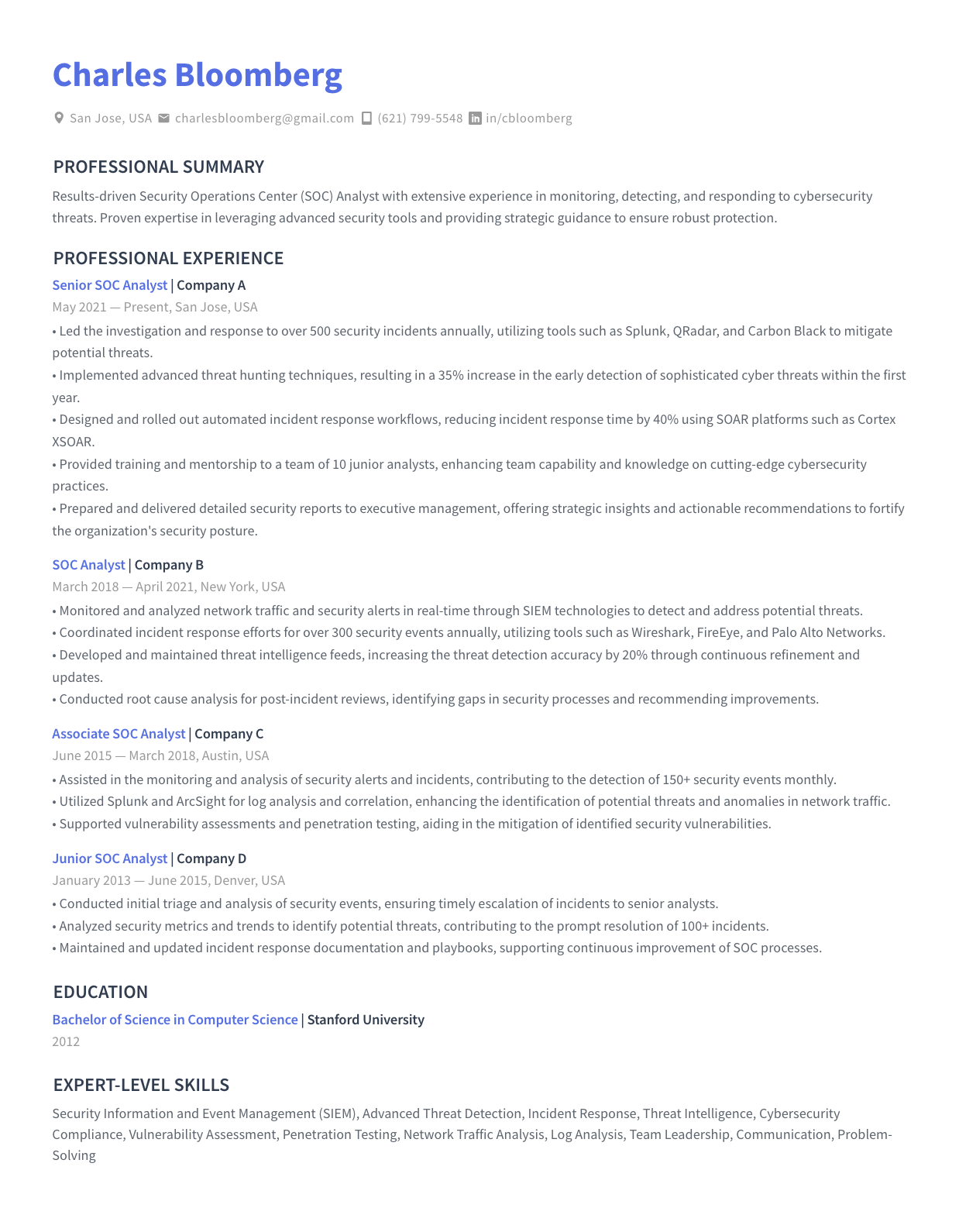
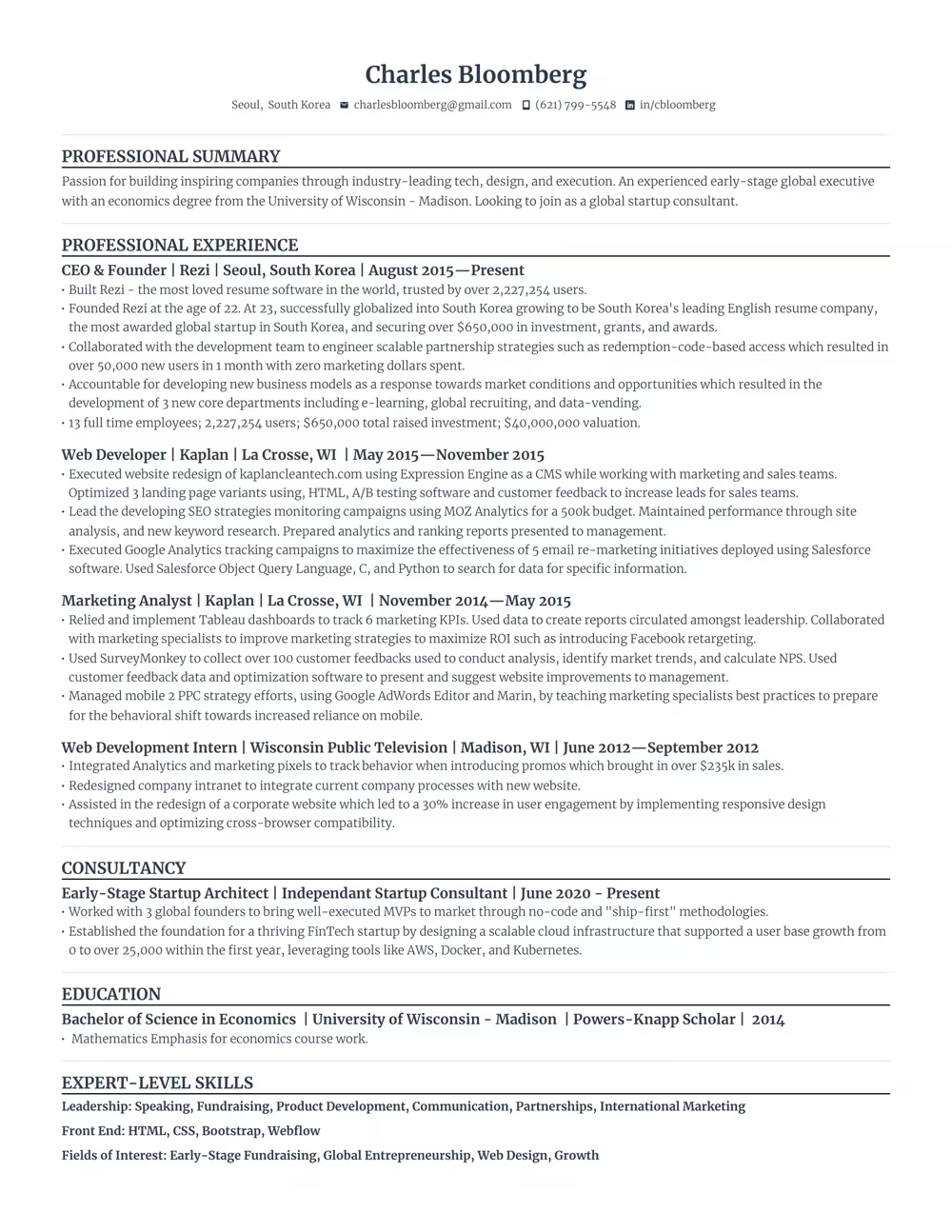
Ultimate readability and well-organized layout. Highlights what matters the most. A safe pick for all jobs across all industries.

Recommended:

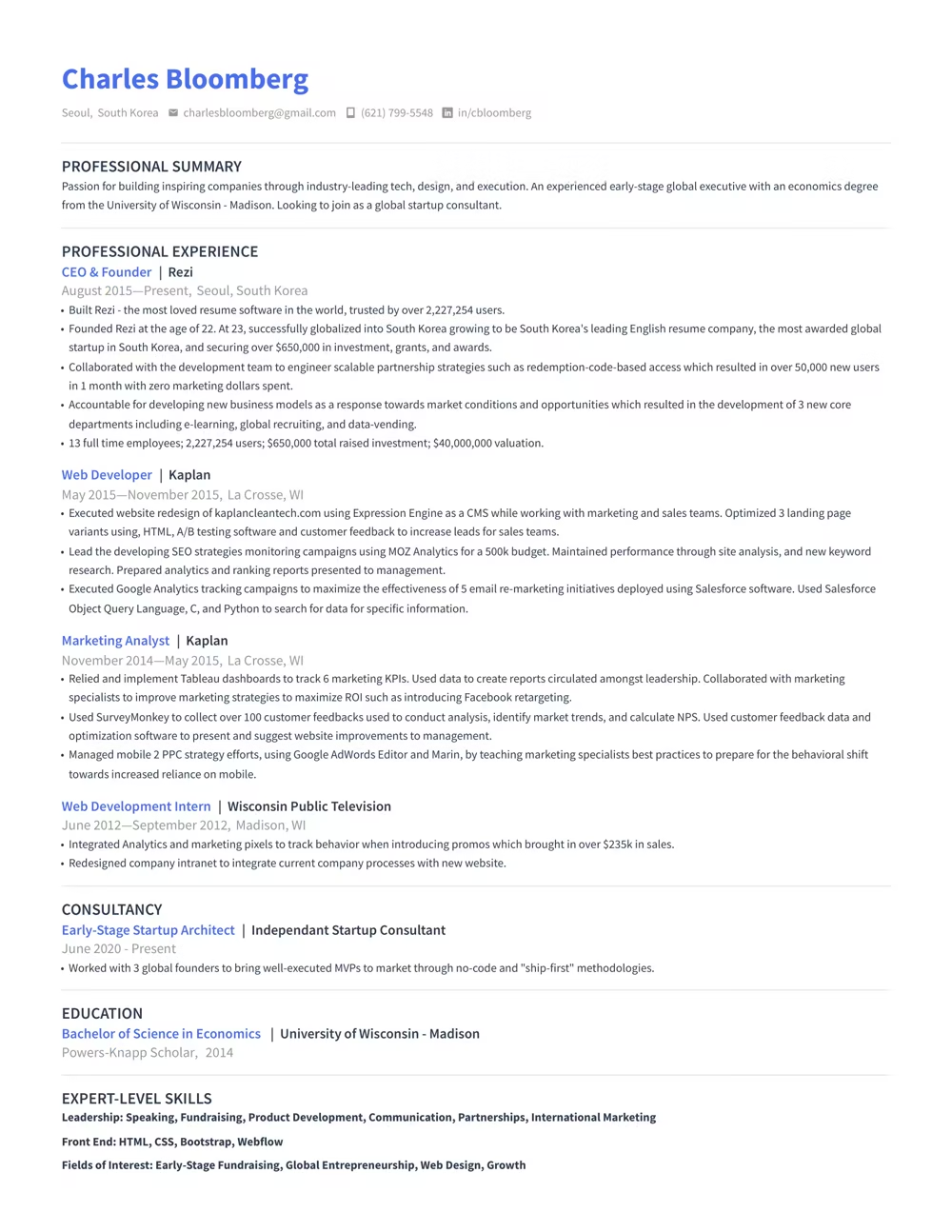
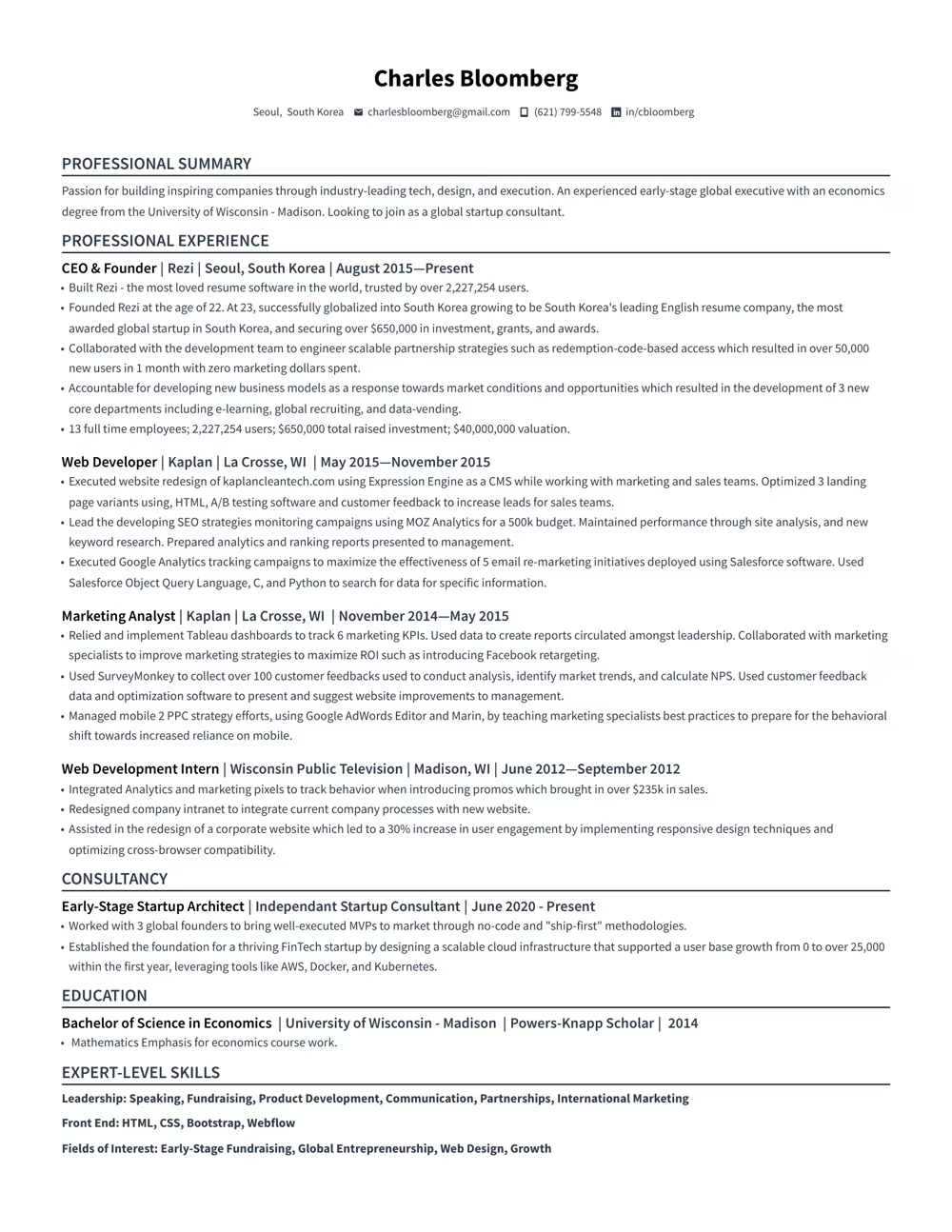
Negative space gives readers breathing room and guides their eyes to where you want them to go. Simplicity = sophistication.

Recommended:

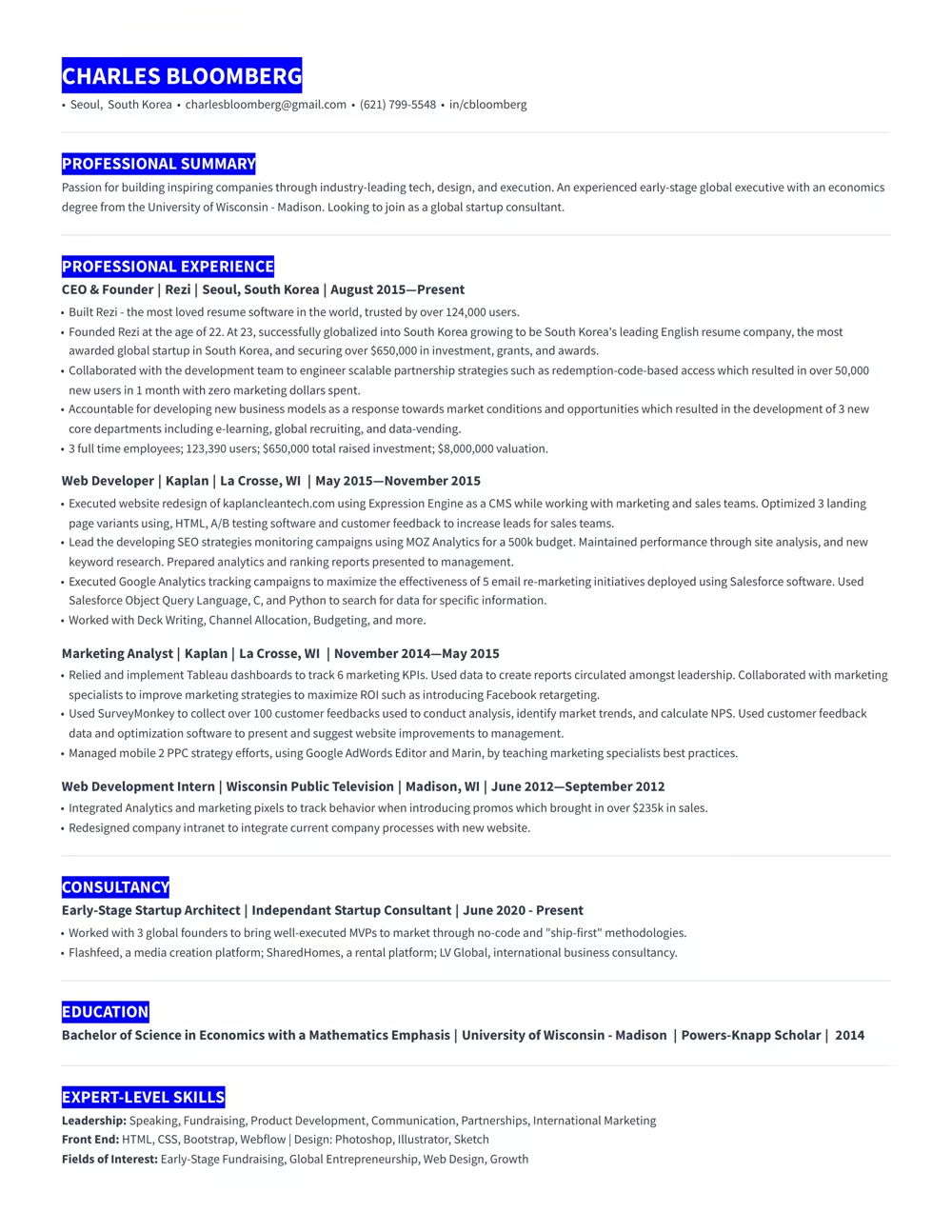
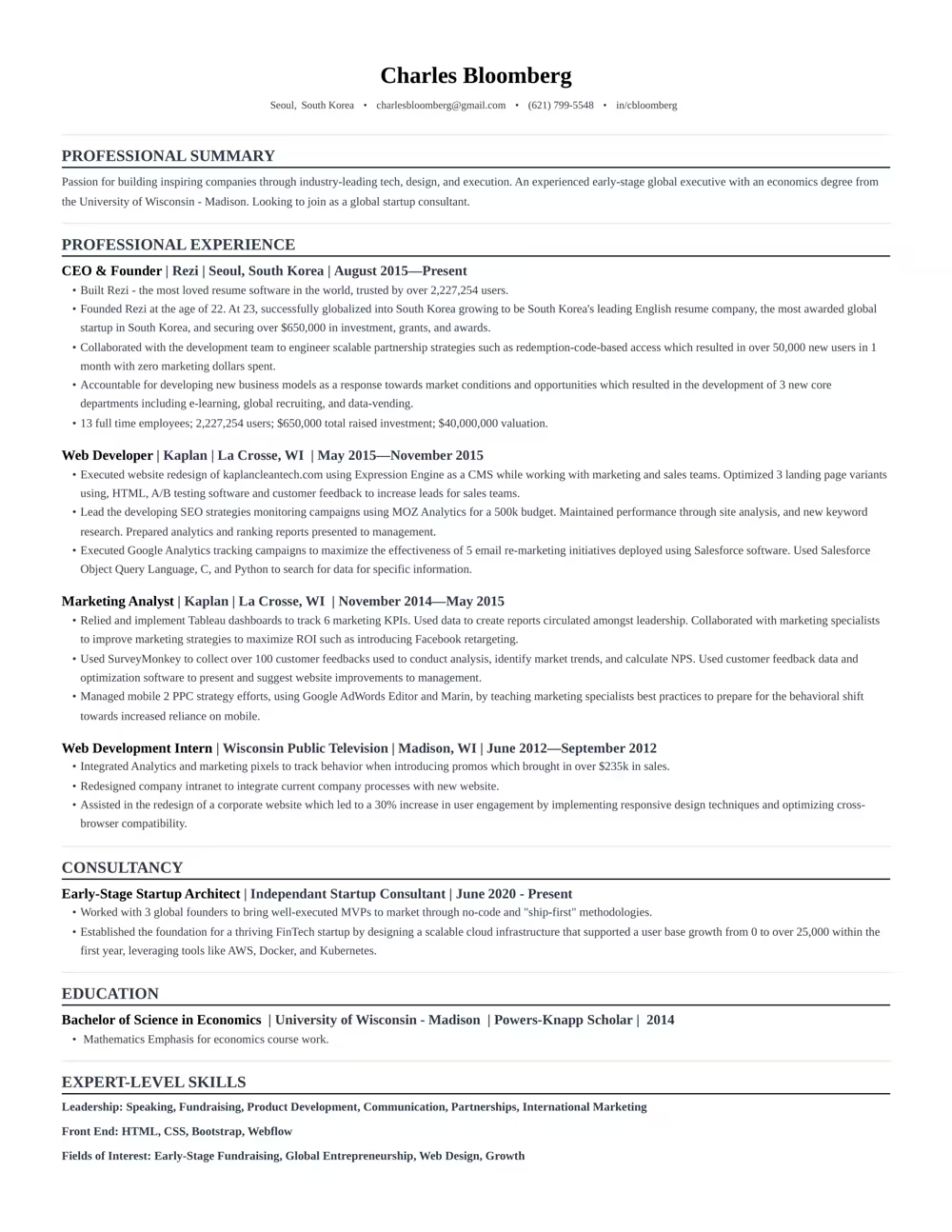
A design familiar for recruiters and hiring managers. Good for corporate positions where you’ll need to paint within the lines.

Recommended:

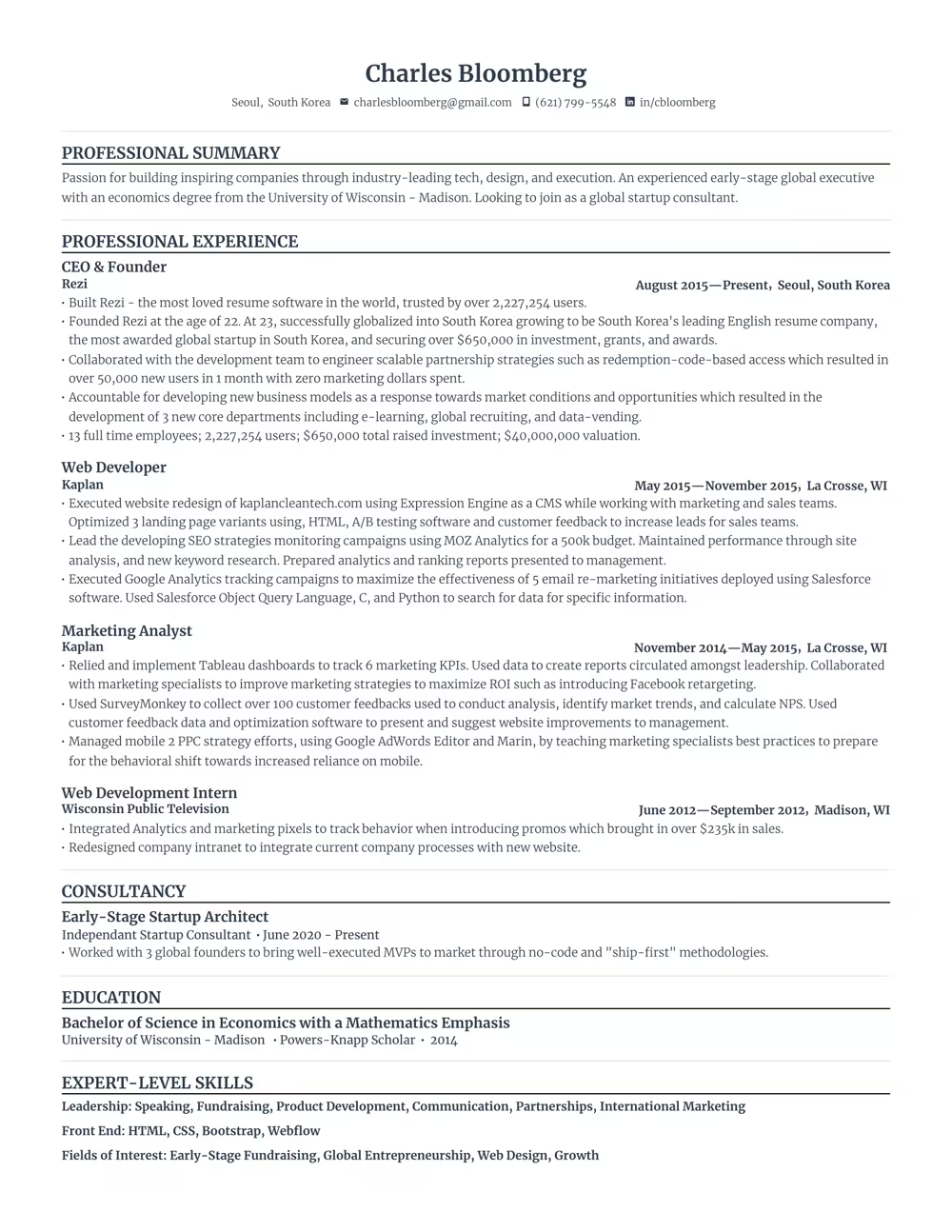
Maximizes page space for dense information. Ideal for seasoned professionals with a lot to say in a limited area.

Recommended:
Tagline

Lorem ipsum dolor sit amet, consectetur adipiscing elit. Suspendisse varius enim in eros elementum tristique. Duis cursus, mi quis viverra ornare, eros dolor interdum nulla, ut commodo diam libero vitae erat.

Rezi is an awesome AI-based resume builder that includes templates to help you design a resume that is sure to check the boxes when it comes to applicant tracking systems. This is a great jumping off point to kickstart a new resume.
Ashley Stahl from forbes image
Ashley Stahl
Career Contributor
Total Users
4,005,400
Interview Rate
62.18%
Avg. User Review
8.23/10
I uploaded my application to various websites like Indeed, LinkedIn, places like that, and I was not getting anything that was in the field that I wanted to be in. I put my information in rezi, and I was able to reorganize my experiences and come up with better bullet points for some of my volunteer experiences that were in that field. And now in the past week I've had like five interviews, and I was able to secure a part time job doing something in that field.
For some reason, I struggled a lot with choosing a format for my resume, and then managing that format when I wanted to make updates. With Rezi, I was able to simply input data, check out the preview, and know that it will be formatted correctly when I export the resume to Word. Rezi made it super easy to refine and iterate on my resume. There are alot of options for resume writing, and if you are reading this on the fence about whether to try Rezi, just do it. A simple, fast, well-designed resume tool.
Rezi is now the only place I edit my resume (I've ditched the Word doc I used to use), and I honestly believe that using Rezi has allowed me to create a much better resume than I would have on my own. I intend to keep using it and experimenting more with the AI generation for customizing the resume to different jobs.
Some difficulties that I faced when creating a resume, initially was formatting. Another feature that I've actually found myself using more often than I expected was the professional resume reviews. Other options that I tried in the past, some like, free alternatives. Some of them wouldn't let you say your resume or came with some unexpected strings, but Rezi is super upfront and continues to improve over time. I've recommended Rezi to several of my friends and colleagues who will continue to do so. I just love this product so much.
Not a paid promo. I've been looking for a change of jobs for almost a year. Got a few calls, but nothing what I wanted. Updated my CV through Rezi, the second call I got was from an MNC and something I was looking forward to. And here I am, completing my second month at the new place. I checked with my HR how she found me - it was through the Rezi cv (I had to check because I used to apply with my old CVs as well)Thank you, Rezi. Thank you, Jacob! Yes the UI, formatting, keyword suggestions etc are all great but the best of all - dedicated customer service.
... I created a few primary versions of my resume and then would copy them and use Rezi to suggest content for each job description. Rezi was helpful by comparing my resume to the job description and making suggestions for extra keywords. Using Rezi for this instead of doing it myself reduced my time per application from 1-2 hours down to 15 minutes. The response I got from applications with targeted resumes and cover letters using Rezi was high.
Rezi has been instrumental in a job search I've participated in in two specific instances. Number one, as my own personal resume customization tool. Searching through thousands of different job descriptions as an MBA student, Rezi really helped me reinforce my resume or customize my resume for the job descriptions I thought were most important. And was a great support tool on top of what I already received as a part of a full time MBA program.
UI: Firstly, the UI is a breeze. It's real fun to use, and what I like most is the fact that the application divides your resume into different sections, and you get to work on each section at a time. Psychologically, this helps you alleviate anxiety and just work on one thing at a time.
Formatting: Trying to format your resume on Google Docs or MS Word or even Latex can be a hassle more often than not. REZI.AI does your formatting like a charm. There's a handful of nifty features like the auto-tune (which automatically adjusts stuff), borders, accent colors and others.
ATS Scoring: This is perhaps the USP of REZI. You can target a resume for a job description and view the score corresponding to that particular application.
I've used many different resume building webistes, all of them ended up wanting more and more money. Rezi on the otherhand has the lifetime option which allows a good taste of what it could do. But overall it is nice and clear what I am supposed to do and love the PDF download option. Not many templates but they are all simple and to the point. Thank you for creating and offering this as a service!
Support

Frequently Asked Questions (FAQs)

What is the best AI resume builder?

Rezi, of course.

What are the main differences between Rezi's Free, Pro, and Lifetime plans?

The Free plan is $0/month and allows you to create one resume, use limited AI tools (such as Keyword Targeting and Analysis), and download up to three PDFs. You can also create unlimited cover and resignation letters. No card is required to begin.

The Pro plan is $29/month and provides unlimited access to all features, including unlimited resumes, full AI capabilities, unlimited downloads, and one free monthly expert resume review (resumes are reviewed by a person).

The Lifetime plan is a $149 one-time payment. It grants permanent access to all the features of the Pro plan (unlimited resumes, full AI tools, and unlimited downloads), but it does not include the free monthly expert review (which can be purchased for an extra fee).

What is your refund policy?

Rezi offers a 100% money-back guarantee on all paid plans (Pro and Lifetime). If you are unsatisfied, you can request a full refund within 30 days of your purchase.

Can I switch or upgrade plans later?

Yes, you can easily upgrade or downgrade your plan at any time through your Rezi Account Billing dashboard. Prorated credits will apply when switching.

Can Rezi assist my organization with creating resumes?

Yes. Rezi Enterprise

Ready to build
your resume?

Join over 4 million people who use Rezi to take control of their job search.