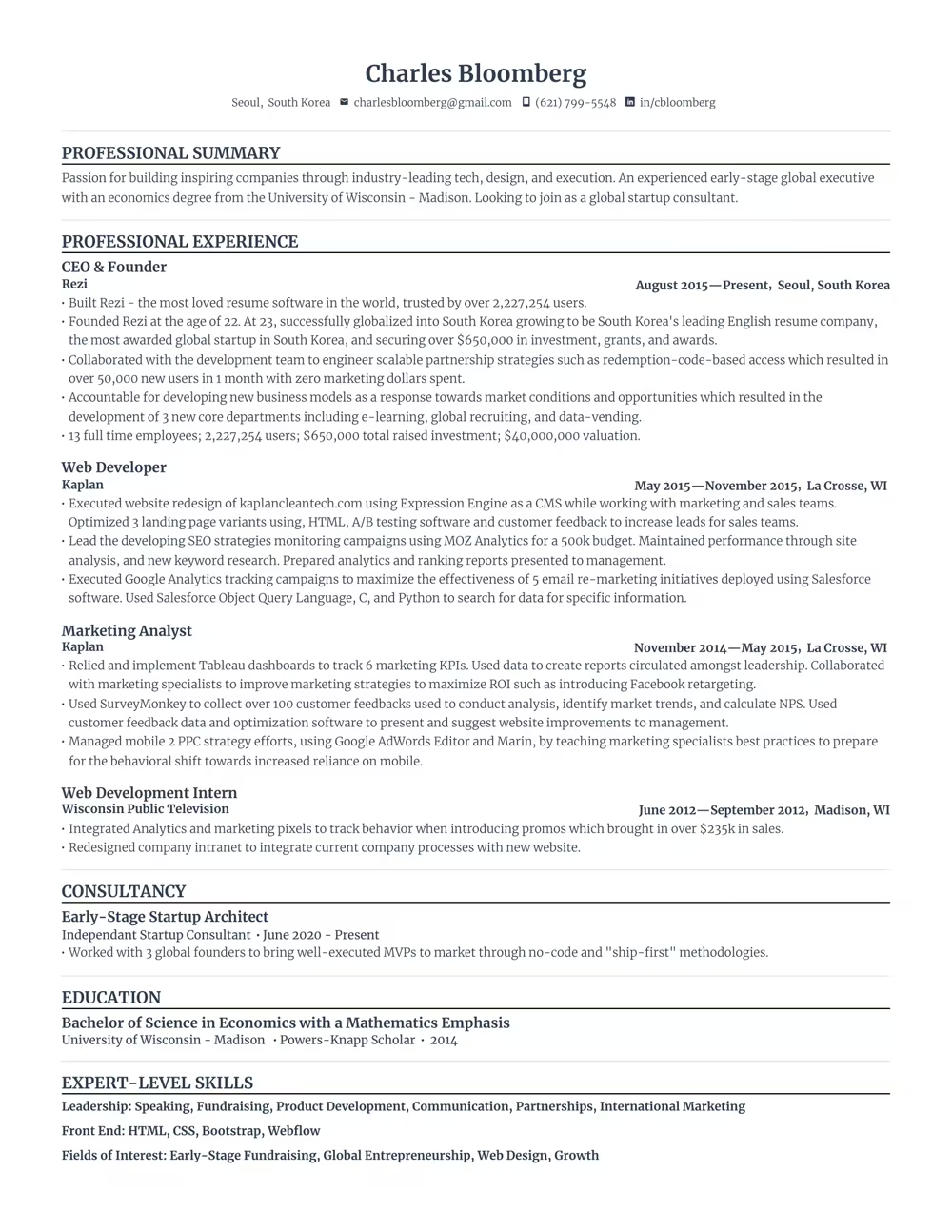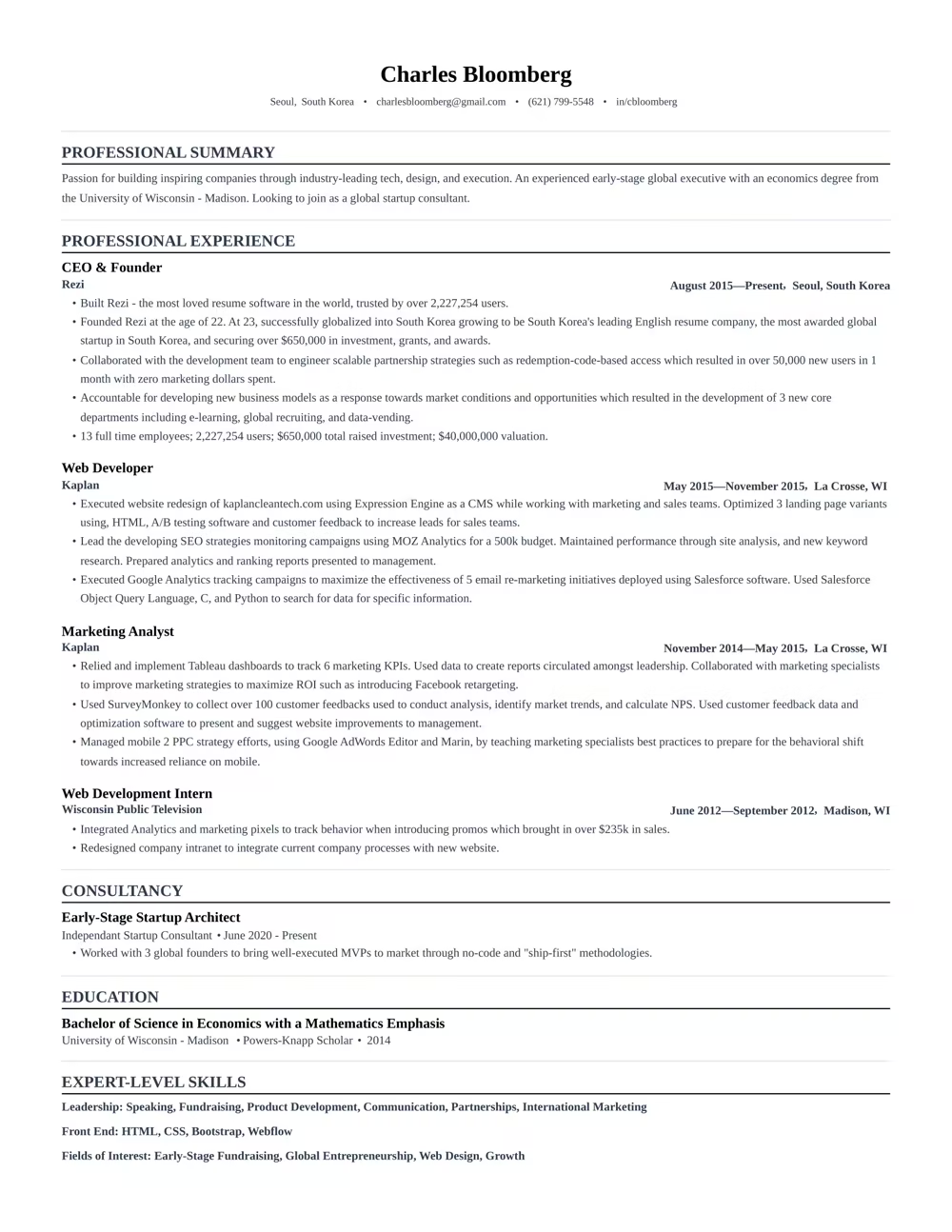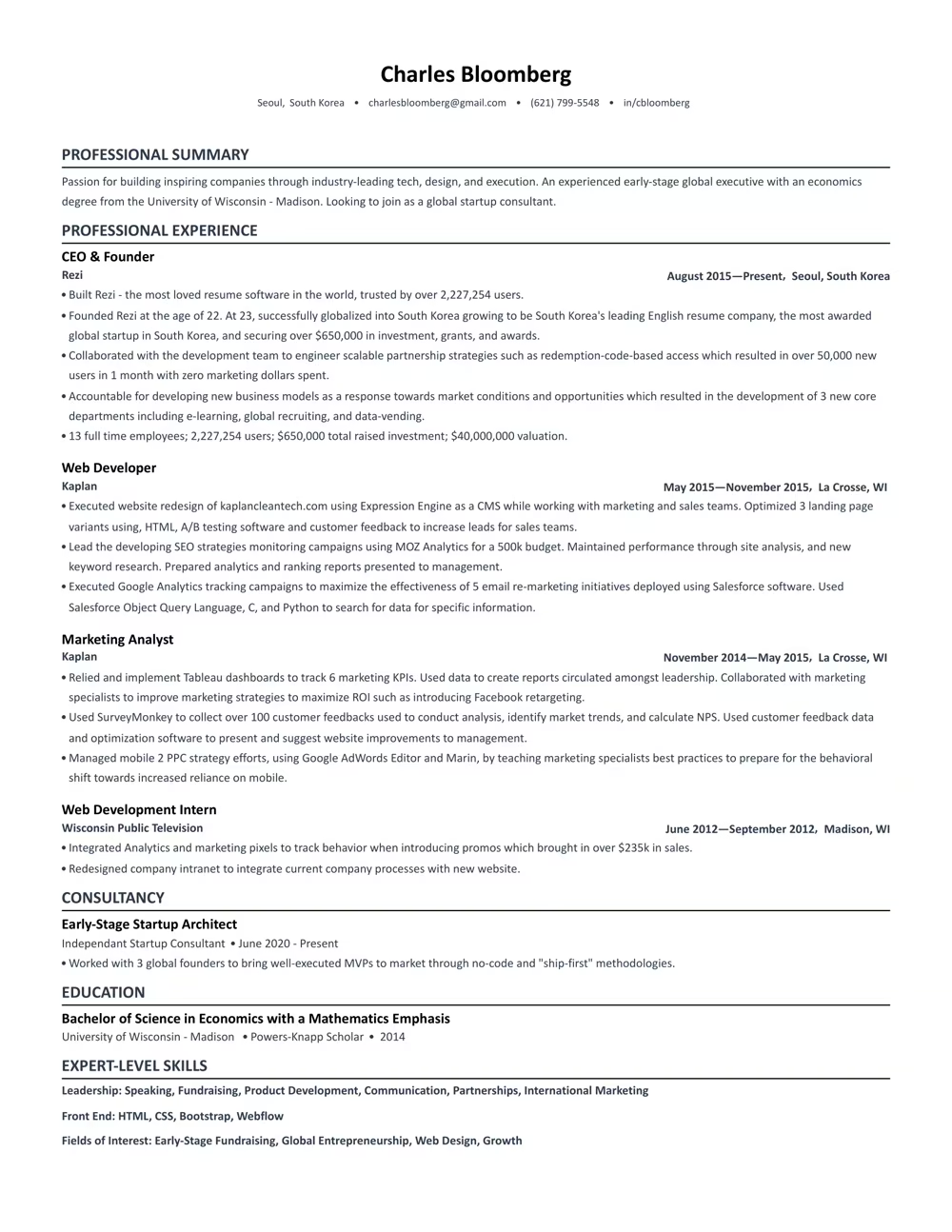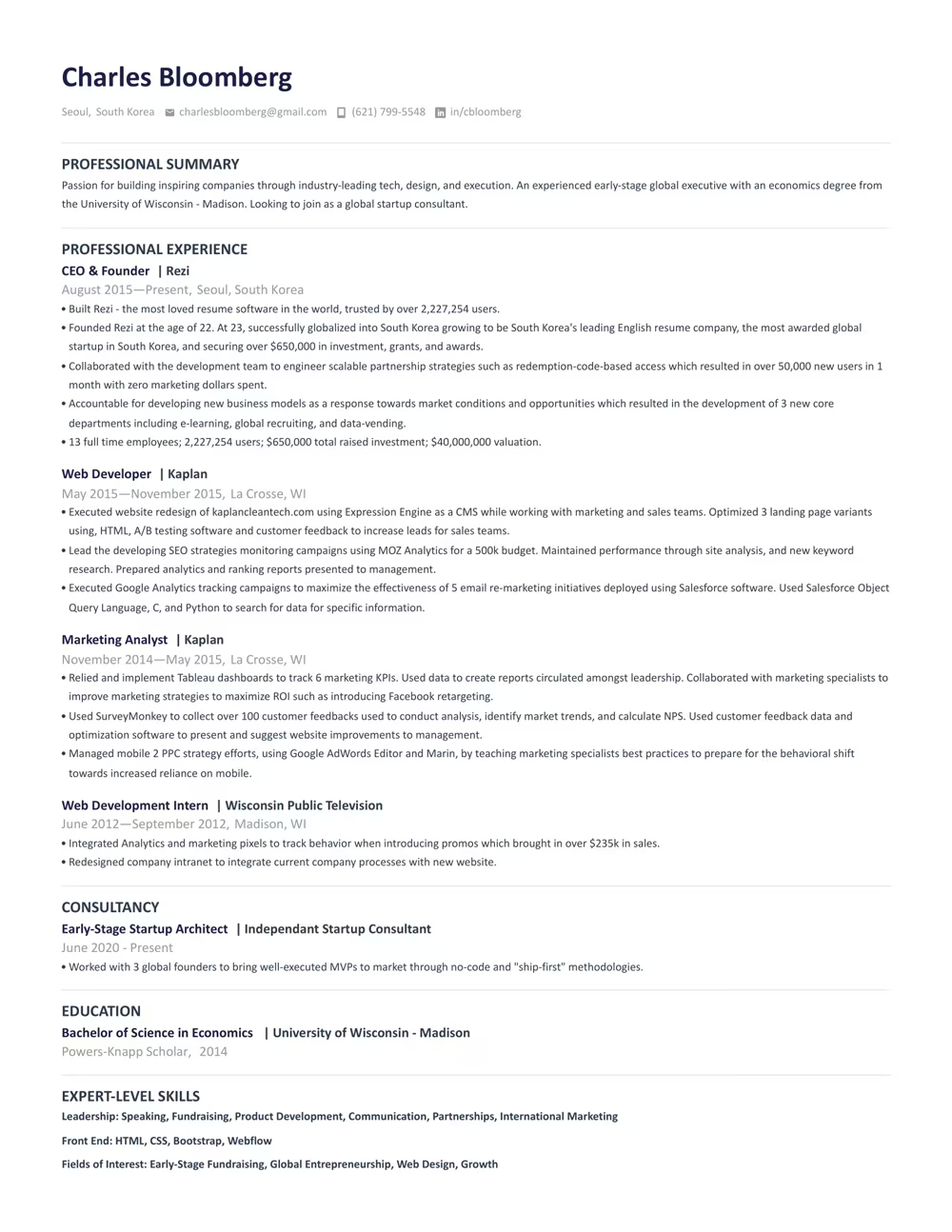

Here's the thing most statistical analyst resumes get wrong: they read like a list of software you've used and courses you've taken. Rows of tools, methods, and acronyms—but almost nothing about what you actually discovered with them or how your analysis changed a decision.
A strong statistical analyst resume tells a story about turning messy data into clear, actionable insights. It shows you can design studies, choose the right methods, interpret results correctly, and—critically—communicate findings to people who don't speak statistics.
And this is exactly what you'll learn from this article. Inside, you'll find:
- Examples of 9+ statistical analyst resumes, covering different specializations and experience levels.
- Insider tips about what really matters to recruiters and hiring managers filling statistical analyst roles.
- A step-by-step guide for building a statistical analyst resume that actually lands interviews.
Sample Statistical Analyst Resumes
Take a look at some top-notch sample resumes for statistical analysts across different specializations and career stages. Find one that matches your profile and use it as a starting point—just make sure to adjust the details to reflect your own experience and accomplishments.
Junior Statistical Analyst
A Junior Statistical Analyst resume should emphasize your educational foundation, relevant coursework in statistics or mathematics, and any internship or project experience involving data analysis. Highlight proficiency in tools like R, Python, or SAS, even if gained in academic settings. Showcase your ability to clean data, run basic analyses, and present findings clearly. Any experience with real-world datasets or capstone projects will strengthen your resume considerably.
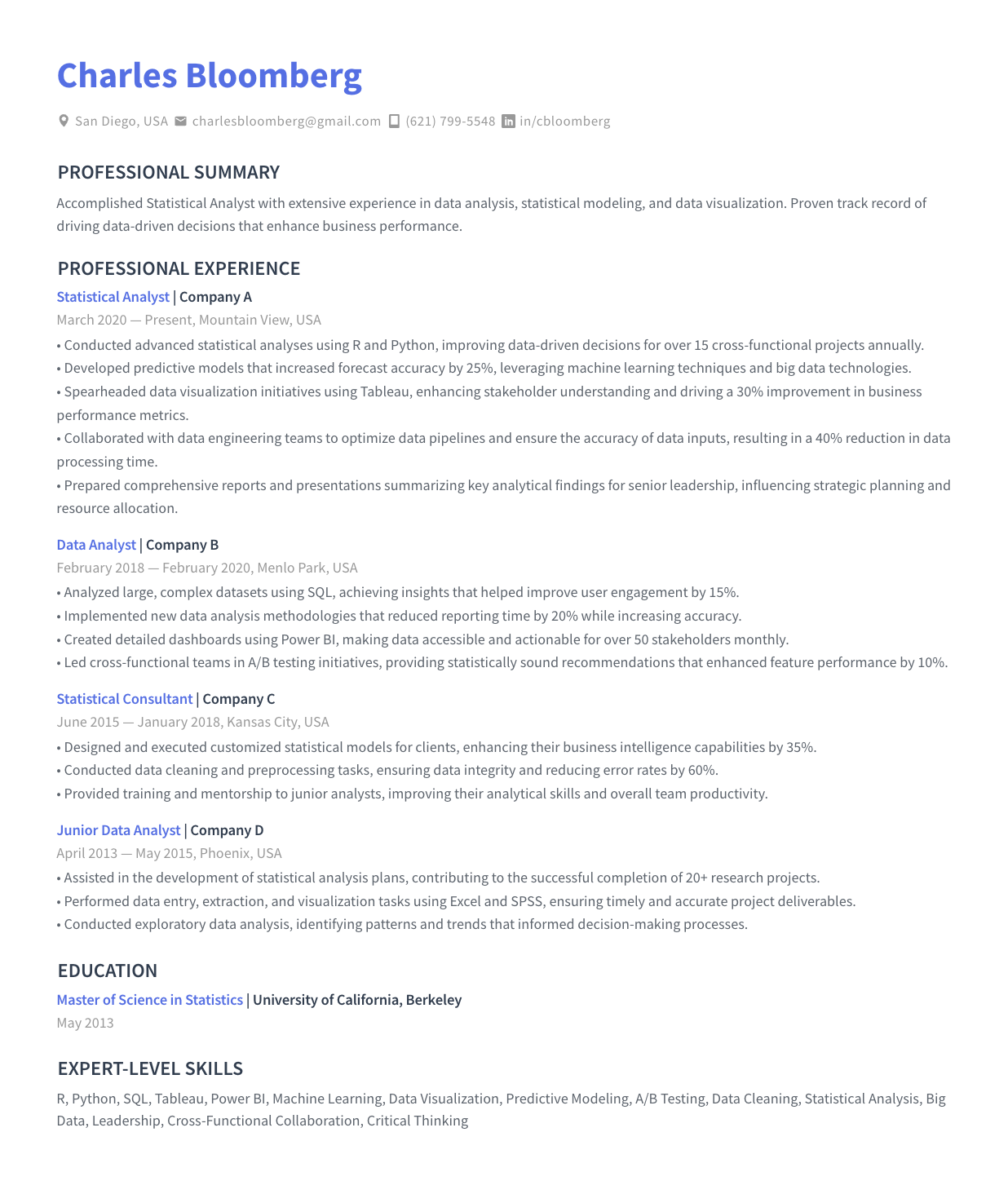
Charles Bloomberg
charlesbloomberg@gmail.com
PROFESSIONAL SUMMARY
Detail-oriented Junior Statistical Analyst with robust expertise in data manipulation and statistical analysis to inform business decision-making. Proven track record in using analytical software to enhance operational efficiency and drive data-backed strategies.
PROFESSIONAL Experience
Junior Statistical Analyst | Company A
April 2023 — Present, Seattle, USA
• Conducted statistical analysis on datasets exceeding 500,000 entries using Python and R, leading to a 20% improvement in operational efficiencies.
• Developed predictive models that enhanced customer segmentation accuracy by 15% using machine learning algorithms in a cloud computing environment.
• Streamlined data visualization processes via Tableau, reducing report preparation time by 30% while increasing clarity for decision-makers.
• Collaborated with senior analysts to design and implement A/B testing protocols, resulting in a 10% increase in marketing campaign effectiveness.
• Validated data integrity of over 100 datasets per month, ensuring compliance with industry standards and company policy.
Data Analyst Intern | Company B
June 2022 — March 2023, Mountain View, USA
• Assisted in cleansing and organizing datasets totaling 300,000 records, achieving a 98% accuracy rate for data analysis initiatives.
• Implemented Excel automation techniques that reduced manual entry errors by 40%, improving data accuracy and reliability.
• Supported the creation of quarterly performance dashboards with SQL and Power BI, conveying insights that influenced strategic priorities.
• Compiled and presented data-driven insights to cross-functional teams on a weekly basis, fostering informed decision-making processes.
Research Assistant | Company C
January 2021 — May 2022, Austin, USA
• Formulated research methodologies and executed data collection, resulting in comprehensive reports for five projects simultaneously.
• Used SPSS and SAS for advanced statistical testing on a range of datasets, enhancing result accuracy by 25% for all analyses.
• Communicated findings and implications to stakeholders in monthly meetings, contributing to an increase in understanding critical data points.
Statistical Consultant | Company D
June 2020 — December 2020, New Haven, USA
• Provided statistical consultancy for 12 mid-size business clients, improving their data-driven decision-making processes.
• Engineered custom data models using Python, achieving a 30% improvement in predictive accuracy for client projects.
• Delivered trainings on statistical software tools, leading to a 60% increase in client proficiency and adoption rates.
Education
Bachelor of Science in Statistics | University of California, Berkeley
May 2020
Expert-Level Skills
Statistical Analysis, Data Visualization, Machine Learning, Python, R, SQL, SPSS, SAS, Tableau, Power BI, Excel Automation, Predictive Modeling, A/B Testing, Data Integrity, Problem-solving, Communication
Mid-Level Statistical Analyst
For a Mid-Level Statistical Analyst, your resume should demonstrate a track record of independently conducting analyses that informed business or research decisions. Emphasize your expertise with multiple statistical methods, your ability to manage projects from data collection through reporting, and your experience collaborating with cross-functional teams. Quantify your impact—mention the scope of datasets, accuracy improvements, or cost savings your analyses enabled.
Charles Bloomberg
charlesbloomberg@gmail.com
PROFESSIONAL SUMMARY
Detail-oriented Statistical Analyst with over 6 years of experience in leveraging statistical models and data analysis techniques to drive actionable insights and business decisions. Proficient in utilizing advanced analytics tools to interpret complex datasets and communicate findings effectively to stakeholders.
PROFESSIONAL Experience
Statistical Analyst | Company A
March 2019 — Present, Seattle, USA
• Developed predictive models using R and Python, resulting in a 15% increase in forecasting accuracy across 12 product lines and improving demand planning efficiency by 20%.
• Implemented a data visualization strategy using Tableau and Power BI, decreasing report generation time by 50% and enhancing data-driven decision-making for 5 cross-functional teams.
• Conducted in-depth statistical analysis on customer purchasing behavior over 3 years, identifying key trends that helped tailor marketing strategies, contributing to a 10% boost in sales conversion rates.
• Collaborated with the data engineering team to optimize a data processing pipeline, reducing processing times by 40% and enabling faster data availability for analysis.
• Spearheaded an initiative to enhance A/B testing methodologies, increasing test result accuracy by 12% and ensuring data integrity for over 50 experiments annually.
Data Analyst | Company B
June 2016 — February 2019, Mountain View, USA
• Analyzed large datasets using SQL and Excel, uncovering key insights that drove a 25% improvement in customer segmentation strategies over 7 distinct market segments.
• Engineered automated dashboards and reporting systems using existing data infrastructure, reducing manual reporting efforts by 30 hours per month.
• Managed data collection initiatives, designing and executing data integrity checks that improved data quality scores by 18%.
• Directed analytical projects focusing on user engagement metrics, delivering actionable recommendations that increased user engagement by 8% within 4 months.
Junior Statistical Analyst | Company C
January 2014 — May 2016, Raleigh, USA
• Assisted in the design and deployment of statistical models for 3 major clients, leading to enhanced predictive accuracy by 10%.
• Provided support in the preparation and presentation of detailed analytical reports for 15+ stakeholders, contributing to enhanced client satisfaction ratings by 12%.
• Conducted thorough research on industry trends, supporting strategic planning efforts and delivering comprehensive market intelligence.
Data Analyst Intern | Company D
June 2013 — December 2013, Charlotte, USA
• Assisted in data collection and preprocessing for survey projects, ensuring a 95% data accuracy rate for 5 distinct studies.
• Supported the analysis of market research data, contributing to the drafting of 10 detailed reports that informed marketing campaigns.
• Collaborated with senior analysts to develop and test data models, gaining practical experience with statistical software such as SPSS.
Education
Bachelor of Science in Statistics | North Carolina State University
May 2013
Expert-Level Skills
R, Python, SQL, Data Visualization, Predictive Modeling, A/B Testing, Tableau, Power BI, Excel Advanced Functions, Statistical Analysis, Data Processing, Attention to Detail, Problem Solving
Senior Statistical Analyst
A Senior Statistical Analyst resume should showcase leadership in designing complex analytical frameworks, mentoring junior analysts, and driving strategic decisions through data. Highlight experience with advanced methods such as multivariate analysis, Bayesian modeling, or machine learning. Demonstrate your ability to communicate technical findings to executive stakeholders and your role in shaping organizational data strategy. Include any publications, conference presentations, or methodology innovations.
Charles Bloomberg
charlesbloomberg@gmail.com
PROFESSIONAL SUMMARY
Highly analytical Senior Statistical Analyst with over a decade of experience leveraging data-driven insights to drive decision-making and strategic planning. Expert in statistical modeling, data interpretation, and delivering actionable business solutions across various industries.
PROFESSIONAL Experience
Senior Statistical Analyst | Company A
January 2021 — Present, New York City, USA
• Developed and implemented advanced statistical models using R and Python, analyzing over 5 million data points monthly to drive efficiency improvements across multiple business units.
• Spearheaded a data visualization initiative using Tableau, leading to a 30% improvement in stakeholder engagement and understanding of complex data sets over the last 2 years.
• Collaborated with cross-functional teams to analyze trends, resulting in the identification of over $1 million in cost savings through strategic pricing adjustments.
• Engineered predictive models utilizing machine learning algorithms to forecast market trends, enhancing decision-making accuracy by 25% within the first 6 months.
• Led training sessions for junior analysts, enhancing team productivity by 15% and reducing project turnaround time by implementing best practices in statistical analysis.
Statistical Analyst | Company B
August 2017 — December 2020, Seattle, USA
• Conducted comprehensive data analyses for over 100 departmental projects, providing actionable insights that led to a 20% increase in process efficiency.
• Optimized customer behavior models which improved targeted marketing campaign ROI by 35%, leveraging sophisticated regression analysis techniques.
• Obtained and cleaned large datasets using SQL to ensure data integrity for monthly reports distributed to leadership teams, reducing errors by 10%.
• Assisted in the development of econometric models to forecast sales trends, increasing forecasting accuracy by 22% year-over-year.
Junior Statistical Analyst | Company C
May 2015 — July 2017, Chicago, USA
• Analyzed operational data using statistical tools, uncovering inefficiencies that reduced operational costs by 15% across multiple sectors.
• Created interactive dashboards in Microsoft Power BI, improving real-time data usage and aiding in the rapid response to market changes.
• Supported data-driven decision making by managing and interpreting datasets containing over 500,000 entries, enhancing business policy formulation.
Data Analyst Intern | Company D
June 2014 — April 2015, Boston, USA
• Conducted statistical analysis for client projects, increasing report accuracy by 18% through diligent data validation processes.
• Automated data report generation processes using Excel VBA, reducing preparation time by 30% for daily updates.
• Researched and presented findings on market trends to senior analysts, contributing to strategic planning efforts across key sectors.
Education
Bachelor of Science in Statistics | Harvard University
May 2014
Expert-Level Skills
Statistical Modeling, Data Analysis, R, Python, SQL, Tableau, Predictive Analytics, Regression Analysis, Machine Learning Algorithms, Data Visualization, Econometrics, Problem-Solving, Strong Communication
Biostatistical Analyst
For a Biostatistical Analyst resume, emphasize your experience with clinical trial design, survival analysis, and regulatory submissions. Highlight proficiency in SAS and familiarity with FDA or EMA guidelines. Showcase your understanding of study protocols, sample size calculations, and safety/efficacy endpoint analysis. Mention any experience with CDISC standards, SDTM, or ADaM datasets. Certifications or advanced degrees in biostatistics will significantly strengthen your candidacy.
Charles Bloomberg
charlesbloomberg@gmail.com
PROFESSIONAL SUMMARY
Accomplished Biostatistical Analyst with extensive experience in designing and analyzing clinical trials. Excels in applying advanced statistical techniques to drive insights and decision-making in healthcare research.
PROFESSIONAL Experience
Biostatistical Analyst | Company A
January 2022 — Present, Raleigh, USA
• Developed and validated complex statistical models to analyze over 50 clinical trial datasets, providing robust results that informed key project decisions.
• Spearheaded the analysis of Phase III clinical trial data using SAS and R, enhancing process efficiency by 25% and accuracy by 20%.
• Collaborated with multidisciplinary teams to design study protocols, improving trial approval rate by 15% through strategic consultations.
• Managed data for over 10 large-scale projects concurrently, ensuring data integrity and compliance with regulatory standards.
• Implemented automated reporting solutions reducing report generation time by 40% using advanced scripting techniques.
Biostatistical Analyst | Company B
August 2018 — December 2021, Thousand Oaks, USA
• Analyzed and interpreted data for 30+ clinical trials, improving throughput with insights using R and Python.
• Led a team of 4 junior analysts in refining data strategies, contributing to a 15% increase in accuracy of clinical data reporting.
• Engineered predictive models that resulted in a 20% reduction in data anomalies across multiple studies.
• Provided biostatistical consultancy to project teams, facilitating the successful design of strategies that saved an estimated 10% in project costs.
Data Analyst | Company C
March 2015 — July 2018, Chapel Hill, USA
• Maintained and analyzed large datasets to drive business decisions, leveraging SQL and SPSS to improve data accuracy by 30%.
• Successfully completed statistical analysis and reporting for six healthcare studies, providing actionable insights to stakeholders.
• Directed data cleaning initiatives, reducing errors by 25% through meticulous data verification techniques.
Junior Biostatistician | Company D
July 2012 — February 2015, Durham, USA
• Assisted in the integration of cutting-edge statistical software, reducing analysis time by 20% across various clinical trials.
• Tracked and validated patient data for multiple projects, improving data reliability by 10%.
• Produced comprehensive reports for senior management that facilitated better understanding and strategic planning.
Education
Master of Science in Biostatistics | University of North Carolina at Chapel Hill
May 2012
Expert-Level Skills
Clinical Trial Design, Statistical Modeling, SAS, R, Python, SPSS, Data Analysis, Predictive Modeling, Data Management, Regulatory Compliance, Team Leadership, Communication, Problem Solving
Statistical Data Analyst
A Statistical Data Analyst resume should balance strong statistical methodology knowledge with hands-on data engineering skills. Highlight your experience with data wrangling, database querying (SQL), and building automated reporting pipelines alongside your statistical analysis capabilities. Show how you bridged the gap between raw data infrastructure and meaningful statistical insights. Mention experience with visualization tools like Tableau or Power BI to demonstrate your ability to communicate findings effectively.
Charles Bloomberg
charlesbloomberg@gmail.com
PROFESSIONAL SUMMARY
Detail-oriented Statistical Data Analyst with over 7 years of experience in leveraging advanced statistical methods and data visualization techniques to drive business decisions. Proven expertise in predictive modeling, data mining, and statistical analysis to uncover insights and optimize performance.
PROFESSIONAL Experience
Statistical Data Analyst | Company A
March 2022 — Present, Omaha, USA
• Developed and implemented predictive models using Python and R, resulting in a 20% increase in forecasting accuracy for product demand across multiple regions.
• Conducted data mining exercises on over 500 million data records annually to identify trends and patterns, contributing to a 15% reduction in costs.
• Collaborated with cross-functional teams to design A/B tests, analyzing results to inform strategic business initiatives and improving conversion rates by 10%.
• Built interactive data visualization dashboards using Tableau, enhancing decision-making processes and reducing report generation time by 30%.
• Analyzed cross-sectional and time-series data using advanced statistical methods to guide corporate strategy and improve performance metrics by 12%.
Quantitative Analyst | Company B
June 2018 — February 2022, Seattle, USA
• Spearheaded the analysis of customer behavior data using SQL, uncovering insights that increased customer retention by 18%.
• Engineered and optimized complex algorithms for risk assessment, reducing fraudulent transactions by 25% through improved detection systems.
• Produced comprehensive reports on key performance indicators, assisting leadership in making data-driven strategic decisions that expanded market reach by 7%.
• Led training sessions for over 50 team members on statistical analysis and data visualization tools, enhancing team productivity by 15%.
Data Analyst | Company C
September 2015 — May 2018, Nashville, USA
• Implemented automated data processing scripts, decreasing data preparation time by 40% and increasing efficiency in data handling for 200+ datasets.
• Developed predictive models for sales forecasting using logistic regression, contributing to a 10% increase in sales accuracy.
• Processed and analyzed large datasets with over 2 million entries using SQL, ensuring data integrity and accuracy for reporting purposes.
Junior Data Analyst | Company D
January 2013 — August 2015, Chicago, USA
• Assisted in the design and execution of market research studies, analyzing survey data from 5,000+ respondents to generate actionable insights.
• Conducted statistical analysis using SPSS, delivering detailed reports that aided in marketing strategy development, boosting campaign ROI by 10%.
• Supported data validation and cleansing activities, maintaining a database accuracy rate of 99.5%.
Education
Bachelor of Science in Statistics | University of California, Berkeley
December 2012
Expert-Level Skills
Statistical Analysis, Predictive Modeling, Data Mining, Python, R, SQL, Tableau, SPSS, A/B Testing, Data Visualization, Algorithm Development, Team Collaboration, Problem Solving, Strategic Thinking
Applied Statistics Analyst
For an Applied Statistics Analyst, your resume should showcase your ability to translate theoretical statistical methods into practical solutions for real-world problems. Highlight experience across multiple domains—marketing, operations, finance, or manufacturing—demonstrating your versatility. Emphasize experimental design, A/B testing, forecasting, or optimization projects. Show how your analyses directly influenced business outcomes, and detail the specific methods and tools you employed to get there.
Charles Bloomberg
charlesbloomberg@gmail.com
PROFESSIONAL SUMMARY
Detail-oriented Applied Statistics Analyst with over 8 years of experience in data analysis and statistical modeling using advanced techniques to drive data-driven decision-making and improve operational efficiencies.
PROFESSIONAL Experience
Applied Statistics Analyst | Company A
March 2021 — Present, San Jose, USA
• Developed predictive models using Python and R, yielding a 30% increase in forecast accuracy and resulting in $1M savings annually.
• Conducted complex data analyses using SQL and SAS, handling datasets over 100 million rows to identify actionable insights that improved marketing ROI by 15%.
• Spearheaded a cross-functional project to integrate machine learning algorithms, reducing processing time by 40% and enhancing decision-making speed.
• Led training sessions for over 50 employees on statistical tools and methodologies, increasing team proficiency by 25% within 6 months.
• Collaborated with IT and data teams to create dynamic dashboards utilizing Tableau, optimizing reporting time by 50%.
Quantitative Analyst | Company B
January 2018 — February 2021, New York City, USA
• Implemented advanced statistical models to track and forecast financial indicators, enhancing forecast accuracy by 35%.
• Developed automated data processing scripts using Python that reduced data handling time by 60%.
• Improved risk assessment models, resulting in a 20% reduction in potential financial exposure.
Data Analyst | Company C
June 2015 — December 2017, Phoenix, USA
• Engineered visualization tools in Excel to streamline departmental reporting, diminishing report creation time by 30%.
• Analyzed large datasets to support business strategy decisions, directly contributing to a 10% increase in revenue.
• Facilitated research initiatives to validate customer segmentation models, achieving a 98% segmentation accuracy.
Statistical Analyst | Company D
August 2012 — May 2015, Austin, USA
• Conducted statistical data analysis using SPSS, providing insights that increased client acquisition rates by 50%.
• Formulated hypothesis tests and A/B experiments, leading to the successful launch of 10 key product initiatives.
• Achieved excellence in providing statistical consultancy, receiving 95% customer satisfaction feedback ratings.
Education
Master of Science in Applied Statistics | Stanford University
June 2012
Expert-Level Skills
Statistical Modeling, Predictive Analytics, Python, R, SQL, SAS, Tableau, Machine Learning, Data Visualization, Excel, SPSS, Problem Solving, Collaborative Leadership, Communication
Healthcare Statistical Analyst
A Healthcare Statistical Analyst resume should highlight your understanding of healthcare data systems, HIPAA compliance, and epidemiological methods. Emphasize experience with claims data, electronic health records, or population health datasets. Showcase analyses that improved patient outcomes, reduced costs, or informed clinical decision-making. Proficiency in SAS, R, or Python alongside familiarity with ICD codes, quality metrics, and healthcare reporting standards will make your resume stand out.
Charles Bloomberg
charlesbloomberg@gmail.com
PROFESSIONAL SUMMARY
Detail-oriented Healthcare Statistical Analyst with over 8 years of experience utilizing advanced statistical methods to optimize patient care and streamline healthcare operations. Proven ability to translate complex data into actionable insights that lead to improved clinical outcomes and reduced operational costs.
PROFESSIONAL Experience
Healthcare Statistical Analyst | Company A
January 2021 — Present, Boston, USA
• Led the analysis of over 200,000 patient records to identify trends and patterns, resulting in a 15% improvement in treatment efficacy using Python and SAS.
• Developed predictive models using R to forecast patient admission rates, achieving a 12% reduction in hospital readmission rates over 18 months.
• Collaborated with cross-functional teams to streamline data processes, reducing data processing time by 25% and improving accuracy by 10%.
• Managed the implementation of a new data visualization platform, enhancing data accessibility and user engagement for over 300 healthcare professionals.
• Spearheaded a project that integrated machine learning algorithms into existing data systems, raising predictive accuracy by 20%.
Data Analyst | Company B
May 2017 — December 2020, Oakland, USA
• Conducted in-depth analyses on patient care data for over 50 healthcare facilities, contributing to a 10% decline in operational costs.
• Built and maintained statistical models in SQL and SPSS that improved patient care decision-making processes.
• Provided analytical reports and visualizations to senior management, facilitating strategic planning and policy-making.
• Assisted in the design and implementation of an electronic health record (EHR) system, reducing data entry errors by 30%.
Business Data Analyst | Company C
March 2014 — April 2017, Rochester, USA
• Analyzed medical data sets for trends and insights, enhancing data-driven decision-making across multiple departments.
• Optimized the extraction of data from clinical databases, decreasing data retrieval times by 40%.
• Engineered dashboards for real-time data tracking, which improved patient monitoring processes by 25%.
Junior Statistical Analyst | Company D
June 2012 — February 2014, Madison, USA
• Conducted statistical analyses on small to medium datasets to support clinical trials and research studies.
• Automated routine reporting tasks, saving approximately 20 hours per month and increasing team productivity.
• Collaborated with research teams to design experiments and interpret results, improving research efficiency by 15%.
Education
Master of Science in Biostatistics | Johns Hopkins University
May 2012
Expert-Level Skills
Advanced Statistical Analysis, Predictive Modeling, Machine Learning, Data Visualization, Python, R, SAS, SQL, SPSS, Data Management, Clinical Data Interpretation, Cross-functional Team Collaboration, Detail-Oriented, Analytical Thinking
Research Statistical Analyst
For a Research Statistical Analyst, emphasize your experience supporting academic or institutional research through rigorous statistical design and analysis. Highlight your role in grant-funded projects, your expertise with survey methodology, longitudinal studies, or mixed-methods research. Mention any peer-reviewed publications or conference presentations you contributed to. Showcase your ability to collaborate with principal investigators and translate research questions into appropriate statistical frameworks.
Charles Bloomberg
charlesbloomberg@gmail.com
PROFESSIONAL SUMMARY
Detail-oriented Research Statistical Analyst with over 8 years of experience in quantitative analysis and data interpretation. Proficient in leveraging advanced statistical techniques and software to drive decision-making and support academic and business research.
PROFESSIONAL Experience
Lead Research Statistical Analyst | Company A
January 2020 — Present, Seattle, USA
• Directed a team of 5 analysts in conducting high-impact research studies, analyzing over 5 million data points monthly to optimize product development processes using R and Python.
• Developed predictive models which increased forecast accuracy by 15% through the implementation of machine learning algorithms, improving data-driven strategies for diverse business units.
• Presented complex statistical analyses to cross-functional teams, resulting in 20% faster decision-making and strategic planning processes.
• Spearheaded the enhancement of data visualization practices by integrating Tableau Software, significantly improving the clarity and dissemination of research insights enterprise-wide.
• Optimized data extraction, transformation, and loading (ETL) processes, reducing processing time by 40% and enhancing data reliability for ongoing research initiatives.
Senior Statistical Analyst | Company B
June 2016 — December 2019, Seattle, USA
• Engineered a comprehensive suite of analytical tools, improving data processing speed by 30% and enabling the extraction of actionable insights from market research data using SQL and SAS.
• Developed and executed over 200 statistical tests annually to validate consumer product hypotheses, leading to an increase in product launch success by 25%.
• Managed large datasets consisting of over 100 million records, ensuring data integrity and accuracy by implementing rigorous data cleaning and validation procedures.
• Served as a key advisor to product managers by providing statistical consultation, contributing to a 10% increase in customer satisfaction ratings through data-driven enhancements.
Research Analyst | Company C
March 2014 — May 2016, Portland, USA
• Conducted more than 150 multivariate analyses annually on client data to inform strategic business decisions, increasing client satisfaction retention rates by 18%.
• Implemented an innovative analytics framework resulting in a 25% reduction in error rates within statistical reports across diverse industries.
• Collaborated with development teams to automate reporting processes using advanced Excel macros, reducing manual labor hours by 20%.
Junior Data Analyst | Company D
July 2012 — February 2014, Boston, USA
• Analyzed and interpreted survey data for over 50 projects annually, applying statistical techniques to derive insights and recommendations.
• Assisted in the maintenance of an extensive database system, improving its functionality and user accessibility through VBA programming, enhancing data retrieval efficiency by 15%.
• Produced comprehensive reports on key findings and trends that supported decision-making processes for small to medium-sized businesses.
Education
Master of Science in Statistics | University of Washington
June 2012
Expert-Level Skills
Quantitative Analysis, Statistical Modeling, Predictive Analytics, R, Python, SQL, SAS, Tableau, Machine Learning, ETL Processes, Data Visualization, Data Cleaning, Excel Macros, VBA Programming, Cross-functional Collaboration, Strategic Communication
Statistical Modeling Analyst
A Statistical Modeling Analyst resume should focus on your expertise in building, validating, and deploying predictive and explanatory models. Highlight experience with regression, time series, classification, and simulation techniques. Showcase your ability to assess model performance, handle feature engineering, and communicate model limitations to stakeholders. Detail specific business problems your models solved, including metrics like accuracy improvements, revenue impact, or risk reduction achieved.
Charles Bloomberg
charlesbloomberg@gmail.com
PROFESSIONAL SUMMARY
Results-oriented Statistical Modeling Analyst with over 8 years of experience designing predictive models and optimizing data analysis processes to drive business decisions.
PROFESSIONAL Experience
Statistical Modeling Analyst | Company A
February 2020 — Present, Mountain View, USA
• Developed over 50 predictive models per year using Python and R, resulting in a 25% increase in forecast accuracy for departmental KPIs.
• Implemented machine learning algorithms using TensorFlow and Scikit-learn, which improved data classification efficiency by 30% across datasets exceeding 1 million observations.
• Collaborated with cross-functional teams to standardize modeling protocols, decreasing model development time by 15% and increasing inter-departmental communication efficiency.
• Spearheaded a project that reduced data processing time by 40% through the introduction of parallel processing techniques using Apache Spark.
• Led mentoring sessions for a team of junior analysts, contributing to their successful completion of 20+ complex statistical analyses.
Data Scientist | Company B
March 2017 — January 2020, Armonk, USA
• Engineered anomaly detection models that minimized fraudulent activities by 18% in real-time transactional systems.
• Directed the development of scalable data architecture that streamlined data retrieval processes, reducing query latency by 35%.
• Improved model deployment procedures, achieving a 45% reduction in time-to-market for data-driven solutions using AWS infrastructure.
• Produced comprehensive data visualizations using Tableau to communicate complex statistical findings to stakeholders in quarterly review meetings.
Quantitative Analyst | Company C
January 2015 — February 2017, New York City, USA
• Achieved a 40% reduction in model errors by optimizing parameters of logistic regression models utilized across five key projects.
• Formulated statistical methodologies that enhanced the accuracy of risk assessment tools by 25%, impacting decision-making in finance.
• Processed and analyzed large datasets, leading to actionable insights that drove a 20% increase in client engagement.
Research Statistician | Company D
June 2013 — December 2014, Chicago, USA
• Developed data collection frameworks that expedited survey analysis timelines by 15%, assisting in timely business development executions.
• Assisted in designing experiments for product launches, leveraging statistical techniques to predict customer satisfaction levels with 80% accuracy.
• Tracked and documented the progression of model efficacy over various phases, contributing to continuous improvement initiatives.
Education
Master's in Statistics | University of California, Berkeley
May 2013
Expert-Level Skills
Statistical Analysis, Predictive Modeling, Machine Learning, R, Python, SQL, Hadoop, Apache Spark, Data Visualization, Tableau, Business Intelligence, Cross-functional Collaboration, Problem-Solving, Analytical Thinking, Communication Skills
How to Write a Statistical Analyst Resume
Short answer:
Focus on your analytical methods, the tools you used, and—most importantly—the insights and outcomes your work produced. Create a professional header with your name and contact details. Right below, write a 2–3 sentence resume summary outlining your most impactful analyses and core expertise. Describe your work history in reverse-chronological order, emphasizing the methods you applied and the results they drove. Then, cover your education (including relevant coursework and certifications), list key technical and soft skills, and add extra sections such as publications, research projects, or professional memberships.
Include all the necessary sections in the correct order
Here's the correct order of sections for most statistical analyst resumes:
- Header with contact information
- Resume summary or objective
- Work experience
- Education
- Skills
- Certifications
Depending on your career situation, you can also add some additional sections. For instance:
- Research projects or portfolio
- Publications
- Conference presentations
- Professional associations
- Volunteer experience
Include everything that demonstrates you can do what the job requires. Make every section count. If it doesn't clearly highlight your statistical skills or analytical impact, it doesn't belong on your resume.
If you have less than five years of relevant experience, keep your resume to one page. For more senior statistical analysts, a two-page resume is perfectly fine.
More details here: What Sections to Include on Your Resume?
Now, I'll give you a high-level overview of how to write each section, going from top to bottom. Well… almost. The only exception is the resume summary section. While it comes right after your contact info, it's actually easier to write it last. More on that in a sec.
Create a professional resume header
- Start with your name and contact information. Include the basics: your full name, phone number, professional email address, location, and LinkedIn profile. A link to your GitHub, portfolio, or personal website with analysis samples can also add credibility.
- Right below your name, clearly state your professional title (e.g., Senior Statistical Analyst or Biostatistical Analyst). This sets expectations and positions you in the field immediately.
For more information, see: How to Create a Resume Header
Describe your work history
- Use reverse-chronological order. List your positions starting with the current or the most recent one.
- In each entry, include your job title, company name, location, and dates of employment.
- Below each position, write 3–7 bullet points—the more recent the position, the more bullet points you should include. Describe your responsibilities and, more importantly, your accomplishments.
- Use action verbs and quantify your achievements (e.g., "Developed a predictive churn model using logistic regression that identified at-risk customers with 89% accuracy, reducing annual churn by 12%").
- If specific statistical methods or tools were central to your roles (e.g., Bayesian inference, survival analysis, SAS, R), weave these details into your descriptions. This also helps you pass ATS scans.
Learn more about the best practices of this section with our detailed guide on how to describe your work experience on a resume.
List your degrees and detail professional learning
- In the education section, list your highest degree first, including the degree type, major, and institution. Statistics, mathematics, biostatistics, economics, or data science degrees are most relevant.
- If you have relevant work experience, include only the name of your school and the degree you earned. If you're an entry-level candidate, add more detail—list relevant coursework (e.g., multivariate analysis, experimental design, Bayesian statistics), academic projects, and achievements like research assistantships.
- If you have statistical certifications (e.g., SAS Certified Statistical Business Analyst, Google Data Analytics Certificate), either include them in an "Education and Certifications" section, or create a separate "Certifications" section placed right below.
For an in-depth guide on how to describe your education on a resume, see: How to List Education on a Resume
List your most relevant skills in the skills section
- Include a mix of technical skills (e.g., statistical software, programming languages, database tools) and analytical methods (e.g., regression analysis, hypothesis testing, time series) that you are proficient in.
- Add in some soft skills such as critical thinking, communication, and attention to detail. These demonstrate your capacity to translate complex statistical findings into clear recommendations.
- You can use two separate subsections—one for hard skills, one for soft skills—or list all skills under one heading.
- Match your skills to the description of the job you're applying for. Don't just dump every statistical term you know. Highlight those areas of expertise where your knowledge genuinely overlaps with the job ad.
Need some inspiration to get started? Here are some good skills to feature on your statistical analyst resume.
Statistical software & programming skills:
- R
- Python (pandas, NumPy, SciPy, statsmodels)
- SAS
- SPSS
- Stata
- SQL
- Tableau
- Power BI
- Microsoft Excel (advanced)
- MATLAB
Statistical methods & techniques:
- Regression analysis (linear, logistic, multivariate)
- Hypothesis testing
- Bayesian inference
- Time series analysis & forecasting
- Survival analysis
- Experimental design & A/B testing
- Factor analysis & PCA
- Sampling methods & survey design
- Machine learning (classification, clustering)
- Monte Carlo simulation
Key soft skills for statistical analysts:
- Critical thinking
- Written & verbal communication
- Attention to detail
- Problem-solving
- Collaboration
- Intellectual curiosity
- Data storytelling
- Time management
- Adaptability
- Stakeholder management
For a full-blown guide on listing skills on a resume, visit: How to Put Skills on a Resume
Use additional sections as further proof of your fit
Additional sections add depth to your resume and back up your claimed expertise. Good examples of extra sections to add to a statistical analyst resume are:
- Publications. If you've co-authored research papers, contributed to journals, or written technical reports, definitely list them. Even blog posts explaining statistical concepts count.
- Research projects. A dedicated section for significant projects you've contributed to—specifying your role, the methods used, and the outcomes—provides concrete proof of your analytical skills.
- Conference presentations. If you've presented findings at conferences or industry events, include them. Even attendance at relevant conferences shows your engagement with the field.
- Professional associations. Membership in organizations like the American Statistical Association (ASA) or Royal Statistical Society (RSS) demonstrates your commitment to the profession.
Highlight the most relevant information in a resume summary
Once you're done writing your statistical analyst resume, give it a full read. Pick the most relevant information and compile it into a summary paragraph. Place it right under the resume header.
- Be brief and to-the-point. In 3–4 sentences, sum up your career highlights, core competencies, and what you bring to the table. Consider this your chance to answer, "Why should you hire me?" Tailor this section to match the employer's needs outlined in the job description.
- Use value-oriented language. Focus on how your analyses drove decisions and outcomes, mentioning specific methods, industries, or results that make you stand out.
Once you've completed the core sections of your resume, you can use Rezi AI Resume Summary Generator to automatically create a powerful summary, tailored to the job you're applying for. All you need to do is add the position and skills you want to highlight. The AI writer will do the rest.
More information here: How to Write a Job-Winning Resume Summary (with Examples)
For finishing touches, make sure your resume looks professional
- Use a clean and tidy resume format. Ensure your statistical analyst resume is easily readable, with a professional font, consistent formatting, and clear section headings. Avoid overloading it with dense text or decorative elements that could distract from the content and confuse resume screening software.
- Aim for a balance between detail and conciseness. If you're a junior candidate, keep your resume to a single page. Experienced statistical analysts can extend to two pages, but still need to make sure every line conveys value.
Learn more about proper resume formatting here: How to Format a Resume & What Standard Resume Format to Use
What Makes Statistical Analyst Resumes Different
In short: the emphasis on methodology, quantified impact, and the ability to communicate complex findings clearly.
This is also what many statistical analysts get wrong on their resumes. Hiring managers won't be impressed by a laundry list of software and techniques. They need to see what you found, how you found it, and what changed because of your work.
Focus on methods and rigor
Unlike many data-adjacent roles, statistical analyst positions demand that you demonstrate deep knowledge of proper statistical methodology—not just the ability to run code. Employers want to know you understand why you chose a particular approach, not just that you used it.
What it means for you:
- Name the specific statistical methods you applied in each role (e.g., "Used mixed-effects models to account for repeated measures" rather than just "Performed statistical analysis"). This signals genuine expertise rather than surface-level familiarity.
- When describing projects, briefly note why you chose a particular method over alternatives. This demonstrates the kind of statistical thinking hiring managers are looking for.
Focus on actionable insights, not just analysis
Running an analysis is only half the job. Employers care deeply about whether your findings actually influenced decisions. A statistical analyst who can connect their output to business or research outcomes is far more valuable than one who simply delivers reports.
What it means for you:
- For every major analysis you describe, include what happened next. Did your model reduce customer churn? Did your findings change a treatment protocol? Did your forecast improve inventory planning by a measurable amount?
- Quantify outcomes wherever possible—percentage improvements, dollar amounts saved, time reduced, or accuracy gains achieved.
Focus on communication skills
This one surprises a lot of statistical analysts, but it shouldn't. You're often the bridge between complex quantitative findings and stakeholders who need to make decisions based on them. Hiring managers will specifically look for evidence that you can do this well.
What this means for you:
- Mention experience presenting findings to non-technical audiences, creating dashboards or visualizations, or writing executive summaries of analytical results.
- If you've translated statistical findings into recommendations that were adopted by leadership, highlight that explicitly. It's one of the most compelling things you can put on your resume.
Focus on domain knowledge
Statistical analysts rarely work in a vacuum. Whether it's healthcare, finance, marketing, or manufacturing, your understanding of the domain you work in is a significant differentiator—and one that many resumes overlook entirely.
What this means for you:
- Mention industry-specific knowledge, data types, and regulatory requirements you've worked with (e.g., HIPAA for healthcare, FDA guidelines for clinical trials, financial risk frameworks).
- Show how domain expertise informed your analytical choices. A hiring manager in pharmaceutical research, for example, wants to see that you understand clinical trial phases—not just that you can run a Cox regression.
Bonus Resources for Statistical Analysts
This isn't going to be a game-changer if you need a resume today. But—
I want you to treat your career holistically. These resources will help you sharpen your statistical skills, add substance to your future resumes, and keep you current with developments in the field.
Professional associations and networks
The ASA is the largest professional community for statisticians in the U.S., offering journals, conferences, certification programs, career resources, and networking opportunities across dozens of specialized sections.
For those based in the UK or working internationally, the RSS offers professional accreditation (Chartered Statistician), publications, events, and a strong global network of statistics professionals.
A global organization promoting the development and application of statistical science, ISI hosts the World Statistics Congress and connects statisticians worldwide through specialized associations.
Online learning platforms
Both platforms offer a wide range of statistics courses—from introductory probability to advanced Bayesian methods and machine learning—developed by university professors and industry practitioners.
With a focus on professional development, LinkedIn Learning provides courses on statistical software (R, SAS, SPSS, Python), data analysis techniques, and data visualization that can help round out your skill set.
DataCamp offers interactive courses specifically focused on statistics, R, Python, and SQL, with hands-on exercises and real datasets that let you practice the exact skills employers are looking for.
Publications
Published by the ASA, this journal covers practical applications of statistics, discussions on statistical education, and reviews of statistical practice—accessible and relevant for working analysts.
Co-published by the ASA and RSS, Significance makes statistics accessible with real-world case studies, data visualizations, and articles about the role of statistics in society and policy.
A Medium-based publication that covers statistical methods, data analysis, machine learning, and practical coding tutorials. Great for staying current with modern analytical techniques and tools.
Tools and software reviews
Both websites provide extensive reviews and comparisons of statistical analysis and data visualization software, helping you evaluate tools based on features, pricing, and user feedback.
An aggregator of blog posts about R, covering new packages, statistical techniques, tutorials, and real-world applications. An excellent resource for staying sharp with one of the most important tools in a statistical analyst's toolkit.
Summary
Here's what you need to know about writing a statistical analyst resume:
- Structure your resume with essential sections in this order: Header, Resume Summary or Objective, Work Experience, Education, Skills, and Certifications. Add extra sections like Publications, Research Projects, or Professional Associations when relevant.
- Include a professional header with your name, contact information, and professional title (e.g., Statistical Analyst, Biostatistical Analyst).
- Describe your work history in reverse-chronological order, emphasizing the statistical methods you used and the outcomes your analyses produced—always with quantifiable results.
- In the education section, list your highest degree first. Include certifications (e.g., SAS certification) either alongside education or in a separate section.
- Highlight a mix of statistical software skills, analytical methods, and soft skills, tailoring them to match the job description.
- Go beyond listing tools and techniques—show how your analyses drove decisions, influenced strategy, or improved outcomes.
- Demonstrate your ability to communicate complex findings to non-technical stakeholders. This is a critical differentiator.
- Once done writing the resume, compile the key information into a brief, value-oriented resume summary at the top.
- Make your resume clean and professional in appearance. One page for junior analysts, two pages maximum for experienced professionals.
Thanks for reading! Got any questions? Feel free to reach out to me on LinkedIn. (Or check out the FAQs first—your question might be answered below.)
FAQ
What keywords should I use on my statistical analyst resume?
Use specific statistical terms and software names relevant to your experience, such as regression analysis, hypothesis testing, SAS, R, Python, Bayesian methods, A/B testing, predictive modeling, and data visualization. Include certifications like SAS Certified Statistical Business Analyst or any relevant graduate credentials. Mirror the language used in the job posting—if they say "multivariate analysis," use that exact phrase rather than a synonym.
How do I show impact if my work was part of a larger team or research project?
Specify your individual contribution clearly. Use phrases like "Designed the sampling methodology for…" or "Conducted the primary regression analysis that…" to distinguish your role. You can reference the team context while still claiming credit for your specific work. If the project produced measurable results, mention them—even if the outcome was a team effort, your analytical contribution was part of what made it happen.
Should I include my GitHub or code portfolio on my resume?
Yes—if it's well-organized and relevant. A GitHub profile with clean, documented statistical analysis projects (e.g., R Markdown reports, Jupyter notebooks with real analyses) can be a powerful supplement to your resume. Just make sure it reflects professional-quality work. A messy repository with incomplete projects can do more harm than good.
I have a PhD but I'm applying for industry roles. How should I present my academic experience?
Translate your academic work into business-relevant language. Instead of "Conducted dissertation research on Bayesian hierarchical models," try "Developed Bayesian hierarchical models to analyze multi-level population data, improving prediction accuracy by 15% over standard approaches." Emphasize analytical skills, tools, and outcomes rather than academic milestones. Keep the education section concise and let your skills and project outcomes do the talking.
Which resume format is best for statistical analyst resumes?
The reverse-chronological format works best for most statistical analysts. It highlights your career progression and makes it easy for employers to see your growing expertise with increasingly complex analyses. If you're transitioning from academia or another field, a combination format—with a strong skills section followed by chronological experience—can also work well.
How technical should my resume be if I don't know who will read it first?
Assume a two-audience scenario: an ATS or recruiter scans it first, then a hiring manager with statistical knowledge reviews it. Use proper technical terminology (this helps with ATS matching and signals competence to the hiring manager), but pair every technical detail with a plain-language result. For example: "Applied survival analysis (Cox proportional hazards model) to identify key predictors of patient readmission, reducing 30-day readmission rates by 8%."
I'm transitioning into a statistical analyst role from a different data-related position. How should I approach this?
Focus on the statistical work you've already done, even informally. If you've run A/B tests, built forecasting models, analyzed survey data, or calculated confidence intervals in a previous role, these are directly relevant. Highlight transferable skills like SQL, data cleaning, and report generation. Consider earning a certification (e.g., SAS certification or a statistics-focused course on Coursera) to demonstrate your commitment and fill any gaps in formal training.