Cover Letter
Cover Letter Template in Google Docs: Free & Easy Guide
Find a free cover letter template in Google Docs, see real examples, and learn to customize, format, and export it. A complete 2026 walkthrough.
Published on
August 21, 2026
Updated on
August 21, 2026
Google Docs does have cover letter templates. Open a blank or existing document, click File > New > From template gallery, and scroll to the Letters section — the "Coral," "Modern Writer," and "Spearmint" designs all work as cover letters. Each opens as a fully editable, free Google Docs template with placeholder text you replace with your own details. If you want more range than the three or four built-in options, you can copy a professionally designed template into Google Drive, or build one from scratch in minutes. Every version prints, downloads as PDF or Word, and shares by link.
Below is exactly how to find each option, what the built-in designs look like, how to tailor one to a job, and when a dedicated cover letter generator beats a static template.
How do you find and use a cover letter template in Google Docs?
Go to docs.google.com, click Template gallery at the top right, and open the Letters category. Pick a design, and Google creates an editable copy in your Drive automatically — no download needed. Replace the placeholder text, then rename and save. The whole process takes under two minutes.
Step by step:
- Open the gallery. From the Docs home screen, the template gallery sits along the top. If you only see a blank document, click Template gallery in the upper-right corner to expand it.
- Choose a letter design. The Letters row is your first step — "Modern Writer," "Coral," "Spearmint," and "Geometric" are the ones people repurpose as cover letters.
- Edit in place. Google opens a live copy titled after the template. Click any block of placeholder text and type over it.
- Save and rename. Google Docs saves automatically to Drive. Rename the file something like Cover Letter – [Company] – [Role] so you can find it later.
Because the file lives in Drive, you can reopen and reuse it for the next application without starting over — which matters when you're sending several a week.
What do the built-in Google Docs cover letter templates look like?
The default designs share a clean, single-column layout: a name and contact header at the top, a date and recipient block, a greeting, three to four body paragraphs, and a sign-off. "Modern Writer" uses a bold serif header; "Coral" adds a thin accent line; "Spearmint" leans minimal. All are one page and print-safe.
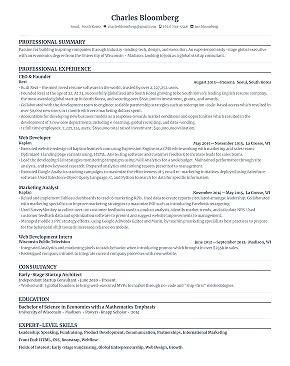
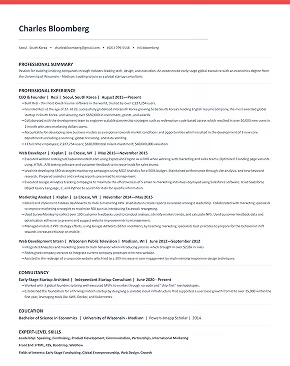
Here's a complete sample cover letter in that same one-page structure, so you can see how the pieces fit before you fill in your own:
A one-page cover letter in the clean, single-column format the built-in Google Docs templates use.
Notice what the strong version does: it names the role in the first line, gives two specific, quantified wins in the body, and ties them to what the employer needs. A template gives you the frame; that evidence is what you supply. For dozens more finished examples to model, see these skillful cover letter examples and the writing choices behind each one.
Where can you find free, downloadable cover letter templates beyond the built-in ones?
The template gallery only shows a handful of letter designs, so if none fit, copy a free Google Docs template from an outside library into your Drive. Open the shared file, click File > Make a copy, and it becomes yours to edit. This is how you get modern, role-specific, and creative layouts Google doesn't ship by default.
Good sources of professionally designed, free cover letter templates:
- Curated template collections. Rezi's roundup of 20+ cover letter Google Docs templates gives you one-click copies across simple, modern, and creative styles.
- Word-compatible designs. If your target employer prefers .docx, a Microsoft Word cover letter template imports cleanly into Google Docs and exports back out.
- A blank, clean build. Sometimes the best template is none — a fresh document with one-inch margins, 11-pt Calibri or Arial, and a matching header. See a basic cover letter with templates for the minimum structure.
One tip from the r/jobs and r/resumes crowd on Reddit: recruiters care far more about a template that matches your resume than about a flashy design. Use the same font, header, and accent color across both documents so your application looks like one deliberate package.
How do you customize and tailor a fill-in-the-blanks template?
A fill-in-the-blanks cover letter template marks every spot you need to change — [Your Name], [Company], [Role], [specific achievement]. Work through each placeholder, then rewrite the opening and one body sentence for the exact job. Personalization is the difference between a letter that gets read and one that gets skipped.
Customize in this order:
- Header and contact info. Your name, city, phone, email, and LinkedIn. Delete the fax/address lines older templates carry.
- The greeting. Find the hiring manager's name on LinkedIn or the job post; "Dear Hiring Manager" is the fallback, never "To Whom It May Concern."
- The opening line. Name the role and where you saw it, plus one reason you're a fit. Mirror a phrase from the job description so it reads as written for this posting.
- The body evidence. Replace generic placeholder text with two concrete results — "cut onboarding time 30%," "grew the email list from 4k to 22k." Numbers beat adjectives.
- The close. A one-line call to action: you'd welcome the chance to discuss how you'd contribute.
Save each tailored version under its own name instead of overwriting. Keep one clean master copy in a "Cover Letters" folder in Drive, then duplicate it per application — that way you organize and track versions without rewriting from zero. When you can articulate the difference between the two documents you're sending, this breakdown of resume vs. cover letter keeps each one doing its own job.
What formatting makes a cover letter look professional and pass an ATS?
A professional cover letter is one page, single-column, with one-inch margins, an 11–12 pt standard font, and consistent spacing. For applicant tracking systems, avoid text boxes, tables, images, and unusual fonts — an ATS reads left to right, top to bottom, and garbles anything in a floating element. A simple layout is both cleaner to the eye and safer for the software.
The ATS-friendly checklist:
- Real text, not graphics. Your name and contact details must be selectable text, never inside an image or header/footer the parser may skip.
- Standard section flow. Contact block, date, greeting, body, sign-off — no multi-column layout that scrambles reading order.
- Keywords from the posting. Echo the exact skills and job title the description uses; that's what the system scores against.
- Left-aligned body text. Justified text creates uneven gaps that hurt readability.
The clean, simple Google Docs templates ("Modern Writer," "Coral") already meet these rules — it's the heavily designed multi-column ones you should avoid when a company screens with software.
Should you send your cover letter as a PDF, Word, or Google Doc?
Send a PDF unless the application explicitly asks for Word. A PDF locks your formatting so it looks identical on every device; a .docx can shift fonts and spacing on the recruiter's machine. Only submit a Google Doc link when someone specifically requests one — a shared link can break if permissions lapse.
From your Google Docs file, use File > Download and pick PDF Document (.pdf) or Microsoft Word (.docx). Name the file professionally — FirstName-LastName-Cover-Letter.pdf — because recruiters see the filename. If an online form has a Word-only upload field, send .docx; if it accepts either, choose PDF.
Google Docs template or a cover letter generator — which should you use?
Use a Google Docs template when you want full manual control and already know what to write. Use an AI cover letter generator when you want a tailored first draft fast, or you're applying to many roles and rewriting from scratch each time is the bottleneck. Most people do both: generate the draft, then polish it in Google Docs.
The trade-off in plain terms:
- Google Docs template — free, flexible, and yours to format exactly, but you write every word and formatting mistakes are on you.
- Cover letter builder — pulls in your resume and the job description to draft matching, keyword-aligned content in minutes, then lets you edit. Rezi's AI cover letter generator is built to match your resume so both documents feel like one application, and this walkthrough of how the AI cover letter generator works shows the drafting step end to end.
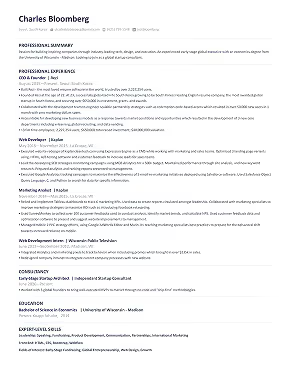
Here's a builder-style draft for a different role, showing the kind of tailored, quantified letter a generator produces before you refine it:
A role-specific draft you'd then personalize in Google Docs.
Are cover letters outdated in 2026?
No. Cover letters are still expected for most professional, senior, and career-change roles in 2026, and they remain optional-but-recommended almost everywhere else. When two candidates have similar resumes, a specific, well-written letter is often the tiebreaker — it shows genuine interest and communication skill a resume can't. Skip it only when an application explicitly says "no cover letter."
A quick note on AI: recruiters can often tell when a letter was generated and never edited, because it repeats the job title, stays vague, and lists no real accomplishments. The fix isn't avoiding AI — it's editing whatever you draft to add concrete numbers, the company's name, and one sentence only you could write. For proven structures across styles and roles, these best cover letter examples and templates are a strong starting point.
The fastest path, whichever route you pick
If you want total control and a free tool you already have, open the Google Docs template gallery, choose a simple letter design, and fill in the blanks. If you're applying widely and want a tailored draft in minutes, generate one against the job description and finish it in Docs. Either way: keep it to one page, quantify two achievements, match it to your resume, and export a PDF named after yourself. That's a cover letter that gets read.
Frequently asked questions
Can recruiters tell if you used ChatGPT for a cover letter?
Sometimes — generic AI writing often reads flat, repeats the job title, and lists no specific accomplishments. Recruiters notice the absence of concrete details more than the AI itself, so always edit any generated draft to add real numbers, company names, and your own voice.
Are these free Google Docs cover letter templates printable?
Yes. Any cover letter you build in Google Docs prints directly from File > Print, and you can export a print-ready PDF from File > Download > PDF Document. Keep margins at one inch so nothing clips at the page edge.
How long should a cover letter be?
One page — roughly 250 to 400 words across three or four short paragraphs. Recruiters skim, so a tight half-page often outperforms a dense full page.
Is there a Harvard cover letter template for Google Docs?
Harvard's career office publishes a well-known one-page format you can rebuild in Google Docs: a header with your contact details, a dated greeting, an opening that names the role, two body paragraphs of evidence, and a brief close. It's a structure, not a downloadable Google Doc, so copy the layout into a blank document.

Upload or drop your resume to get started
Upload your resume to get started
Score my resume

Jacob is the founder and CEO of Rezi. He has been sharing his unique insights on solving the resume since 2015, helping millions around the world land their dream jobs. Lately, Jacob finds himself giving a ton of speeches on topics related to global employment and building startups.