Resume
20 AI Skills for Your Resume 2026: Examples & Tools
Discover the top AI skills for your resume, with real examples and tools to help you stand out to employers and future-proof your career.

Published on
September 9, 2025
Updated on
February 25, 2026
We’ve all heard about AI, whether you’ve used ChatGPT as your personal life coach or come across some questionable images on social media. But this is just the tip of the iceberg. AI has been growing rapidly and is constantly being integrated across businesses and organizations to improve workflows and speed up processes.
So, which AI skills are the most in demand, and how do you prove you’re not just jumping on the AI buzzword bandwagon? It’s all about presenting these abilities using these two key rules: specifics and success stories.
Find out how these rules translate to your AI skills resume. This guide will cover:
- The importance of AI skills in the workplace.
- A rundown of the most popular AI skills with examples.
- How to highlight your skill set throughout your resume.
You can also see AI technology in action with our free AI Resume Builder. Simply enter your details to get a tailored, ATS-friendly resume in minutes, with handy suggestions and feedback.
And check out more popular resume skills and examples:
- Computer Skills for a Resume
- Interpersonal Skills for Your Resume
- Best Communication Skills for Your Resume
- How to Write Teamwork Skills on a Resume?
What Are AI Skills?
AI skills cover both the technical and practical sides of artificial intelligence. On the technical end, this can include experience with machine learning, natural language processing, or building models with tools like Python or SQL.
But these skills also include understanding how AI works, what it can do, its limitations, and using it to improve your workflow. Knowing how to use tools like ChatGPT or automation features in everyday software is becoming incredibly valuable, even in non-technical roles.
Including AI on your resume shows that you’re current, adaptable, and prepared for the direction most industries are heading. Companies in all kinds of fields are integrating AI into their processes, so being able to show you know the ropes will give you a solid advantage.
Why are AI Skills Important on a Resume?
AI is quickly becoming the backbone of how businesses operate, even outside the tech industry. When you include AI skills on your resume, you’re not just showing off a cool buzzword; you’re proving that you’re equipped for where the job market is heading.
The Future of Jobs Report 2025 found that AI and big data are among the fastest-growing skill sets, ahead of cybersecurity and general tech literacy. In simple terms, people who understand how to work with AI are going to be in much higher demand than those who don’t.
And it’s happening fast. The report also found that over 90% of top industries expect AI and big data to play a bigger role in their work in the next few years. Another report from Multiverse suggests that 38% of companies are banking on AI to boost efficiency, as long as employees know how to use it.
Top Resume Skills for AI
Here’s a quick overview of the best AI skills and tools for your resume:
- GenAI
- Machine Learning
- Applied Machine Learning
- Machine Learning Operations
- Computer Vision
- ChatGPT
- Prompt Engineering
- Deep Learning
- Reinforcement Learning
- Supervised Learning
- Artificial Neural Networks
- PyTorch
- Retrieval-Augmented Generation
- Big Data
- AI Literacy
- Programming
- Statistics
- AI Tools
- Analytical Thinking
- Flexibility
Now, let’s see how to include these AI skills in your resume with examples for inspiration.
Generative AI (GenAI)
GenAI focuses on creating original content, such as text, images, or code, using models and algorithms. It learns from enormous datasets and produces human-like output based on the prompts you give it.
And these skills are certainly in demand. According to the Coursera Job Skills Report 2025, GenAI is the fastest-growing skill in today’s market. So, having it on your resume shows that you’re future-focused and capable of using emerging tools to drive creativity and efficiency.
Resume example:
Built a transformer-based generative model for automated content creation, reducing manual writing workload by 45% while improving creative output quality.
Machine Learning
Machine learning is a core part of AI that allows computers to learn from data and make decisions without being explicitly programmed. It’s the backbone of predictive analytics, recommendation systems, and tons of smart apps we all use daily.
Employers want proof that you understand how your models fit into real systems. Mention things like integrating with logging services or monitoring tools in your resume, so they know you understand the full ML workflow.
Resume example:
Trained and deployed a machine learning model using feature store integration, improving fraud detection accuracy across live transactions.
Applied Machine Learning
Applied machine learning is all about using ML techniques to solve practical problems, like classifying emails, predicting churn, or analyzing trends, but without heavy coding. It’s more about the real-world application than building models from scratch.
On your resume, show that you’ve used applied machine learning tools to interpret data, predict outcomes, and apply them in a business context. Companies appreciate seeing applied machine learning tied to measurable results, as it lets them see your potential at the company.
Resume Example
Used applied machine learning techniques to classify customer feedback and predict churn, boosting retention by 12% and improving response targeting.
Machine Learning Operations (MLOps)
MLOps focuses on deploying, scaling, and managing machine learning models in production environments. While ML engineers build models, MLOps engineers make sure they run smoothly without crashing or drifting.
This skill shows you’re comfortable working with cloud tools, deployment pipelines, testing systems, and monitoring solutions. It can also signal collaboration skills across engineering, data, and business teams.
Resume Example
Built an automated MLOps pipeline for model deployment and monitoring, cutting release time by 30% and improving model stability significantly.
Computer Vision
Computer vision is a field that teaches machines to interpret and act on visual data, from digital images to video. It’s used in everything from facial recognition to quality inspection on factory lines.
It’s one of the most in-demand tech skill sets, and experts expect the market to hit $386B by 2031. Want to prove your computer vision skills on your resume? Show that you can build, test, and deploy visual models using large, complex datasets.
Resume Example:
Designed and deployed a CV model to detect product defects in real time, reducing inspection errors by 25% and speeding up QA processes.
ChatGPT
Even the technophobes have probably heard of this one. ChatGPT is a conversational AI tool that generates human-like responses and supports a variety of tasks, such as drafting emails, coding, research, and answering life’s greatest mysteries (not recommended).
And it’s taken the world by storm. DeskTime found it’s now used in 76% of offices, so showing you can work with ChatGPT signals you’re aligned with how modern teams get work done. This is a great skill for roles that involve communication, content creation, or customer interaction.
Resume Example:
Leveraged ChatGPT to automate research and draft reports, saving the team an estimated ten hours weekly and improving turnaround speed.
You can also use ChatGPT in your job search. Find out more:
- How to Write a ChatGPT Resume
- How to Use ChatGPT for a Cover Letter?
- Rezi vs ChatGPT: Which is Better for Writing a Resume
Prompt Engineering
Prompt engineering is the art of writing inputs that get the best results out of AI tools like ChatGPT or image generators. It’s about understanding nuance, context, and how to guide the model to produce high-quality output.
As GenAI spreads across different industries, prompt design has become a powerful skill that bridges business needs and technical tools. It’s a great way to show both creativity and technical understanding.
Resume Example:
Created optimized prompts to generate data summaries and marketing copy, improving content relevance and accelerating team workflows.
Deep Learning
Deep learning uses neural networks and machine learning to mimic the human brain and handle complex tasks, like image recognition, speech transcription, or text generation. It’s an advanced branch of AI that can power things like self-driving cars and voice assistants.
You’re demonstrating serious technical depth by showing you can build or improve deep learning systems (CNNs, RNNs, etc.). Just make sure your resume reflects both the frameworks you used and the practical outcomes.
Developed a CNN-based deep learning model to classify medical images, increasing diagnostic accuracy by 15% and supporting clinical decision-making.
Supervised Learning
Supervised learning uses labeled data to help the algorithm learn and make predictions. It’s widely used for classification and regression tasks across industries, from fraud detection to medical diagnostics.
It’s practical and very measurable, so focus on highlighting the business impact of your model. Employers will appreciate seeing how you used real data to solve genuine problems at scale.
Resume Example:
Built a supervised learning model using labeled customer data to predict churn, achieving 85% accuracy and enabling targeted retention campaigns.
Reinforcement Learning
Reinforcement learning trains software agents through trial and error, improving decisions over time based on rewards or penalties. This kind of adaptive learning is great for robotics, game AI, and advanced automation scenarios.
Showing this skill proves you can build systems that adapt and optimize themselves, which is great for employers working on cutting-edge automation or autonomous products.
Resume Example:
Designed a reinforcement learning agent to optimize supply chain routing, increasing delivery efficiency and reducing operational costs.
Artificial Neural Networks (ANNs)
Artificial Neural Networks are computer models designed to work like the human brain, using interconnected nodes to process information and make predictions. They’re the backbone of deep learning and show up in image recognition, time series forecasting, and language processing.
Employers look out for ANN experience because it means you know how to build systems that can learn from data. It’s relevant across various industries, and mentioning it on your resume makes it clear you understand how AI works under the hood.
Resume Example:
Developed an ANN-based model to predict sales trends using time-series data, improving forecasting accuracy by 22% across quarterly reports.
PyTorch
PyTorch is a deep learning framework in Python that makes it easy to build neural networks. It uses an intuitive, “run-as-you-code” style that’s popular among developers, especially those with regular Python backgrounds. It’s also used in a ton of online courses, so even entry-level candidates can gain credibility with it.
Because PyTorch is widely used in both research and industry (and has a super consistent API), including it on your resume shows hiring managers that you’re hands-on with modern deep learning tools. It signals that you can prototype and build models quickly.
Resume Example:
Built deep learning models in PyTorch to classify images and fine-tuned model parameters, improving validation accuracy by 15% across test datasets.
Retrieval-Augmented Generation (RAG)
RAG is a technique that improves language model responses by pulling from trusted data sources before generating an answer. Instead of relying only on the model’s training data, it retrieves real-time information from an external knowledge base to generate more accurate output.
This is becoming huge at companies that want reliable AI without retraining giant models from scratch. Adding RAG to your resume shows you understand how to bridge LLMs with actual business data to produce smarter, more dependable responses.
Resume Example:
Implemented RAG pipeline to integrate the company knowledge base into the chatbot, increasing response accuracy and cutting hallucination errors drastically.
Big Data
Big Data refers to the massive volumes of structured and unstructured data that companies collect every second. It’s way too complex for traditional systems to handle, which is why new tools like Hadoop, Spark, and cloud analytics are so popular.
With IoT and connectivity exploding, data is everywhere, and businesses need people who know how to make sense of it. Listing big data on your resume shows you can work with large datasets and extract valuable insights, something nearly every enterprise is investing in now.
Resume Example:
Analyzed multi-terabyte customer datasets using Spark and SQL, generating insights that informed strategy and increased quarterly revenue by nearly 10%.
AI Literacy
AI literacy is the ability to understand what AI tools can do, what their limitations are, and how to use them responsibly. According to DataCamp’s 2025 AI Literacy Report, it’s one of the fastest-growing skills leaders want, yet 60% of leaders feel their teams aren’t quite there yet.
That said, being AI literate can give you a huge edge. On your resume, AI literacy shows you can use AI tools thoughtfully and ethically, without blindly trusting them. It’s perfect for roles that blend strategy, decision-making, and smart tech adoption.
Resume Example:
Led team training on AI fundamentals and ethical use of tools, improving overall AI tool adoption and decision quality across multiple departments.
Programming (for AI)
Programming is the foundation that tells computers what to do. In AI, that usually means writing code in languages like Python, Java, or C++ to build algorithms and train models. It’s also about using frameworks like SQL or PyTorch to manipulate data and develop AI systems.
On a resume, programming shows you can build practical AI tools, beyond just the theory. Employers want to see that you can write code that solves real problems, ideally with measurable outcomes.
Resume Example:
Created Python scripts and machine learning models using TensorFlow to analyze customer patterns, resulting in a 17% improvement in predictive accuracy.
Statistics
Statistics is what makes AI models smart, and how algorithms learn from data and make predictions. Concepts like standard deviation, recall, and RMSE are all statistical foundations.
If you can use stats to extract meaningful insights, that sets you apart from someone who just plugs numbers into a model. Employers like seeing that you understand what the metrics mean and how to improve them.
Resume Example:
Used statistical analysis to identify outliers and optimize model performance, boosting precision and F1 score in a natural language classification project.
AI Tools
AI tools are software platforms that help people work faster, make better decisions, or generate content. The goal isn’t to replace humans (for the most part), but to amplify what we can do. Using them saves time, boosts productivity, and shows you’re keeping up with how workflows are changing.
Adding AI tools to your resume shows you’re resourceful and efficient. Whether it’s for writing code faster or analyzing data, it signals to an employer that you know how to get more done with modern tech.
Even skills in non-programming AI tools, are a massive asset in your job hunt, for instance:
- Productivity assistants
- Video and image editing tools
- AI customer support software
- AI workflow automation tools
Resume Example:
Leveraged AI productivity tools to streamline data analysis and content creation tasks, saving an estimated 8 hours per week across project teams.
Analytical Thinking
If you thought AI skills were all technical, you’d be wrong. Analytical thinking is all about making sense of complex information, spotting patterns, and solving problems logically. And according to The Future of Jobs Report 2025, it’s still one of the most in-demand soft skills.
Employers want people who can take data, interpret it, and turn it into smart decisions. To highlight this, show an example where you diagnosed a problem, used data to figure it out, and delivered a clear result.
Resume Example:
Analyzed user engagement metrics across platforms, identified drop-off points, and created a data-driven strategy that increased user retention by 14%.
Flexibility
Flexibility means you can adapt to change, think creatively, and stay calm when new tech or processes pop up (which happens a lot in AI). The Future of Jobs Report says flexibility (along with resilience) is one of the top core skills employers need by 2025, and for good reason.
On a resume, flexibility shows in how you tackle new challenges, embrace uncertainty, and stay productive even when everything shifts. It’s especially valuable in AI, where projects evolve quickly and ambiguity is part of the process.
Resume Example:
Adapted to rapidly evolving project scope by learning new AI tools on the fly, helping the team meet deadlines and launch ahead of schedule.
How to Include AI Skills on Your Resume?
Here’s a breakdown of how to add AI skills to your resume:
- Target the AI skills mentioned in the job description and mirror those keywords in your resume.
- Outline real AI projects or work experience with measurable results using specific tools and frameworks.
- Highlight relevant AI coursework, certifications, and technical training, especially if you’re early in your career.
- Balance technical AI abilities with soft skills like critical thinking, adaptability, and communication throughout your resume.
- Polish your resume carefully and review it for spelling, grammar, and clarity to maintain a professional and trustworthy impression.
Now, let’s get into my top tips with examples to help you build your resume.
1. Identify AI skills in the job description
AI may be everywhere right now, but the golden rule still applies: tailor your resume to each job description. Instead of listing every impressive-sounding AI skill you’ve ever heard of, focus on what that employer is asking for and their specific requirements.
One simple strategy is to mirror the language of the job posting in your skills and experience sections. If the company emphasizes a tool like PyTorch or prompt design, and you’ve used it (or can upskill fast), make sure it shows up word-for-word.
Pulling keywords from both the job ad and some online research in that industry can massively increase your match rate in Applicant Tracking Systems (ATS). And you might get bonus points for paying attention.
Take a look at this machine learning job posting:
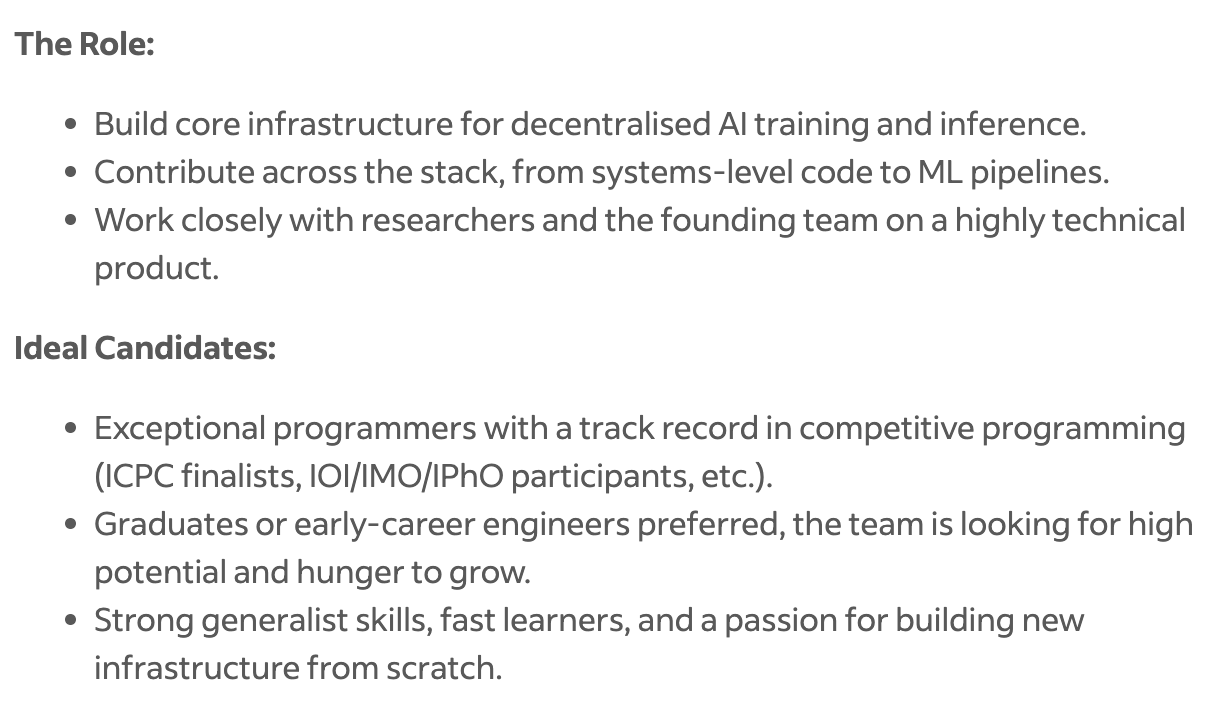
Now, see how you can naturally weave those keywords into your work experience:
- Built scalable ML infrastructure to support both training and inference, optimizing performance and reliability across decentralized systems.
- Collaborated closely with researchers and engineers to develop systems-level components for deep learning workflows and improve end-to-end ML pipelines.
- Wrote high-performance code for distributed computing and contributed to infrastructure projects from the ground up, working across the full stack.
2. Give examples in the work experience section
Your work experience section is where you prove you’re not just all talk. Most of the people I know have used ChatGPT for some unique searches, but I think they’d agree that using bots as an alternative therapist doesn’t make you an AI expert.
If you’re going to claim AI literacy, prove what you can do in a professional setting. Write three to five bullet points under each role, using strong action verbs, and go beyond simple tasks. Here are some points you can mention:
- Talk about what problem you solved.
- Mention specific AI tools or frameworks you used.
- Focus on positive outcomes and results.
- Quantify your resume achievements (if possible) with percentages and metrics.
Be specific. Name any relevant tools and show how you used them in context. Employers don’t want generic and cringe-worthy terms like “AI wizard”. They want to see the actual systems, languages, or models in your toolkit, including the results that came from them.
Here are a few work experience bullet points to show off your AI skills:
- Developed a generative AI model using PyTorch to create marketing copy variations, reducing manual drafting time by 35% for the content team.
- Built a Python-based data pipeline to preprocess and label images for a computer vision project, improving training accuracy.
- Led a team project to integrate ChatGPT API into a customer support chatbot, handling basic queries and deflecting ~40% of repetitive tickets.
Even if you have no formal work experience, you can still include skills and accomplishments from internships, side projects, or even volunteer work involving AI. Everyone has to start from somewhere, just be clear that this was unpaid work, or create additional resume sections labelled “Volunteering” or “Projects”.
3. Highlight your technical abilities in your education
If you’ve been in the workforce for a while, keep your education simple. Once you’ve got real-world experience, that degree becomes more of a checkbox, so just listing your university and degree is honestly enough.
But if you’re a recent grad or making a switch into AI, your education section is your chance to show that you’ve built a foundation. You can add a short “Relevant Coursework” section with things like machine learning, NLP, AI ethics, or anything that proves you’ve studied the basics. It helps with credibility and sneaks in some extra ATS-friendly keywords from the job description (as long as you’re being truthful).
Listing certifications is also a great way to beef up your resume and get past ATS filters. Even if a recruiter doesn’t read the full course title, the system will notice phrases like “Machine Learning,” “Deep Learning,” or “AI Fundamentals”, and that can give you an edge.
Here’s how to show your AI skills in your education section:
Education
Bachelor of Science in Computer Science
University of California, San Diego
Relevant Coursework:
Machine Learning, Natural Language Processing, Data Structures & Algorithms, AI Ethics
Certifications:
Google Professional Machine Learning Engineer (2023)
4. Don’t forget about soft skills
Let’s get this straight: your work experience section is where your technical skills should shine. It’s your space to prove your skills lead to success.
That said, you should also make the recruiter’s life easier by including a categorized list in your skills section, so they can quickly check off those boxes.
Here’s what that looks like:

Now imagine everyone has the same technical skills with the same degree. That’s when your resume soft skills can help give you the edge. You don’t have to list them in a separate section unless you’re low on content, but you should demonstrate them throughout your resume. Skills like communication, adaptability, and problem-solving are super valuable when tied to AI.
The Future of Work 2025 found that flexibility, creative thinking, and resilience are rising in importance alongside AI. So, use your work experience bullets and other sections to show how you collaborated, learned quickly, and adapted to stand out among technical candidates.
5. Double-check for spelling and grammar
This should go without saying, but proofread your resume like your career depends on it (because… it kind of does). Even a brilliant AI resume can get dismissed if it’s full of typos.
Use tools like Grammarly to catch errors, or at least run it through a spellcheck and read it out loud. Getting someone else to review it is even better — after staring at your resume for three hours, your eyes will miss easy mistakes.
An error-free, organized resume shows professionalism and attention to detail, which is especially important when you’re trying to convince employers you’re precise enough to work with advanced AI systems.
How to Improve AI Skills?
Short answer:
To improve your AI skills, start by taking courses or certifications that align with your goals. But don’t just study. Work on hands-on projects to apply what you’ve learned and build a portfolio. Stay curious by reading AI news, following experts, or listening to quick podcasts so you keep up with how fast the field is changing. Join communities or forums to learn from others and share tips. Most importantly, stay flexible and keep learning consistently to help you grow and stand out.
Let’s get into the details of the steps you can take to work on your AI skills and impress those future employers.
Explore AI certifications and courses
Before getting excited and diving into all the courses (because there’s a lot), figure out which direction you want to move in your career. Do you want to get more technical or just become smarter about using AI tools at work? Once you know your angle, you can pick courses and certifications that make sense for you instead of just collecting badges.
What you can do:
- Check platforms like Coursera, Udemy, or edX for AI, machine learning, or Python courses. Don’t be afraid to start small and level up.
- If you need structure and a clear path, aim for a beginner certification in AI or ML to give yourself accountability and a real benchmark.
Develop your AI skills with projects
I’m terrible with board game instructions. Just skip the small print and let me play, please. Honestly, the biggest learning comes from actually building or trying something, and that also applies to AI. Exploring AI tools helps you get a better understanding and gives you something to show off in your portfolio or resume.
What you can do:
- Pick a mini project, such as predicting stock prices or building a chatbot, and document the process (this will eventually become portfolio gold).
- Learn basic AI fundamentals, such as Python, or improve your skill set through hands-on tutorials. Then, apply your knowledge using frameworks to solve real problems.
Stay updated with the latest trends
AI changes every week, and that’s not an exaggeration. Reading about it regularly keeps you in the loop so you can sound smart in conversations and understand new tools. You don’t need to read PhD papers; start with short newsletters or articles, then dive deeper if something catches your eye.
What you can do:
- Subscribe to AI newsletters, follow AI creators on LinkedIn, or skim a daily digest so you’re not left behind.
- Set aside ten minutes a day (or more) to read, watch a video, or listen to a podcast on AI to keep up with the latest trends and advancements.
Learn from specialized communities
AI communities help you learn from people who are also figuring things out (or already ahead of you). You can go to networking events or stick to the comfort of your home with Reddit, Discord groups, or LinkedIn communities. Asking questions, reading threads, or joining meetups should keep you motivated and in the loop.
What you can do:
- Join AI or tech groups online and contribute (or just lurk) to pick up tips, tools, and open-source projects to try.
- Step out of your comfort zone with hackathons or online challenges just to get experience collaborating and solving problems with others in AI.
Stay open and adaptable
AI won’t stay still; new tools are popping up constantly. The best mindset is staying curious and flexible. You don’t need to know everything, but you should be willing to keep learning and experimenting as things evolve.
What you can do:
- Commit to learning in small, consistent doses instead of a one-time cram session (that’s how you actually build mastery). You can set SMART goals to keep on track.
- Treat AI like a moving target: keep exploring new tools and techniques, and stay open to pivoting as things change.
Summary
Here’s an overview of everything you need to know about adding AI skills to your resume:
- Always tailor your AI skills to match the specific job description, using the same keywords the company uses whenever possible.
- List AI tools, languages, and frameworks clearly in your Skills or Technical Skills section, so recruiters can quickly spot them.
- Use your work experience section to show how you used AI in real situations, including tools, techniques, and impact numbers.
- If you’re newer to the field, highlight AI projects, internships, or personal work as proof of real-world practice.
- Include relevant AI certifications or courses under Education or Certifications, especially if you’re still early in your career.
- Show that you understand key concepts like machine learning, neural networks, data analysis, or automation, not just general buzzwords.
- Demonstrate soft skills alongside technical AI knowledge by showing situations where you collaborated, solved problems, or adapted.
- Use strong action verbs like “developed,” “implemented,” “optimized,” or “deployed” in your bullet points to sound confident and credible.
- Stay current by mentioning recent tools or trends like generative AI, ChatGPT, or prompt engineering if they fit your experience.
- Keep your resume professional and proofread, so the quality of your AI skills isn’t overshadowed by messy writing or formatting.
FAQ
What are the skills for AI?
AI skills fall into two categories: technical skills and applied skills. On the technical side, this includes machine learning, neural networks, deep learning, Python, data analysis, natural language processing, and tools like TensorFlow or PyTorch.
On the applied side, it’s about being able to use AI tools in everyday tasks, knowing their strengths and limits, and making smart decisions with them. You don’t need to code to have AI skills; even being able to use AI tools and understand how they generate results counts.
How to mention ChatGPT skills in a resume?
Treat ChatGPT like any other productivity tool. Instead of just writing “ChatGPT” under your skills, show how you used it. If it helped you automate research, draft documents faster, or support customer queries, make that clear in your bullet points.
You could write: “Leveraged ChatGPT to automate first-draft creation of client reports, reducing document prep time”. That sounds more impressive and professional than simply listing it under tools.
What’s the best AI writing generator?
There are a few strong contenders. ChatGPT is one of the most popular tools because it’s user-friendly and versatile, but other tools like Jasper, Claude, and Gemini are gaining recognition, especially for marketing copy or specialized writing tasks. “Best” depends on what you need: Jasper is popular for content marketing, while Claude is praised for longer, more analytical writing.
How to add generative AI skills to a resume?
You can list “Generative AI” or “GenAI” in your skills section, while also showing how you applied those tools in your work experience section. Mention outcomes like saved time, boosted creativity, or improved results. If you’ve worked with models or trained your own, name them to paint a more specific picture of your talents. Hiring managers want proof of impact, not just trendy terms.

Upload or drop your resume to get started
Upload your resume to get started
Score my resume

Lauren Bedford is a seasoned writer with a track record of helping thousands of readers find practical solutions over the past five years. She's tackled a range of topics, always striving to simplify complex jargon. At Rezi, Lauren crafts genuine and actionable content that guides readers in creating standout resumes to land their dream jobs.