Resume
Soft Skills for a Resume: 30 Examples + Copy-Ready Bullet Points (2026)
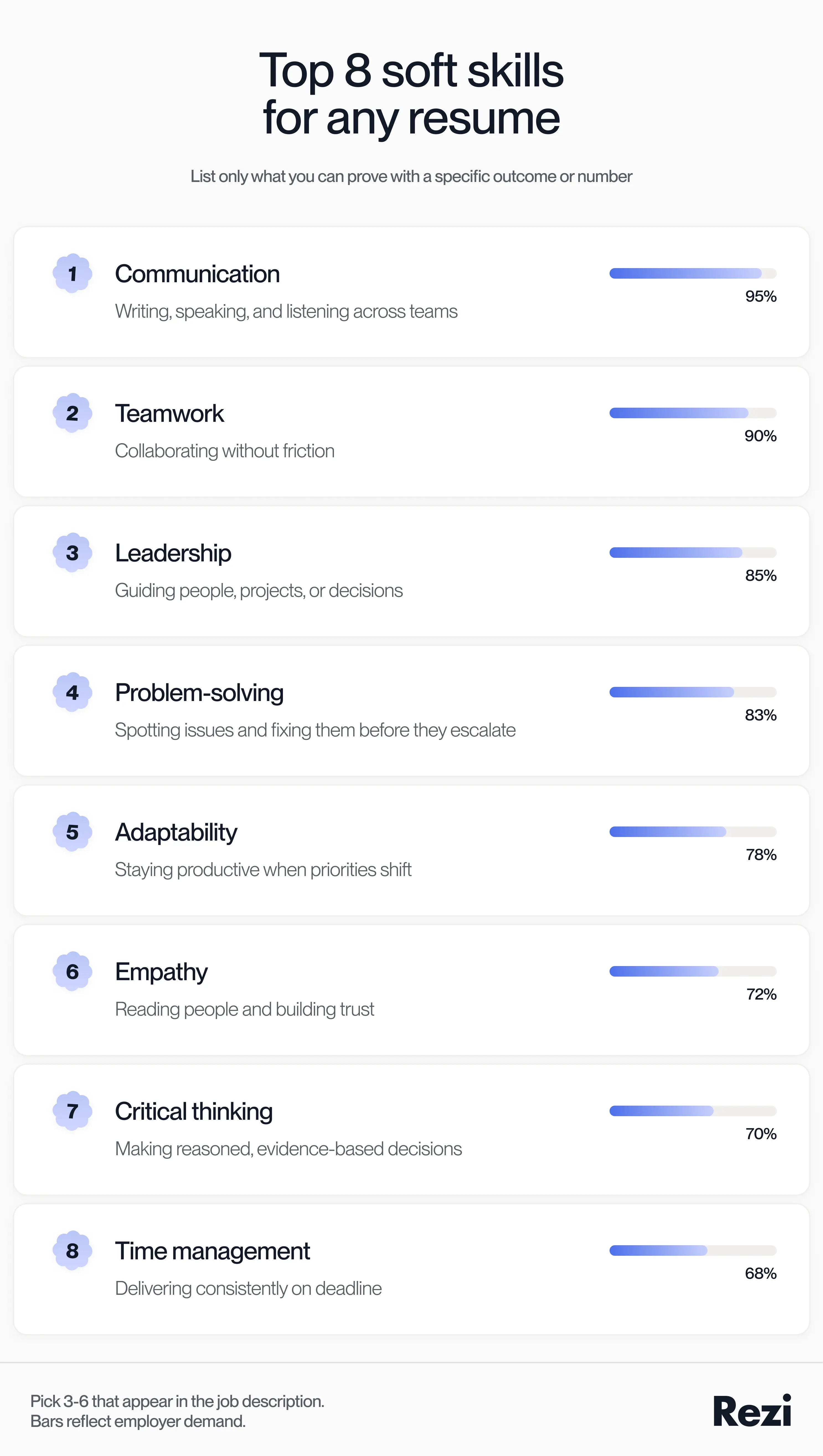
The top soft skills to put on a resume in 2026 are communication, teamwork, leadership, problem-solving, adaptability, empathy, critical thinking, and time management — but only when you can prove them with a specific, measurable result. This guide gives you 30 soft skills by category, 15 ready-to-paste resume bullets, and exactly where to put them.
Published on
June 21, 2024
Updated on
April 27, 2026
We can all brag about being good communicators and solid team players. But recruiters don't want to know if you can hold a conversation — they want to see how you used that skill to move a business forward. That's the difference between a soft skill that gets you an interview and one that gets skipped.
This guide skips the fluff. Below you'll find the 30 soft skills that matter most in 2026, how to write about each one on a resume, and a formula you can use to turn any soft skill into a bullet point worth reading.
Complete your resume in minutes with Rezi's AI Resume Builder. Tailor your skills to the job description automatically, then pick one of our 15+ resume templates and you're done.
The Quick Answer: Best Soft Skills to Put on a Resume in 2026
If you only have two minutes, here are the soft skills that work on almost any resume — as long as you can back them up with a concrete example:
- Communication — writing, speaking, and listening across teams
- Teamwork — collaborating without friction
- Leadership — guiding people, projects, or decisions
- Problem-solving — spotting issues and fixing them
- Adaptability — staying productive when priorities shift
- Empathy — reading people and building trust
- Critical thinking — making reasoned, evidence-based decisions
- Time management — delivering on deadline
The rule I keep coming back to: a soft skill belongs on your resume if you can prove it with a number or a specific outcome. If you can't, leave it out and save it for the interview.
30 Soft Skills for a Resume, by Category
Here's the full list, grouped by category so you can find the ones that match your field. I'd pick three to six that genuinely describe you and that also show up in the job description.
Communication skills
- Active listening
- Public speaking
- Written communication
- Verbal communication
- Presentation skills
- Negotiation
Verbal communication skills are about how well you express your thoughts and understand what others say.
- Interpersonal communication
- Listening skills
- Outbound calling
- Body language
- Foreign languages
- Presenting skills
Written communication skills involve conveying information through messages, emails, reports, and notes.
- Sending emails
- Proposal and report writing
- Spelling and grammar
- Editing skills
- Paraphrasing
- Translation
Digital communication skills are essential in today’s remote and hybrid work environments. Knowing your way around Zoom, Slack, Asana, and Microsoft Teams ensures easy collaboration and interaction.
- Online meeting etiquette
- Remote collaboration
- Professional branding
- Customer support
- Digital messaging
- Social media networking
For deeper examples and bullet-point templates, see our guide to communication skills on a resume.
Leadership skills
- Coaching and mentoring
- Conflict resolution
- Decision-making
- Delegation
- Strategic planning
- Team management
Start your bullet points with action verbs associated with leadership, such as:
- Directed
- Oversaw
- Coached
- Expanded
- Mentored
- Resolved
Teamwork and interpersonal skills
- Collaboration
- Empathy
- Relationship building
- Customer service
- Cross-functional coordination
- Cultural awareness
More on this one in our interpersonal skills for a resume post.
Problem-solving and thinking skills
- Critical thinking
- Analytical thinking
- Creativity
- Attention to detail
- Research
- Decision-making
Analytical skills are the abilities you use to interpret information and see the bigger picture behind it. They help you ask the right questions, spot patterns, compare options, and find the smartest way forward.
Self-management skills
- Adaptability
- Time management
- Work ethic
- Organization
- Self-motivation
- Learning agility
Need a hand picking the right ones? Rezi's AI Skills Explorer will generate a list tailored to your role in a few seconds.
Best Soft Skills by Job Type
The universal list above works, but the real skill is matching what you pick to the role. Here's a quick-reference for common fields:
- Customer service and retail: communication, empathy, patience, adaptability, conflict resolution
- Sales and account management: negotiation, relationship building, active listening, resilience, persuasion
- Engineering and technical roles: problem-solving, collaboration, written communication, attention to detail, adaptability
- Management and leadership: delegation, strategic planning, coaching, conflict resolution, decision-making
- Healthcare: empathy, attention to detail, stress management, teamwork, clear communication
- Education: patience, adaptability, public speaking, organization, mentoring
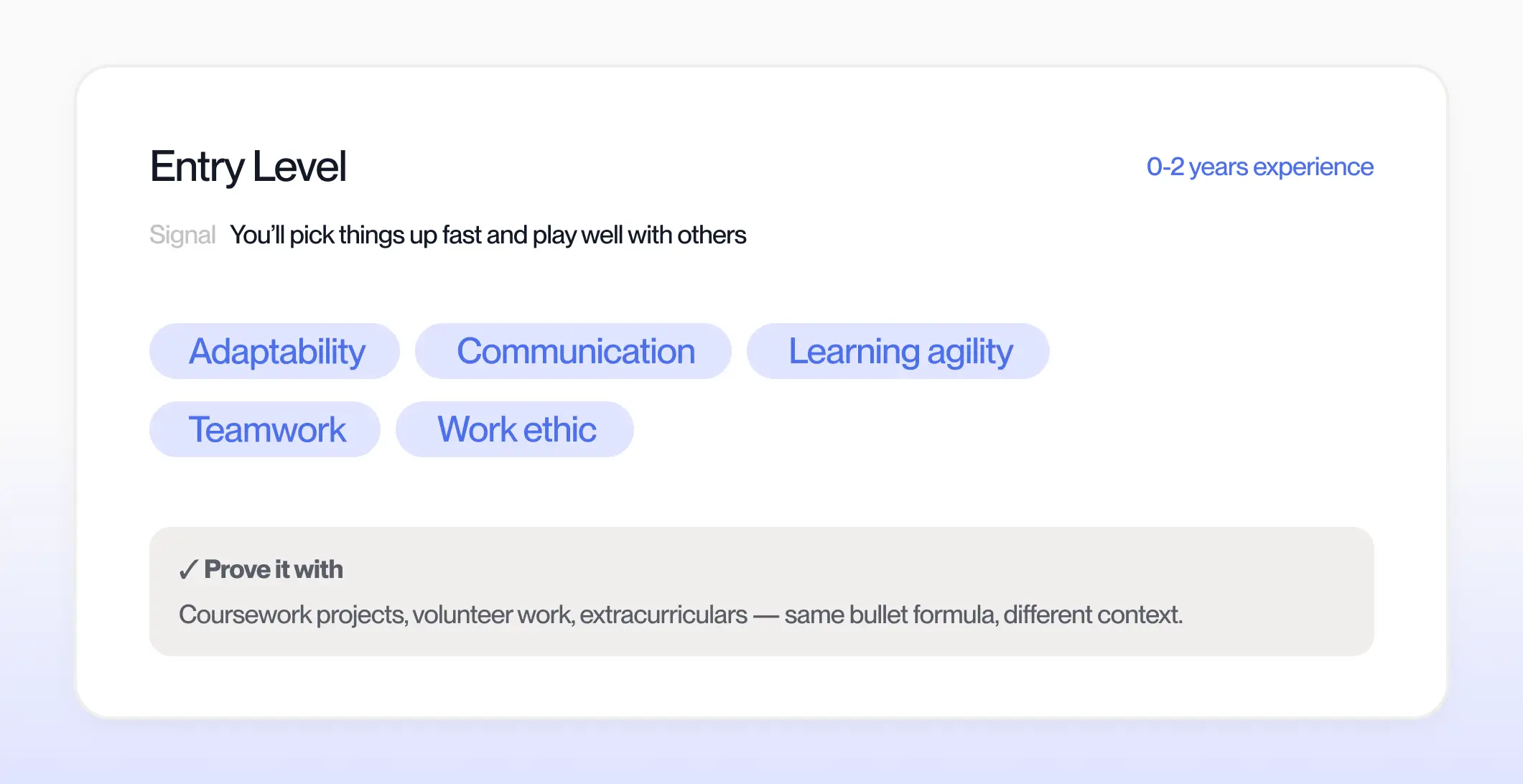
- Entry-level (any field): learning agility, work ethic, communication, teamwork, adaptability

Best Soft Skills by Experience Level
- Entry-level: Adaptability, communication, learning agility, teamwork, work ethic. You're signaling that you'll pick things up fast and play well with others.
- Mid-level: Problem-solving, time management, project management, mentoring, conflict resolution. You're showing you can own outcomes without being told how.
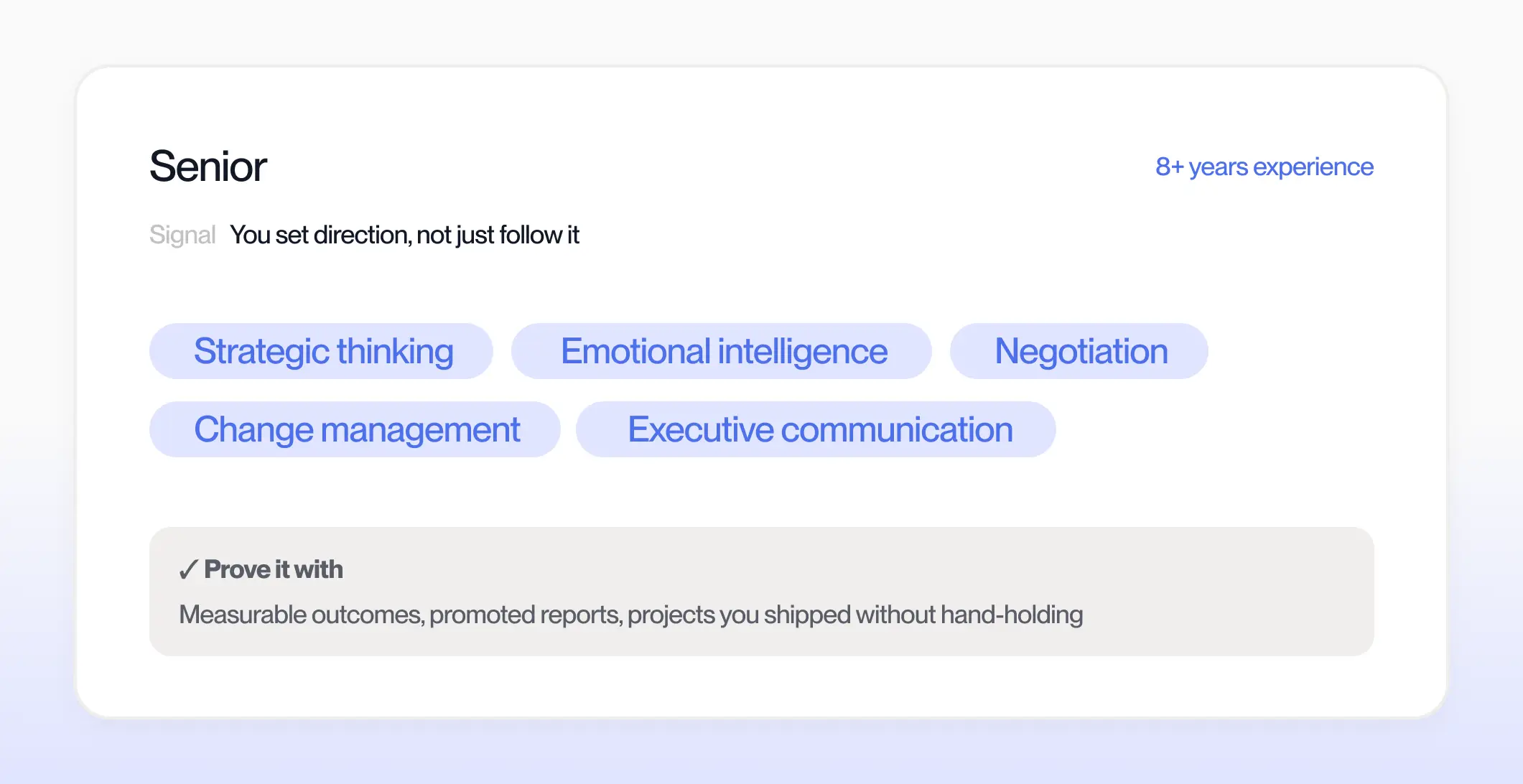
- Senior: Strategic thinking, emotional intelligence, change management, negotiation, executive communication. You're proving you can set direction, not just follow it.
When I applied for my first job, I had zero leadership experience. Putting "leadership" on that resume would've fallen apart in the first interview question. Match your claims to what you can actually defend.
How to Write a Soft Skill on a Resume (The Formula)
The formula that works in almost every case:
[Action verb] + [what you did] + [soft skill applied] + [quantified result]
That's it. Start with a verb, name the task, signal the skill (sometimes explicitly, sometimes implied), and close with a number. The number is what turns the bullet from a claim into evidence.
Weak version:
Great communicator with strong teamwork skills.
Strong version:
Led weekly cross-functional syncs between engineering and marketing, aligning 12 stakeholders on release priorities and cutting launch delays by 40%.
Same skills. Only one of them reads like something a real person did.
For verb inspiration, we have whole lists: synonyms for "lead", synonyms for "collaborate", synonyms for "created", synonyms for "managed", and synonyms for "assisted".
23 Copy-Ready Resume Bullet Points (by Soft Skill)
These are templates. Swap in your own numbers and context.
Communication
- Presented quarterly performance reviews to a leadership team of 8, translating technical metrics into business recommendations that shaped the next quarter's roadmap.
- Wrote and maintained onboarding documentation used by 40+ new hires, cutting average ramp time from 6 weeks to 4.
- Led weekly client syncs for a $1.2M account, resolving three escalations without account-manager involvement.
Teamwork and collaboration
- Partnered with design and engineering to ship a redesigned checkout flow, increasing conversion by 18%.
- Coordinated a 12-person volunteer team for a community fundraiser, raising 30% more than the previous year.
Leadership
- Mentored 4 junior analysts, two of whom were promoted within 12 months.
- Led a cross-departmental initiative to migrate reporting to a new BI tool, delivering on time and 8% under budget.
Problem-solving
- Diagnosed a recurring checkout bug by analyzing support tickets and session replays, reducing related complaints by 65% in one quarter.
- Redesigned inventory workflow after noticing a 12% stock discrepancy pattern, bringing it down to under 2%.
- Built a new issue-tracking method that improved team communication and cut resolution delays by 35%.
- Led troubleshooting efforts for a critical system failure, coordinating teams and deploying a fix within 48 hours to prevent revenue loss.
Adaptability
- Rebuilt the Q3 marketing plan in two weeks after a major product pivot, still hitting the original lead target.
- Took over a vacant PM role mid-sprint and delivered the release on schedule with no team attrition.
Time management
- Managed a rolling caseload of 50+ clients, maintaining a 95% same-week response rate over 18 months.
- Shipped 3 concurrent product launches in Q4 by restructuring the team's sprint cadence.
Organization
- Ranked incoming support requests by urgency and complexity, cutting response times in half during peak hours.
- Set monthly performance goals and created a clear action plan that helped the team boost sales by 15% in a single quarter.
- Delegated customer service follow-ups among team members, allowing higher-priority client issues to receive immediate attention.
Critical thinking
- Analyzed 6 months of churn data to identify the top three cancellation drivers, informing a retention plan that lifted 90-day retention by 12%.
Analytical skills
- Analyzed weekly SKU-level sales data with Excel pivot tables, identifying slow movers and informing a product display reset that increased category revenue by 12%.
- Rebuilt a weekly leadership agenda by weighing tasks against deadlines and cross-team dependencies, reducing missed deliverables by 40%.
- Forecasted seasonal demand spikes using sales data, helping the team stock inventory that increased Q4 revenue by 18%.
Empathy and customer service
- Handled 50+ customer interactions per shift during peak season while maintaining a 4.9/5 satisfaction score.
Where to Put Soft Skills on Your Resume
Soft skills don't belong in one place — they belong everywhere you can prove them.
In the resume summary
Lead with your strongest skill plus a result.
Experienced project manager with a track record of leading cross-departmental teams on time and on budget. Managed a remote team of 12 to deliver a high-profile product launch, improving client satisfaction by 25%.
More examples in our resume summary guide, or let Rezi's AI Summary Generator draft one for you.
In the resume objective (if you're using one)
Tie your soft skills to the employer's goals, not yours.
Motivated to build a long-term retail career by delivering strong customer service and supporting team goals. Eager to apply communication, problem-solving, and teamwork skills to improve the shopping experience and help the store hit its quarterly sales targets.
See our full guide to resume objectives.
In the work experience section
This is where soft skills actually earn their spot. Use the formula from earlier — verb, task, skill, result — on every bullet. More in our resume work experience guide.
In the education section
Useful if you're early-career. List coursework, group projects, or leadership roles that show the skills in action. Education section guide here.
Bachelor of Science in Business Administration, University of Technology, May 2024
• Completed coursework in organizational behavior and team dynamics
• Led a 5-person capstone team in a market-analysis project that received top marks
In projects, volunteering, or extracurriculars
Great for anyone with light work history. Use the same bullet formula. See how to frame resume achievements and extracurricular activities on a resume.
In the certifications section
If you have formal recognition — a leadership certificate, a conflict-resolution course — list it. Our certifications on a resume guide covers format.
In the skills section
Keep this section mostly for hard and technical skills so recruiters can scan your qualifications quickly. If you do list soft skills here, group them:
• Leadership: team management, strategic planning, conflict resolution
• Communication: public speaking, active listening, negotiation
• Problem-solving: analytical thinking, creativity, adaptability
More on the right structure in our skills section of a resume post, and the trade-offs vs. hard skills for a resume.
See our full resume sections guide for where everything fits.
When NOT to List Soft Skills
Not every soft skill earns its spot. Skip one if any of these are true:
- You can't name a specific time you used it
- You can't attach a number or outcome to it
- It isn't mentioned or implied anywhere in the job description
- The word is overused to the point of meaninglessness ("hard worker," "team player," "detail-oriented" — see our list of resume buzzwords to avoid)
If it fails two of these, leave it off. You're not underselling yourself — you're saving space for claims you can actually defend.
Soft Skills vs. Hard Skills: What's the Difference?
Quick breakdown:
Most jobs need both. The more technical the role, the more your soft skills become a differentiator — plenty of people have the hard skills, fewer can also lead a team through a messy quarter. See the full hard skills for a resume guide for the other side.
How to Find the Right Soft Skills for the Job
Three steps, in order of priority:
- Read the job description. Highlight every soft-skill word or phrase — "collaborate," "own," "communicate," "lead," "navigate ambiguity." Those are the ones to prioritize. Or save time and use our AI Keyword Targeting feature — paste the job ad, get the keywords.
- Look at other listings for the same role at bigger companies in your field. Patterns across 5–10 ads tell you what the industry actually values.
- Check credible sources. LinkedIn Learning publishes an annual Workplace Learning Report, Gartner tracks workforce trends, and the World Economic Forum's Future of Jobs report flags which skills are rising. Use these to find the skills trending up in your industry, not just the evergreen ones.
Some roles won’t say “problem-solving” outright. Instead, they’ll use phrases like:
- Optimize
- Resolve
- Investigate
- Improve performance
- Identify gaps
- Troubleshoot
- Support solutions
Those are all problem-solving keywords in disguise. Mirror the same language naturally in your bullets.
How to Get Better at Soft Skills
You can't download leadership. But you can work on it:
- Ask for specific, written feedback from managers and peers
- Take on small leadership roles — running a meeting, owning a project — before you need them on a resume
- Join workshops or courses in communication, conflict resolution, or public speaking
- Work on self-awareness: know what you're good at, know what you're not
- Build your network with people whose soft skills you admire, and pay attention to what they do differently
Most soft skills come from reps, not theory. Start small.
What Are Soft Skills, Actually?
Soft skills are the traits that shape how you work — with people, with pressure, with change. Unlike hard skills, you don't learn them from a textbook or a certification. You build them through experience, feedback, and a lot of trial and error.
They matter because almost every job involves other humans. Even in highly technical roles, the person who can also communicate clearly, take ownership, and adapt under pressure tends to get promoted faster than the one who can't. And as AI automates more of the technical work, the specifically-human skills get more valuable, not less.
For a broader look at what belongs on a resume beyond soft skills, see what to put on a resume and our full resume skills guide.
FAQ
What are the best soft skills to put on a resume in 2026?
Communication, teamwork, leadership, problem-solving, adaptability, empathy, critical thinking, and time management. Pick three to six that you can back up with a specific example or number.
How many soft skills should I list?
Three to six. More than that and they start to look generic. Prioritize the ones mentioned in the job description first.
Is communication a soft skill?
Yes. Communication — including active listening, writing, and public speaking — is one of the most in-demand soft skills across almost every industry.
Is problem-solving a soft skill?
Yes. Problem-solving is considered a soft skill because it's about how you approach challenges rather than a specific technical method. Some people group it with "critical thinking" skills.
Is teamwork a soft skill?
Yes. Teamwork is a core soft skill and usually one of the first things employers look for, especially for entry and mid-level roles.
Is work ethic a skill?
It's a soft skill — or more accurately, a cluster of them (self-motivation, reliability, accountability). It's worth mentioning only if you can show it: a perfect attendance record, consistent performance reviews, or a specific project you saw through.
What are the most overused soft skills on resumes?
"Communication" and "teamwork" top the list, along with buzzwords like "hard worker," "team player," and "detail-oriented." They're not bad skills — they're just meaningless without proof.
Should I put soft skills in the skills section or work experience?
Work experience, mostly. Your skills section is better used for hard and technical skills that recruiters scan for. Soft skills land harder when they're attached to a real outcome in a bullet point.
What are soft skills for a CV?
Same as for a resume. If you're applying in the UK, rest of Europe, or anywhere that uses "CV" instead of "resume," the top soft skills are identical — communication, teamwork, leadership, problem-solving, adaptability.
Can I use the same soft skills on every application?
You can, but you shouldn't. The best candidates tailor — matching the two or three soft skills they lead with to each job description. A recruiter can usually tell in the first ten seconds whether a resume was written for their job or recycled.
What soft skills do employers find most impressive?
Communication and interpersonal skills, by a wide margin. Finding a candidate with the right hard skills is often easier than finding one with the character to fit the team — which is why proof of strong soft skills can tip a hiring decision in your favor.
Are leadership skills and management skills the same thing?
Not quite. Leadership refers to the soft skills of an individual. Whereas, management skills refer to technical expertise. The former is about how well you can get on with other people by encouraging and motivating them. In contrast, the latter is about how well you maintain the way a company operates.
What is another word for communication skills?
Other synonyms for communication skills include “people skills”, “social intelligence”, and “interpersonal skills”.
What is the difference between analytical thinking and critical thinking?
Analytical thinking focuses on dissecting information, while critical thinking steps in afterward to challenge those findings, asking whether the information is reliable, whether the conclusions hold up, and what the best next move is. Analytical thinking helps you understand the data, and critical thinking helps you decide what to do with it.
What are the best problem-solving techniques?
Here are some popular problem-solving methods and techniques to help you add more structure to the process:
- 5 Whys: Ask why repeatedly until you uncover the root cause, not just the symptom.
- Fishbone (Cause + Effect) Diagram: Map out possible causes across categories (people, tools, process, environment).
- Brainstorming: Generate ideas freely, then narrow them based on impact vs effort.
- Controlled Testing: Experiment, analyze results, and adjust in small cycles.
- Six Thinking Hats: Look at the problem through logic, emotion, risk, creativity, and structure to balance your decision-making.
Is it “organization skills” or “organizational skills”?
“Organizational skills” is the correct and widely accepted term; it describes someone’s ability to manage tasks, time, and responsibilities. “Organization skills” pops up occasionally, but it can sound like you’re talking about the skills of an organization.
How do you show multitasking skills on a resume?
Show multitasking by describing times you handled several responsibilities at once and still delivered. Mention overlapping deadlines, multiple clients, or juggling projects. Use action verbs, add numbers when possible, and highlight the results.
TL;DR
- The best soft skills to put on a resume are the ones mentioned in the job description and that you can prove with a specific result
- Pick three to six — not fifteen
- Use the formula: verb + task + skill + number
- Weave soft skills into your summary and work experience, not just the skills section
- If you can't prove it with an example, save it for the interview
Soft skills are one of the most underrated parts of a resume. Done right, they're what get you past someone with the same hard skills and better networking. Done wrong, they're filler. The difference is whether you can show, not tell.
When in doubt, go back to the job description. Hiring managers want a resume that feels written for their role, not a generic one. Match the skills, prove them with numbers, and keep the rest for the interview.

Upload or drop your resume to get started
Upload your resume to get started
Score my resume

Michael Tomaszewski, CPRW, is a resume and career advice expert with 9+ years of experience in the hiring industry. He has helped millions of readers and dozens of one-on-one clients create resumes and cover letters that *finally* do their talents and accomplishments justice.

%2520(1).webp)