Career Advice
Everyone Has a Keyword-Matched Resume Now. Here’s What Actually Gets You the Interview.
The best AI resume builder is the one that forces you to prove what you’re claiming—so you don’t end up with a “90% ATS match” resume that reads like a cloned job description and collapses the second a recruiter skims it.


Published on
March 12, 2026
Updated on
April 13, 2026
The assumption most people still have is simple: if you can get your resume to score high in some arbitrary “ATS score” metric, you’ll get more interviews.
That assumption used to be useful. Now it’s actively hurting candidates.
Because the moment everyone has access to the same AI, the same templates, and the same keyword lists, “optimized” stops meaning “stands out.” It just means you’ve hit the baseline.
Meanwhile, applicant volume is going up—not down. Greenhouse reported applications per job rising from 28 (2021) to 95 (2025), a 239% increase, and tied part of that pressure to AI-assisted applying.
So the resume that wins isn’t the one that sounds impressive. It’s the one that reads like evidence.
Rezi Thesis: The “best” AI resume builder is an accountability system
If you’re choosing a resume tool based on who can spit out the most polished bullets the fastest, you’re optimizing for the wrong outcome.
Your real goal isn’t a prettier PDF.
Your goal is a resume that:
- parses cleanly
- matches the role
- still feels human
- holds up under follow-up questions
That’s why the best AI resume builder is the one that uses AI to make you specific, verifiable, and consistent—not just keyword-dense.
ATS scores measure keyword coverage, not candidate quality
ATS adoption is real. Jobscan’s 2025 reporting puts ATS usage at 98.4% of Fortune 500 companies.
But here’s the harsh truth: “ATS match score” marketing has trained you to worship the wrong metric.
Most “match” tools are doing some version of:
- keyword overlap
- skill phrase frequency
- section detection / parse checks
That’s not useless. It’s just not the same thing as “this recruiter will call you.”
Where people get burned
You tailor, you optimize, you hit 80–90%.
And then you get silence.
That’s usually because you created a resume that technically passes… but reads like it was assembled from the job posting.
Recruiters don’t hire the best keyword overlap. They hire the clearest evidence of performance.
Copy/paste fix: treat ATS coverage as a checklist, not the finish line
Use this line as your personal rule:
“Keyword coverage earns me a skim. Evidence earns me a call.”
Then run this quick edit after you optimize:
- For every bullet with a keyword, add one proof detail:
- a number
- a scope
- a system/tool
- a timeframe
- a before/after
Example (before):
- Optimized onboarding process to improve customer experience.
Example (after):
- Reduced onboarding time from 14 days to 9 days by rebuilding the email + CRM handoff and removing 3 redundant approval steps.
You didn’t change the keyword (“onboarding”). You changed the credibility.

Mass AI adoption created a resume “same-voice” problem
If you’ve been applying a lot lately, you’ve probably noticed something weird.
Your resume looks better than it used to.
But it’s getting fewer responses than you think it deserves.
That’s not you being paranoid. That’s the market reacting to sameness.
When thousands of candidates use similar tools, the output converges:
- the same verbs (“spearheaded,” “optimized,” “collaborated”)
- the same vague scope (“cross-functional stakeholders”)
- the same “impact” claims without a receipt
And as application volume inflates, recruiters tighten filters and get more skeptical—because their inbox starts looking like copy/paste soup. Greenhouse’s pipeline-overload data is basically the macro version of what you’re experiencing personally.
Templates can’t solve sameness. Specificity does.
A “better template” is like putting nicer packaging on generic cereal.
It’s still generic cereal.
What cuts through is detail that’s hard to fake.
Copy/paste fix: replace “generic scope” with “trackable scope”
Swap these phrases out immediately:
- “collaborated with cross-functional teams” → name the functions + artifact
- “improved efficiency” → what got faster + by how much
- “enhanced customer satisfaction” → which metric (CSAT, NPS, churn, renewal) + movement
- “managed stakeholders” → who + cadence (weekly QBRs, sprint planning, exec readouts)
Example rewrite you can steal:
Instead of:
- Collaborated cross-functionally to deliver projects on time.
Use:
- Ran weekly sprint planning with Design + Engineering, shipped 6 releases in 2 quarters, and cut average cycle time from 12 days to 8 days.
That bullet now has fingerprints.

The biggest risk isn’t “low ATS score.” It’s unverified AI output presented as fact.
This is the failure mode that wrecks interviews.
Fake precision.
AI is extremely good at producing confident-sounding bullets that imply:
- leadership you didn’t have
- scope you didn’t own
- metrics you can’t defend
And plenty of people paste it in as-is.
Surveys and commentary around AI job-search usage keep repeating the same warning: AI helps, but you have to review it. Tech and career outlets routinely frame AI resume tools as productivity aids—not magic—and emphasize human verification to avoid generic or inaccurate claims.
Also: AI use in job materials is common enough that “everyone’s doing it” is no longer a defense. ResumeBuilder.com’s February 29, 2024 Pollfish survey of 1,000 respondents found that a meaningful share of job seekers use ChatGPT, and it also includes consequences like candidates believing they lost opportunities when employers detected its use.
So here’s the practical reality:
- If AI invents a metric, you might get through ATS…
- …and then lose the recruiter screen in 30 seconds.
What “best AI resume builder” actually means in 2026
It means the tool pushes you toward:
- verification (can you back it up?)
- specificity (what exactly changed because of you?)
- consistency (does your story align across bullets and roles?)
- gap visibility (what’s missing vs. what’s already covered?)
That’s the difference between “AI that writes for you” and “AI that keeps you honest.”
The product signal that matters: scoring that checks substance, not just polish
This is where tools that treat resume building like an evidence-based workflow separate themselves.
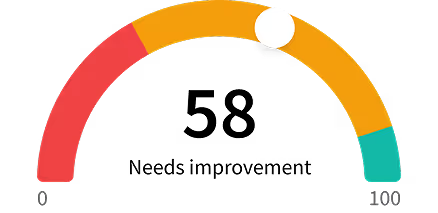
For example, Rezi’s Rezi Score is built around a 23-criteria scoring system across areas like content, formatting, optimization, best practices, and application readiness—paired with real-time analysis that nudges you toward clearer, more complete resume material (not just prettier phrasing).
And Rezi’s Keyword Targeting doesn’t just hand you a score—it identifies gaps (missing keywords) and what you’ve already covered, which makes it a discipline tool instead of a “score-chasing” toy.
Copy/paste fix: the “AI-proof” bullet test
Before you keep any AI-generated bullet, paste it into this template and fill the blanks. If you can’t fill them, the bullet is fluff.
Did [what] for [who/what scope] using [tools/process] resulting in [metric change] over [timeframe]. Proof: [where it shows up].
Example:
- Did: rebuilt monthly reporting
- Scope: 4 business units
- Tools: SQL + Looker
- Result: reduced reporting time 6 hours → 45 minutes
- Timeframe: 6 weeks
- Proof: dashboard link / manager reference / ticket history
Now your resume reads like a work product, not a vibe.

What to do instead: pick a builder based on accountability (not aesthetics)
Here’s what to focus on if you want a real answer to “what’s the best AI resume builder?”
You’re looking for three capabilities:
- Parsing safety (single-column, standard headings, clean exports)
- Keyword gap identification (so you don’t miss required skills)
- Evidence enforcement (so your bullets don’t drift into fiction)
If your tool can’t do all three, you’ll spend your time polishing something that still fails where it counts.
1) Build a “receipt bank” before you generate anything
Open a doc and dump:
- performance reviews (phrases + metrics)
- project names + outcomes
- dashboards you owned
- tools/systems you used
- before/after numbers (even small ones)
Copy/paste prompt to use inside any AI tool:
“Use only the facts below. If a metric is missing, ask me questions instead of inventing one. Write 6 bullets that include scope, tools, and outcomes.”
2) Run keyword targeting, then write like a human
Do keyword matching after you have the receipts.
Then write bullets that include the keywords naturally inside real proof.
Copy/paste bullet formula:
- Action + What you built/changed + Tool/Method + Outcome (metric) + Timeframe
3) Use a score/report to find weak spots—then fix the weak spots
A score is useful when it’s a diagnostic, not a trophy.
If your scoring system flags:
- missing role keywords
- weak impact language
- unclear formatting / sections
- thin or repetitive bullets
…that’s actionable.
Copy/paste weekly workflow (30 minutes):
- Pick 1 target job description
- Run keyword targeting
- Rewrite only the top 5 bullets for that role
- Re-check formatting + parse
- Export and test: copy/paste the PDF into a plain text editor to see if it stays readable
If you’re done chasing “ATS match” dopamine and you want a builder that pushes you toward specific, verifiable impact, start here: Create your resume

Jacob is the founder and CEO of Rezi. He has been sharing his unique insights on solving the resume since 2015, helping millions around the world land their dream jobs. Lately, Jacob finds himself giving a ton of speeches on topics related to global employment and building startups.