
Engineering Resumes
DevOps Engineer Resume Example and Writing Guide
Customize any of these resumes in minutes using our free AI-powered resume builder.
“Rezi is super upfront and continues to improve over time. I've recommended Rezi to several of my friends and colleagues. I just love this product so much.”

Ricky M.
Software Engineer
“Rezi is super upfront and continues to improve over time. I've recommended Rezi to several of my friends and colleagues. I just love this product so much.”
Ricky M.
Software Engineer
Helping users land jobs at 1,000+ companies such as















This DevOps engineer resume example follows a common route into the job: a university help desk, then web programming and a senior software role, then platform work on AWS. The note under the sample points to the lines worth copying. After it, you'll find what to put in a DevOps summary, which tools and certifications to list, how to turn pipeline, on-call and cost work into bullets, and how to build an entry-level DevOps resume. The FAQ covers SRE and platform titles, managed Kubernetes, Terraform and Azure DevOps.
DevOps Engineer Resume Example
The candidate is fictional and the contact details are placeholders, so copy the structure and fill it with your own systems and numbers.
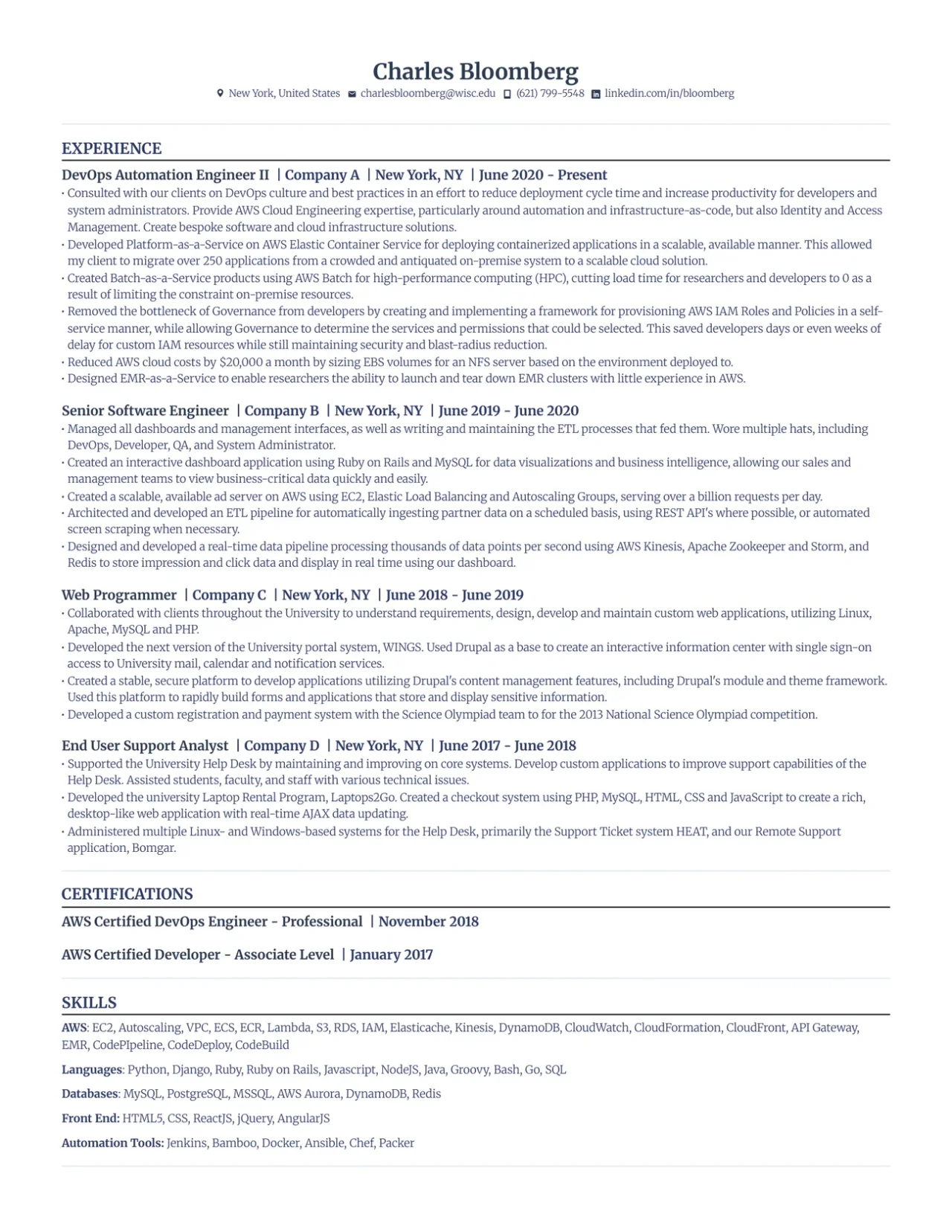
AWS DevOps automation engineer resume with a help desk and developer start
Read the DevOps Automation Engineer II job first. The ECS bullet gives scale (more than 250 applications moved off an on-premise system), the IAM bullet says who gained what (developers request roles and policies themselves while governance still picks the allowed services), and the EBS bullet puts a figure on the work, $20,000 a month in AWS costs. Older jobs get fewer bullets, six for the current role down to three for the help desk, which keeps four roles easy to read. One tip: the first bullet packs consulting, cloud engineering and custom software into three sentences, so in your version give each its own bullet and result.
What should a DevOps engineer resume summary say?
Write two or three sentences: your title, your years, the cloud and orchestration stack you run in production, and one measured result. The sample above has no summary because its current title already says DevOps. Add one when yours doesn't, for example if you're a system administrator or developer moving into platform work.
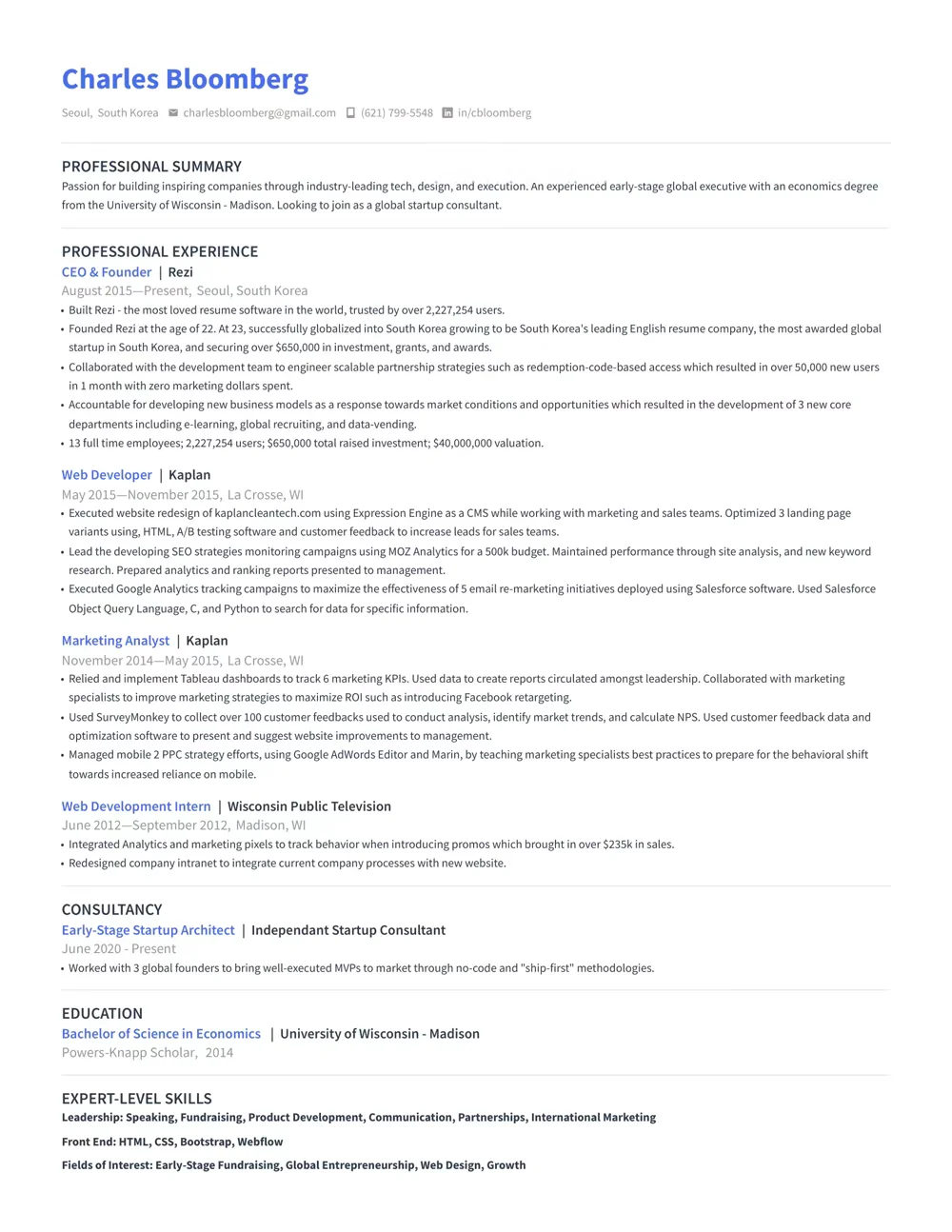
The summary in this screenshot is the kind to rewrite. Phrases like "scalable solutions" and "fast-paced environments" could describe any engineer, and the summary names no tool, system or result.

Patterns you can fill in, by level:
- Entry level: "Junior DevOps engineer with [N] years in [IT support or software development] and [degree or certification]. Built [a GitHub Actions pipeline or Terraform setup] for [team or project] that cut [build or setup time] from [X] to [Y]. Seeking a junior DevOps or cloud operations role on [AWS, Azure or Google Cloud]."
- Mid-level: "DevOps engineer with [N] years running [Kubernetes or ECS] on [cloud] for [type of product]. Moved [N] services to [Argo CD, Terraform or your platform], taking deployments from [weekly] to [several a day]."
- Senior: "Senior DevOps engineer with [N] years in platform and SRE work, owning CI/CD, infrastructure as code and on-call for [N] services. Cut [change fail rate, recovery time or monthly cloud spend] from [X] to [Y]."
Take the number from a bullet in your experience section, so the summary previews a claim you back up below. For a first draft to edit, the resume summary generator runs in the Rezi app with a free account.
Which skills and tools belong on a DevOps engineer resume?
List the tools you've used in real work, grouped by what they do, and make sure each one also appears in a bullet. The sample groups its skills by type (AWS services, languages, databases, front end, automation tools), which is the easiest layout to scan once you pass ten tools.
- Cloud: AWS (EC2, EKS, ECS, IAM, VPC, RDS, Lambda), Microsoft Azure, Google Cloud
- Infrastructure as code and configuration: Terraform, OpenTofu, AWS CloudFormation, Pulumi, Ansible, Packer
- Containers and orchestration: Docker, Kubernetes, Helm, Kustomize, Argo CD, Flux
- CI/CD: GitHub Actions, GitLab CI/CD, Jenkins, Azure Pipelines, CircleCI
- Observability: Prometheus, Grafana, OpenTelemetry, Datadog, PagerDuty, SLOs and error budgets
- Scripting and languages: Bash, Python, Go, YAML, HCL
Then check your list against your bullets. The sample's automation line names Jenkins, Bamboo, Docker, Ansible, Chef and Packer, but none of them appears in an experience bullet, so a reader can't tell whether the candidate ran them in production or tried them once. If a tool shows up only in your skills section, add the bullet that uses it or cut the tool.
Leave soft skills out of the list and prove them in bullets instead: an incident you ran and what the review changed, a runbook another team relied on, or templates other teams adopted.
Which certifications should a DevOps engineer list?
List the certification for the cloud or tool the posting names, with its full official name and the month and year you earned or last renewed it. None of these is a license. Each one supports the experience in your bullets, and none can stand in for it.
- AWS Certified DevOps Engineer - Professional: the exam guide describes a target candidate with 2 or more years of provisioning, operating and managing AWS environments. The certification is valid for three years.
- Microsoft Certified: DevOps Engineer Expert (exam AZ-400): you must first hold Azure Administrator Associate or Azure Developer Associate. It expires unless you renew it by passing a free online assessment on Microsoft Learn.
- Google Cloud Professional Cloud DevOps Engineer: Google recommends 3+ years of industry experience, including 1+ years designing and managing production systems on Google Cloud.
- Certified Kubernetes Administrator (CKA) from the Linux Foundation: a two-hour, performance-based exam solved at the command line, valid for two years.
- HashiCorp Certified: Terraform Associate (004): a one-hour multiple-choice exam on Terraform fundamentals, valid for two years.
This screenshot shows a clean layout for the section: the full certification name, then the year, then one line on what it covers.

Check old dates before you send. A CKA earned in 2018 has lapsed unless it was renewed, and so have the sample's 2017 and 2018 AWS certifications if they were never recertified. Renew a lapsed certification, mark it as expired, or leave it off. Our guide to listing certifications on a resume shows how to list one you're still studying for.
How do you write DevOps engineer resume bullets?
Name the system, the tool, the scale and what changed afterward, in one or two lines. "Built CI/CD pipelines" describes every DevOps job; a bullet with a before and after describes yours.
For delivery results, DORA's software delivery metrics give you a shared vocabulary. The five are change lead time, deployment frequency, failed deployment recovery time, change fail rate and deployment rework rate. DORA uses them to track a team's improvement over time, so say which service and period a figure covers and what part you played. Other figures hiring managers recognize are pipeline duration, monthly cloud spend, pages per on-call week and hours of manual work removed. Pull them from your CI dashboard, the billing console, your paging tool's history and the ticket system.
The experience entry in this screenshot is a common first draft. It names Jenkins, Chef, Puppet, the ELK stack and Grafana, but no bullet says what changed.
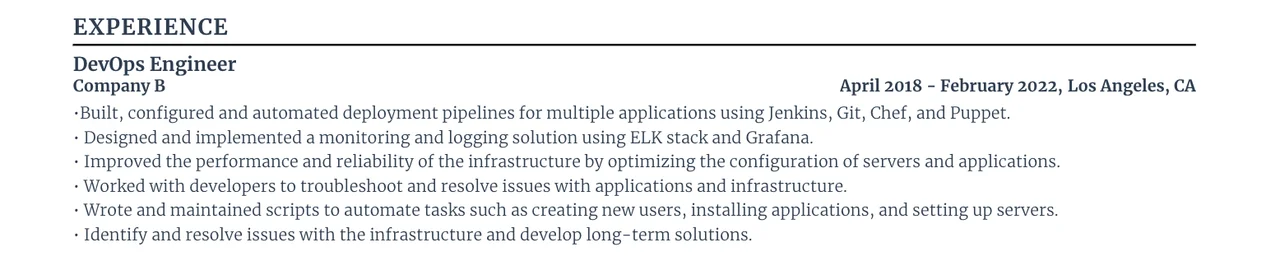
Here is how three of those lines read once you add scope and a result, with brackets where your own figures go:
- Before: "Built, configured and automated deployment pipelines for multiple applications using Jenkins." After: "Moved [N] services from manual deploys to Jenkins pipelines with automated tests, cutting release time from [X hours] to [Y minutes]."
- Before: "Designed and implemented a monitoring and logging solution using ELK stack and Grafana." After: "Sent logs and metrics from [N] services to the ELK stack and Grafana, with alerts tied to SLOs, cutting time to detect an outage from [X] to [Y] minutes."
- Before: "Wrote and maintained scripts to automate tasks such as setting up servers." After: "Replaced a [N]-step manual server setup with an Ansible playbook; the playbook became the standard for every new host."
The last one has no number, and it doesn't need one, because adoption is the result. Outages work the same way. "Ran incident command for a [length] outage of [service] and shipped the review's fixes, a rollback runbook and a load test in the release pipeline" shows judgment without a metric. Enter your title, level and tools in the bullet point generator for starter bullets, then add your pipelines, systems and real figures.
How do you write an entry-level DevOps engineer resume?
Lead with the closest operations or delivery work you've done, then add one project built the way a team would build it. Few people start with a DevOps title. The sample candidate began on a university help desk, where one bullet covers administering Linux and Windows systems, and wrote PHP before moving to platform work.
If you come from IT support or system administration, describe the systems you ran and the scripts you wrote, with counts: "Administered [N] Linux servers and automated user setup with a Bash script." If you come from software development, put your delivery work first under each role: the pipeline you fixed, the Dockerfiles you wrote, the alerts you added after an outage, the releases you ran. Keep one strong feature bullet per role, since your coding depth is part of what you bring.
For the projects section, one deployed system beats a list of tutorials. For example, an app in containers on AWS, its infrastructure written in Terraform, a CI pipeline that runs tests before each deploy, and alerts on errors and cost. Link the repository, and see our guide to projects on a resume for the layout. Keep the resume to one page. The Linux engineer, cloud engineer and software engineer examples show how the jobs next to DevOps are written.
How should you format and tailor a DevOps engineer resume?
Use a reverse chronological layout with standard headings (Summary, Experience, Skills, Certifications, Education), on one page if you have less than about five years of experience and two if you're a senior platform or SRE engineer. Newest-first puts your current stack, such as Kubernetes on Amazon EKS, ahead of older Jenkins and Chef work. It also shows how you got into DevOps, the way the sample climbs from support analyst to automation engineer.
For each application, read the posting for its stack and put its cloud, orchestrator and CI tool first in your summary and skills list, using its exact names where your work matches. Write a term in both forms once, as in "infrastructure as code (IaC)," so a search for either finds it. If you apply to both AWS and Azure roles, keep a version for each; reordering the skills list and swapping a bullet or two is usually enough. Our guide to resume keywords explains how recruiters search for terms. Before you send a version, the keyword scanner compares your resume with the posting and lists terms you haven't used. It works inside the Rezi app once you make a free account. Add only the terms that describe work you've done.
FAQ
Should a DevOps resume say DevOps engineer, SRE or platform engineer?
Use the title you actually held in your experience section, and the posting's title in your headline and summary when your work fits it. The three titles overlap but signal different emphasis. SRE points to SLOs, error budgets and incident work. Platform engineer points to internal tooling other teams use. DevOps engineer points to CI/CD and infrastructure as code. If your title was Systems Engineer but you ran the deploy pipeline, keep the real title and let your first bullet say what you did.
What should a senior DevOps engineer resume show?
A senior DevOps engineer resume should show the standards you set for other teams and how far they reached, in numbers. Mid-level bullets describe a pipeline or cluster you ran. Senior bullets describe the shared deploy template, Terraform module library or incident review process you introduced, how many teams or services adopted it, and what improved: "Rolled out a standard deploy pipeline to [N] teams, taking change fail rate from [X%] to [Y%] of deployments." Add mentoring or hiring if you did it, and the budget if you owned cloud spend. If you managed people, say how many, and keep at least one hands-on bullet per role.
How do I show Kubernetes experience if I only used a managed service like EKS?
Managed Kubernetes is still Kubernetes experience, so write it as "Kubernetes (Amazon EKS)" and describe the parts you ran. On EKS, AWS manages the Kubernetes API server and the etcd database. According to AWS's EKS Auto Mode documentation, Auto Mode also takes over the nodes, autoscaling, load balancing, pod networking and block storage, while you stay responsible for your application containers, including their availability, security and monitoring. That leaves plenty to describe: workloads, Helm charts, ingress, RBAC, network policies and upgrade testing, as in "Upgraded [N] EKS clusters across [N] Kubernetes versions with no failed deployments." If a posting asks for self-managed clusters built with kubeadm, don't claim that work; the CKA is one way to show control-plane knowledge.
How much coding should a DevOps engineer resume show?
Show enough code to prove you build tools as well as configure them. Name the language in the bullet where you used it: a Python script that rotates credentials, a Go service that cleans up idle environments, a Bash wrapper that cut a manual release from [X] to [Y] minutes. If the posting names Python or Go, put real work in that language near the top. YAML and HCL belong in your skills list too, but they describe configuration, so pair them with at least one general-purpose language.
What if a DevOps job asks for Terraform and I've only used CloudFormation?
List CloudFormation and show the habits that transfer: reusable templates, parameters, drift detection and change sets reviewed before execution. Add Terraform to your skills list once you've written it. A small project narrows the gap honestly: rebuild one of your CloudFormation stacks in Terraform, list it under Projects, and mention it in your summary. If you're preparing for the HashiCorp Certified: Terraform Associate exam, list it in your certifications section as "in progress, expected [month year]."
How do I put DevSecOps work on a DevOps engineer resume?
Put DevSecOps work in the bullet for the pipeline it protected, with the control you added and what it caught: "Added Trivy image scanning and a policy gate to GitHub Actions; blocked [N] critical CVEs from reaching production in [period]." Name the categories security-minded postings often use: secrets management (HashiCorp Vault, AWS Secrets Manager), dependency and container scanning, signed images, least-privilege IAM and policy as code with Open Policy Agent. If you ran a scanner someone else set up, write "maintained" instead of "built."
Is Azure DevOps experience the same as DevOps experience on a resume?
Azure DevOps experience is DevOps experience when you used it to automate delivery. It's a Microsoft product, so list it as a tool and show that work. Microsoft's Azure DevOps overview names its core services: Boards, Repos, Pipelines, Test Plans and Artifacts. Name the parts you used, as in "Azure Pipelines (YAML) and Azure Repos," so a search for "Azure Pipelines" finds them. Delivery work counts: pipelines you built, branch policies you set, artifact feeds you ran, tests wired into releases. Tracking work items in Azure Boards alone is project tracking, so describe it that way.

Upload or drop your resume to get started
Upload your resume to get started
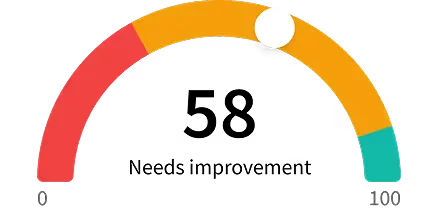
Score my resume
Contents
Resume Formats & Examples
ATS-Friendly resume formats that land jobs
Use a template that guides you. Our ATS-compliant designs are trusted by 4,785,497+ job seekers.
“Rezi is an awesome AI-based resume builder that includes templates to help you design a resume that is sure to check the boxes when it comes to applicant tracking systems. This is a great jumping off point to kickstart a new resume.”

Ashley Stahl
Career Contributor
62.18%
Interview Rate
4,785,497+
Total Users
8.23 / 10
Avg. User Review
Wall of Love
4,785,497+ users trust Rezi

Resume Building felt like pulling teeth – until I found Rezi.
Davis Allen
Software Developer

I was blown away by Rezi. It streamlined everything...
Celine Watko

I needed a resume tool as smart as my work.
Yosra Naceur
Data Scientist
“A great tool that is very helpful. I found the Rezi system easy to use and very helpful as I was working on getting my resume in shape for job applications.”

Dakota Rubin
United States
Written via

“This is actually one of the first reviews I’ve ever written for a business, and that alone says a lot. I highly recommend Rezi to anyone who’s job searching, it makes the entire process so much easier.”

Yazan Alkhatib
United States
Written via
“Reduced my time per application from 1-2 hours down to 15 minutes.”
Kixxx
Experience with Rezi
“I love how simple and convenient it is to use and been coming back to update it every time I need a fresh resume.”

Zara Wazir
U.A.E.
Written via