
Legal Resumes
10+ Mergers and Acquisitions Lawyer Resume Examples & Tips for 2026
Customize any of these resumes in minutes using our free AI-powered resume builder.
“Rezi is super upfront and continues to improve over time. I've recommended Rezi to several of my friends and colleagues. I just love this product so much.”

Ricky M.
Software Engineer
“Rezi is super upfront and continues to improve over time. I've recommended Rezi to several of my friends and colleagues. I just love this product so much.”
Ricky M.
Software Engineer
Helping users land jobs at 1,000+ companies such as














Here's the problem I keep seeing with M&A lawyer resumes: they read like a list of transactions without any context. "Advised on $500M acquisition." Great — but what did you actually do? Did you lead the due diligence team? Negotiate the purchase agreement? Identify the regulatory hurdle that nearly killed the deal and find a workaround?
To create a compelling M&A lawyer resume, you need to go beyond deal lists. You need to tell a story that captures your role in each transaction: the complexity you navigated, the structures you designed, the clients you advised, and the outcomes you delivered from letter of intent through closing.
And this is exactly what you'll learn from this article. Inside, you'll find:
- Examples of 10+ mergers and acquisitions lawyer resumes, covering different specializations and seniority levels.
- Insider tips about what really matters to hiring partners and legal recruiters evaluating M&A candidates.
- A step-by-step guide for putting together an M&A lawyer resume that gets you interviews at top firms and in-house legal departments.
Sample Mergers and Acquisitions Lawyer Resumes
Take a look at some top-notch sample resumes for M&A lawyers across different specializations and experience levels. Find one that matches your profile and use it as a reference point (or feel free to steal it, just make sure to adjust the wording to reflect your own deal experience and career trajectory).
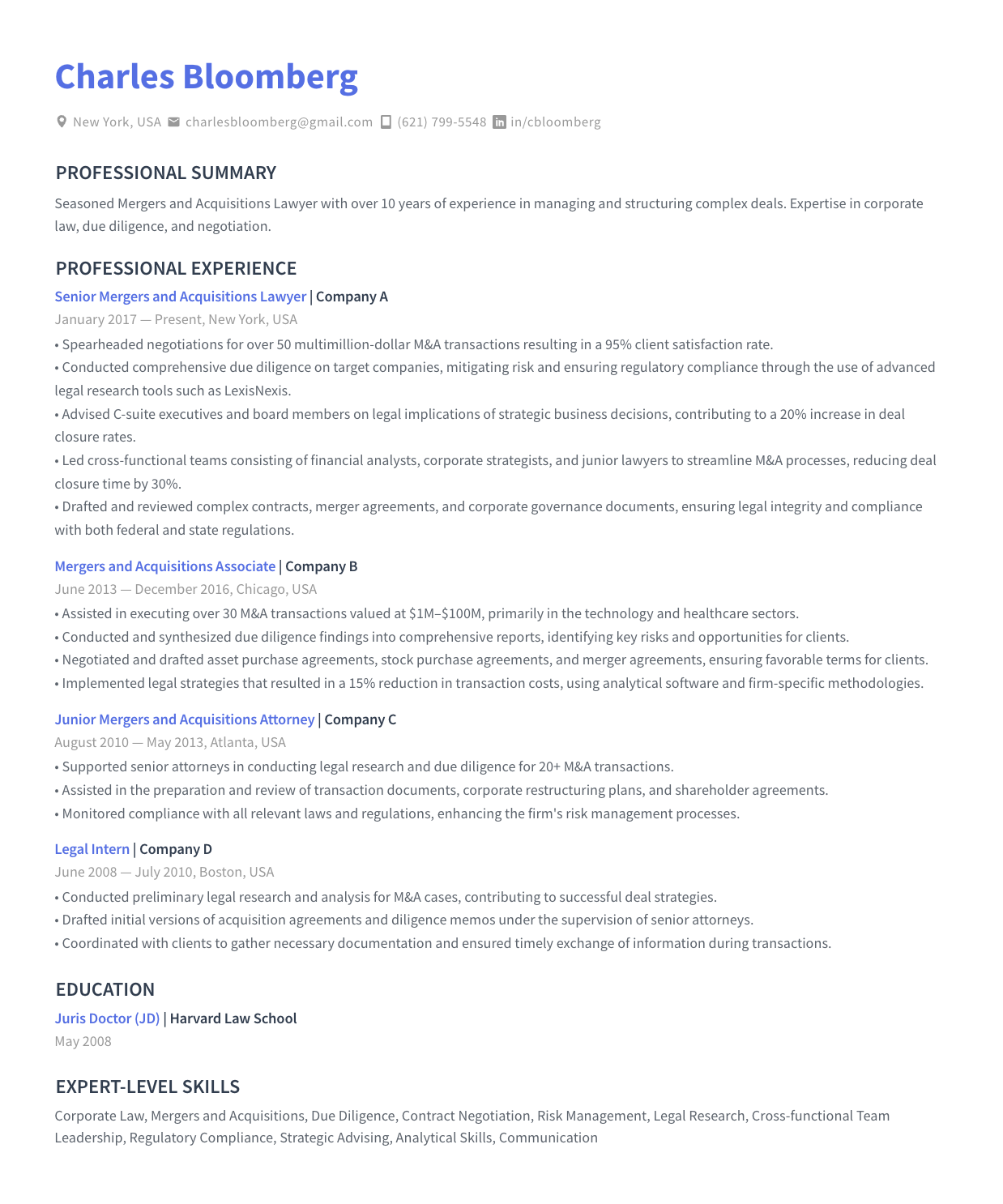
Junior M&A Lawyer
A Junior M&A Lawyer's resume should emphasize your legal education, relevant coursework in corporate law and securities regulation, and any transactional experience from internships or clerkships. Highlight your research and drafting skills, due diligence capabilities, and familiarity with deal documentation. If you've assisted on any live transactions — even in a supporting role — describe your contributions clearly. Bar admission and law review participation are strong additions at this stage.
Mid-Level M&A Lawyer
For a Mid-Level M&A Lawyer, your resume should demonstrate growing deal responsibility and client-facing experience. Showcase transactions where you managed workstreams independently — leading due diligence, drafting and negotiating ancillary agreements, or coordinating with regulatory counsel. Quantify your deal experience by aggregate value and number of transactions. Highlight your ability to manage junior associates and your developing expertise in specific deal structures or industries.
Senior M&A Lawyer
A Senior M&A Lawyer resume should demonstrate a track record of leading complex transactions from origination through closing. Emphasize your role as primary deal counsel, your ability to manage large deal teams, and your experience advising C-suite executives and boards of directors. Highlight marquee transactions, your expertise in sophisticated deal structures like carve-outs or take-privates, and any business development contributions. Include leadership within your firm or legal department.
Mergers and Acquisitions Attorney
A Mergers and Acquisitions Attorney resume should present a well-rounded transactional profile. Emphasize your experience across the full deal lifecycle — from structuring and due diligence to negotiation and closing. Highlight your ability to draft and negotiate purchase agreements, disclosure schedules, and ancillary documents. Showcase your understanding of regulatory frameworks including antitrust, HSR filings, and securities compliance. Detail the industries you've worked in and the size range of transactions handled.
Corporate M&A Lawyer
For a Corporate M&A Lawyer, your resume should underscore your broader corporate law foundation alongside your transactional expertise. Highlight experience advising on governance matters, shareholder agreements, joint ventures, and strategic investments in addition to traditional mergers and acquisitions. Show your ability to counsel clients on corporate structuring, fiduciary duties, and post-closing integration issues. Proficiency in SEC reporting and public company matters will strengthen your profile significantly.
M&A Associate Attorney
An M&A Associate Attorney resume should showcase your growth within a law firm's corporate practice. Focus on the increasing complexity of transactions you've worked on, your expanding role in deal execution, and your ability to handle multiple deals simultaneously. Highlight specific contributions — such as leading due diligence for a $200M acquisition or drafting the definitive agreement for a cross-border merger. Mention your billable hours track record and any recognition from partners or clients.
M&A Partner
An M&A Partner resume should lead with your book of business, client relationships, and deal origination track record. Highlight landmark transactions you've led, your reputation in the market, and the teams you've built and mentored. Quantify your practice's revenue contribution and showcase thought leadership through publications, speaking engagements, and industry rankings like Chambers or Legal 500. Include board advisory roles and your involvement in firm management or strategy committees.
Transactional M&A Lawyer
A Transactional M&A Lawyer resume should emphasize your hands-on deal execution skills. Showcase your expertise in drafting and negotiating purchase agreements, employment agreements, non-competes, and transition services agreements. Highlight your efficiency in managing closing mechanics, escrow arrangements, and post-closing adjustments. Detail your experience across different transaction types — asset purchases, stock deals, mergers, and tender offers — to demonstrate your versatility in structuring and documenting transactions.
Private Equity M&A Lawyer
For a Private Equity M&A Lawyer, your resume should highlight experience representing PE sponsors, portfolio companies, or management teams in leveraged buyouts, add-on acquisitions, and exit transactions. Showcase your understanding of fund structures, management incentive arrangements, and sponsor-specific deal dynamics. Detail your experience with financing documentation, rollover equity arrangements, and co-investment structures. Familiarity with specific PE sectors or fund sizes will further differentiate your profile.
Cross-Border M&A Lawyer
A Cross-Border M&A Lawyer resume should emphasize your ability to navigate multi-jurisdictional transactions. Highlight experience coordinating with foreign counsel, managing regulatory approvals across multiple countries, and advising on international tax structures and foreign investment restrictions. Showcase language skills, international bar admissions, and familiarity with legal frameworks in key jurisdictions. Detail specific cross-border deals, noting the countries involved and how you addressed jurisdictional complexities to achieve successful closings.
How to Write a Mergers and Acquisitions Lawyer Resume
Short answer:
Focus on your transactional expertise, deal outcomes, and the specific role you played in each transaction. Create a professional header with your name and contact details. Right below, write a 2–3 sentence resume summary outlining your most significant deal experience and legal capabilities. Describe your work history in reverse-chronological order, focusing on transactions closed and your specific contributions. Then, cover your education — including law school, bar admissions, and certifications — list key skills, and add extra sections such as representative transactions, publications, or professional affiliations.
Include all the necessary sections in the correct order
Here's the correct order of sections for most M&A lawyer resumes:
- Header with contact information
- Resume summary or objective
- Work experience
- Education
- Bar admissions
- Skills
- Certifications (if applicable)
Depending on your current career situation, you can also throw in some additional sections. For instance:
- Representative transactions (a deal sheet summarizing key transactions)
- Publications and thought leadership
- Speaking engagements and conference presentations
- Professional associations and memberships
- Pro bono experience
- Industry rankings and recognition (Chambers, Legal 500, Super Lawyers)
Include everything that demonstrates you're capable of handling the transactions the role requires. Make every section count. If it doesn't clearly highlight your deal experience or legal expertise, it doesn't belong on your resume.
If you have less than five years of post-qualification experience, keep your resume to 1 page. For more senior M&A lawyers, a two-page resume is appropriate — though a separate deal sheet can extend beyond that.
More details here: What Sections to Include on Your Resume?
Now, I'll give you a high-level overview of how to write each section, going from top to bottom. Well… almost. The only exception is the resume summary section. While it comes right after your contact info, it's actually easier to write it last. More on that in a sec.
Create a professional resume header
- Start with your name and contact information. Include the basics: your full name, phone number, professional email address, location, and LinkedIn profile. A link to your professional bio on your firm's website or a personal site featuring publications can add credibility.
- Right below your name, clearly state your professional title (e.g., Senior M&A Associate or Mergers & Acquisitions Counsel). This sets expectations and immediately signals your area of practice.
For more information, see: How to Create a Resume Header
Describe your work history
- Use reverse-chronological order. List your positions starting with the current or most recent one.
- In each entry, include your job title, firm or company name, location, and dates of employment.
- Below each position, write 3–7 bullet points — the more recent the position, the more bullet points you should include. Describe your role in specific transactions and, more importantly, the outcomes you helped achieve.
- Use action verbs and quantify your deal experience (e.g., "Led due diligence and negotiated the purchase agreement for a $750M cross-border acquisition in the healthcare sector, achieving closing two weeks ahead of schedule").
- If you worked on specific deal types or in specific industries, weave these details into your descriptions. This will also help you pass ATS scans at law firms and in-house legal departments.
Learn more about the best practices of this section with our detailed guide on how to describe your work experience on a resume.
List your degrees and detail professional credentials
- In the education section, list your J.D. first, including the law school, graduation year, and any honors (e.g., magna cum laude, law review, moot court). If you also hold an LL.M. in a relevant area like corporate law or taxation, list that as well.
- If you have significant work experience, keep the education section concise — law school, degree, and key honors. If you're a junior candidate, add more detail: relevant coursework (securities regulation, corporate finance), clinical experiences, and academic achievements.
- Bar admissions deserve their own section or subsection. List every jurisdiction where you're admitted to practice — this is critical for M&A roles, especially those involving multi-state or cross-border work.
For an in-depth guide on how to describe your education on a resume, see: How to List Education on a Resume
List your most relevant skills in the skills section
- Include a mix of technical legal skills (e.g., purchase agreement drafting, due diligence management) and domain-specific knowledge (e.g., SEC compliance, antitrust review) that you are proficient in.
- Add in soft skills such as negotiation, client relationship management, and cross-functional collaboration. These demonstrate your capacity to advise clients and manage deal teams effectively.
- You can use separate subsections for hard skills and soft skills, or list them all under one heading.
- Match your skills to the description of the job you're applying for. I'm not saying you should dump every skill the posting mentions (especially if you don't really have them), but highlight those areas of expertise where your knowledge overlaps with what the employer needs.
Need some inspiration to get started? Here are some good skills to feature on your M&A lawyer resume.
Technical legal skills for M&A lawyer resumes:
- Purchase agreement drafting and negotiation
- Due diligence management and analysis
- Corporate governance advisory
- SEC and securities law compliance
- Antitrust and HSR filing review
- Tax structuring for transactions
- Regulatory approvals and CFIUS review
- Disclosure schedule preparation
- Closing mechanics and post-closing adjustments
- Representations and warranties insurance
Tools and platforms for M&A lawyers:
- Intralinks
- Datasite (formerly Merrill DatasiteOne)
- DealRoom
- HighQ
- Kira Systems (contract analysis AI)
- Bloomberg Law
- Westlaw Edge
- PitchBook
- Capital IQ
- Microsoft Excel (financial modeling basics)
Key soft skills for M&A lawyers:
- Negotiation
- Client relationship management
- Attention to detail
- Strategic thinking
- Communication (written and verbal)
- Time management under pressure
- Cross-functional collaboration
- Problem-solving
- Leadership and team management
- Business judgment and commercial awareness
For a full-blown guide on listing skills on a resume, visit: How to Put Skills on a Resume
Use additional sections as further proof of your fit
Additional sections add depth to your resume and back up your claimed deal expertise. Good examples of extra sections to add to an M&A lawyer resume are:
- Representative transactions. A curated deal sheet listing key transactions you've worked on, with your specific role, deal value, and industry sector. This is one of the most important additions to any M&A resume — many hiring partners will look at this before anything else.
- Publications and thought leadership. If you've written articles for law reviews, legal publications, or industry outlets on M&A topics, list them in a dedicated section. This signals deep subject matter expertise.
- Professional associations. Membership in organizations like the ABA's Section of Business Law or your local bar association's M&A committee demonstrates your commitment to the practice area.
- Speaking engagements. If you've presented at conferences, CLEs, or industry events on M&A-related topics, include them. Even panel participation counts.
- Industry rankings and awards. Chambers, Legal 500, Super Lawyers, Best Lawyers — if you've been recognized, make sure it's visible.
Highlight the most relevant information in a resume summary
Once you're done writing your M&A lawyer resume, give it a full read. Pick the most relevant information and compile it into a summary paragraph. Place it right under the resume header.
- Be brief and to-the-point. In 3–4 sentences, sum up your deal experience, areas of specialization, and what you bring to the table. Consider this your chance to answer, "Why should you hire me?" Tailor this section to match the employer's needs outlined in the job description.
- Use value-oriented language. Focus on how you can add value to the potential employer — mention aggregate deal value, industry expertise, and specific outcomes you've achieved for clients.
Once you've completed the core sections of your resume, you can use Rezi AI Resume Summary Generator to automatically create a powerful summary, tailored to the job you're applying for. All you need to do is add the position and skills you want to highlight. The AI writer will do the rest.
More information here: How to Write a Job-Winning Resume Summary (with Examples)
For finishing touches, make sure your resume looks professional
- Use a clean and tidy resume format. Ensure your M&A resume is easily readable, with a professional font, consistent formatting, and clear section headings. Law firms tend to be conservative — avoid flashy design elements and stick to a classic, polished layout that conveys professionalism.
- Aim for a balance between detail and conciseness. Junior associates should keep their resume to a single page. Senior associates and partners can extend to two pages, with a separate deal sheet if needed. Make sure every word conveys value.
Learn more about proper resume formatting here: How to Format a Resume & What Standard Resume Format to Use
What Makes Mergers and Acquisitions Lawyer Resumes Different
In short: the emphasis on transactions, client advisory, and deal complexity.
This is also where many M&A lawyers stumble. You see, hiring partners and legal recruiters won't be impressed with a generic list of practice areas or vague references to "corporate transactions." They need to see the specific deals you worked on, the role you played, and the sophistication of the work you handled — because that's how they assess whether you can hit the ground running.
Your deal sheet is your resume's secret weapon
Unlike most other legal specialties, M&A hiring decisions are heavily influenced by your deal experience. A representative transaction list — essentially a curated deal sheet — can be more persuasive than your work experience section alone.
What it means for you:
- Prepare a separate deal sheet (or integrate a condensed version into your resume) listing 10–20 of your most significant transactions. Include the deal type, your role, the industry, and the aggregate deal value.
- Organize your deals strategically. If you're applying to a firm known for private equity work, lead with your PE deals. If the role is in-house at a tech company, front-load your tech M&A experience.
Focus on your specific role in each transaction
M&A deals involve large teams. Simply saying you "worked on" a $2B merger tells hiring decision-makers very little. They want to know whether you were running the deal or reviewing a single ancillary document.
What it means for you:
- Be specific about your contributions. Did you draft the purchase agreement? Lead the due diligence process? Negotiate indemnification provisions? Coordinate with antitrust counsel on the HSR filing? Spell it out.
- Indicate your level of responsibility. Phrases like "served as lead associate," "managed a team of four associates and three paralegals," or "acted as primary point of contact for the client" convey meaningful information about your seniority on the deal.
Demonstrate industry and deal-type versatility (or deep specialization)
M&A practices vary widely. Some lawyers are generalists; others specialize in specific sectors or deal types. Either approach can work — but your resume needs to tell a coherent story about your expertise.
What this means for you:
- If you're a generalist, showcase your range by highlighting transactions across different industries, deal sizes, and structures (mergers, stock purchases, asset deals, carve-outs, joint ventures).
- If you're a specialist, go deep. Show the depth of your expertise in a particular sector (e.g., healthcare, technology, energy) or deal type (e.g., leveraged buyouts, take-privates). Consistency in your deal sheet reinforces your niche authority.
Show business acumen, not just legal skill
M&A clients expect their lawyers to understand the commercial objectives behind every deal — not just the legal mechanics. The best M&A lawyers are trusted business advisors, and your resume should reflect that.
What this means for you:
- Frame your achievements in business terms, not just legal ones. Instead of "Drafted representations and warranties section," try "Negotiated seller representations that secured $15M in indemnification coverage for the buyer, protecting against identified environmental liabilities."
- Highlight instances where your legal advice directly influenced deal strategy — such as recommending a structure change that reduced tax exposure, or identifying a regulatory risk early enough to renegotiate the purchase price.
Career progression matters — show your path to increasing deal responsibility
No worries if you're just starting out, but if you have significant experience, your M&A resume should clearly show your trajectory from junior deal team member to lead transaction counsel.
What this means for you:
- Highlight transitions from supporting roles to leadership positions on deals. Show how you progressed from running due diligence as a junior associate to negotiating the purchase agreement and advising the board as a senior associate or partner.
- The easiest way to demonstrate this is through the increasing size, complexity, and strategic importance of the deals you've handled over time.
Bonus Resources for Mergers and Acquisitions Lawyers
This isn't going to be a game-changer if you need a resume right now. But —
I want you to treat your career holistically. These resources will help you sharpen your M&A expertise, build the credentials that make future resumes more compelling, and keep you plugged into the latest developments in the dealmaking world.
Professional associations and networks
ABA Section of Business Law
The American Bar Association's Section of Business Law is the premier professional organization for transactional lawyers in the U.S. It offers committees focused on M&A, corporate governance, and private equity, along with CLE programs, publications, and networking events.
International Bar Association (IBA)
For lawyers involved in cross-border transactions, the IBA provides a global platform for networking, professional development, and insights into international legal frameworks affecting M&A deals worldwide.
Association of Corporate Counsel (ACC)
If you're pursuing or already in an in-house M&A role, ACC offers resources, events, and a community of in-house counsel who regularly handle transactions from the client side.
Online learning platforms
Coursera & edX
Both platforms offer courses in corporate finance, financial modeling, and M&A fundamentals from top universities. These are excellent for lawyers looking to strengthen the financial and business side of their transactional skill set.
Practising Law Institute (PLI)
PLI offers some of the most respected CLE programs for M&A lawyers, including the annual "Acquiring or Selling the Privately Held Company" and "M&A of Public Companies" programs. Attendance looks strong on a resume and delivers practical deal knowledge.
Harvard Law School Forum on Corporate Governance
A free, regularly updated resource featuring commentary from top practitioners and academics on M&A trends, deal litigation, corporate governance, and shareholder activism. Essential reading for staying current.
Publications
The Deal
A leading publication covering M&A news, deal analysis, and market trends. Staying plugged into The Deal helps you understand the competitive landscape and talk intelligently about market dynamics in interviews.
Mergermarket
The industry-standard intelligence service for M&A professionals, providing deal data, league tables, and forward-looking M&A intelligence. Familiarity with Mergermarket signals that you understand the business side of dealmaking.
The American Lawyer
Covers law firm M&A rankings, deal of the year awards, and in-depth profiles of leading M&A practices. Useful for understanding where firms stand in the market and tailoring your job search accordingly.
Tools and platform reviews
Capterra & G2
Both websites provide extensive reviews and comparisons of virtual data room platforms and contract analysis tools commonly used in M&A transactions, helping you stay current with the technology that deal teams rely on.
Datasite Knowledge Hub
Datasite (formerly Merrill DatasiteOne) publishes regular content on M&A process best practices, due diligence trends, and data room management — useful for both practical deal work and demonstrating tech fluency on your resume.
Summary
Here's what you need to know about writing a mergers and acquisitions lawyer resume:
- Structure your M&A lawyer resume with essential sections in this order: Header, Resume Summary, Work Experience, Education, Bar Admissions, Skills, and Certifications. Add extra sections like Representative Transactions, Publications, or Professional Associations when relevant.
- Include a professional header with your name, contact information, professional title, and bar admission jurisdictions.
- Describe your work history in reverse-chronological order, emphasizing your specific role in transactions and quantifying deal values and outcomes.
- Prepare a representative transactions list (deal sheet) — this is often the most scrutinized part of an M&A lawyer's application materials.
- In the education section, list your J.D. and any advanced degrees first. Include law review, moot court, and relevant honors.
- Highlight a mix of technical legal skills, tools and platforms, and soft skills, tailoring them to the specific job description.
- Use additional sections to further showcase your deal expertise, thought leadership, and commitment to the M&A practice area.
- Once done writing the resume, compile the key information into a brief, value-oriented resume summary at the top.
- Demonstrate business acumen alongside legal skill — show that you understand the commercial drivers behind every transaction.
- Keep the formatting clean and professional. Law firms and in-house legal departments expect a polished, conservative presentation.
Thanks for reading! Got any questions? Feel free to reach out to me on LinkedIn. (Or check out the FAQs first, maybe your question is answered there.)
FAQ
Should I include a separate deal sheet, or list transactions on my resume?
Ideally, both. Include a condensed "Representative Transactions" section on your resume with 5–8 key deals, and prepare a more comprehensive deal sheet as a separate document. Many legal recruiters and hiring partners expect a standalone deal list, so having one ready shows you understand M&A hiring conventions.
How specific should I be about deal values and client names?
Include deal values whenever possible — aggregate transaction value is one of the first things reviewers look for. As for client names, only include them if the deal was publicly announced. For confidential transactions, describe the parties generically (e.g., "a Fortune 500 healthcare company" or "a mid-market private equity sponsor").
I'm transitioning from litigation to M&A. How should I position my resume?
Focus on transferable skills like contract analysis, negotiation, legal research, and attention to detail. Highlight any exposure to transactional matters — even if it was tangential, like handling post-closing disputes or reviewing indemnification claims. Include any M&A-related coursework, CLEs, or certifications to demonstrate your commitment to the transition.
How important are bar admissions on an M&A lawyer resume?
Very important. Always list every jurisdiction where you're admitted, especially if the role involves multi-state or cross-border transactions. If you're waiving into a new jurisdiction, note it as "admission pending." Some in-house roles may not require bar admission in a specific state, but law firm roles almost always do.
Should I include billable hours targets or metrics?
Generally, no — billable hours are an internal firm metric and don't translate well to a resume. The exception is if you consistently exceeded targets by a significant margin and want to signal your work ethic and deal volume. In that case, a brief mention (e.g., "Consistently exceeded 2,200 billable hour target") can be effective, especially for lateral moves between firms.
I've worked on many small deals. Should I only list the biggest transactions?
Not necessarily. While large headline deals attract attention, a mix of deal sizes actually demonstrates versatility. Middle-market transactions often involve more hands-on responsibility earlier in your career. If you led a $50M acquisition end-to-end, that can be more impressive than being one of fifteen associates on a $10B merger. Choose deals where your role was most significant.
How do I handle gaps between law firm positions on my resume?
Be straightforward. If you took time for additional education (e.g., an LL.M. or MBA), a clerkship, or a planned career break, state it plainly. If the gap was due to a layoff during a market downturn — something not uncommon in M&A — you don't need to explain it extensively. Focus your resume on the strength of your deal experience and skills rather than chronological gaps.
Contents

Resume Formats & Examples
ATS-Friendly resume formats that land jobs
Use a template that guides you. Our ATS-compliant designs are trusted by over 4 million job seekers.



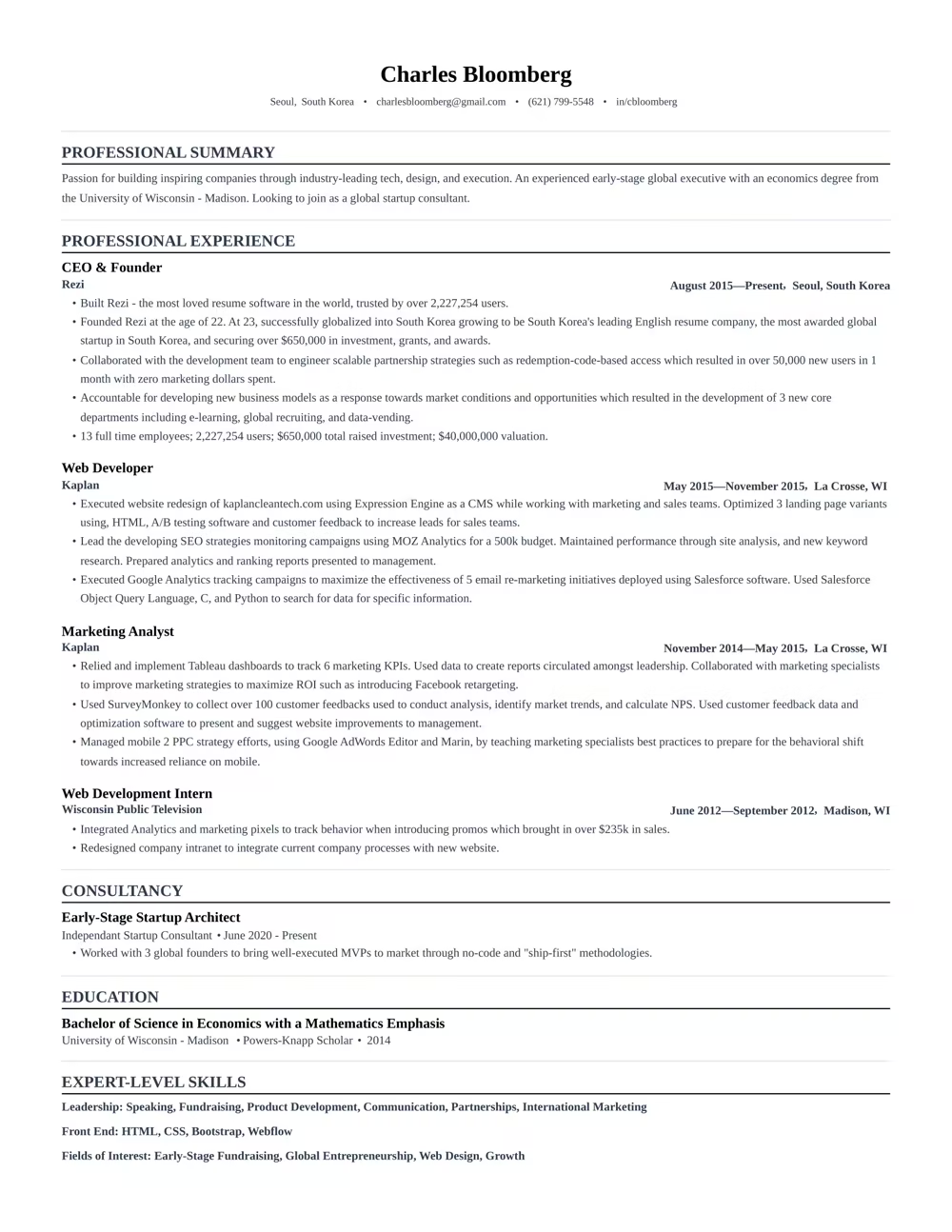
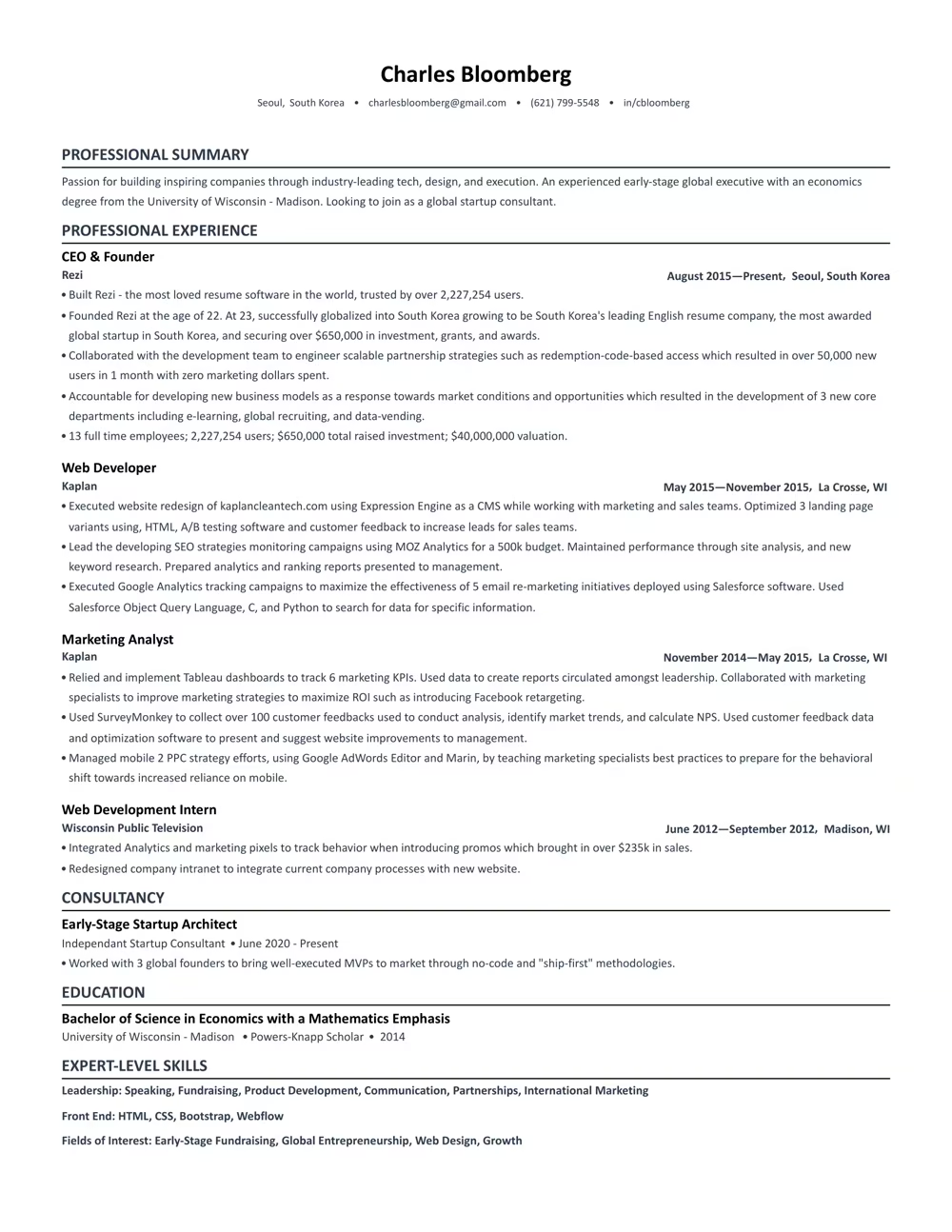
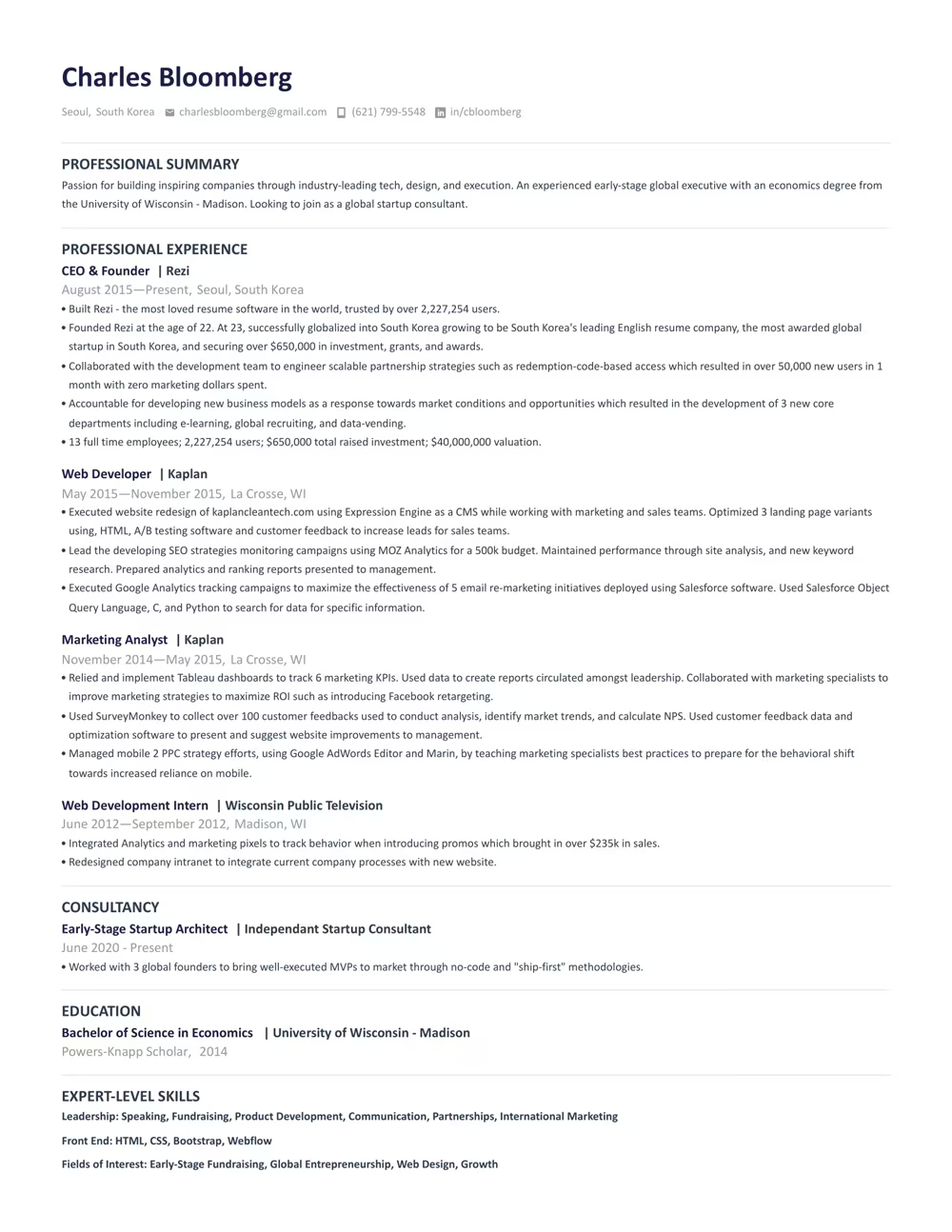
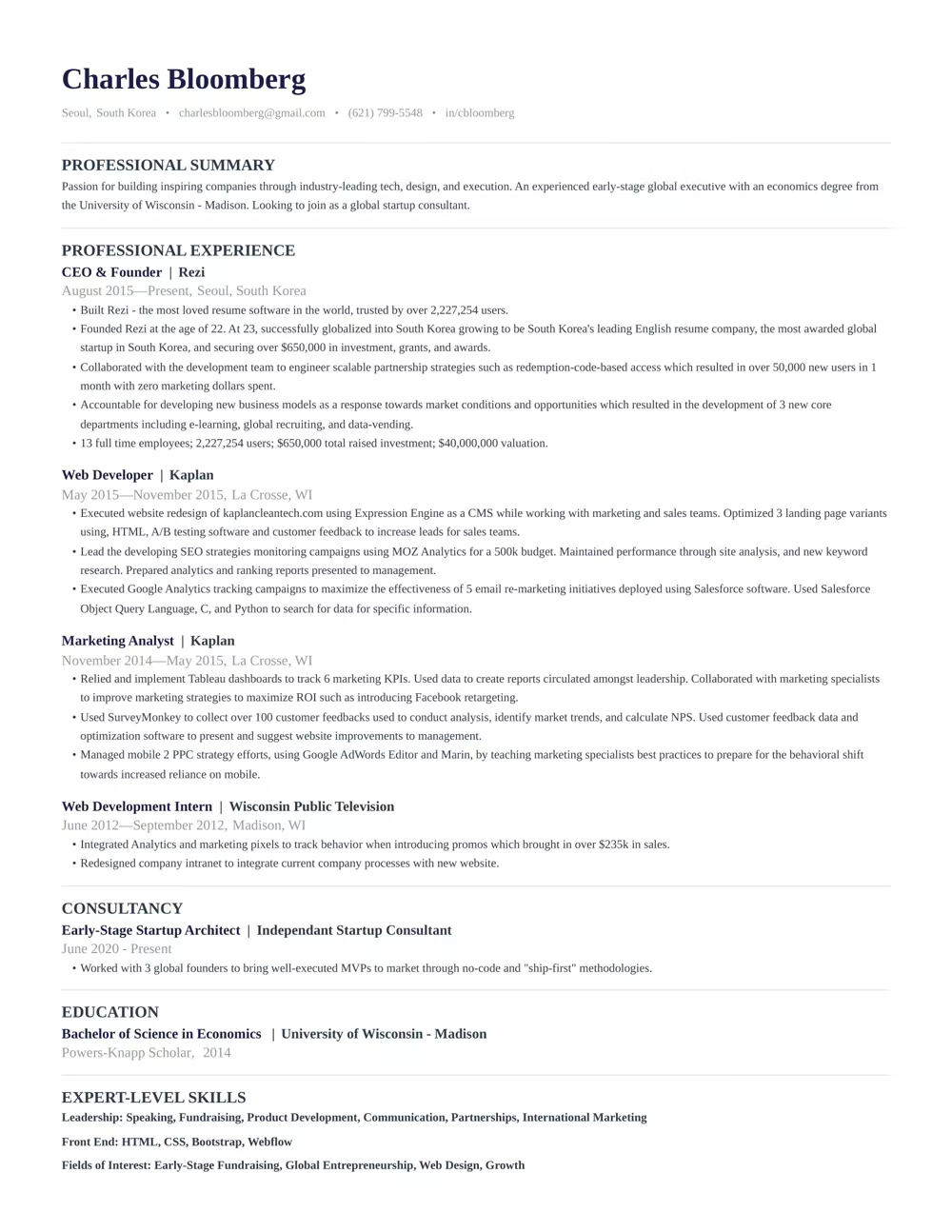

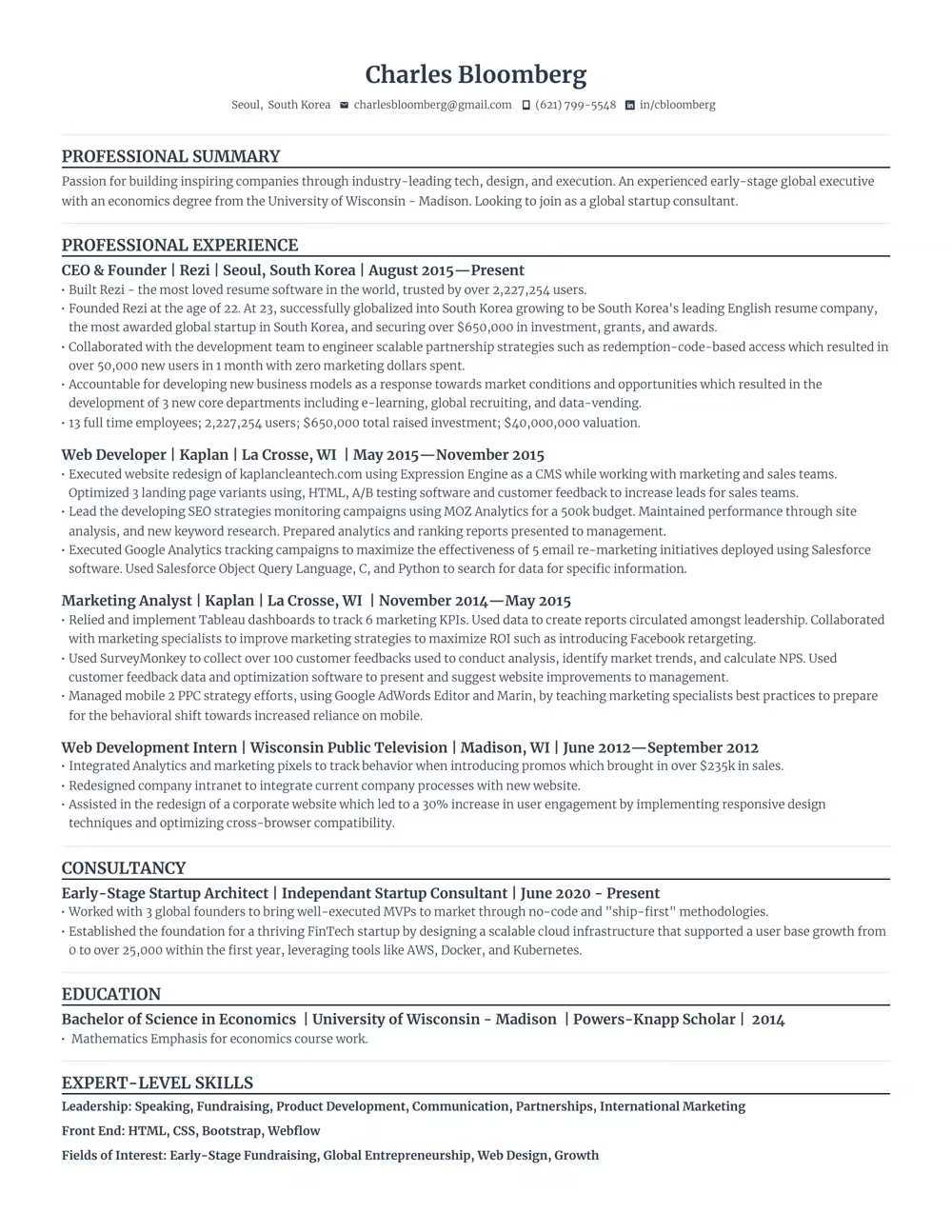
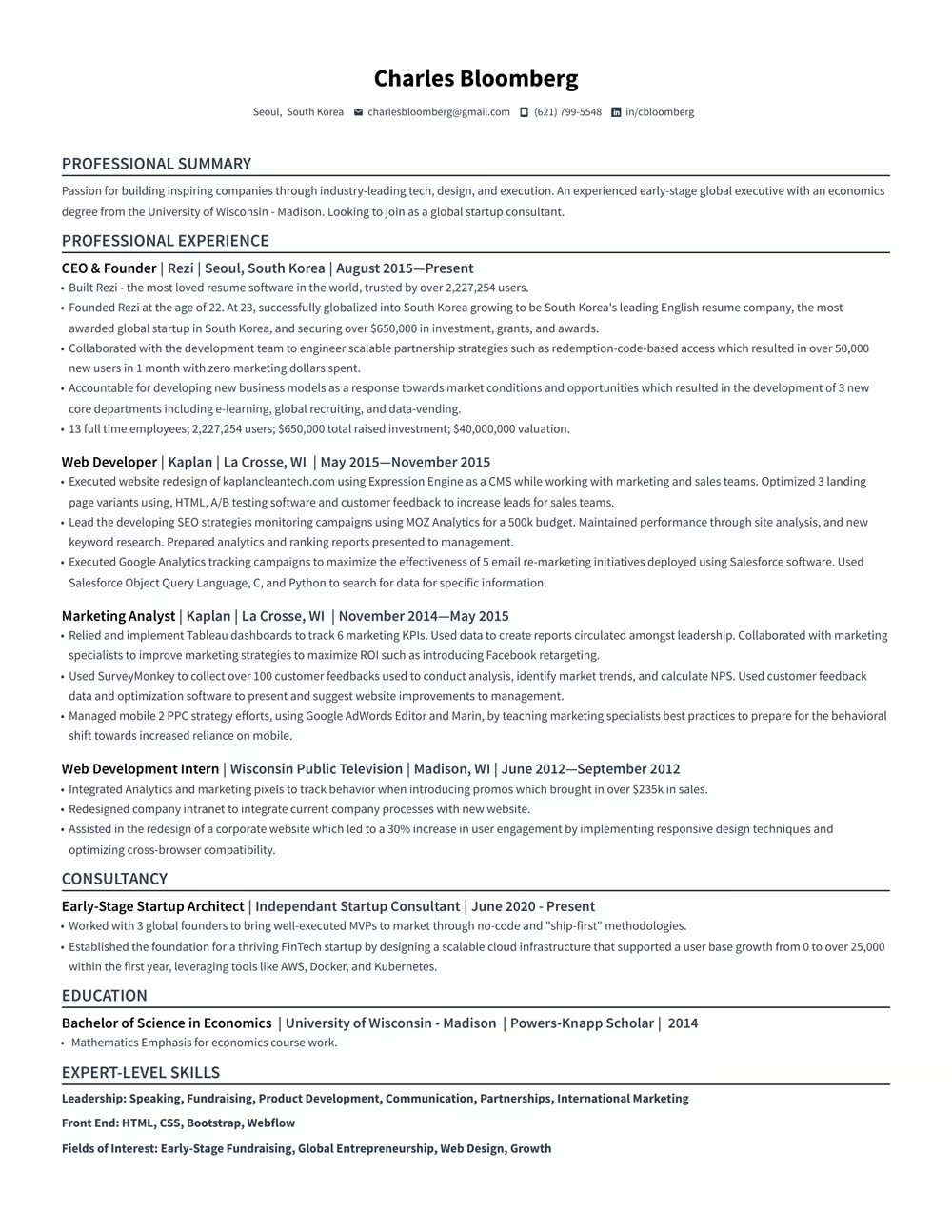
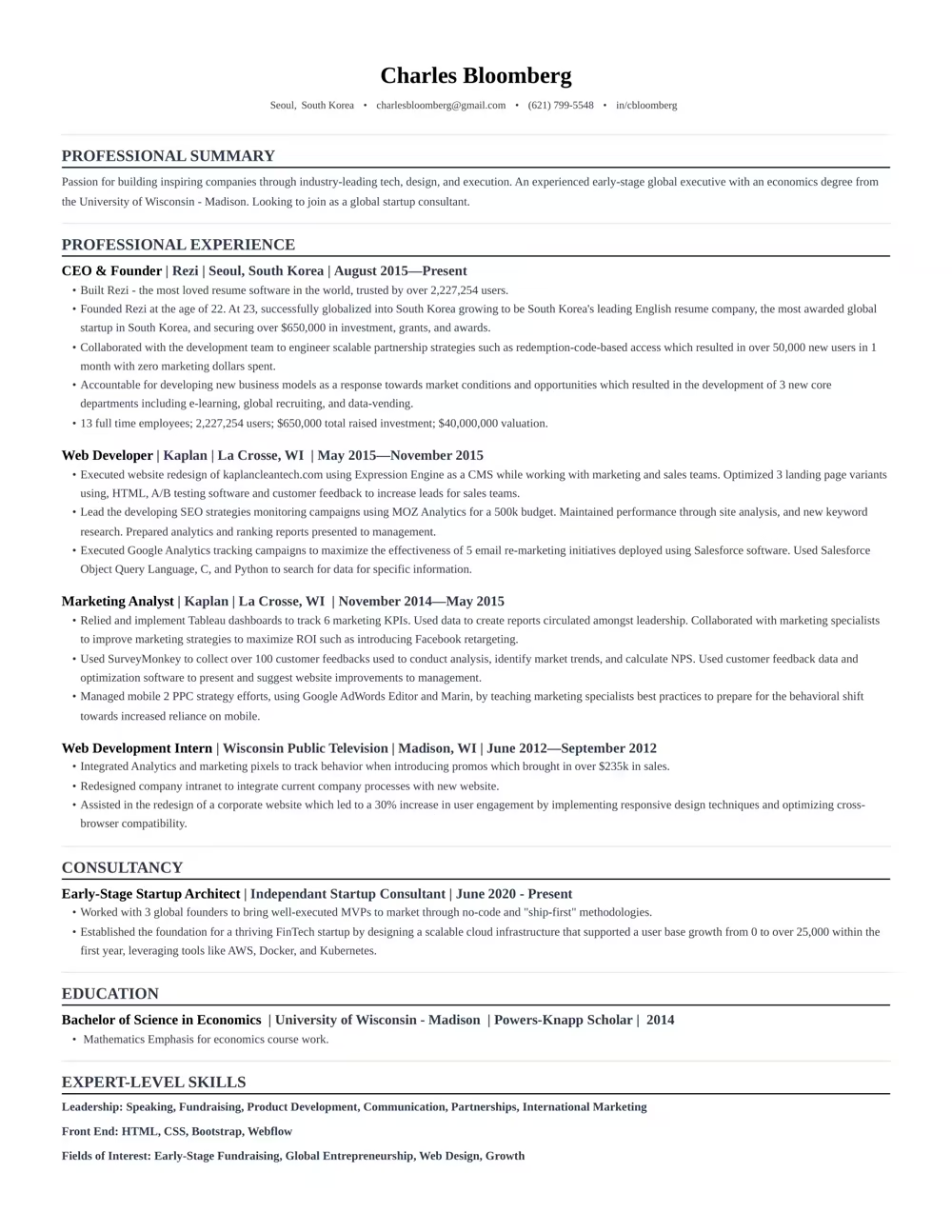
“Rezi is an awesome AI-based resume builder that includes templates to help you design a resume that is sure to check the boxes when it comes to applicant tracking systems. This is a great jumping off point to kickstart a new resume.”

Ashley Stahl
Career Contributor
62.18%
Interview Rate
4,510,834
Total Users
8.23 / 10
Avg. User Review
Wall of Love
Over 4 million users trust Rezi

“Resume Building felt like pulling teeth – until I found Rezi.”
Davis Allen
Software Developer

“I was blown away by Rezi. It streamlined everything...”
Celine Watko

“I needed a resume tool as smart as my work.”
Yosra Naceur
Data Scientist
“A great tool that is very helpful. I found the Rezi system easy to use and very helpful as I was working on getting my resume in shape for job applications.”

Dakota Rubin
United States
Written via

“This is actually one of the first reviews I’ve ever written for a business, and that alone says a lot. I highly recommend Rezi to anyone who’s job searching, it makes the entire process so much easier.”

Yazan Alkhatib
United States
Written via
“Reduced my time per application from 1-2 hours down to 15 minutes.”
Kixxx
Experience with Rezi
“I love how simple and convenient it is to use and been coming back to update it every time I need a fresh resume.”

Zara Wazir
U.A.E.
Written via
Frequently Asked Questions
Your questions, answered.
An AI resume maker helps you build a resume perfectly fit for the job you want. Top-notch AI resume builders are designed to speak the language hiring managers are looking for, increasing your chances of standing out in the crowd. It aligns your skills and experience with the job description effectively.
Rezi templates are ATS-safe. Hiring software can parse your resume with accuracy and you won't have to enter the entire resume all over again after uploading it. Our best resume template is always free. More templates and personalisation is available on Pro subscription. Regardless of what resume template you can customise sections to suit your needs. When in doubt, a clean single-column template works for every industry and every applicant tracking system.
To get the most out of an AI resume builder, either start from scratch or upload your current resume. Fill in as much detail as possible about your career and skills, and upload the job description you’re targeting. This personalization allows the AI to build a unique and tailored resume that’s bound to catch potential employers' attention.
Yes. Rezi stores your content separately from the design, so you can switch templates at any time without retyping anything. Your Rezi Score and keyword targeting stay intact across every template. Some advanced resume template formats require a Pro subscription, but our best template is always free.
AI-generated resumes can seem similar if you're not giving personalized inputs or if you're using basic prompts. Provide specific details about your work experience and target the job you’re eyeing. Use specialized AI tools instead of general chatbots to avoid robotic-sounding resumes and to ensure individual creativity.
A Word or Google Docs template is a static file: one wrong edit breaks the formatting, and nothing checks the result. Rezi keeps the layout locked and parser-safe while its AI writes your content, then scores the finished resume against the job you want.
Employers might think you used AI, but that’s rarely an issue. What they really care about is getting a well-written resume that showcases your skills and experiences accurately. A top-notch resume tailored to their needs will speak volumes more than worrying about AI involvement.
No. Recruiters expect a standard structure, and applicant tracking systems parse it more reliably than a hand-built layout. What hurts is generic content. Rezi's AI tailors your bullet points and keywords to each job description, so your resume never reads like a template.
Yes, using AI to optimize your current resume is highly effective. You just need to upload your resume, share details about your career goals and the job you want, and let the AI refine everything to elevate your resume's impact and ATS compatibility.
Rezi uses a tool called the AI Keyword Targeting. This feature scans the job description to identify crucial keywords and naturally incorporates them into your resume, giving it the right focus without keyword stuffing.
The Free plan is $0/month and allows you to create one resume, use limited AI tools (such as Keyword Targeting and Analysis), and download up to three PDFs. You can also create unlimited cover and resignation letters. No card is required to begin.
The Pro plan is $29/month and provides unlimited access to all features, including unlimited resumes, full AI capabilities, unlimited downloads, and one free monthly expert resume review (resumes are reviewed by a person).
The Lifetime plan is a $149 one-time payment. It grants permanent access to all the features of the Pro plan (unlimited resumes, full AI tools, and unlimited downloads), but it does not include the free monthly expert review (which can be purchased for an extra fee).
Yes. The standard template free and available for all users. With the free plan, you can completely create 1 resume, use AI writer, and download your resume 3 times in PDF format. No credit card is required to join the free plan. Rezi Pro at $29 per month removes the limits and unlocks all our Pro templates including Compact, Modern and Smart templates.
Rezi offers a 100% money-back guarantee on all paid plans (Pro and Lifetime). If you are unsatisfied, you can request a full refund within 30 days of your purchase.
The free template that comes with the free plan is rated as one of our best resume templates. Pro subscription offers more personalisation and more templates while keeping ATS-safe designs; Pro removes limits on resumes, downloads, and AI tools. Our best template is never paywalled and is always free for everyone.
Yes, you can easily upgrade or downgrade your plan at any time through your Rezi Account Billing dashboard. Prorated credits will apply when switching.
An AI resume maker helps you build a resume perfectly fit for the job you want. Top-notch AI resume builders are designed to speak the language hiring managers are looking for, increasing your chances of standing out in the crowd. It aligns your skills and experience with the job description effectively.
They are risky. Many parsers read multi-column layouts out of order or skip a column entirely, so skills and dates end up scrambled. You can easily check this in popular ATS like Workday and Lever. Rezi templates will seamlessly populate the fields in these ATS where two-column templates struggle. The same applies for graphical resumes. Rezi uses single-column layouts because they parse correctly in every major applicant tracking system.
Use a text-based PDF unless the job posting asks for Word. PDFs have been around for years and modern applicant tracking systems read PDFs reliably. PDF locks your layout so it looks the same everywhere. Rezi exports machine-readable PDFs that parse cleanly in every major ATS and ensure compatibility.
Yes. The same ATS rules apply to CVs: single column, standard headings, machine-readable text. CVs usually tend to be longer than resumes. You can check their differences here. Rezi templates can handle both if you require a longer CV format, you can easily add sections like publications, certifications, and research without breaking the layout. It is recommended to use a shorter resume format than CVs when applying for jobs, unless mentioned otherwise.
Yes, Rezi Enterprise.