
Business Resumes
Startup Founder Resume Examples and Writing Guide
Customize any of these resumes in minutes using our free AI-powered resume builder.
“Rezi is super upfront and continues to improve over time. I've recommended Rezi to several of my friends and colleagues. I just love this product so much.”

Ricky M.
Software Engineer
“Rezi is super upfront and continues to improve over time. I've recommended Rezi to several of my friends and colleagues. I just love this product so much.”
Ricky M.
Software Engineer
Helping users land jobs at 1,000+ companies such as















Startup Founder Resume Examples
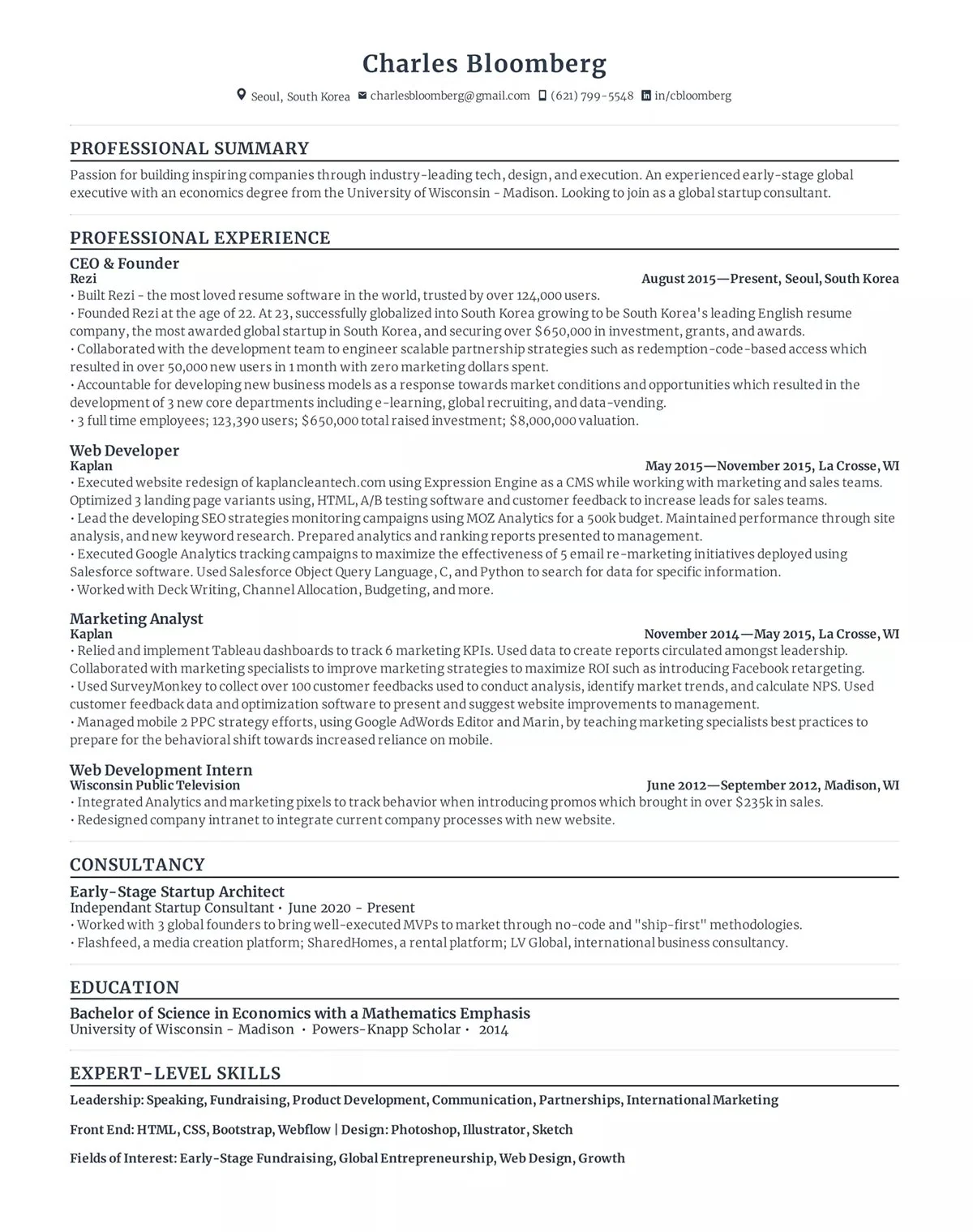
The two samples below are for founders writing a resume to get hired: a founder and CEO who still runs a small software company and wants consulting work, and a three-time co-founder applying for a product manager job. After them you'll find how to list a founder role, write the summary and bullets, choose skills, and explain a startup that closed or sold.
Both candidates are fictional, and their contact details are placeholders. Put your own dates and figures in their place.
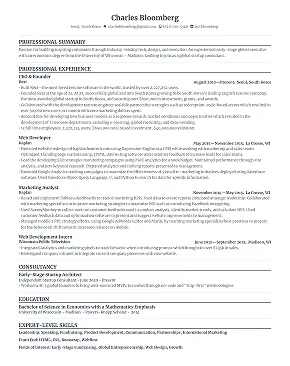
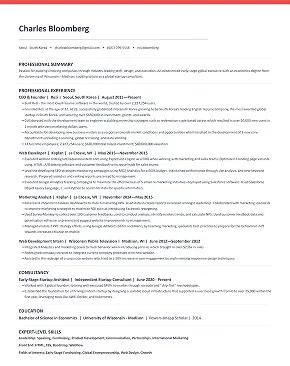
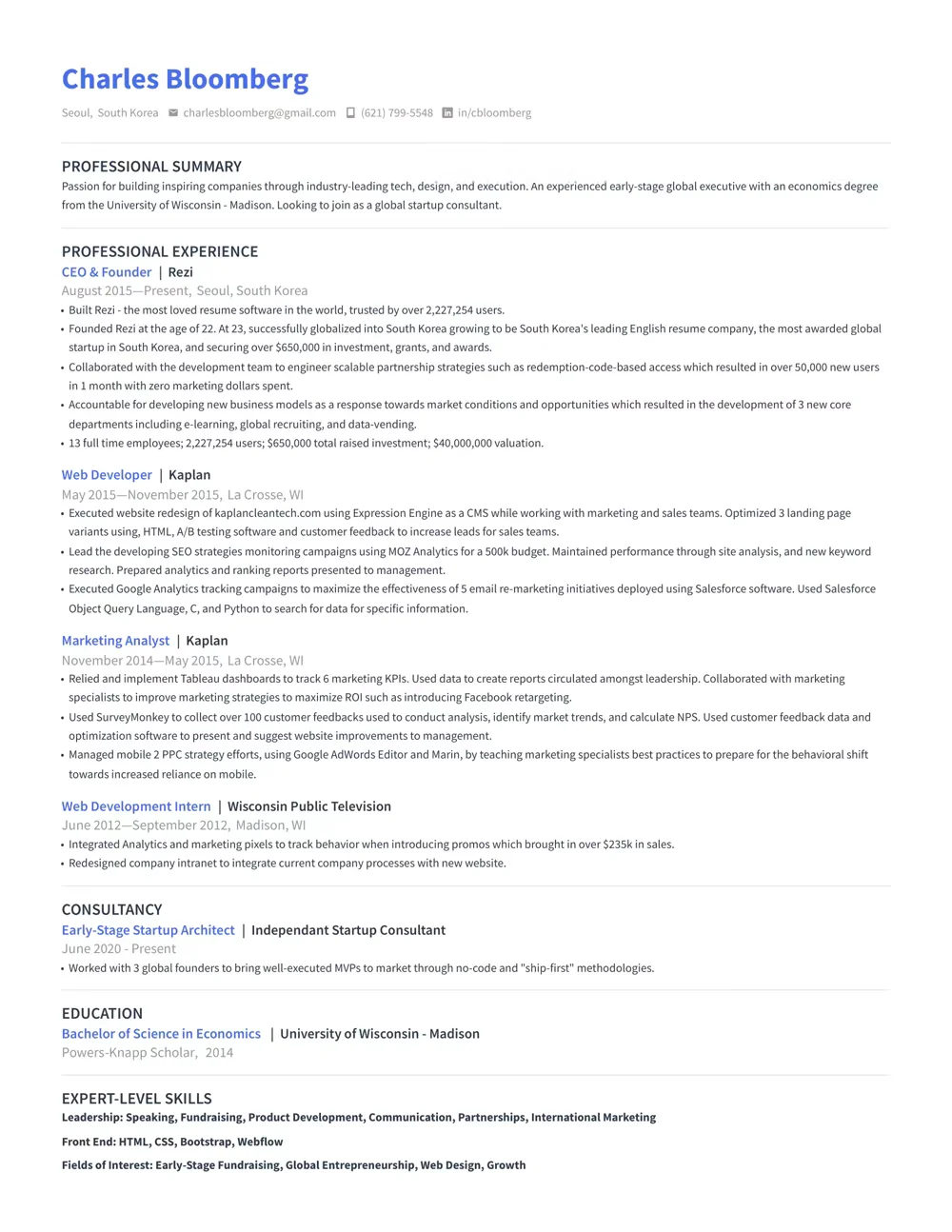
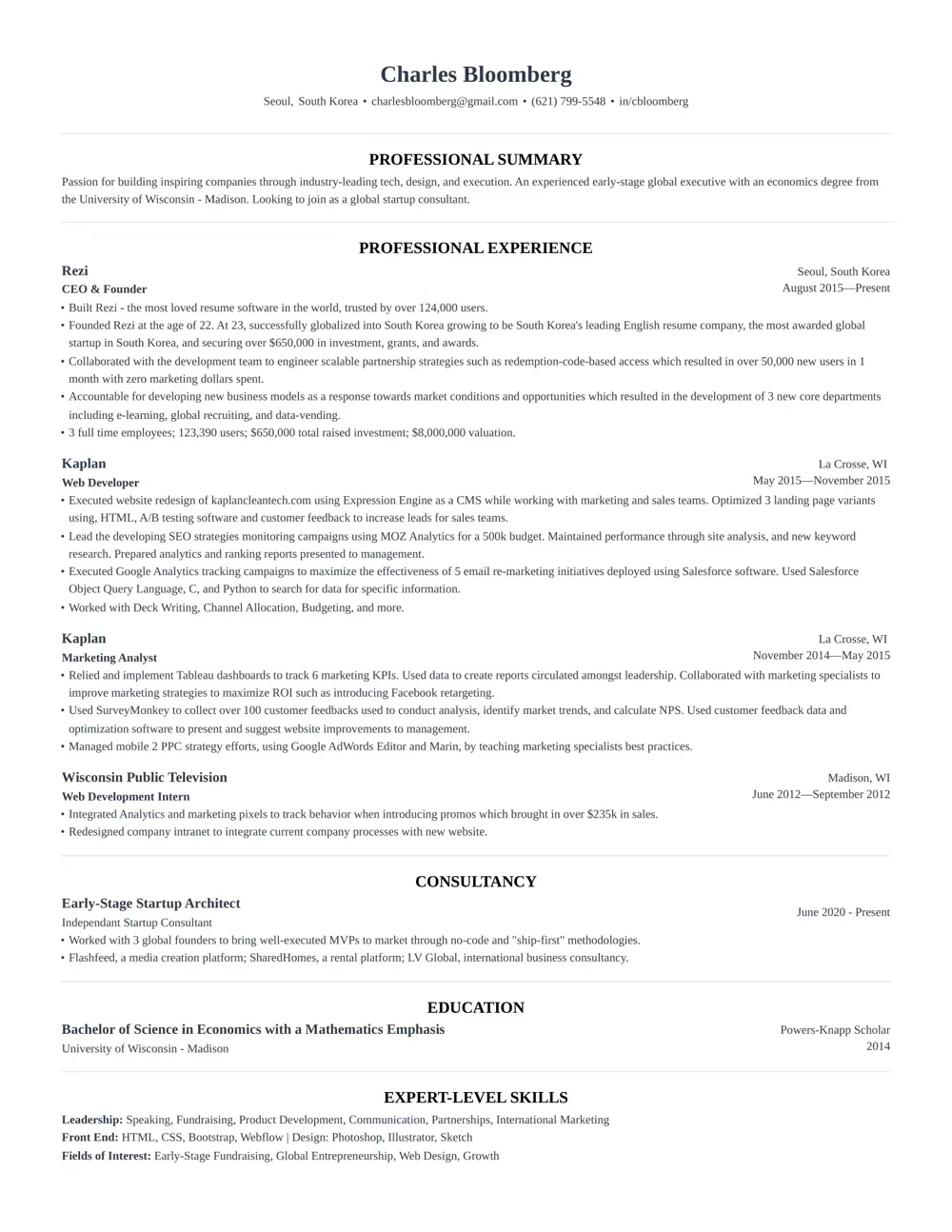
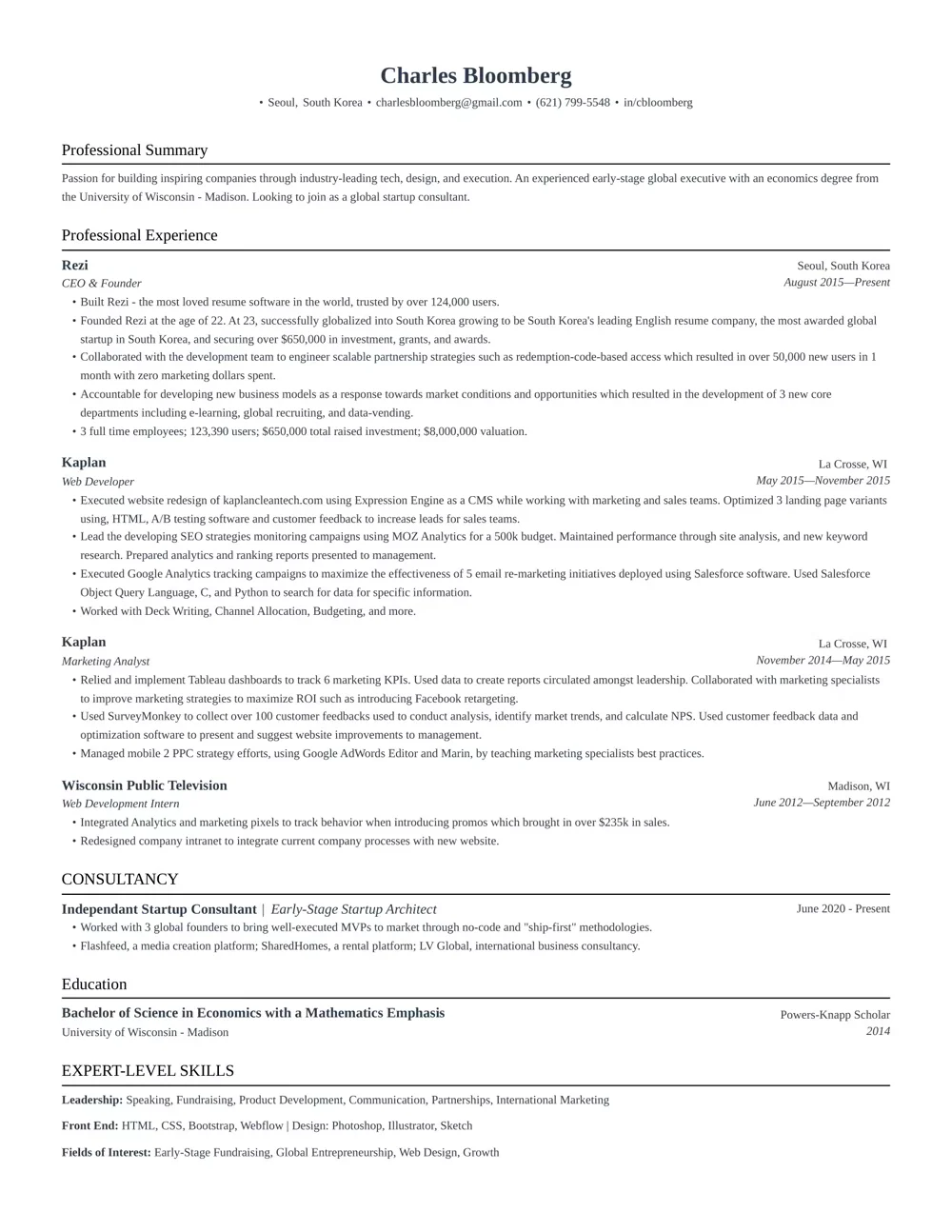
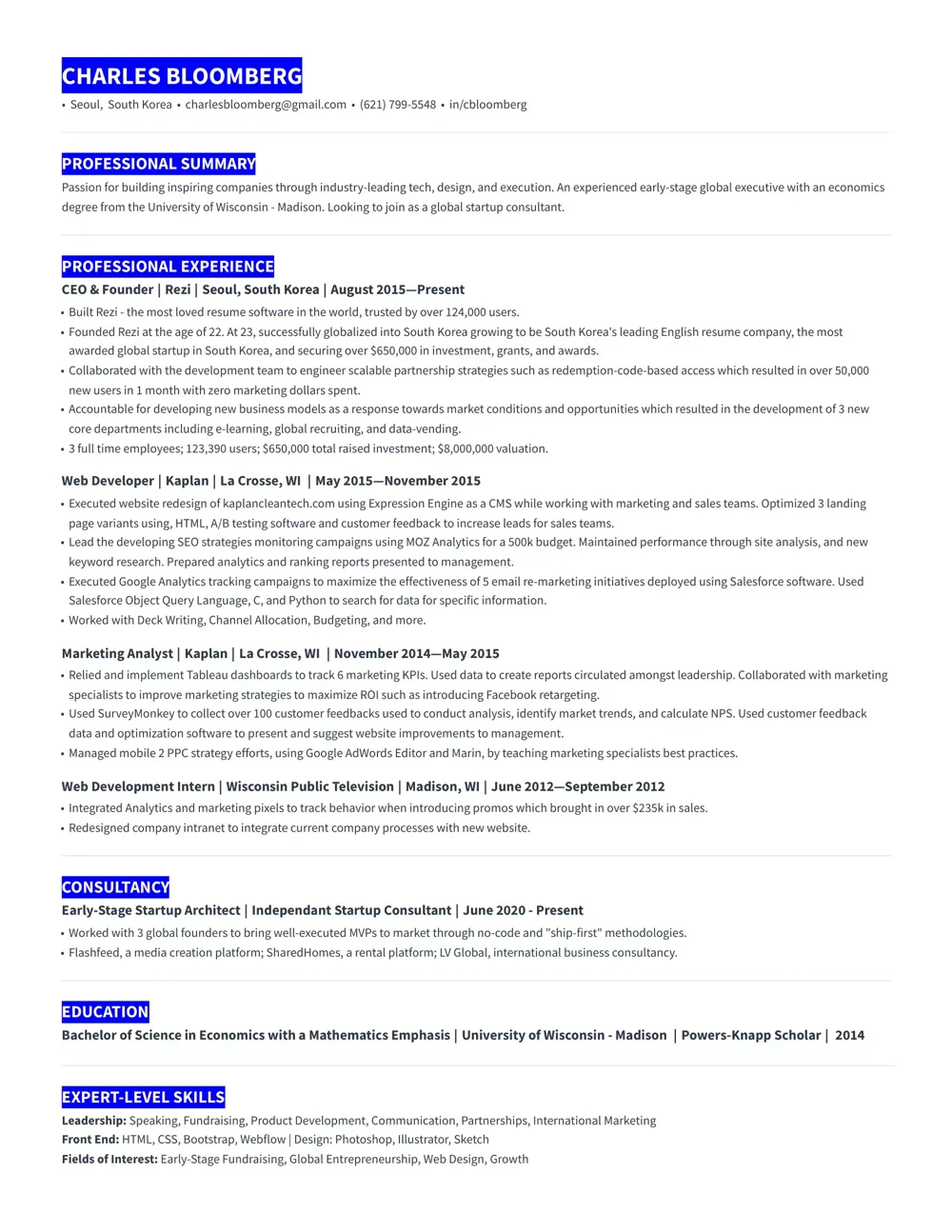
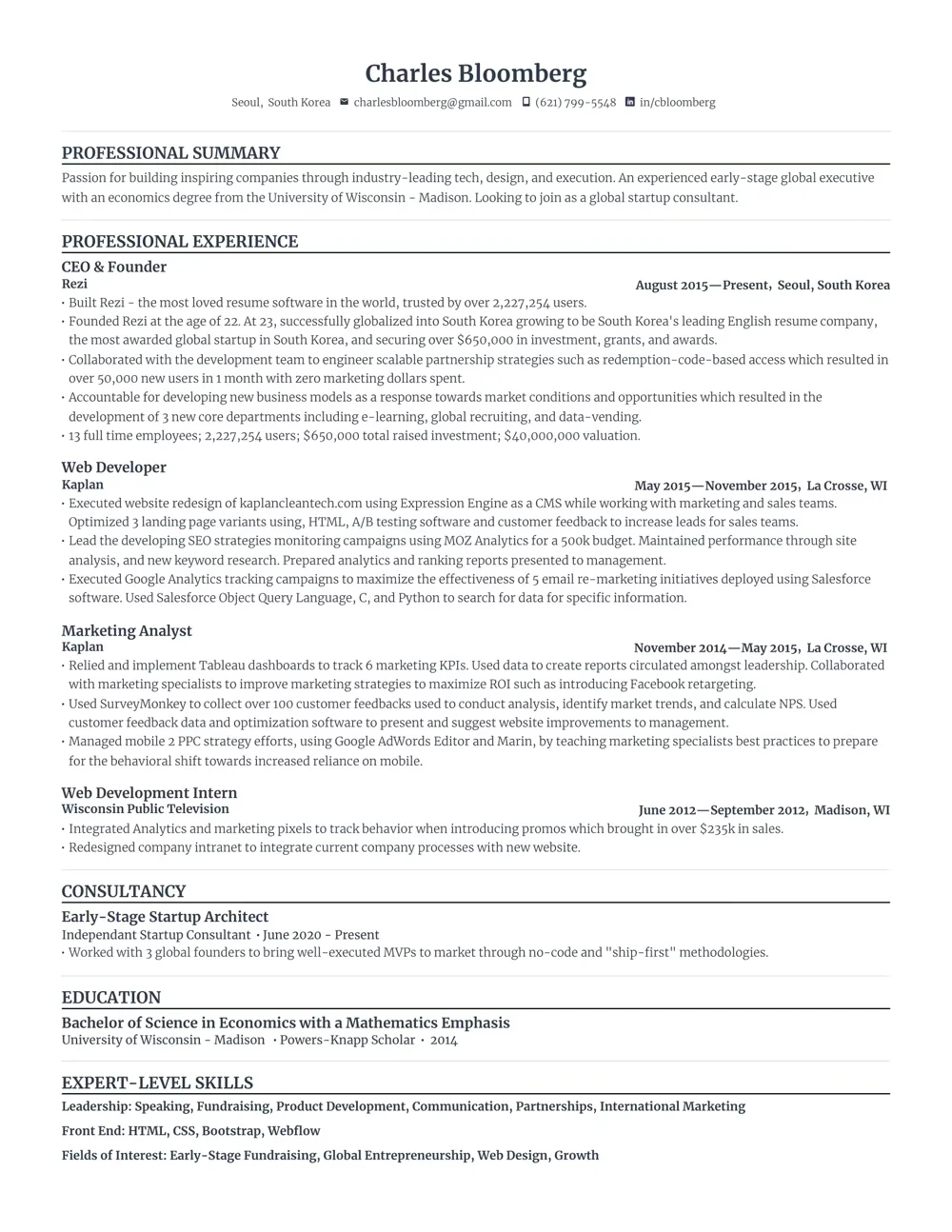
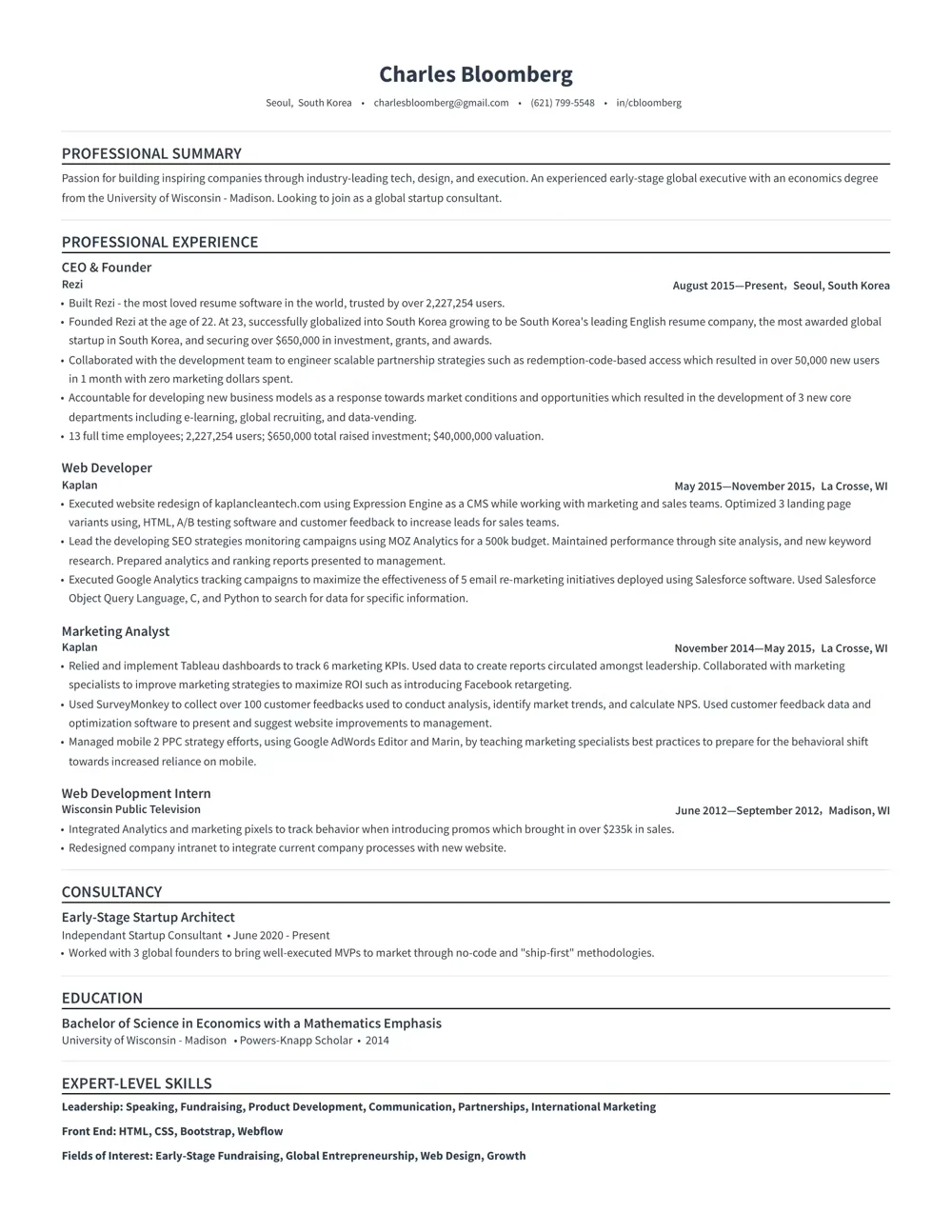
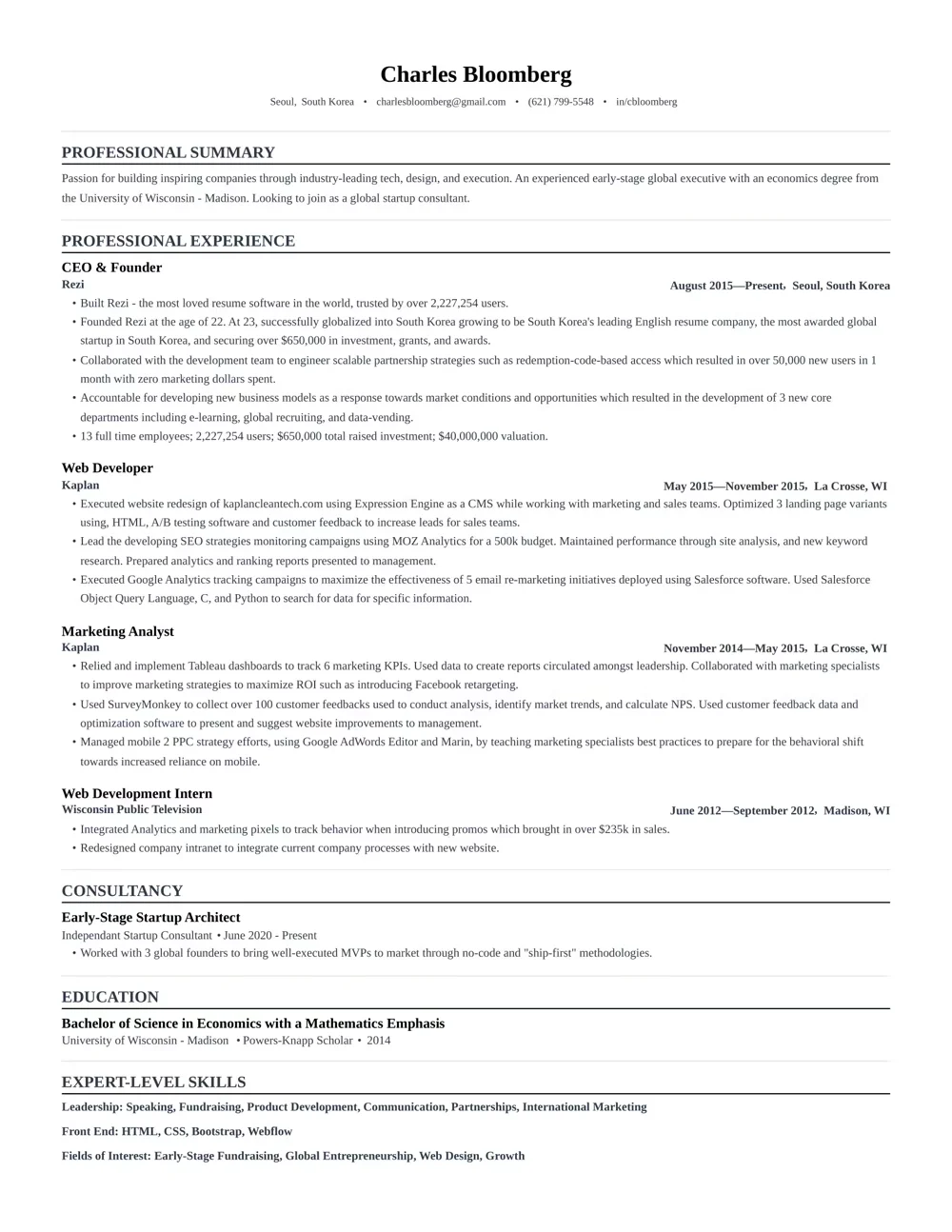
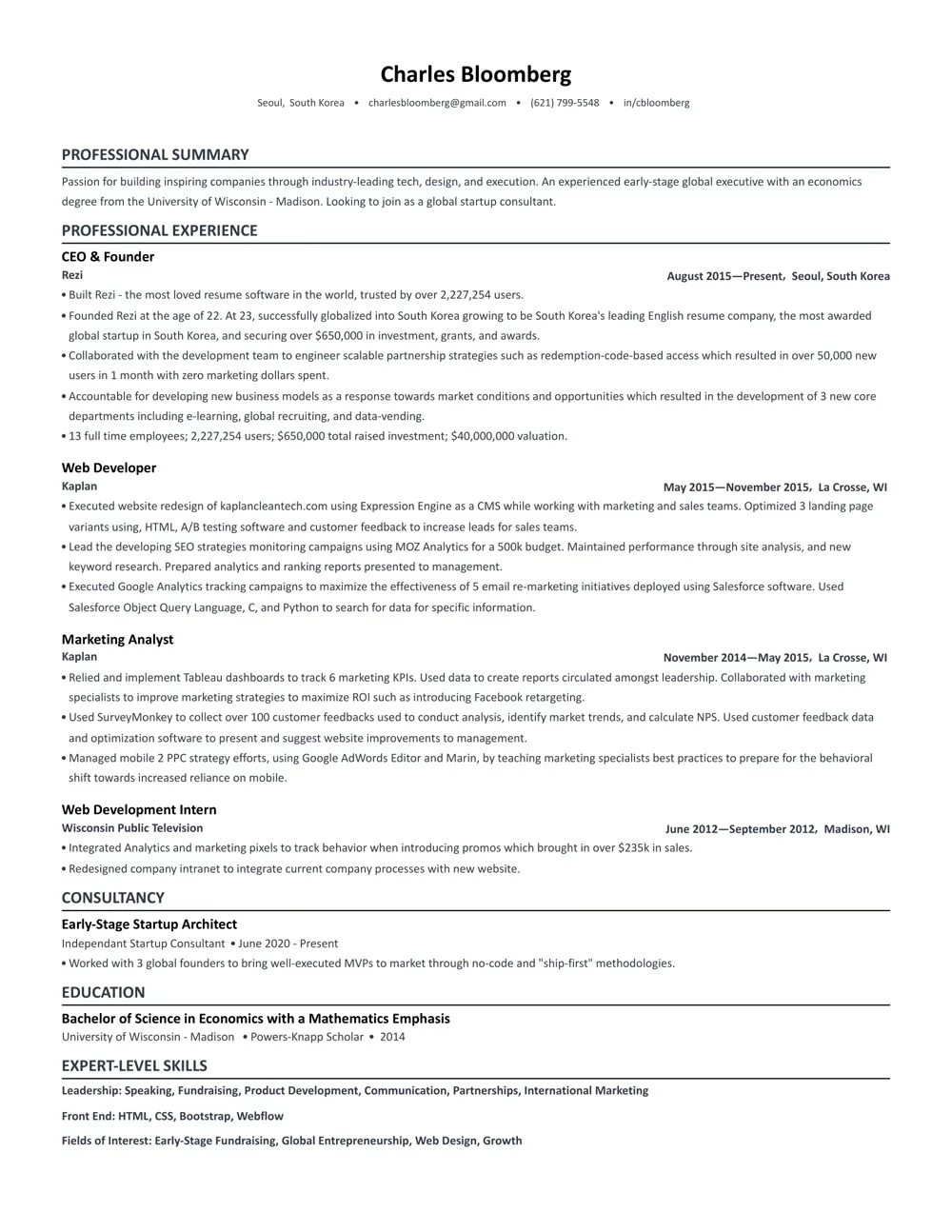
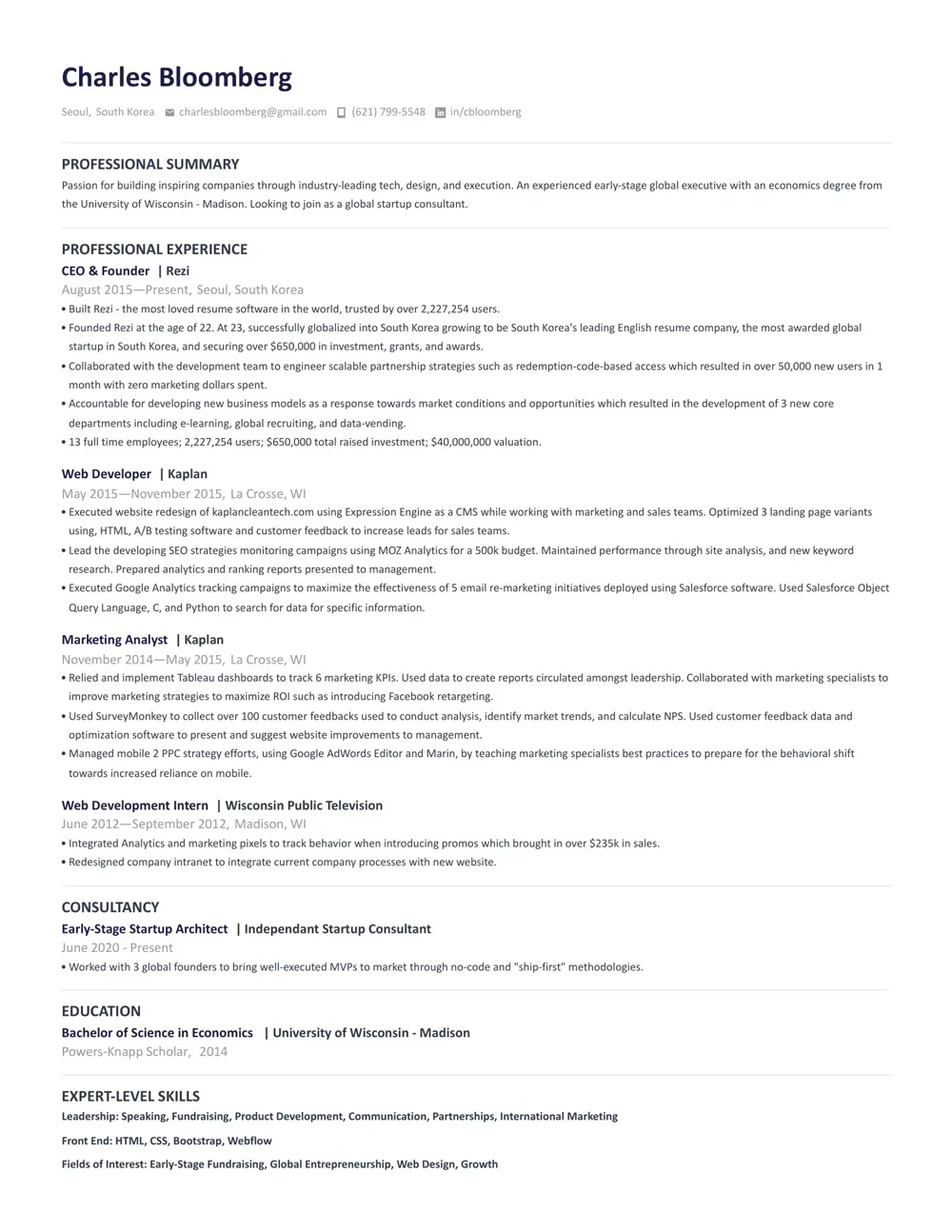
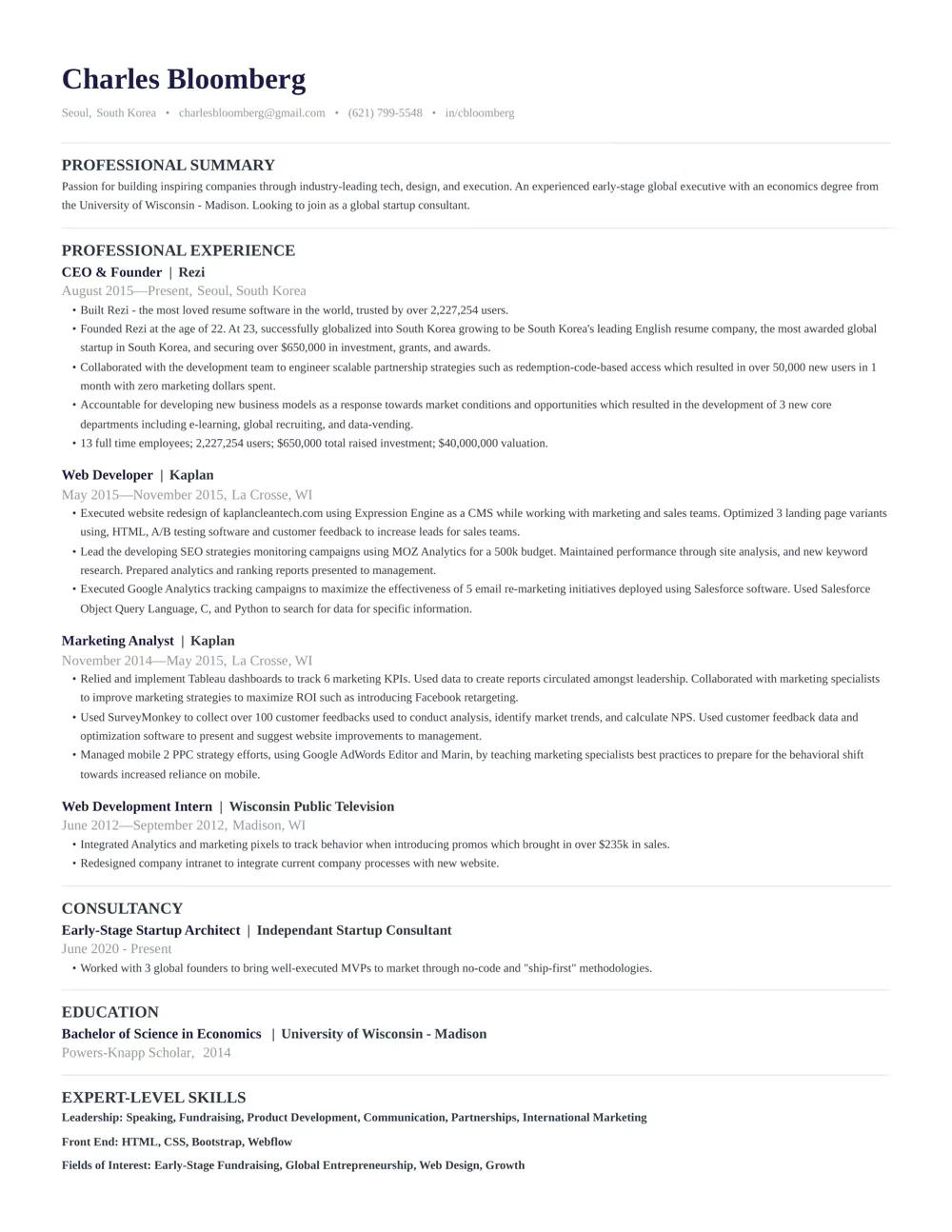
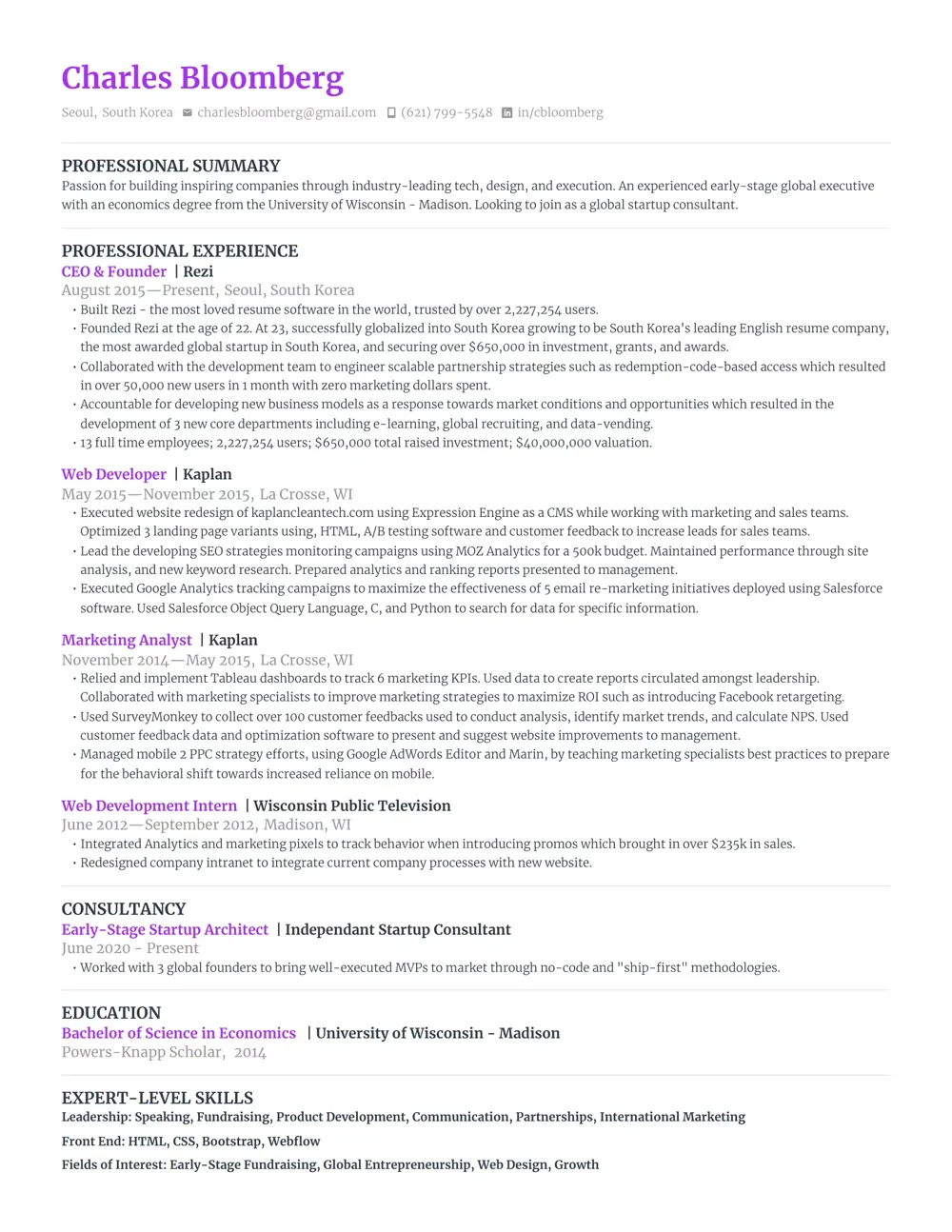
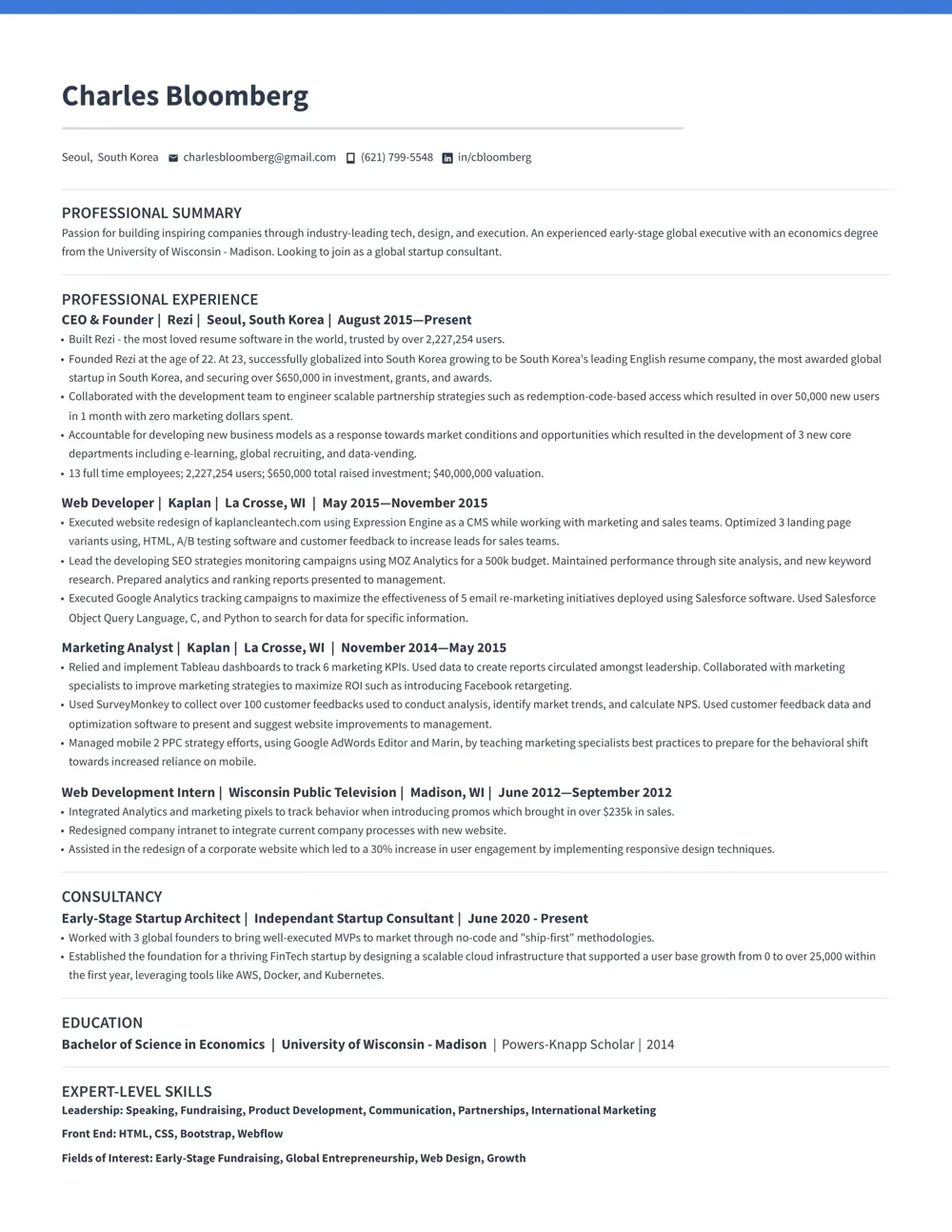
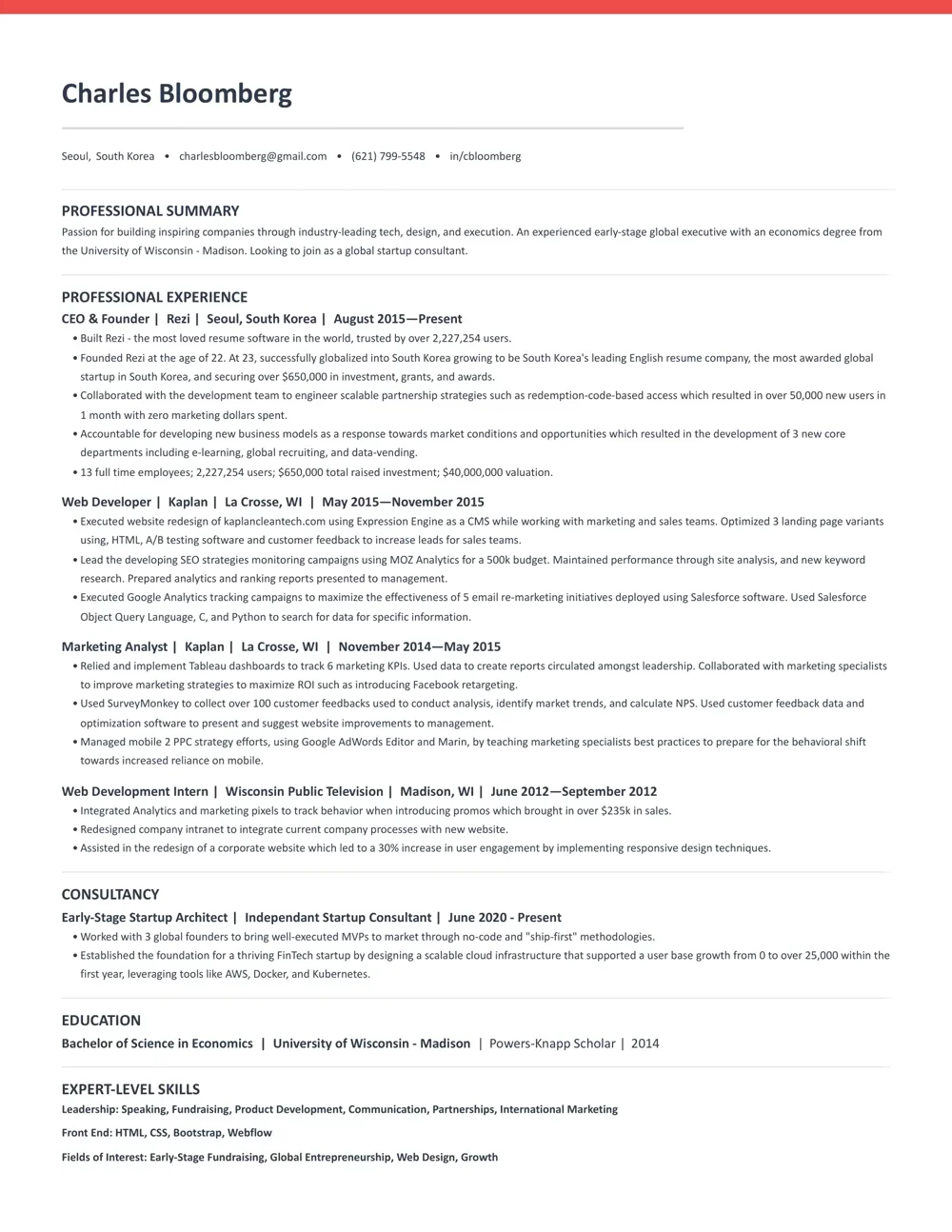
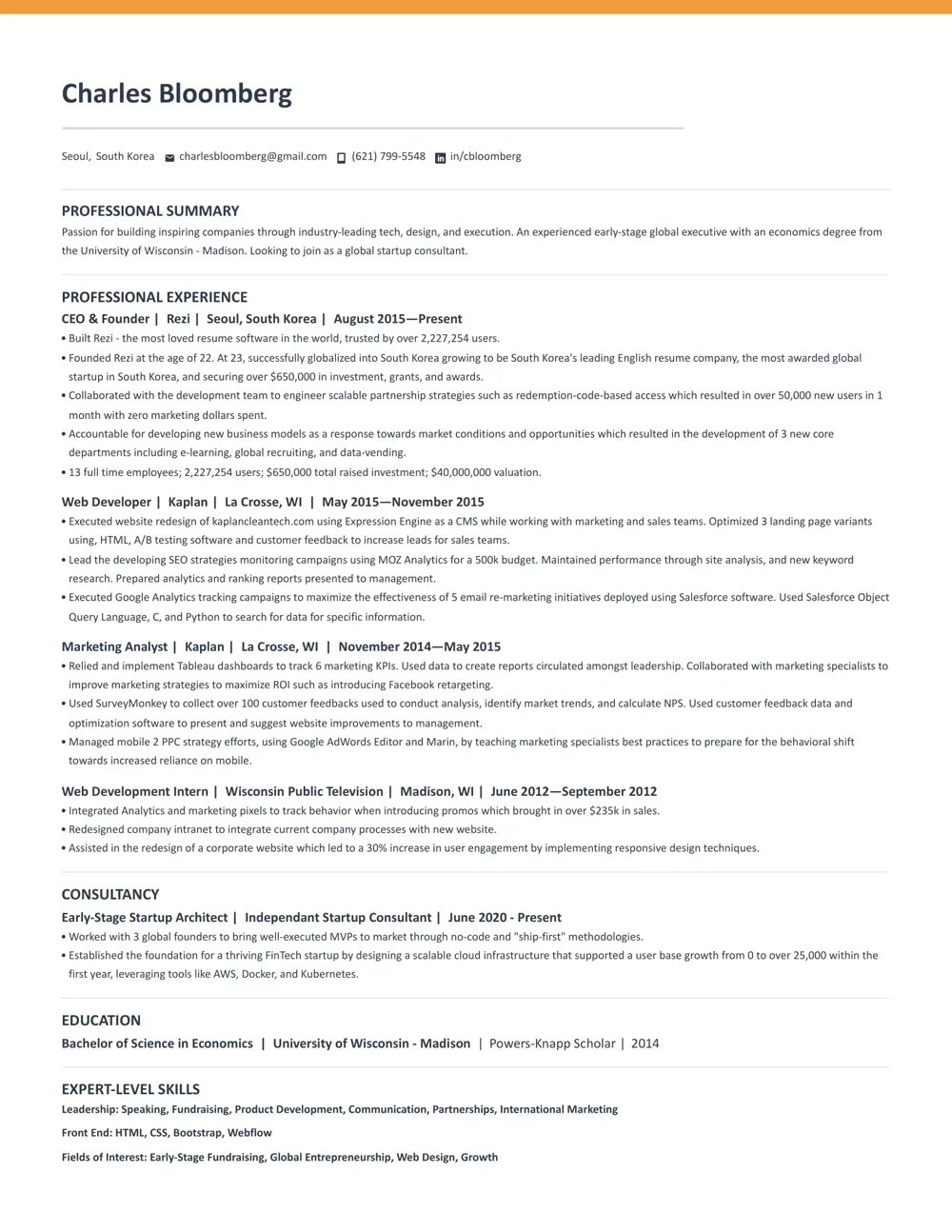
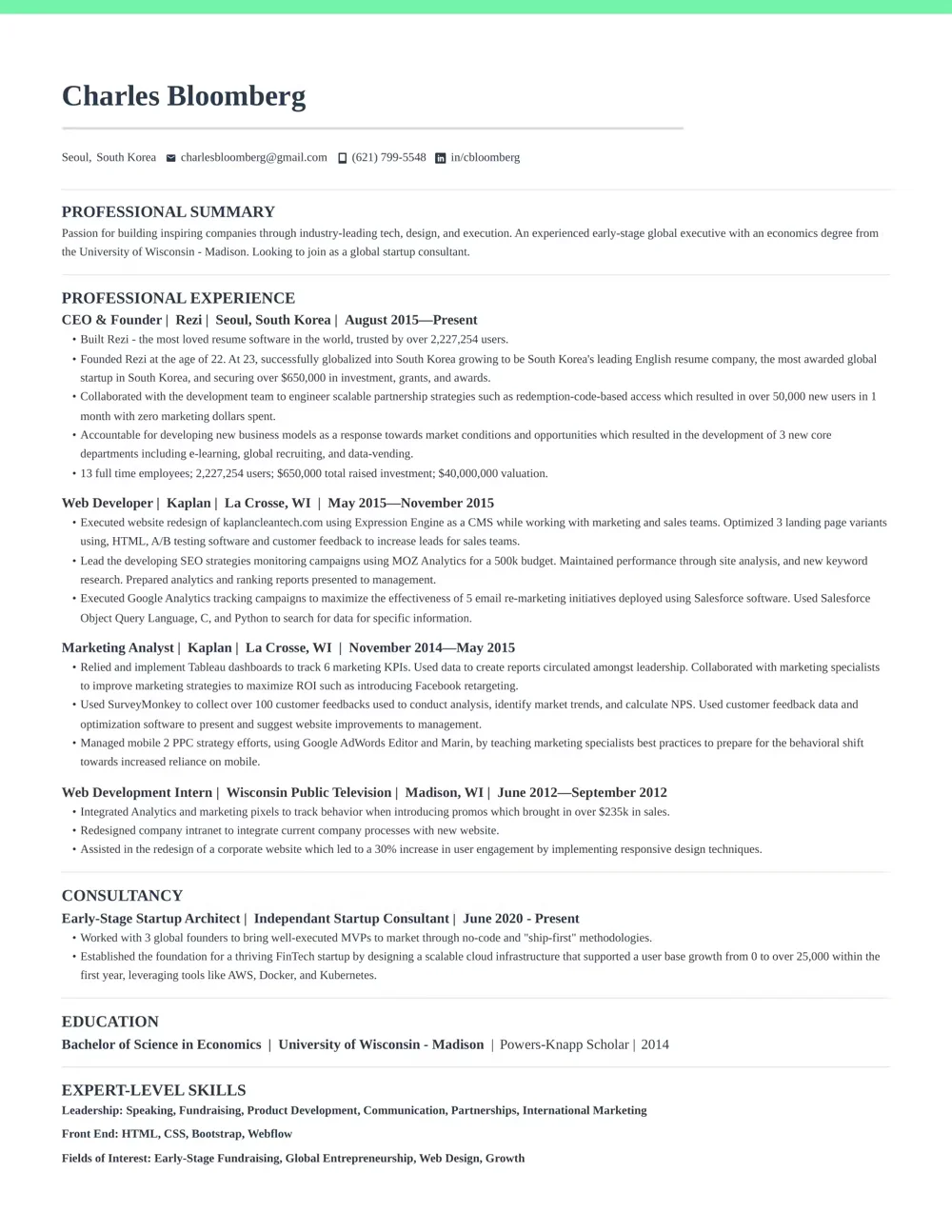
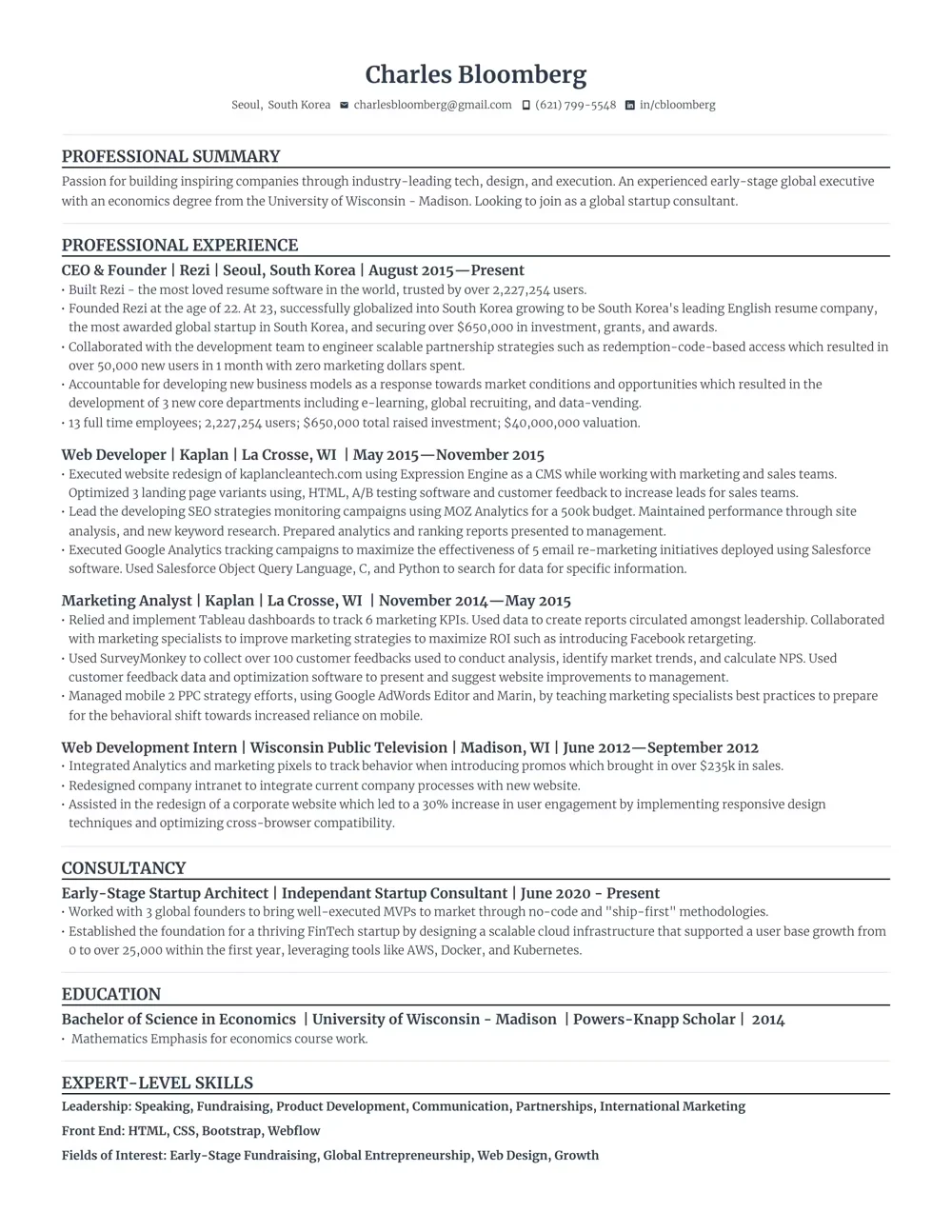
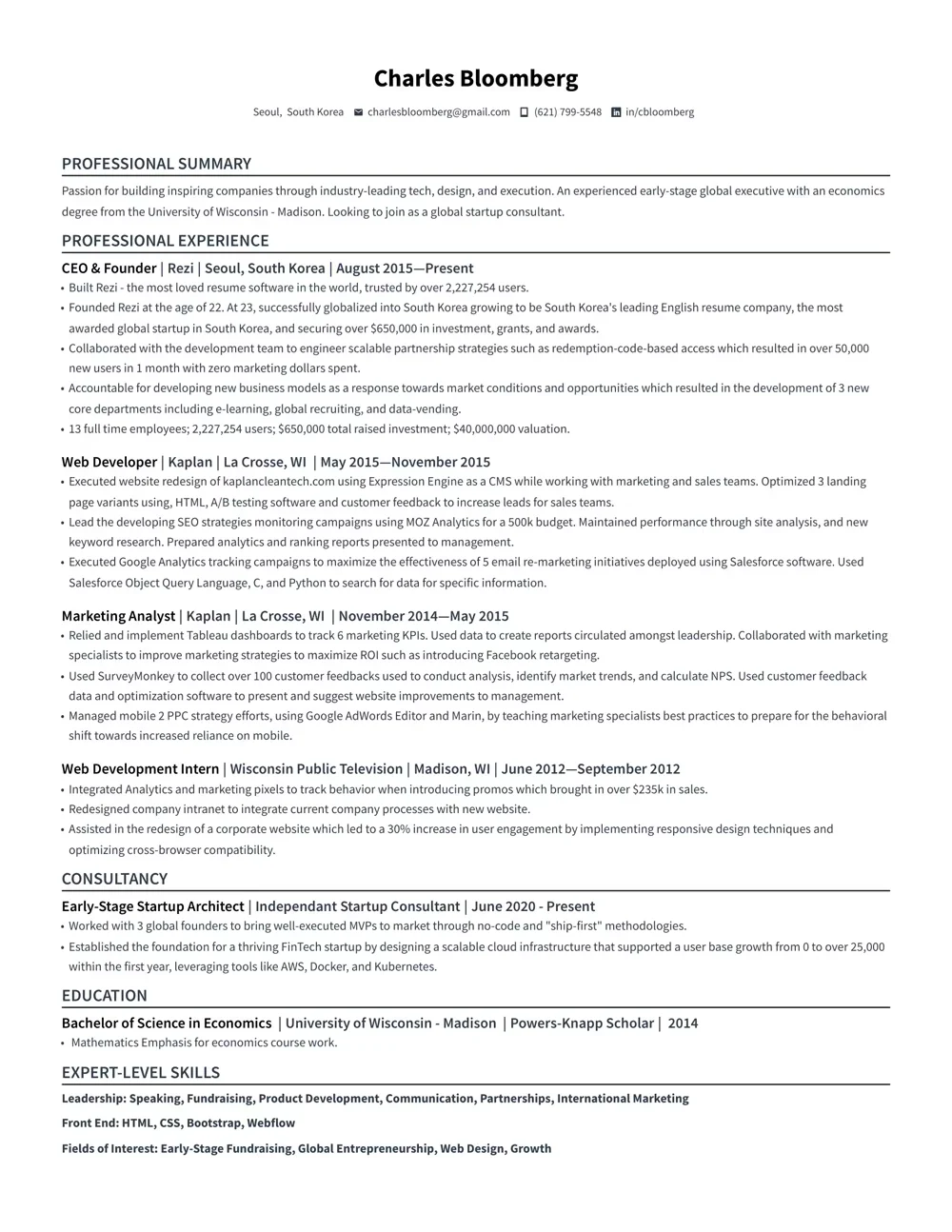
Founder and CEO resume with marketing analytics roots and a consulting section
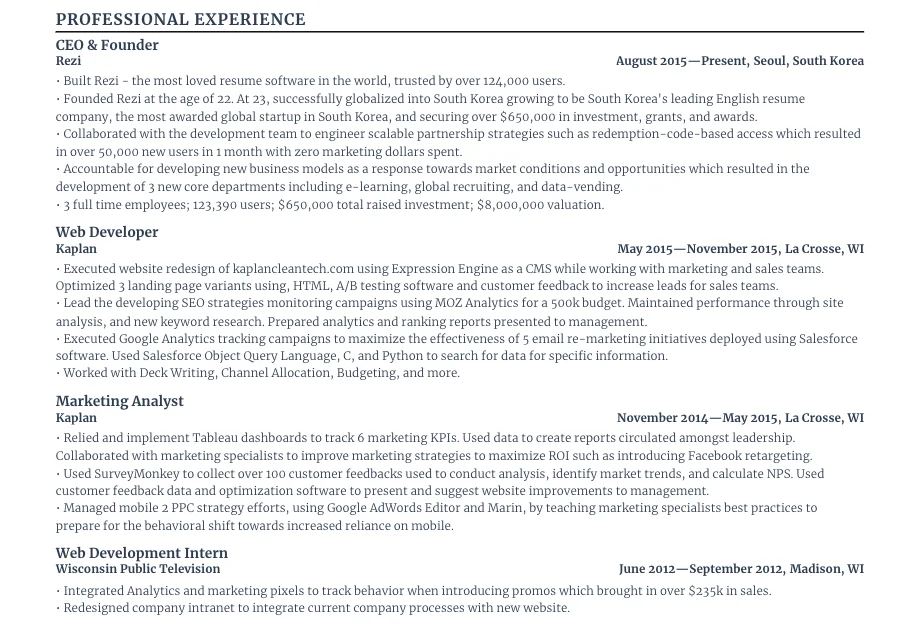
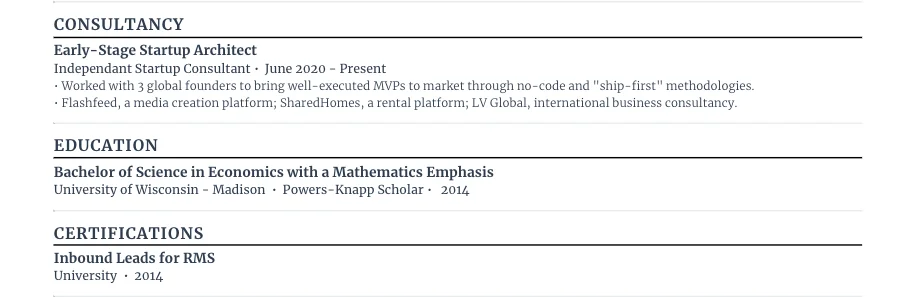
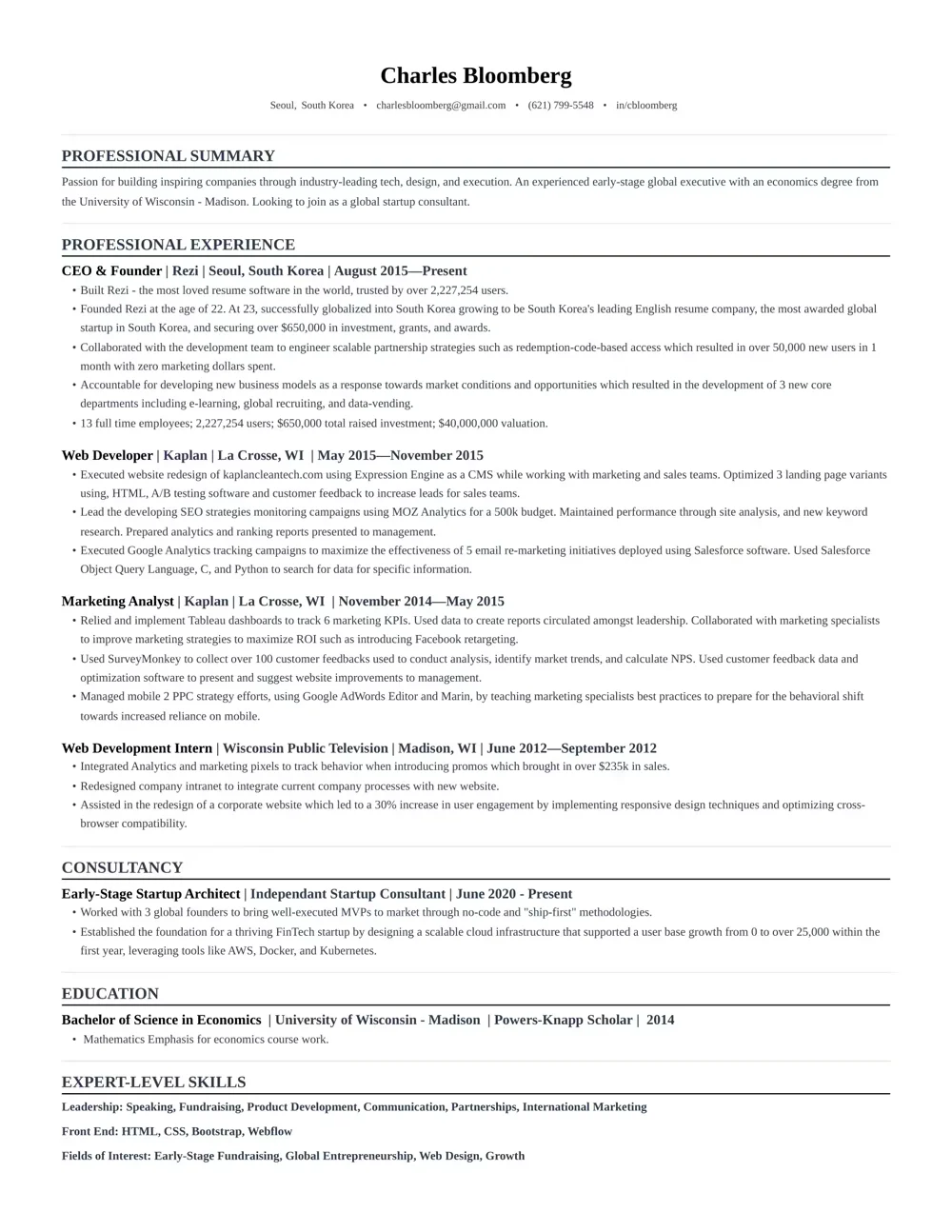
The founder entry gives scale. The last bullet gives team size (3 full-time employees), and the business-model bullet names the three departments it produced: e-learning, global recruiting and data-vending. The Kaplan roles carry the hands-on proof, with Tableau dashboards for 6 KPIs and 3 landing page variants tested. One tip: split "secured investment, grants and awards" into separate lines, each with an amount and a year.
Co-founder resume for a move back into product management
Notice that every co-founder title names a function ("Co-Founder, Product and Marketing"), so a recruiter can see which part of each company was this person's. The best line to copy is the Company E sales bullet: over 100 devices sold in 22 countries with a marketing team of 4. It gives units, reach and team size in one sentence. The summary also ends with the job being applied for, Product Manager. That answers the first question a hiring manager has about any former founder: what job do you want now?
How to List Founder or Co-Founder on a Resume
List your company like any other job: your title, the company name, dates and city, then one line on what the company did and how big it got. The bullets below that cover what you personally did.
Give scale in terms you can document, such as team size, customers, revenue or money raised, each with a date. Then keep your own work apart from the company's results. Founder bullets tend to blur product, sales, hiring and finance into "built the company", so say which decisions were yours, and report customers, revenue, costs and investment as separate figures.
The O*NET profile for chief executives lists tasks such as directing budget activities to fund operations and conferring with board members. If you did that work, give each its own bullet. A title like "Founder & CEO" doesn't tell an employer whether you ran the budget or the board.
Keep your earlier jobs, especially the ones that match the role you want next. In the first sample, the marketing analyst and web developer roles show the tools behind the founder entry. If you're aiming at a functional role, compare how the operations manager, product line manager, sales director and marketing lead examples are written.
How to Show Startup Experience When You Weren't the Founder
Add one line under the employer name giving the company's stage and size, such as "Seed-stage fintech, [N] employees", so a reader understands why your job was broad. Then give each hat its own bullet.
The second sample's Company B entry works this way. One bullet covers the Smart TV and web app development, one the fundraising workshops, one the pitch coaching and B2B sales strategy, and one the meeting time saved. Use the title you were actually given, and let the bullets show the extra work.
How to Write a Startup Founder Resume Summary
In two or three sentences, name your founder role, what the company did, the function you led and the job you want next. If you're applying for an employee role, say which one. The second sample's summary closes on it.
Cut lines about passion or vision that a reader can't check, and use the space for scale or a result you can back up.

Hypothetical example: "Founder and CEO of a B2B scheduling software company, leading product and sales for [N] years. Grew the team from [N] to [N] and set the company's pricing and sales process. Seeking a head of product role at a growth-stage software company."
Hypothetical example: "Co-founder and COO of a consumer software startup, responsible for operations, hiring and finance. Built the first hiring and finance processes as the team grew to [N] people. Looking for an operations leadership role."
Hypothetical example: "Founder of a web content company with [N] years in business strategy and publishing. Tested three revenue models, from advertising to subscriptions, and took two products from concept to launch. Seeking a business development role at a media company."
For a first draft to edit, Rezi's resume summary generator runs in the Rezi app with a free account. Check every claim in the draft against your own records.
How to Write Founder Resume Bullets
Each bullet should say what you did, how you did it and what changed, with a number and a date where you have one. "Built a resume software platform" tells a reader what existed; add who used it and by when.
Weak founder lines and stronger versions, with the figures left for you to fill from your own records:
- Before: "Responsible for sales and partnerships." After: "Closed [N] partnerships with [type of partner] in [period], bringing in [X] in revenue." Pull the figures from your CRM or invoices.
- Before: "Managed fundraising." After: "Led the [round] raise, pitching [N] investors over [months] and closing [$X] from [lead investor]."
- Before: "Hired the team." After: "Hired the first [N] employees across engineering and sales and wrote the onboarding plan the team still uses."
The last line has no headline number, and it doesn't need one: a process the team kept using is a result. Keep revenue, grants and investment as separate measures, say what each number counts, and leave out any figure you couldn't back up if asked. For a few starter bullets based on your title and skills, try the resume bullet point generator, which works right on the page.
Skills and Certifications for a Founder Resume
List the hard skills and tools the next job asks for and you have used, grouped by area. Show leadership and communication through bullets, such as a partnership you negotiated or a team you hired, not in a list.
- Business and finance: fundraising, financial modeling, budgeting, pricing, business development, P&L ownership
- Product: roadmaps, user research and testing, MVP development, Jira, Confluence, Figma, Miro
- Marketing and growth: SEO, paid search, email marketing, Google Analytics, Tableau, CRM software such as Salesforce
- Web: HTML, CSS, Bootstrap, Webflow and similar no-code tools
The product, marketing and web tools in that list come from the two samples above; list the business and finance terms only if you did that work. Use the job posting's own terms, such as go-to-market or P&L ownership, only where they describe work you did. Recruiting software such as Greenhouse lets recruiters search resumes for keywords, so a missing term can keep your resume out of that search, though a match doesn't decide who gets an interview. Rezi's resume keyword scanner compares your resume with a job description and runs in the Rezi app with a free account.
Certifications are optional for founders. List one only if you earned it and it supports the role you want, such as Scrum Alliance's Certified Scrum Product Owner (CSPO) for a product job. Scrum Alliance asks holders to renew it every two years with a fee and Scrum Education Units, so list it only while it's current. An MBA is a degree and goes under education.
Founder Resume Format and Length
Use a reverse chronological resume with standard headings, and let relevance set the length. Newest entries come first, so your startup, usually your latest role, is the first thing a reader sees.
One page often works for a founder with one early-stage company. A founder with several ventures or senior operating roles may need two. Put first whatever shows operating scope, such as team size, customers, revenue or funding you can document, and follow any length instructions in the application.
Keep headings plain (Summary, Experience, Education, Skills) and the layout in one column, so the resume reads in the order you wrote it.
Going From Founder to Employee: What to Say in Your Cover Letter
Use the cover letter to answer the question every employer has about a founder: why this job, and why now. Say what you learned running the company, what kind of role you want, and why this team fits.
Expect a reader to wonder whether you'll leave to start another company, and answer it by naming what draws you to this role, such as a larger team, more scale or a specific product. The same idea fits in one summary line: "Former founder of a B2B scheduling startup, seeking a senior product manager role at a growth-stage software company."
The letter is also the place to say how your startup ended. Whether you sold it, shut it down or stepped away, a sentence or two of plain context means the reader doesn't have to guess. Then turn to what carries over, such as running a budget, building an early sales process or leading a small team. If the posting doesn't ask for a letter, our guide on whether cover letters are necessary helps you decide, and Rezi's cover letter generator can start a draft you edit until every detail is yours.
FAQ
What job title should a former startup founder use on a resume?
Use "Founder" or "Co-founder" plus the function you actually ran, such as "Co-founder & Head of Product", or "Founder & CEO" if you led the company. The function tells a recruiter which job you're ready for next, which a bare "Founder" doesn't. Use "CEO" only if you held that title, and put the company's scale right under it, such as team size, funding, customers or revenue, so a big title on a small company doesn't look inflated.
How do I list a startup that shut down on my resume?
List it like any other job, with real dates, and add one short line on how it ended, such as "Company wound down in [year] after a seed round; returned remaining capital to investors." Then use the bullets for what you built and measured before it closed: the product you shipped, the customers or users you won and the team you hired.
Should I put funding raised on a startup founder resume?
Yes, when the round is public or you're free to share it, with the round and lead investor: "Raised a [$X] seed round led by [firm]." Say what your part in the raise was, and keep investment separate from grants, awards and revenue. Apply the same rule to a valuation, and include one only if it was publicly disclosed and you know which financing it came from.
How do I show results on a founder resume when the startup had little revenue?
Show the traction you can measure: paying pilots, letters of intent, users and retention, partnerships signed, the product you shipped and how fast, and the people you hired. For example: "Signed [N] paid pilots with regional hospitals in [months]; [N] converted to annual contracts." Give each number a date. Leave out page views and social followers unless the job you want is in marketing or growth.
How do I list a startup acquisition on my resume?
Put the acquisition on the company line: "Founder & CEO, [Startup] (acquired by [Buyer] in [year]), [start year] to [end year]." If you stayed on, list your role at the buyer as its own entry. Add what made the company worth buying, such as "Grew to [N] customers and [$X] in annual recurring revenue before the acquisition," and share deal terms only if they were made public.
Is a small business owner or entrepreneur resume different from a startup founder resume?
The structure is the same: list the business as a job, with "Owner" or "Founder" as the title, then show its scale and the work you did yourself. Scale for a bakery owner might be staff, locations and annual sales; for a software founder, users, revenue and funding. If you're moving into a different field, lead with what matches it, such as staff scheduling for an operations job or bookkeeping and payroll for a finance job.
Who can I use as a reference after running my own company?
Use people who saw your work from different sides: a co-founder, a board member or lead investor, an early employee you managed, and a customer or partner. Together they can speak to how you led, sold, built and handled money, which a former boss would normally cover. Ask each one first and tell them which job you're applying for. Keep the list off the resume itself. Our guide to references on a resume explains when to send it.

Upload or drop your resume to get started
Upload your resume to get started
Score my resume
Contents
Resume Formats & Examples
ATS-Friendly resume formats that land jobs
Use a template that guides you. Our ATS-compliant designs are trusted by 4,785,497+ job seekers.
“Rezi is an awesome AI-based resume builder that includes templates to help you design a resume that is sure to check the boxes when it comes to applicant tracking systems. This is a great jumping off point to kickstart a new resume.”

Ashley Stahl
Career Contributor
62.18%
Interview Rate
4,785,497+
Total Users
8.23 / 10
Avg. User Review
Wall of Love
4,785,497+ users trust Rezi

Resume Building felt like pulling teeth – until I found Rezi.
Davis Allen
Software Developer

I was blown away by Rezi. It streamlined everything...
Celine Watko

I needed a resume tool as smart as my work.
Yosra Naceur
Data Scientist
“A great tool that is very helpful. I found the Rezi system easy to use and very helpful as I was working on getting my resume in shape for job applications.”

Dakota Rubin
United States
Written via

“This is actually one of the first reviews I’ve ever written for a business, and that alone says a lot. I highly recommend Rezi to anyone who’s job searching, it makes the entire process so much easier.”

Yazan Alkhatib
United States
Written via
“Reduced my time per application from 1-2 hours down to 15 minutes.”
Kixxx
Experience with Rezi
“I love how simple and convenient it is to use and been coming back to update it every time I need a fresh resume.”

Zara Wazir
U.A.E.
Written via