Resume
How to Tailor Your Resume to a Job Description With AI
Tailoring your resume to every job description is one of the highest-leverage things you can do in a job search. AI makes it fast enough to actually do for every application.

Published on
October 13, 2025
Updated on
April 21, 2026
Most people send the same resume to every job. It's understandable — rewriting your resume for each application takes 20 to 30 minutes, and when you're applying to dozens of roles, that time adds up fast. But generic resumes get filtered out. Applicant tracking systems scan for specific keywords, and hiring managers spend an average of seven seconds on an initial review. If your resume doesn't immediately reflect what the job posting asks for, it gets skipped.
AI changes the math. What used to take half an hour per application can now happen in under a minute. But not all approaches work equally well, and the tooling is evolving quickly. This guide covers why tailoring matters, how AI actually does it, and how to get the best results — whether you're using a chatbot, a dedicated resume tool, or an AI agent connected directly to your resume.
Why you should tailor your resume to every job description
Tailoring isn't about lying or exaggerating. It's about emphasis. You have a set of real skills, experiences, and accomplishments. Different roles value different parts of that set. A tailored resume surfaces the parts that matter most for a specific job.
There are three practical reasons this works:
ATS compatibility. Most companies use applicant tracking systems to screen resumes before a human ever sees them. These systems look for keywords and phrases that match the job description. If your resume says "managed client relationships" but the posting says "account management," the ATS may not make the connection. Tailoring closes that gap.
Recruiter attention. Even after passing ATS, your resume lands in a stack. Recruiters scan quickly. A tailored resume puts the most relevant experience and skills front and center, which makes the recruiter's job easier and your candidacy more obvious.
Demonstrated interest. A resume that mirrors the language and priorities of a job posting signals that you actually read it. That effort matters, especially at competitive companies where hundreds of people apply to the same role.
What AI actually does when it tailors a resume
AI resume tailoring isn't magic. Here's the general process, regardless of which tool you use:
1. It analyzes the job description. The AI reads the posting and identifies the key requirements: skills, qualifications, tools, certifications, years of experience, and soft skills the employer is looking for. Good AI tools go beyond simple keyword extraction — they understand which requirements are essential versus nice-to-have based on how the posting is written.
2. It compares against your resume. The AI maps your existing content to the job's requirements. It identifies what's already a strong match, what's present but poorly phrased, and what's missing entirely.
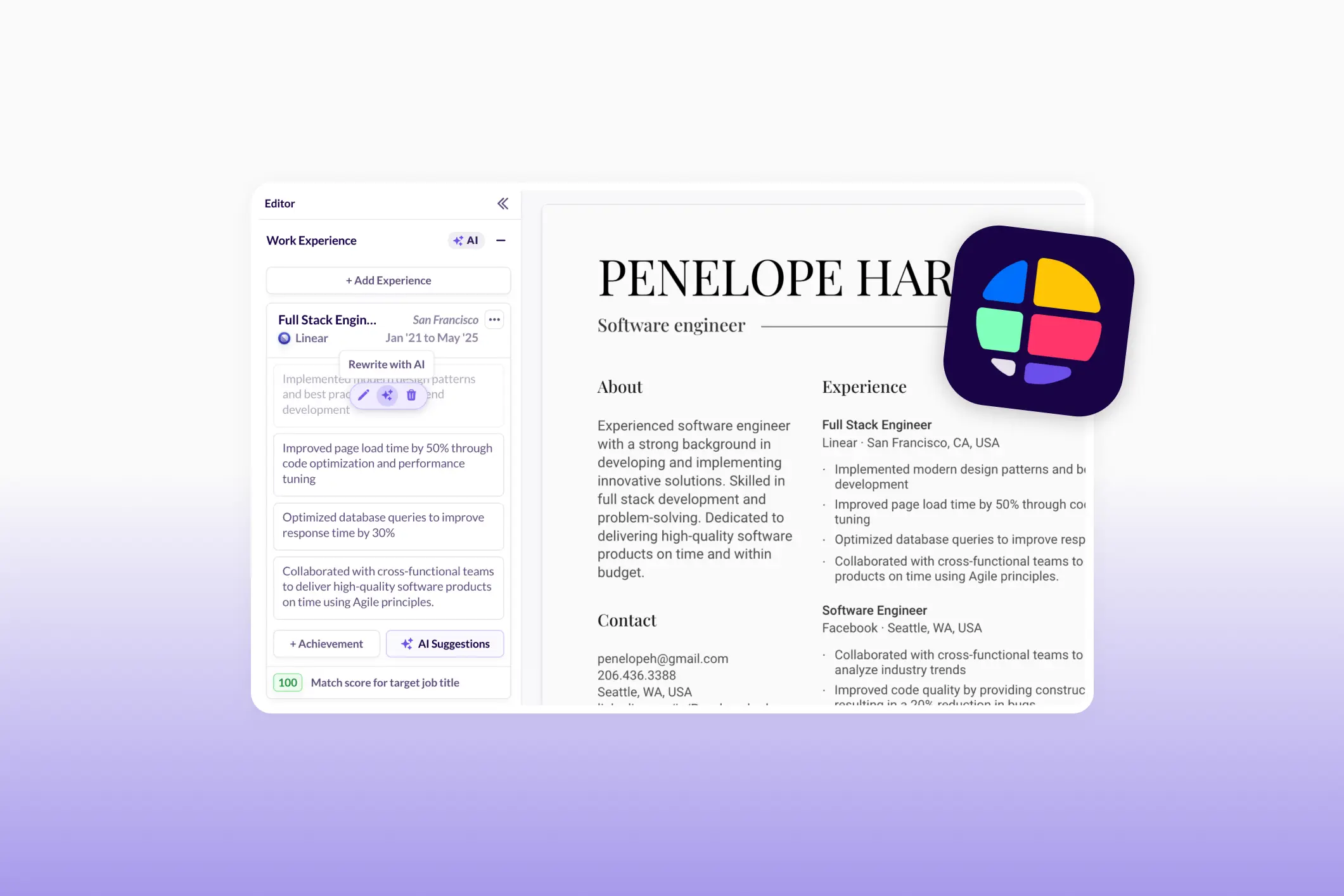
3. It rewrites relevant sections. This is where tailoring happens. The AI rephrases your bullet points to emphasize the skills and experiences that align with the role. It adjusts your summary. It may reorder sections to put the most relevant content first. It weaves in keywords naturally so they read well to a human while also satisfying ATS software.
4. It preserves your actual experience. A good AI tool doesn't invent qualifications. It works with what you give it. If you've never used Salesforce, it shouldn't add Salesforce to your skills. The goal is better framing, not fabrication.
Three approaches to AI resume tailoring
Not every method works the same way. Here's how the main options compare.
Approach 1: General-purpose chatbots
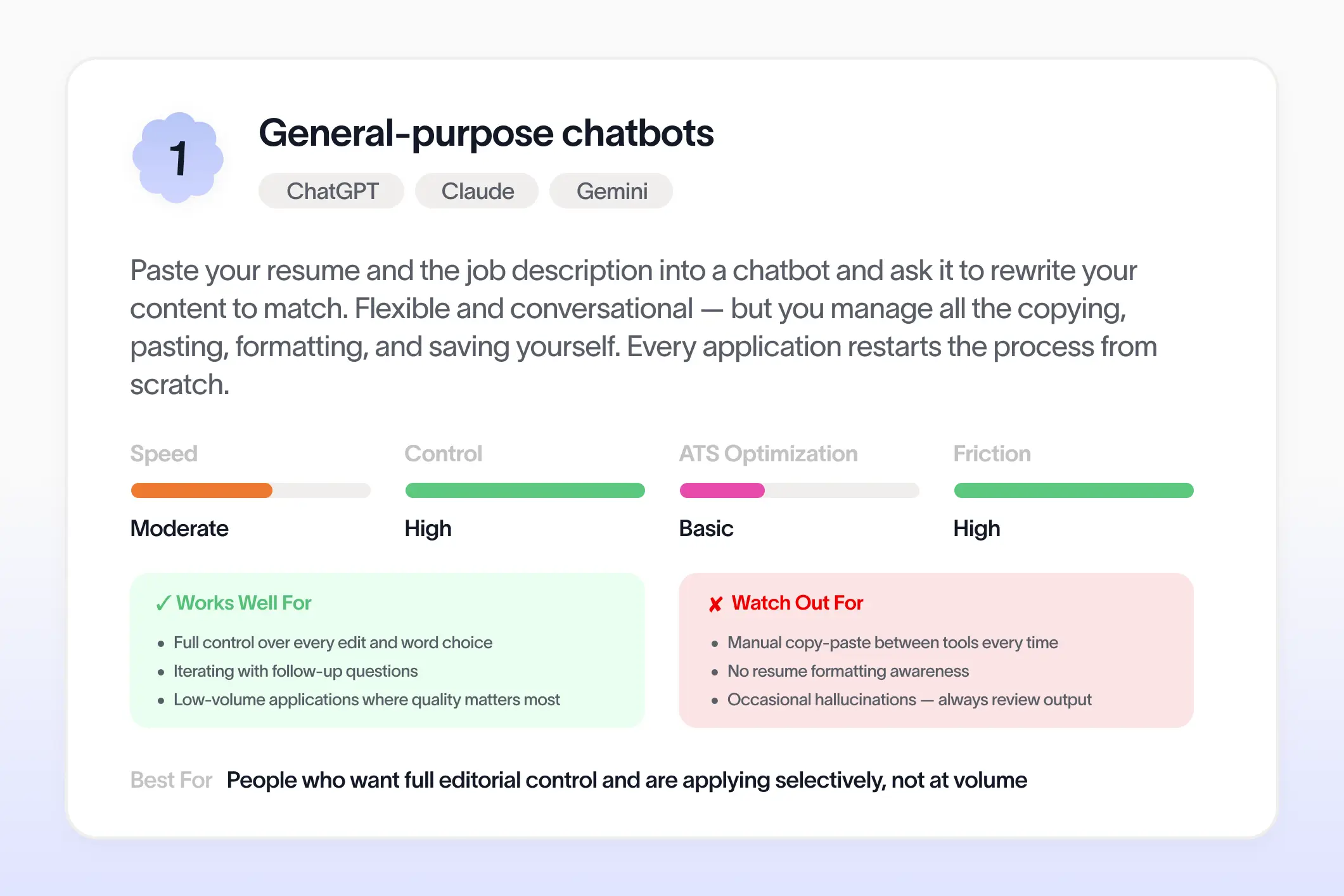
Tools like ChatGPT, Claude, and Gemini can tailor a resume when you give them the right prompts. You paste in your resume and the job description, then ask the AI to rewrite your content to match.
This works, but it has friction. You're manually copying and pasting between tools. The AI doesn't know your formatting preferences or have access to your previous resume versions. You have to handle the output yourself — copying the rewritten text back into your resume template, checking formatting, and saving the result. Every application restarts this process from scratch.
The advantage is flexibility. You can ask follow-up questions, request specific changes, and use the AI as a collaborator rather than an automated tool. For people who want full control over every edit, this is a reasonable option.
Tips for getting better results from chatbots:
Provide context beyond just the resume and job description. Tell the AI what role you're targeting, what experience you want to emphasize, and what tone you prefer. Be specific — "rewrite my bullet points to include more quantitative results" works better than "make my resume better." And always review the output. Chatbots sometimes hallucinate details or use phrasing that sounds generic.
Approach 2: Dedicated resume tailoring tools
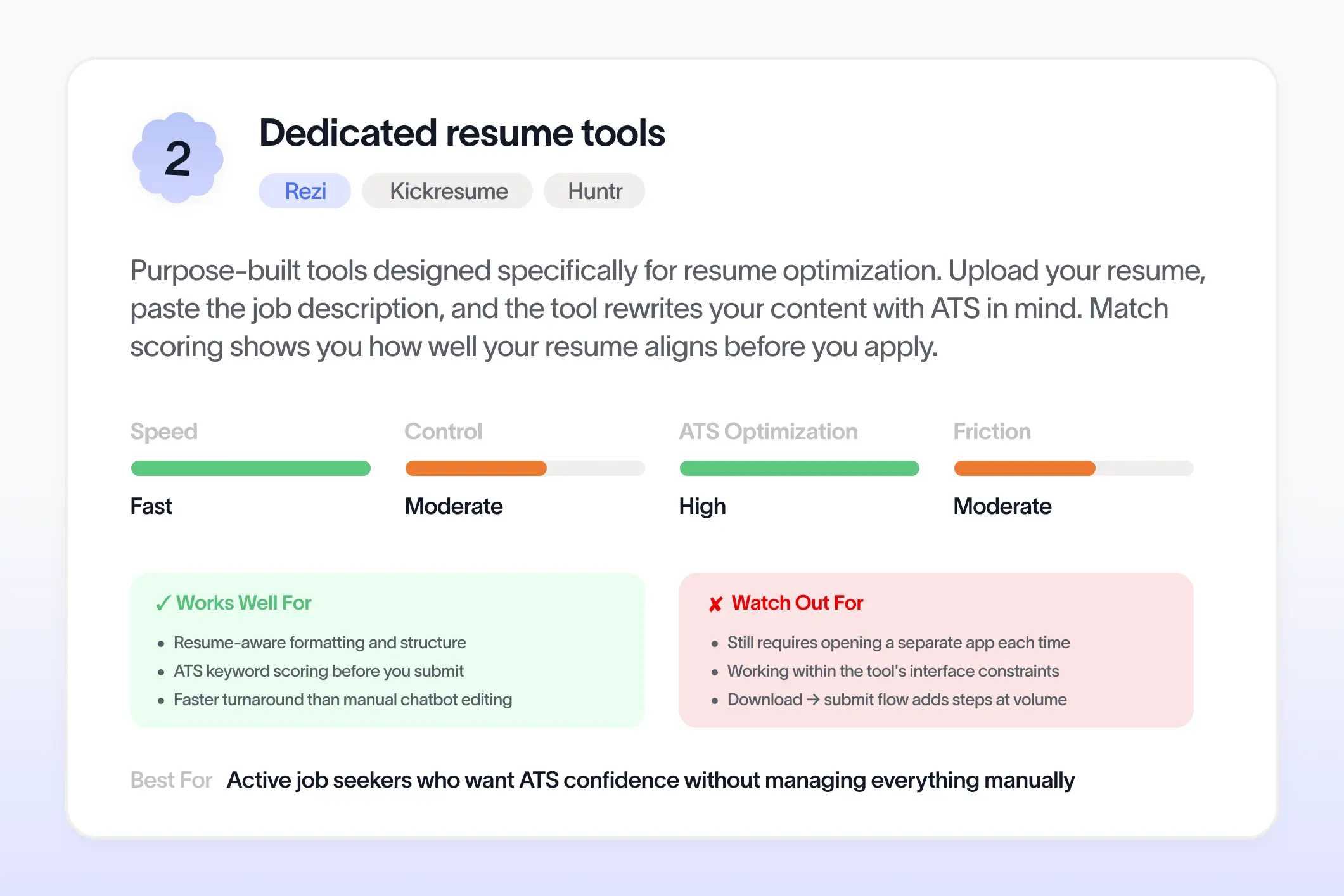
Purpose-built tools like Rezi, Kickresume, Huntr, and others are designed specifically for resume optimization. You upload your resume, paste a job description, and the tool rewrites your content with ATS optimization in mind.
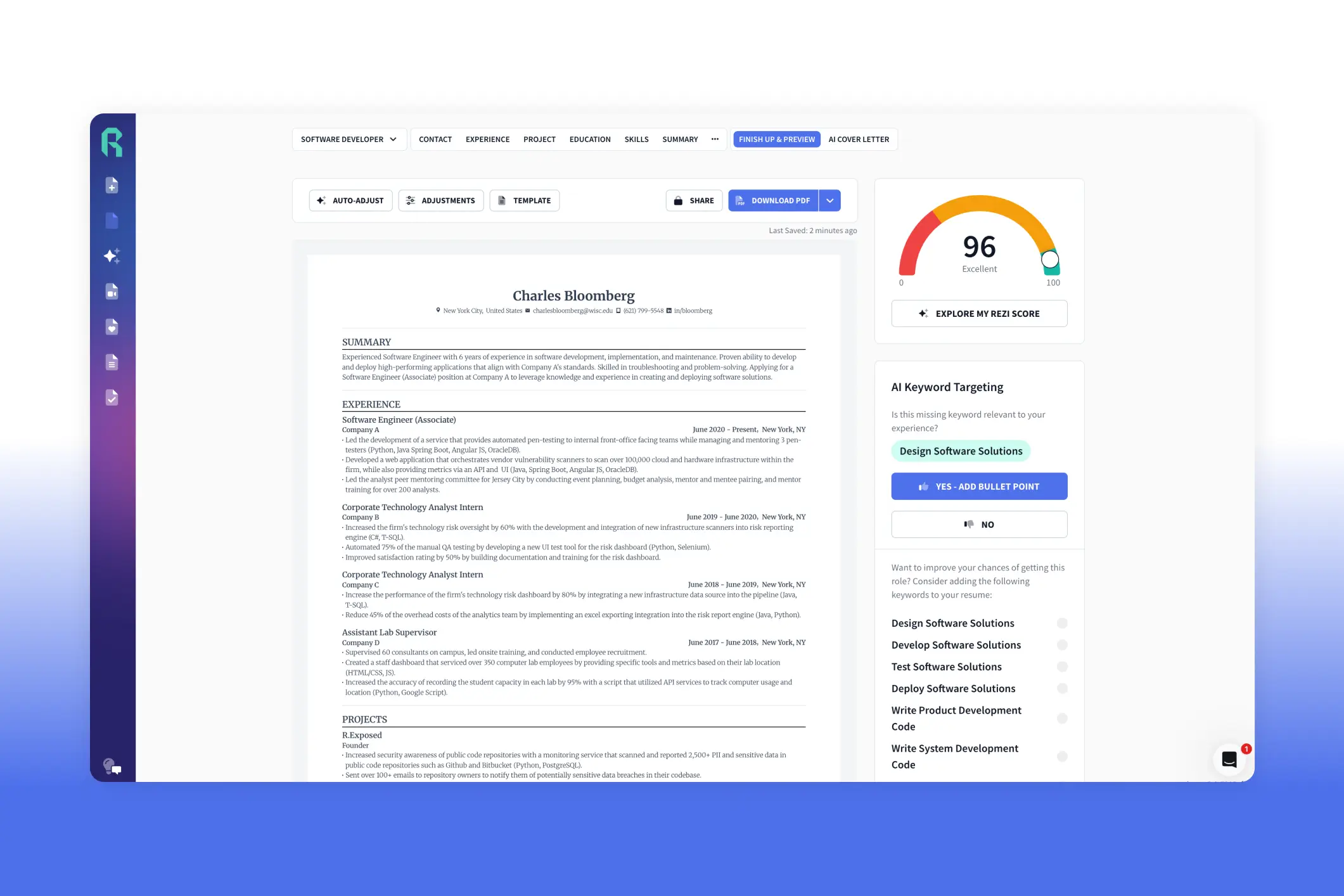
These tools have advantages over general chatbots: they understand resume structure, they know what ATS systems look for, and they handle formatting automatically. Many include match scoring so you can see how well your resume aligns with the posting before you apply.
The trade-off is that you're working within the tool's interface. You go to the app, make your changes, download the result, and submit it. For high-volume applications, even this streamlined process takes time.
Approach 3: AI agents with direct resume access
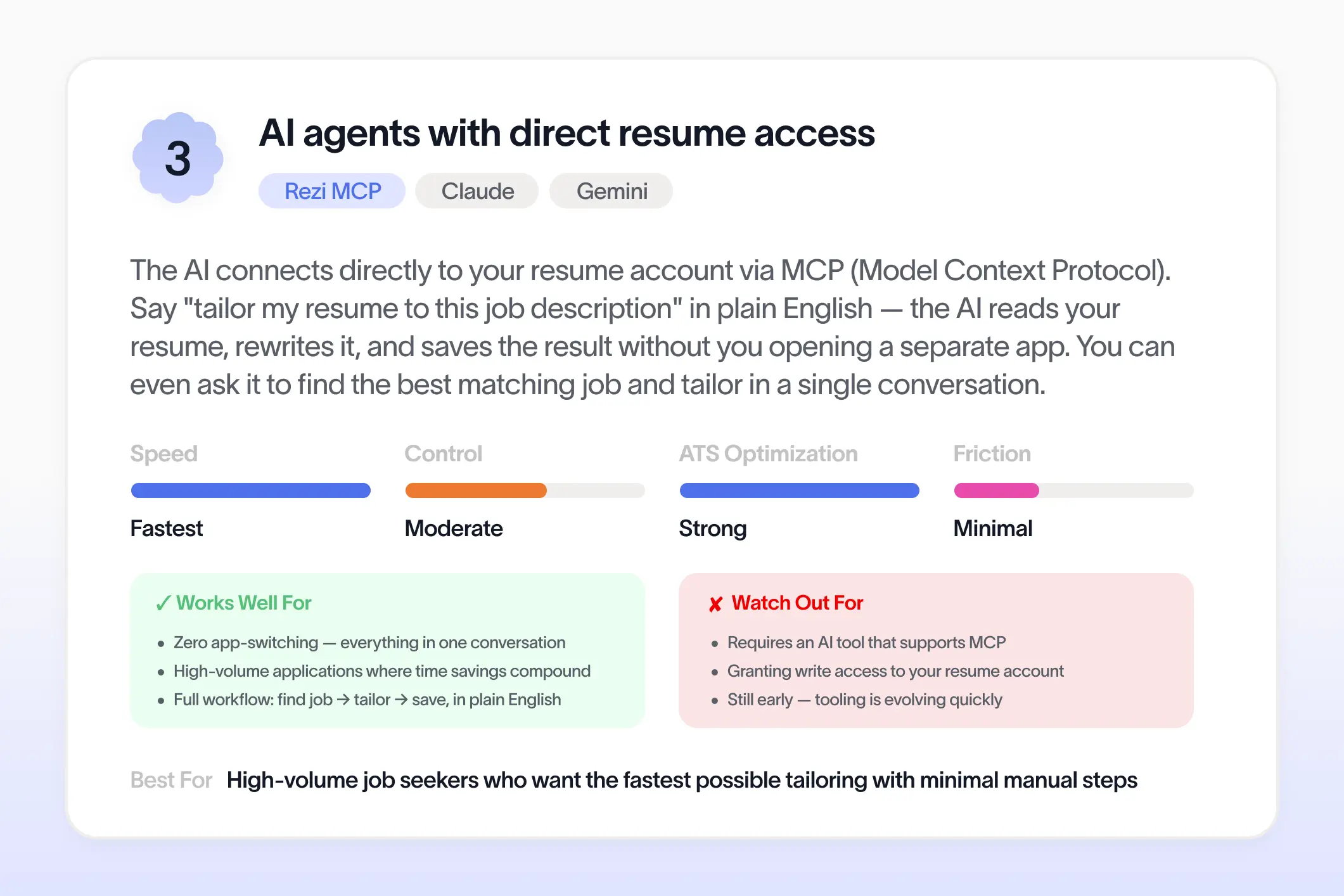
This is the newest approach, and it changes the workflow significantly. Instead of you going to a tool, the AI connects directly to where your resumes live and makes changes on your behalf.
This works through protocols like MCP (Model Context Protocol), which lets AI agents plug into external services — including resume platforms. When your AI tool has a direct connection to your resume account, you can say "tailor my resume to this job description" in a single conversation, and the AI reads your current resume, rewrites it, and saves the updated version without you ever opening a separate app.
Rezi offers this through our MCP server, which connects to AI tools like Claude, Codex, Cursor, and Gemini. Once connected, you can go further than just tailoring. You can search for jobs, pick the best match, and have your resume tailored to it — all in one conversation. The AI handles the API calls; you just talk in plain English.
The advantage is speed and integration. The disadvantage is that you need an AI tool that supports MCP, and you need to trust the AI with write access to your resumes. For job seekers applying at high volume, the time savings compound quickly.
I spoke to Daniel Catalan, a professional resume writer, who shared his thoughts on how long it should take to tailor your resume:
Good tailoring should take 10 to 15 minutes, but that’s over time after you get into the rhythm of doing it. And every job seeker should aim to apply within the same day when they see a job, or focus on jobs posted within the same week. It just goes so quickly; you want to be among the first to apply.
What to tailor (and what to leave alone)
AI can rewrite your entire resume, but that doesn't mean it should. Here's what to focus on:
Always tailor your summary. This is the first thing a recruiter reads. It should reflect the specific role, not be a generic overview of your career. If the job is for a "senior product manager focused on B2B SaaS," your summary should say that — not "experienced professional seeking new opportunities."
Tailor your bullet points for relevance. You don't need to rewrite every bullet point. Focus on the ones that overlap with the job's core requirements. If the posting emphasizes cross-functional collaboration and you led a project with engineering, design, and marketing, make sure that bullet point leads with collaboration rather than burying it.
Match the job's language. If the posting says "stakeholder management," use "stakeholder management" — not "working with executives" or "managing relationships." ATS systems are often literal, and even human readers process familiar terms faster.
Don't tailor your job titles or dates. These are verifiable. Changing them is dishonest and will come up in background checks.
Don't add skills you don't have. AI can make your existing experience sound more relevant, but it shouldn't fabricate expertise. If the job requires Python and you've never used Python, don't let the AI add it.
I spoke with Colin McIntosh, Founder of Sheets Resume Builder + Executive Search at Riviera Partners, about his approach to creating a master resume:
I highly recommend building 2-3 "master" resumes for each role type that you’re applying for. For example, a front-end engineering resume, a full-stack version, perhaps a design-focused version, and then only change small things for each role you apply for. Specifically, I recommend changing for each job application only the following:
• Your most recent title (small tweaks only to better match the role you’re applying for; just don’t misrepresent yourself).
• Your first bullet point (this is the thing they are most likely to read).
• Your skills: drop irrelevant ones, add the ones you see on the job description that you have, and reorder your skills to put the most crucial ones at the front of the list.
What Is a Master Resume?
A master resume is a broad document that outlines your entire professional work history and qualifications. You include every single skill, accomplishment, and project without worrying about page limits.
This serves as your personal “career database” that you can easily update whenever you have something new to add. It also allows you to quickly tailor it to any new job opportunity you come across by selectively removing or editing bullet points from your master resume to create a targeted version for that specific role.
Here’s how to create a master resume:
- Add your current and previous jobs in the work experience section
- Write bullet points on key responsibilities and outcomes from previous roles
- Showcase a clear narrative of your skills and career progression
- Emphasize your field of expertise and broad career highlights in the summary section
- List qualifications in the education section
- List your top skills in the skills section
- Use additional sections to showcase related credentials and experience
- Add contact details and relevant links in the header section
- Finalize your master resume using an ATS resume checker
- Download your master resume and keep it stored somewhere safe
Targeted Resume Examples
Writing a targeted resume doesn’t mean creating a brand-new job application every time you apply (at that point, you’re just procrastinating). Having a master resume and making tweaks to your wording and skills is something that gets easier over time and makes a big difference.
So, what does a targeted resume look like?
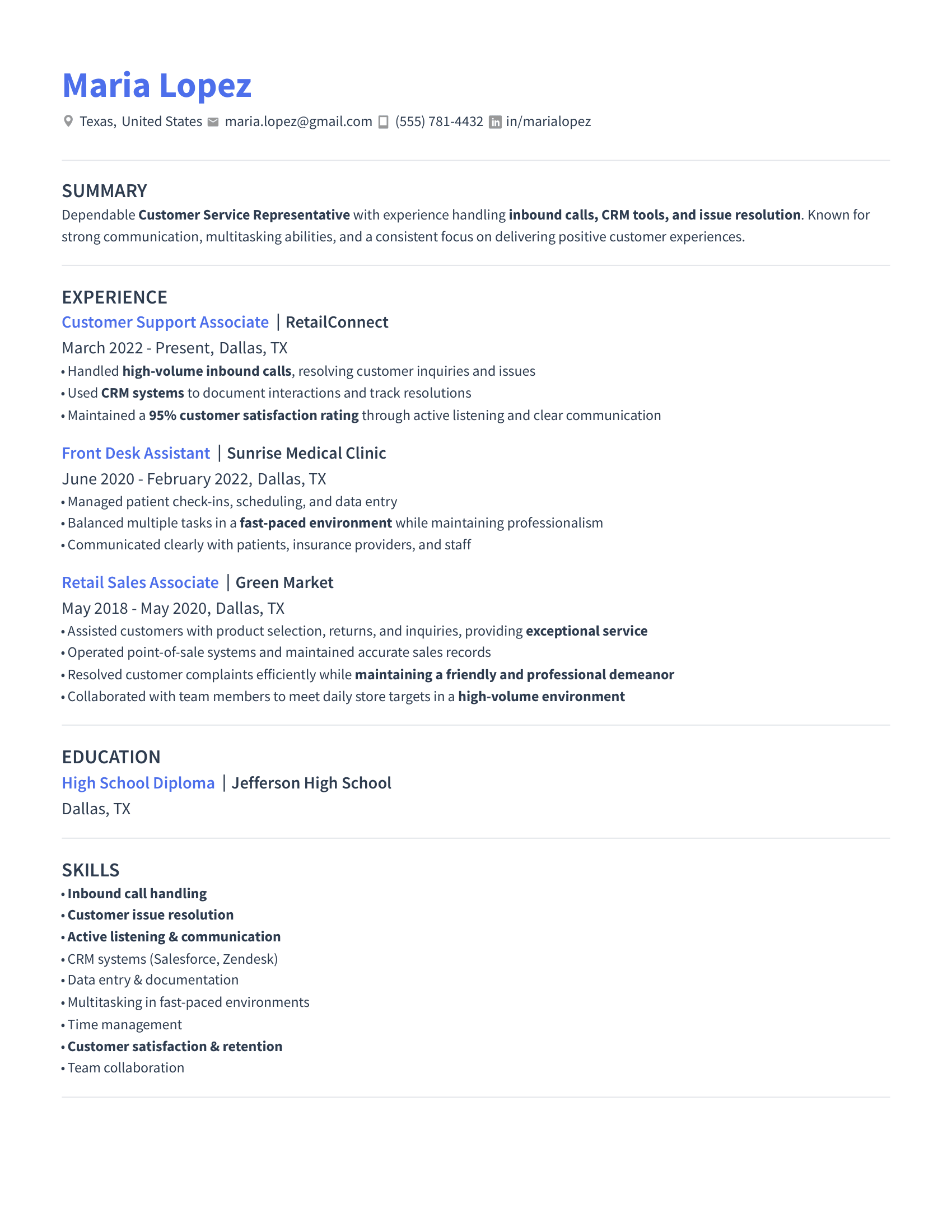
Below, I’ve included four job descriptions from different industries with targeted resumes. I’ve highlighted the matching details from each resume in bold, so you can see where I’ve tailored the application.
Software Developer
The Role:
• Working collaboratively with the technology and business teams on our trading and research platforms
• Designing and implementing high-quality software solutions used for algorithmic trading, exchange connectivity, and research
• Exploring and working with industry-leading software and hardware
• Learning from industry experts in the fields of technology and finance
• Working on challenging and dynamic problems in a team atmosphere
The Requirements:
• Bachelor’s Degree in Computer Science or an equivalent field
• Programming skills and understanding of general programming concepts, such as OOP and data structures
• C++ experience is a plus, but not required
• Problem solvers who are driven, self-motivated, and “outside of the box” thinkers
• Motivated, dependable, and responsible team players
• Excellent written and verbal communication skills
To target this software development role, Daniel focused heavily on the job’s emphasis on collaboration, problem-solving, and trading-related platforms. Sure, Daniel isn’t a pure algorithmic trading expert, but his FinTech role and academic projects imply key technical skills.
Daniel’s IT support role isn’t a perfect match (totally normal), but it reinforces communication skills and teamwork, which are both clearly valued in the job ad. His skills also directly reflect the role’s emphasis on programming fundamentals and problem-solving, without overstating his expertise.

Customer Service Representative
JOB SUMMARY
The Inbound Contact Center Agent serves as the first point of contact for customers, providing exceptional service and support through inbound phone calls and other communication channels. This role is responsible for handling inquiries, resolving issues, and ensuring a positive experience for every customer interaction.
QUALIFICATIONS
• High school diploma or equivalent required.
• Customer service experience in a contact center is preferred but not mandatory.
• Excellent verbal and written communication skills.
• Strong problem-solving and active listening abilities.
• Ability to multitask, manage time effectively, and work in a fast-paced environment.
• Proficiency with computer systems, CRM tools, and data entry.
• Dependable, punctual, and team-oriented with a commitment to customer satisfaction.
Maria’s resume mirrors the contact center language used in the job posting, with terms like inbound calls, CRM, multitasking, and customer satisfaction appearing naturally. Again, the clinic role isn’t an exact match, but it clearly shows transferable skills like data entry, communication, and handling people under pressure.
The skills list also reflects contact center language and highlights dependability, communication, and system proficiency — all valuable traits and key screening factors for this role.
Marketing Specialist
Full job description
We’re looking for a Marketing Specialist to join our Sales & Marketing team. We’re providing you with an opportunity to gain real business-building and marketing experience in one of the fastest-growing organizations in the country.
The Ideal Candidate:
• Proficiency in Microsoft Office Suite software products (PowerPoint, Excel, Word, etc.)
• Excellent interpersonal and verbal communication skills
• Thrives in a deadline-driven environment with exceptional multitasking abilities
• Self-motivated, self-disciplined, and results-oriented
• Possesses a positive, can-do attitude with meticulous attention to detail
What You Will Be Doing:
• Assist the Sales & Marketing Directors in their daily duties
• Organize and maintain databases and online portals
• Execute marketing and advertising campaigns by analyzing sales forecasts
• Plan and organize captivating promotional presentations
• Monitor and enhance active marketing programs
• Contribute ideas for experimental marketing programs to enhance the company’s brand
Jordan leaned into the role’s emphasis on supporting leadership, organization, and execution, rather than pretending to be a senior strategist. The sales support role isn’t pure marketing, but it reinforces data handling, deadlines, and collaboration, which are important parts of the job.
The skills section focuses on execution, organization, and support, which aligns perfectly with an entry-to-mid-level marketing specialist role.

Electrician
Job Description
• Install various electrical wiring systems and equipment
• Use measuring equipment and hand tools to perform work
• Perform all work in a manner that meets and follows electrical codes, blueprints, and standards
• Test electrical systems and components to ensure proper functioning
• Ensure adequate inventory of necessary supplies and parts
• Calibrate equipment to provide specifications
• Perform preventative maintenance on electrical systems and components
• Troubleshoot problems and make repairs
Qualifications for Electrician
• Completion of an electrician program at a technical or trade school is preferred
• Minimum 2 years of electrical experience
• Valid driver’s license
• Ability to lift, carry, push, and pull up to 50 pounds
• Comfortable reading and understanding electrical blueprints, schematics, and diagrams
• Working knowledge of electrical theory, and the associated principles, materials, and equipment
• Demonstrated ability to operate hand and power tools associated with electrical work
• Ability to calculate basic mathematical problems
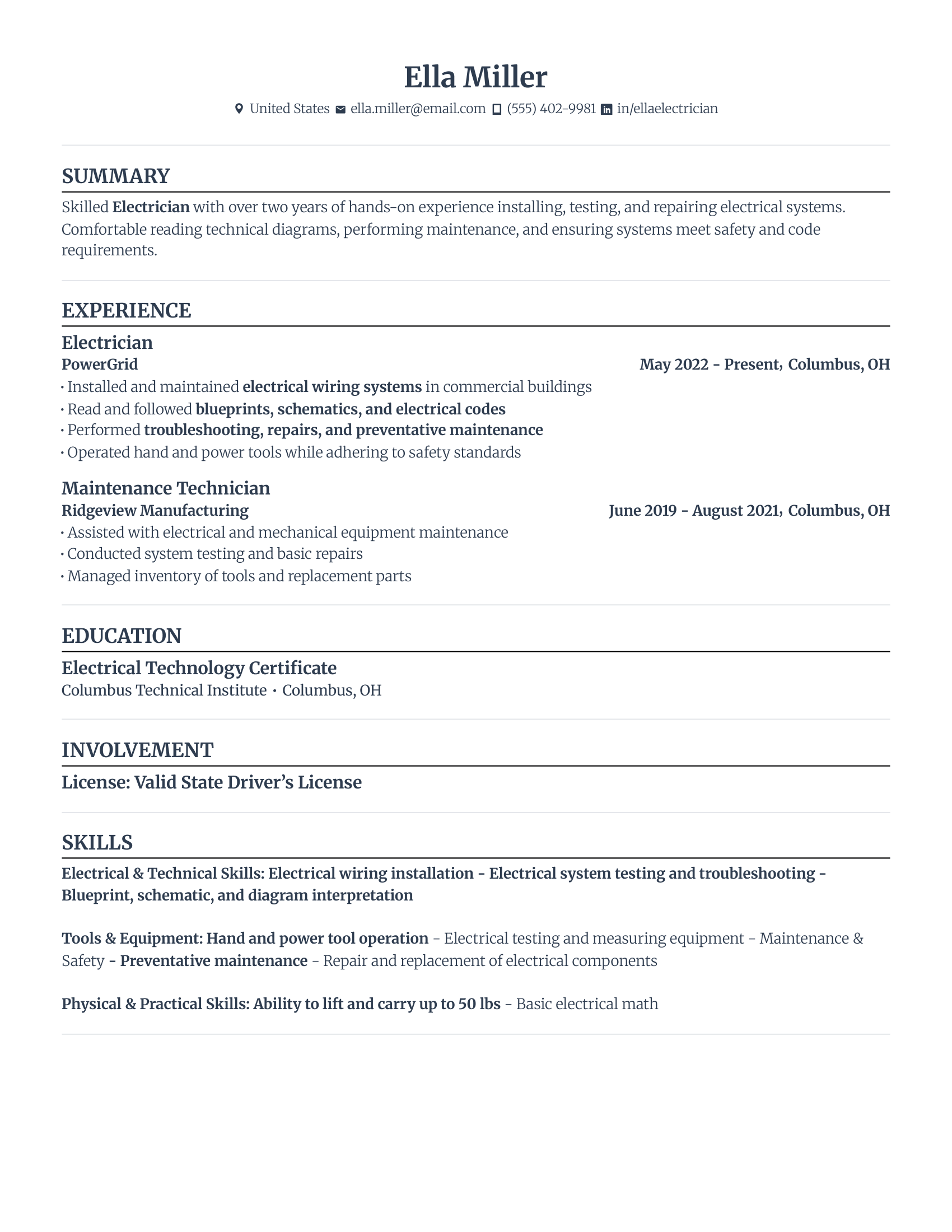
Ella’s resume directly reflects the hands-on nature of the role, with relevant tools, testing, troubleshooting, and code compliance. The maintenance technician role doesn’t totally line up with the traditional electrician background, but it supports the required experience with equipment, repairs, and preventative maintenance.
The skills section on Ella’s resume directly targets the core technical and industry-standard requirements listed in the job description without adding anything unrealistic.
Like the look of these resume templates? Check out more: ATS Resume Templates
Common mistakes when using AI to tailor resumes
Over-relying on AI without reviewing. AI generates fluent text, which makes it easy to trust uncritically. Always read through the output. Check that it accurately reflects your experience. Watch for generic phrasing that could apply to anyone — good tailoring should feel specific to you.
Keyword stuffing. Some tools and approaches prioritize cramming in as many keywords as possible. This might boost an ATS score, but it creates a resume that reads poorly to the human who reviews it next. Keywords should appear naturally within the context of your actual accomplishments.
Using the same prompt for every job. If you're using a chatbot, resist the urge to reuse the same generic prompt. Each job description is different. Take 30 seconds to identify what makes this posting unique before you ask the AI to tailor your resume to it.
Ignoring formatting. AI handles text, but formatting matters too. Make sure your tailored content still fits on the page, that section headers are consistent, and that your template remains ATS-readable. Fancy designs with columns, graphics, and unusual fonts often cause problems with tracking systems.
How to evaluate the result
After tailoring, run through this quick checklist:
Does the summary mention the specific role and key requirements from the posting? Do the first two bullet points under each job speak to what this employer cares about? Are the job description's most important keywords present in your resume? Does everything in the resume still accurately describe your real experience? Is the resume still one to two pages? Does it read naturally, or does it sound like it was written by a robot?
If you're using a tool with match scoring, aim for a strong alignment — but don't chase a perfect score at the expense of readability. The resume needs to work for both the ATS and the person reading it.
The bottom line
Tailoring your resume to every job description is one of the highest-leverage things you can do in a job search. AI makes it fast enough to actually do for every application. Whether you use a chatbot, a dedicated tool, or an AI agent connected directly to your resume, the core principle is the same: match your real experience to what the employer is asking for, and do it in their language.
The tooling will keep getting better. Agent-based workflows — where your AI reads your resume, finds a job, and tailors the content in a single conversation — are already here. The job seekers who adopt these tools early will apply faster, match better, and spend their time on what actually matters: preparing for interviews.
FAQ
How to target a title on your resume?
Target your resume’s professional headline or job title by aligning it with the title in the job description or a close equivalent. This instantly shows recruiters that your experience fits the role.
If your previous titles don’t match exactly, use the headline to bridge the gap while staying truthful. For example, if the posting is for “Marketing Manager” and your past title was “Communications Lead,” you could use a headline like “Marketing and Communications Professional” to create that connection.
Related: Top Job Titles of Rezi Users
What is a master resume?
A master resume is a comprehensive document that lists every job, skill, certification, achievement, and project you’ve completed over your career. But you don’t submit it as-is. Instead, you use relevant details from it to build targeted resumes for different roles.
Maintaining a master resume saves time, keeps your experiences organized, and ensures you don’t overlook key accomplishments when preparing applications.
Should You Send Your Master Resume to Employers?
In short, no. You shouldn’t send your master resume to employers.
A master resume might work for a lucky few, but it won’t give you the best shot at landing interviews. Technically, a master resume could work if you’re applying for a role that perfectly matches every single thing you’ve ever done, but that’s a gamble. More often than not, a master resume is too broad and contains far too much information for a recruiter who is only going to skim it for a few seconds.
How to write a master resume?
To write a master resume, start by listing every single professional experience, educational milestone, and skill you’ve ever acquired (without worrying about page limits for now). Focus on adding data-driven bullet points for every role, including specific metrics and individual contributions that you can later "cherry-pick" for different job applications. Keep this document in a simple, easy-to-edit format so you can continuously add new certifications, projects, or responsibilities as they happen. After you have everything outlined and you’re job hunting, condense your resume down to one or two pages and tailor it to the specific target job description.
Read more:
What are the 5 elements of a job description?
The five essential elements of a job description include:
- Job title: Identifies the role and signals the level and focus of the position.
- Summary or overview: Explains the purpose of the role and how it fits within the organization.
- Responsibilities: Outlines the day-to-day tasks, goals, and expectations of the position.
- Required and preferred qualifications: Define the skills, education, certifications, and experience the employer is looking for.
- Company information or culture: Highlights the organization’s mission, values, and work environment.
Understanding these elements makes it easier to build a targeted resume that emphasizes the skills and qualifications most important to the employer.
What happens if you don’t tailor your resume?
If you don’t tailor your resume, you risk blending in or not showing up with ATS filters. Your experience might be solid, but if it doesn’t clearly match the job description, both ATS systems and recruiters may overlook it. Hiring managers skim quickly, so if the connection isn’t obvious, they’ll move on. You don’t need heavy customization, but without at least light tailoring, your resume can feel too generic and miss the chance to stand out.
How to tailor a resume to the job description using ChatGPT?
You can use ChatGPT to speed up tailoring without overthinking it. Paste your resume and the job description, then ask for help to identify key skills or rewrite bullets to better match the role. For example, prompt it to highlight gaps, suggest stronger wording, or align your experience with the job’s requirements. Just make sure you review everything, keep it accurate, and true to your experience.
Check out more ways to use ChatGPT:

Upload or drop your resume to get started
Upload your resume to get started
Score my resume

Jacob is the founder and CEO of Rezi. He has been sharing his unique insights on solving the resume since 2015, helping millions around the world land their dream jobs. Lately, Jacob finds himself giving a ton of speeches on topics related to global employment and building startups.