
Career Advice
How to Change Careers: 10 Steps for Switching Jobs
Discover how to change careers, covering everything from identifying your passion to building experience for a successful job switch.

Published on
July 8, 2025
Updated on
July 8, 2025
Changing careers starts with clarifying why you want the change: more fulfillment, better balance, or a new challenge? Consider your transferable skills (like communication, leadership, or problem-solving) and match them to roles or industries that excite you. Do your research, talk to people in those roles, and take a course or certification to fill any gaps. Action leads to clarity, so start small if needed, such as freelancing, volunteering, or shadowing someone. Get support, stay open to feedback, and be patient.
We live in a world where your job title often feels like your identity. You’re expected to have a solid idea by your teens, and it’s one of the first things people ask when they meet you. So when you’re unsure about your career path, it can feel overwhelming, isolating, and frustrating.
The reality? It’s completely normal not to have it all mapped out. Changing careers isn’t just about trial and error or jumping back into school for years. You don’t need to have everything figured out today, but you need to start somewhere. Taking small, intentional steps is how real change happens.
Let’s go through it one step at a time. This guide will cover:
- How to find the right career for you.
- Tips and advice for making a career change.
- The best jobs for people who don’t know what to do.
Reasons for a Career Shift
If you’ve made it here, I’d say that’s a pretty strong sign you’re ready to explore a new direction. But if you’re still on the fence, here are some of the most common (and totally valid) reasons people decide to switch careers — you might just see your own story reflected in them.
- You’re not being paid enough. Money isn’t everything, but it matters. It’s natural to think about a career shift if your current role isn’t paying enough to support the life you want (or you know you could earn more elsewhere). The goal is to find a field where your time and skills are valued — and compensated fairly.
- You want more than just a paycheck. Do you want to help people, create something beautiful, or contribute to a cause that matters to you? When your current job feels empty or misaligned with your values, it’s time to explore something more fulfilling.
- The stress and environment are wearing you down. Toxic workplaces, lack of support, poor management — these things can drain your mental and physical health. If your job feels like it’s slowly chipping away at your happiness or peace of mind, start looking for a healthier environment where you can actually thrive.
- You feel you’ve hit a wall. If every day feels like déjà vu, and you’re no longer learning, growing, or excited about your work, that’s a red flag. A career change can reignite your curiosity and open up new opportunities for personal and professional development.
- Your life, goals, or values have shifted. Maybe you became a parent, moved to a new city, or just had a change in priorities. What mattered to you five years ago might not match where you are now. A career shift can help realign your work with the life you want today, not the one you imagined in high school.
Learn more about when to walk away: I Hate My Job: What to Do, and When to Quit?
How to Change Careers?
Before we go through your job shift step-by-step, here’s a quick overview of how to start a new career:
- Identify what excites and drains you by reflecting on your interests, past roles, and ideal work environment.
- Research growth potential, salary expectations, required qualifications, and practical aspects that align with your life goals and financial needs.
- Use personality and career assessments to highlight your strengths. Combine this with advice from mentors or career coaches who can help you navigate your next move.
- Think about your transferable skills, like problem-solving, leadership, or training others, and match them with the needs of your target industry or role.
- Talk to professionals through LinkedIn, events, or casual chats to get fresh insights and open doors.
- Look internally for opportunities to pivot. Volunteering for cross-functional projects can reveal hidden potential and ease the transition.
- Upskill through education or certifications. And don’t exclude certain jobs if you don’t have a degree. Many people pivot with short-term training, online courses, or community college certificates.
- Map out your career change with actionable goals like researching roles, updating your resume, enrolling in a course, and networking.
- Tailor your resume for the career switch with relevant coursework, side projects, or certifications to prove your commitment to a fresh path.
- Gain hands-on experience through freelance work, volunteering, or side projects — even within your current role. Every experience boosts your resume and your confidence.
1. Identify your passions and interests
Our interests evolve as we grow, and sometimes life throws experiences at us that shift what we value or what excites us. The first step in changing careers is figuring out what lights you up.
Take some time to think about these questions:
- What energizes you?
- What kind of work makes you feel like you’re doing something meaningful?
- Are you craving more collaboration or independence?
- What type of work environment helps you stay motivated?
Consider what you want your days to look like. If your current job leaves you drained or uninspired, try to pinpoint the cause. Is it the actual work, the people, the environment, or all three? Knowing what doesn’t work for you can be just as valuable as knowing what does.
It’s helpful to reflect on past roles, too. Maybe you liked problem-solving but couldn’t stand the repetitive tasks. Or you loved the people, but not the rigid office hours. Looking at past experiences can point you in the right direction.
2. Research the job market and career prospects
Don’t walk into the unknown completely blind. Once you’ve got a few directions, dig into what the job market looks like in those areas. Is the demand growing? Are there opportunities for advancement? Will this career path still be viable ten years down the road?
Check out sites like the U.S. Bureau of Labor Statistics for data on job growth, average salaries, and required qualifications. You can also browse job boards — not necessarily to apply, but to get a feel for what employers are asking for. What skills keep popping up? What experience do they want? This can help you figure out what gaps you might need to fill.
And be honest about what salary you need to maintain your lifestyle. It’s one thing to chase a dream job, but you need to support your life outside of work. This stage is about balancing passion with practicality so you can move forward with confidence, not guesswork.
3. Take a career quiz and seek mentorship
Career and personality tests get a bad rap. Yes, they probably won’t magically figure everything out for you. But that’s not the point. If you’re feeling lost, these quizzes can reveal patterns in your strengths and preferences you haven’t noticed before, and set you on the right path.
Check out these popular career and personality tests to give you some direction:
- The Princeton Career Quiz
- Career Explorer Assessment
- Holland Code Career Quiz
- Job Test Career Test
- 16 Personalities Personality Test
And if you’re ready to go deeper, talk to a mentor or career coach. Sometimes, we’re too close to our own experiences to see a clear direction. A mentor can help you connect your past roles and future opportunities, while a career counselor can provide insight into how your personality aligns with different career paths.
Find out what your MBTI personality says about your ideal career path: MBTI at Work
4. Focus on your transferable skills
Even if your next role seems completely unrelated to your current one, you’ve likely built up skills that can carry over — that’s where your power lies. And even better, instead of being stuck in your ways, you can approach everything with a fresh perspective.
Communication, problem-solving, project management, and leadership skills are in demand pretty much everywhere. Have you managed budgets, improved workflows, handled customer complaints, or trained new hires? These all reveal key skills. Write them down.
Once you’ve mapped out those skills, compare them to the job descriptions in your desired field. You’ll probably find more overlap than you expected. Use those connections to promote yourself.
Learn more about which skills are in demand: The Best Skills to Put on a Resume
5. Network and talk to industry professionals
You’ve heard it before, but it’s worth repeating: it’s all about who you know. If your current network doesn’t stretch into your target industry, now’s the time to branch out.
LinkedIn is a great starting point. Look up people in the roles you’re interested in and don’t be afraid to reach out. A simple message like, “Hey, I’m exploring a career shift and would love to hear about your experience,” can open doors.
Check out networking events, conferences, and workshops to find people who’ve already made a similar leap. Talking to other professionals is great for learning the lay of the land and meeting folks who can help guide your next steps.
The more conversations you have, the more real your vision becomes — not just about what you want to do, but how to get there. People love talking about their work (trust me), and you never know which chat will lead to your next opportunity.
6. Explore internal opportunities
Before jumping ship, look at where you are now — your next move might be right under your nose. Internal transitions can be one of the smoothest ways to shift careers, especially if you have no direct experience.
Why? You’ve already built trust, know the culture, and (hopefully) have advocates who believe in your potential.
Reach out to teams or departments you’re curious about. If possible, volunteer for projects that cross departmental lines. For example, if you’re in operations and curious about marketing, ask if you can help with a campaign. These mini-experiences let managers see what you can do outside your usual role.
Here’s some solid advice about making an internal career shift:
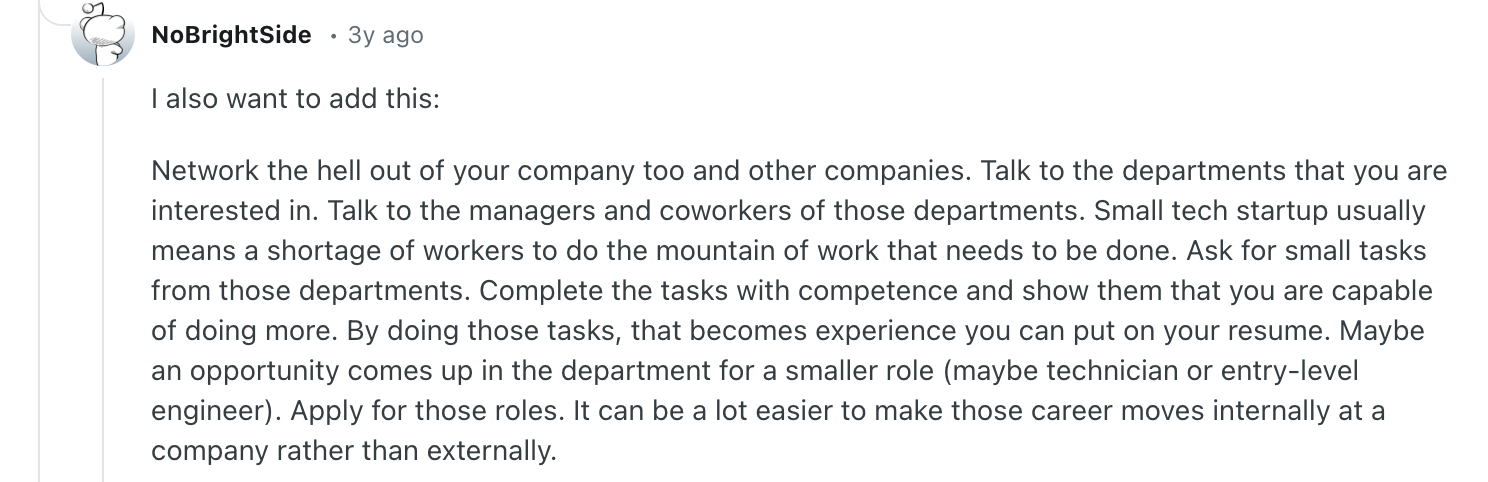
If something opens up, even if it’s a step sideways or down in title, it may be the right decision if it gets you closer to your ideal path. Internal moves can come with less risk and more support — a huge bonus when navigating new territory.
Learn more about tweaking your job application: How to Write a Cover Letter for an Internal Position
7. Get more training or education
Don’t hold yourself back just because you lack the qualifications; it’s never too late to upskill. And this doesn’t necessarily mean returning to school for a four-year degree (unless that’s what you want). Many professionals pivot careers through targeted learning, like short courses, certificates, or workshops.
Here’s what one career changer said about returning to education:
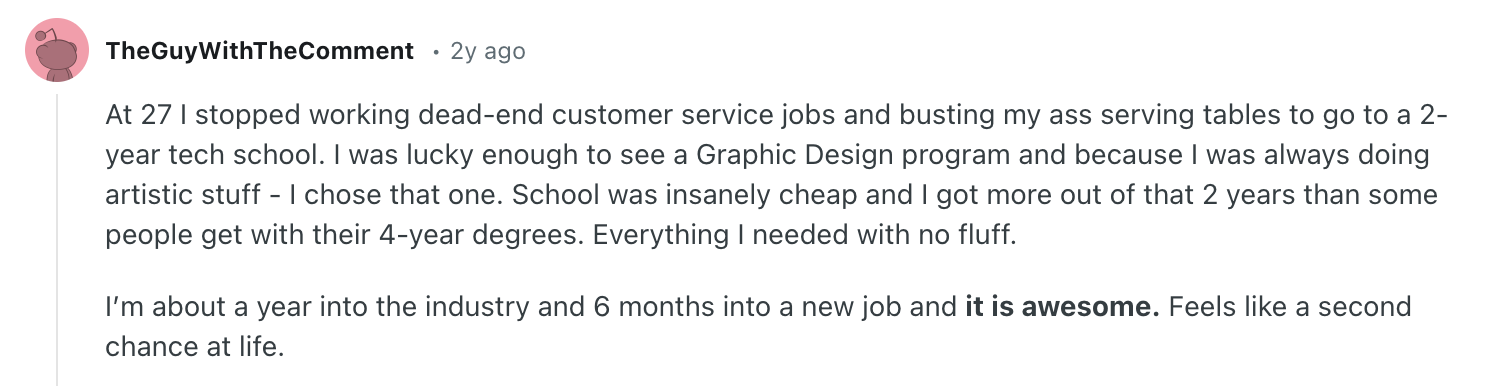
Many community colleges also offer certificate programs for working adults who want to switch gears. These programs are shorter than traditional degrees but can be just as effective in helping you land a role in a new industry.
And if you’re still unsure about which direction to go, check out your local college’s career center. Some are open to prospective students, even if you’re not enrolled yet. Talking to someone there could help clarify your options and recommend programs.
And don’t let age hold you back from changing your life:

8. Create a step-by-step strategy
No big goal becomes a reality without a plan. Once you decide to change careers, map out a strategy. You don’t have to have all the answers right away, but you do need a general direction and a few solid first steps.
Break that big dream into bite-sized tasks. Here are some starting points:
- Research job descriptions.
- Identify skills you need to learn.
- Enroll in a course or go back to school.
- Update your job application.
- Network with people in the field.
Tracking your progress helps, too — it can be as simple as using that old notebook or Google Docs. Seeing how far you’ve come gives you momentum, especially on those days when self-doubt creeps in. Celebrate the small wins and don’t be afraid to tweak your plan as you go.
9. Update your resume
When switching careers, your resume becomes less about what you’ve done in the same industry and more about your potential. To impress recruiters, you’ll need to shift the focus to your transferable skills, relevant experience, and future potential.
Here are some ways to tweak your resume for a career change:
- Use a summary that outlines your career goal and how your background supports it.
- Highlight the transferable skills in your work experience section that overlap with your target role.
- Include any certifications, relevant coursework, or side projects that show you’re actively building experience in this new field.
You can also use a career change cover letter to show your passion for the industry. Explain your reasons for the transition and detail that you’re willing to learn and grow — never underestimate the power of enthusiasm.
Need help creating a career change resume? Use our free AI Resume Builder to tailor your skills and experiences to your ideal job.
10. Gain relevant experience
I get that it’s frustrating to see years of experience on every job listing. How are you supposed to get experience if nobody will give you a chance? Well, you have to get creative.
Think outside the box: Can you volunteer with an organization that needs your help in your target field? Do any of your connections need help with any projects? Can you offer your services on a freelance basis?
You can also gain experience while keeping your current job. For example, if you’re transitioning into social media, could you help your current company run its online accounts? These “extra” projects can show initiative and fill out your portfolio.
Trying new things also helps clarify what you don’t want, which is just as important as figuring out what you do. Every bit of experience counts — not only for your resume, but for building confidence in your new path.
Career Transition Tips
In short: put your plans into action.
You’ve done a few fun career tests, googled some interesting jobs, and had more than a few rants about your current job. But what tangible steps have you taken to change your situation? Yes, it may seem daunting or even impossible. But you won’t know until you try.
Here’s some career change advice to get the ball rolling:
Don’t tackle the change alone
Take the load off by having people in your corner. Lean on your circle, find communities, and talk it out with those who’ve been in your position (trust me, you’re not the only one who’s changed their mind).
What you can do:
- Start talking to professionals doing what you’re interested in. This could be a quick coffee chat, a networking event, or an online forum. Real stories and insights can open your eyes to roles you didn’t know existed.
- Let friends, family, or coworkers know you’re exploring something new. They might have advice, connections, or encouragement that gives you a fresh perspective (or the push you need).
Avoid wasting time procrastinating
Planning is great, but too much can trap you in analysis paralysis. If you’re waiting for the “perfect moment” with your spreadsheets and highlighted notebooks, you might be waiting forever. Progress comes from doing, not just planning.
What you can do:
- Take a small step now, even if it feels scary. Sign up for a class, ask about other departments at work, reach out for an informational interview, or volunteer in a new space.
- Set short deadlines to act. Give yourself a definitive timeline to explore a new idea, update your resume, or research a field — then move, even if it’s imperfect.
Listen to feedback and advice
You don’t have to have all the answers — and honestly, those around you might see your strengths more clearly than you do. Don’t take constructive feedback as an attack. It’s much easier to grow once you see it as a learning mechanism.
What you can do:
- Find a career counselor or mentor to share your ideas and get more clarity. Look for online communities, professional groups, or networking events where professionals share experiences and offer advice.
- Listening to advice can be incredibly helpful, but don’t hand over the steering wheel to someone else. One person’s path or opinion is just that: one perspective. Gather input from different people, weigh it against your own goals and values, but trust yourself to make the final call.
Think about the bigger picture
While I’m all about chasing your dreams, don’t forget how a career change affects your finances, daily life, and long-term dreams. Make sure your decision fits into the life you want to build.
What you can do:
- Ask yourself why you want this change. Is it passion, burnout, values, misalignment, or something else? Identifying any issues helps you avoid making the same mistakes.
- Do a financial check-in. Know your budget, savings, and what kind of salary you’ll need to support the lifestyle you want. This is especially important if you’re going back to school or taking a pay cut at first.
Be flexible but stay focused
Career change is rarely a straight line. You might pivot a few times before landing exactly where you want. You’re stepping into the unknown, so it’s normal to take some time to figure out which path you want to take. Stay open, but keep your eye on the long-term goal.
What you can do:
- Let your plan evolve as you learn. You might discover that what looked like the dream job actually isn’t what you thought. Adjust as you go, but try to keep everything intentional.
- Keep a journal or tracker of your progress. It’ll help you stay motivated, spot patterns, and remind you how far you’ve come, especially when things feel slow.
Best Career Change Jobs
It’s not easy to get advice or focus on the end goal when you don’t know what you want to do. But there’s no pressure to have it all figured out today. Think about what you enjoy, where you’ve excelled in past roles, and then explore careers that might line up. Sometimes, seeing what’s out there can flip a switch and give you direction.
Check out these career change jobs and estimated salaries to help spark inspiration.
Easy career changes
Not feeling another four years of school just to make a career change? Well, you don’t have to. Plenty of great career paths let you pivot without racking up more student debt or spending years in the classroom. You might need a short course or certification here and there, but we’re talking months, not years.
Here are some practical career options that could lead to bigger and better career paths:
Caregiver
Caregiving can be an incredibly fulfilling second career for the compassionate and patient. It involves offering companionship and personal care to those who need help in their daily lives, such as elderly clients or individuals with disabilities.
You don’t always need a formal certification (depending on your state), though some employers or locations may require a basic course. And if you’re interested in going deeper into healthcare, caregiving can be a great entry point into nursing or medical assistant roles.
Estimated salary: $31,075 to $37,975
Customer service representative
Customer service is where your communication skills, patience, and problem-solving will help you succeed. Plus, many companies provide full training, so no prior experience is necessary. Typical duties involve chatting with customers across nearly every industry, including tech, retail, and finance.
If you want to rise the ranks, consider learning CRM software or taking a short course in customer service. With the right experience and training, these roles can be a stepping stone to sales, account management, or operations.
Estimated salary: $36,054 to $44,938
Real estate agent
Real estate is one of those rare industries where you don’t need a four-year degree to succeed. All you need is a real estate license, which you can often earn in a matter of months. This could be a great move if you enjoy networking, guiding people through big decisions, and have a solid sales drive.
Whether helping someone buy their first home or sell a commercial space, you’re playing a real role in people’s lives. Plus, there’s a lot of potential for high income and flexibility with your schedule.
Estimated salary: $45,178 to $71,821
Medical coder
Medical coders are healthcare professionals who translate patient visits into universal codes for billing and records. The healthcare field is always growing, and coders are in constant demand.
While prior experience helps, many certification programs will let you in with minimal background, especially if you can start in entry-level roles like a billing assistant. And once you’re certified? You can specialize even further in fields like cardiology or pediatrics.
Estimated salary: $52,027 to $63,830
Social Media Manager
It’s easy to assume managing social media means scrolling through Instagram and firing off quirky tweets. But in reality, it’s a strategic, multi-faceted job that blends creativity, analytics, crisis management, and brand storytelling. And the demand for social media experts is growing as more businesses go digital.
A degree in marketing or communications helps, but it’s not a deal-breaker. You can also prove your potential with a portfolio showing you can grow a brand, engage a community, and handle the heat when things get dicey. Even running your own content calendar can be a great start.
Estimated salary: $103,550 to $132,170
High-paying second careers
You can get a high-paying job by working hard and climbing the ladder. But in most cases, you’ll need at least a bachelor’s degree. Yes, that could involve going back to school, but it’s worth looking at the bigger picture if your goal is to achieve financial freedom, stability, or that ideal lifestyle.
Check out these easy career changes that pay well:
Financial advisor
Financial advisors guide clients on investments, savings, insurance, and retirement planning. While a bachelor’s degree is common, it’s not always required, but you’ll need to pass certification exams through designations like CFP, CFA, and CPA.
This is a great path for people with strong communication skills and an analytical mind. Over time, advisors can build a client base that leads to a solid income and long-term relationships.
Estimated salary: $48,456 to $175,321
Project manager
These professionals keep teams on track, ensuring everyone meets deadlines, sticks to budgets, and communicates smoothly. You can find this role in nearly every industry, from construction to IT to marketing.
You don’t necessarily need a degree in project management, but you’ll need to prove strong organizational skills, leadership experience, and the ability to juggle multiple moving pieces. Still, a PMP (Project Management Professional) certification can boost your credibility, especially when you’re just breaking in.
Estimated salary: $64,154 to $78,935
Software developer
Making a jump into software development might seem intimidating, but it’s absolutely doable — and worth it if you enjoy problem-solving and building things from scratch. And with the tech industry booming, the demand for skilled coders is only growing.
While a computer science degree is one path, many get in through boot camps or self-taught portfolios. The key is building hands-on projects, learning key programming languages, and proving your ability to create something functional. With high salaries and the flexibility of remote work, this is a future-proof shift.
Estimated salary: $75,890 to $91,990
Marketing manager
Marketing managers shape campaigns, analyze consumer behavior, and bring brand stories to life. While a degree in marketing or business helps, it’s not the only way in.
Many marketers start in unrelated fields and use transferable skills like writing, analysis, and project coordination to shift over. Digital marketing, in particular, is booming right now, and there are many short courses online to help you get up to speed and impress recruiters.
Estimated salary: $102,065 to $129,704
Data scientist
Data scientists dig through data to help companies make better decisions. While many data scientists have a master’s degree, it’s not mandatory if you have a related bachelor's degree that’s helped you build skills in data analysis, Python or R, and machine learning.
Full transparency: the competition is tough, especially for entry-level positions. But there’s also demand, especially in tech, finance, and healthcare. Once you’re in, the field has plenty of opportunities for growth and strong compensation.
Estimated salary: $111,644 to $136,996
Careers with transferable skills
You don’t always need a specific degree or experience to enter a new field (I studied Medieval History, and look at me now). Often, it’s about recognizing the value of your existing skills and reframing those strengths for a new role. A degree can help open doors, but so can real-world experience.
Here are some career paths where transferable skills can help you get started:
Sales representative
Sales roles exist in every industry and often come with commission-based pay that can boost your earnings significantly. The barrier to entry is relatively low — many positions don’t require a degree, though business or marketing knowledge definitely helps.
Sales is also one of those roles where your results matter more than your resume, so if you’re good at it, you can grow fast and earn big.
Estimated salary: $52,365 to $71,401
Technical writer
Technical writers create user manuals, instruction guides, and help documents for products and services, particularly in tech-heavy industries.
While many technical writers have degrees in English, communications, or engineering, a strong portfolio can often speak louder than your credentials. If you’re detail-oriented and enjoy bridging the gap between technical and non-technical audiences, this job offers both autonomy and solid pay.
Estimated salary: $53,169 to $73,714
Legal assistant
Becoming a legal assistant can be an interesting career transition if you’re organized and have a good eye for detail. You’ll support lawyers by managing documents, tracking schedules, and handling the administrative side of legal work.
No law degree needed; just strong communication, time management, and basic computer skills. In smaller firms, they might even train you on the job. Over time, you can also grow into more advanced legal roles or specialize in areas like real estate or litigation.
Estimated salary: $62,437 to $79,525
Product manager
Product management is all about strategy, collaboration, and execution. If you’ve worked in a role where you coordinated across teams or led initiatives, you’ve already built many of the skills you’ll need. Product managers guide a product from concept to launch, balancing customer needs with business goals.
You don’t need a specific degree, but business, marketing, or communications backgrounds are a big advantage. It’s a great fit if you enjoy solving problems, thinking big picture, and keeping moving parts in sync.
Estimated salary: $74,852 to $229,653
HR manager
This could be a smart pivot if you’ve worked in leadership or operational roles and found yourself drawn to the people side of business. HR managers are responsible for hiring, training, resolving conflicts, and shaping company culture.
Most HR professionals have a degree in business or social sciences, but plenty transition in from other fields. If you want to sharpen your qualifications, consider HR certifications or courses in labor law and organizational behavior.
Estimated salary: $106,184 to $127,950
Summary
Here’s a breakdown of everything to know about switching careers:
- Start by identifying what’s pushing you to switch careers. Is it burnout, lack of growth, or new interests? Understanding your motivation helps you choose a path that better aligns with your values and goals.
- Assess your transferable skills, such as communication, leadership, or problem-solving. Make a list of what you can offer in different career paths.
- Explore and research roles that interest you. Look into job descriptions, day-to-day responsibilities, salary expectations, and future growth to ensure it’s a solid long-term fit.
- Career coaches or industry mentors can provide clarity, accountability, and feedback. They can help you avoid common mistakes and accelerate your transition.
- If the role requires new knowledge, take an online course, join a bootcamp, return to school, or get certified. You don’t always need a degree — practical skills, knowing the right people, and initiative go a long way.
- Instead of starting over, look for internal positions or roles that build on what you already know. For example, a teacher might transition into instructional design, or a journalist into content marketing.
- Talk to people already in your desired field. Informational interviews, LinkedIn connections, or local meetups can give you insider insight and sometimes open unexpected doors.
- Tailor your resume and LinkedIn profile to highlight relevant experiences. Even small projects or volunteer work can position you as a strong candidate in your new field.
- Consider freelance work, part-time roles, or internships to get hands-on experience. It’s okay to take a step sideways (or slightly down) to move forward long term.
- Career changes often involve rejection, doubt, or impostor syndrome. Stay patient, remind yourself why you’re taking the leap, and celebrate progress.
FAQ
How to change careers at 40?
Changing careers at 40 is increasingly common. By this stage, you’ve built valuable life experience, a strong work ethic, and likely a clearer sense of what you want. The first step is getting honest about why you’re ready for change. Once you’ve nailed that down, assess which transferable skills can move with you.
From there, do your research into industries. You might need to take a course, earn a certification, or start with a step-down role to break in, but it’s all doable. Talk to people already in that field. The goal is to gather real-world insight before making any big leaps.
What to do when you don’t know what to do with your life career?
First off, take a breath. When you’re stuck, get curious instead of overwhelmed. Start by listing what you enjoy, what people come to you for, or tasks that make time fly. Explore careers that overlap with those strengths and interests. It also helps to experiment a little, such as taking a class, volunteering, or freelancing, to test different paths.
Talk to people in roles you find intriguing and ask how they got there. You might find a common thread between your skills and passions that you hadn’t noticed. You don’t have to have it all figured out at once. It’s okay to explore and evolve.
How long does it take to find a new job?
It depends, but the average job search can take around three to six months. That said, it can move faster (or slower) depending on a few things: the field you’re entering, how competitive it is, your experience level, and how much time you’re dedicating to the search.
If you’re changing industries, that may stretch the timeline since you’ll be positioning yourself for a role that doesn’t exactly match your past. But don’t let that discourage you. The more intentional you are by networking, customizing your resume, and being strategic in your search, the quicker you’ll likely land something that’s a good fit.
What is the easiest career to switch to?
The “easiest” career to switch to depends on your background, but roles that value soft skills and offer on-the-job training are great options. For example, customer service, sales, administrative roles, or even real estate. These positions often don’t require a specific degree or years of specialized experience — you just need to show you’re coachable and bring the right mindset.
Is 30 too old to change careers?
Not at all. In fact, 30 is prime time to shift gears. You’re old enough to have real work experience and some self-awareness, but young enough to still have decades ahead of you. Changing careers at 30 is about taking what you’ve learned so far and using it to pivot toward something that better aligns with who you are now.
Evaluate what you liked and didn’t like about your past roles, then use that insight to choose something that feels more sustainable or fulfilling. You might have to upskill, start small, or make temporary sacrifices, but the long-term payoff is huge.

Upload or drop your resume to get started
Upload your resume to get started
Score my resume

Lauren Bedford is a seasoned writer with a track record of helping thousands of readers find practical solutions over the past five years. She's tackled a range of topics, always striving to simplify complex jargon. At Rezi, Lauren crafts genuine and actionable content that guides readers in creating standout resumes to land their dream jobs.