Resume
How to write an entry-level resume (and get past ATS)
No experience? Here's how to write an entry-level resume that clears ATS and gets read. Step-by-step guide with examples and a pre-submit checklist.

Published on
March 20, 2026
Updated on
March 24, 2026
Entry-level job postings attract more applications than almost any other category. According to LinkedIn data, a single entry-level posting can receive 400 or more applications. Most of those resumes never reach a recruiter.
The reason isn't always underqualification. According to Jobscan, approximately 75% of resumes are filtered out by Applicant Tracking System (ATS) software before a human ever reviews them. For entry-level candidates, that number is likely higher — the competition is denser, and ATS filtering is more aggressive as a result.
Most advice for writing an entry-level resume focuses on sections and formatting. That's useful, but it skips the more important question: will the resume actually survive automated screening?
This guide covers how to write an entry-level resume that clears ATS and reads well when a recruiter does open it — including section structure, how to write an objective that actually works, how to frame limited experience into strong bullets, and how to verify your resume before you submit.
What makes an entry-level resume different
Two things set entry-level resumes apart from experienced-hire resumes: volume and weight.
Volume: More applicants per posting means more aggressive filtering. A hiring team reviewing 400+ applications isn't reading each one — they're relying on ATS to surface a shortlist. If your resume doesn't match the right keywords and format, it won't make that list, regardless of how relevant your background is.
Weight: With limited work history, every section carries more consequence. A senior candidate's resume has years of demonstrated performance to anchor it. An entry-level resume relies more heavily on how education, skills, and projects are framed. When there isn't much, presentation matters more.
The practical implication: an entry-level resume isn't just a shorter senior resume. It needs a different structure — one that leads with your strongest qualifications and is built to pass ATS before it worries about impressing a human reviewer.
Entry-level resume sections (and what order to use)
For most entry-level candidates and recent graduates, this section order works best:
- Contact information
- Resume objective
- Education
- Skills
- Work experience (internships, part-time, volunteer)
- Projects and coursework (if relevant)
- Certifications (if applicable)
This ordering puts your most credible qualifications — education and skills — near the top of the page. ATS reads your resume the same way a recruiter does: from top to bottom. Burying your degree below an unimpressive work history creates a weak first impression with both.
If you have a substantive internship or relevant part-time work history, move work experience above education. The principle: lead with whatever is most compelling for the specific role you're targeting.
Contact information
Include your full name, phone number, professional email address, city and state, and a LinkedIn profile URL. Skip your full street address — it wastes space and isn't needed. Use a clean email address (firstname.lastname format). A recruiter who sees "coolkid1998@gmail.com" will notice.
Education
For recent graduates, education is typically your most credible credential. List your degree, major, university name, and graduation date (or expected graduation date). Include your GPA if it's 3.5 or above. Add one to three lines of relevant coursework, academic honors, or notable projects if they strengthen the application.
Skills
The skills section is where much of ATS keyword matching happens. List technical skills, tools, platforms, and software relevant to the role — and mirror the language from the job description. If the posting says "Google Analytics," write "Google Analytics," not "GA." If it says "customer relationship management," write that, not "CRM."
List hard skills here. Save soft skills like "communication" and "team player" for your bullet points, where you can actually demonstrate them with context.
Work experience
Internships, part-time jobs, volunteer work, and relevant campus roles all belong here. Use a standard format: job title, organization name, dates (Month Year format), and three to six bullet points per role.
Start every bullet with a strong action verb. Write toward outcomes, not duties.
Projects and coursework
If you don't have much paid experience, add a dedicated Projects section below work experience. Academic projects, capstone work, personal side projects, and freelance work all qualify. Include the project name, your role, what you built or produced, and any measurable result.
Certifications
Include any relevant certifications — Google Analytics, HubSpot, AWS Cloud Practitioner, Microsoft Office, and similar credentials. List them with the issuing organization and year. This section is optional; only include it if the certifications are directly relevant to the roles you're targeting.
How to write your resume objective the right way
The resume objective has a bad reputation, mostly because most people write bad ones.
A typical bad objective: "Seeking a challenging position where I can utilize my skills and contribute to a growing organization." This tells a recruiter nothing specific, applies to every job that exists, and wastes the most valuable real estate on the page.
A strong objective does three things: names your target role, highlights a relevant qualification, and communicates what you bring to the job.
The formula
"[Job title/function] with [relevant credential or experience], seeking a role at [type of company or in a specific area]. [One specific differentiator.]"
Weak example: "Recent graduate looking for an opportunity in marketing where I can learn and grow."
Strong example: "Marketing graduate with hands-on experience managing paid social campaigns for two university organizations, seeking a coordinator role at a B2B SaaS company. Proficient in HubSpot, Canva, and Google Analytics."
The difference is specificity. A recruiter scanning 50 entry-level resumes should be able to read your objective in five seconds and understand exactly what you're offering.
Priya graduated in May 2025 with a degree in business administration. She applied to 30+ marketing coordinator roles over six weeks and heard back from two. When she finally got feedback from a contact at one company, the note was blunt: her resume objective read like a form letter, and her skills section listed generic terms that didn't match any job description she'd applied to.
She rewrote her objective to name the specific type of role and highlight her two most relevant skills. She revised her skills section to mirror the language in each job description she applied to. She got three interview requests in the following two weeks from an additional 15 applications.
For entry-level candidates who want help identifying which skills to highlight — particularly from coursework and part-time work — Rezi's AI resume builder includes an AI Skill Explorer that surfaces relevant skills from your background based on the roles you're targeting.
How to write work experience bullets with limited experience
Limited experience is not the same as no relevant experience. The issue for most entry-level candidates isn't what they've done — it's how they describe it.
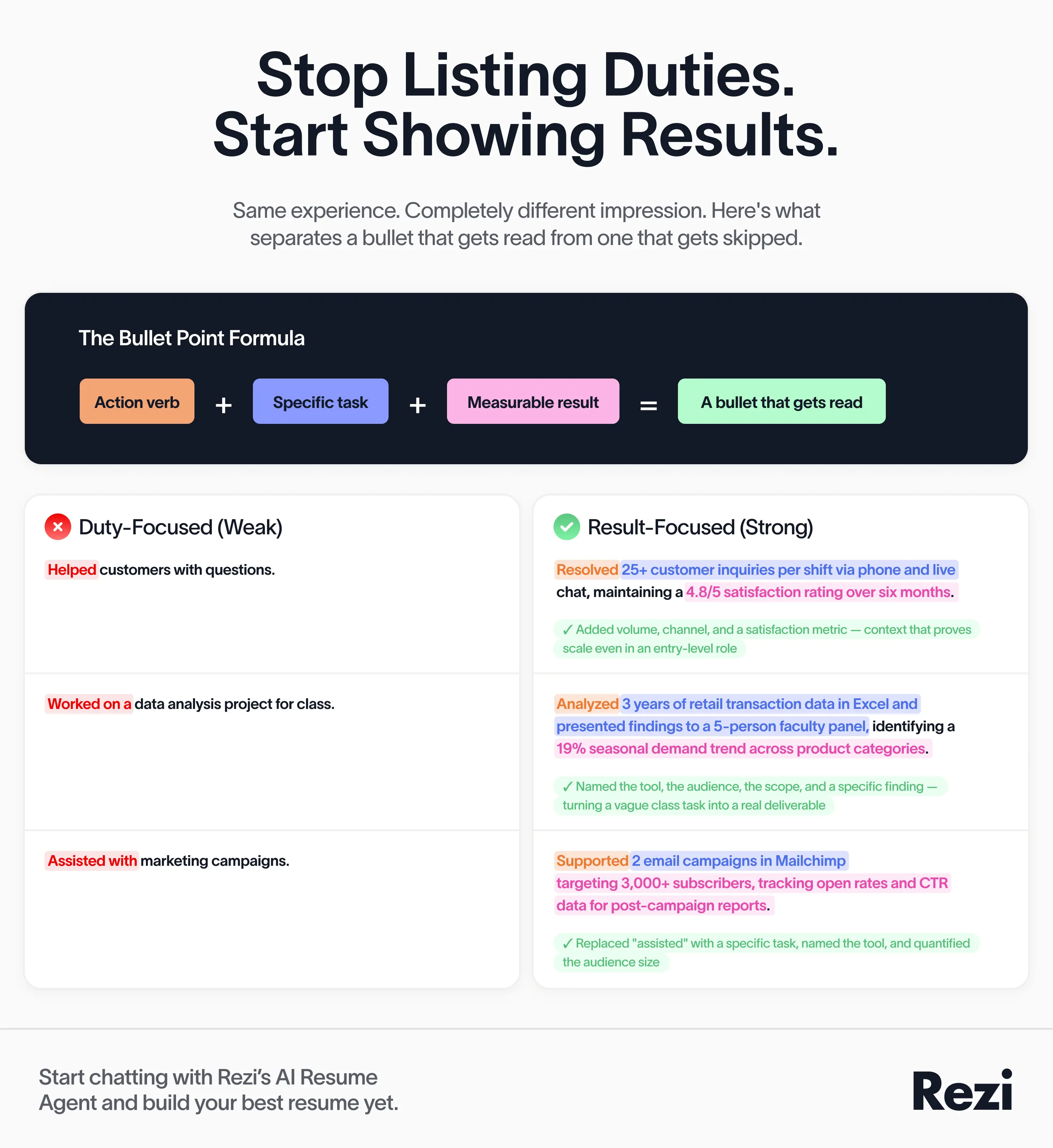
The most common mistake: listing responsibilities instead of results. "Assisted with social media content" describes a task. "Wrote and scheduled 20+ posts per week across Instagram and LinkedIn, contributing to a 14% increase in engagement over three months" describes a contribution with scale and outcome.
The bullet formula
[Action verb] + [specific task or responsibility] + [measurable result or context]
This works even when your numbers are modest. Context is enough when metrics aren't available: team size, project duration, tools used, volume handled.
Weak vs. strong bullet examples:
- Weak: "Helped customers with questions"
- Strong: "Resolved 25+ customer inquiries per shift via phone and live chat, maintaining a 4.8/5 satisfaction rating over six months"
- Weak: "Worked on data analysis project for class"
- Strong: "Analyzed three years of retail transaction data in Excel and presented findings to a five-person faculty panel, identifying a 19% seasonal demand trend across product categories"
- Weak: "Assisted with marketing campaigns"
- Strong: "Supported two email campaigns in Mailchimp targeting 3,000+ subscribers, tracking open rates and click-through data for post-campaign reports"
Framing coursework and academic projects
If you don't have paid experience, a dedicated Projects section fills the gap. Use the same bullet formula. Include the project name, your role, what you produced, and the result or scope.
Two to three strong project entries beat a long list of vague ones. Only include projects that are directly relevant to the roles you're applying for.
How to optimize your entry-level resume for ATS
ATS doesn't evaluate whether you're a good candidate. It evaluates whether your resume matches the criteria set by the hiring team — primarily keywords and formatting. Here's what that means in practice.
Keywords
Pull keywords directly from the job description. Focus on:
- The job title and common variants (for example, "marketing coordinator," "marketing associate," "marketing specialist")
- Tools and platforms named explicitly in the posting
- Skills listed as required or preferred qualifications
- Industry terminology used repeatedly throughout
Place keywords in your skills section, objective, and bullet points. Distribute them naturally — don't cluster all keywords in one section and leave the rest of the resume thin.
Formatting
ATS reads resumes line by line. Elements that break the parsing process:
- Two-column layouts: ATS reads across the page, not column by column. A two-column resume often produces scrambled output.
- Tables and text boxes: Content inside tables is frequently skipped or misread.
- Graphics, icons, and skill rating bars: These are images. ATS can't read them.
- Headers and footers: Many ATS systems can't parse content in document headers or footers. Never put your contact information there.
Single-column layout, standard section headings (Work Experience, Education, Skills), readable fonts (Arial, Calibri, Helvetica), and consistent date formatting. That's the baseline.
File format
Submit as a PDF unless the application explicitly requests a Word document. PDF preserves your formatting across systems.
The plain-text test
Before submitting, paste your resume text into a plain-text editor (Notepad, TextEdit in plain text mode). If the content makes sense in plain text — no garbled sections, no missing information — it will likely parse correctly in most ATS platforms.
Before submitting any application: Run your resume through Rezi's ATS resume checker and paste in the specific job description you're targeting. It flags hidden formatting issues, identifies missing keywords, and scores your resume's ATS compatibility before you apply — not after a rejection you'll never get feedback on.
Jordan graduated in December 2024 with a communications degree and a design-focused resume he'd spent weeks on. Two columns, a sleek header, and a skills section rendered as a visual chart. He sent it to over 60 applications over two months and got two callbacks.
He ran his resume through an ATS checker. The results were straightforward: the two-column layout was scrambling the parsed output, the skills chart was being read as an image and ignored entirely, and his contact information — placed in a document header — wasn't being detected at all. His resume wasn't reaching anyone.
He rebuilt it on a single-column template, moved contact info to the body of the document, and converted the skills chart to plain text. His callback rate improved meaningfully in the following two weeks of applying.
Common entry-level resume mistakes
These are the patterns that show up most consistently in entry-level resumes that don't generate responses.
Listing duties instead of achievements. Describing what your job involved is not the same as showing what you contributed. Every recruiter already knows what a customer service rep or marketing intern does. What you did specifically, at what scale, with what outcome — that's what they're looking for.
Using a visually complex template. Design-heavy templates with two columns, skill bars, and icons look impressive. Many of them fail ATS. If your template came from a design platform or was chosen for how it looks, verify it's actually ATS-compatible before building a resume on it.
Writing a vague objective. "Seeking a position that allows me to develop my skills" is not an objective — it's space filler. An objective that doesn't name a role, a credential, or a differentiator is doing nothing for you.
Submitting the same resume to every job. A resume built for a data analyst role and one built for a marketing coordinator role should look different. The section emphasis, keyword choices, and framing of your experience should shift based on the job description. This doesn't mean rewriting from scratch — it means tailoring the skills section, tweaking the objective, and adjusting bullet points to match what each role asks for.
No measurable results anywhere. Even part-time and volunteer roles have scope and scale. If you handled money, managed schedules, served a volume of customers, completed a project — include the numbers. "Served customers" is weak. "Served 80+ customers per shift" is specific.
One page only. For any candidate with fewer than five years of experience, keep your resume to one page. Recruiters expect it, and a two-page entry-level resume signals poor editing judgment before anyone reads a word.
Final checklist before you submit
Use this before every application:
- [ ] Single-column layout with no tables, graphics, skill bars, or two-column formatting
- [ ] Contact information is in the document body (not a header or footer)
- [ ] Resume objective names a specific role and includes at least one credential or differentiator
- [ ] Skills section mirrors language from the job description
- [ ] All bullets start with a strong action verb
- [ ] Bullets follow the [verb] + [task] + [result/context] structure
- [ ] At least two bullets include measurable numbers or quantified scope
- [ ] Education section includes GPA (if 3.5 or above) and relevant coursework
- [ ] One page total
- [ ] Saved as a PDF
- [ ] Passed the plain-text test (pasted into a text editor to check parsing)
- [ ] ATS compatibility checked against the specific job description
FAQ
What should I put on an entry-level resume if I have no work experience?
Use your education, relevant coursework, academic projects, volunteer work, extracurricular activities, and any freelance or personal projects. Frame all of them using the [verb] + [task] + [result] bullet structure. The goal is to show what you've actually done and produced, not just what roles you held. Most entry-level candidates have more relevant material than they realize — the issue is usually how it's framed, not whether it exists.
Should I use a resume objective or a resume summary at the entry level?
Use a resume objective. A resume summary is written for candidates who have enough experience to summarize — typically two or more years in a relevant field. An objective is appropriate when you're starting out: it tells the employer what you're targeting and what you're bringing, rather than summarizing a work history that doesn't exist yet. The key is writing a specific objective, not a generic one.
How long should an entry-level resume be?
One page. For candidates with fewer than five years of experience, a one-page resume is the standard expectation. If your resume is running long, cut anything that isn't directly relevant to the roles you're applying for. A one-page resume that's dense with relevant content is better than two pages of padded history.
What format should I use for an entry-level resume?
A reverse-chronological, single-column format. This means your most recent experience appears first under each section. Single-column layouts parse correctly in ATS and are easy for recruiters to scan. Avoid functional or skills-based resume formats — they're generally less trusted by hiring teams and can flag candidates as trying to hide limited experience.
How do I know if my resume will pass ATS?
The most reliable approach is to run it through an ATS checker before you apply. Rezi's ATS resume checker lets you paste in the job description alongside your resume and scores compatibility based on keywords, formatting, and structure. It flags specific issues rather than giving you a generic score — which is the difference between knowing something is wrong and knowing what to fix.
Building your first resume is a process, not a one-time event. Most entry-level candidates improve their resume several times before they find a version that converts. The fastest way to close the gap between where you are and where you want to be is to understand what's actually blocking you — usually format or keyword mismatch — and fix it before the next application.
Rezi's free plan lets you build, check, and download a complete resume at no cost. For a walkthrough of how to use Rezi's tools specifically for student and graduate job applications, see how to use Rezi for student and graduate applications.

Upload or drop your resume to get started
Upload your resume to get started
Score my resume

Jacob is the founder and CEO of Rezi. He has been sharing his unique insights on solving the resume since 2015, helping millions around the world land their dream jobs. Lately, Jacob finds himself giving a ton of speeches on topics related to global employment and building startups.

.jpeg)