Resume
How to Use Rezi for Student and Graduate Job Applications
Learn how to use Rezi for students and graduates to create standout resumes, tailored cover letters, and practice interviews.

Published on
September 11, 2025
Updated on
March 16, 2026
You’ve applied to hundreds of jobs. Silence. I’ve been in your shoes, and it’s discouraging, to say the least. But a lot of this isn’t about you. Employers are often looking for experience and skills that recent graduates are still building, and with shifting industries and economic uncertainty, breaking into the workforce isn’t exactly easy.
Understanding these challenges is the first step to overcoming them. And with the right tools, you can make a strong first impression — starting with your resume.
Rezi cuts all the fluff and fancy templates to give you the best shot at landing an interview. Our free AI Resume Builder uses expert technology to generate a tailored resume in minutes.
And it comes with a ton of features to help you stand out. This guide will cover:
- Key facts and statistics about the student and graduate job market.
- The challenges new grads face when looking for work.
- All the Rezi features to help you stand out and get noticed.
You can also check out more expert guidance and resume examples for students:
- Student Resume Examples
- Improve An Entry-Level Resume with Rezi
- I Can’t Find a Job: What to Do When You Can’t Get Hired
- Common Resume Mistakes Among Students & Fresh Grads
Why Students and Graduates Are Finding It Difficult to Get a Job
With economic and political uncertainty keeping companies hesitant to hire, it can feel like your job applications are disappearing into a black hole. On top of that, tech disruption and AI are reshaping roles, while skills-based hiring is making degrees less of a guarantee.
Reading the headlines and seeing these challenges can feel overwhelming. But the more you know, the better you can adapt. With that said, here’s a quick overview of the tangled web that makes up the current job market for students and new graduates.
Economic and political turmoil
Graduates are entering the job market in a shaky economy and an even shakier political landscape. Companies often hire when they’re confident, but right now, uncertainty is holding them back. Sudden tariff changes, shifting tax policies, and general economic volatility make employers cautious about expanding their teams.
And this isn’t just happening in the U.S. The ManpowerGroup Employment Outlook Survey found that economic uncertainty is the top hiring challenge globally. For grads, this could mean fewer open roles, longer hiring timelines, and more competition for entry-level spots.
The jobs are available, but the hiring pace is slower because businesses want a clearer sense of what’s ahead before making big commitments.
Learn more about the challenges for the younger generation: Gen Z Job Market
Evolving tech industry
We’ve all heard about the mass tech layoffs and AI takeovers by now, but how much is clickbait vs. a genuine job market shift? It’s no secret that artificial intelligence is reshaping entire industries, and unfortunately, it’s often the entry-level jobs that get automated first.
According to the Future of Jobs Report, 86% of business leaders expect AI and digital technologies to transform their operations by 2030. Unsurprisingly, students are noticing: the Talent Disrupted report shows that 13% of grads have abandoned plans to work in tech, and nearly half believe AI will reduce jobs in their field.
Here’s a Redditor’s first-hand experience of disappearing graduate tech jobs:
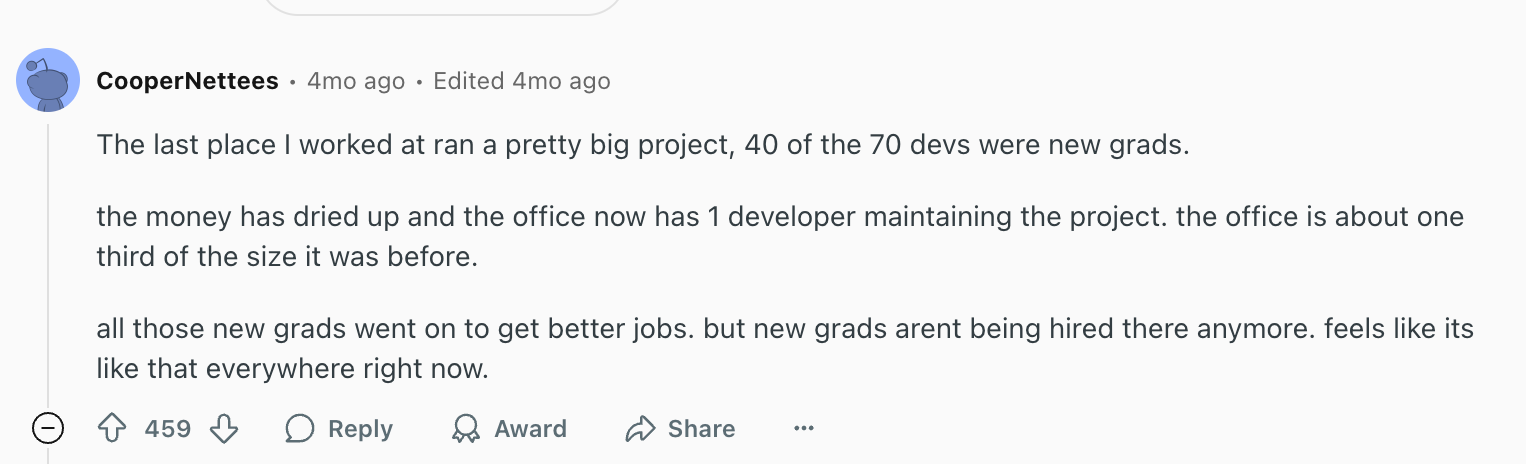
But it’s not all doom and gloom. Tech disruption also creates new opportunities. ManpowerGroup found that 20% of U.S. employers plan to hire more to keep up with advancements, with fast-growing roles tied to AI, robotics, and digital access. The challenge for grads is navigating which tech-driven jobs are disappearing, and which ones are emerging.
Skills-based hiring
Having a bachelor’s degree isn’t the flex it used to be (fact: no employer has ever asked about my not-so-useful History degree). Sure, you’ll still see them in the job requirements, but the focus is shifting to technical abilities and soft skills that you can’t always learn in the classroom.
Indeed found that since 2019, degree requirements have dropped in 87% of job categories, and as of early 2024, fewer than 18% of postings asked for a four-year degree.
More and more companies are prioritizing skills and experience, but many grads struggle to get them without those first “foot in the door” roles. Add AI taking over junior-level tasks, and it creates a catch-22.
The Hiring Benchmark Report highlights this tension: 70% of hiring professionals say there’s a talent shortage, yet grads still face barriers proving themselves. It’s a landscape where skills matter most, but proving them is harder than ever.
Underemployment
If landing a job feels tough, landing one that actually uses your degree can feel even tougher. The Talent Disrupted report found that 52% of graduates are underemployed within a year of finishing school, and even ten years later, nearly half are still in roles that don’t require a degree.
STEM majors tend to do better, but in engineering, more than a quarter of grads are underemployed. The No Country for Young Grads report found that over half of the Class of 2023 were in jobs not requiring a degree a year after graduation. So, the real challenge isn’t only getting a job; it’s getting one that sets you up for long-term growth.
Need some help tackling these challenges? Find out more: How to Get A Job Fast
What Rezi Tools Are Effective for Landing an Entry-Level Job?
Here’s the short version of the top Rezi tools that are helping students and graduates with their job search:
- Find real positions with Rezi Job Search to avoid ghost jobs and focus on active opportunities.
- Take advantage of extra resume sections by adding projects, certifications, and volunteering to stand out from other graduates.
- Find popular requirements with the AI Skill Explorer to uncover in-demand abilities and tailor them to postings.
- Use the AI Bullet Point Writer to make an impact with professional, results-focused language.
- Check your Rezi Score to improve your resume and use the feedback to meet recruiter and ATS standards.
- Show your potential and passion with the AI Cover Letter Builder when you lack experience.
- Gain confidence with AI Interview to practice and prove your skills in conversations.
Now, here’s the full rundown with details on how to take full advantage of Rezi’s features.
1. Find real entry-level positions with Rezi Job Search
As a student or grad, the last thing you need is to come across scammy ads or ghost jobs (fake listings that companies never plan to fill). Rezi’s AI Job Search pulls openings directly from company websites, updated hourly, so you’re only applying to active roles. With filters for skills, roles, and remote work, you can focus on jobs that actually fit your search.
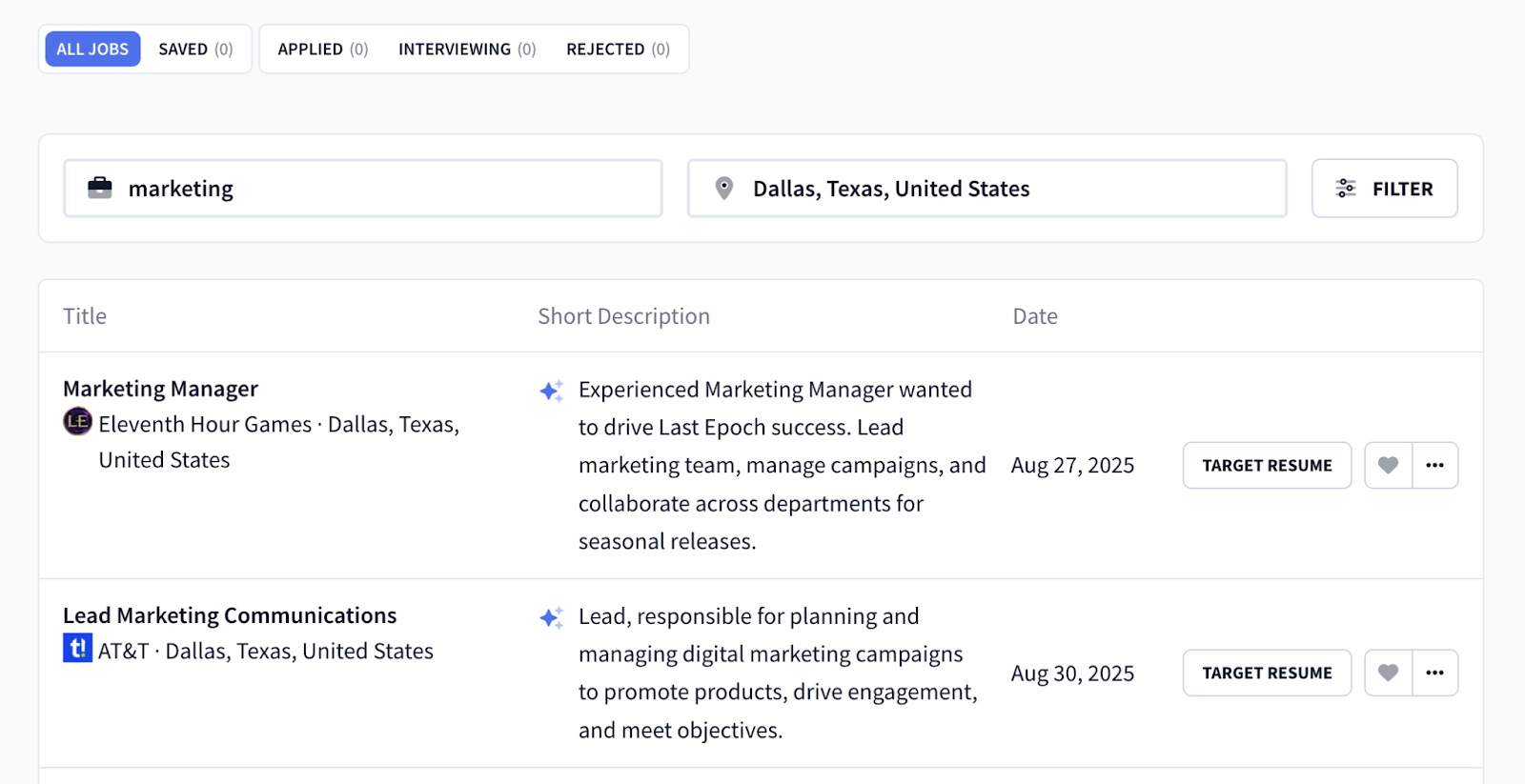
Tips for using Rezi Job Search as a student or graduate:
- Search by entry-level or specific job titles to zero in on the right opportunities.
- Save and track your applications on one dashboard so nothing slips through the cracks.
- Check listings daily; fresh updates mean you’ll spot openings before the competition.
2. Take advantage of extra resume sections to set yourself apart from other graduates
When you’re competing against hundreds of grads with the same degree, it’s the extras that set you apart. Rezi’s customizable resume sections let you add projects, awards, or certifications that highlight why you’re a better match than anyone else.
You can also move sections around to suit your experience level. For example, placing your education section at the top if you don’t yet have much work experience. However, I recommend moving this back under your work history once you spend more time in the workplace.

Here’s what you could include to boost your application:
- Add resume projects, relevant awards, or volunteering to show hands-on learning.
- Highlight certifications (Google Analytics, AWS, etc.) that show off relevant skills.
- Use keywords and skills from the job description to strengthen each section for ATS.
One of your users also told us how useful they found Rezi’s resume tabs:
3. Find popular entry-level skill requirements with AI Skill Explorer
Skills are the new currency of the job market, especially since fewer roles require degrees. Rezi’s AI Skill Explorer helps you uncover in-demand skills and tailor them to the job you’re applying for. This is perfect for grads who may not realize that classwork, part-time jobs, or volunteer experience already result in marketable abilities.
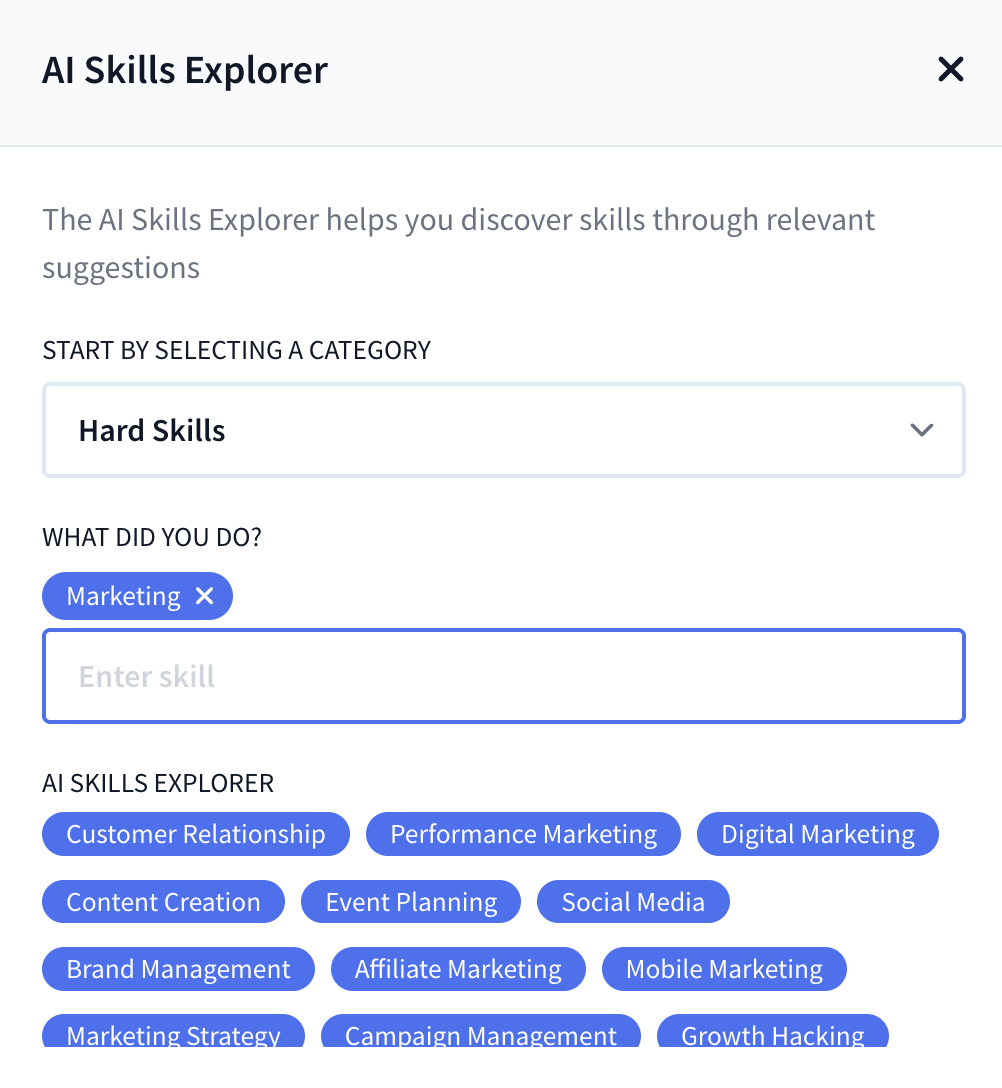
Use these tips when looking for relevant entry-level skills using this tool:
- Enter your current skills to discover hidden or related ones to add.
- Discover tailored skills to match the specific language in each job posting.
- Focus more on hard skills (Excel, Python) for your skills section (you can give examples of your soft skills in your work experience).
4. Use AI Bullet Point Writer to prove your impact in group projects or previous roles
How do you describe your work experience when it’s limited to a summer at Applebee’s? Rezi’s AI Bullet Point Writer takes your internships, part-time jobs, or even a school project and turns them into professional, achievement-focused bullet points. This helps prove you can deliver actual results in real-world environments.
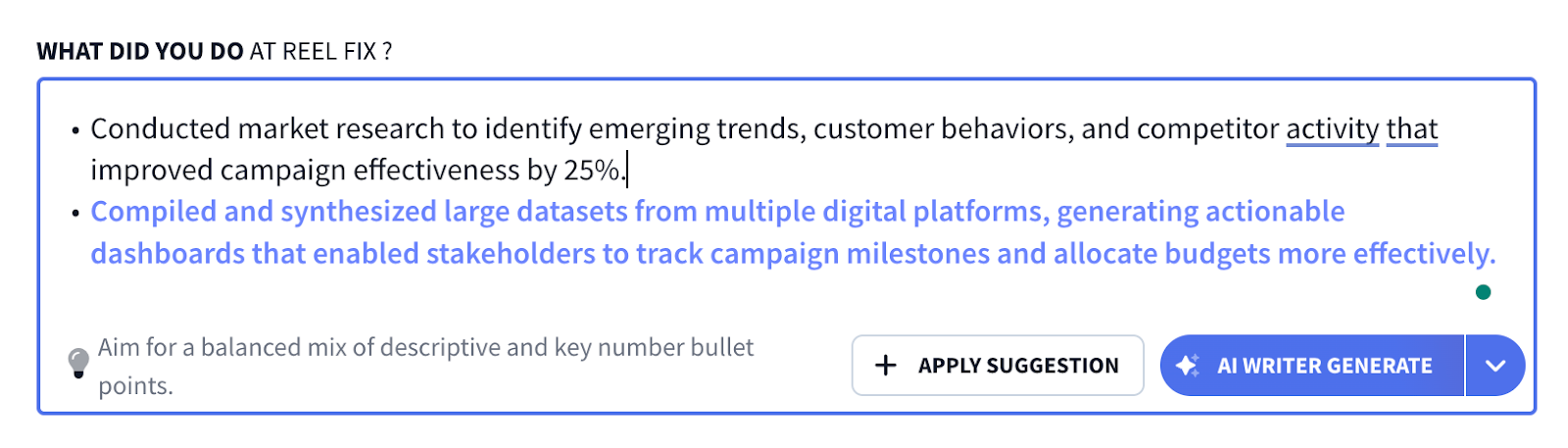
Here's what we suggest when writing resume bullet points that make you stand out, even if you don't meet all target job requirements:
- Translate any experience into results-driven bullets (“Designed X, leading to Y outcome”).
- Include volunteering and leadership roles to show relevant, transferable skills.
- Emphasize skills and examples of problem-solving and teamwork in real-world contexts.
- Keep bullets direct, strong, and measurable whenever possible.
5. Check your Rezi Score to improve your resume
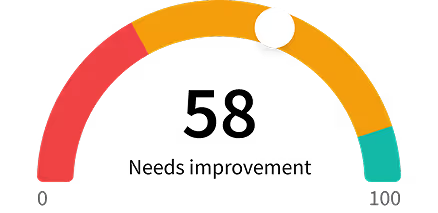
Wondering why you’re not getting any emails back? You could just be unlucky, but it could be your resume. Once you finalize your resume, the Rezi Score gives you clarity by grading your resume (1–100) in real time based on four key categories: Content, Format, Optimization, and Best Practices.
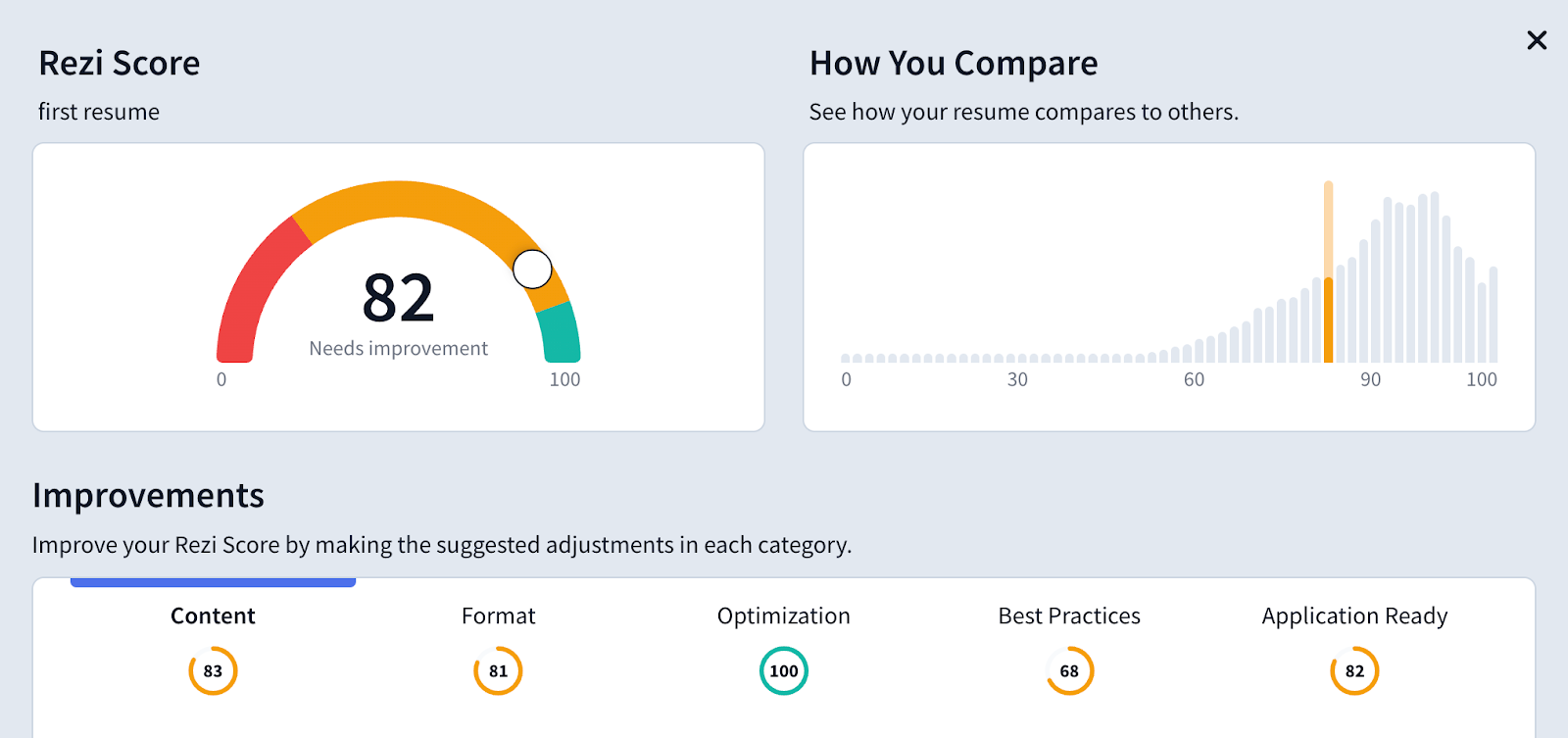
Here’s my advice when checking your Rezi Score:
- Aim for a score above 90 before submitting applications.
- Use feedback from the Real-Time Analysis tool to fine-tune weak sections (keywords, formatting, clarity).
- Update your resume for each job and re-check the score.
Jonah, one of our Rezi users, spoke about how useful he found the Rezi Score:
6. Show your potential with AI Cover Letter Builder
Cover letters can feel daunting when you don’t have years of experience. But Rezi’s AI Cover Letter Writer helps you quickly create a tailored, professional letter that highlights your enthusiasm, transferable skills, and relevant education. Emphasizing your potential and passion can go a long way when you’re new to the workforce.

Here’s how to use the tool and add your personal touches:
- Enter the company and role to generate a tailored draft instantly.
- Highlight part-time work, internships, or clubs that align with the job.
- Use your cover letter to explain gaps or lack of experience with confidence.
- Personalize the letter with details about the company and your enthusiasm for the role to add a human touch.
Want more expert cover letter tips? Look no further:
- How to Format a Cover Letter
- What Should a Cover Letter Include
- How to Write a Cover Letter With No Work Experience
- Best Cover Letters: Examples, Templates, and Writing Tips
7. Gain confidence with AI Interview
Your resume gets you in the door, but the interview seals the deal. Rezi’s AI Interview tool helps you practice tough questions, refine your answers, and build confidence in showing off your skills. Since many employers now focus on skills over credentials, this is your chance to prove you’re ready, even if you’re light on work history.
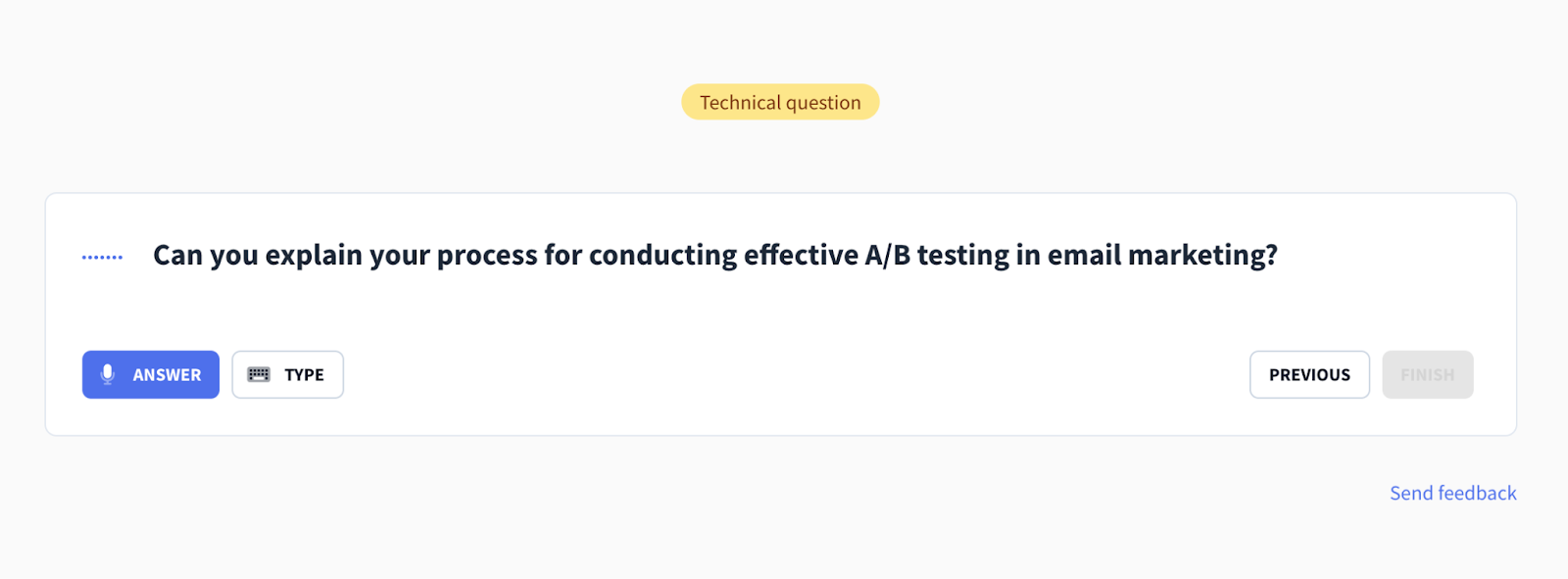
Here’s a quick rundown of how students and graduates can benefit from this feature:
- Practice common entry-level interview questions in a safe environment.
- Get AI feedback on pacing, clarity, and confidence.
- Use examples from projects, internships, or part-time jobs to prove your value.
You can also practice with these common questions and methods:
- STAR Method Interview Guide
- Phone Interview Questions to Prepare For
- Unique Interview Questions to Ask Employers
- Common Interview Questions & Good Sample Answers
How Difficult Is It for Students and Graduates to Get Their First Job?
The current U.S. job market for students and new grads is a mixed picture.
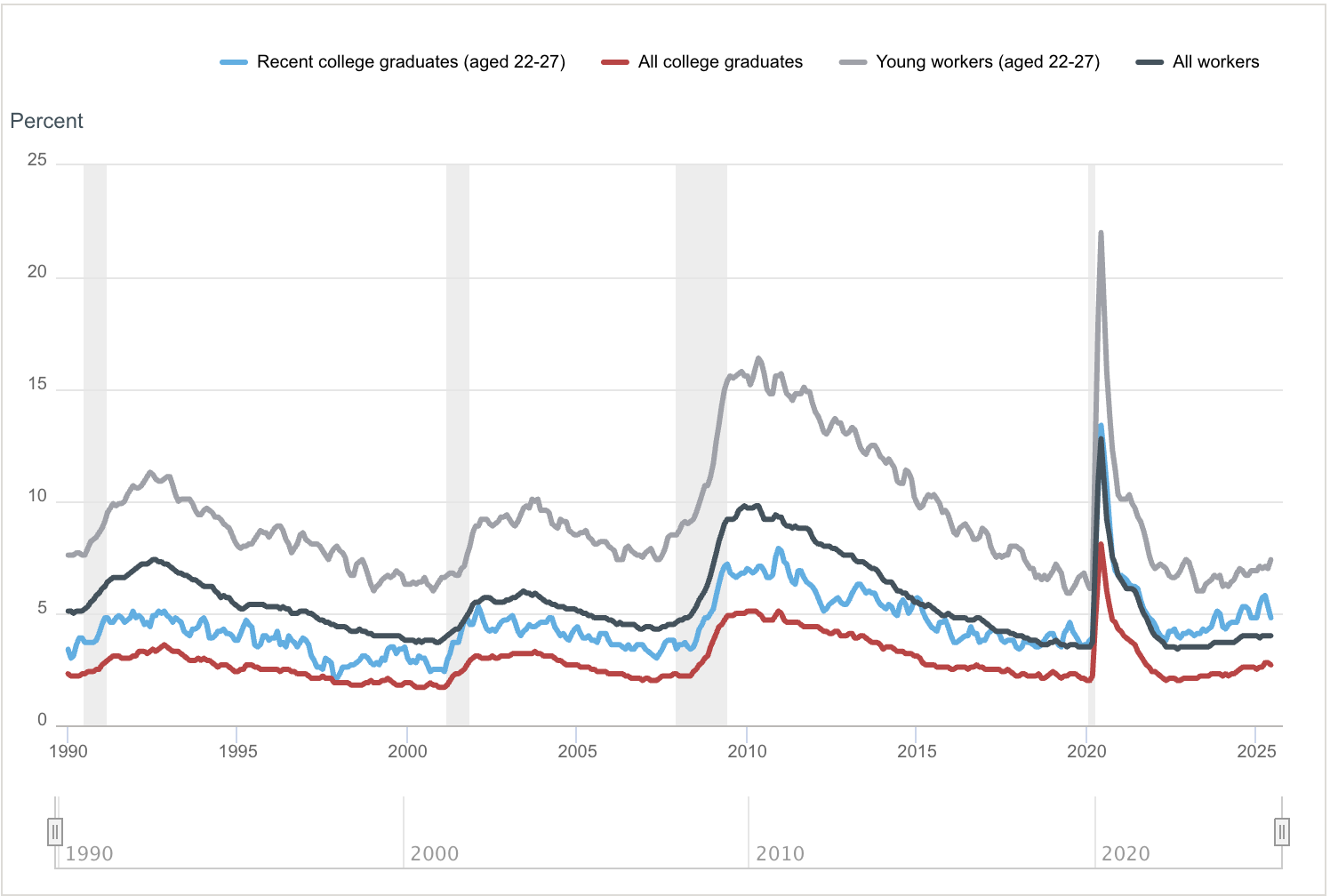
According to the U.S. Bureau of Labor Statistics, those with a bachelor’s or higher have a 2.7% unemployment rate in July 2025, which is steady but still the highest since late 2021. The Federal Reserve Bank of New York reports that unemployment for recent grads dropped to 4.8% in May 2025, an improvement but still higher than in 2022 and most of 2023.
But college students are staying hopeful. A ZipRecruiter survey found that 73% of soon-to-be grads feel their major is useful, and 82% expect to land a job within three months. And it seems they’re right, with 77% joining the workforce in the first few months.
But that doesn’t mean they’re landing the job of their dreams, or even one related to their degree. Underemployment isn’t a new phenomenon, but it’s now extending way beyond those initial entry-level years.
The No Country for Young Grads report highlights some record-breaking shifts:
- The fastest rise in underemployment across majors.
- A decline in entry-level jobs in AI-exposed fields.
- The narrowest gap in employment between degree and non-degree holders in 30 years.
So, where does that leave you? Jobs are out there, but they may take longer to secure, and they might not align exactly with what you pictured. Your degree still matters, but adaptability, skills outside the classroom, and networking are more important than ever.
Final Thoughts
Landing that first job as a student or grad isn’t easy. I’ve been there, and it honestly took years before I found my direction. Nowadays, new graduates are also up against ghost postings, shifting job requirements, and the risk of underemployment. But getting your foot in the door is far from impossible.
While we can’t perform miracles and change the job market, using Rezi can genuinely help with tricky parts of job hunting, such as finding real opportunities, creating a professional resume and cover letter, and practicing for interviews. Our tools will help you stand out in a crowded market and feel more confident in the process.
FAQ
How much does a Rezi resume cost?
Rezi offers both free and paid options. With the free version, you get limited access to advanced features, such as the Rezi Resume Builder, Rezi Score, AI Keyword Targeting, and the AI Resume Summary Writer.
You can get full access to all these features and more for $29 per month (Pro) or a $149 one-time purchase (Lifetime). Additional features include the Rezi Cover Letter Writer, AI Resignation Letter Writer, and access to all our ATS-friendly Rezi templates.
Find out more about Rezi pricing and all the features included in the payment plans.
Can companies detect AI on resumes?
Employers shouldn’t be able to tell if you used AI to write your resume, as long as it looks professional and matches your experience. And even if they can detect AI, what matters most is that you’ve made the effort to personalize your job application and tailor it to the role. What they won’t appreciate is fluff, overused buzzwords, or skills you can’t back up in an interview.
What is a CV vs. a resume?
A resume is your 1–2 page professional story, focused on skills, experience, and education relevant to the job. A CV (curriculum vitae) in the U.S. usually means an academic CV, which is much longer and includes research, publications, and teaching experience. Outside the U.S. (like in the UK and much of Europe) “CV” is basically just what Americans call a resume.
Applying overseas? Find out more:
How to write a resume as a student?
When you don’t have tons of work experience yet, focus on what you do have, such as projects, internships, part-time jobs, volunteering, and leadership roles in clubs. Employers care about your potential from the skills you’ve gained, so highlight popular transferable skills like teamwork, communication, and problem-solving.
If experience is thin, place your education at the top. You should also review the job description and try to align your skills and experiences with the job description to show you meet the expectations of the role. And remember, an organized, simple format can make even a short resume look professional.
How to write a resume for graduate students?
Beyond listing your degree and work history, you can include research projects, internships, notable projects, or any relevant coursework. Employers love to see a practical application of knowledge, so connect your academic work to real-world skills.
If you’ve had internships or part-time roles, highlight them with achievement-focused bullet points in your work history section. The key is to balance your academic strengths with transferable skills to show you’re ready for the professional world.

Upload or drop your resume to get started
Upload your resume to get started
Score my resume

Lauren Bedford is a seasoned writer with a track record of helping thousands of readers find practical solutions over the past five years. She's tackled a range of topics, always striving to simplify complex jargon. At Rezi, Lauren crafts genuine and actionable content that guides readers in creating standout resumes to land their dream jobs.
.webp)