
Resume
How to List Education on a Resume: Best Practices + Examples
What to put in the education section of a resume and how to approach the education section when you didn’t attend university. Plus examples and writing tips.
.webp)
Published on
August 17, 2022
Updated on
August 8, 2025
Here’s how to list education on a resume: add your degree title, name of institution, and the location of the institution by city or state. Optional details for less experienced candidates include GPA (if above 3.5), year of graduation, relevant courses and extracurricular activities, honors, and awards. If your studies are your main achievement, place the education section after your resume summary or objective statement. If you have professional experience, place it after the work experience section.
I’ve looked at tons of resumes—almost all included an education section, with only a few rare exceptions.
To dig deeper, I teamed up with our data team to analyze over 1.6 million resumes built with Rezi. In our analysis, we found that more than 75% included at least a high school diploma.
So yes, your education section still matters. A lot. It’s one of those sections that’s consistently included and expected on a resume.
In this guide, I’ll break down how to list education on your resume no matter what stage you’re at in your career. We’ll cover real examples, edge cases (like unfinished degrees), and practical ways to highlight what you do have without overstating what you don’t.
The Most Common Educational Qualifications From 1,624,279 Resumes
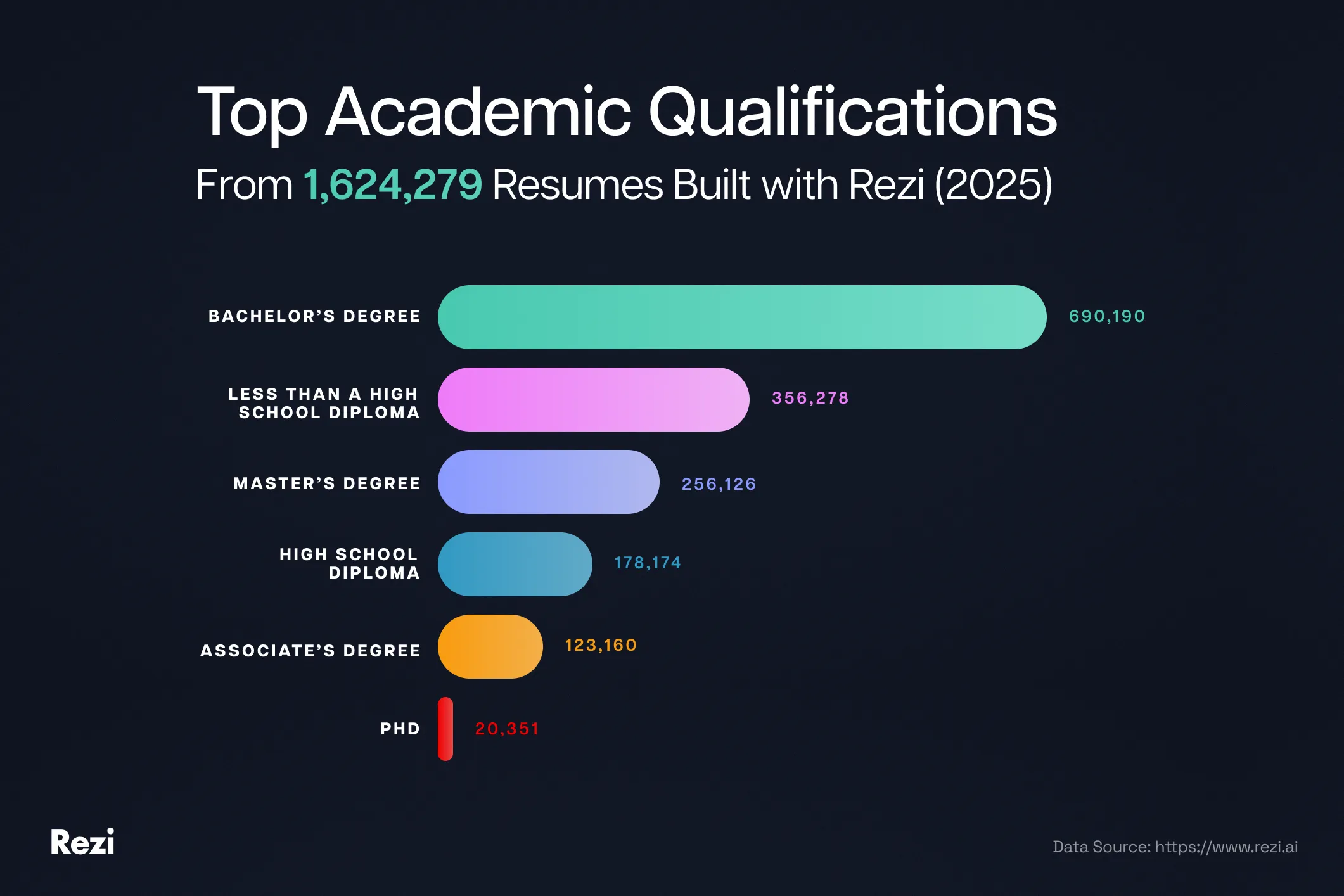
We dug into over 1.6 million resumes built with Rezi to see what real job seekers are actually including in their education sections.
Here’s what we found:
- 42.49% listed a bachelor’s degree.
- 21.93% included less than a high school qualification.
- 15.77% had a master’s degree.
- 10.97% included their high school qualification.
- 7.58% had an associate degree or professional diploma.
- Only 1.25% listed a PhD.
Even if you’re not working toward a traditional academic path, this shows one thing clearly: the education section matters.
From our findings, most resumes include some form of academic qualification or credential.
If you don’t have a university degree, that doesn’t mean you’re at a disadvantage. You just need to be more intentional. Think certifications, self-study, apprenticeships, or standout projects. These all count when framed properly (more on this later).
Where to Place the Education Section on a Resume
Here’s where you can place the education section of a resume:
- Near the top: recent graduates and those with little to no work experience can place the education section right after the summary or objectives section.
- Below your work experience: if you have achievements and duties to showcase from your professional experience, put the education section right after the work experience section. This is the standard place for the education section on a resume.
- Below additional section(s): when your education isn’t as relevant as the additional sections you’ve put on your resume (which should come after the work experience section), you can place the education section right below.
- Leave it out: there are few exceptions, but there are some instances where you can skip the education section (more on this later). That said, *always* include your education section if the job ad explicitly lists a particular degree as a requirement.
Where you put the education section depends on your strengths. Your education could either be the star of the show, or it could be a supporting role.
What to Include in the Resume Education Section
Here are the main details to include in the education section:
- Qualification (e.g., title of your bachelor’s degree)
- Name of institution
- Location (city or state)
Here’s an example of a simple resume education section:

If you’re limited on space, you can add all these details in a single line, like the example below:

Optional details to include in the education section
Here are details that aren’t essential that you could add to the education section:
- GPA (only if you’ve scored above 3.5 and have graduated within the last two years)
- Year of graduation (only when you graduated within the last ten years)
- Relevant coursework, modules, and minors
- Honors and awards
- Specific projects
- Extracurricular activities
See below for an example of a more detailed resume education section:

How to List Education on a Resume
This is how to list education on your resume as an experienced professional:
- Add your highest level of academic qualification using bold text and a slightly larger font size.
- State the institution where you earned your degree or qualification.
- Mention the location of the institution by city or state.
- Include the year of graduation (if your graduation date is within the last ten years).
No further details are needed. Use the education section to mention your degree to prove you’re academically qualified, and then focus on showcasing the impact you made in previous roles.
Although you could go more in-depth on your academic background, it’s more effective to use the space to double down on your professional skills and achievements. Hiring managers are generally more interested in your work history, skills, and measurable results on a resume when you have experience.
Here’s a plain text example of an education section when you have work experience:
B.A. in Marketing
University of California, Los Angeles (UCLA), Los Angeles, CA
June 2024
How to List Education on a Resume When You Have No Work Experience
This is how to list education on your resume when you have little to no work experience:
- Add your highest level of academic qualification.
- State the institution where you earned your degree or qualification.
- Share the location of the institution by city or state.
- Include the year of graduation.
- Specify coursework or modules that demonstrate your level of knowledge in a particular area that’s related to the role.
- Mention projects where you applied relevant skills or knowledge.
- Include any honors, awards, or positive recognition that you received.
- Highlight extracurricular activities where you made key contributions and demonstrated leadership skills.
As someone with little to no experience, expand on the education section by sharing notable accomplishments during your time as a student. Show potential employers how your academic experience translates into real-world abilities.
Your degree is one thing, but showcasing what you achieved while earning it can make a difference.
Here’s a plain text example of an education section when you have no experience:
B.A. in English Literature
University College London, London, UK
June 2024
• Relevant Coursework: Creative Writing, Digital Publishing, Modern British Fiction
• Honors: Graduated with First-Class Honors, Dean’s List (2022)
• Developed a short story collection as part of a final-year project, focusing on themes of cultural identity and modern society.
• Editor-in-Chief of the university’s student newspaper, leading a team of 10 contributors and publishing monthly issues. Organized and hosted a university-wide writing competition.
How to Format the Education Section of a Resume
Here’s the standard way to format the education section:
- List degrees or qualifications in reverse chronological order. Start with your most recent and advanced qualification first.
- If you’re still in college, list your college degree with an expected graduating date. Include your high school as the highest level of completed education.
- If you have completed college education, skip your high school.
- If you have master’s and bachelor’s degrees, include both.
- If you have a PhD, include your PhD and your master’s degree, skip your bachelor’s degree.
- Have a clear heading. Title the section “Education” and slightly increase the resume font size for readability.
- Bold qualification titles. Add your degree or qualification title in bold text so that it stands out.
- Keep it concise. Focus on the essentials—degree, institution, and location. Only include extra details like honors or relevant coursework if they add value.
- Be space-efficient. Include key information using minimal space for more room to highlight your professional background.
However, you may want to format the education section a bit differently depending on your situation:
- If you’re still in college, list your college degree with an expected graduating date. Include your high school as the highest level of completed education.
- If you have completed college education, skip your high school.
- If you have master’s and bachelor’s degrees, include both.
- If you have a PhD, include your PhD and your master’s degree, skip your bachelor’s degree.
Formatting the education section is about presenting your academic qualifications clearly and professionally.
However, there are scenarios that make formatting a resume, particularly the education section, tricky. Below, I’ll walk you through these scenarios and share how to tailor your education section based on your situation.
Having multiple degrees and academic qualifications
If you have multiple qualifications, add each degree or qualification as a separate entry in reverse chronological order.
You can include more than one entry when the qualifications you’re showcasing are relevant to the field you’re applying for. If not, prioritize your highest level of education.

Mentioning an unfinished degree
If you have an unfinished degree, it means you’re in one of two situations:
- Incomplete: you didn’t complete your degree, and you don’t intend to. The solution is to use the education section to mention a relevant coursework or module completed during your studies before you left.
- Ongoing: this means you’re still working towards completing your degree. In this case, list your degree as usual, but include an expected graduation date.
Incomplete degree on a resume example:

Ongoing degree on a resume example:

Featuring study abroad programs
Mention study abroad programs by either adding a bullet point under the university degree entry in the education section, or create a dedicated section to detail what you did during your time at the study program in full.
For either option, make sure to:
- Provide the program name and institution you attended abroad.
- Add the location (city or state) and duration of the program.
- Mention notable projects or accomplishments (optional).
Here’s an example:

If you want to make the study abroad program stand out, you can create another entry in the education section:
- Add the program name in bold text.
- Include the institution you attended abroad.
- State the location by city or state.
Here’s an example:

Clarifying that you transferred colleges or universities while studying
When listing degrees, there’s no need to mention that you transferred. Just include the institution where you graduated and completed your degree.
Got specific coursework, projects, extracurricular activities, and volunteering experiences from your previous college or university that you want to highlight? Add them in a separate resume section, such as “Involvement” or “Side Projects,” and then mention the institution where you completed those activities.
Including certifications and coursework
You can include certifications and relevant coursework in the education section underneath your degree entry, but only if these were earned or completed during your time as a student at that institution.
Add these horizontally alongside the location and institution name, or list them using bullet points directly below.
If these were earned outside your university or college, you have two options:
- Include them in the skills section. Create a category in the skills section based on what you want to highlight, e.g., “certifications” to list certificates.
- Add a separate resume section. Create a dedicated section, like “Relevant Coursework.”
Including related projects or extracurricular activities
Only include significant projects or extracurricular activities under a degree entry in the education section if they were completed while you were a student at that institution.
To do this, add a bullet point to highlight the project or activity. Summarize your role or achievement in one concise line, such as: “Led a team of 5 students to develop a marketing strategy for a local nonprofit, resulting in a 30% increase in community engagement.”
Alternatively, you can create a separate resume section like “Projects” or “Extracurricular Activities.” For a broader approach, use a title like “Involvement” to group multiple items under one section.
Showcasing noteworthy academic achievements
If you’ve earned notable academic achievements, they deserve a place on your resume to help you stand out.
Here’s how to showcase them effectively:
- Add a bullet point under your degree entry to highlight honors like “Cum Laude” or “Dean’s List,” as well as academic awards or scholarships. You may also add a bullet point to emphasize a specific accomplishment, such as ““Awarded to the top 5% of students in the program.”
- If you have multiple awards and honors, create an additional section titled “Awards and Honors.” Next, list them all in one place by adding the title, granting institution, location, and date of recognition.
Listing Education on a Resume Based on Different Educational Paths
Here are examples of different types of educational paths:
- Traditional path. You went to school, attended university, and graduated with a bachelor’s degree.
- Alternative path. You went to school, but took an alternative academic route by pursuing community college or a program that offers professional qualifications similar or equivalent to a university degree.
- Academic path. This means continuing your education after a bachelor’s degree, such as pursuing a master’s, PhD, or another bachelor’s.
- Apprenticeship route. Instead of going to college or university, you may pursue apprenticeship opportunities at a company where you can learn while gaining work experience.
- Unconventional route. After completing school, you might carve your own path through self-study, freelancing, entrepreneurship, or working different jobs.
Some people may have had more unique academic journeys, and in which case, how you list your education on a resume should reflect that.
If you’re later in your career, you don’t have to list everything, just your most advanced and relevant qualifications can be enough. The most important rule of thumb is to keep it relevant.
Also, don’t stress too much about fitting it all into one page. Two pages are perfectly fine, and even three if you’ve got a compelling story to tell.
Relevant guides:
- Should a Resume Be One Page?
- How Long Should a Resume Be?
- One-Page Resume Examples
- Two-Page Resume Examples
How to list education on a resume when you’ve taken the traditional educational path
If you’ve followed the traditional path—graduating from university with a bachelor’s degree—here’s how to list it on your resume:
- List your highest degree first (e.g., Bachelor of Arts in English).
- Write the full name of the university or college.
- Include the location of the institution by city or state.
- Add the year of graduation (unless you graduated more than ten years ago).
- If you have extra space, mention any relevant honors, distinctions, or accomplishments.
How to list education on a resume when you’ve taken an alternative educational path
If you’ve followed an alternative path—pursuing professional qualifications similar to a university degree or attending a community college—here’s how to list it on your resume:
- List your diploma or professional qualification (e.g., advanced diploma in software engineering).
- Include the name of the institution or organization.
- Mention the location of the institution by the city or state.
- Add the year of completion (unless you graduated more than ten years ago).
- If you have extra space, highlight key courses, projects, or certifications.
How to list education on a resume when you’ve taken the academic career path
If you’ve pursued further education, such as a master’s, PhD, or multiple bachelor’s degrees, here’s how to present your academic credentials on your resume:
- Start with your highest degree (e.g., PhD in Computer Science or Master of Business Administration).
- Write the full name of the university or institution where you earned your degree.
- Mention the location of the institution by city or state.
- Add the year of graduation (unless you graduated more than ten years ago).
- If directly related to the role, mention notable academic awards, research projects, or publications that showcase your expertise.
- Following the steps above equals one education entry. Make another entry for your other university degrees, listing the most advanced qualifications first.
In some cases, you might not need to include all your academic qualifications (usually, it’s fine to skip your bachelor’s degree if you’ve enrolled in a PhD program). Remember to prioritize the details that are most relevant to the job you’re applying for.
Important Note: if you’re applying for a job in academia, you’ll probably need an academic CV rather than a traditional resume.
To add a bit more perspective, here’s one scenario that I came across on Reddit:

In this instance when you’re a recent graduate, have limited experience, and your academic background is your strongest asset, it’s perfectly valid to include all your degrees and place them near the top of your resume right after your summary or objective to make them stand out.
How to list education on a resume when you’ve taken the apprenticeship route
If you’ve completed an apprenticeship program and earned a qualification, here’s how to list it on your resume:
- State the apprenticeship title (e.g., Level 3 Apprenticeship in Engineering).
- Include the company or training provider’s name.
- Mention the location of the organization by city or state.
- Specify the year of completion (unless it goes further back than ten years ago).
- Note key certifications, licenses, or awards during the apprenticeship.
Side Note: you can also add your apprenticeship under the work experience section. Instead of stating the apprenticeship title, simply state your job position and the company name, followed by the dates of employment and location. Next, focus on your professional responsibilities and accomplishments.
How to list education on a resume when you’ve taken the unconventional route
Carved your own path without higher education? You can still build a strong resume. It might look a little different, but that’s not a problem.
If you didn’t attend university or earn any professional diplomas, it can be worth skipping the education section altogether. Instead, focus on showcasing work experience, professional achievements, and the skills you’ve applied through real-world projects.
Additionally, consider replacing the education section with one or more of the following sections:
- Certifications: include professional certificates directly related to the field you’re applying for.
- Licenses: mention any licenses that prove you’re knowledgeable about a particular subject.
- Publications: share where your work has been featured by notable organizations.
- Testimonials: list glowing client reviews to indicate your level of expertise.
Examples of Resume Education Sections for All Career Stages
See below for resume examples with tailored education sections for:
- High school students
- College and university students
- Entry-level professionals
- Mid-level professionals
- Seniors
- Career changers
Resume education section example for high school students

Resume education section example for college and university students

Resume education section example for graduates and entry-level professionals

Resume education section example for mid-level professionals

Resume education section example for seniors

Resume education section for career changers

When to Skip the Education Section of a Resume
Skipping the education section means leaving out formal academic achievements from your resume.
These are the only situations where it might make sense to skip the education section:
- No formal education. If you haven’t attended university or completed any formal academic programs at a recognized institution, focus on your work experience. And instead of an education section, use an alternative section such as “Certifications” or “Licenses.”
- Long-established career. If you have an extensive and successful career history that’s more relevant to the role, and your degree is outdated or less important, you can omit the education section to emphasize your professional track record. However, if the job you’re applying for explicitly requires a certain educational qualification, make sure to include it.
If neither of these applies to you, it’s best to include an education section on your resume, even when your degree isn’t directly related to the field you’re applying for. A degree shows that you’re academically capable for the role upfront.
Example of a resume without an education section for a social media manager

Example of a resume without an education section for a software engineer
-1.png)
Example of a resume without an education section for a creative producer

Summary
Here’s a recap of how to list education on a resume:
- Include your degree title, institution name, and the city or state of the institution.
- Optional details include your GPA (if above 3.5), year of graduation (except if you graduated more than ten years ago), relevant coursework, honors, and awards.
- Place the education section near the top if your academic qualifications are your main highlight, or below the work experience section if you have professional experience.
- Format the section by listing your degrees in reverse chronological order, starting with your highest level of education. Bold the qualification titles to make them stand out.
- When you have multiple degrees or qualifications, prioritize the most relevant ones for the job.
- If you have certifications or significant projects completed during your studies, you can include them under your education entry or create separate sections.
- For ongoing or incomplete degrees, state the expected graduation date or coursework completed.
- Only skip the education section if you have no formal education or a long-established track record that outweighs it.
Now, you have everything you need for an effective resume education section. You also have the blueprint for approaching the education section of a resume when you’ve had a non-traditional academic background.
If you need help building your resume, I’d suggest giving Rezi AI a try. It’s free, and offers all the tools you need to land an interview.
FAQs
What’s the minimum academic level of qualification to put on the education section of a resume?
For most professional roles, a bachelor's degree is typically the minimum requirement. However, some positions may accept equivalent qualifications like a professional diploma. If you're applying for internships or entry-level jobs, a high school diploma can be sufficient, but post-secondary education, such as an associate degree or certificate program, is often becoming more preferred.
How to put ongoing education on a resume?
To list ongoing education on a resume, include the degree you’re pursuing, the name of the institution, location, and your expected graduation date. For example, “Bachelor of Science in Marketing (Expected Graduation: June 2025).” You can also mention any relevant coursework, projects, or extracurricular achievements.
How do I add my master’s degree on my resume?
Adding your master’s degree to your resume is the same process as adding a bachelor’s degree. Simply mention the title of your master’s degree, followed by the name of institution and location. If relevant, you can also include honors, key coursework, or major projects underneath to highlight specific achievements related to the role you're applying for.
How to complete the education section if I have no formal qualifications?
If you have no formal qualifications whatsoever, skip the education section and replace it with a "Certifications" or "Licenses" section. Additionally, you can create a custom section such as “Professional Development” or “Training” to list any related courses or programs you’ve completed (or working towards). Focus on highlighting your skills, practical experience, and any other learning that applies to the job you're applying for.
Should I list all my academic qualifications?
You don’t need to list everything. Include your highest level of education, followed by any qualifications directly related to the job position. Listing every qualification, especially older or less relevant ones, can clutter your resume and distract from your key strengths. The only exception to this is when you have little to no experience. In this case, your academic qualifications can help set you apart.
What to put on the education section of a resume if I’m still in high school?
Include the name of your high school followed by the expected graduation date and any relevant coursework or extracurricular activities. Highlight academic achievements, honors, or projects related to the job you’re applying for. If applicable, mention relevant courses and expected grades to indicate your level of academic knowledge.

Upload or drop your resume to get started
Upload your resume to get started
Score my resume

Astley Cervania is a career writer and editor who has been sharing resume and job search insights for 5+ years. He shapes the direction of the Rezi blog, providing practical answers for important career-related questions and helping hundreds of thousands of people navigate the job market and build resumes that land interviews.