Other Resumes
9+ Media Communications Coordinator Resume Examples & Tips for 2026
Customize any of these resumes in minutes using our free AI-powered resume builder.
“Rezi is super upfront and continues to improve over time. I've recommended Rezi to several of my friends and colleagues. I just love this product so much.”

Ricky M.
Software Engineer
“Rezi is super upfront and continues to improve over time. I've recommended Rezi to several of my friends and colleagues. I just love this product so much.”
Ricky M.
Software Engineer
Helping users land jobs at 1,000+ companies such as














Here's the thing most media communications coordinator resumes get wrong: they read like a list of tasks anyone in a comms department might do. "Drafted press releases. Managed social media accounts. Coordinated events." That's not a resume — that's a job description pulled straight from a careers page.
A media communications coordinator resume that actually lands interviews tells a story about impact. It shows how you shaped narratives, amplified brand visibility, built media relationships, and turned messaging strategies into measurable results — not just that you "assisted with communications."
And this is exactly what you'll learn from this article. Inside, you'll find:
- Examples of 9+ media communications coordinator resumes, covering different specializations and experience levels.
- Insider tips about what really matters to hiring managers filling communications roles.
- A step-by-step guide for building a media communications coordinator resume that gets you in the door.
Sample Media Communications Coordinator Resumes
Take a look at some top-notch sample resumes for media communications coordinators across different specializations and experience levels. Find one that matches your profile and use it as a reference point (or feel free to steal it, just make sure to adjust the wording to reflect your own career journey).
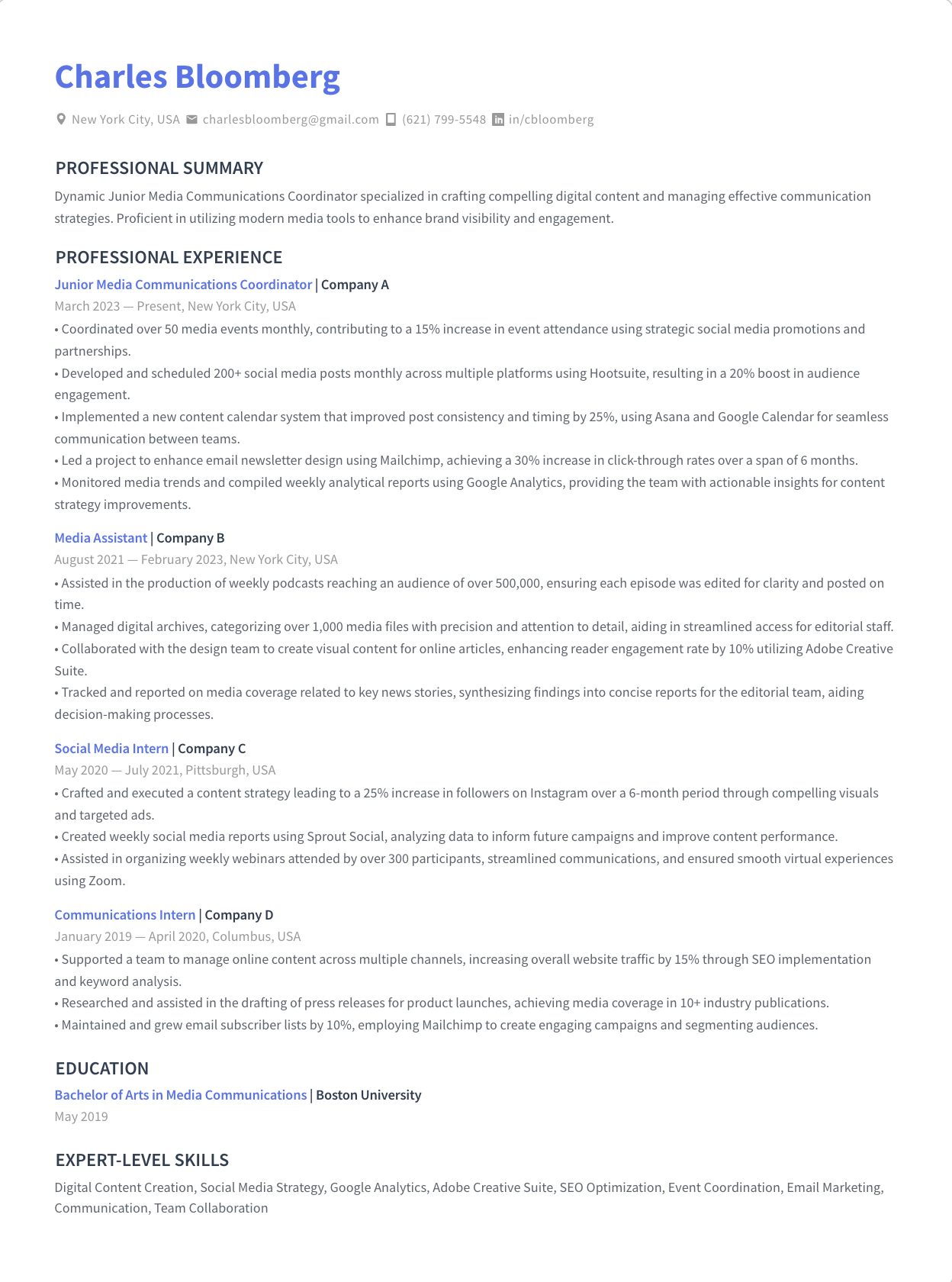
Junior Media Communications Coordinator
A Junior Media Communications Coordinator resume should lead with relevant internships, coursework, and any hands-on media experience — even student publications or campus PR work count. Highlight your writing skills, familiarity with social media platforms, and eagerness to learn. Showcase any measurable wins, like growing a social following or earning media placements during internships. Soft skills like attention to detail and collaboration are essential at this stage.
Mid-Level Media Communications Coordinator
At the mid-level, your resume should demonstrate that you can run communications campaigns independently. Emphasize media placements you've secured, press materials you've developed, and cross-functional projects you've managed. Quantify your results — mention audience reach, engagement rates, or coverage volume. Show proficiency with media monitoring tools and content management systems, and highlight your ability to manage multiple projects and deadlines simultaneously.
Senior Media Communications Coordinator
A Senior Media Communications Coordinator resume should showcase strategic leadership in communications. Highlight your experience developing and executing multi-channel media strategies, mentoring junior staff, and serving as a spokesperson or key media contact. Demonstrate your track record with high-profile campaigns, crisis communications, and executive-level stakeholder management. Include metrics that prove business impact — brand awareness growth, sentiment shifts, or earned media value.
Media Relations Coordinator
For a Media Relations Coordinator, your resume should emphasize relationship-building with journalists, editors, and media outlets. Highlight your press outreach experience, media list management, and ability to pitch stories that earn coverage. Include specific placements in notable publications or broadcasts. Show proficiency with media databases like Cision or Muck Rack, and demonstrate your understanding of news cycles and editorial calendars across print, digital, and broadcast media.
Public Relations and Media Coordinator
A Public Relations and Media Coordinator resume should blend PR strategy with hands-on media coordination. Emphasize experience managing press events, drafting talking points, and supporting reputation management initiatives. Showcase your ability to craft compelling narratives across earned, owned, and paid channels. Include crisis communication experience if applicable, and highlight campaign results such as media impressions, sentiment analysis outcomes, or successful product launches you supported.
Digital Media Communications Coordinator
For a Digital Media Communications Coordinator, your resume should spotlight expertise in digital channels — social media, email campaigns, web content, and digital advertising. Highlight analytics skills, showing how you used data to refine messaging and improve engagement. Include proficiency with tools like Hootsuite, Google Analytics, Sprout Social, or CMS platforms. Showcase content creation skills across formats including video, graphics, and written copy for digital audiences.
Corporate Communications Coordinator
A Corporate Communications Coordinator resume should focus on internal and external corporate messaging. Highlight experience writing executive communications, managing employee newsletters, supporting investor relations materials, or coordinating town halls. Demonstrate your ability to maintain brand consistency across all touchpoints and your understanding of corporate governance and compliance in communications. Showcase collaboration with legal, HR, and leadership teams on sensitive messaging.
Media Outreach Coordinator
For a Media Outreach Coordinator role, your resume should center on proactive engagement with media targets and influencers. Emphasize your track record of building and maintaining media contact databases, crafting personalized pitches, and securing earned media coverage. Highlight event coordination for press conferences or media tours. Show results — number of placements, reach of coverage, or partnerships established with key outlets and content creators.
Strategic Communications Coordinator
A Strategic Communications Coordinator resume should demonstrate your ability to align messaging with organizational goals. Highlight experience developing communication plans, conducting audience research, and measuring campaign effectiveness against KPIs. Show your understanding of integrated communications — how paid, earned, shared, and owned media work together. Include examples of campaigns where your strategic approach delivered measurable outcomes like increased brand awareness or stakeholder engagement.
How to Write a Media Communications Coordinator Resume
Short answer:
Focus on your storytelling ability, media results, and the tools and strategies you used to amplify brand messaging. Create a professional header with your name and contact details. Right below, write a 2–3 sentence resume summary outlining your most impressive communications achievements. Describe your work history in reverse-chronological order, emphasizing media placements, campaigns managed, and measurable outcomes. Then, cover your education including relevant certifications, list key skills, and add extra sections such as a portfolio, publications, or professional memberships.
Include all the necessary sections in the correct order
Here's the correct order of sections for most media communications coordinator resumes:
- Header with contact information
- Resume summary or objective
- Work experience
- Education
- Skills
- Certifications
Depending on your current career situation, you can also throw in some additional sections. For instance:
- Portfolio of media campaigns or writing samples
- Publications or bylined articles
- Volunteer communications work
- Conference presentations or panel participation
- Professional association memberships
Include everything that shows you're capable of doing what the job requires. Make every section count. If it doesn't clearly highlight your communications skills, it doesn't belong on your resume.
If you have less than five years of relevant experience, keep your resume 1-page long. For more senior communications coordinators, a two-page resume is fine.
More details here: What Sections to Include on Your Resume?
Now, I'll give you a high-level overview of how to write each section, going from top to bottom. Well… almost. The only exception is the resume summary section. While it comes right after your contact info, it's actually easier to write it last. More on that in a sec.
Create a professional resume header
- Start with your name and contact information. Include the basics: your full name, phone number, professional email address, location, and LinkedIn profile. A link to your online portfolio or personal website showcasing writing samples and campaign work can add serious credibility.
- Right below your name, clearly state your professional title (e.g., Media Communications Coordinator). This sets expectations and immediately tells the reader what you do.
For more information, see: How to Create a Resume Header
Describe your work history
- Use reverse-chronological order. List your positions starting with the current or the most recent one.
- In each entry, include your job title, company name, location, and dates of employment.
- Below each position, write 3–7 bullet points — the more recent the position, the more bullet points you should include. Describe your responsibilities and, more importantly, your accomplishments.
- Use action verbs and quantify your achievements (e.g., "Secured 45+ media placements in tier-1 outlets over 12 months, increasing brand mentions by 60%").
- If specific communications strategies or tools were pivotal in your roles (e.g., Cision, Meltwater, social media management platforms), weave these details into your descriptions. This will also help you pass ATS scans.
Learn more about the best practices of this section with our detailed guide on how to describe your work experience on a resume.
List your degrees and detail professional learning
- In the education section, list your highest degree first, including the degree type, major, and institution.
- If you have some relevant work experience, include only the name of your school and the degree you got. If you're an entry-level candidate, you can add some more detail to your education section — list relevant coursework, extracurricular activities, and academic achievements.
- If you have communications certifications (e.g., APR, HubSpot Content Marketing), either include them in an "Education and Certifications" section, or create a separate "Certifications" section and place it right below.
For an in-depth guide on how to describe your education on a resume, see: How to List Education on a Resume
List your most relevant skills in the skills section
- Include a mix of technical skills (e.g., media monitoring software, content management systems) and communications competencies (e.g., press release writing, media pitching) that you are proficient in.
- Add in some soft skills such as storytelling, relationship building, and adaptability. These demonstrate your capacity to navigate the fast-moving media landscape.
- You can use two separate subsections, one for hard skills, one for soft skills, or just list all the skills under one heading.
- Match your skills to the description of the job you're applying for. I'm not saying you should just dump all the skills the position requires (especially if you don't really have them), but highlight those areas of expertise where your knowledge overlaps with the job ad.
Need some inspiration to get started? Here are some good skills to feature on your media communications coordinator resume.
Software and tools for media communications resumes:
- Cision
- Meltwater
- Muck Rack
- Hootsuite
- Sprout Social
- Google Analytics
- Canva
- Adobe Creative Suite
- WordPress
- Mailchimp
- Microsoft Office Suite
Communications and media skills:
- Press release writing
- Media pitching
- Social media strategy
- Content creation and copywriting
- Crisis communications
- Media monitoring and analysis
- Brand messaging
- Editorial calendar management
- Event coordination
- SEO and digital marketing fundamentals
Key soft skills for media communications coordinators:
- Written and verbal communication
- Storytelling
- Relationship building
- Attention to detail
- Time management
- Creativity
- Adaptability
- Collaboration
- Problem-solving
- Multitasking under pressure
For a full-blown guide on listing skills on a resume, visit: How to Put Skills on a Resume
Use additional sections as further proof of your fit
Additional sections add depth to your resume and back up your claimed expertise. Good examples of extra sections to add to a media communications coordinator resume are:
- Professional associations. Membership in industry organizations (e.g., PRSA, IABC) can showcase your commitment to the communications field.
- Portfolio or writing samples. A resume section dedicated to significant campaigns or media projects you've led, specifying your role, the strategy, and the outcomes, can provide concrete examples of your expertise in action.
- Publications. If you've contributed bylined articles, blog posts, or op-eds — whether for your organization or industry outlets — definitely list them in a separate section.
- Conference participation. This is ideal to include when you've presented at communications or PR conferences. If you're at the beginning of your career, listing industry events you attended can show you're serious about professional development.
Highlight the most relevant information in a resume summary
Once you're done writing your media communications coordinator resume, give it a full read. Pick the most relevant information and compile it into a summary paragraph. Place it right under the resume header.
- Be brief and to-the-point. In 3–4 sentences, sum up your career highlights, core competencies, and what you bring to the table. Consider this your chance to answer, "Why should you hire me?" Tailor this section to match the employer's needs outlined in the job description.
- Use value-oriented language. Focus on how you can add value to the potential employer, mentioning specific outcomes you've driven — media coverage earned, audience growth achieved, or campaigns successfully launched.
Once you've completed the core sections of your resume, you can use Rezi AI Resume Summary Generator to automatically create a powerful summary, tailored to the job you're applying for. All you need to do is add the position and skills you want to highlight. The AI writer will do the rest.
More information here: How to Write a Job-Winning Resume Summary (with Examples)
For finishing touches, make sure your resume looks professional
- Use a clean and tidy resume format. Ensure your resume is easily readable, with a professional font, consistent formatting, and clear section headings. Avoid overloading it with dense text or fancy design elements that could distract from the content and confuse resume screening software.
- Aim for a balance between detail and conciseness. If you're a junior or entry-level candidate, keep your resume to a single page. Experienced communications coordinators can extend their resumes to two pages, but still need to make sure every word conveys value.
Learn more about proper resume formatting here: How to Format a Resume & What Standard Resume Format to Use
What Makes Media Communications Coordinator Resumes Different
In short: the emphasis on storytelling, media results, and the ability to manage multiple channels and audiences simultaneously.
This is also what many communications coordinators get wrong on their resumes. Hiring managers won't be impressed with a laundry list of routine tasks. They need to see how your messaging moved the needle — that way, they'll be more likely to believe you can do it for them, too.
Your resume itself is a writing sample
Unlike most professions, communications is one where the quality of your resume's writing is itself evidence of your competence. Sloppy phrasing, passive voice, or generic language will immediately raise red flags for a hiring manager who's looking for someone to represent their brand in writing every single day.
What it means for you:
- Treat every bullet point like a piece of published copy. Be concise, use active voice, and choose words with precision. Your resume should read as smoothly as the press releases you'd write on the job.
- Proofread ruthlessly. A typo on a marketing manager's resume is a minor issue. A typo on a communications coordinator's resume is a dealbreaker.
Focus on measurable media outcomes
Quantifying achievements matters in every resume, but in media communications, it's the difference between sounding like someone who "did stuff" and someone who drove real results.
What it means for you:
- Detail your successes with tangible metrics. For example, number of media placements secured, audience reach of earned coverage, social media engagement growth percentages, or email open rate improvements.
- Mention the scope and scale of campaigns you coordinated, including budget sizes, number of channels managed, and the audiences you reached. This gives hiring managers a concrete sense of what you can handle.
Demonstrate channel versatility
Media communications coordinators rarely work in just one channel. You're expected to juggle press outreach, social media, internal comms, content creation, and event coordination — sometimes all in the same week.
What this means for you:
- Show breadth across media channels. Make sure your resume reflects experience with earned, owned, paid, and shared media — not just one area.
- Highlight your ability to adapt messaging across formats and audiences. Writing a press release is very different from crafting an Instagram caption or an internal memo. Show that you understand those differences and can execute across all of them.
Show you understand the media landscape
Hiring managers want to see that you're plugged into the current media environment — not just executing tasks, but understanding why certain tactics work and how the landscape is evolving.
What this means for you:
- Reference specific media strategies, tools, or platforms you've used effectively. Mentioning that you used Meltwater for media monitoring and earned media analysis is far more compelling than simply saying "monitored media coverage."
- If you've navigated a crisis communication situation, managed a brand reputation issue, or adapted strategy based on shifting news cycles, make sure to include those experiences. They signal a higher level of media sophistication.
Highlight relationship-building skills
Media communications is fundamentally a relationship-driven field. Your connections with journalists, influencers, stakeholders, and internal teams are among your most valuable assets.
What this means for you:
- Showcase your media relationship management. Mention the types of outlets and journalists you've worked with, and the results those relationships produced.
- Highlight cross-functional collaboration. Communications coordinators work with marketing, leadership, legal, and creative teams. Show that you can navigate those dynamics effectively.
Bonus Resources for Media Communications Coordinators
This isn't going to be a game-changer for you if you need a resume now. But —
I want you to treat your career holistically. These resources will help you sharpen your communications skills, add substance to your future resumes, and keep you current with the evolving media landscape.
Professional associations and networks
Public Relations Society of America (PRSA)
PRSA is one of the largest professional organizations for communicators, offering the APR certification, professional development events, and a robust network of PR and communications professionals across industries.
International Association of Business Communicators (IABC)
IABC connects communications professionals worldwide, offering certification programs, resources, and events focused on strategic communication, employee engagement, and brand management.
National Press Club
For those interested in media relations and journalism intersections, the National Press Club offers events, networking opportunities, and resources that can deepen your understanding of the media industry from the other side of the pitch.
Online learning platforms
Coursera & edX
Both platforms offer courses in public relations, digital marketing, media studies, and strategic communications — many from top universities. Great for building new skills or filling gaps in your expertise.
LinkedIn Learning
With a focus on professional development, LinkedIn Learning provides courses on media relations, content strategy, social media marketing, and communications software tools, all tailored to help you advance in your career.
HubSpot Academy
HubSpot offers free certifications in content marketing, social media, and email marketing. These are widely recognized and can strengthen both your skill set and your resume's certifications section.
Publications and blogs
PRWeek
A leading publication covering the public relations and communications industry, offering news, analysis, and case studies from top brands and agencies.
PR Daily
An excellent resource for communications professionals, featuring articles on writing, media relations, social media strategy, and crisis communications, with practical tips you can apply immediately.
Spin Sucks
Gini Dietrich's blog and community focus on ethical PR practices, the PESO model (Paid, Earned, Shared, Owned media), and modern communications strategy. It's an invaluable resource for staying sharp on integrated media approaches.
Tools and software reviews
Capterra & G2
Both websites provide extensive reviews and comparisons of PR software, social media management tools, and content management systems, helping you choose the right tools based on features, pricing, and user feedback.
Buffer Blog
Buffer's blog offers practical insights on social media strategy, content creation, and digital engagement — highly relevant for communications coordinators managing social channels as part of their media mix.
Summary
Here's what you need to know about writing a media communications coordinator resume:
- Structure your resume with essential sections in this order: Header, Resume Summary or Objective, Work Experience, Education, Skills, and Certifications. If relevant, add extra sections like a Portfolio, Publications, or Professional Memberships.
- Include a professional header with your name, contact information, and professional title.
- Describe your work history in reverse-chronological order, emphasizing accomplishments with quantifiable media outcomes — placements secured, audience reach, engagement growth.
- In the education section, list your highest degree at the top. You can list communications certifications either in the education section or under a separate heading.
- Highlight a mix of technical tools, communications competencies, and soft skills, tailoring them to the job description.
- Use additional sections to further showcase your expertise and commitment to the communications field.
- Once done writing the resume, compile the key information into a brief, value-oriented resume summary at the top.
- Remember that your resume doubles as a writing sample — make every word count and proofread meticulously.
- Showcase channel versatility, media relationship skills, and measurable campaign results effectively.
Thanks for reading! Got any questions? Feel free to reach out to me on LinkedIn. (Or check out the FAQs first, maybe your question is answered there.)
FAQ
What keywords should I use on my media communications coordinator resume?
Use specific communications terminologies and tool names relevant to your experience, such as media relations, press releases, content strategy, Cision, Meltwater, social media management, crisis communications, and brand messaging. Highlight certifications like APR, HubSpot Content Marketing, or Google Analytics if you possess them. Mirror the language used in the job posting wherever it genuinely reflects your experience.
How do I show results if I wasn't the lead on campaigns?
You don't need to have led a campaign to claim credit for your contributions. Use phrasing like "Contributed to a media campaign that generated 200+ placements" or "Supported crisis communications response that reduced negative coverage by 40%." Be specific about your role — whether you drafted materials, managed the media list, or coordinated logistics — and tie it to the overall outcome.
Should I include a portfolio link on my resume?
Absolutely. Communications is a show-don't-tell field. A link to an online portfolio with writing samples, press releases, campaign summaries, or media coverage examples can dramatically strengthen your candidacy. If you don't have a dedicated portfolio site, even a well-organized Google Drive folder or a Contently profile works.
I have experience in both marketing and communications. How should I position my resume?
Lead with whichever area the job posting emphasizes more. If the role is primarily media-focused, foreground your press relations, media pitching, and earned media experience. Weave in your marketing skills — analytics, content creation, campaign management — as complementary strengths. This shows versatility without diluting your positioning as a communications professional.
Which resume format is best for media communications coordinator resumes?
The reverse-chronological format is your best bet. It highlights your career progression and makes it easy for employers to see how your responsibilities and impact have grown over time. It's also the most ATS-friendly format, which matters when you're applying through online job portals.
I'm transitioning from journalism into a media communications coordinator role. How should I approach my resume?
Your journalism background is actually a significant asset. Emphasize transferable skills like deadline-driven writing, media relationship management, story development, and audience analysis. Reframe your journalism experience in communications terms — "sourcing and pitching" becomes "media outreach," "beat coverage" becomes "industry expertise." Add any PR-adjacent experiences, such as managing a publication's social media or coordinating with communications teams for sources.
How important are certifications for media communications coordinator roles?
They're not always required, but they can give you a meaningful edge — especially if you're early in your career or changing fields. The APR (Accreditation in Public Relations) carries weight in the industry. HubSpot certifications in content marketing or social media are free, widely recognized, and signal that you're proactive about skill development. Google Analytics certification is also valuable for digital-focused roles.

Upload or drop your resume to get started
Upload your resume to get started
Score my resume
Contents
Resume Formats & Examples
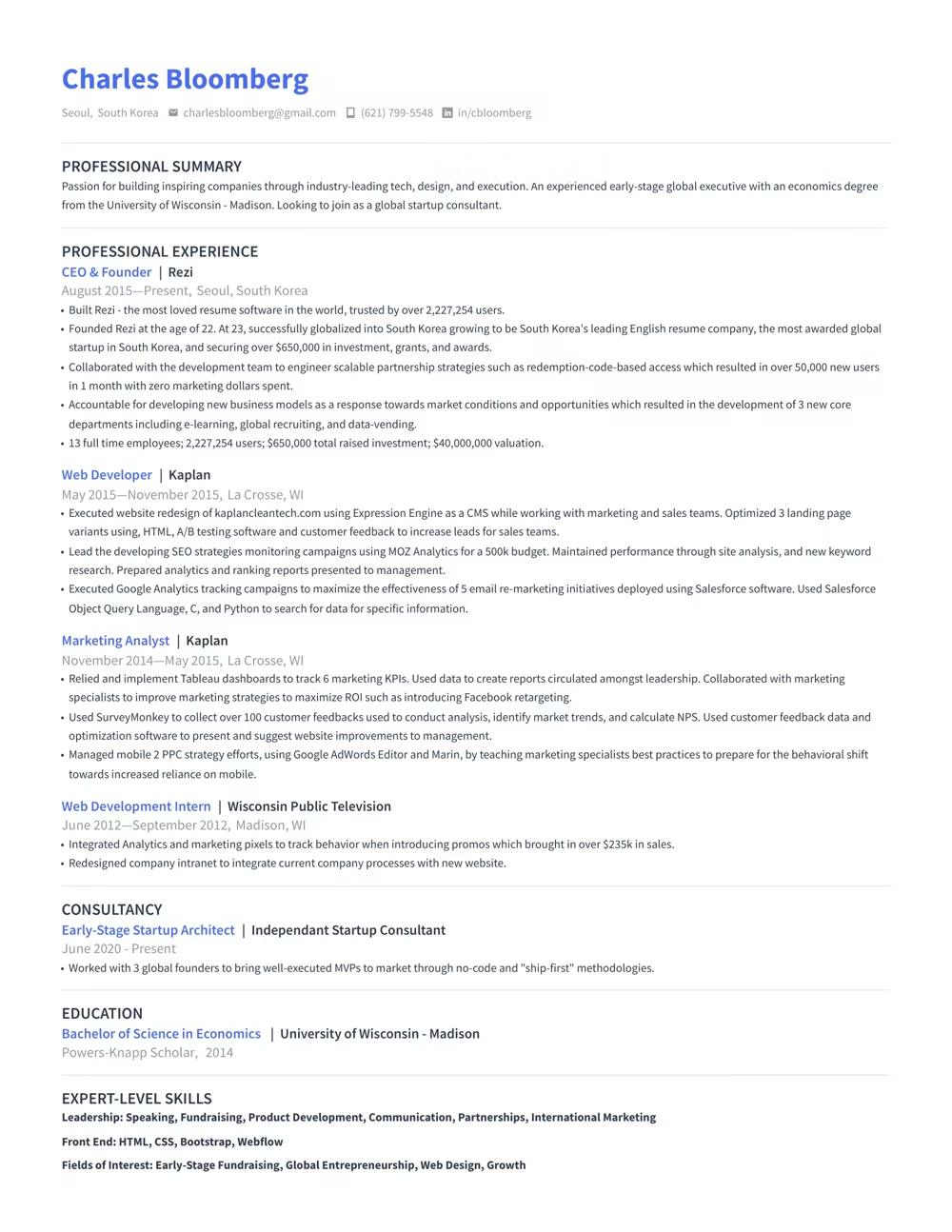
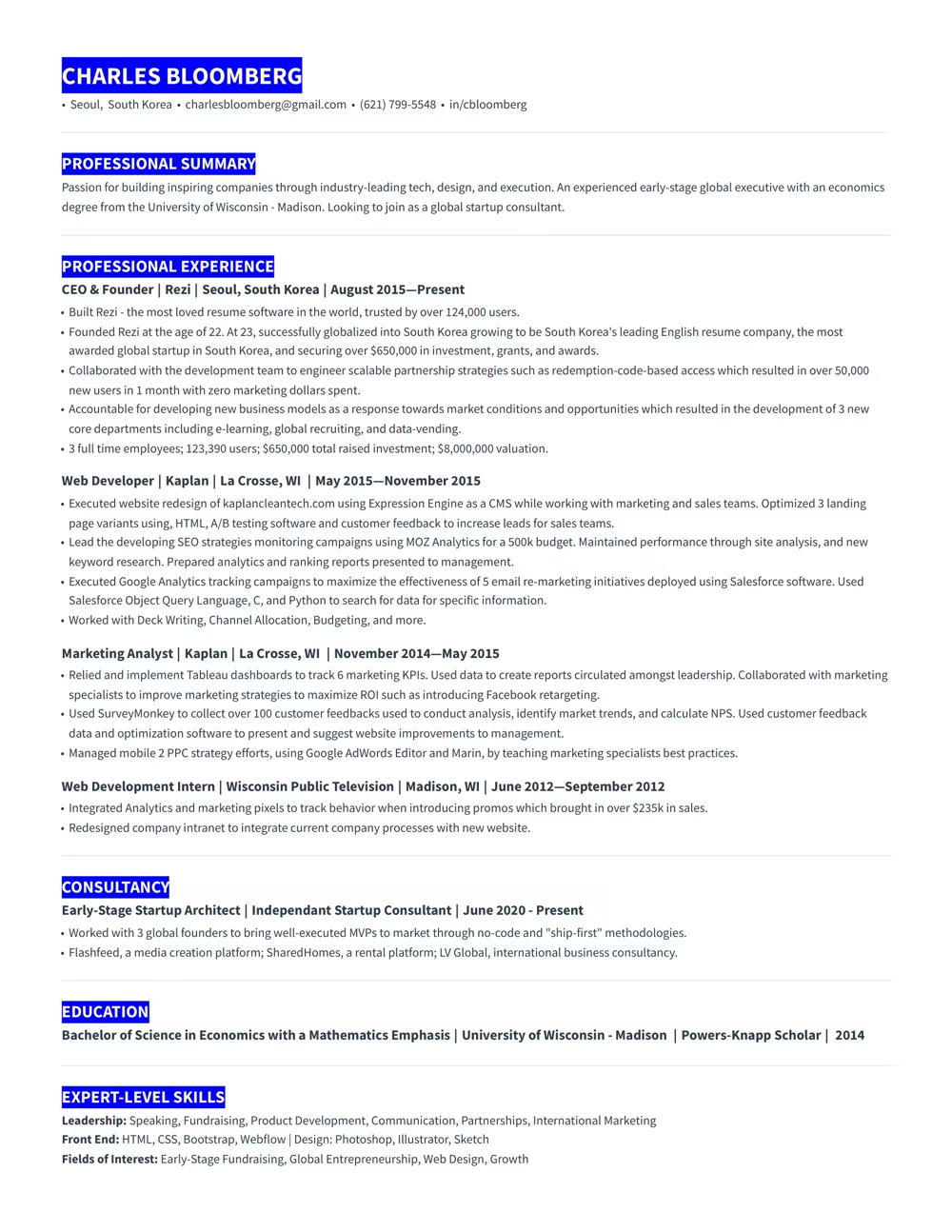
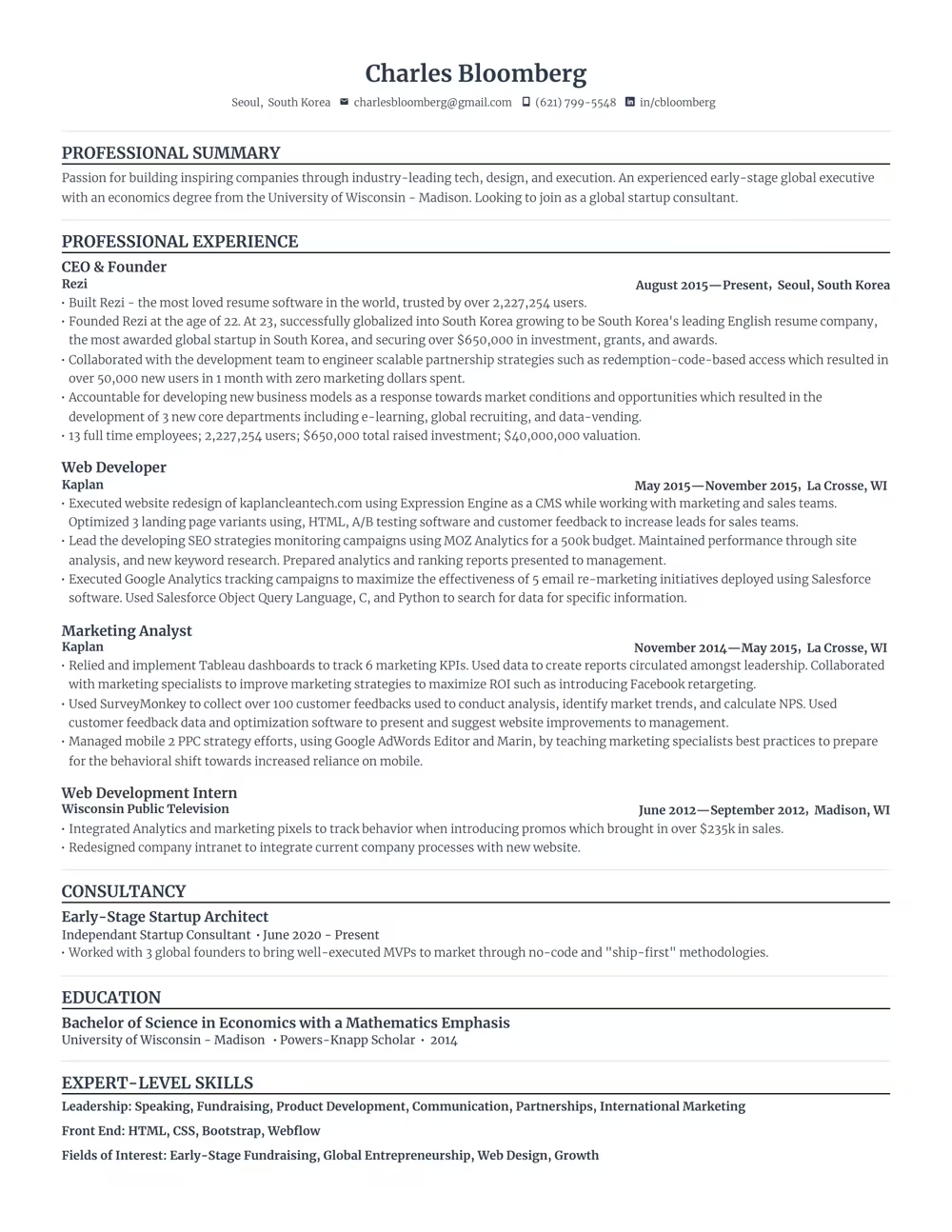
ATS-Friendly resume formats that land jobs
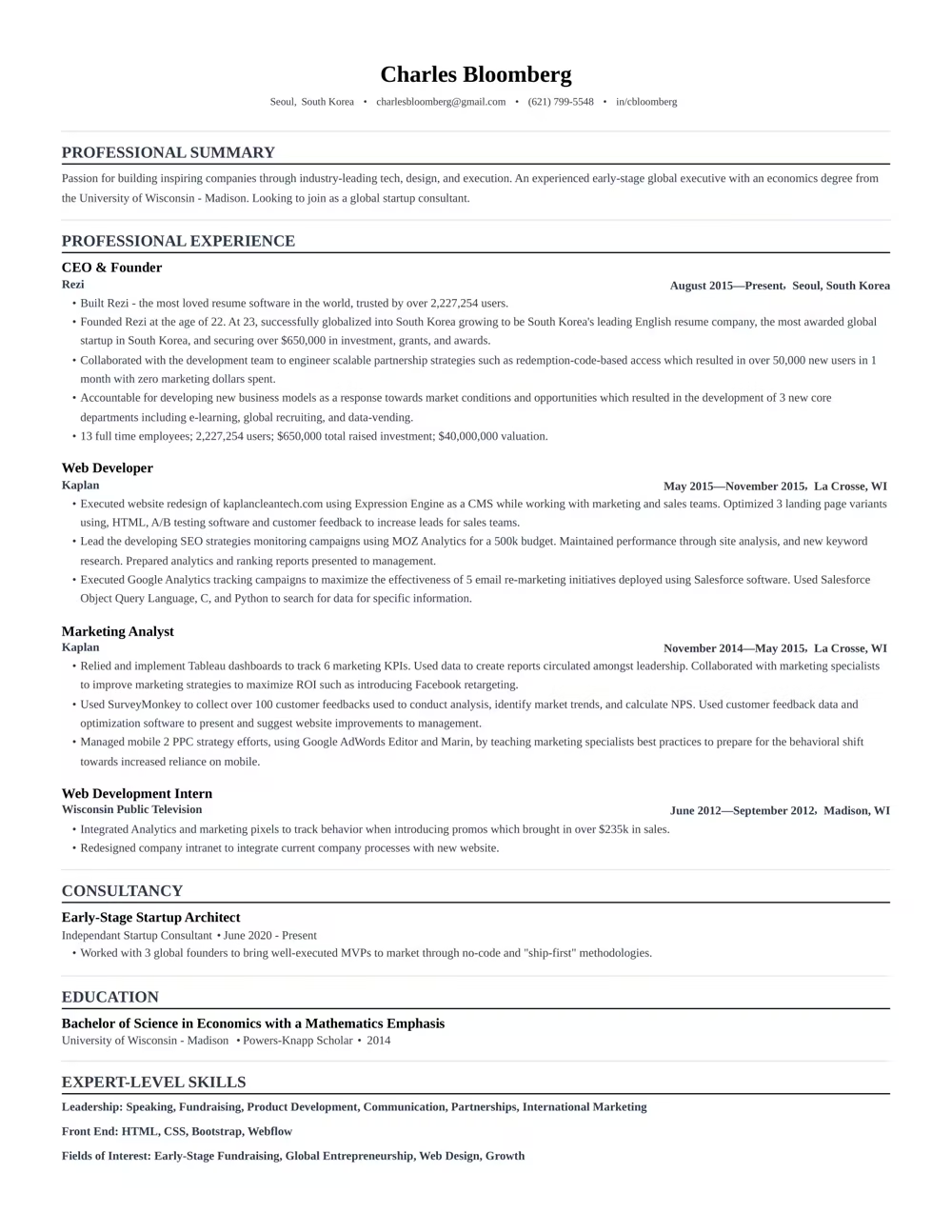
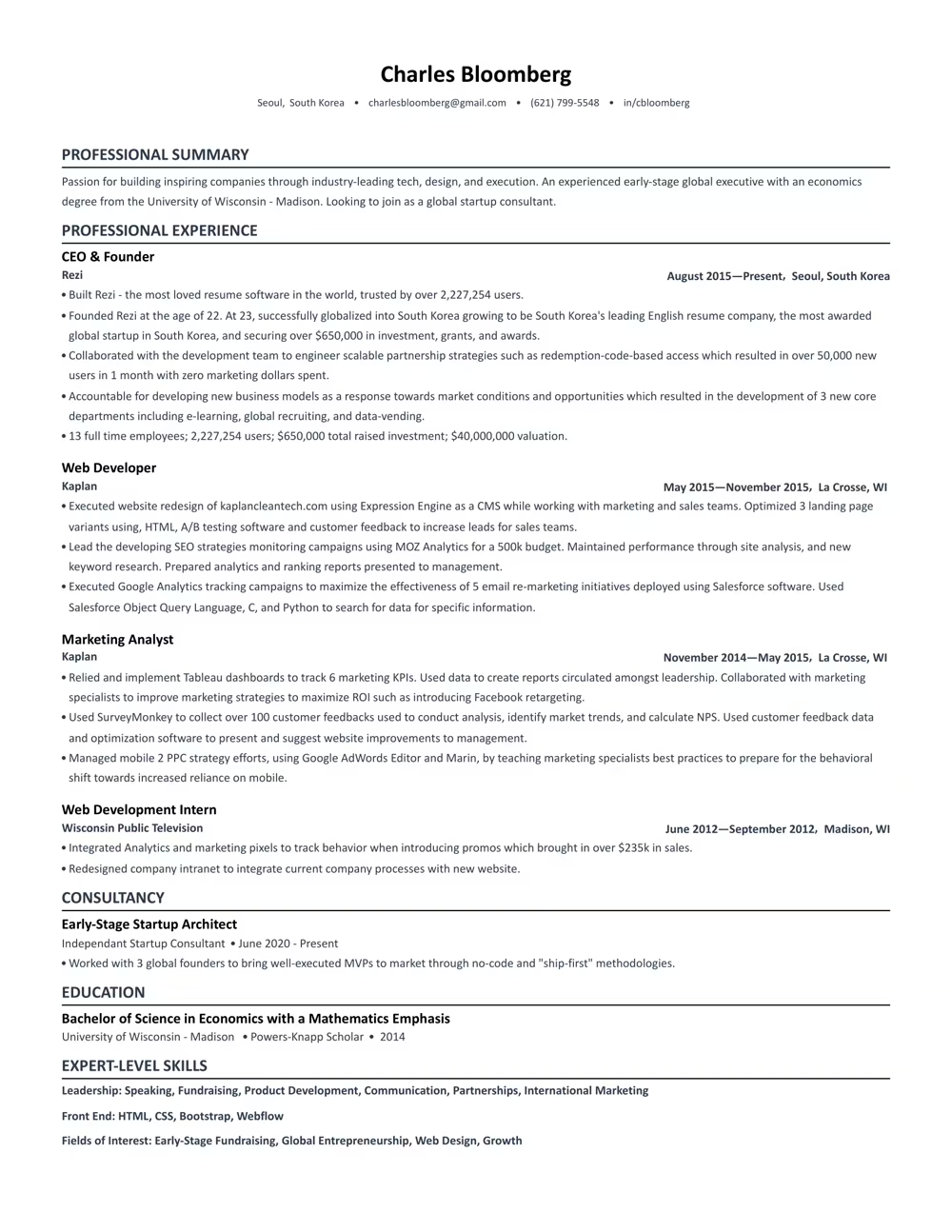
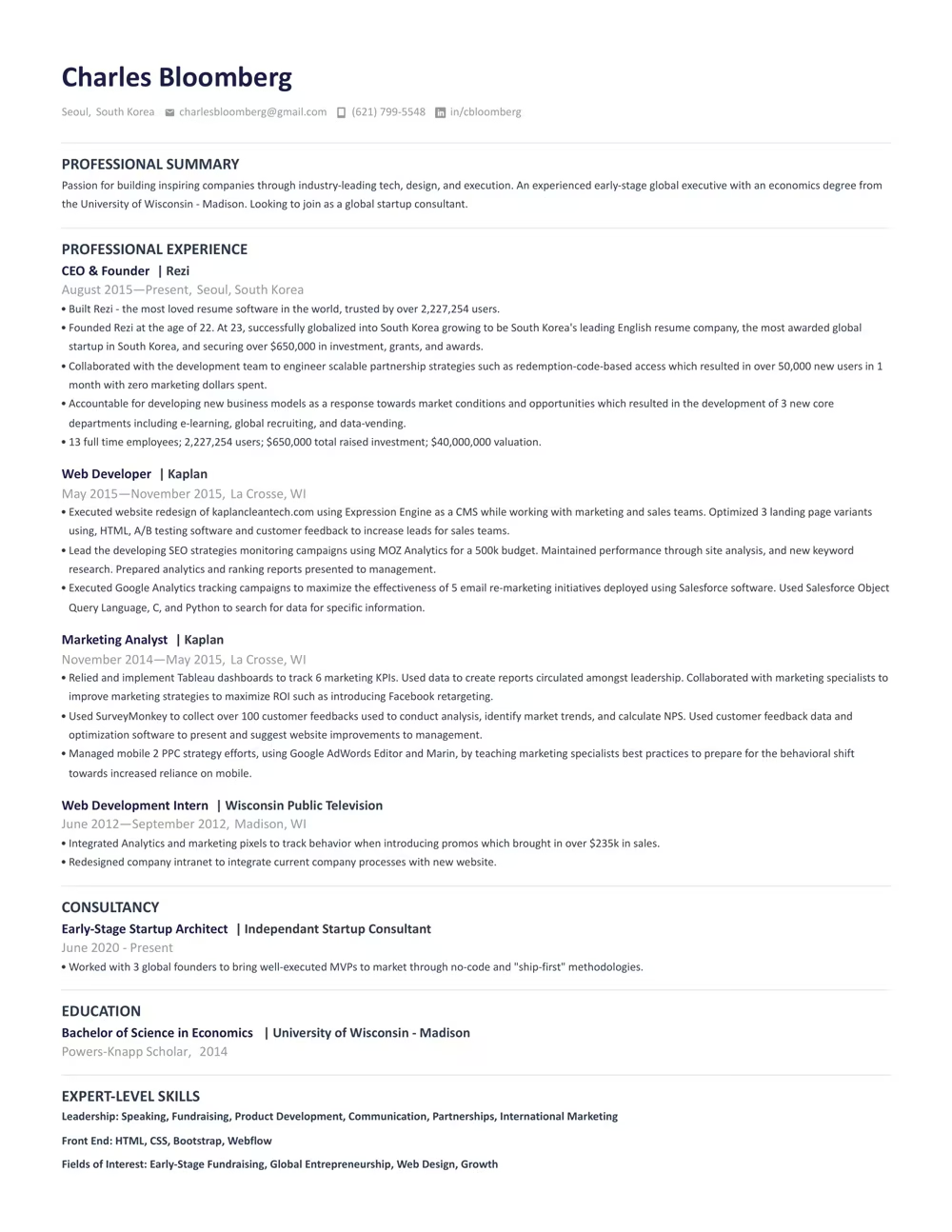
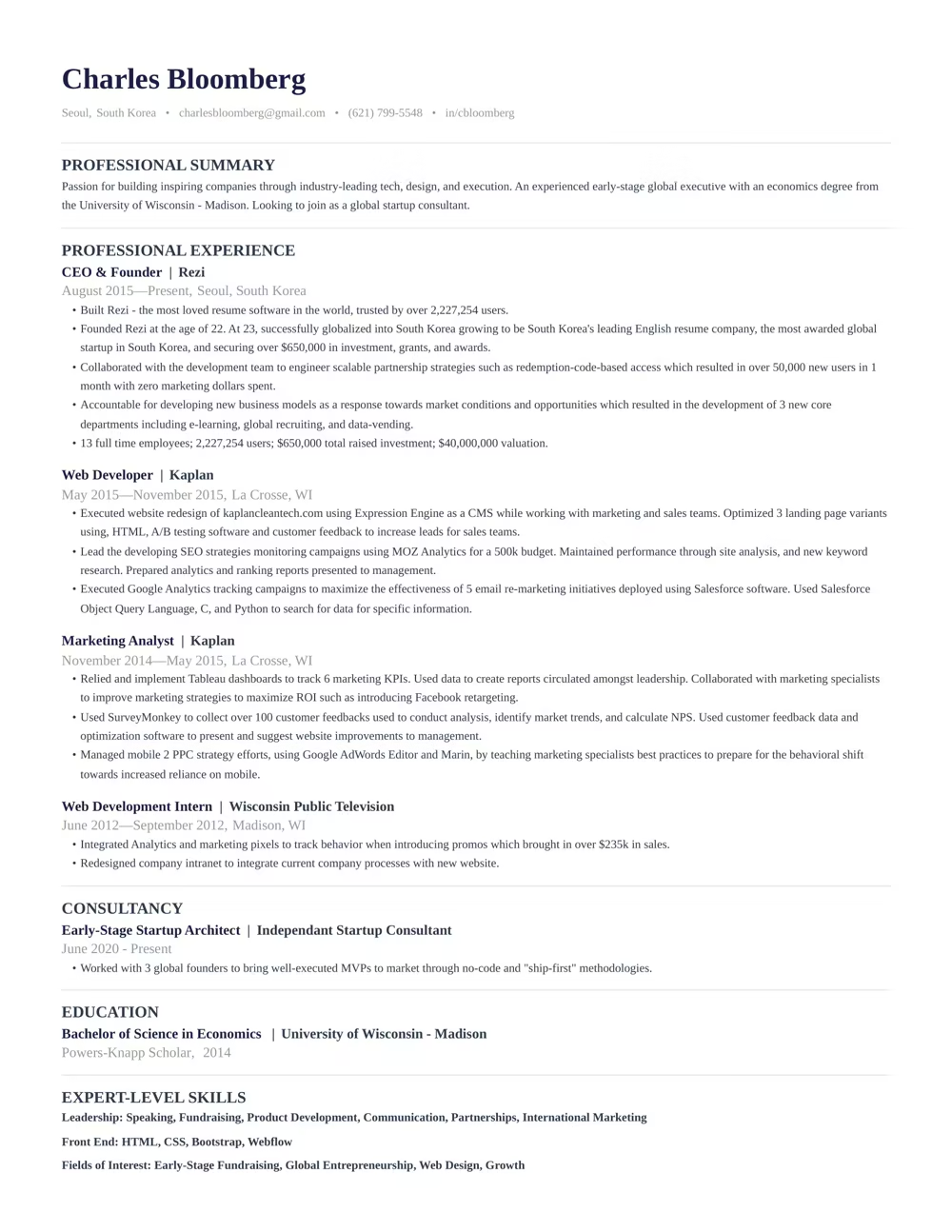
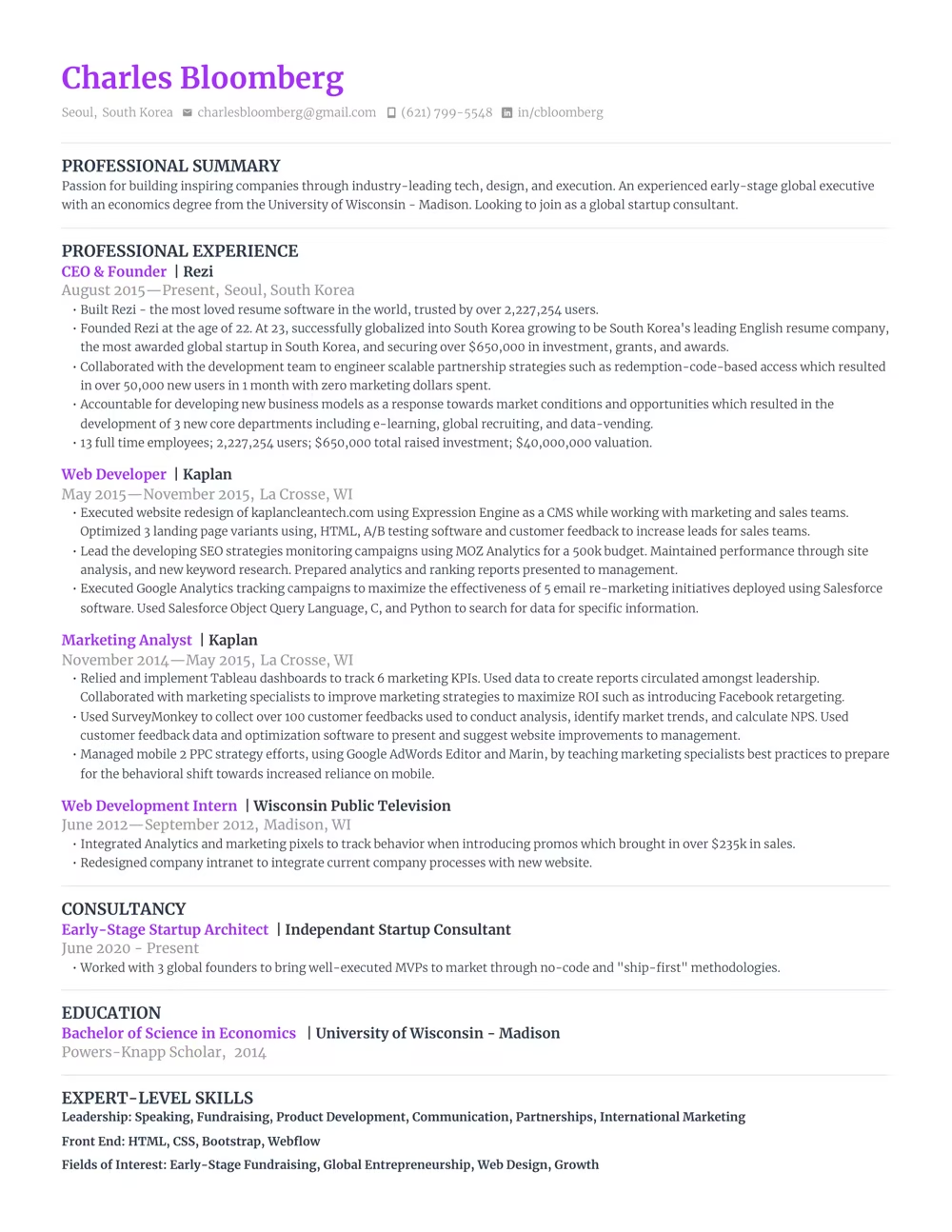
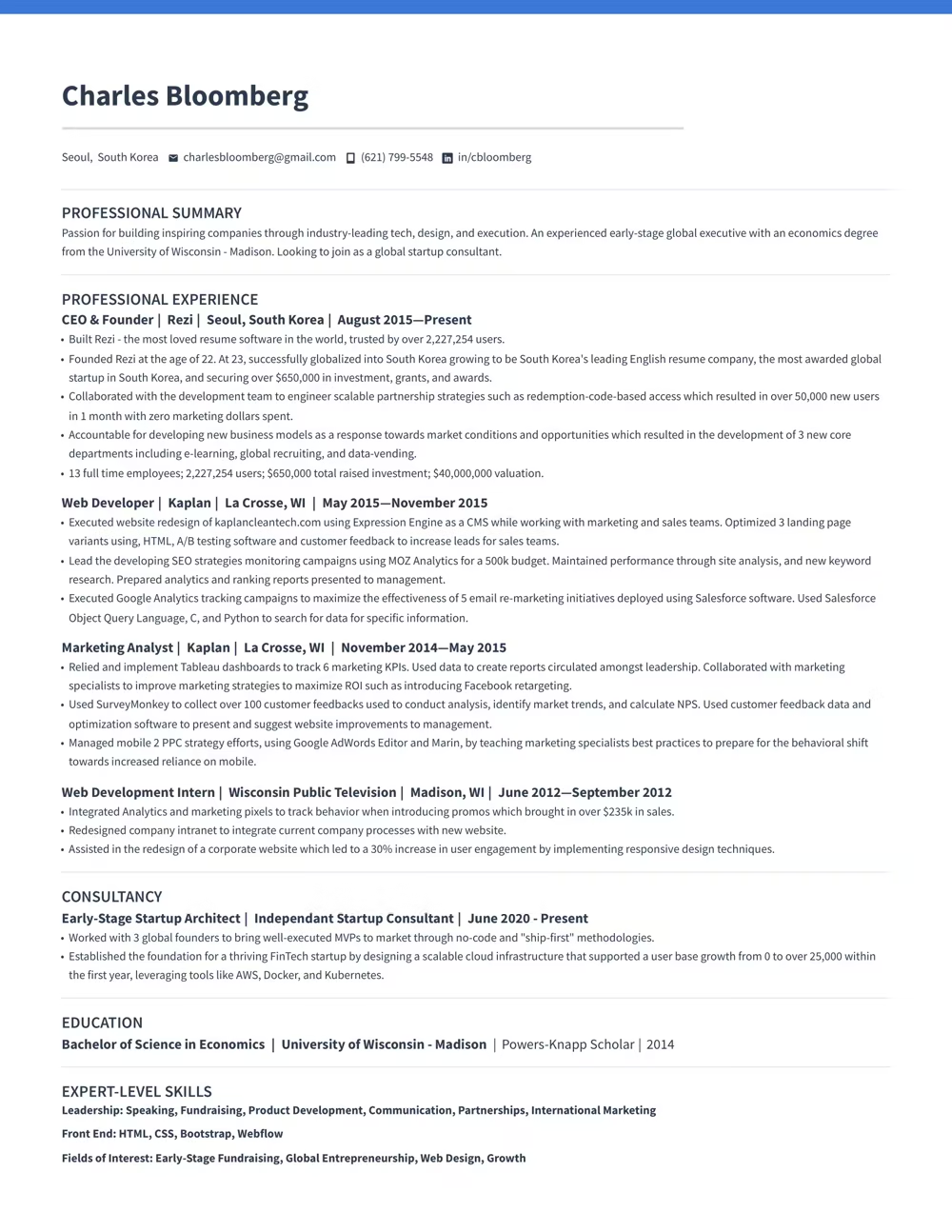
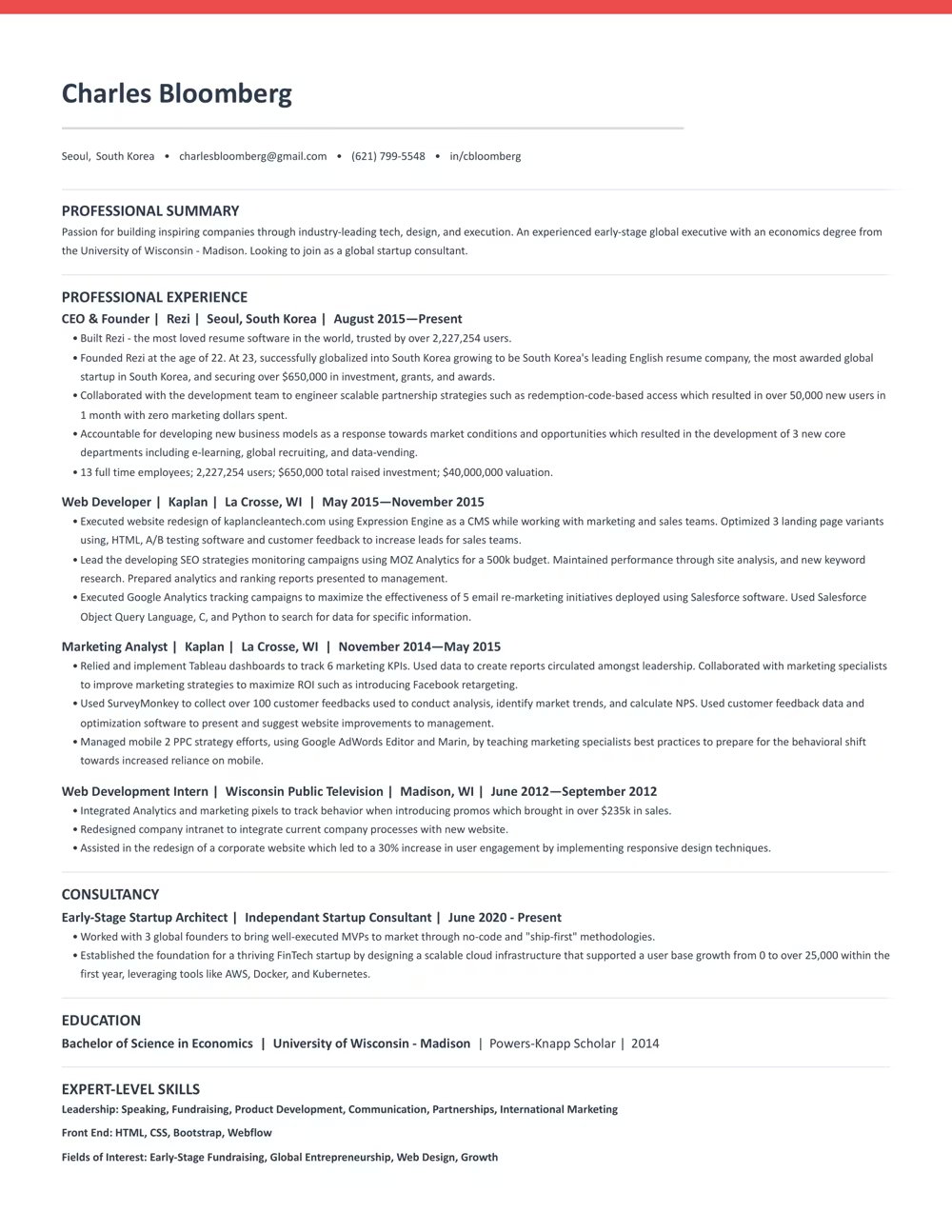
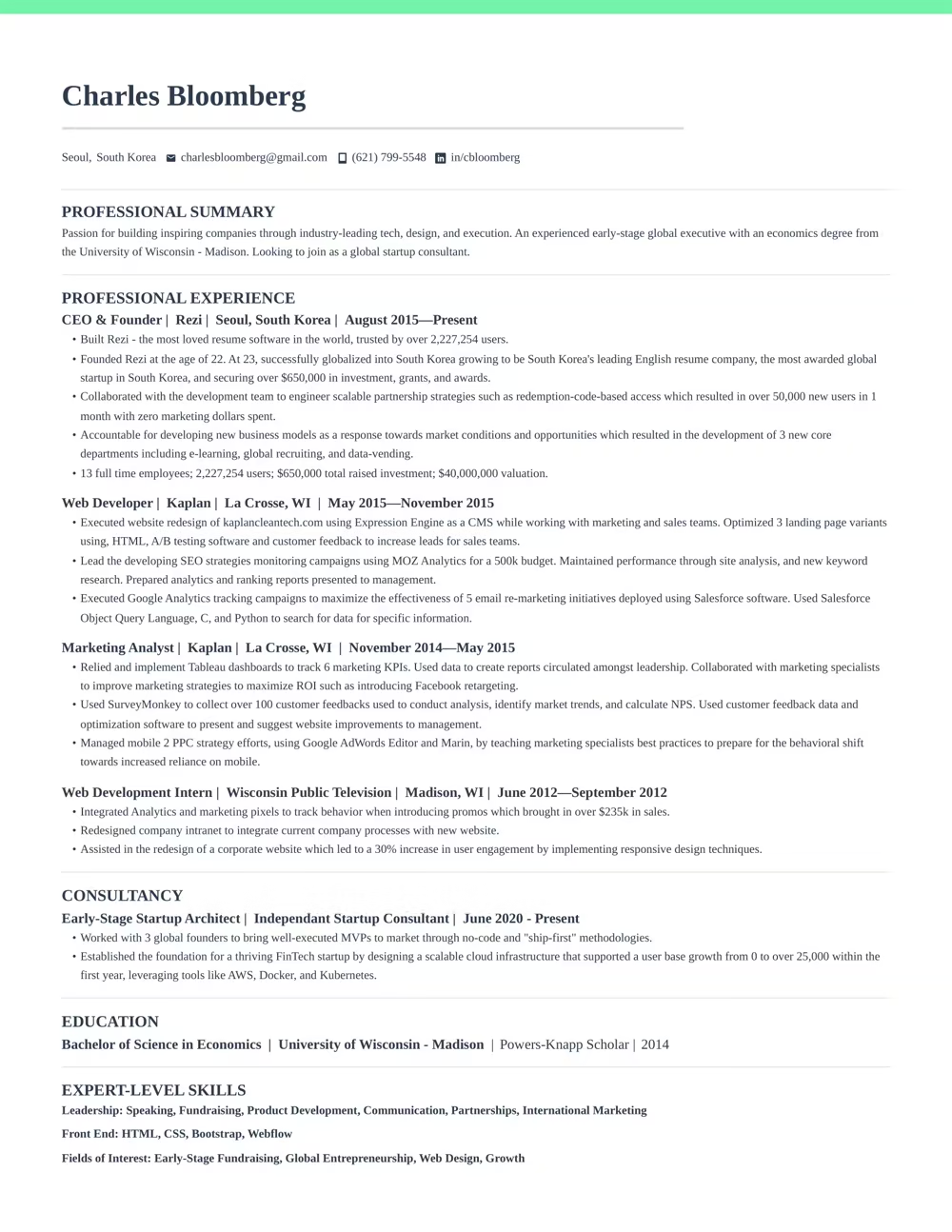
Use a template that guides you. Our ATS-compliant designs are trusted by over 4 million job seekers.




“Rezi is an awesome AI-based resume builder that includes templates to help you design a resume that is sure to check the boxes when it comes to applicant tracking systems. This is a great jumping off point to kickstart a new resume.”

Ashley Stahl
Career Contributor
62.18%
Interview Rate
4,510,834
Total Users
8.23 / 10
Avg. User Review
Wall of Love
Over 4 million users trust Rezi

Resume Building felt like pulling teeth – until I found Rezi.
Davis Allen
Software Developer

I was blown away by Rezi. It streamlined everything...
Celine Watko

I needed a resume tool as smart as my work.
Yosra Naceur
Data Scientist
“A great tool that is very helpful. I found the Rezi system easy to use and very helpful as I was working on getting my resume in shape for job applications.”

Dakota Rubin
United States
Written via

“This is actually one of the first reviews I’ve ever written for a business, and that alone says a lot. I highly recommend Rezi to anyone who’s job searching, it makes the entire process so much easier.”

Yazan Alkhatib
United States
Written via
“Reduced my time per application from 1-2 hours down to 15 minutes.”
Kixxx
Experience with Rezi
“I love how simple and convenient it is to use and been coming back to update it every time I need a fresh resume.”

Zara Wazir
U.A.E.
Written via
Frequently Asked Questions
Your questions, answered.
An AI resume maker helps you build a resume perfectly fit for the job you want. Top-notch AI resume builders are designed to speak the language hiring managers are looking for, increasing your chances of standing out in the crowd. It aligns your skills and experience with the job description effectively.
To get the most out of an AI resume builder, either start from scratch or upload your current resume. Fill in as much detail as possible about your career and skills, and upload the job description you’re targeting. This personalization allows the AI to build a unique and tailored resume that’s bound to catch potential employers' attention.
AI-generated resumes can seem similar if you're not giving personalized inputs or if you're using basic prompts. Provide specific details about your work experience and target the job you’re eyeing. Use specialized AI tools instead of general chatbots to avoid robotic-sounding resumes and to ensure individual creativity.
Employers might think you used AI, but that’s rarely an issue. What they really care about is getting a well-written resume that showcases your skills and experiences accurately. A top-notch resume tailored to their needs will speak volumes more than worrying about AI involvement.
Yes, using AI to optimize your current resume is highly effective. You just need to upload your resume, share details about your career goals and the job you want, and let the AI refine everything to elevate your resume's impact and ATS compatibility.
Rezi uses a tool called the AI Keyword Targeting. This feature scans the job description to identify crucial keywords and naturally incorporates them into your resume, giving it the right focus without keyword stuffing.
The Free plan is $0/month and allows you to create one resume, use limited AI tools (such as Keyword Targeting and Analysis), and download up to three PDFs. You can also create unlimited cover and resignation letters. No card is required to begin.
The Pro plan is $29/month and provides unlimited access to all features, including unlimited resumes, full AI capabilities, unlimited downloads, and one free monthly expert resume review (resumes are reviewed by a person).
The Lifetime plan is a $149 one-time payment. It grants permanent access to all the features of the Pro plan (unlimited resumes, full AI tools, and unlimited downloads), but it does not include the free monthly expert review (which can be purchased for an extra fee).
Rezi offers a 100% money-back guarantee on all paid plans (Pro and Lifetime). If you are unsatisfied, you can request a full refund within 30 days of your purchase.
Yes, you can easily upgrade or downgrade your plan at any time through your Rezi Account Billing dashboard. Prorated credits will apply when switching.
An AI resume maker helps you build a resume perfectly fit for the job you want. Top-notch AI resume builders are designed to speak the language hiring managers are looking for, increasing your chances of standing out in the crowd. It aligns your skills and experience with the job description effectively.
Yes, Rezi Enterprise.