
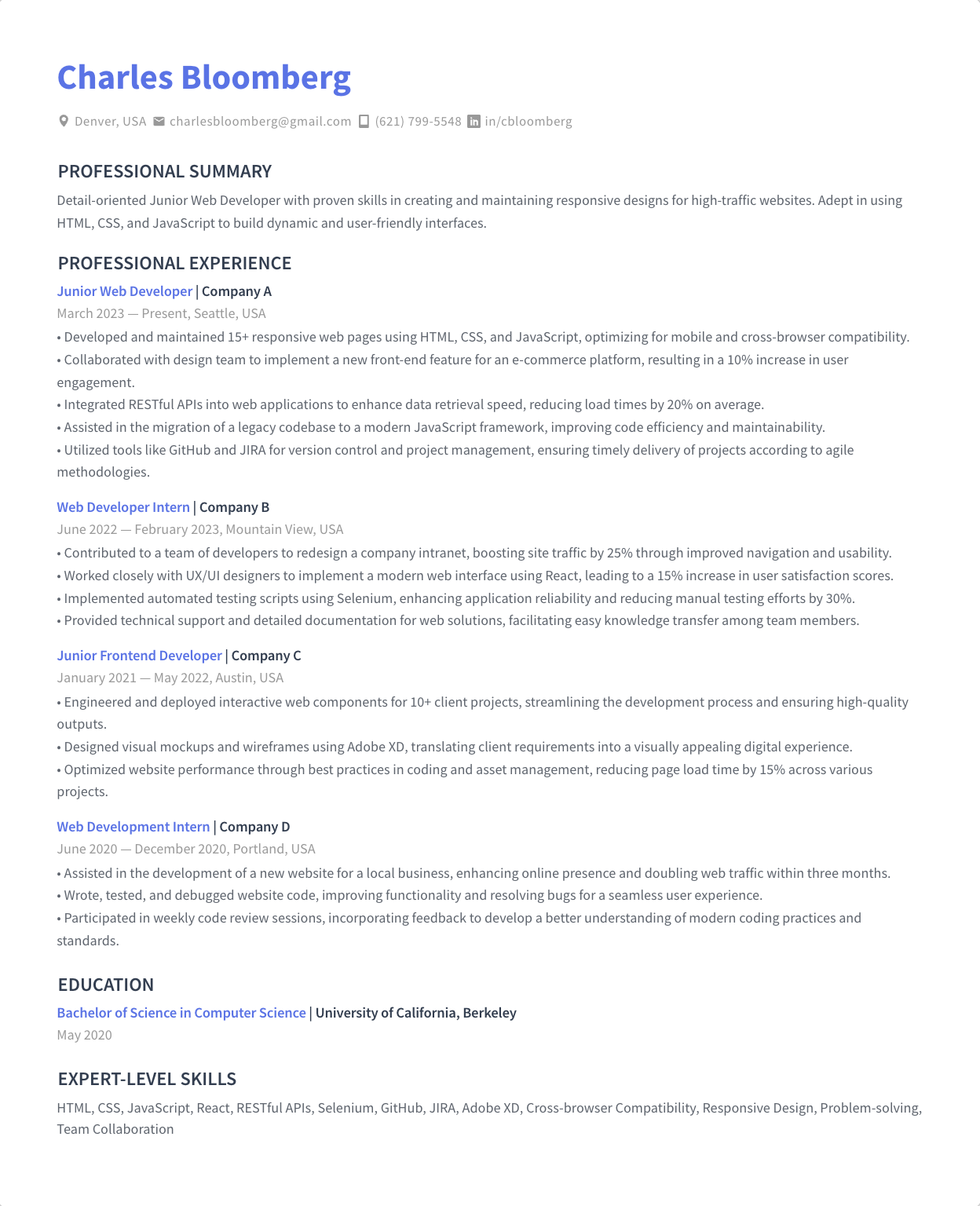


Here's the thing most entry level web developer resumes get wrong: they read like a laundry list of technologies the candidate has heard of, not a story about what they've actually built. Listing "HTML, CSS, JavaScript" without context tells a hiring manager nothing. Every applicant does that.
To create a compelling entry level web developer resume, you need to show what you've created with those technologies — real projects, measurable outcomes, and evidence that you can write clean, functional code that solves actual problems. Even if your experience comes from bootcamps, personal projects, or freelance gigs, the way you frame it makes all the difference.
And this is exactly what you'll learn from this article. Inside, you'll find:
- Examples of 8+ entry level web developer resumes, covering different specializations and paths into the field.
- Insider tips about what really matters to recruiters hiring for junior web development roles.
- A step-by-step guide for putting together an entry level web developer resume that actually lands interviews.
Sample Entry Level Web Developer Resumes
Take a look at some top-notch sample resumes for entry level web developers across different specializations and career paths. Find one that matches your profile and use it as a reference point (or feel free to steal it — just make sure to adjust the wording to reflect your own journey).
Junior Web Developer Resume
A Junior Web Developer resume should showcase hands-on coding experience, whether from professional work, internships, or substantial personal projects. Highlight your proficiency in core web technologies like HTML, CSS, and JavaScript, along with any frameworks you've used. Include links to your GitHub profile or portfolio site, and quantify your contributions where possible — pages built, load times improved, or bugs resolved.
Web Developer Intern Resume
For a Web Developer Intern resume, focus on your eagerness to learn and any real-world exposure you've had during your internship. Highlight specific tasks you contributed to, such as implementing UI components, fixing bugs, or writing documentation. Mention the tech stack you worked with and any feedback or recognition you received. Coursework, academic projects, and hackathon participation can fill gaps if your internship was short.
Associate Web Developer Resume
An Associate Web Developer resume should demonstrate that you can work within a development team and contribute meaningfully to production code. Emphasize collaborative work — pull requests reviewed, features shipped, and sprints completed. Show your familiarity with version control, code reviews, and development workflows. Highlight any mentorship you've received or given, and include metrics that prove your contributions had a tangible impact on the product.
Entry Level Frontend Developer Resume
Your Entry Level Frontend Developer resume should emphasize your eye for design implementation and your ability to translate mockups into responsive, accessible web pages. Highlight proficiency in HTML, CSS, JavaScript, and frontend frameworks like React or Vue. Showcase projects where you focused on user experience, cross-browser compatibility, or performance optimization. Mention any experience with design tools like Figma and your understanding of responsive design principles.
Entry Level Full Stack Developer Resume
An Entry Level Full Stack Developer resume needs to demonstrate competence across both frontend and backend technologies. Highlight projects where you built complete applications — from the user interface to the database and server logic. Show your familiarity with frameworks on both ends, such as React and Node.js or Django and PostgreSQL. Deployments to live environments, even for personal projects, signal that you understand the full development lifecycle.
Trainee Web Developer Resume
For a Trainee Web Developer resume, focus on your training program accomplishments and the practical skills you've developed. Highlight completed projects from your training, technologies you've learned, and any assessments or certifications earned. Show that you can follow development best practices, work in a structured environment, and absorb new concepts quickly. Enthusiasm and a clear trajectory of skill growth matter more here than years of experience.
Graduate Web Developer Resume
A Graduate Web Developer resume should leverage your academic background while connecting it to practical development skills. Highlight your degree, relevant coursework in computer science or web development, and your capstone or thesis project if it involved building software. Include hackathons, coding competitions, or open-source contributions. Show that your education gave you a solid foundation and that you've already started applying it to real projects.
Apprentice Web Developer Resume
An Apprentice Web Developer resume should highlight what you've accomplished during your apprenticeship — features you built, technologies you picked up, and how you contributed to your team's goals. Emphasize your ability to learn on the job and adapt to professional development workflows. Mention any code that made it to production, pair programming experience, and feedback from mentors. This resume is about proving you can grow fast in a professional setting.
How to Write an Entry Level Web Developer Resume
Short answer:
Focus on your technical skills, the projects you've built, and demonstrable problem-solving ability. Create a professional header with your name, contact details, and links to your portfolio and GitHub. Right below, write a 2–3 sentence resume summary or objective highlighting your strongest technical skills and what you bring to a development team. Describe your work history (including internships and freelance work) in reverse-chronological order, focusing on code you shipped and technologies you used. Then, cover your education, list key skills, and add extra sections such as a projects portfolio, certifications, or open-source contributions.
Include all the necessary sections in the correct order
Here's the correct order of sections for most entry level web developer resumes:
- Header with contact information
- Resume summary or objective
- Projects portfolio
- Work experience
- Education
- Skills
- Certifications
Depending on your current career situation, you can also throw in some additional sections. For instance:
- Open-source contributions
- Hackathon participation
- Volunteer experience
- Online courses and bootcamp credentials
- Technical blog or publications
Include everything that shows you're capable of doing what the job requires. Make every section count. If it doesn't clearly highlight your skills or potential, it doesn't belong on your resume.
As an entry level candidate, keep your resume to a single page. You don't need more space — you need sharper focus.
More details here: What Sections to Include on Your Resume?
Now, I'll give you a high-level overview of how to write each section, going from top to bottom. Well… almost. The only exception is the resume summary section. While it comes right after your contact info, it's actually easier to write it last. More on that in a sec.
Create a professional resume header
- Start with your name and contact information. Include the basics: your full name, phone number, professional email address, and location. Then — and this is crucial for web developers — add links to your portfolio website and GitHub profile. A LinkedIn URL is good too, but your portfolio is what really counts.
- Right below your name, clearly state your professional title (e.g., Entry Level Web Developer or Junior Frontend Developer). This sets expectations immediately and helps recruiters categorize your application.
For more information, see: How to Create a Resume Header
Describe your work history
- Use reverse-chronological order. List your positions starting with the current or the most recent one. Internships, freelance work, and contract gigs all count.
- In each entry, include your job title, company name, location, and dates of employment.
- Below each position, write 3–5 bullet points. Describe your responsibilities and, more importantly, your contributions and accomplishments.
- Use action verbs and be specific (e.g., "Built a responsive landing page using React and Tailwind CSS that increased mobile conversion rates by 18%" or "Resolved 30+ bug tickets across a 3-month internship").
- Mention the specific technologies, frameworks, and tools you used in each role. This will also help you pass ATS scans.
Learn more about the best practices of this section with our detailed guide on how to describe your work experience on a resume.
List your degrees and detail professional learning
- In the education section, list your highest degree first, including the degree type, major, and institution.
- As an entry level candidate, you can add more detail to your education section — list relevant coursework (e.g., Data Structures, Web Application Development, Database Systems), academic projects, and honors.
- If you attended a coding bootcamp, include it here. Name the program, the institution, and the technologies covered. Bootcamps are widely respected in web development hiring.
- If you have certifications (e.g., freeCodeCamp, Google, AWS), either include them in an "Education and Certifications" section, or create a separate "Certifications" section and place it right below.
For an in-depth guide on how to describe your education on a resume, see: How to List Education on a Resume
List your most relevant skills in the skills section
- Include a mix of programming languages, frameworks, tools, and soft skills that you're proficient in.
- Don't list every technology you've ever touched. Focus on the ones you can actually use confidently in a work setting.
- You can use separate subsections — for example, "Languages & Frameworks," "Tools & Platforms," and "Soft Skills" — or just list all skills under one heading.
- Match your skills to the description of the job you're applying for. If the job ad mentions React and you know React, make sure it's prominent. But don't list skills you can't back up in a technical interview.
Need some inspiration to get started? Here are some good skills to feature on your entry level web developer resume.
Programming languages and frameworks:
- HTML5
- CSS3 / Sass / Less
- JavaScript (ES6+)
- TypeScript
- React
- Vue.js
- Angular
- Node.js
- Express.js
- Python / Django / Flask
- PHP / Laravel
- SQL (MySQL, PostgreSQL)
Tools and platforms:
- Git / GitHub / GitLab
- VS Code
- Chrome DevTools
- npm / Yarn
- Webpack / Vite
- Figma
- Docker (basic)
- AWS / Netlify / Vercel
- REST APIs / GraphQL
- WordPress / CMS platforms
Key soft skills for entry level web developers:
- Problem-Solving
- Attention to Detail
- Communication
- Teamwork
- Adaptability
- Time Management
- Willingness to Learn
- Self-Motivation
- Critical Thinking
- Receiving and Applying Feedback
For a full-blown guide on listing skills on a resume, visit: How to Put Skills on a Resume
Use additional sections as further proof of your fit
Additional sections add depth to your resume and back up your claimed expertise. Good examples of extra sections to add to an entry level web developer resume are:
- Projects portfolio. This is arguably the most important "extra" section for a web developer. A dedicated resume section for projects you've built — with links, tech stacks used, and brief descriptions of what the project does — gives recruiters concrete proof of your abilities.
- Open-source contributions. Even small contributions to open-source projects show that you can work with existing codebases, follow contribution guidelines, and collaborate with other developers.
- Hackathons and coding competitions. Participation (and especially wins or notable placements) demonstrates initiative, speed, and the ability to deliver under pressure.
- Technical blog or writing. If you write about web development — tutorials, problem-solving walkthroughs, or technology comparisons — include it. It shows communication skills and deep understanding.
Highlight the most relevant information in a resume summary
Once you're done writing your web developer resume, give it a full read. Pick the most relevant information and compile it into a summary paragraph. Place it right under the resume header.
- Be brief and to-the-point. In 2–3 sentences, sum up your core technical skills, what you've built, and what you're looking to contribute. Consider this your chance to answer, "Why should you hire me?" Tailor this section to match the employer's needs outlined in the job description.
- Use value-oriented language. Focus on what you can contribute to the team, mentioning specific technologies you're strong in and the kinds of projects you've successfully completed.
Once you've completed the core sections of your resume, you can use Rezi AI Resume Summary Generator to automatically create a powerful summary, tailored to the job you're applying for. All you need to do is add the position and skills you want to highlight. The AI writer will do the rest.
More information here: How to Write a Job-Winning Resume Summary (with Examples)
For finishing touches, make sure your resume looks professional
- Use a clean and tidy resume format. Ensure your web developer resume is easily readable, with a professional font, consistent formatting, and clear section headings. Ironically, some web developers go overboard with flashy resume designs. Save the creativity for your portfolio — keep the resume scannable for both humans and ATS software.
- As an entry level candidate, keep your resume to a single page. Every word needs to earn its place. If you're padding with filler, cut it.
Learn more about proper resume formatting here: How to Format a Resume & What Standard Resume Format to Use
What Makes Entry Level Web Developer Resumes Different
In short: the emphasis on what you've built and your ability to learn fast.
Unlike more senior roles where years of experience speak for themselves, entry level web developer resumes need to work harder to prove capability. Hiring managers know you won't have a decade of production code under your belt. What they want to see is evidence that you can actually code, that you understand modern development practices, and that you'll ramp up quickly on their team.
Your portfolio is your resume's secret weapon
Most professions don't expect you to show your work directly on a resume. Web development does. Your projects section — and the links you provide to live demos, GitHub repos, and deployed sites — carries enormous weight at the entry level.
What it means for you:
- Include 2–4 strong projects on your resume with brief descriptions, the tech stack used, and live links. Quality over quantity — one well-built full stack app beats ten half-finished tutorial clones.
- Make sure your linked projects actually work. Broken links or sites with console errors will hurt you more than having no portfolio at all.
You're being evaluated on learning ability, not just current knowledge
Hiring managers for entry level roles know they're investing in potential. They want to see that you can pick up new technologies, adapt to unfamiliar codebases, and grow within the role.
What it means for you:
- Show a trajectory of learning. If you started with HTML/CSS and progressed to React and Node.js within a year, make that progression visible through your projects and education sections.
- Mention specific examples of learning new technologies on the job or under tight deadlines — e.g., "Learned Vue.js in two weeks to deliver a client project on schedule."
Clean code matters more than fancy titles
Unlike roles where job titles and company names do the heavy lifting, web developer resumes — especially at the entry level — are evaluated on technical substance. Recruiters and hiring managers will actually look at your GitHub.
What this means for you:
- Make sure your public repositories have clean, well-commented code and meaningful README files. Treat your GitHub profile as an extension of your resume.
- On the resume itself, describe what you built and the specific technical problems you solved — not just the technologies you used. "Built a REST API with Node.js and Express that handles user authentication using JWT" is far more compelling than "Used Node.js."
Non-traditional paths are completely normal
Web development is one of the most accessible tech careers. Many candidates come from bootcamps, self-study, career changes, or non-CS degrees. Hiring managers are used to this — but your resume needs to address it confidently.
What this means for you:
- Don't apologize for or hide a non-traditional background. Instead, frame it as an asset. Career changers bring domain expertise. Self-taught developers demonstrate exceptional discipline and motivation.
- If you don't have a CS degree, compensate with strong projects, certifications, and a visible commitment to continuous learning. A bootcamp graduate with three solid deployed projects is more impressive than a CS graduate with nothing to show.
Bonus Resources for Entry Level Web Developers
This isn't going to be a game-changer if you need a resume now. But —
I want you to treat your career holistically. These resources will help you sharpen your web development skills, add real substance to your future resumes, and keep you up to date with the constantly evolving web development landscape.
Learning platforms and courses
freeCodeCamp
A completely free, project-based curriculum covering responsive web design, JavaScript algorithms, frontend libraries, APIs, and more. You earn certifications as you complete sections, which are great additions to your resume.
The Odin Project
An open-source, full-stack web development curriculum that takes you from the basics through to advanced JavaScript and React or Ruby on Rails. Highly respected in the self-taught developer community.
Udemy & Coursera
Both platforms offer a wide range of web development courses, from beginner HTML/CSS to advanced React, Node.js, and full stack development. Coursera also offers professional certificates from companies like Meta and Google.
Codecademy
An interactive learning platform with hands-on coding exercises covering HTML, CSS, JavaScript, React, Python, SQL, and more. Their career paths provide structured learning tracks for aspiring web developers.
Developer communities and networks
DEV Community
A thriving community of developers sharing articles, tutorials, and discussions. Great for learning, networking, and even publishing your own technical writing — which can strengthen your resume.
Stack Overflow
Beyond being the go-to Q&A site for debugging, an active Stack Overflow profile with helpful answers demonstrates your problem-solving skills and willingness to contribute to the developer community.
Meetup
Search for local or virtual web development meetups, hackathons, and coding groups. Networking with other developers can lead to job referrals, mentorship, and collaborative project opportunities.
Publications and blogs
CSS-Tricks
A long-running web development blog with deep-dive articles, guides, and tutorials on CSS, JavaScript, and frontend development best practices.
Smashing Magazine
Offers high-quality articles on web design, development, UX, and performance optimization. A fantastic resource for staying current with industry trends and techniques.
JavaScript.info
A comprehensive, modern JavaScript tutorial that covers everything from basics to advanced topics. Excellent for deepening your understanding of the language that powers the modern web.
Tools and practice platforms
GitHub
Your GitHub profile is essentially a living portfolio. Contribute to open-source projects, showcase personal projects with clean README files, and maintain an active commit history to demonstrate consistent coding habits.
Codewars & LeetCode
Both platforms offer coding challenges that sharpen your problem-solving and algorithmic thinking skills — exactly what you'll need for technical interviews at many web development positions.
Summary
Here's what you need to know about writing an entry level web developer resume:
- Structure your resume with essential sections in this order: Header, Resume Summary or Objective, Projects Portfolio, Work Experience, Education, Skills, and Certifications. Add extra sections like open-source contributions or hackathon participation if relevant.
- Include a professional header with your name, contact information, professional title, and — critically — links to your portfolio and GitHub profile.
- Showcase 2–4 strong projects with descriptions, tech stacks, and live links. Your projects portfolio is the most impactful section on an entry level web developer resume.
- Describe your work history in reverse-chronological order, specifying technologies used and quantifying your contributions wherever possible.
- In the education section, include relevant coursework, bootcamp credentials, and academic projects. If you have certifications, list them in a dedicated section.
- Highlight a mix of programming languages, frameworks, tools, and soft skills — tailored to the specific job description.
- Once done writing the resume, compile the key information into a brief, value-oriented resume summary at the top.
- Keep your resume to one page, use a clean format, and make sure every line demonstrates your ability to build things with code.
- Ensure your GitHub repos have clean code and meaningful documentation — hiring managers will check.
Thanks for reading! Got any questions? Feel free to reach out to me on LinkedIn. (Or check out the FAQs first — maybe your question is answered there.)
FAQ
I don't have any professional web development experience. What do I put on my resume?
Lead with projects. Personal projects, bootcamp capstones, freelance work, and open-source contributions all count. Describe each project as if it were a job: what you built, what technologies you used, and what problem it solved. A strong projects section can absolutely compensate for a lack of formal work experience.
Should I include tutorial projects on my resume?
Avoid listing projects that are obviously straight from a tutorial (e.g., a generic to-do app). Instead, take tutorial concepts and build something original with them. If you followed a course that taught you React, build your own unique project using those skills. Hiring managers can spot tutorial clones, and they won't impress.
Do I need a computer science degree to get hired as an entry level web developer?
No. Many web developers are hired from bootcamps, self-study backgrounds, or unrelated degrees. What matters is demonstrable skill. A strong portfolio, clean GitHub repos, and relevant certifications (like freeCodeCamp or Meta's frontend developer certificate) can be just as effective as a CS degree — sometimes more so.
How many programming languages and frameworks should I list?
Only list technologies you can confidently discuss and use in a technical interview. For most entry level candidates, a solid core of 5–8 technologies is ideal. Listing 25 technologies suggests you're padding your resume rather than demonstrating real proficiency. Depth beats breadth at the entry level.
Should I include a link to my GitHub profile?
Absolutely — but only if your profile is presentable. Pin your best repositories, write clear README files, and clean up any half-finished or messy projects. An active GitHub with well-documented projects is one of the most powerful assets on an entry level web developer resume. A neglected or empty GitHub is worse than not linking one at all.
I'm changing careers into web development. How should I handle my previous work experience?
Include your previous experience, but keep it concise — 1–2 bullet points per role focused on transferable skills like problem-solving, project coordination, client communication, or analytical thinking. Then dedicate the bulk of your resume space to your web development projects, technical skills, and any training you've completed. Frame the career change as an intentional move, not something you're apologizing for.
Is it worth listing soft skills on a web developer resume?
Yes, but strategically. Don't just dump "teamwork" and "communication" into your skills list without context. Instead, weave soft skills into your project descriptions and work experience bullets — e.g., "Collaborated with a team of four developers using Git and daily standups to deliver a client project two days ahead of schedule." That's far more convincing than a standalone keyword.
Should my resume design be flashy to show off my web design skills?
No. Your resume needs to be ATS-compatible and easy to scan. Fancy layouts, custom graphics, and multi-column designs often break when parsed by applicant tracking systems. Save your design skills for your portfolio website. Your resume should be clean, well-structured, and focused entirely on readable content.


