


Here's the thing most first year students get wrong on their resumes: they think they have nothing to put on one. So they either leave it nearly blank or stuff it with vague filler like "hard worker" and "quick learner" — neither of which tells an employer, scholarship committee, or internship coordinator anything useful.
The truth is, you have more to work with than you think. High school achievements, volunteer work, part-time jobs, club involvement, personal projects — all of it counts. The trick is presenting it in a way that shows initiative, potential, and the specific skills someone is actually looking for.
And this is exactly what you'll learn from this article. Inside, you'll find:
- Examples of 8+ first year student resumes, covering different academic tracks and student profiles.
- Practical tips on what recruiters, admissions offices, and hiring managers actually want to see from freshmen.
- A step-by-step guide for building a first year student resume that opens doors — even without years of experience.
Sample First Year Student Resumes
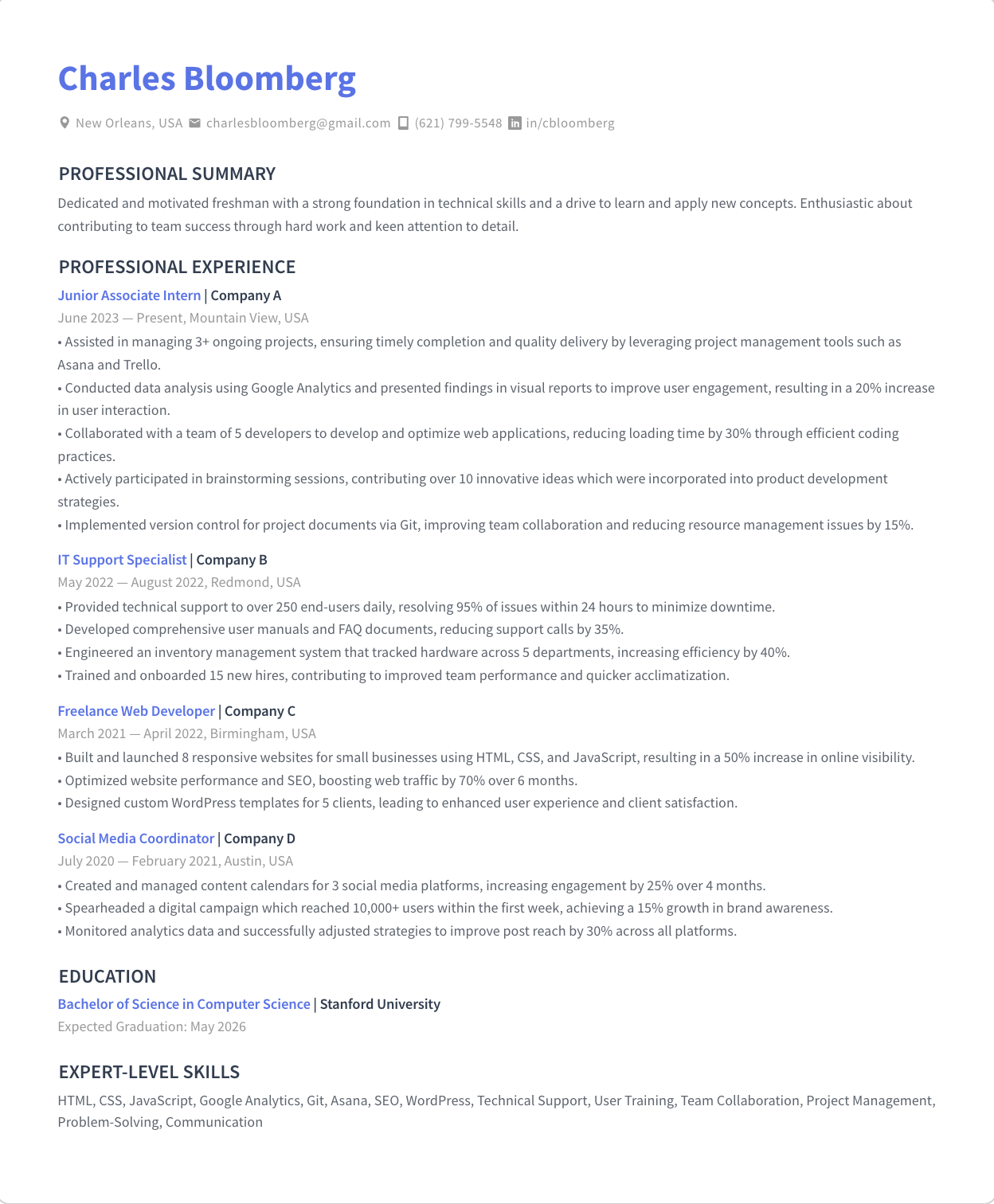
Take a look at some strong sample resumes for first year students across different academic focuses and backgrounds. Find one that matches your situation and use it as a starting point — just make sure to adjust the details to reflect your own experiences and goals.
Note: these examples are organized by academic focus and student profile. Pick the one closest to yours and adapt from there.
Freshman Resume
A general freshman resume should emphasize your high school accomplishments, extracurricular activities, and any work or volunteer experience. Focus on transferable skills like communication, teamwork, and responsibility. Highlight academic honors, club leadership, or community service that demonstrate initiative. Even without formal work experience, showing you can commit to activities and deliver results goes a long way.
First Year College Student Resume
As a first year college student, your resume should bridge your high school achievements with your new college involvement. Highlight any early campus activities, orientation leadership roles, or first-semester coursework relevant to your target opportunity. Include part-time jobs or summer employment to show reliability. Emphasize adaptability and eagerness to learn — these matter more than a long work history at this stage.
First Year University Student Resume
A first year university student resume should showcase academic focus alongside extracurricular engagement. Highlight your declared major or area of interest, relevant coursework, and any research or academic projects. If your university offers honors programs or learning communities, mention your participation. Include volunteer work and any technical skills you've developed through classes or self-study to round out your profile.
Undergraduate Freshman Resume
For an undergraduate freshman resume, emphasize the intersection of academics and personal development. Highlight your GPA if strong, relevant coursework, and participation in student organizations or intramural activities. Any leadership roles — even informal ones like organizing a study group or planning a club event — deserve a spot. Showcase skills gained through hobbies, personal projects, or online courses that relate to your goals.
First Year Engineering Student Resume
A first year engineering student should highlight technical coursework, lab experience, and any hands-on projects — even from high school robotics clubs or personal tinkering. List programming languages, CAD software, or tools you've started learning. Emphasize problem-solving skills and collaborative project work. Hackathon participation, maker space involvement, or engineering competition experience can set your resume apart from other freshmen.
First Year Business Student Resume
For a first year business student, focus on any entrepreneurial activities, sales experience, or customer-facing roles you've held. Highlight involvement in business clubs, case competitions, or student government. Proficiency in tools like Microsoft Excel, Google Workspace, or basic data analysis is worth mentioning. Even running a small online shop or managing social media for a local business demonstrates initiative and commercial awareness.
First Year Science Student Resume
A first year science student resume should emphasize lab skills, relevant coursework in biology, chemistry, physics, or related fields, and any research exposure. Highlight science fair participation, independent research projects, or shadowing experiences. Mention technical skills like data collection, statistical software, or laboratory safety protocols. Volunteering at hospitals, nature centers, or environmental organizations adds practical context to your academic interests.
College Freshman Resume
A college freshman resume works best when it tells a clear story about who you are and where you're headed. Combine your strongest high school accomplishments with early college involvement. Focus on activities that show consistency and growth — a job you held for two years, a sport you captained, or a cause you championed. Tailor every bullet point toward the specific opportunity you're applying for.
How to Write a First Year Student Resume
Short answer:
Focus on your potential, transferable skills, and the experiences that demonstrate your character and work ethic. Create a clean header with your name and contact details. Write a 2–3 sentence resume objective highlighting your goals and strongest qualifications. List your education prominently — as a first year student, this is your anchor section. Add any work experience, volunteer roles, or extracurriculars in reverse-chronological order. Then list your skills and include extra sections like projects, awards, or certifications.
Include all the necessary sections in the correct order
Here's the correct order of sections for most first year student resumes:
- Header with contact information
- Resume objective
- Education
- Work experience (if any)
- Extracurricular activities and volunteer work
- Skills
Depending on your background, you can also add some additional sections. For instance:
- Projects (academic, personal, or collaborative)
- Awards and honors
- Certifications or online courses
- Languages
- Relevant hobbies or interests
Include everything that shows you're capable and motivated. Make every section count. If it doesn't clearly highlight a skill, achievement, or quality, it doesn't belong on your resume.
As a first year student, keep your resume to a single page. You don't have decades of experience to fill two pages — and that's completely fine. One strong page beats two mediocre ones every time.
More details here: What Sections to Include on Your Resume?
Now, I'll give you a high-level overview of how to write each section, going from top to bottom. Well… almost. The only exception is the resume objective section. While it comes right after your contact info, it's actually easier to write it last. More on that in a sec.
Create a professional resume header
- Start with your name and contact information. Include the basics: your full name, phone number, professional email address (not xXgamer2007Xx@email.com — create a simple one), your college or city, and a LinkedIn profile if you have one. A link to a personal website or portfolio can also help if relevant.
- Right below your name, include a descriptor like First Year Engineering Student at [University Name] or Freshman – Business Administration. This immediately tells the reader who you are and what you're studying.
For more information, see: How to Create a Resume Header
Lead with your education
- As a first year student, education is your most important section — place it before work experience.
- List your current university, expected graduation date, degree program, and major or intended major.
- Include your GPA if it's 3.0 or above. If your major GPA is stronger than your cumulative, you can list that instead.
- Add relevant coursework, academic honors (Dean's List, scholarships), and any AP or IB credits from high school that are notable.
- If your high school experience is particularly strong (valedictorian, significant awards), you can include it briefly — but it should take up less space than your college education.
For an in-depth guide on how to describe your education on a resume, see: How to List Education on a Resume
Describe any work experience you have
- Use reverse-chronological order. List your positions starting with the current or most recent one.
- In each entry, include your job title, employer name, location, and dates of employment.
- Below each position, write 2–4 bullet points describing your responsibilities and, more importantly, what you accomplished or learned.
- Use action verbs and be specific (e.g., "Trained 3 new team members on point-of-sale system and closing procedures" is much better than "Helped with training").
- Don't have formal work experience? That's okay. Include babysitting, lawn care, tutoring, freelance gigs, or helping with a family business. What matters is showing responsibility and follow-through.
Learn more about the best practices of this section with our detailed guide on how to describe your work experience on a resume.
Highlight extracurricular activities and volunteer work
- This section is where first year students can really shine. List clubs, sports, student organizations, community service, and any leadership roles.
- Treat each entry like a mini work experience: include your role, the organization name, dates, and 2–3 bullet points about what you did and achieved.
- Quantify whenever possible (e.g., "Organized a food drive that collected 500+ items for the local food bank").
- Prioritize activities that demonstrate skills relevant to the opportunity you're applying for.
List your most relevant skills in the skills section
- Include a mix of hard skills (e.g., Microsoft Office, basic coding, social media management) and soft skills (e.g., communication, teamwork, time management) that you genuinely possess.
- Don't just list skills you think sound impressive — include ones you can actually demonstrate through your experiences.
- You can use two separate subsections (hard skills and soft skills) or list everything under one heading.
- Match your skills to the description of the opportunity you're applying for. If a campus job posting asks for "attention to detail" and "customer service," and you have those skills, make sure they're on your resume.
Need some inspiration to get started? Here are some good skills to feature on your first year student resume.
Technical and software skills for first year students:
- Microsoft Office Suite (Word, Excel, PowerPoint)
- Google Workspace (Docs, Sheets, Slides)
- Social media platforms (Instagram, TikTok, LinkedIn)
- Basic data entry
- Canva or basic graphic design
- Python, Java, or other introductory programming languages
- Learning management systems (Canvas, Blackboard)
- Research databases (JSTOR, Google Scholar)
- Basic HTML/CSS
- Video conferencing tools (Zoom, Microsoft Teams)
Soft skills for first year students:
- Communication (written and verbal)
- Time management
- Teamwork and collaboration
- Adaptability
- Problem-solving
- Organization
- Leadership
- Critical thinking
- Work ethic and reliability
- Active listening
Academic and research skills:
- Academic writing and citation (APA, MLA, Chicago)
- Note-taking and summarization
- Library and database research
- Lab techniques (if applicable)
- Public speaking and presentations
- Study group facilitation
- Foreign language proficiency
For a full-blown guide on listing skills on a resume, visit: How to Put Skills on a Resume
Use additional sections as further proof of your fit
Additional sections add depth to your resume and help compensate for limited work experience. Good examples of extra sections to add to a first year student resume are:
- Projects. Include academic or personal projects that demonstrate initiative — a research paper, a website you built, or a group project where you played a key role.
- Awards and honors. Dean's List, National Honor Society, scholarship awards, essay contest wins — these all show you're someone who stands out.
- Certifications and online courses. Completed a Google Career Certificate, HubSpot Inbound Marketing course, or a Coursera specialization? Include it. It shows self-motivation.
- Languages. If you speak more than one language, list it with your proficiency level. This is a genuine differentiator for many opportunities.
- Relevant hobbies. Use this sparingly, but a hobby like coding personal apps, managing a blog, or competitive debate can add context to your skillset.
Highlight the most relevant information in a resume objective
Once you're done writing the rest of your resume, go back and craft your objective. Place it right under the resume header.
- Be brief and specific. In 2–3 sentences, state your academic focus, your most relevant skills or experiences, and what you're looking for. Consider this your chance to answer, "Why should you consider me?" Tailor this section to match what the opportunity is looking for.
- Use forward-looking language. As a first year student, your resume objective should emphasize what you're eager to contribute and learn, not just what you've done. Something like: "First year biology student at State University seeking a research assistant position to apply strong lab skills and a passion for molecular biology in a hands-on setting."
Once you've completed the core sections of your resume, you can use Rezi AI Resume Summary Generator to automatically create a compelling objective tailored to the opportunity you're applying for. All you need to do is add the position and skills you want to highlight. The AI writer will do the rest.
More information here: How to Write a Job-Winning Resume Summary (with Examples)
For finishing touches, make sure your resume looks professional
- Use a clean and tidy resume format. Ensure your resume is easily readable, with a professional font, consistent formatting, and clear section headings. Avoid overloading it with colors, graphics, or fancy design elements that could distract from the content and confuse resume screening software.
- Keep it to one page. As a first year student, you absolutely do not need two pages. A tight, well-organized single page sends a stronger message than a padded, sprawling document.
Learn more about proper resume formatting here: How to Format a Resume & What Standard Resume Format to Use
What Makes First Year Student Resumes Different
In short: the emphasis on potential over experience.
This is also what trips up most freshmen. You can't compete with seasoned professionals on work history — and you shouldn't try to. Instead, your resume needs to clearly demonstrate that you're capable, motivated, and ready to grow. Here's how first year student resumes differ from most others, and what you need to do about it.
Your education section carries the most weight
For most professionals, education is a brief footnote at the bottom of their resume. For you, it's the main event. Your degree program, coursework, GPA, and academic honors are the strongest signals you have.
What it means for you:
- Place your education section above work experience. List relevant coursework that connects to the opportunity you're targeting — if you're applying for a marketing internship, that Intro to Marketing class absolutely belongs here.
- Include academic distinctions like Dean's List, scholarships, or honors program membership. These are concrete proof that you perform at a high level.
Experience comes in many forms
Most resume guides focus on formal work history. But as a first year student, your experience likely comes from different places — and that's perfectly valid. Volunteer work, club leadership, part-time jobs, family responsibilities, and personal projects all count.
What it means for you:
- Don't limit yourself to paid employment. A year of consistent volunteering or leading a student club can be just as impressive as a part-time job — sometimes more so.
- Frame every experience in terms of skills and outcomes. Instead of "Volunteered at animal shelter," write "Managed intake documentation for 20+ animals weekly and trained new volunteers on shelter procedures."
Transferable skills matter more than job-specific expertise
Nobody expects a first year student to be a subject matter expert. What they do expect is someone who can learn quickly, communicate clearly, show up reliably, and work well with others.
What it means for you:
- Identify the transferable skills that run through your various activities — time management from balancing academics and a job, communication from a customer service role, leadership from captaining a team.
- Connect those skills explicitly to the opportunity. Don't make the reader guess why your experience as a camp counselor makes you a good fit for a campus tour guide position. Spell it out.
A resume objective works better than a summary
Professional resumes typically use a summary that highlights years of accomplishments. As a freshman, a forward-looking objective statement is a better fit — it frames your application around ambition and relevance rather than a track record you haven't had time to build yet.
What it means for you:
- Write a concise objective that names the specific role or opportunity, your area of study, and 1–2 strengths or experiences that make you a strong candidate.
- Avoid generic statements like "Seeking a position where I can grow." Be specific: "First year computer science student seeking a helpdesk assistant position to apply strong troubleshooting skills and customer service experience."
Formatting simplicity is your friend
Some students try to compensate for limited experience with elaborate resume designs — multiple columns, icons, infographics. This usually backfires. It can confuse applicant tracking systems and distract from your actual content.
What it means for you:
- Stick to a single-column, clean layout with clear headings. Let your content do the talking.
- Use white space strategically. A well-spaced one-page resume with strong bullet points looks far more professional than a crammed, overly designed document.
Bonus Resources for First Year Students
This won't transform your resume overnight. But —
I want you to think about your career from day one. These resources will help you build skills, find opportunities, and set yourself up so that each future version of your resume gets stronger and more compelling.
Campus resources
Your University's Career Services Center
This is the single most underused resource on any college campus. Career services offers free resume reviews, mock interviews, job and internship boards, and career counseling. Visit during your first semester — don't wait until senior year.
Your Academic Advisor
Beyond course planning, your advisor can connect you to research opportunities, departmental jobs, and faculty mentors who may need student assistants. Building these relationships early pays off enormously.
Job and internship platforms
Handshake
Used by hundreds of universities, Handshake is one of the best platforms for finding internships, part-time jobs, and entry-level positions specifically targeted at college students. Create your profile early and keep it updated.
Even as a freshman, having a LinkedIn profile matters. Connect with classmates, professors, and professionals in your field of interest. Follow companies you admire. Many internships and campus jobs are posted here as well.
Indeed & Glassdoor
Both platforms list part-time jobs, seasonal work, and internships suitable for first year students. Glassdoor also offers company reviews and salary information that can help you prepare for applications and interviews.
Online learning and skill-building
Coursera & edX
Both platforms offer free and affordable courses from top universities. Whether you want to learn Excel, Python, graphic design, or public speaking, completing a course and earning a certificate gives your resume an immediate boost.
LinkedIn Learning
Many universities provide free access to LinkedIn Learning. Take advantage of courses on professional skills, software tools, and career development — and add completed courses to both your LinkedIn profile and your resume.
Khan Academy
A completely free resource for brushing up on math, science, economics, and computing skills. While you won't earn a formal certificate, it's an excellent way to strengthen foundational knowledge that supports your coursework and resume.
Professional development and networking
National Association of Colleges and Employers (NACE)
NACE defines the career readiness competencies that employers look for in college graduates. Understanding these competencies early — critical thinking, teamwork, communication, professionalism — helps you build your resume with purpose from day one.
Student Professional Organizations
Whether it's the American Marketing Association, the National Society of Black Engineers, the Society of Women Engineers, or a pre-law society, joining a professional student organization gives you networking opportunities, conference access, and resume-worthy experiences.
Summary
Here's what you need to know about writing a first year student resume:
- Structure your resume with these sections in order: Header, Resume Objective, Education, Work Experience, Extracurricular Activities/Volunteer Work, Skills. Add extra sections like Projects, Awards, or Certifications if they strengthen your profile.
- Include a professional header with your name, contact information, and a descriptor like your year and major.
- Lead with education — as a first year student, this is your strongest section. Include your degree program, relevant coursework, GPA (if 3.0+), and academic honors.
- List any work experience in reverse-chronological order, focusing on responsibilities and achievements with specific details.
- Don't overlook non-traditional experience. Volunteer roles, club leadership, personal projects, and part-time jobs all demonstrate valuable skills.
- Highlight a mix of technical, academic, and soft skills, tailoring them to the opportunity you're applying for.
- Use additional sections like awards, certifications, or languages to add depth and differentiation.
- Write your resume objective last — compile the key information into a brief, forward-looking statement at the top.
- Keep your resume to one page with clean, simple formatting. Every line should earn its place.
- Focus on demonstrating potential, transferable skills, and initiative — not on apologizing for limited experience.
Thanks for reading! Got any questions? Feel free to reach out to me on LinkedIn. (Or check out the FAQs first — your question might already be answered there.)
FAQ
I have literally zero work experience. Can I still write a resume?
Absolutely. Focus on your education, extracurricular activities, volunteer work, personal projects, and skills. A resume isn't just about paid employment — it's about showing what you can do. If you organized a charity event, tutored classmates, managed a social media page, or built something in your spare time, that all belongs on your resume.
Should I include my high school information on my resume?
As a first year student, yes — but keep it brief and phased out over time. If you were valedictorian, won a state competition, or held significant leadership roles, include that. By sophomore year, most high school details should be replaced with college experiences. The exception: if a high school achievement is directly relevant to what you're applying for, keep it.
Is it okay to include a GPA on my resume?
If your GPA is 3.0 or above, include it. If it's below that, leave it off — no one will assume the worst, and you can highlight other strengths instead. If your major GPA is significantly higher than your cumulative GPA, you can list your major GPA instead. Just be honest and label it clearly.
How do I make a part-time retail or food service job sound relevant?
Focus on the skills, not the job title. Working in retail or food service teaches customer service, time management, teamwork, conflict resolution, cash handling, and working under pressure. Frame your bullet points around what you accomplished and learned: "Processed 100+ customer transactions daily while maintaining 98% accuracy" sounds a lot more compelling than "Worked the register."
Should I use a resume objective or a resume summary?
As a first year student, go with a resume objective. A summary highlights years of professional accomplishments — which you don't have yet, and that's fine. An objective states who you are, what you're studying, and what opportunity you're targeting. It's forward-looking and perfectly suited for someone early in their academic career.
What if I'm applying for something unrelated to my major?
That's completely normal for freshmen. Focus on transferable skills that apply to the role. If you're a biology major applying for a campus event planning job, emphasize organization, attention to detail, teamwork, and any event-related experience you have. Employers hiring first year students care more about reliability and attitude than a perfect major-to-job match.
Should I include hobbies and interests on my resume?
Only if they add genuine value. "Watching Netflix" doesn't help. But "competitive chess player," "amateur photographer with an online portfolio," or "built and maintain a personal blog about sustainable fashion" all give the reader useful information about who you are. If a hobby demonstrates a skill or passion relevant to the opportunity, include it.
How often should I update my resume as a first year student?
At least once per semester. Every new class, activity, job, project, or skill you pick up is potential resume material. Keep a running document where you jot down accomplishments as they happen — it's much easier than trying to remember everything months later. By the time sophomore year rolls around, you'll have a strong, evolving resume ready to go.


