
User Guides
AI Interview: Speaking Time
ai-interview-practice-speaking-time
Published on
January 22, 2026
Updated on
August 7, 2026
Speaking Time is one of five key interview communication metrics that Rezi AI Interview assesses you on. It measures how effectively you use your time when answering interview questions — specifically, whether you speak enough to demonstrate value without rambling or dominating the conversation.
Even strong candidates underperform when they give answers that are too short, too vague, or cut off their own opportunity to show impact. Rezi AI Interview helps you use your speaking time strategically so your experience is fully understood.
Check out more interview guides:
- Common Interview Questions & Good Answers
- Phone Interview Questions to Prepare For
- Unique Interview Questions to Ask Employers
- How to Practice With Rezi AI Interview
What Is “Speaking Time” in Rezi AI Interview?
Speaking Time refers to how much of the response window you own when answering interview questions.
It captures whether your answers:
- Are fully developed, not cut short
- Give enough context, action, and outcome
- Allow interviewers to understand your contribution
Healthy speaking time means your answers feel thoughtful and complete, not rushed or unfinished.
Why Is Speaking Time Important in Job Interviews?
Good speaking time can make you appear more thoughtful and credible. Interviewers prefer that you take a moment to process the question before responding. This allows you to deliver a clear, concise answer rather than rushing into a verbose response because you didn't think it through.
Poor speaking time often leads to:
- Your experience sounding smaller than it actually is
- Missing opportunities to show ownership and impact
- Interviewers being forced to guess your level of contribution
When you manage speaking time well:
- Your role and responsibilities are clear
- Your value is easier to assess
- You appear more confident and prepared
How Rezi AI Interview Assesses Your Speaking Time
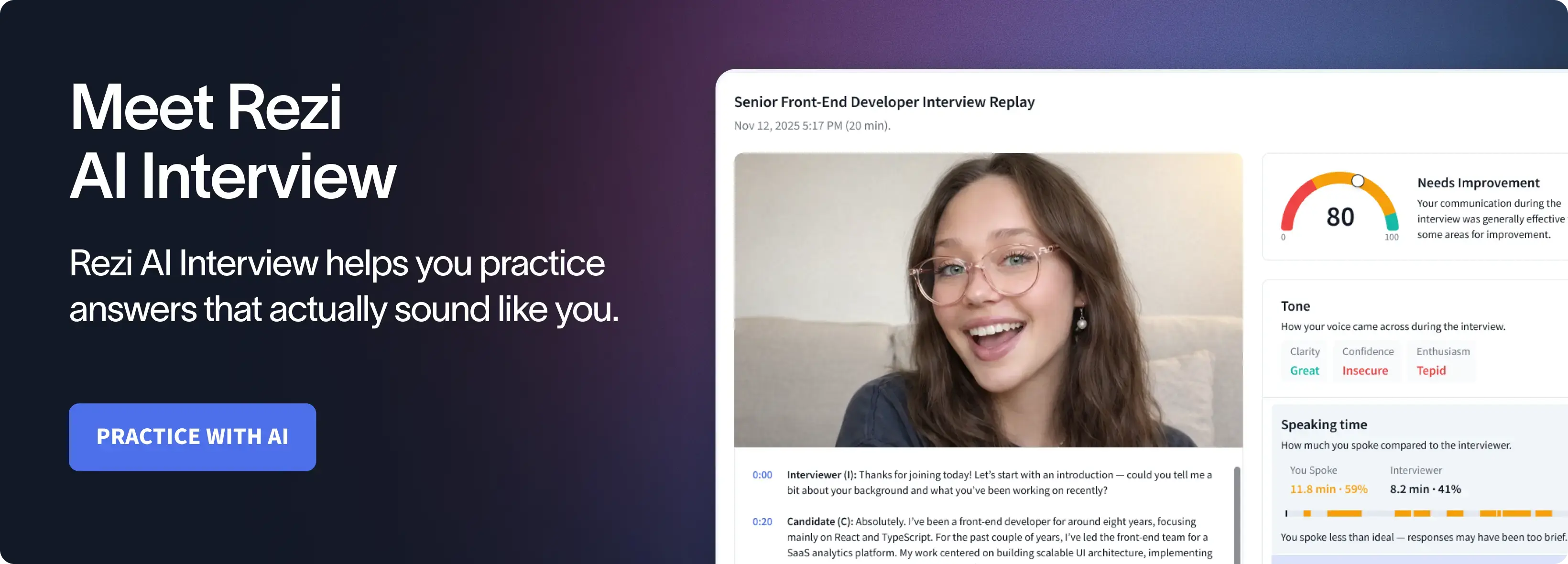
Rezi AI Interview evaluates whether you’re using enough of the response window to communicate your answers clearly.
Rather than aiming for an exact percentage, the goal is for you to own the majority of the response window — typically around 60–70% or more — so your answers feel fully developed without becoming verbose.
This doesn’t mean talking for the sake of talking. It means answering the question thoroughly, then stopping once your point is made.
Feedback focuses on if your answers come across as the following:
- Underdeveloped
- Appropriately complete
- Overextended
Example: poor vs strong speaking time
Example interview question: “Can you summarize your role on your last project?”
Bad reply with poor speaking time: “I mainly worked on the frontend.”
This response signals poor speaking time because:
- It gives up speaking time
- No signal of value, ownership, or impact
- Forces follow-up questions
Strong reply with good speaking time: “On my last project, I owned the frontend architecture. I defined the component structure, established consistent state management, and ensured shared UI logic was easy to maintain. I also collaborated closely with backend engineers to align on API contracts early, which reduced integration issues and helped the team ship faster.”
This response signals good speaking time because:
- It’s a fully developed answer
- Signals clear ownership
- Concise but complete
- Appropriately fills the response window
How to Improve Your Speaking Time for Job Interviews
More talking doesn't always lead to better results; often, more is said by saying less. Strong speaking time is about using your response window effectively to make sure your experience is fully understood.
Here’s how to improve your speaking time in interviews:
1. Answer fully, then stop
Avoid overly short replies that invite follow-up questions too early. Deliver a complete answer, then pause. This shows confidence and control.
2. Ask clarifying questions early
If a question seems too broad or ambiguous, ask a brief clarifying question before answering. This helps you give a more focused response and reduces interruptions later.
3. Own the response window
Treat each question as your allotted space to demonstrate value. Use it intentionally to explain your role, decisions, and impact.
How to Thoughtfully Expand Your Answers in Job Interviews
Here are strategies to expand your interview answers:
- Structure your answers to behavioral questions using the STAR method. Start with brief context, add your task or responsibility, followed by what you did (this part should take the most time), and ending with a positive outcome or key takeaway.
- Use bridge statements by connecting questions back to your strengths when relevant. For example, “That’s a great question, and it directly relates to my experience with…”
- Prepare 90-second narratives about key accomplishments. These give you a reliable way to expand answers without improvising under pressure.
How to Manage Speaking Time Without Dominating the Conversation
Good speaking time balances completeness with awareness.
- Watch visual cues. If interviewers lean forward or nod, continue. If they look away or shift, wrap up.
- Use check-ins when appropriate. Phrases like “Does that fully address your question?” or “Would you like me to elaborate on any part” can help ensure you and the interviewer are on the same page.
- Prioritize quality over quantity. It’s better to speak 60% of the time with clear, structured answers than 80% with rambling.
Best Practices for Speaking Time in Job Interview Communication
Improving your speaking time helps your experience land clearly without over-talking or underselling yourself. This is all about communicating your experience clearly, not trying to constantly fill the silence.
- Use structure to deliver complete answers that are easy to follow
- Spend most of your time explaining what you did and why it mattered
- Treat each question as your opportunity to demonstrate value
- Pause once your point is made instead of trailing off or over-explaining
- Stay aware of interviewer cues to guide when to continue or wrap up
These habits apply beyond interviews. Clear, well-timed communication improves meetings, presentations, and leadership conversations.
Common Speaking Time Mistakes That Can Hurt Job Interviews
Here are common mistakes people make when it comes to speaking time in job interviews:
- Giving answers that are too short and underdeveloped
- Ending responses early out of nervousness
- Rambling without a clear point or structure
- Talking past the question instead of addressing it directly
When speaking time is mismanaged, interviewers may struggle to assess your impact even if your track record is strong.
Improve Your Job Interview Performance Now
Rezi AI Interview helps you refine your interview skills so you never undersell your experience again. Turn your background into a compelling story that wins the job.

Upload or drop your resume to get started
Upload your resume to get started
Score my resume

Astley Cervania is a career writer and editor who has been sharing resume and job search insights for 5+ years. He shapes the direction of the Rezi blog, providing practical answers for important career-related questions and helping hundreds of thousands of people navigate the job market and build resumes that land interviews.