User Guides
AI Interview: Tone
Tone is one of five key categories that Rezi AI Interview assesses you on. It refers to how confident, professional, and engaged you sound.
Published on
January 22, 2026
Updated on
August 7, 2026
Tone is one of five key interview communication metrics that Rezi AI Interview assesses you on. It refers to how confident, professional, and engaged you sound. Even if your answers in an interview are technically correct, how you sound when you answer the interviewer’s questions are important for raising your perceived value.
Rezi AI Interview analyzes your tone to help you communicate clearly, confidently, and with intent in job interviews.
Check out more interview guides here:
- Common Interview Questions & Good Answers
- Phone Interview Questions to Prepare For
- Unique Interview Questions to Ask Employers
- How to Practice With Rezi AI Interview
What Is “Tone” in Rezi AI Interview?
With Rezi AI Interview, your tone is about how you deliver your answer. It captures whether your response sounds:
- Clear and easy to follow
- Confident and decisive
- Engaged and genuinely interested
A strong tone helps interviewers understand your answer quickly and trust your communication style.
Why Is Tone Important in Job Interviews?
Interviewers don’t just evaluate your answers. They also evaluate how those answers are delivered and communicated.
A strong, professional tone can:
- Increase perceived confidence and competence
- Make your answers easier to understand and remember
- Signal emotional intelligence and communication skills
- Improve how senior, reliable, and prepared you appear
Tone also matters beyond interviews. The same habits that improve interview tone — clarity, confidence, and engagement — improve overall professional communication, including meetings, presentations, and stakeholder conversations.
How Rezi AI Interview Assesses Your Tone
Rezi AI Interview evaluates tone by analyzing observable speaking behaviors rather than judging your ideas or opinions.
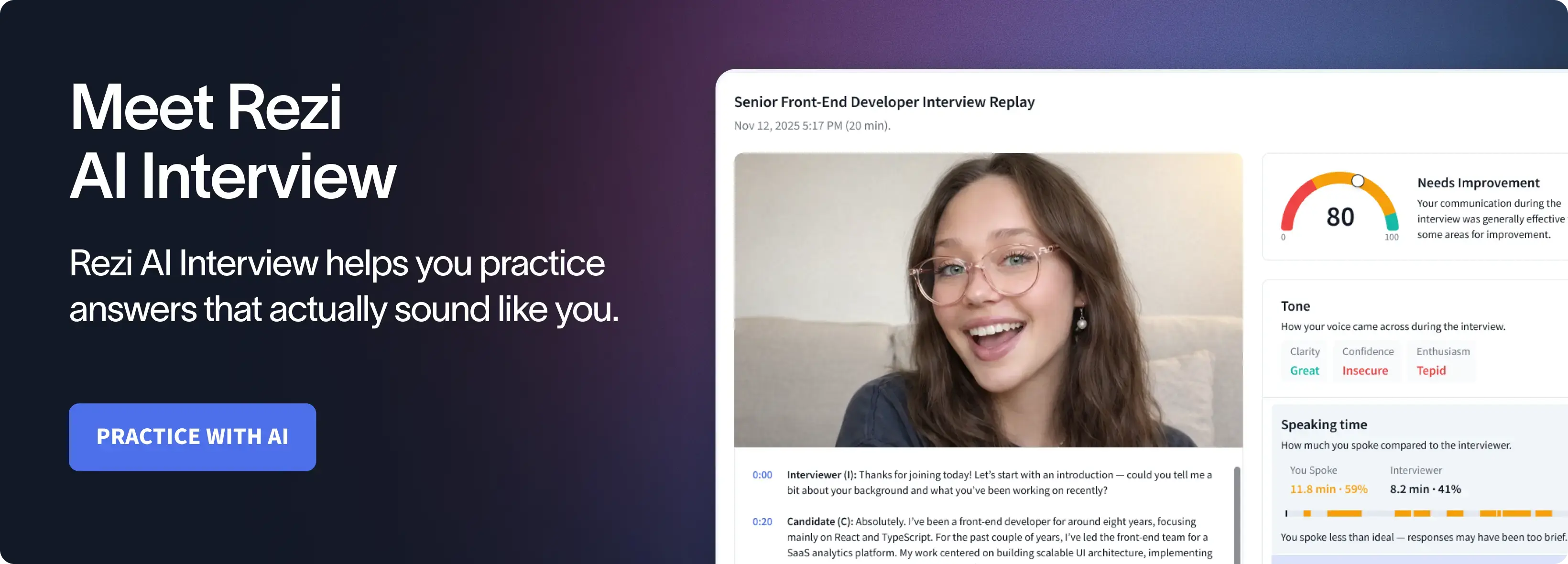
Tone is measured across three dimensions:
- Clarity: How clearly and logically your ideas come across
- Confidence: How decisive and certain your delivery sounds
- Enthusiasm: How engaged, expressive, and interested you appear
Each dimension highlights specific strengths and improvement areas so you know exactly what to work on.
Rezi evaluates the tone you use to communicate your experience: clarity of thought, confidence in delivery, and genuine engagement. These are the same signals hiring managers use to assess credibility, seniority, and professionalism during interviews. Each piece of feedback is grounded in real interview patterns and experience-based communication.
Clarity
Clarity is all about how understandable your answers are.
Rezi AI Interview measures how clearly words are articulated, whether your answers follow a logical structure, and if what you’re saying is easy to follow. Your interviewer should be able to summarize your answer in one sentence.
How to improve your clarity score
- Use structured answers (for example, use the STAR interview framework for a logical flow)
- Keep sentences focused on one idea at a time
- Use signposting phrases like “The key point is…” or “To summarize…”
- Pause briefly between ideas so they land clearly
Example of a bad reply: low clarity
Example interview question: “Can you explain a technical decision you made recently?”
Here is a reply with low clarity:
“So yeah, there were a lot of things going on, and we had to kind of think through a few options, and eventually we landed on something that seemed okay at the time, mostly because of constraints, but it wasn’t super straightforward.”
Why this reply is considered low clarity:
- Vague language
- Rambling and mumbling words
- No clear structure
- Hard to summarize
Example of a good reply: high clarity
Example interview question: “Can you explain a technical decision you made recently?”
Here is a reply with high clarity:
“Yes, I recently decided to migrate one of our services from REST to GraphQL. We were over-fetching data, which slowed down client-side rendering and made the frontend harder to maintain. I evaluated caching and pagination first, but they didn’t fully solve the problem. By moving to GraphQL, we reduced payload size by about 30% and simplified the frontend logic. As a result, page responsiveness improved noticeably and the team was able to ship changes faster.”
Why this reply is considered high clarity:
- Logical structure
- Straight-to-the-point language
- Specific details
- Easy to understand
Confidence
Confidence refers to how certain and assured you sound.
Rezi AI Interview measures whether your sentences sound deliberate or hesitant, your use of decisive and hedging language, and your vocal stability and certainty. For the best results, your statements should come across deliberate rather than exploratory.
How to improve your confidence score
- Replace hedging phrases (“I think”, “maybe”) with clear assertions
- End sentences with certainty rather than rising intonation that sounds like a question
- Pause instead of using fillers (silence is more preferable to filler sounds)
- Practice grounded posture and relaxed nasal breathing before speaking to stabilize vocal delivery
- Prepare strong opening lines for common questions to set the tone for the entire answer
Example of a bad reply: low confidence
Example interview question: “How do you typically approach debugging production issues?”
Here is a reply with low confidence:
“I think I usually start by maybe checking the logs first, and then I guess I try a few things to see what might be wrong, depending on the situation.”
Why it falls short:
- Hesitant phrasing
- Exploratory and uncertain tone
Example of a good reply: high confidence
Example interview question: “How do you typically approach debugging production issues?”
Here is a reply with high confidence:
“I start by isolating the impact and identifying whether the issue is systemic or localized.
I then review logs and metrics to form a hypothesis before making any changes. This approach minimizes risk and shortens resolution time.”
Why it works:
- Declarative statements
- No verbal uncertainty
- Controlled delivery
Enthusiasm
Enthusiasm is about how engaged you sound.
Rezi AI Interview measures vocal energy, emotional engagement, and expressiveness. The listener should be able to gauge your interest in the role and clearly identify or understand what motivates you.
How to improve your enthusiasm score
- Vary your pitch intentionally by emphasizing keywords or phrases with subtle vocal variation
- Briefly explain why something mattered to you
- Smile while speaking to naturally increase vocal warmth and energy
- Shift your tone when speaking between setup and outcome to avoid monotony
Example of a bad reply: low enthusiasm
Example interview question: “What part of your work do you enjoy the most?”
Here is a reply with low enthusiasm:
“I mean, I guess building features is fine. It’s part of the job, and yeah, that’s mostly what I do.”
Why it falls short:
- Flat delivery
- No emotional signal
- Sounds disengaged
Example of a good reply: high enthusiasm
Example interview question: “What part of your work do you enjoy the most?”
Here is a reply with high enthusiasm:
“I really enjoy turning ambiguous requirements into something concrete. When a feature goes from a vague idea into something users actively rely on, I find that extremely satisfying. I’ve built a strong track record of working with loosely defined problems, and seeing positive user feedback once a feature is live is a big motivator for me, especially when the impact of what I’ve built is clear.”
Why it works:
- Emotional engagement
- Vocal emphasis implied
- Clear personal motivation
Best Practices for Professional Tone in Job Interview Communication
Here are the best industry-standard communication practices for developing a strong interview tone:
- Structure answers so they’re easy to follow. A simple structure helps interviewers understand your thought process.
- Speak with intention. Ground your answers in what you did and what you observed, instead of hypothetical or hesitant language.
- Balance confidence with professionalism. Sound assured, and let clarity and calm delivery do the work.
- Show genuine interest without overacting. Enthusiasm should feel natural and experience-driven, not exaggerated or forced.
- Aim to sound natural and human. The goal is credible communication, not memorization.
These improve interview performance and translate directly to everyday professional communication from meetings to presentations to stakeholder discussions.
Common Tone Mistakes That Can Hurt Job Interviews
Many candidates lose impact not because their experience is weak, but because their tone undermines it.
Common mistakes include:
- Sounding unsure even when you have a real track record. Hesitant delivery can make strong experience sound less credible.
- Over-explaining instead of delivering clear points. More words don’t equal more value. Clarity builds trust.
- Using overly casual or disengaged delivery. Tone should match the professional setting and company’s values.
- Speaking in a flat or monotone voice all the time. Lack of vocal engagement may suggest low interest, even when that’s not true.
These mistakes can often cause interviewers to underestimate otherwise qualified candidates.
Improve Your Job Interview Performance Now
Rezi AI Interview helps you refine your interview skills so you never undersell your experience again. Turn your background into a compelling story that wins the job.

Upload or drop your resume to get started
Upload your resume to get started
Score my resume

Astley Cervania is a career writer and editor who has been sharing resume and job search insights for 5+ years. He shapes the direction of the Rezi blog, providing practical answers for important career-related questions and helping hundreds of thousands of people navigate the job market and build resumes that land interviews.
.webp)