

Career Advice
25 Best Blue-Collar Jobs: Definitions, Salaries & Examples
Discover the best blue-collar jobs with salaries, requirements, and examples. Learn which roles pay the most, the skills you need, and how to start your career.

Published on
September 26, 2025
Updated on
September 30, 2025
“Blue-collar jobs don’t pay well.” Heard that one before? Or, “You need a degree to earn a decent living.” These generalizations have stuck around for far too long. The truth? Some blue-collar careers can rival (or outpace) office jobs in pay, stability, and opportunity.
Blue-collar work spans a huge range of roles, from skilled trades to specialized technical fields. With the right training and some grit, you can build a solid career. Some take the journeyman to master level route, while others thrive by setting up their own business. Opportunity is there if you’re ready to put in the work.
Find out which blue-collar jobs are the best fit for you. This guide will cover:
- The blue-collar definition and industries.
- My picks for the best blue-collar examples with salaries.
- The difference between a blue-collar worker and a white-collar worker.
Looking for your next blue-collar job? Try our free AI Resume Builder to create a customized and ATS-friendly job application in minutes.
And check out these blue-collar resume examples to kick off your job application:
- Welder Resume Examples
- Plumber Resume Examples
- Electrician Resume Examples
- Firefighter Resume Examples
- Wind Turbine Technician Resume Examples
What Does Blue-Collar Mean?
When people say blue-collar work, they’re talking about jobs that are mostly hands-on, rather than desk-bound. This outdated term comes from the blue work shirts and uniforms that tradespeople often wore to handle dirt, grease, and long hours on the job.
But what’s considered blue-collar work has become blurry over the years.
Some jobs don’t need much formal training, so you can start working right after high school. There are also highly skilled trades, such as electricians, welders, and plumbers, which involve apprenticeships, certifications, and years of experience. What ties them together is the focus on physical work, problem-solving, and practical skills.
Yes, these jobs aren’t the easiest, but they’re also essential. Without blue-collar workers, the lights wouldn’t stay on, buildings wouldn’t go up, and half the things we take for granted every day just wouldn’t function. Another big plus? Many of these jobs can’t be replaced by AI.
What Are the Types of Blue-Collar Jobs?
Blue-collar work no longer fits into one box. You’ll find these essential workers in a whole mix of industries and roles. They are the people who keep everything running, and would be the first to survive in a zombie apocalypse. Most of them have highly specialized skills, working in a range of environments.
Here are some of the main blue-collar jobs, broken down by industry:
- Construction. Everything from carpenters and roofers to heavy equipment operators and electricians. Their work involves building our homes, offices, roads, and bridges.
- Manufacturing & factory work. Includes assembly line workers, machine operators, and quality control techs. They’re the ones producing the products we use daily, from cars and electronics to packaged food.
- Maintenance & repair. Covers plumbers, HVAC techs, and mechanics. They keep buildings, vehicles, and systems working safely and efficiently.
- Energy & utilities. Roles like power plant operators, wind turbine techs, and solar panel installers. These jobs are huge right now as the world shifts toward renewable energy, but they’ve always been essential for keeping the lights on.
- Mining & extraction. Miners, drill operators, and other specialists who extract natural resources like coal, oil, and natural gas. This can be tough work, but it’s still a major part of the global economy.
- Agriculture & farming. Farmworkers, equipment operators, and food-processing specialists, all making sure the food gets from the ground to our tables.
- Transportation. Includes truck drivers, subway operators, delivery drivers, and aircraft mechanics. Basically, anyone who helps move people or goods safely and reliably.
- Technical trades. Welders, nuclear technicians, elevator installers, and others in highly skilled niches. These roles often require certifications or apprenticeships, but the pay and job security can be top-notch.
Blue-collar work isn’t one-size-fits-all. Some jobs lean heavily on physical labor, while others are super technical and require years of training. But they all share one thing: they’re practical, hands-on, and essential to the foundations of society.
Thinking of moving into a blue-collar industry? Find out more: How to Change Careers
25 Best Blue-Collar Jobs
Claiming a job is “the best” is subjective. So how did I narrow the sea of blue-collar jobs down to just 25? I focused on three big factors:
- Salary: Does the job reward your time and effort?
- Entry requirements: How easy is it to break into the field?
- Career prospects: Is this a job that will stay in demand?
A quick note: salaries can vary a lot depending on experience and specialization. I didn’t list every niche or senior-level paycheck because, honestly, we’d be here all day. Instead, I used the median salaries for junior to intermediate-level workers to give you a general idea.
These numbers come from Salary.com, which calculates pay using an industry-standard method that adjusts for inflation and salary trends over time.
With that said, here’s a breakdown of the top blue-collar jobs:
Nurse
Salary: $116,793 median annual wage
Nurses are the backbone of the healthcare system, supporting doctors and collaborating with other professionals to ensure patients get the best care. While some debate whether nursing is blue- or white-collar, the physical demands and patient care certainly give it blue-collar qualities.
A nurse’s role covers monitoring vital signs, administering treatments, educating patients, and advocating for their needs. Success in this field takes empathy, communication, problem-solving, and the stamina to handle long shifts.
Entry requirements:
- Complete a nursing program (associate, bachelor’s, or hospital diploma route).
- Pass the NCLEX-RN exam to earn a state license.
- Clinical experience during training to learn hands-on skills.
- Continuing education courses to stay licensed and updated on best practices.
Check out these handy guides if you want to find a job in nursing:
Engineer
Salary: $92,162 median annual wage, though pay varies widely by specialty
Engineers design, test, and build systems that improve our lives, such as bridges, cars, software, and renewable energy. The field is vast, with specialties in mechanical, civil, electrical, and chemical engineering, each with its own unique focus.
Day-to-day, engineers may design projects, write code, analyze data, or present solutions to teams. While many roles are office-based, others require time in labs, workshops, or construction sites. Engineering blends technical expertise with creativity and communication.
Entry requirements:
- A bachelor’s degree in engineering from an accredited program is the standard path.
- An associate degree can help prepare for further study, but it rarely qualifies for full roles.
- You may need licensing for higher-level work.
- Strong math, science, and problem-solving skills are essential for success.
Check out these engineering resume examples for different specializations:
- Engineer Resume Examples
- Materials Engineer Resume Examples
- Mechanical Engineer Resume Examples
- Automation Engineer Resume Examples
Elevator Installer and Repairer
Salary: $82,047 median annual wage
Elevator installers and repairers specialize in assembling, maintaining, and troubleshooting elevators, escalators, and similar systems. They ensure smooth and safe operation of the equipment in commercial, residential, and industrial buildings.
The work requires strong electrical and mechanical knowledge, along with problem-solving skills, to diagnose issues. Technicians often work in confined or elevated spaces, making safety training critical.
Entry requirements:
- High school diploma or GED required.
- Most enter the trade through union or contractor-sponsored apprenticeships (usually 4 years).
- Most states require licensing to work independently.
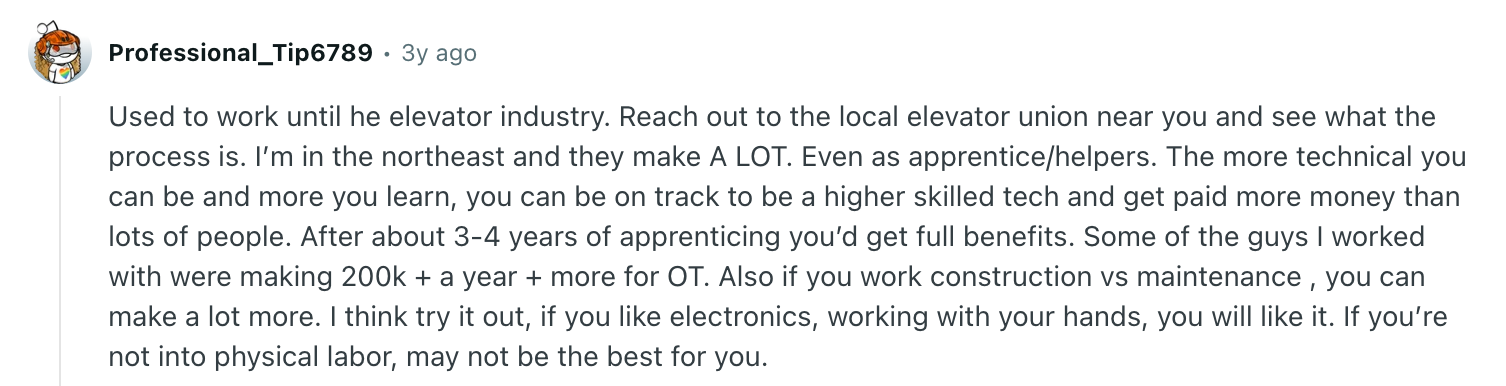
Here’s what a former worker in the elevator industry said about this career path:
Power Plant Operator
Salary: $80,945 median annual wage
Power plant operators manage systems that generate and distribute electricity, ensuring the grid runs smoothly. They monitor equipment, adjust controls, and respond to emergencies to keep power flowing.
Operators often specialize in plants powered by coal, gas, nuclear, or hydroelectric energy. The role requires focus, technical ability, and readiness to work rotating shifts, including nights and weekends.
Entry requirements:
- High school diploma or GED required.
- Some employers prefer vocational or college training.
- Extensive on-the-job training is typical, especially for new hires.
- Nuclear plant operators must earn an NRC license, which requires training, experience, a medical exam, and a licensing test.
Wind Turbine Service Technician
Salary: $65,690 median annual wage
Wind turbine technicians install, maintain, and repair turbines that generate renewable energy. Their work keeps these machines running, supporting the transition to clean power. Tasks may include inspecting components, troubleshooting electrical or hydraulic systems, and climbing turbine towers.
The role demands technical know-how, physical stamina, and comfort with heights and harsh outdoor conditions. However, a major plus is that this is a rapidly growing industry, with the U.S. Bureau of Statistics predicting these jobs will grow by a huge 50% by 2034.
Entry requirements:
- Associate degree or technical training in mechanical, electrical, or engineering fields.
- Hands-on experience with machinery or electronics is often required before hiring.
- Employers often provide turbine-specific training after hiring.
- Must pass physical tests (vision, hearing, endurance) and meet safety standards.
- Comfort with working in remote or offshore environments.
Plumber
Salary: $64,933 median annual wage
Plumbers keep water, gas, and heating systems running in homes, businesses, and industrial facilities. They install pipes, repair leaks, and maintain equipment like water heaters or HVAC systems, often working alongside other trades on construction projects.
Daily tasks include reading blueprints, troubleshooting problems, and using specialized tools. Knowledge of building codes and safety standards is a must. Plumbers also rely on math skills for measuring, calculating, and ensuring everything fits precisely.
Entry requirements:
- A high school diploma or equivalent is the minimum requirement.
- Apprenticeships (4–5 years) combine on-the-job training with study.
- Must pass a licensing exam to become a journeyman, then later a master plumber.
- Trade school programs can be an alternative path to get started more quickly.
Here’s a plumber’s success story from Reddit:

Electrician
Salary: $64,658 median annual wage
Electricians install, maintain, and repair electrical systems in homes, businesses, and factories. They’re the experts who make sure lights, machines, and power systems operate safely and reliably.
Daily tasks include reading blueprints, running wiring, inspecting equipment, and troubleshooting issues. Safety knowledge is crucial, since electricians often work with live circuits or high-voltage equipment.
Entry requirements:
- High school diploma or GED required (math and mechanical courses are useful).
- Apprenticeships (4–5 years) combine job-site experience with study.
- You may need to take a license exam to become a certified journeyman.
- With additional years of experience, electricians can advance to master status, allowing them to train others and take on more complex projects.
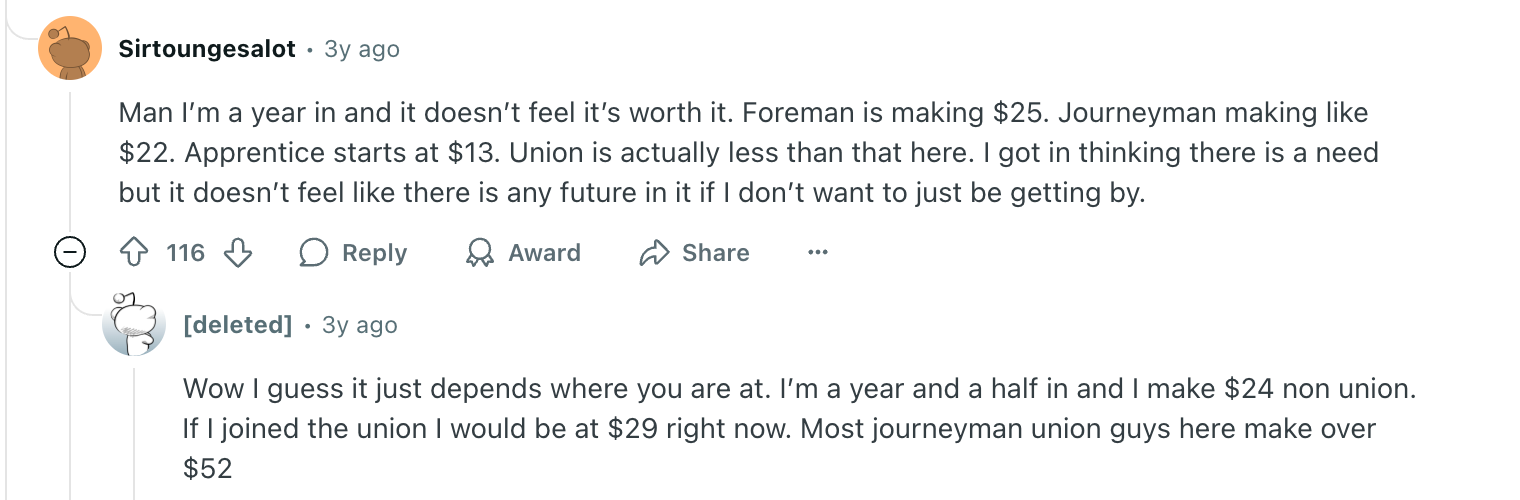
Just a heads up: I found mixed accounts online regarding an electrician’s salary:
Police Officer
Salary: $63,900 median annual wage
Police officers protect communities by enforcing laws, responding to emergencies, and maintaining public safety. Beyond crime prevention, they play a vital role in building trust and positive relationships with the public.
The job calls for sharp decision-making, communication, and teamwork. Officers might spend a shift patrolling, writing reports, or helping resolve conflicts. They also need the physical ability to run, lift, and occasionally deal with high-stress situations.
Entry requirements:
- You’ll need a high school diploma at a minimum.
- Many agencies prefer training courses or a degree.
- Must complete and graduate from a police academy program.
- Physical fitness test, background check, and sometimes a psychological evaluation.
Aircraft Mechanic
Salary: $62,770 median annual wage for aircraft mechanics; $81,390 for avionics technicians
Aircraft mechanics and avionics technicians maintain and repair airplanes and helicopters, ensuring they are safe and flight-ready. They may specialize in engines (powerplant), aircraft bodies (airframe), or onboard electronics (avionics).
The job involves inspections, part replacements, system tests, and strict record-keeping to meet FAA regulations. Mechanics work in hangars, airports, or repair stations and play a crucial role in aviation safety.
Entry requirements:
- Must be proficient in English.
- Training usually comes from FAA-approved aviation maintenance technician schools or military aviation programs.
- FAA certification is mandatory: Airframe (A), Powerplant (P), or both (A&P).
- Mechanics must pass written, oral, and practical exams to be licensed.
Firefighter
Salary: $62,595 median annual wage
Firefighters do much more than fight fires — they handle medical emergencies, car accidents, search-and-rescue operations, and disaster response. They’re community protectors, often providing fire safety education and supporting local services beyond emergency calls.
The job requires courage, quick decision-making, and strong teamwork. Firefighters face dangerous, high-pressure situations and need both physical strength and endurance. Many departments also require emergency medical training, since medical calls can make up a lot of their work.
Entry requirements:
- High school diploma or GED required.
- Must pass written civil service exams and the Candidate Physical Ability Test (CPAT).
- Complete fire academy training and a probationary period after hiring.
- EMT or paramedic certification is often required, especially in larger cities.
Just remember, firefighting isn’t all action and heroics:

Automotive Mechanic
Salary: $61,585 median annual wage
Auto mechanics are the problem-solvers who keep our cars running. They diagnose, repair, and maintain everything from engines and transmissions to brakes and electrical systems. Their expertise helps extend the life of vehicles and keeps drivers safe.
A typical day might involve running diagnostics, doing oil changes, replacing worn parts, or performing complex repairs. Mechanics combine technical skill with customer service, since explaining issues helps build trust with vehicle owners.
Entry requirements:
- A high school diploma or GED is the base requirement.
- Technical training through trade schools or community colleges is recommended.
- Apprenticeships or entry-level shop jobs provide critical hands-on experience.
- ASE certification (exams + work experience) can boost career options and credibility.
Construction Inspector
Salary: $60,860 median annual wage
Construction and building inspectors ensure projects, such as buildings, roads, and bridges, meet safety codes, design specs, and legal requirements. They review plans, inspect sites, and document compliance throughout the construction process.
The role requires knowledge of construction methods, attention to detail, and the ability to spot potential problems early. Inspectors often walk job sites and interact with contractors, engineers, and government officials.
Entry requirements:
- A high school diploma or equivalent is the minimum standard.
- Many inspectors pursue certificates or associate degrees in building inspection technology or construction technology.
- Some employers prefer candidates with a bachelor’s degree in construction management, civil engineering, or architecture.
- Certifications from organizations like ICC (International Code Council) can improve career opportunities.
Carpenter
Salary: $60,054 median annual wage
Carpenters are skilled woodworkers who build and repair furniture, cabinetry, building frameworks, and trim. They’re vital on construction sites, contributing to residential, commercial, and infrastructure projects.
Their work involves reading blueprints, measuring materials, and using both hand and power tools to cut, shape, and assemble wood. Precision, attention to detail, and creativity are all key in this craft.
Entry requirements:
- A high school diploma or equivalent is often preferred.
- Most learn through apprenticeships or on-the-job training with experienced carpenters.
- Vocational school or technical programs (6 months–2 years) provide formal training.
- State licenses may be required; these typically involve passing an exam and proving work experience.
Boilermaker
Salary: $58,539 median annual wage
Boilermakers build, install, and repair boilers, tanks, and other large vessels that hold liquids or gases under pressure. Their work is critical in industries such as power generation, shipbuilding, and manufacturing.
The role involves blueprint reading, cutting and welding metal, assembling components, and conducting pressure tests. Boilermakers often work in confined spaces, at heights, and in physically demanding conditions.
Entry requirements:
- A high school diploma or GED is required.
- Most learn through 4 to 5-year apprenticeships.
- Welding skills are highly valued, and many boilermakers pursue welding certification.
- Some states require specific licenses for certain types of boiler work.
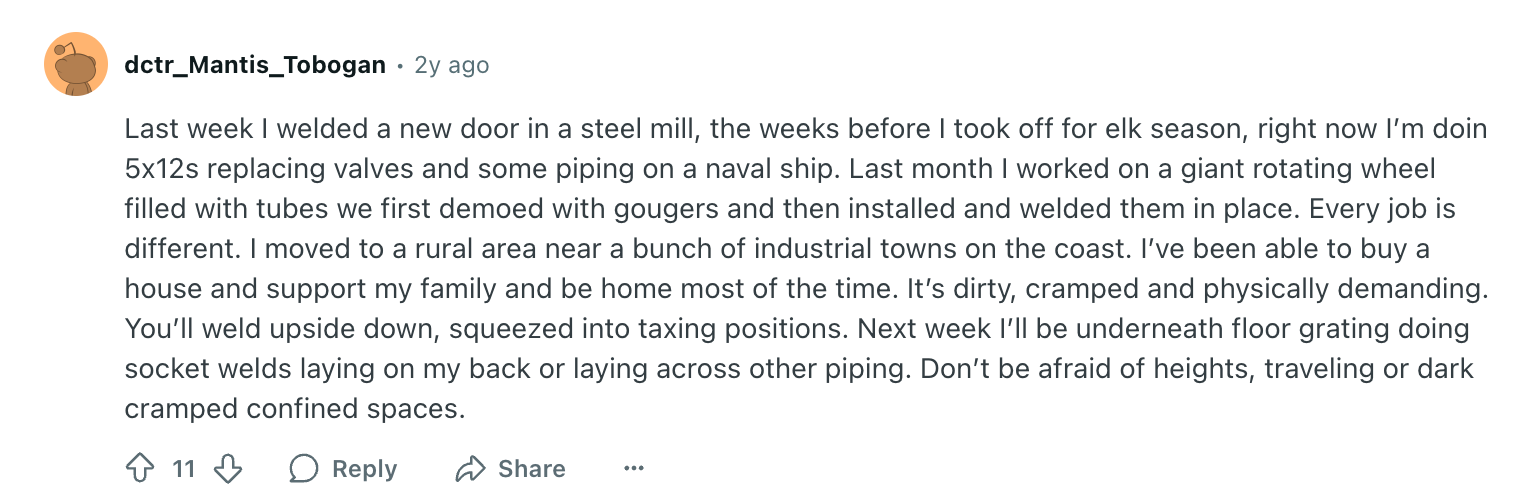
Here’s an accurate representation of the highs, lows, and everything in between of being a boilermaker:
Solar Panel Installer
Salary: $58,296 median annual wage
Solar panel installers, also called solar PV installers, set up panels and support structures on homes, businesses, and large-scale projects. They often work in teams and collaborate with electricians to connect systems to the power grid.
The role includes planning layouts, mounting equipment, wiring panels, and testing performance. Installers need good tool skills, basic electrical knowledge, and comfort working outdoors on rooftops or other elevated sites.
Entry requirements:
- A high school diploma or GED is the minimum requirement.
- Vocational school or community college programs in solar technology provide useful technical training.
- Certifications (such as NABCEP) aren’t always required, but can improve job prospects.
- Employers value hands-on skills with tools, basic wiring, and comfort working at heights.
Landscaper
Salary: $56,251 median annual wage
Landscapers bring outdoor spaces to life, blending plants, pathways, and structures into inviting environments. They may work on private yards, public parks, or large commercial properties, with projects ranging from routine upkeep to major redesigns.
The work is very hands-on, involving tasks like planting, mowing, building patios, setting up irrigation systems, and controlling pests. You need physical stamina, an eye for design, and knowledge of plants and soils. Since most jobs are outdoors, you have to be comfortable working in all weather.
Entry requirements:
- You don’t need a formal degree, but on-the-job training teaches core skills.
- Must hold a state license if applying pesticides or fertilizers.
- Familiarity with landscaping tools and safe equipment use.
- Ability to lift heavy loads, bend, kneel, and work in varied weather.
Welder
Salary: $56,023 median annual wage
Welders join metals together to create or repair structures, tools, and machinery. Their work shows up everywhere — in bridges, pipelines, cars, airplanes, and buildings. With welding methods like MIG, TIG, or stick welding, skilled welders can adapt to a variety of projects.
The role demands precision, problem-solving, and stamina. Welders must measure, cut, and assemble materials accurately while working safely around heat, sparks, and heavy equipment. Strong math skills and attention to detail are handy, along with following strict safety protocols.
Entry requirements:
- High school diploma or GED, ideally with math and science coursework.
- Training through community college, vocational school, or trade high school.
- Apprenticeships provide paid, hands-on industry experience while learning.
- Certification from the American Welding Society (AWS) boosts credibility.
While the median salary is around $50k, some claim you can earn six-figures:

Factory Worker
Salary: $50,220 median annual wage
Factory workers are the backbone of manufacturing, producing everything from food and clothing to pharmaceuticals and machinery. Their responsibilities vary by industry but may involve assembling products, operating machines, packing goods, or checking quality.
This work often requires standing for long hours, handling heavy materials, and following safety procedures. Operators focus on running equipment, while assemblers put components together into finished products. With experience, workers can move into specialized or supervisory roles.
Entry requirements:
- A high school diploma or GED is required in most cases.
- Must be physically fit for lifting, moving, and standing for long periods.
- Employers often provide on-the-job training for specific machines and tasks.
- Willingness to follow safety protocols and work in repetitive environments is essential.
Truck Driver
Salary: $48,316 median annual wage
Truck drivers keep the economy moving by delivering goods across towns, states, or the country. Routes can be local, regional, or national, with schedules ranging from standard shifts to long-haul trips that last days at a time.
The work involves driving long distances, loading and unloading cargo, inspecting vehicles for safety, and sometimes handling minor mechanical issues. Independence, problem-solving, and good communication with dispatchers and clients are all important.
Entry requirements:
- A high school diploma or equivalent is preferred, though not always required.
- Must hold a valid state driver’s license and maintain a clean driving record.
- You need a Commercial Driver’s License (CDL) for heavy trucks.
- Ability to pass medical exams, drug tests, and meet federal safety requirements.
Construction Worker
Salary: $44,100 median annual wage
Construction laborers help build homes, offices, roads, and infrastructure. They’re part of crews that handle projects from the ground up, often working in fast-paced, busy environments alongside skilled workers and supervisors.
Their daily tasks may include carrying materials, operating tools, digging, or assisting specialists like carpenters and electricians. And the industry isn’t slowing down. The U.S. Bureau of Statistics predicts construction employment will grow 7% in the next decade, way faster than the average for all occupations.
Entry requirements:
- You don’t need formal schooling, though most employers prefer a high school diploma.
- Learn skills directly on-site through training and shadowing experienced workers.
- Must be physically fit to handle heavy lifting and tough conditions.
- Certifications (like OSHA safety, lead removal) may open up more opportunities.
Roofer
Salary: $40,697 median annual wage
Roofers specialize in installing and repairing roofs, keeping buildings safe, dry, and energy efficient. They work on homes, businesses, and industrial sites, tackling projects that range from minor patching to complete replacements.
The job requires climbing ladders, lifting heavy materials, and working at heights in all weather. Despite the hard work involved, this is another fast-growing industry, with jobs expected to increase 6% by 2034.
Entry requirements:
- A high school diploma or GED provides a helpful foundation.
- Most roofers learn on the job or through apprenticeships with contractors.
- Math and physics knowledge are useful for measurements and structural planning.
- Licensing requirements vary by state, especially for contractors running their own business.
Here’s some honest advice if you’re thinking about a long-term career in roofing:

What Are the Highest-Paying Blue-Collar Jobs?
There’s a common misconception that blue-collar jobs don’t pay as well as their white and gold collar counterparts. And sure, those office jobs can come with some hefty paychecks. But so can specialized trades that also require years of training and experience.
Here’s a rundown of the highest-paying blue-collar jobs:
- Nurse ($116,800/year): Nursing is technically a blend of blue- and white-collar, but it makes the list because it’s so hands-on. It’s also one of the best-paying career paths in this space. Nurses are in demand everywhere, and the pay reflects that.
- Engineer ($92,200/year): Engineering also straddles the line between blue- and white-collar, but many roles involve fieldwork and hands-on problem-solving. If you’ve got a degree and technical savvy, engineering is a lucrative option with many specialties.
- Elevator installer and repairer ($82,000/year): This is one of those jobs most people don’t think about, but it’s an excellent trade. It requires strong mechanical and electrical skills, often gained through an apprenticeship. The pay is high, and demand is steady.
- Power plant operator ($80,900/year): Operators are the ones keeping electricity flowing to our homes and businesses. It’s highly technical work, and while some plants are downsizing, the positions that remain tend to pay really well.
- Wind turbine technician ($65,700/year): A newer trade that’s booming thanks to renewable energy. It’s physical, technical, and sometimes requires working in remote or high-up places, but the pay is solid and the job outlook is promising.
- Plumber ($64,900/year): Plumbing is one of those trades that will never go out of style. Skilled plumbers can make pretty good money, especially if they branch out on their own or specialize in complex systems.
- Electrician ($64,700/year): Like plumbing, electrical work isn’t going anywhere. Electricians earn strong wages, and as you advance from apprentice to journeyman to master, your earning potential grows significantly.
Blue-Collar Worker vs. White-Collar Worker: What’s the Difference?
Before exploring the differences, let’s recap the definition of blue-collar vs. white-collar jobs.
White-collar jobs are often associated with office or remote work. Roles include managers, accountants, or consultants, where they spend most of the day at a desk or on a computer. They usually get a fixed salary and often require a college degree or higher education.
Blue-collar jobs are more hands-on and physical. Workers are often on construction sites, factories, repair shops, and outdoors, focusing on building, operating, or fixing. It’s often enough to have a high school diploma, licensing, and hands-on experience to secure one of these jobs.
Here’s a quick overview of the key differences between blue and white-collar jobs:
| Category | Blue-Collar Jobs | White-Collar Jobs |
|---|---|---|
| Work setting | Blue-collar jobs often take place in physical environments, like construction sites, factories, or outdoors. | White-collar jobs are typically in offices, corporate buildings, healthcare facilities, or remote home offices. |
| Type of work | The work is hands-on, physical, and often involves operating machinery, tools, or manual labor. | The work is primarily mental or administrative, focusing on analysis, management, or planning. |
| Pay | Employers can pay blue-collar workers hourly, so earnings can vary based on hours worked or productivity. | Most white-collar workers receive a fixed annual salary, often with benefits and sometimes performance bonuses. |
| Education | A high school diploma is often enough, with additional training gained through apprenticeships, certifications, or vocational programs. | A college degree is usually required, and some roles demand advanced degrees or specialized certifications. |
| Skills | Workers can often develop skills through hands-on experience, trade schools, or union apprenticeships. | Skills are typically built through academic study, professional certifications, and training programs. |
| Examples | Common jobs include electricians, welders, plumbers, truck drivers, and construction workers. | Typical jobs include accountants, consultants, lawyers, managers, and office administrators. |
Now, let me say this loudly for the people at the back.
Just because white-collar workers often have a degree, it doesn’t make them more skilled than blue-collar workers. I work in a white-collar industry, but I’d have no idea how to repair complex electrical systems without giving myself a shock. White and blue-collar workers both have skills that are important in different areas of society, but that doesn’t make one better than the other.
Final Thoughts: What Is the Best Blue-Collar Job?
The “best” blue-collar job depends on what you value most. If you want top-dollar pay, roles like nurses, engineers, elevator installers, and power plant operators are all lucrative choices.
If you care about stability and future growth, fields like wind turbine technicians and solar panel installers are worth a look, as renewable energy is only getting bigger. Want a balance of pay and reliable demand? Electricians and plumbers are both popular careers that will likely stand the test of time.
Ultimately, the best blue-collar job is the one that fits your strengths, interests, and lifestyle. Some roles require years of apprenticeships or certifications, while others let you start with just a high school diploma and on-the-job training. What’s important is finding work that pays the bills but also feels sustainable for you long term.
FAQ
How to get a blue-collar job?
Getting started in a blue-collar job usually doesn’t require a four-year college degree. Most people start with a high school diploma or GED and then either jump straight into entry-level work or enroll in a vocational program. From there, you can take apprenticeships, get certifications, or just learn on the job. A lot of trades are built on hands-on training, so your career path often grows with your skills.
What is considered a blue-collar worker?
A blue-collar worker is someone who does hands-on, often physical work, such as building, repairing, operating machinery, or maintaining systems. Roles include electricians, mechanics, welders, and truck drivers. These are the people who keep everything running behind the scenes.
Where did the term blue-collar come from?
The term is pretty outdated, as it originates from the sturdy blue denim and chambray shirts that manual laborers used to wear back in the day. The fabric was practical and dark enough to hide dirt and durable enough for tough work. Over time, “blue-collar” became shorthand for jobs outside the office.
Who is a blue-collar worker?
If your job relies more on skill, tools, and physical effort than sitting at a desk crunching numbers, you’re a blue-collar worker. That includes everyone from carpenters to miners to solar panel installers. Some roles are unskilled and require little training, while others are highly specialized trades that take years to master.
What blue-collar job pays the most?
Among the highest-paying roles, elevator installers and repairers take the crown, with salaries well into the six figures. Power plant operators also rank high, along with skilled trades like boilermakers and aircraft mechanics. These jobs often require technical training, certifications, and in some cases, apprenticeships, but the payoff can be huge.
What are the easiest blue-collar jobs?
“Easy” is subjective, but generally, the easiest to get into are jobs that require little training upfront. This could be entry-level construction laborers, landscapers, or factory workers. They may not pay as much as specialized trades, but they’re a solid way to get your foot in the door, and you can always build skills and move into higher-paying roles down the line.

Upload or drop your resume to get started
Upload your resume to get started
Score my resume

Lauren Bedford is a seasoned writer with a track record of helping thousands of readers find practical solutions over the past five years. She's tackled a range of topics, always striving to simplify complex jargon. At Rezi, Lauren crafts genuine and actionable content that guides readers in creating standout resumes to land their dream jobs.