
Resume
Here’s How Recruiters Rewrite Candidate Resumes Efficiently
Most resumes get touched by recruiters. Besides optimizing the format, they may edit the summary, experience, and skills resume sections of a candidate.

Published on
November 27, 2025
Updated on
November 27, 2025
Before rewriting a candidate’s resume, recruiters first check if the candidate meets the basic job requirements. If they do, the focus shifts to refining the work experience section, then tightening up the skills and summary so everything is tailored to the client’s needs. To make this process faster, white-labeled resume software like Rezi Enterprise can help rewrite and reformat candidate resumes in minutes.
If you run a staffing agency or recruiting platform, you already know this: most candidate resumes aren’t client-ready.
They’re too long, poorly formatted, or filled with vague details that don’t line up with the role.
And while your recruiters may only spend a few seconds scanning each one, almost every resume still needs some level of cleanup before it can be submitted. This doesn’t necessarily mean full rewrites, but more about optimization.
Teams reformat resumes into a consistent template, polish up work experience bullets, refine skills to match the role, and add a clear summary so hiring managers can quickly see fit. It’s extra work, but it’s also one of the clearest ways agencies add value to both clients and candidates.
How Often Do Recruiters Rewrite Candidate Resumes?
Short answer: almost every resume gets touched in some way, but not every resume gets a full rewrite.
It’s common for resumes to come in not quite client-ready. They might be five pages long, formatted poorly, or filled with details that don’t line up with the role. In those cases, staffing teams often step in to reformat or tidy up the resume—sometimes even rewrite sections—so long as the candidate meets the core requirements.
Of course, not every resume is worth the effort.
If the experience doesn’t align with the job or the quality is too poor, many recruiters simply move on. But in practice, staffing teams handle the majority of resumes before submission, because clients expect clean, consistent documents that present candidates in the best possible light.
How to Rewrite Candidate Resumes Effectively
Here’s how to rewrite a resume:
- See if the candidate meets the basic job requirements.
- Focus on the work experience section.
- Refine the skills section.
- Tweak the summary section.
These three sections—experience, skills, and summary—are where hiring managers spend most of their attention, which is why you should usually focus your rewriting efforts here. They’re the parts of the resume that quickly answer the question: can this candidate do the job?
By tightening up work history, refining the skills list to match client expectations, and making the summary clear and targeted, you’re making sure the candidate’s strongest points are front and center. That not only makes your candidate look better, it also makes your submissions easier and faster for clients to evaluate.
Related guides:
1. See if the candidate meets the basic job requirements
Before you put effort into rewriting a resume, take a quick pass to see if the candidate actually meets the role’s baseline requirements. Recruiters rarely spend more than a few seconds on this first scan—just like an ATS, you’re checking for the essentials.
That means looking for the must-haves: core skills, relevant job titles, required certifications, or industry background. If those elements aren’t there, no amount of reformatting will make the candidate a real fit, and it’s usually better to move on.
But if they hit the basics, then a resume rewrite can be worth it. Just refine the way their experience is presented so clients see the value clearly. This quick qualification step saves you time, keeps clients from wasting theirs, and makes sure that candidates only move forward when there’s a genuine chance of success.
2. Focus on the work experience section
The work experience section is the most important part of a resume. Make sure the candidate’s past roles translate into value for the client.
When rewriting this part of the candidate’s resume, make sure the language used to describe key achievements align with the target job description.
To save time, you can also use tools like Rezi AI Bullet Point Editor. This helps you turn a vague resume sentence into something sharper and outcome-focused. Just highlight the bullet point and get up to three suggestions for improving it.
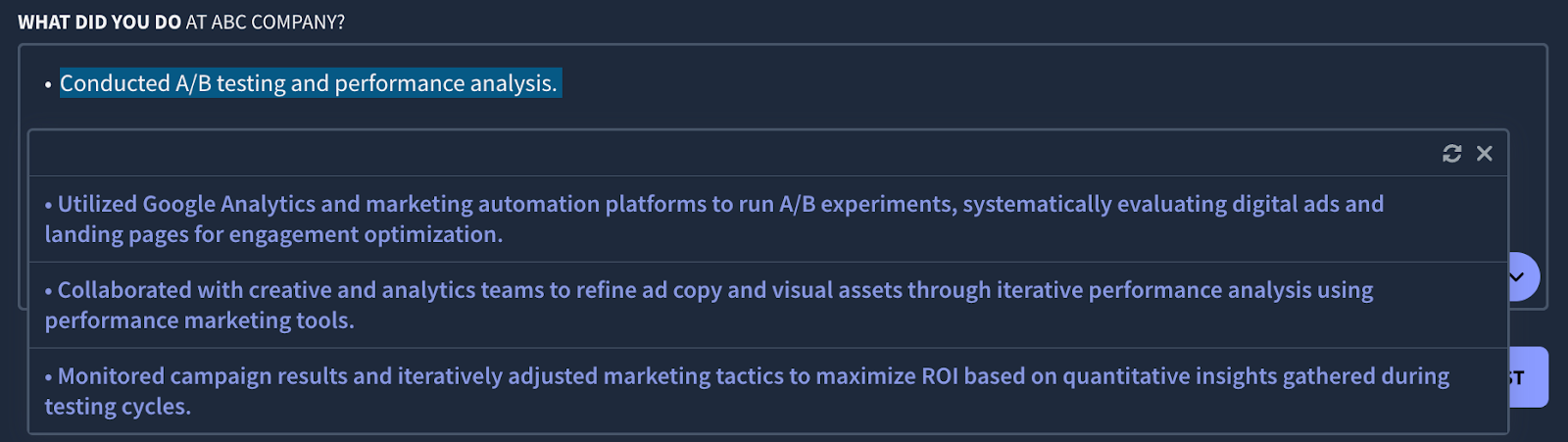
That said, here’s the line you can’t cross: never misrepresent the candidate.
One Reddit post shared the story of a candidate who was blindsided in an interview when the hiring manager asked about responsibilities they had never done. The recruiter had completely redone their resume, even adding skills and experience that the candidate didn’t have.
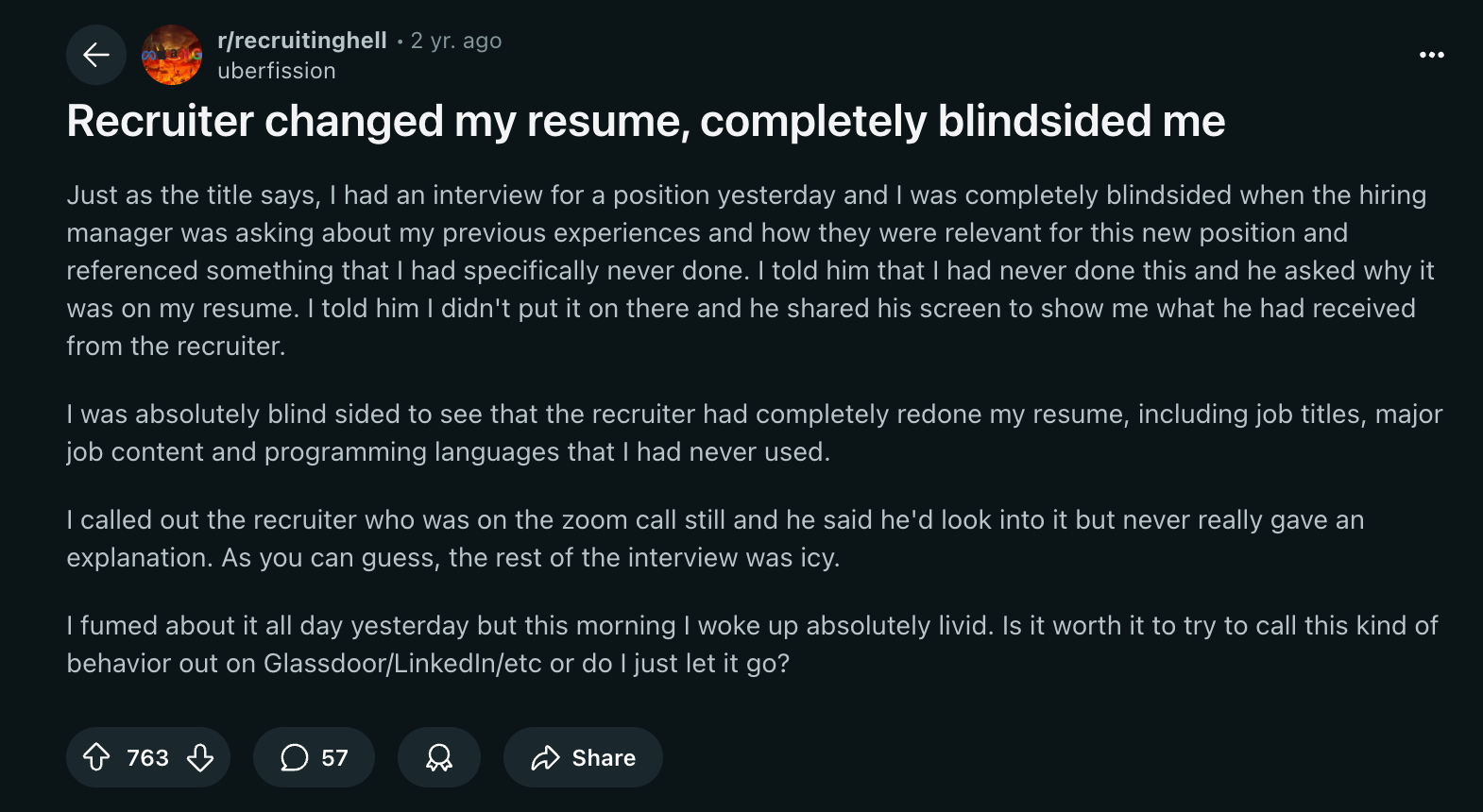
This is the exact opposite of what “resume rewriting” should mean.
Your role is to polish, not fabricate. Preserve the candidate’s true background and achievements, and only refine how those are presented. Your edits should make them look their best without ever putting their credibility—or your agency’s reputation—at risk.
3. Refine the skills section
The resume skills section might feel like an afterthought, but for clients (and their ATS), it’s one of the quickest ways to judge fit. A scattered list of “Microsoft Office, teamwork, communication” won’t cut it. The skills you highlight should directly reflect the role and what the client cares about.
When rewriting, focus on tightening the list. Include the most important resume skills. Remove irrelevant or generic skills, and make sure the most in-demand, job-specific ones are front and center. For example, if you’re submitting for a data analyst role, “SQL” and “Tableau” should stand out, not “time management.”
To make sure you’ve included all key skills in minimal time, tools like Rezi AI Keyword Targeting can scan a job opening and show which skills and keywords matter most. You can use this to check if the candidate’s resume is aligned or to quickly add in skills they already have but forgot to include.
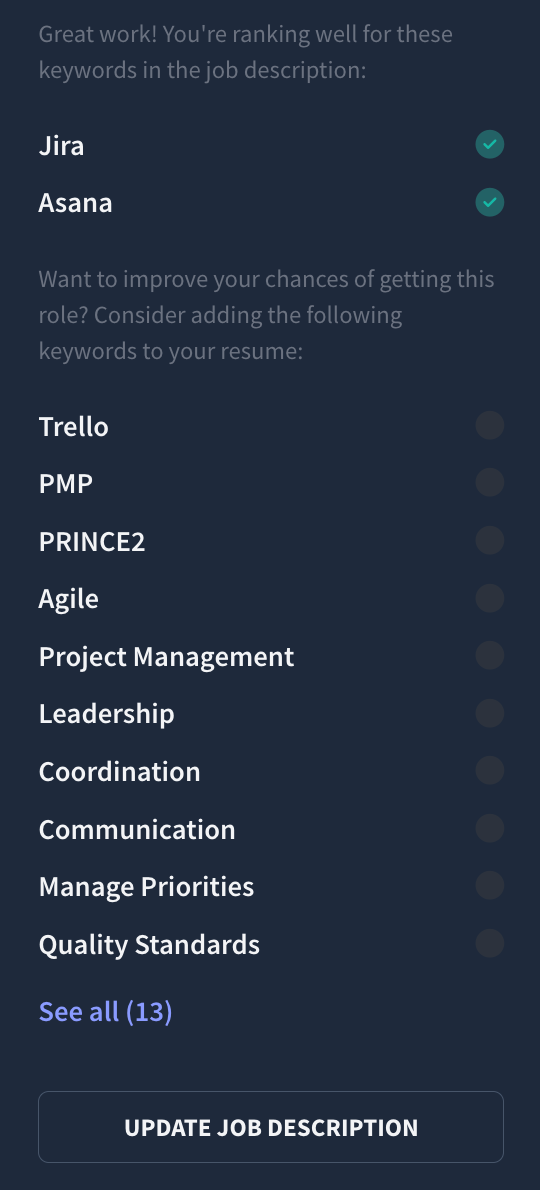
4. Tweak the summary section
The resume summary is one of the first things a hiring manager sees.
Too often, candidates either skip it or write something vague like “hardworking professional seeking new opportunities.” That doesn’t help your client make a quick decision.
When rewriting, the goal is to make the summary short, clear, and tailored to the role. A good summary should highlight the candidate’s core strengths, career highlights, and what makes them best for the specific role.
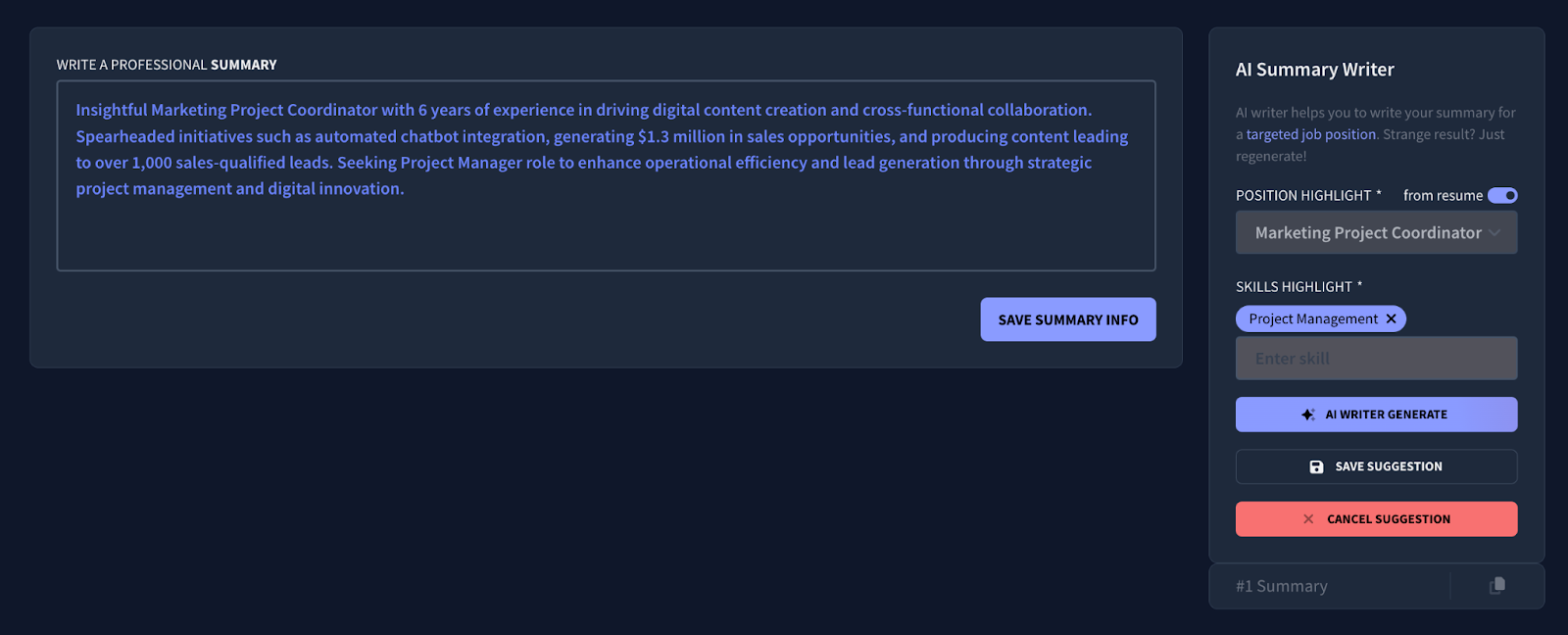
For help doing this in seconds, use Rezi AI Resume Summary Generator. Just enter the candidate’s target role and key skills to highlight, then you can generate a personalized summary. Rezi AI Resume Summary Generator also takes into account the rest of what’s written on the candidate’s resume.
Common Resume Writing Mistakes From Candidates That Recruiters Face
Here are some of the most common resume writing mistakes candidates make that recruiters run into:
- Too long (or too short): Five-page resumes stuffed with every job since high school, or one-pagers missing key details.
- Vague work experience: Failing to highlight achievements that show how candidates contributed to the outcomes clients care about most.
- Poor formatting: Inconsistent fonts, messy spacing, or overdesigned layouts that confuse ATS systems.
- Generic skills lists: “Teamwork” and “Microsoft Office” without the role-specific hard skills clients want to see.
- No clear summary: Either missing entirely or filled with empty buzzwords.
- Irrelevant details: Outdated jobs, hobbies, or filler content that distracts from what matters.
If you’ve been in recruitment long enough, you’ve probably seen it all when it comes to candidate resumes. Some are close to perfect, but most need work.
Relevant guides:
Summary
Let’s recap on how to rewrite candidate resumes:
- Check the basics. Make sure the candidate meets the minimum job requirements before investing time.
- Focus on the work experience section. Rework vague bullets into clear, outcome-focused achievements that align with the client’s needs.
- Refine the skills section. Tighten the list to emphasize job-relevant hard skills and use keyword checks to stay aligned with the job description.
- Tweak the summary section. Keep it short, targeted, and tailored so hiring managers immediately see the candidate’s value.
- Watch out for common mistakes. Long resumes, vague work history, poor formatting, generic skills, and irrelevant details are the usual suspects.
And if you want to turn candidate resumes into client-ready documents faster, tools like Rezi Enterprise can help you standardize and sharpen them in just minutes.
FAQs
How much time should a recruiter spend rewriting a candidate’s resume?
Ideally, no more than 10–15 minutes per resume. Standardized templates and AI tools can cut this time by a half or more.
Should recruiters rewrite resumes on behalf of candidates, or just coach them?
For speed and client-readiness, most agencies rewrite resumes themselves while keeping candidate approval. However, never misrepresent candidates. Don’t fabricate their work experience, skills, or achievements.
What’s the best way to balance resume rewriting with high-volume recruiting?
Build an internal workflow—use templates, set clear standards, and leverage automation tools to handle bulk edits.

Upload or drop your resume to get started
Upload your resume to get started
Score my resume

Astley Cervania is a career writer and editor who has been sharing resume and job search insights for 5+ years. He shapes the direction of the Rezi blog, providing practical answers for important career-related questions and helping hundreds of thousands of people navigate the job market and build resumes that land interviews.