
Career Advice
How to Become a Flight Attendant: Steps and Requirements
Learn how to become a flight attendant with all the steps, requirements, tips, and insider advice to start your career in the skies.

Published on
September 30, 2025
Updated on
October 13, 2025
Flying isn’t for everyone (I still hold my breath during the dreaded takeoff). But there’s no denying that travel opens doors to new countries, cultures, people, and yes, amazing food. So why not turn that love of exploring into a career? Though becoming a flight attendant isn’t a typical 9-to-5 path, so where do you even start?
First, let’s bust a myth: you don’t need prior experience in aviation or travel. Most of the time, you don’t even need a college degree. That said, there are preferred skills and firm requirements to meet if you want to succeed in this role.
The good news? It’s not nearly as intimidating as those bumpy rides through turbulence. Here’s what we’ll cover:
- What you need to do to become a flight attendant.
- All the industry requirements before taking to the skies.
- How long it takes to get through flight attendant training.
Want to prove you have what it takes? Try our free AI Resume Builder to get a personalized job application in minutes, with expert suggestions and feedback to give you the best shot.
What Do Flight Attendants Do?
Flight attendants are responsible for keeping everyone on board safe. That involves ensuring passengers follow security regulations, securing the cabin for takeoff and landing, and being prepared for emergencies. They’re trained in first aid, CPR, evacuations, you name it. If something goes wrong, it’s their job to take charge.
Another big part of the role is customer service. They greet passengers, help with boarding, demonstrate safety procedures, serve meals and drinks, and answer requests. And yes, sometimes that means solving dramas, like handling drunk passengers or calming down anxious flyers who have a meltdown after seeing a storm outside (aka, me).
Then there’s the general lifestyle. The hours are long and unpredictable, and flight attendants often spend nights away from home. But the flip side is that you see new cities, meet people from all over the world, and immerse yourself in different cultures — all while on the clock.
How to Become a Flight Attendant
In a rush to take off? Here’s a quick overview of how to become a flight attendant:
- Research different airlines to identify which carriers match your lifestyle, career goals, and values.
- Check the airline requirements to ensure you meet each carrier’s criteria, including minimum age, educational background, legal eligibility to work, and height.
- Apply for jobs online with a tailored application, including a strong resume and cover letter that highlights customer service experience and people skills.
- Go through the interview process by preparing for multiple stages, including video, group, and individual interviews, and answering behavioral and situational questions.
- Attend the airline training program after receiving a conditional offer, completing 4 to 10 weeks of intensive training.
- Get FAA certified with the airline’s assistance, submitting your information for background checks and security clearance.
Let’s get into the details.
1. Research different airlines
You wouldn’t apply for a job without researching the company (I hope), and the same applies to flight attendant positions. Before you even apply, it’s smart to figure out which airlines actually fit your lifestyle and career goals.
Here are some things to consider:
- Bases (home airports): Airlines operate out of designated “base cities.” While you don’t have to live near a base, commuting from another city can be exhausting. It’s easier if your airline has a base near where you live, or somewhere you wouldn’t mind relocating.
- Pay and benefits: Regional airlines usually pay less, but have shorter flights and smaller bases. Major carriers offer higher salaries and more international routes, but trips tend to be longer. Also, don’t forget the extras, such as travel perks, healthcare, retirement plans, tuition assistance, and family planning resources.
- Company culture: Every airline feels different. Some are very formal and structured, while others are more relaxed. Look for a culture that matches your personality and values; it can make a huge difference in job satisfaction.
- Union vs. non-union: Most airlines have strong unions (APFA and AFA) that negotiate pay, schedules, and job protections. However, some don’t, which can mean fewer safeguards.
- Lifestyle fit: Watch flight attendant vlogs or talk to current crew members. The job can sound glamorous, but the hours, layovers, and commuting can be tough. You’ll want to know what you’re getting into.
Once you’ve set your sights on a few airlines, don’t miss any opportunities. Sign up for career alerts on airline websites. Flight attendant positions open and close quickly because thousands of people apply. Being on top of it gives you a better shot.
Need some help with research? I found this handy spreadsheet comparing all the different airlines from a generous Reddit user. Just keep in mind that anyone is free to update this document, so I recommend fact-checking any key details before making a decision.
2. Check the airline requirements
On paper, airline requirements don’t look too restrictive. But every airline has its own specific rules, and if you don’t meet them, you won’t even make it to the interview stage.
Most airlines require you to be at least 18–21 years old (21 is most common for international carriers), have a high school diploma or GED, and be eligible to work in the country where the airline is based.
Physical requirements also come into play. You need to be tall enough to access safety equipment and overhead bins without issue. If you’re very tall, some carriers also have maximum height limits because of the cabin’s limited space.
Appearance is another big one. Some airlines prefer you to cover tattoos with the uniform, so anything on your neck, hands, or wrists could be a deal breaker. Many airlines also favor natural-colored and neat hair and beards.
3. Apply for jobs online
Applications can be long and detailed. They may ask about your work history, customer service skills, and sometimes scenario-based questions. This is where tailoring your resume and cover letter matters. Don’t just send in something generic. Airlines get thousands of applications, so yours has to stand out.
The best way to do that is to highlight any experience that shows you’re a people person. Jobs in hospitality, retail, restaurants, or healthcare are great because they show you can handle the public, solve problems, and stay calm under pressure.
Don’t have this experience? Many seasoned flight attendants recommend getting a customer service role for at least a year to build up your resume before applying. Take a look:

4. Go through the interview process
If your application gets noticed, the next step is the interview process. Airlines look at everything. The way you present yourself, your mannerisms, and how you get along with others in the room (no pressure). They want people who come across as professional and dependable, but also warm and personable.
You’ll likely go through multiple stages, starting with a video interview, then group and individual interviews. Expect a mix of questions, from the easy ones like:
- “Tell me about yourself.”
- “Why do you want to be a flight attendant?”
…to the tougher ones like:
- “Describe a time when you dealt with a difficult customer.”
- “Tell me about a conflict with a coworker and how you resolved it.”
- “Give me an example of a time you failed and what you learned from it.”
To avoid word-vomit, I recommend using the STAR method (Situation, Task, Action, Result) when answering. Be concise, stick to the point, and focus on how your actions led to positive outcomes.
And remember: the group interview isn’t just about impressing the recruiters. They’re also watching how you interact with other candidates. Be friendly, professional, and respectful without being too try-hard.
Here’s some advice from a flight attendant who made it past the face-to-face interviews:

Prepare yourself with AI Interview. Our expert technology helps you practice with tailored questions and personalized feedback to boost your confidence.
5. Attend the airline training program
If you get through the interview process, congrats! You’ll likely receive a conditional job offer. That means the airline wants you, but you still have to pass their training program before you’re officially in. It’s essentially a boot camp for flight attendants, lasting anywhere from 3 to 8 weeks, depending on the airline.
You’ll spend long days learning everything from safety protocols and emergency evacuations to first aid, security procedures, and customer service. Training can take place in mock cabins and simulators, so you’ll practice things like evacuating down slides, putting out fires, and handling medical emergencies in a hands-on environment.
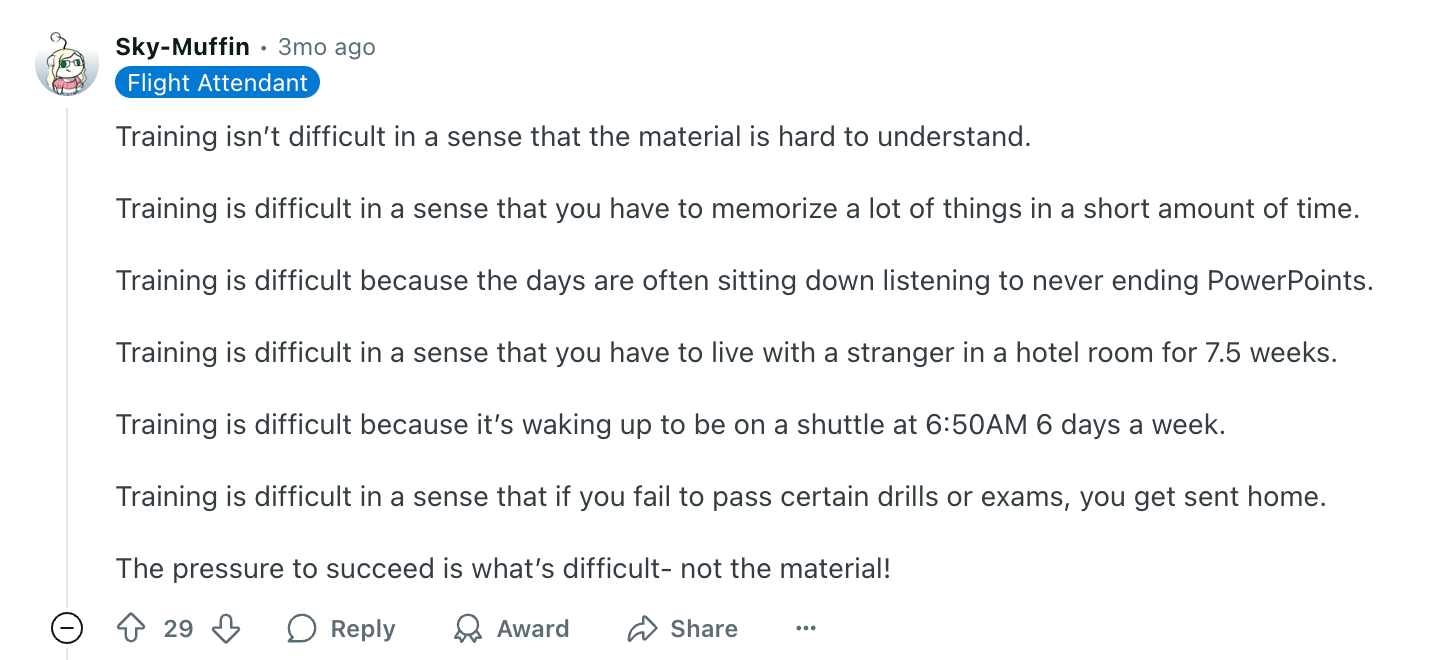
It’s intense, and yes, there are frequent evaluations. Most airlines require you to maintain a minimum score to stay in the program. If you fail too many exams, you’ll be sent home.
Here’s what a flight attendant said when asked about the difficulty of training:
During this time, the airline usually provides housing at a hotel near the training center and sometimes covers meals and transportation. Some airlines pay during training, and others, annoyingly, don’t pay at all (more on that below). Either way, the reward at the end is the same: getting your wings.
Check out what United Airlines shared about their training program to give you an idea:

6. Get FAA certified
Before you can step on board as crew, you need certification from the Federal Aviation Administration (FAA), which the airline will usually help you with. Essentially, you submit your information for clearance, and once approved, you’re officially authorized to work in secured airport areas and operate as a flight attendant.
What Are the Requirements to Be a Flight Attendant?
Gone are the days when you needed “nice hands”, an “even temper”, and the “ability to carry a lively conversation” to become a flight attendant (yep, all real requirements in the 50s). However, airlines still have a much less strict set of rules if you want to land a job in the skies.
The main flight attendant requirements cover:
- Minimum age
- Citizenship and background check
- Height and physical fitness
- Tattoos and piercings
- Regular screenings
These requirements vary widely depending on the airline and the country, so it’s worth checking the specifics online and during the application process. That said, here’s a general breakdown to give you an idea of what to expect:
Minimum age
Airlines want to make sure flight attendants are mature enough to handle responsibility, but not limited by arbitrary age caps. While you might imagine flight attendants as being young, the truth is this career is open to a range of ages, as long as you can meet the physical demands of the job.
- Most airlines set their minimum age at either 18 or 21. The exact number depends on the carrier, but you’ll usually need to meet the requirement by the time training ends.
- There is no official upper age limit for becoming a flight attendant. As long as you can meet the physical requirements, you can pursue the role; I’ve heard many stories of people getting their wings in their 40s and 50s.
- Age is less about numbers and more about stamina and health. Because the job involves being on your feet for hours, moving carts, and helping passengers during turbulence, airlines want to ensure you can physically keep up.
Thinking about pursuing this career later in life? Find out more: Career Change at 40
Citizenship and background check
Airlines have strict requirements regarding legal eligibility and security. After all, flight attendants need clearance to work in highly restricted areas and to travel across borders without issue.
- If you’re applying to a U.S.-based airline, you need to be a U.S. citizen or legal resident. This ensures you can legally work in the country and travel in and out without complications.
- You’ll be required to provide identification documents. A valid passport, Social Security card, and government-issued ID are all checked during the hiring process.
- Background checks are federally mandated for flight attendants. Minor issues like speeding tickets usually don’t matter, but serious charges, like DUIs or arrests, could prevent you from being cleared for employment.
Education and language
You don’t need a college degree to fly, but basic education and good old-fashioned common sense do matter. Airlines want attendants who can read regulations, communicate with passengers, and follow detailed procedures.
- The baseline requirement is a high school diploma or GED. A college degree isn’t necessary, but it can give you a competitive edge, especially with larger carriers.
- The English language is non-negotiable. Since the standard language of aviation is English, you must be able to read, write, listen, and speak in the language.
- Being bilingual (or multilingual) can give you an advantage. Airlines serving international destinations often prioritize candidates who speak additional languages fluently, especially in hubs that see diverse travelers.
Learn more about showing your language abilities: How to List Resume Language Skills
Height and physical fitness
Height and weight rules aren’t about appearance (in most airlines); they’re about safety and practicality. Airlines need to know you can reach equipment, sit safely in jump seats, and move quickly in emergencies.
- Most airlines use a “reach test” rather than a strict height minimum. For example, United Airlines lists between 5’2” and 6’3”, but other carriers may simply ask you to reach a certain height marker.
Here’s some firsthand insight into the height requirements:

- Weight itself isn’t measured, but size is still a factor. You must be able to sit comfortably in the jump seat and buckle your harness without an extender.
- Physical condition is important. You’ll be required to lift equipment, assist passengers, and maneuver in tight spaces, all while keeping balance in turbulence and during takeoff or landing.
Tattoos and piercings
This is one of the trickier areas. Policies surrounding appearance vary widely between airlines, and what they consider professional can be subjective. While some carriers have relaxed their rules, many still expect a traditional and “professional” appearance in uniform.
- Many airlines prohibit visible tattoos while in uniform. Depending on the carrier, you’ll probably be able to have tattoos as long as you can cover them with good-quality makeup, clothing, or hosiery.
And apparently, there are plenty of flight attendants hiding their tattoos:

- Some airlines allow small, discreet tattoos. The general rule is that they must be smaller than an ID card and in a place that doesn’t draw too much attention.
- Piercings usually follow a similar rule. A single earring per ear is often acceptable, but multiple facial piercings or unconventional jewelry won’t fly (literally).
Regular screenings
Because flight attendants work in secure environments and carry enormous safety responsibilities, medical and security screenings are ongoing. And these checks aren’t just for hiring, they’re part of the job throughout your career.
- All flight attendants must pass fingerprinting, drug screenings, and medical evaluations. These screenings ensure you’re physically and mentally fit to handle emergencies and secure enough to access restricted areas.
- If you take prescription medication, it generally won’t affect your eligibility. During drug testing, you may be asked to provide proof of your prescription to a Medical Review Officer (MRO) for verification.
- Illicit drugs, including marijuana, are automatic disqualifiers. Even if cannabis is legal in your state, it’s federally prohibited for aviation workers. Alcohol misuse is also strictly monitored and can end your career.
How Long Does It Take to Become a Flight Attendant
From the moment you hit “submit” on your application to the day you graduate from training, it can take a minimum of three to four months. Sometimes it can be longer depending on the airline’s hiring pace and how quickly they move through applicants.
Why does it take so long? After you apply, it can take days or even weeks to hear back. And if you’re selected to move forward, the interview process itself can stretch out. Airlines often use multiple stages: video interviews, in-person interviews, and even event days. Each round comes with its own waiting period before you find out if you’ve advanced to the next step.
If you’re successful, the final hurdle is training. Depending on the airline, training can last anywhere from three to seven weeks. During that time, you’ll learn safety procedures, practice emergency drills, and study aviation policies.
Here are more details about the training process from the biggest airlines in the U.S.:
| Airline | Duration | Location | Details |
|---|---|---|---|
| American Airlines | 6 ½ weeks | Fort Worth, Texas | AA won’t pay you for training, but they do cover lodging, transportation, and meals. |
| Delta Airlines | 7 weeks | Atlanta, Georgia | Delta doesn’t specify payment on their website, but some claim they got paid around $7 per hour during training. |
| Frontier Airlines | 3 ½ weeks | Cheyenne, Wyoming | Though not specified on their website, it appears they don’t pay for training. But they do provide housing and most of your meals. |
| Southwest Airlines | 4 weeks | Dallas, Texas | Training is unpaid, but those who graduate receive a $1,200 initial training stipend, minus taxes and benefit deductions. |
| United Airlines | 6 ½ weeks | Houston, Texas | You get two meals per day, accommodation (with a roommate), a $140 weekly stipend during training, and a $1,000 cash bonus after successful completion. |
You get two meals per day, accommodation (with a roommate), a $140 weekly stipend during training, and a $1,000 cash bonus after successful completion.
What is a Flight Attendant’s Salary
Pinpointing a flight attendant’s salary isn’t so black-and-white because it’s not structured like a traditional 9–5 salary. The U.S. Bureau of Labor Statistics reported a median annual wage of about $67,130 in May 2024, while Salary.com placed it higher, around $77,003. That said, those figures don’t tell the total story of how compensation works in this job.
Unlike most jobs where you’re paid for a 40-hour workweek, flight attendants are often paid for “flight hours,” which means the time from when the aircraft door closes to when it opens at the destination. All the other parts of the day, such as checking in, boarding, delays, and sitting on the tarmac, don’t always count as paid hours.
That’s why monthly paychecks can vary depending on routes, seniority, and scheduling. On top of the base hourly rate, flight attendants also earn per diem pay (a daily allowance for food and expenses while traveling), plus bonuses or incentives depending on the airline.
Is it a path to instant luxury? Honestly, no. This job won’t make you rich, but it can offer financial security while enriching your life in other ways. You’ll collect experiences, travel around the world, and build a diverse network of people.
Summary
Here’s a step-by-step rundown of how to become a flight attendant:
- Research different airlines to understand their bases, pay, benefits, and culture. Each airline feels different, so choose one that fits your lifestyle and personality.
- Check the eligibility requirements like age, height/reach, education, background checks, and appearance guidelines.
- Tailor your resume and cover letter to highlight customer service, problem-solving, and communication skills.
- Apply online and set up career alerts on airline websites to avoid missing opportunities.
- Prepare for a multi-step interview process that may include video submissions, group exercises, and one-on-one interviews.
- Show professionalism and warmth during interviews by being approachable and cooperative with other candidates.
- Attend the airline’s training program if you’re offered a position. Training often lasts 3–7 weeks and covers safety drills, first aid, security, and service skills.
- Get FAA certified once you successfully complete training, which officially allows you to work as a flight attendant and grants you clearance.
- Begin your probationary period on the line where you’ll put training into practice, adjusting to irregular schedules, layovers, and long days.
- Commit to continuous learning and adaptability because regulations, aircraft types, and company policies often change.
FAQ
Is it worth going to a flight school before applying?
Attending flight school isn’t necessary, and many refer to it as a scam. Airlines train you themselves once you’re hired, covering everything from safety drills to customer service, and they do it in a way that’s specific to their own procedures. Your time and money are probably better spent on gaining customer service experience or perfecting your resume.
What does it take to be a flight attendant?
Becoming a flight attendant takes more than a love of travel. Physically, you have to be able to move quickly, lift luggage, and work long hours on your feet in tight spaces. Mentally, flexibility is important; schedules change, delays happen, and you’re often in different time zones within a few days. You also have to deal with tired, stressed, or upset passengers while still maintaining a calm and professional demeanor.
Airlines look for people who are disciplined, detail-oriented, and able to follow safety procedures to the letter. Presentation and communication are also part of the package. You’re the face of the airline, so professionalism, grooming standards, and the ability to connect with people from all walks of life are key.
Is a flight attendant a good job?
If your dream job is steady hours, a predictable routine, and being home every night, then being a flight attendant probably isn’t for you. But if you thrive on variety, enjoy travel, and like the idea of having layovers in cities you might never otherwise visit, then it can be one of the most rewarding jobs out there.
There are plenty of benefits, such as discounted or even free flights, retirement programs, and sometimes generous healthcare. The downside is irregular hours, jet lag, and being away from home, sometimes for days at a time. Many flight attendants say the job doesn’t make you “rich” in money, but it makes you rich in experiences, friendships, and memories.
What is the 35-7 rule for flight attendants?
The “35-7 rule” means reserve flight attendants can’t be scheduled for more than 35 hours of flight time within seven days, which helps prevent overwork.
Alongside this, the FAA sets rest rules. Normally, after a duty period of 14 hours or less, you must get at least nine consecutive hours of rest before your next shift. In certain cases, that rest can drop to eight hours, but then your following rest must be at least 10 hours, starting no later than 24 hours after the shortened break. These rules work together to ensure crew members are rested enough to perform safely, even with the irregular schedules the job often brings.

Upload or drop your resume to get started
Upload your resume to get started
Score my resume

Lauren Bedford is a seasoned writer with a track record of helping thousands of readers find practical solutions over the past five years. She's tackled a range of topics, always striving to simplify complex jargon. At Rezi, Lauren crafts genuine and actionable content that guides readers in creating standout resumes to land their dream jobs.