
Career Advice
Fact Checked
How to Become a Real Estate Agent: Requirements & Steps
Learn how to become a real estate agent, from meeting state requirements and passing the exam to joining a brokerage and advancing your career.


Published on
October 17, 2025
Updated on
October 17, 2025
Becoming a real estate agent starts with meeting basic requirements: you generally need to be at least 18, a legal US resident, and have a high school diploma or GED. Next, check your state’s rules, complete state-approved pre-licensing courses, and pass the licensing exam, which may include a background check and fingerprints. Once you pass, you must join a licensed brokerage to legally represent clients. From there, you can start earning commissions, gain experience, and eventually take the next step — becoming a Realtor or pursuing a broker license. Consistency and hard work are key to building a successful real estate career.
You love the idea of helping people find their dream homes. You’re a natural salesperson, have the gift of gab, and genuinely enjoy working with people.
But I can imagine you probably have a million questions buzzing in your head: What are the requirements? How does your state stack up against the next one over? Do you even need a diploma, or can charm carry you through?
In this guide, we’ll cover:
- The requirements to become a real estate agent.
- The step-by-step process to get licensed.
- What you can expect to earn and how to advance your career.
If you’re ready to land your first role, check out our free AI Resume Builder or these guides:
- How to Write a Real Estate Agent Resume
- Best Job Search Engines in 2025
- How to Write a Career Change Resume
- How to Use Resume Keywords to Beat the ATS
What Is a Real Estate Agent?
A real estate agent is a licensed professional who helps people buy, sell, or rent property. They’re the middle ground between buyers and sellers, who keep deals on track and guide clients from “I’m interested” to “Here are the keys” (or the sales proceeds), without losing their mind in the process.
By law, agents have to work under a licensed broker — you can’t just get your license and operate solo. That sponsorship is what makes it possible to legally represent clients.
The work itself is never boring — though it’s probably not as glamorous (or dramatic) as Selling Sunset. One day you’re helping a buyer find the right home, the next you’re advising a seller on pricing and marketing. Agents handle showings, negotiations, contracts, and closings, plus all the behind-the-scenes tasks like researching market trends, scheduling inspections, and double-checking the paperwork.
What Do You Need to Be a Real Estate Agent
Before you can start selling houses, there are a few requirements you need to qualify:
- Basic eligibility: Most states require you to be at least 18 (19 in Alabama, Alaska, and Nebraska) and a legal US resident.
- Education: A high school diploma or GED is standard.
- Identification: Most states ask for a Social Security number; some accept an ITIN.
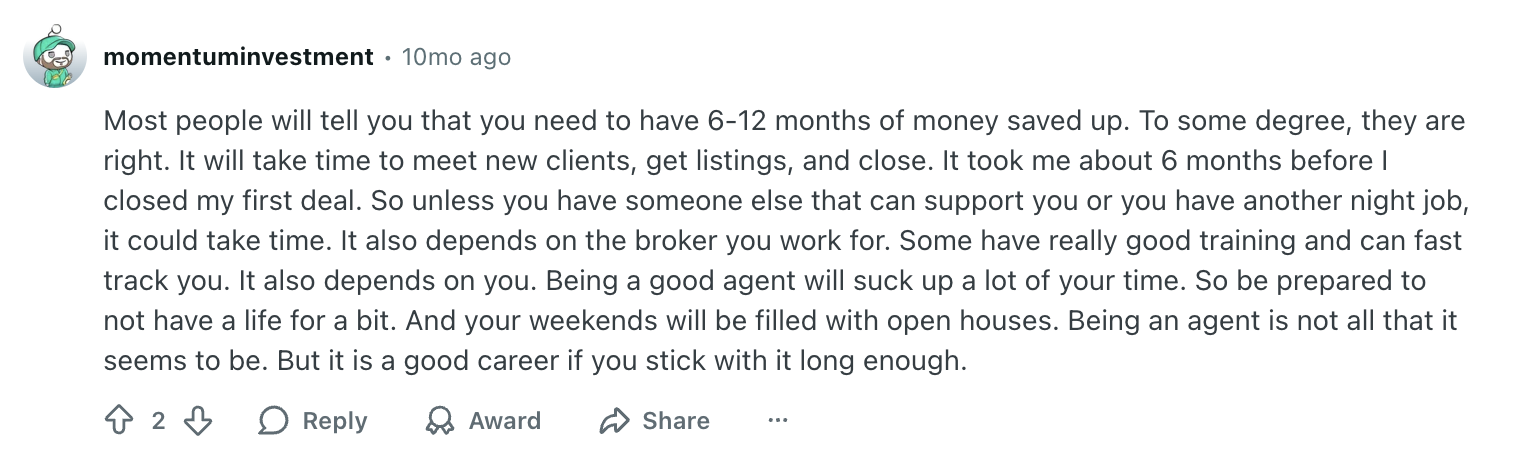
And one more thing: you’ll need patience. Success in real estate doesn’t happen overnight.
As one Reddit user put it, the early days can be a grind:
How to Get Your Real Estate License
Here’s how to get your real estate license:
- Learn your state’s requirements, including background checks and fingerprints.
- Complete a pre-licensing course through a state-approved provider and get your certificate to schedule the exam. Course length varies by state (40–180 hours).
- Schools like Kaplan, Colibri, and The CE Shop are popular for pre-licensing courses.
- Pass the licensing exam (practice tests and prep courses will help).
- Join a brokerage. Choose one with training, mentorship, and real leads. Once your broker submits your paperwork, you’re ready to start.
1. Check your state’s licensing requirements
The process varies by state, but most require a background check with fingerprints, pre-licensing courses, and a state exam. Course lengths and exam procedures aren’t the same everywhere, so make sure you know your state’s rules before you start.
If you’re already licensed elsewhere, some states offer reciprocity, which lets you transfer your credentials without starting from scratch. Colorado, for example, accepts licenses from all 50 states.
Here’s a table showing some state-specific requirements:
2. Complete pre-licensing education
Before you can take the exam, you’ll need to finish a pre-licensing course from a state-approved provider (check your state’s real estate commission website for the list).
Popular online schools include:
Course length depends on your state. If you’re in Michigan, you’re blessed with just 40 hours. If you’re in Texas, not so much — it’s 180.
Once you finish, you’ll receive a certificate of completion, which allows you to schedule your licensing exam.
3. Apply for and pass the exam
Before booking your exam, find out whether your state requires fingerprints or a background check. These steps can take weeks to process, so start early.
Exams are usually run by PSI or Pearson VUE, so check how often they’re offered in your area and how many retakes are allowed.
Remember: finishing your course doesn’t guarantee a pass. The exam is tough, and many people need more than one try. Prep makes all the difference — take practice tests, focus on weak spots, and use exam prep courses.
4. Join a brokerage
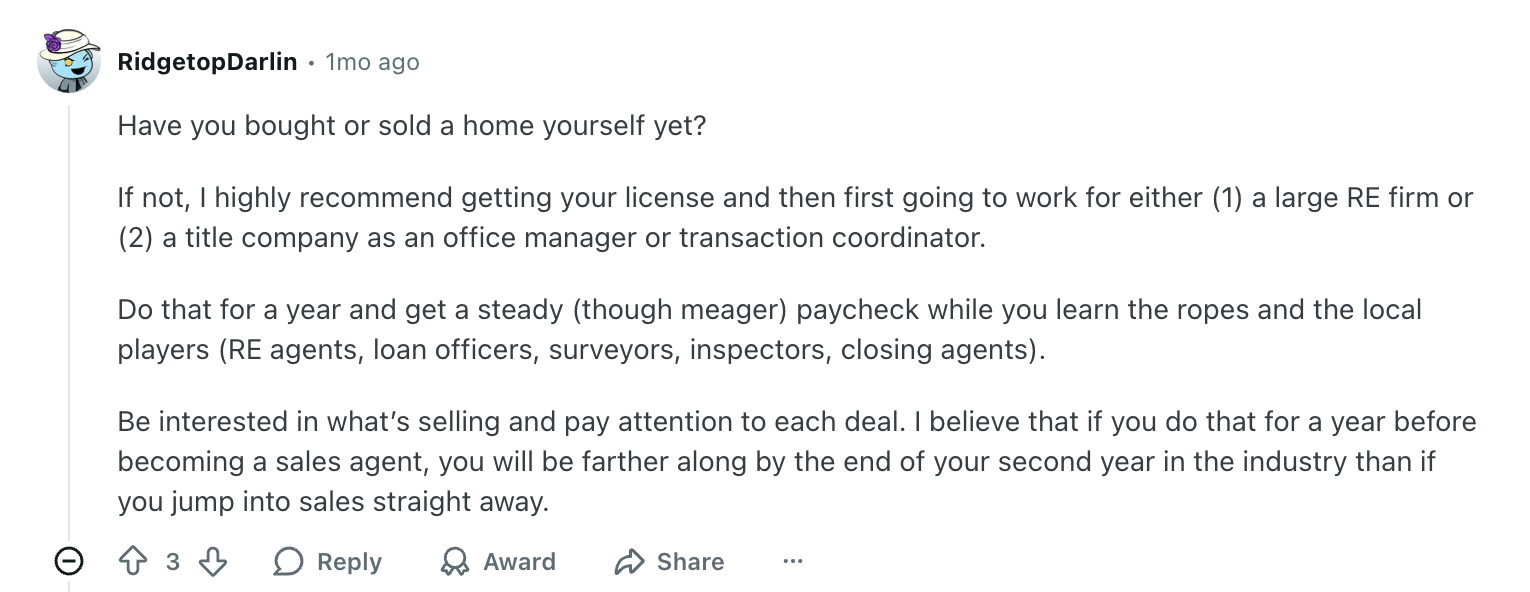
After passing the exam (woo, congrats!), you need to work under a licensed broker to legally practice. Start thinking about your options while finishing your pre-licensing courses.
When choosing a brokerage, focus on training, mentorship, and real leads, not just the brand name. Once your broker submits the paperwork and it’s approved, you’re officially licensed and ready to start working.
This Reddit user shares their advice:
Real Estate Agent Salary
How much you earn as a real estate agent comes down to how many properties you sell and your commission on each deal. In May 2024, the median annual wage for real estate agents was $56,320 (US Bureau of Labor Statistics).
Be prepared for a slow start — some agents make their first sale in a month, while it might take others six months or more.
I’ve seen plenty of stories online about both ends of the spectrum:
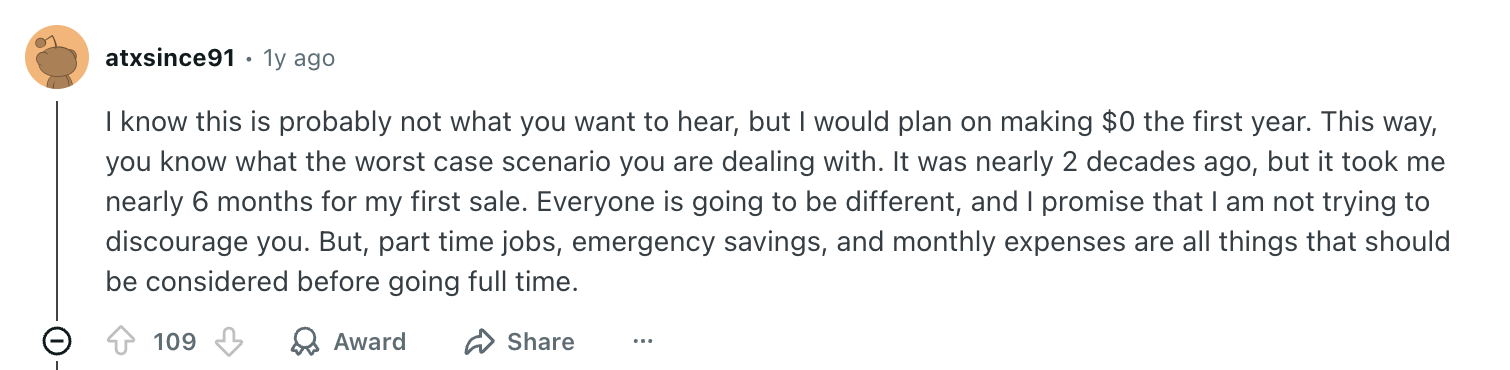
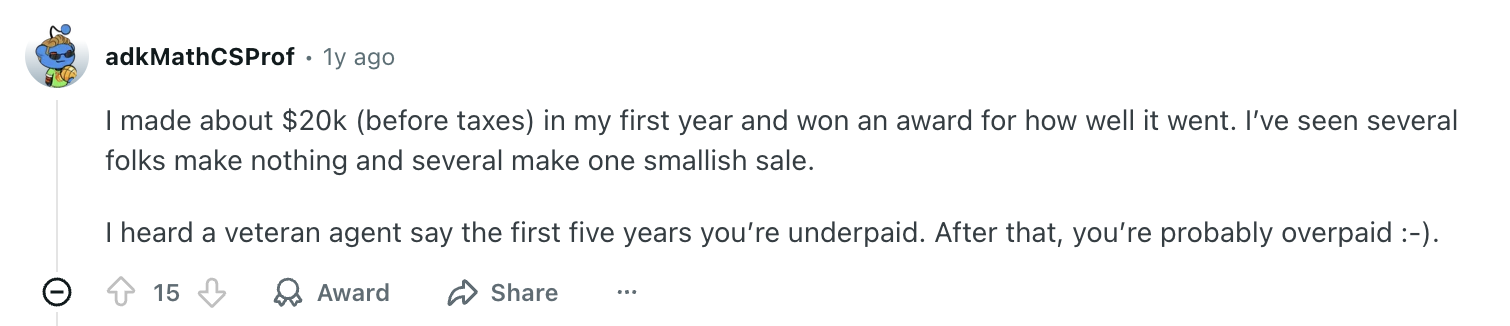
The takeaway? Consistency and hard work pay off. Keep at it, and eventually your effort will translate into income.
Next Steps in Your Real Estate Career
Here are the next steps in your real estate career:
- To become a realtor: maintain your active license, join your local NAR (your broker needs to be a member first), pay membership fees, and complete the Code of Ethics training every three years.
- To become a broker: build 2–5 years of experience under a broker, take the required state courses, and pass the broker exam.
- Submit your broker application with a background check, fingerprints, proof of experience, and applicable state fees.
Once you’ve settled into life as a real estate agent, you might start thinking about the next step — whether that’s becoming a realtor or moving up to a broker.
How to become a realtor
- Keep your license active and stay engaged in the business.
- Join your local National Association of Realtors (NAR) — your broker must be a member first.
- Pay annual dues and complete NAR’s Code of Ethics training, required for new members and every three years after.
Check out more tips on becoming a realtor.
How to become a real estate broker
- Get hands-on experience, usually 2–5 years full-time under a broker.
- Complete state-specific broker pre-licensing courses covering law, property management, and ethics.
- Pass your broker licensing exam (both national and state sections).
- Submit your application with a background check, fingerprints, proof of experience, and state fees ($150–$300).
- Optional: pursue certifications like CLHMS, RENE, or CBAE to specialize and boost your credibility.
Summary
Here’s a recap on how to become a real estate agent:
- A real estate agent is a licensed professional who helps clients buy, sell, or rent properties and must work under a licensed broker.
- Basic requirements include being at least 18 (19 in some states), a legal US resident, and having a high school diploma or GED.
- Complete pre-licensing courses through a state-approved provider, which can range from 40 to 180 hours depending on your state.
- Pass the state licensing exam, which may require fingerprints and a background check; preparation with practice tests and prep courses can help.
- After passing, join a licensed brokerage to legally practice real estate. Look for one that provides mentorship, training, and leads.
- Real estate agent income depends on sales and commission; median annual pay was $56,320 in 2024, and initial earnings can take time.
- Career advancement includes becoming a Realtor (join NAR, complete Code of Ethics training, pay dues) or a broker (2–5 years experience, broker courses, exam, and optional certifications).
FAQ
How long does it take to become a real estate agent?
Most people can get licensed in about four to six months, but it depends on your state. Some only require 40 hours of classes, while others ask for 180. Add in time for studying, background checks, and scheduling the exam, and the process can take a little longer.
How to become a commercial real estate agent?
You’ll start the same way as residential — finish pre-licensing courses, pass the exam, and get licensed. After that, focus on brokerages or programs that deal in commercial property. Learning about leases, investments, and property law is key, and joining groups like CCIM can boost your credibility and connections.
How to become a real estate agent with no experience?
Starting with zero experience is completely normal in real estate. Just complete your pre-licensing classes, pass the exam, and join a sponsoring broker. That’s where you’ll get hands-on training, mentorship, and real practice. Bring your people skills and eagerness to learn; that’s what matters most.
How hard is it to become a real estate agent?
Getting licensed isn’t too difficult if you can put in the study time and handle the paperwork. The real challenge comes after, when you’re building your career. Success takes networking, marketing yourself, and staying consistent. If you’re self-motivated and resilient, it’s very doable.
How many times can you take the real estate exam?
Most states let you retake the exam multiple times, though you’ll pay a fee each time. Some states require a short waiting period between attempts or extra coursework after multiple tries. Don’t stress, though — plenty of successful agents don’t pass on their first go.

Upload or drop your resume to get started
Upload your resume to get started
Score my resume

Sarah Coghlan is a writer and editor passionate about making resume and career advice clear and accessible to all. Based in Barcelona, her goal is to help job seekers create standout resumes and navigate the job search process with confidence and ease.