
Recruiting
How to Increase Your Recruitment Placements
The number of placements recruiters make vary depending on the roles, industry, and more. You can increase it by automatically fixing resume bottlenecks…
.webp)
Published on
January 22, 2026
Updated on
January 22, 2026
To increase recruitment placements, eliminate resume formatting issues, tailor submissions to the job description, reduce time-to-submit with SOPs and automation, and build long-term candidate relationships. Use “placement-ready” scorecards to pre-qualify talent, adjust your workflow based on the req level, improve the candidate experience with clear communication and tools, and track metrics like time-to-submit and interview-to-offer ratios to optimize your process.
What’s stopping most agencies from hitting higher placement numbers isn’t a lack of hustle.
From our conversations with the recruiters and staffing teams we’ve partnered with, the real bottlenecks tend to fall into three areas:
- Resume prep takes too long
- Candidate submissions feel rushed or inconsistent
- Clients get frustrated when quality or speed slips
We’ve seen teams boost their placement rates not by finding better candidates, but by tightening the systems behind their submissions. Cleaner, faster, more tailored resumes. More confident submissions. Less back-and-forth.
In this article, I’ll walk you through how to increase recruitment placements using the exact strategies we’ve seen work. From streamlining resume workflows to reducing time-to-submit, these are the practical steps modern staffing agencies are taking to place more candidates, faster and with better outcomes.
How Many Placements Should a Good Staffing Agency and Recruitment Team Be Making?
It’s difficult to give a precise number for this because it depends on several factors such as the industry, role requirements, and recruiter experience.
With that in mind, 1–3 placements per month is considered a standard benchmark for recruiters. Again, this number can be higher or lower depending on the required skills, knowledge, and role complexity.
However, placement quality matters just as much as quantity.
What separates great recruitment and staffing teams is having repeat clients, successful long-term hires, and strong candidate relationships. If you’re hitting fewer placements but maintaining high client satisfaction and solid candidate fits, that still signals strong performance.
How to Increase Your Placement Rates
Here’s how to increase your recruitment placement rates:
- Eliminate resume formatting bottlenecks.
- Tailor candidate submissions.
- Reduce time-to-submit with SOPs and automation.
- Prioritize relationship-based sourcing.
- Use “placement-ready” scorecards to pre-quality.
- Consider the req level.
- Improve the candidate experience.
- Track the metrics that actually affect placements.
The top performing staffing agencies and recruitment teams we’ve partnered with are doubling down on personalization. They focus on building repeatable systems that allow them to move fast and deliver better-fit candidates.
Below, I’ll go through each step in more detail.
1. Eliminate resume formatting bottlenecks
Having to stop and fix resume formatting before submitting to clients slows everything down.
Fix this by not manually reformatting resumes, but by using a platform that allows you to give candidates pre-approved professional resume templates under your agency’s brand. An example of such a platform is Rezi Enterprise.
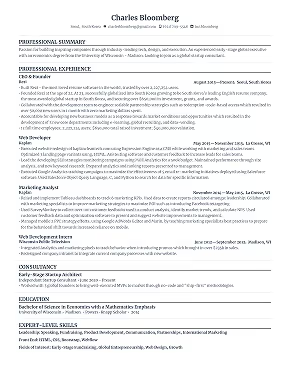
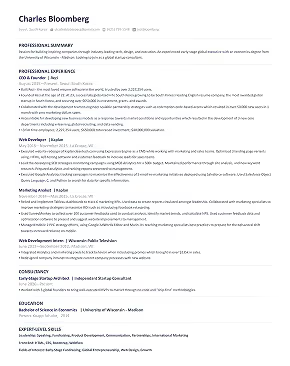
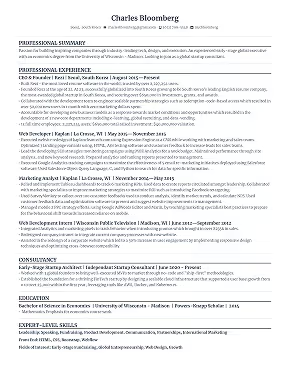
If there’s a formatting issue in the resume, you can instantly fix it using our white-label resum platform’s auto-adjust feature when you reach the finish tab, as shown below:
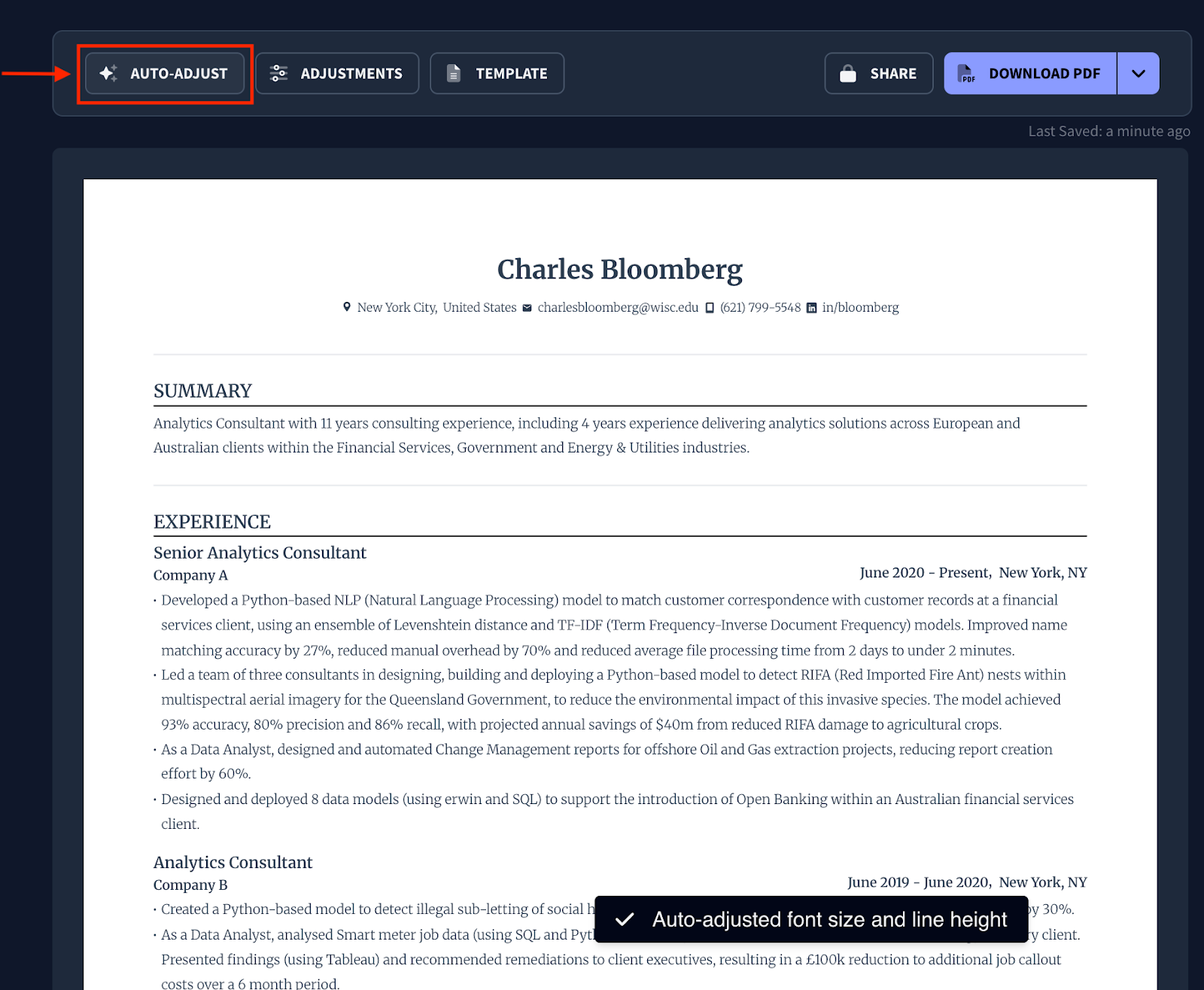
Regardless of who’s preparing the resume, this will help you remove the hassle of fixing font, layout, or structural issues that make resumes look unprofessional or fail to pass through applicant tracking systems (ATS).
2. Tailor candidate submissions
Resumes tailored to the specific role and company significantly increase your chances of filling the position. Personalized submissions make it easier for clients to say yes because they show exactly how a candidate’s experience aligns with the employer’s specific needs.
It’s fairly straightforward to pinpoint what parts of the resume to tailor, however, the real challenge is doing it at scale.
Fortunately, it’s entirely possible to streamline by using resume keyword scanner like Rezi AI Keyword Targeting. It shows which keywords from the job description are missing, so your team knows what to focus on, or better yet, give candidates access so you receive more tailored resumes upfront instead of having to rewrite them yourself.
3. Reduce time-to-submit with SOPs and automation
Standardize your internal review process. Create SOPs, checklists, or templates so recruiters know exactly what makes a resume “submission-ready” — things like formatting, relevance to the job, and client-specific requirements.
Next, automate wherever possible. Shrink the gap between identifying a qualified candidate and getting them in front of the client.
Some high-performing teams, for example, will use internal Slack bots or Notion databases that auto-generate submission packets with the latest candidate data so that they don’t have to scramble for availability, salary expectations, or role fit notes.
Others may set up automated job-candidate matching systems using pre-tagged candidate pools. As soon as a new req comes in, these systems surface a shortlist of pre-vetted candidates based on skills, location, and past engagement, which cuts hours of sourcing and helps recruiters act faster with greater confidence.
4. Prioritize relationship-based sourcing
The best recruiters build long-term relationships.
Candidates placed today could be clients tomorrow. And referrals from warm connections tend to lead to better cultural fits and higher retention.
That said, focus on nurturing your talent pool beyond one-and-done outreach. Stay in touch with past candidates, regardless of whether they’ve been placed or not. Send occasional updates, check in on their goals, and continue to share roles aligned with their interests or skill set.
Done right, you won’t need to start from scratch all the time since you’ll be able to pull from a warm bench of trusted, qualified candidates that already know, like, and trust you.
5. Use “placement-ready” scorecards to pre-qualify
Not every candidate in your pipeline will be ready to submit, and rushing to place unqualified candidates isn’t a viable option.
Having a “placement-ready” scorecard helps you quickly assess whether a candidate is truly submission-ready. This scorecard could include things like resume quality, alignment with role requirements, availability, and salary expectations.
Not only does this give your team a shared framework to minimize bias, but it also helps prevent wasting time on pursuing candidates that simply aren’t a good fit.
6. Consider the req level
Not all placements are equal, and so, your strategy should reflect that. Adjusting your workflow this way allows you to submit more of the right candidates.
High-volume, entry-level roles require a different approach than niche or executive-level reqs.
For volume roles, you can put more emphasis on speed and efficiency. Focus on automation, batch outreach, and streamlined processes to keep up with demand. You’ll likely need to move fast and submit multiple candidates quickly to hit placement targets.
For senior or specialized roles, it’s more about precision. Invest extra time in research, deeper qualification, and tailored submissions. These placements often require a stronger recruiter-candidate relationship, more nuanced communication with the client, and a polished, personalized job application.
7. Improve the candidate experience
Don’t ghost candidates and give updates whenever you can. Set the expectations early and always give timely feedback, even when it’s a no.
It might seem obvious, but simply treat candidates like people and not transactions. A few extra minutes to check in goes a long way.
Make things more candidate-friendly by sharing any tools or resources that can help guide applicants through the process. This also helps reduce any friction points without eating up more of your team’s time.
8. Track the metrics that actually affect placements
It’s hard to fix what you don’t measure.
Don’t get caught up in vanity metrics like impressions. The metrics that actually matter are those tied directly to placements.
Focus on data points like time-to-submit, submittal-to-interview ratio, interview-to-offer ratio, and candidate drop-offs. These will show you where the bottlenecks are and where quality breaks down. For instance, if your interview-to-offer rate is poor, perhaps your candidates aren't aligned well with client needs.
Summary
Let’s recap how to increase your recruitment placement rates:
- Eliminate resume formatting bottlenecks to avoid delays.
- Tailor candidate submissions to improve client alignment.
- Reduce time-to-submit with SOPs and automation.
- Prioritize relationship-based sourcing for better long-term outcomes.
- Use “placement-ready” scorecards to pre-qualify candidates.
- Adjust your workflow based on the req level.
- Improve the candidate experience to boost engagement and referrals.
- Track metrics that actually affect placements to pinpoint bottlenecks.
Each of these steps helps your team work faster, place more qualified candidates, and strengthen client trust. Be the recruitment agency known for precision and speed, and the partner that clients rely on to get it right the first time.
If you’re ready to automate and scale by starting with the resume, you can request a demo for Rezi Enterprise here.
FAQs
What KPIs should we track to measure if our placement process is improving?
To evaluate and improve your placement process, track metrics like time-to-submit, application to interview ratio, interview to hire ratio, resume revision rate, and client feedback on candidate quality. These KPIs can indicate where the bottlenecks are and help quantify improvements in speed, quality, and consistency.
How can we speed up candidate resume prep without sacrificing quality?
You can speed up resume prep by giving candidates access to AI-powered resume tools that auto-format and auto-tailor resumes to job descriptions and flag weak content. This helps significantly with the resume evaluation process.
How do we reduce the back-and-forth between recruiters and candidates during resume edits?
Equip candidates with a guided resume builder that gives them all the tools to build and optimize a resume that meets your standards. This reduces the need for manual edits and back-and-forth emails by helping candidates submit resumes that are already aligned with what recruiters and clients expect.
What’s the most effective way to standardize resume formatting across our team?
Use resume templates that you approve of. Next, standardize it by using a resume builder like Rezi Enterprise that makes it easy to reformat and tailor resumes as needed. White-labeled resume platforms make it a lot more straightforward to centralize the process across your team and make sure every candidate submission reflects your brand.

Upload or drop your resume to get started
Upload your resume to get started
Score my resume

Astley Cervania is a career writer and editor who has been sharing resume and job search insights for 5+ years. He shapes the direction of the Rezi blog, providing practical answers for important career-related questions and helping hundreds of thousands of people navigate the job market and build resumes that land interviews.