
Resume
30 Synonyms for “Managed” to Use on Your Resume
Check out the top resume synonyms for managed that show off your leadership skills. Swap overused words with more specific verbs to boost your resume’s impact.

Published on
July 8, 2025
Updated on
March 11, 2026
Using the verb “managed” puts you in charge, implying that you handled, directed, or took responsibility for a task, project, or team. On a resume, “managed” does even more; it signals leadership, accountability, and often people skills.
While “managed” is a strong leadership verb, using it in every bullet point can become repetitive or vague. That’s why it’s helpful to swap it out for more specific, impactful synonyms that reflect how you led, what you achieved, and the scope of your responsibility.
Check out these alternatives and how to use them. This guide will cover:
- Other words for managed on your resume.
- Resume examples to show your leadership skills.
- When and where to use managed synonyms.
Need help choosing the right words for your resume? Try our free AI Resume Builder to get customized suggestions and build your application in minutes.
30 Resume Synonyms for Managed
“Managed” can mean anything from hovering over your team’s every move to showing up once a week with donuts and a thumbs-up (hopefully somewhere in the middle). Either way, using more specific verbs helps paint a clearer picture of how you managed your team.
Here are the top “managed” synonyms and similar words to give your resume more depth.
| Administered | Enforced | Orchestrated |
| Appointed | Facilitated | Organized |
| Chaired | Guided | Oversaw |
| Coordinated | Handled | Planned |
| Controlled | Headed | Ran |
| Delegated | Implemented | Regulated |
| Developed | Led | Supervised |
| Directed | Monitored | Supported |
| Drove | Operated | Took charge of |
| Enabled | Optimized | Worked on |
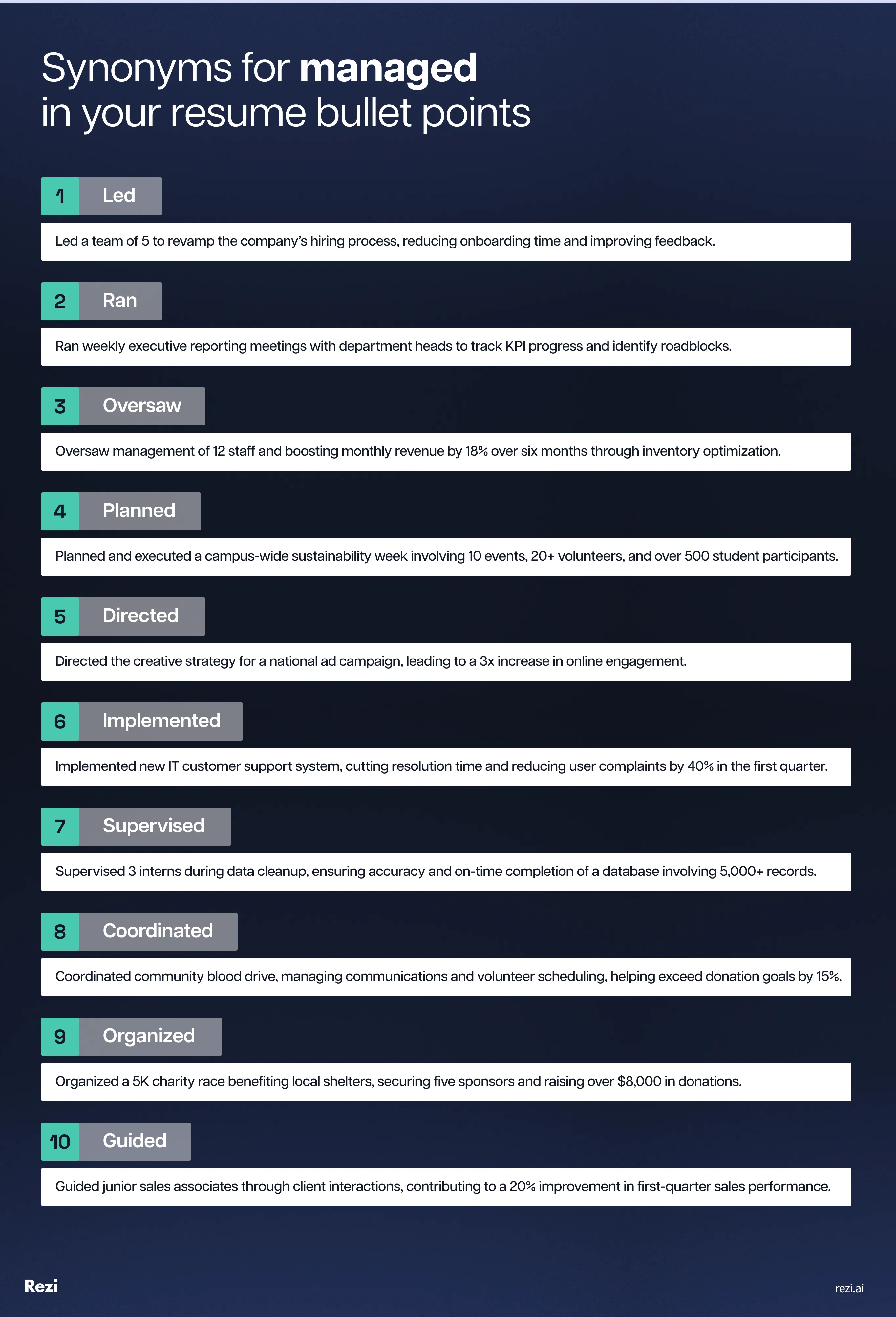
Here’s how to use these synonyms in your resume:
Combine these verbs with the most in-demand resume skills: Skills Section for a Resume
How to Replace “Managed” With Synonyms on Your Resume
Leading isn’t just about telling your team what to do and calling it a day. If you want to give recruiters more insight into your leadership style, you can swap out “managed” for more specific verbs that say more about your duties and involvement.
Check out the difference when you replace “managed” with these popular synonyms.
Led vs. Managed
“Led” shows you’re not just overseeing, but actively guiding your team. It adds a leadership and mentorship layer, which sounds more impressive than basic supervision.
“Managed a team of ten customer service reps.”
“Led a high-performing team of ten customer service representatives, improving resolution times by 25%.”
Optimized vs. Managed
“Optimized” emphasizes content quality and strategic improvement. Use this verb to shift from passive maintenance to intentional growth.
“Managed the company’s social media accounts.”
“Optimized social media content across 5 platforms, boosting engagement by 40% in 6 months.”
Directed vs. Managed
“Directed” shows leadership skills and emphasizes follow-through. Use this verb to convey that you maintained control and owned the process from start to finish.
“Managed marketing campaigns.”
“Directed integrated marketing campaigns, resulting in a 20% increase in qualified leads.”
Coordinated vs. Managed
“Coordinated” is more dynamic, showing you handled moving parts, worked across teams, and kept everything on track.
“Managed event logistics.”
“Coordinated logistics for corporate events with 100+ attendees, staying under budget and ahead of schedule.”
Oversaw vs. Managed
“Oversaw” still shows authority, but implies a more passive role. It suggests your team had more independence, and you were there to step in when needed.
“Managed daily office operations.”
“Oversaw daily office operations to support workflow efficiency and reduce bottlenecks.”
Monitored vs. Managed
“Monitored” implies you ensured deadlines were met and held teams accountable, without being actively involved in every step of the process.
“Managed project timelines.”
“Monitored project milestones, ensuring on-time delivery for 100% of initiatives.”
Implemented vs. Managed
“Implemented” means you took initiative and contributed something new and valuable, such as a plan, strategy, process, or decision.
“Managed website updates.”
“Implemented UX improvements on the company website, increasing site traffic by 30%.”
Facilitated vs. Managed
“Facilitated” adds a supportive and structured tone. By definition, it means you helped to make something easier, such as a process or action.
“Managed onboarding for new hires.”
“Facilitated onboarding programs for new employees, reducing ramp-up time by 2 weeks.”
Orchestrated vs. Managed
“Orchestrated” gives a sense of coordination, timing, and complexity. It’s a strong leadership word that shows you brought everything together.
“Managed product launches.”
“Orchestrated the launch of 3 major products, collaborating with sales and design to exceed revenue goals.”
Maintained vs. Managed
“Maintained” adds consistency, making it clear you built something useful and kept it running smoothly.
“Managed internal documentation.”
“Maintained a centralized documentation system, increasing team access to resources.”
Want to know verbs to avoid? Check out these red flags: The Top 30 Weakest Action Verbs
Best “Managed” Synonym Examples
Using “managed” in your resume instantly implies you held a position of authority, which is great if you’re going for those senior positions. But once you’ve used it a couple of times (your job title is also a giveaway), it’s worth showing how you led. What did that look like? What kind of leader were you?
For personalized suggestions when writing your resume, you can use our AI resume writing tool. It generates bullet points for you based on your role, and can even provide suggestions for rewrites.
Take a look at how to use different verbs to show your range of leadership skills.
1. Led
“Led” is one of the strongest and most popular alternatives to “managed.” It shows ownership, initiative, and the ability to inspire or guide a team toward results. It’s especially effective in team-based environments where you want to emphasize leadership, even if you weren’t a formal manager.
Examples:
• Led a cross-departmental team of eight to deliver a mobile app MVP in ten weeks.
• Led weekly strategy meetings to align marketing and sales teams, improving lead conversion by 18%.
• Proven ability to lead teams in high-pressure environments and deliver results under tight deadlines.
2. Ran
“Ran” is simple, strong, and practical. It suggests you were the engine behind something, handling daily execution and making sure everything worked. It’s a great fit for fast-paced environments like startups, operations, retail, or small teams, where agility and autonomy matter more than titles.
Examples:
• Ran daily operations for a boutique agency, coordinating schedules, vendor outreach, and client communication.
• Ran paid social media campaigns, resulting in a 3x return on ad spend.
• Self-starter who successfully ran multichannel initiatives with minimal supervision.
3. Oversaw
“Oversaw” conveys trust, accountability, and authority. Use it to show you were responsible for monitoring outcomes, supervising teams, or ensuring standards were met, without necessarily getting into the weeds yourself. It’s ideal for industries that involve compliance or oversight.
Examples:
• Oversaw financial reporting and compliance for a $2.5M annual budget.
• Oversaw onboarding of 50+ new hires during peak hiring season.
• Oversaw student volunteers as president of the Business Club, coordinating charity fundraisers.
4. Planned
“Planned” suggests you’re proactive, detail-oriented, and strategic. It shows you have the ability to map out situations, organize resources, and make things happen smoothly. It’s a great fit for event planning, marketing, education, logistics, or any role where structure and foresight are key.
Examples:
• Planned and scheduled quarterly content calendars for five client accounts.
• Planned logistics for a company retreat with 150+ attendees; delivered the event under budget by 12%.
• Planned and led peer study sessions every week for final exams in economics.
5. Directed
“Directed” has a commanding tone that implies strategic leadership and control over a project, team, or process. It’s especially effective when you’ve managed complex initiatives with multiple moving parts. Perfect for creative industries, consulting, project management, and executive-level roles.
Examples:
• Directed a rebranding initiative across 3 business units, including design, messaging, and rollout.
• Directed efforts between engineering and product teams to align development with user needs.
• Experienced in directing cross-functional teams to meet aggressive business goals.
6. Implemented
“Implemented” shows that you can turn plans into action to get things across the finish line. It implies technical know-how, reliability, and follow-through. It’s excellent for IT, operations, HR, marketing, and anywhere process improvement or rollout is key.
Examples:
• Implemented a new CRM system, reducing client follow-up time by 35%.
• Implemented employee feedback loops that increased retention by 20%.
• Skilled at implementing scalable systems to improve efficiency and team performance.
7. Supervised
“Supervised” communicates that you had oversight over people, processes, or projects. It’s a reliable synonym for “managed,” particularly in service, education, healthcare, or admin roles. It implies responsibility when managing people, training, or maintaining order.
Examples:
• Supervised a team of 12 seasonal employees, ensuring adherence to safety protocols.
• Supervised daily front desk operations and resolved escalated client issues.
• Supervised student volunteers during campus outreach events.
8. Coordinated
“Coordinated” shows that you kept things organized, handled communication between parties, and ensured smooth execution. It’s especially good for roles where collaboration is key, like marketing, HR, admin, event planning, or operations.
Examples:
• Coordinated internal training programs across 4 departments, reaching 200+ employees.
• Coordinated project timelines between product and engineering teams to meet launch deadlines.
• Coordinated cross-functional teams to improve workflows and increase productivity.
9. Organized
“Organized” is great when you want to highlight your ability to bring structure, efficiency, and order. It’s less about authority and more about your ability to make chaos manageable. It’s a great fit for admin, event roles, early-career resumes, or when showing soft skills.
Examples:
• Organized quarterly team offsites and training sessions for 40+ employees.
• Organized digital filing systems, reducing document retrieval time by 50%.
• Organized campus-wide food drive as part of student leadership initiative.
10. Guided
“Guided” implies mentorship, support, and influence, showing that you helped others grow or move forward. This is a solid choice for people-focused roles like education, customer success, sales, leadership training, or support-based work.
Examples:
• Guided new hires through onboarding and training, cutting ramp-up time by 30%.
• Guided clients through the post-sale implementation process to ensure success.
• Guided a team of classmates on a semester-long capstone project in business strategy.
When You Should Still Use “Managed” in Your Resume
Words like “managed” are fine to start with, but they’re not enough on their own. Just saying you managed a team doesn’t automatically mean you were good at it. What really matters is how you back them up — with real examples, results, and a clear picture of how you work.
Here’s how to go beyond the basics and use better language to show your potential.
- Focus on positive outcomes. Don’t just say you “managed” something — show what changed because of you. Always pair management verbs with outcomes, improvements, or scale. Show the impact, not just the role.
- Mix up your synonyms to avoid sounding repetitive. If you use “managed” in every resume bullet point, your resume will start to blur. Swap in strong, specific verbs like “led,” “coordinated,” or “implemented” to keep your experience varied and dynamic.
- Use leadership synonyms in your work experience. Words like “supervised,” “oversaw,” and “directed” are perfect in your resume work experience section because they show what you were responsible for and create a more specific picture.
- Choose verbs that fit the level of your role. “Directed” or “oversaw” might sound inflated if you were an intern. In that case, “coordinated,” “assisted,” or “supported” feel more honest and professional, and they still sound capable.
- Don’t use “managed” for solo projects. If you worked independently, words like “executed,” “owned,” or “developed” are clearer and more accurate. “Managed” implies you were responsible for others, not just yourself.
- Highlight achievements more than duties. Avoid bullets like “Managed calendar scheduling.” Instead, say, “Organized and improved scheduling efficiency by reducing double bookings by 30%.” The verb matters, but the result matters more.
- Tailor your resume for your experience level. Verbs like “organized,” “facilitated,” or “guided” still communicate leadership potential without overstating experience. They’re great for extracurriculars, internships, and academic projects where you weren’t the official manager but played a meaningful role.
- Keep it honest. Synonyms are powerful, but don’t use a fancier word just to sound impressive. “Directed” when you really mean “coordinated” might raise eyebrows in an interview. Choose words that reflect what you did, but in the strongest light.
Check out more resume tips and examples: How to Write a Resume to Win a Job Interview
FAQ
What is another word for managed on a resume?
There are plenty of great alternatives to “managed” on a resume, depending on what exactly you did. Words like led, supervised, oversaw, coordinated, or directed can work well and tell a specific story. For example, “coordinated” implies collaboration, while “directed” sounds more high-level and strategic. You should choose based on your role and impact.
What’s a synonym for management?
If you’re trying to avoid repeating “management” in your resume, consider terms like leadership, oversight, operations, team direction, or project coordination, depending on the context. “Management” is pretty broad, so it helps to be more specific about people, projects, or processes.
How do you say you managed someone on a resume?
Rather than just saying “managed people,” try something like “supervised a team of five,” “guided junior staff,” “mentored interns,” or “led a group of customer service reps.” These options tell the hiring manager you were in charge and that you interacted with your team and supported their work.
How to say you managed a team on a resume?
You can phrase it more dynamically by saying “led a high-performing sales team,” “oversaw daily operations of a customer support team,” or “directed a team of ten through a product launch.” It’s smart to add numbers or outcomes to show the scope of your leadership and the results you helped drive.
What is another word for handled or managed?
“Handled” and “managed” can be a little vague on their own. Instead, go with more specific action verbs like coordinated, executed, led, organized, or implemented. These give clearer insight into your role. For example, instead of “handled scheduling,” try “organized and maintained executive calendar with zero conflicts for six months.”

Upload or drop your resume to get started
Upload your resume to get started
Score my resume

Lauren Bedford is a seasoned writer with a track record of helping thousands of readers find practical solutions over the past five years. She's tackled a range of topics, always striving to simplify complex jargon. At Rezi, Lauren crafts genuine and actionable content that guides readers in creating standout resumes to land their dream jobs.