“Rezi is super upfront and continues to improve over time. I've recommended Rezi to several of my friends and colleagues. I just love this product so much.”
Ricky M.
Software Engineer
“Rezi is super upfront and continues to improve over time. I've recommended Rezi to several of my friends and colleagues. I just love this product so much.”
Ricky M.
Software Engineer
Helping users land jobs at 1,000+ companies such as
Investment banking recruiting is a different breed.
In most industries, a resume is one piece of a broader application, but for investment banking job applications, your resume is often the entire first round.
That one or two pages of your resume will be reviewed by someone who has seen thousands of applications from candidates with nearly identical credentials. The same target schools, same finance degrees, and even the same internships.
The margin for error is almost zero, and the margin for standing out is measured in how precisely you communicate your experience, technical skills, and career trajectory.
This guide includes 10+ investment banking resume examples across levels and specializations, followed by a writing guide that covers what IB resumes specifically require and where most candidates get filtered out.
Investment Banking Resume Examples
The resume examples below are organized by career level first, then by specialization. Find the one closest to your situation and use the writing guide that follows to refine it.
Or if you want to jump ahead and start customizing your own investment banking resume, start with one of our professional resume templates.
Note: For an investment banking resume, GPA can be included unless it hurts you. Education goes at the top after your summary section if you're a recent grad and after the experience section if you're not.
General Investment Banking Resume
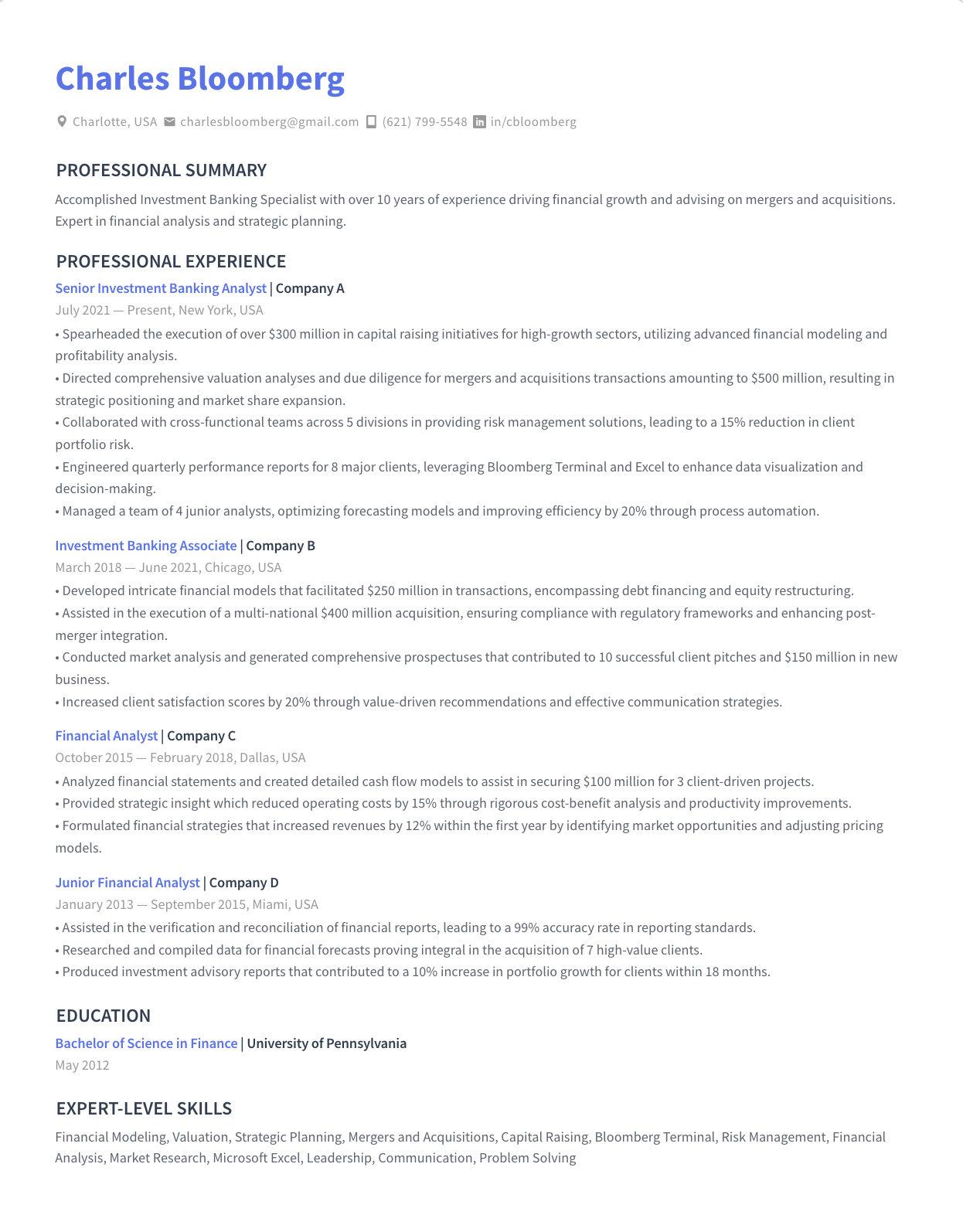
A general investment banking resume should communicate three things immediately: your deal experience, your technical proficiency, and your career trajectory. This template works if you're applying broadly across groups or banks and haven't yet specialized in a single product or sector. Lead with your strongest transactions (include deal values, types, and your specific contribution), show modeling and valuation skills in context, and make sure your education and certifications are clearly visible.
Your resume is only 30 seconds away from being done.
Charles Bloomberg
Charlotte, USA
charlesbloomberg@gmail.com
(621) 799-5548
in/cbloomberg
PROFESSIONAL SUMMARY
Accomplished Investment Banking Specialist with over 10 years of experience driving financial growth and advising on mergers and acquisitions. Expert in financial analysis and strategic planning.
PROFESSIONAL Experience
Senior Investment Banking Analyst | Company A
July 2021 — Present, New York, USA
• Spearheaded the execution of over $300 million in capital raising initiatives for high-growth sectors, utilizing advanced financial modeling and profitability analysis. • Directed comprehensive valuation analyses and due diligence for mergers and acquisitions transactions amounting to $500 million, resulting in strategic positioning and market share expansion. • Collaborated with cross-functional teams across 5 divisions in providing risk management solutions, leading to a 15% reduction in client portfolio risk. • Engineered quarterly performance reports for 8 major clients, leveraging Bloomberg Terminal and Excel to enhance data visualization and decision-making. • Managed a team of 4 junior analysts, optimizing forecasting models and improving efficiency by 20% through process automation.
Investment Banking Associate | Company B
March 2018 — June 2021, Chicago, USA
• Developed intricate financial models that facilitated $250 million in transactions, encompassing debt financing and equity restructuring. • Assisted in the execution of a multi-national $400 million acquisition, ensuring compliance with regulatory frameworks and enhancing post-merger integration. • Conducted market analysis and generated comprehensive prospectuses that contributed to 10 successful client pitches and $150 million in new business. • Increased client satisfaction scores by 20% through value-driven recommendations and effective communication strategies.
Financial Analyst | Company C
October 2015 — February 2018, Dallas, USA
• Analyzed financial statements and created detailed cash flow models to assist in securing $100 million for 3 client-driven projects. • Provided strategic insight which reduced operating costs by 15% through rigorous cost-benefit analysis and productivity improvements. • Formulated financial strategies that increased revenues by 12% within the first year by identifying market opportunities and adjusting pricing models.
Junior Financial Analyst | Company D
January 2013 — September 2015, Miami, USA
• Assisted in the verification and reconciliation of financial reports, leading to a 99% accuracy rate in reporting standards. • Researched and compiled data for financial forecasts proving integral in the acquisition of 7 high-value clients. • Produced investment advisory reports that contributed to a 10% increase in portfolio growth for clients within 18 months.
Education
Bachelor of Science in Finance | University of Pennsylvania
May 2012
Expert-Level Skills
Financial Modeling, Valuation, Strategic Planning, Mergers and Acquisitions, Capital Raising, Bloomberg Terminal, Risk Management, Financial Analysis, Market Research, Microsoft Excel, Leadership, Communication, Problem Solving
Investment Banking Analyst Resume
The investment banking analyst resume lives or dies on deal experience and technical skills. You're expected to show that you can build models, prepare pitch books, and support live transactions under pressure. List specific deals you've worked on (with approximate values when possible), the type of work you did (financial modeling, due diligence, valuation analysis), and the outcome. If you're coming straight from undergrad, your education section goes first and should include GPA (if 3.5+), relevant coursework, and honors.
Your resume is only 30 seconds away from being done.
Charles Bloomberg
Miami, USA
charlesbloomberg@gmail.com
(621) 799-5548
in/cbloomberg
PROFESSIONAL SUMMARY
Investment Banking Analyst with over 5 years of experience in financial modeling, valuation, and strategic advisory for mergers and acquisitions. Proven track record of optimizing ROI through detailed analysis and innovative solutions.
PROFESSIONAL Experience
Investment Banking Analyst | Company A
January 2021 — Present, Miami, USA
• Conducted 20+ comprehensive financial analyses per quarter using Excel and Bloomberg Terminal, resulting in a 15% increase in client engagement. • Spearheaded 10 merger and acquisition transactions, collectively valued at $1.5 billion, enhancing company portfolio diversity. • Developed detailed valuation models, including DCF and LBO, that improved acquisition strategy decision-making by 30%. • Collaborated with cross-functional teams to produce client-facing presentations that secured $500 million in new business. • Optimized financial forecasting processes, reducing turnaround time by 40% and increasing accuracy by 20%.
Junior Investment Banking Analyst | Company B
August 2018 — December 2020, New York, USA
• Assisted in the execution of 15 equity and debt financing projects, totaling $700 million in capital raised. • Engineered financial models that improved profitability projections by 25% through scenario analysis and risk assessment. • Analyzed market trends and performance metrics, providing vital insights that led to a 10% increase in client ROI. • Produced detailed industry reports that improved the accuracy of strategic recommendations by 35%.
Financial Analyst | Company C
March 2016 — July 2018, Atlanta, USA
• Conducted due diligence for 20 potential investment opportunities, resulting in $300 million in strategic investments. • Improved efficiency of financial reporting processes by 30% through the implementation of automated data solutions. • Developed a proprietary risk assessment framework, reducing client portfolio risk by 15%.
Investment Banking Intern | Company D
June 2015 — February 2016, Charlotte, USA
• Supported senior analysts in preparing pitch books and presentations that led to $150 million in deal mandates. • Managed data compilation for financial databases, enhancing data accuracy by 20%. • Assisted in benchmarking activities, producing competitive analysis reports that informed key decision-making processes.
Education
Bachelor of Science in Finance | University of Pennsylvania
If you're recruiting for a summer analyst position, your resume needs to compensate for limited deal experience. Lead with education (school name, GPA, relevant coursework, finance clubs, case competitions). Then include any finance-adjacent internships, personal investment projects, or modeling work you've done independently. If you've completed Wall Street Prep, Breaking Into Wall Street (BIWS), or CFI's FMVA certification, include it. Banks recruiting summer analysts are evaluating potential, not just track record. Show you understand the work, even if you haven't done it at a bank yet.
Your resume is only 30 seconds away from being done.
Charles Bloomberg
San Francisco, USA
charlesbloomberg@gmail.com
(621) 799-5548
in/cbloomberg
PROFESSIONAL SUMMARY
Aspiring Investment Banking Analyst with a strong foundation in financial analysis, modeling, and market research. Adept at leveraging quantitative skills to support transaction processes and deliver actionable insights.
PROFESSIONAL Experience
Investment Banking Intern | Company A
June 2023 — Present, San Francisco, USA
• Conducted detailed financial analysis and valuation of over 15 prospective investment opportunities, utilizing discounted cash flow (DCF) and comparable company analysis models. • Assisted in the preparation of pitch books and presentations by collating data and structuring complex financial information to aid decision-making for M&A transactions. • Supported deal execution by performing due diligence, analyzing financial statements, and tracking market trends to identify potential risks and opportunities. • Developed robust Excel models that streamlined the processing of financial data, improving efficiency by approximately 35% in the preparation of client advisory reports. • Collaborated with senior analysts and associates to generate equity research reports, providing insights into industry dynamics that informed strategic investment decisions.
Financial Analyst Intern | Company B
January 2023 — May 2023, New York City, USA
• Analyzed quarterly earnings reports and assisted in identifying trends affecting over 10 industries, contributing to periodic client updates and investment strategies. • Developed advanced VBA macros to automate the generation of financial models, reducing analysis time by 50% for recurring analytical tasks. • Participated actively in weekly strategy sessions, presenting findings from market research and economic data, facilitating informed decision-making by senior management. • Prepared and maintained comprehensive databases of financial metrics and economic indicators, ensuring accurate and up-to-date information for team projects.
Junior Financial Analyst | Company C
June 2022 — December 2022, Miami, USA
• Contributed to the analysis and reporting on financial performance and trends for a portfolio of 20+ investment assets, providing insights on potential growth opportunities. • Developed detailed financial projections and profitability analyses, enhancing investment decision-making and minimizing risk for client portfolios. • Assisted in generating weekly market analysis reports, synthesizing data from various financial news sources and databases to inform investment strategies.
Finance Intern | Company D
January 2022 — May 2022, Houston, USA
• Researched and evaluated financial market trends, contributing to monthly investment outlook briefings that informed strategy meetings and investment decisions. • Coordinated with various teams to gather and analyze financial data, streamlining the reporting process and improving data accuracy by 20%. • Assisted in the formulation of client investment presentations by assembling relevant financial data and market analyses, enhancing engagement and investment appeal.
Education
Bachelor of Science in Finance | University of Pennsylvania
Associates are expected to have either been promoted from analyst or to hold an MBA from a target program. An investment banking resume at this level should reflect a shift from execution to management and client interaction. Show that you've led deal teams, managed analyst workflows, and participated in client-facing presentations. Include aggregate deal experience (total transaction value, number of deals closed), and highlight any origination or business development contributions. An MBA should be listed prominently, along with CFA progress if applicable.
Your resume is only 30 seconds away from being done.
Charles Bloomberg
Miami, USA
charlesbloomberg@gmail.com
(621) 799-5548
in/cbloomberg
PROFESSIONAL SUMMARY
Accomplished Investment Banking Associate with extensive expertise in financial modeling, M&A advisory, and client relationship management. Proven track record in driving revenue growth and delivering strategic insights to enhance investment strategies.
PROFESSIONAL Experience
Investment Banking Associate | Company A
January 2020 — Present, New York, USA
• Spearheaded execution of over 20 M&A transactions, with total deal value exceeding $15 billion, by conducting thorough due diligence and financial analysis. • Developed comprehensive financial models to evaluate investment opportunities, enhancing clients' decision-making processes, and resulting in a 25% increase in revenue. • Collaborated with a team of analysts to prepare pitch books and presentations for C-level clients, which directly led to securing $1.5 billion in new engagements. • Managed cross-functional teams to streamline processes, reducing project timelines by 30% and increasing efficiency in transaction execution. • Engineered unique market entry strategies, leveraging macroeconomic and industry research, resulting in a 40% growth in client portfolios.
Analyst | Company B
June 2017 — December 2019, Chicago, USA
• Conducted detailed financial analysis and modeling, directly contributing to the successful closure of transactions valued at over $10 billion. • Assisted senior bankers in creating strategic advisory presentations, which secured $500 million in new business for the firm. • Implemented proprietary financial models, resulting in a 20% improvement in forecast accuracy for client portfolios. • Researched market trends to develop compelling investment proposals, increasing client engagement and satisfaction by 30%.
Investment Banking Summer Intern | Company C
June 2016 — August 2016, Houston, USA
• Developed detailed industry reports by analyzing market data and competitor performance, providing critical insights for potential investment opportunities. • Supported deal teams in preparing financial statements and valuations, leading to streamlined deal execution and enhanced client satisfaction. • Assisted in financial statement analysis, aiding the senior management in making informed strategic investment decisions.
Financial Analyst | Company D
July 2015 — May 2017, San Francisco, USA
• Improved financial reporting processes, reducing data collection time by 15% and enhancing the accuracy of financial analyses. • Oversaw portfolio performance assessments, enabling a year-on-year return increase of 12% for key clients. • Created detailed financial forecasts and budgets for multiple projects, ensuring alignment with corporate strategy and financial objectives.
Education
Bachelor of Science in Finance | University of Pennsylvania
At the VP level, your investment banking resume shifts toward client relationships, deal origination, and revenue generation. Show that you've sourced deals, maintained senior client relationships, and managed the execution of significant transactions. Include total deal value led or contributed to, notable client names (if appropriate), and team management scope. The VP resume in banking is where the transition from "execution" to "rainmaking" needs to be visible. If you've brought in mandates or expanded existing client relationships into new product areas, lead with that.
Your resume is only 30 seconds away from being done.
Charles Bloomberg
New York City, USA
charlesbloomberg@gmail.com
(621) 799-5548
in/cbloomberg
PROFESSIONAL SUMMARY
Dynamic Investment Banking VP with over 15 years of experience in driving multimillion-dollar deals and building client relationships across various industries. Expertise in financial modeling, strategic advisory, and capital markets with a track record of delivering high-impact results.
PROFESSIONAL Experience
Vice President, Investment Banking | Company A
January 2020 — Present, New York City, USA
• Led cross-functional teams in executing 12 M&A deals totaling over $5 billion, achieving enhanced valuation through advanced financial modeling and strategic negotiations. • Developed strategic client relationships across technology and healthcare sectors, resulting in a 25% increase in deal flow and long-term advisory mandates. • Spearheaded the capital markets division's private equity efforts, successfully raising over $1.2 billion in equity and debt capital over a period of 2 years. • Managed a team of 15 junior analysts and associates, optimizing workflow through implementation of advanced financial software, resulting in a 30% reduction in report preparation time. • Collaborated with senior executives on strategic initiatives resulting in a 40% increase in cross-border transaction volume.
Director, Investment Banking | Company B
June 2015 — December 2019, New York City, USA
• Directed over 20 high-profile M&A transactions, totaling $4 billion, utilizing complex valuation techniques and strategic financial assessments. • Launched tailored financial solutions leading to a 35% increase in client acquisition and retention, focusing on both mid-cap and large-cap firms. • Pioneered a new market entry strategy for technology clients, boosting sector market share by 15% within the first year. • Enhanced due diligence processes, reducing timeline by 20% and ensuring compliance with regulatory standards.
Senior Associate, Investment Banking | Company C
January 2012 — May 2015, Chicago, USA
• Produced detailed valuation models, contributing to more than $1 billion in closed transactions. • Improved capital budgeting processes, resulting in a 25% increase in project return indicators for key clients. • Collaborated with legal teams in structuring complex deal agreements, ensuring mitigation of potential risks.
Investment Banking Analyst | Company D
July 2009 — December 2011, Philadelphia, USA
• Assisted in the execution of multiple IPOs raising over $500 million, through rigorous financial analysis and investor engagement. • Engineered financial models to forecast company performance, aiding in strategic advisory classifications and recommendations. • Facilitated internal training programs for junior analysts, increasing technical competency and efficiency by 15%.
Education
Master of Business Administration (MBA) | Wharton School, University of Pennsylvania
May 2009
Expert-Level Skills
Financial Modeling, Mergers & Acquisitions, Capital Markets, Valuation, Strategic Advisory, Risk Management, Client Relationship Management, Team Leadership, Regulatory Compliance, Negotiation, Analytical Skills, Communication Skills
M&A (Mergers & Acquisitions) Resume
M&A resumes should emphasize transaction execution across buy-side and sell-side mandates. Include deal types (mergers, divestitures, carve-outs, spin-offs), deal sizes, and your specific contribution (built the merger model, ran the data room, prepared management presentations). Highlight valuation methodologies you've applied: DCF, comparable company analysis, precedent transactions, LBO analysis. If you've worked on cross-border M&A or deals involving regulatory approvals, those add complexity that's worth noting.
Your resume is only 30 seconds away from being done.
Charles Bloomberg
New York, USA
charlesbloomberg@gmail.com
(621) 799-5548
in/cbloomberg
PROFESSIONAL SUMMARY
Dynamic Investment Banking Professional specializing in Mergers & Acquisitions with a proven track record of driving strategic transactions, optimizing valuation, and enhancing shareholder value for Fortune 500 companies.
PROFESSIONAL Experience
Vice President of Investment Banking - M&A | Company A
July 2020 — Present, New York, USA
• Directed a team of 15 analysts and associates in executing M&A transactions totaling over $2 billion in deal value within a 12-month span, leading to a 25% increase in revenue. • Spearheaded due diligence process for 10 high-profile M&A deals, effectively assessing company valuations and potential synergies using financial modeling and analysis. • Developed comprehensive financial models to evaluate different deal structures, resulting in the optimization of capital allocation and over $300 million in cost savings. • Negotiated and crafted strategic terms for transactions, achieving a 15% premium over target company's market value in a competitive bidding environment. • Cultivated relationships with C-suite executives of Fortune 500 companies, enhancing cross-sell opportunities and expanding service offerings by 20%.
Associate - Investment Banking M&A | Company B
May 2017 — June 2020, San Francisco, USA
• Collaborated on more than 25 M&A transactions, providing financial analysis and strategic guidance that contributed to $5 billion in closed deals. • Engineered complex financial models and valuation analyses, improving accuracy of forecasts and enhancing decision-making process for high-stakes investments. • Managed client relationships and coordinated cross-departmental efforts, ensuring seamless execution of strategic initiatives and resulting in a 98% client satisfaction rate. • Conducted market research and industry analysis for client presentations, increasing competitive intelligence and identifying opportunities for growth and acquisition.
Investment Banking Analyst | Company C
January 2015 — April 2017, Chicago, USA
• Assisted in the execution of over 15 mergers and acquisitions, contributing to deals exceeding $1 billion in total value. • Engaged in extensive financial modeling and analysis, enhancing valuation processes for both buy-side and sell-side transactions and increasing accuracy by 30%. • Provided critical support in deal structuring and negotiation phases, aiding in the successful closure of 90% of pursued deals.
Investment Banking Intern | Company D
June 2014 — December 2014, Los Angeles, USA
• Conducted industry research and compiled market intelligence reports for the senior banking team, supporting strategy development for client acquisition. • Assisted in the preparation of pitch books and client presentations, contributing to securing new accounts worth over $50 million. • Analyzed financial statements and market data, supporting senior analysts with financial projections and due diligence reviews.
Education
Bachelor of Science in Finance | University of Pennsylvania, Wharton School
ECM resumes should show experience with IPOs, secondary offerings, follow-ons, and block trades. Include deal sizes, your role in the bookbuilding or marketing process, and any investor outreach or roadshow coordination. Mention familiarity with SEC filings (S-1, prospectus), pricing analysis, and syndication processes. If you've worked on notable public offerings or supported deals during volatile market windows, those are strong differentiators.
Your resume is only 30 seconds away from being done.
Charles Bloomberg
Kansas City, USA
charlesbloomberg@gmail.com
(621) 799-5548
in/cbloomberg
PROFESSIONAL SUMMARY
Seasoned Equity Capital Markets professional with over 10 years of experience in managing high-stakes IPOs, secondary offerings, and capital raising strategies. Demonstrated expertise in financial modeling, market analysis, and strategic advisory to drive optimal investment outcomes.
PROFESSIONAL Experience
Vice President, Equity Capital Markets | Company A
March 2018 — Present, New York, USA
• Spearheaded IPO efforts for 10+ companies, cumulatively raising over $50 billion with an 85% success rate in terms of post-launch stock performance. • Engineered complex financial models for valuation and pricing analysis using advanced Excel and VBA tools, significantly reducing model turnaround time by 30%. • Collaborated with C-suite executives and legal advisors to structure equity offerings, maintaining compliance and maximizing shareholder value in transactions. • Led a team of 5 analysts, improving team output by 25% through innovative workflow management and training initiatives. • Developed investor relations strategies and roadshows, increasing investor engagement by 40% and broadening investment networks across global markets.
Associate, Equity Capital Markets | Company B
May 2015 — February 2018, Chicago, USA
• Managed secondary offering transactions worth over $20 billion across various industries, achieving an average 92% subscription rate. • Increased market share by 15% through strategic targeting and tailored product offerings for emerging market equities. • Produced comprehensive equity market analysis reports, enabling the advisory team to make informed decisions with 95% accuracy in forecasts. • Assisted in the preparation and execution of 8 successful equity roadshows, enhancing client visibility and investor interest.
Analyst, Equity Capital Markets | Company C
January 2013 — April 2015, Boston, USA
• Conducted detailed financial assessments and due diligence for 50+ equity transactions, ensuring accuracy and compliance with regulatory standards. • Formulated investment strategies that resulted in a 10% increase in average client ROI. • Implemented a new analytics framework using Bloomberg Terminal, reducing equity research time by 20%.
Intern, Equity Capital Markets | Company D
June 2012 — December 2012, San Diego, USA
• Supported senior analysts in the evaluation of 15 equity investment opportunities, contributing to a successful investment year with 8% portfolio growth. • Maintained and updated financial databases, ensuring data integrity and providing timely information to the team. • Researched market trends and sector performance, aiding in the preparation of presentation materials for client pitches.
Education
Bachelor of Science in Finance | University of Chicago
DCM resumes should show experience with bond issuances, leveraged finance, investment-grade debt, and loan syndications. Include deal sizes, credit analysis work, covenant structuring, and pricing model contributions. If you've worked across different debt products (high yield, IG, convertible, structured) or supported refinancing transactions, show that range. Familiarity with credit rating agency processes and debt documentation is worth mentioning.
Your resume is only 30 seconds away from being done.
Charles Bloomberg
New York, USA
charlesbloomberg@gmail.com
(621) 799-5548
in/cbloomberg
PROFESSIONAL SUMMARY
Seasoned investment banking professional with extensive expertise in Debt Capital Markets (DCM), adept at structuring and securing capital for global corporations. Proven track record of optimizing financing strategies and executing high-value transactions.
PROFESSIONAL Experience
Vice President of Debt Capital Markets | Company A
August 2020 — Present, New York, USA
• Structured and executed over $25 billion in debt financing transactions annually, utilizing advanced financial modelling and analytics to optimize capital structure. • Spearheaded a team of 10 analysts and associates in originating, marketing, and closing bond issuances, achieving a 30% increase in transaction volume. • Developed innovative financing solutions for Fortune 500 clients, leveraging market insights and risk assessments to meet strategic objectives. • Managed relationships with over 50 institutional investors, enhancing client portfolios through strategic investment recommendations and capital allocation. • Pioneered the implementation of digital platforms to streamline transaction processes, reducing execution time by 20% and improving transactional accuracy.
Associate of Debt Capital Markets | Company B
May 2017 — July 2020, Chicago, USA
• Collaborated on the execution of cross-border debt financings totaling over $15 billion, ensuring compliance with international regulations and optimizing investor returns. • Conducted in-depth market analysis and due diligence for debt issuances, advising senior leadership on strategic investment opportunities. • Increased client engagement by 25% through targeted outreach and development of custom financing solutions tailored to client needs. • Instrumental in crafting pitch books and presentations that secured $5 billion in new capital commitments from institutional investors.
Analyst | Company C
January 2015 — April 2017, Atlanta, USA
• Assisted in the preparation and analysis of critical financial documentation for over 100 debt offerings, ensuring accuracy and compliance. • Engineered comprehensive financial models to support the evaluation of debt instruments, improving decision-making processes for senior executives. • Collaborated with cross-functional teams to enhance the strategic direction of client engagements, resulting in a 15% improvement in client satisfaction scores.
Junior Analyst | Company D
June 2013 — December 2014, Orlando, USA
• Provided support in the execution of debt capital market strategies, contributing to transactions valuing upwards of $2 billion. • Conducted quantitative analysis and valuation of debt markets, increasing data-driven insights into investment opportunities. • Developed comprehensive sector reports, enhancing client understanding of market trends and investment potentials.
Education
Bachelor of Science in Finance | Harvard University
May 2013
Expert-Level Skills
Debt Capital Markets, Financial Modeling, Strategic Investment, Cross-Border Financing, Advanced Risk Management, Market Analysis, Investor Relations, Transaction Structuring, Regulatory Compliance, Digital Platforms Implementation, Leadership, Communication
Leveraged Finance Resume
Leveraged finance sits between DCM and M&A, focusing on the debt that funds acquisitions and buyouts. Your resume should show experience structuring leveraged credit facilities, building LBO models, and working with private equity sponsors. Include deal sizes, types of facilities structured (term loans, revolvers, mezzanine), and any involvement in credit committee presentations. Understanding of both the debt and equity sides of leveraged transactions is the key differentiator here.
Your resume is only 30 seconds away from being done.
Charles Bloomberg
Charlotte, USA
charlesbloomberg@gmail.com
(621) 799-5548
in/cbloomberg
PROFESSIONAL SUMMARY
Highly skilled Leveraged Finance professional with over 10 years of experience in structuring complex financial transactions. Expert in financial modeling, risk assessment, and capital raising, with a proven track record of closing high-profile deals.
PROFESSIONAL Experience
Vice President, Leveraged Finance | Company A
July 2020 — Present, New York, USA
• Spearheaded the structuring and execution of over $10 billion in leveraged buyouts and recapitalizations, enhancing client portfolio returns by 25%. • Developed advanced financial models and stress-tested scenarios for high-stakes transactions using Excel and VBA, resulting in a 30% decrease in forecasting errors. • Managed a team of 8 analysts to conduct due diligence on target companies, increasing efficiency by 20% and ensuring thorough risk mitigation. • Collaborated with cross-functional teams in underwriting and syndication processes, leading to the successful placement of $2 billion in syndicated loans across 30+ investors. • Negotiated covenants and terms for debt packages, achieving favorable conditions for clients, and reducing interest costs by an average of 15%.
Associate, Leveraged Finance | Company B
March 2016 — June 2020, Chicago, USA
• Assisted in structuring and closing over $5 billion in debt transactions, enhancing company's market presence in the mid-market sector. • Engineered comprehensive financial models that supported decision-making processes, resulting in a 20% increase in transaction approval rates. • Formulated credit analyses and reports for senior management, leading to more informed lending decisions and mitigating potential risks. • Coordinated with legal teams to draft term sheets and credit agreements, ensuring regulatory compliance and client satisfaction.
Financial Analyst | Company C
June 2013 — February 2016, Boston, USA
• Conducted in-depth market research and financial analyses, driving investment strategies that boosted firm returns by 12% annually. • Produced detailed valuation models for potential acquisitions targets, contributing to the successful negotiation of $500 million in acquisitions. • Supported senior associates in drafting client presentation materials, enhancing client engagement and securing new business opportunities.
Junior Analyst | Company D
May 2011 — May 2013, San Francisco, USA
• Researched industry trends and financial metrics to support senior analysts in deal structuring, resulting in a streamlined and cost-effective workflow. • Assisted in the preparation of pitch materials for over 50 prospective clients, helping secure over $200 million in financing commitments. • Maintained databases of financial information and market data, ensuring accuracy and timeliness for strategic planning purposes.
Education
Bachelor of Science in Finance | University of Pennsylvania, The Wharton School
May 2011
Expert-Level Skills
Financial Modeling, Leveraged Buyouts, Risk Assessment, Capital Markets, Debt Structuring, Excel, VBA, Bloomberg Terminal, Credit Analysis, Negotiation, Communication, Team Leadership
Private Equity-Bound / Pre-MBA Resume
If you're an analyst positioning for PE recruiting or preparing a resume for MBA applications, the focus shifts to demonstrating analytical depth, leadership potential, and a clear narrative. PE firms want analysts who've built complex models (LBO, merger, DCF), managed due diligence workstreams, and shown initiative beyond the bare minimum. Highlight your most sophisticated modeling work, any deal where you had outsized responsibility, and extracurricular leadership. GPA and target school still matter heavily here.
Your resume is only 30 seconds away from being done.
Charles Bloomberg
Chicago, USA
charlesbloomberg@gmail.com
(621) 799-5548
in/cbloomberg
PROFESSIONAL SUMMARY
Dynamic Investment Banking Analyst with comprehensive experience in financial modeling and deal execution. Expertise in private equity transactions, risk assessment, and strategic investments.
PROFESSIONAL Experience
Investment Banking Analyst | Company A
January 2021 — Present, Chicago, USA
• Developed complex financial models for 15+ private equity transactions, ensuring accuracy and precision in forecasts to drive informed decision-making. • Conducted extensive market research and due diligence, analyzing 100+ industry reports to provide strategic recommendations for mergers and acquisitions. • Facilitated the execution of 10 multimillion-dollar equity financings, coordinating with cross-functional teams and external stakeholders to ensure successful closures. • Improved client portfolio performance by 25% through targeted investment strategies and risk assessment techniques, utilizing Bloomberg Terminal and CapitalIQ. • Spearheaded the strategic restructuring of a $200M distressed asset portfolio, resulting in a 35% increase in asset value within 18 months.
Investment Banking Associate | Company B
June 2018 — December 2020, New York, USA
• Managed and executed the full lifecycle of 8 acquisition deals valued at over $1 billion, ensuring alignment with client objectives and regulatory compliance. • Collaborated with sector-specific teams to research and prepare comprehensive industry reports, identifying potential investment opportunities for high-net-worth clients. • Optimized client presentations through advanced data visualization techniques, leading to a 30% improvement in client engagement and satisfaction. • Engineered innovative valuation models, shortening analysis time by 20% and enhancing the accuracy of financial projections for potential investments.
Financial Analyst | Company C
March 2016 — May 2018, Dallas, USA
• Provided detailed financial analysis and valuation services for 25 privately held companies, aiding in securing $150M in new funding. • Assisted in the preparation of over 30 financial statements and performance reports for clients, increasing transparency and trust in financial advisory services. • Led quarterly financial reviews with senior management, yielding actionable insights and recommending 15 strategic adjustments for enhanced profitability.
Investment Analyst Intern | Company D
June 2015 — February 2016, Boston, USA
• Conducted hands-on research and analysis for 10 prospective venture capital investment opportunities, contributing to a $10M increase in firm capital allocation. • Assisted in building financial models for client portfolios, increasing investment success rates by 15% and enhancing decision-making strategies. • Collaborated with senior analysts to generate sector-specific reports, providing insightful market trends that informed strategic planning and investment tactics.
Education
Bachelor of Science in Finance | University of Pennsylvania
May 2015
Expert-Level Skills
Financial Modeling, Private Equity Transactions, Risk Assessment, Mergers and Acquisitions, Portfolio Management, Bloomberg Terminal, CapitalIQ, Strategic Analysis, Market Research, Data Visualization, Team Leadership, Client Engagement, Problem Solving
Boutique and middle-market banks often value sector depth and client access over the sheer deal volume that bulge brackets emphasize. Your resume should show that you've had significant deal responsibility earlier in your career than you would at a larger bank. If you ran an entire sell-side process as a second-year analyst, or if you had direct client communication that associates at a bulge bracket wouldn't get until later, highlight that. Include deal values even if they're smaller. A $75M deal where you owned the model and managed the data room demonstrates more capability than a $5B deal where you formatted pages in the pitch book.
Your resume is only 30 seconds away from being done.
Charles Bloomberg
Atlanta, USA
charlesbloomberg@gmail.com
(621) 799-5548
in/cbloomberg
PROFESSIONAL SUMMARY
Accomplished investment banking professional with over 10 years of experience in boutique and middle-market sectors, specializing in M&A and capital raising. Proven track record in optimizing valuation and executing transactions efficiently.
PROFESSIONAL Experience
Vice President of Investment Banking | Company A
March 2020 — Present, Atlanta, USA
• Spearheaded 25 M&A transactions totaling over $2 billion, achieving an average valuation increase of 15% above client expectations through strategic negotiation and deal structuring. • Managed comprehensive due diligence processes for transactions ranging from $50 million to $500 million, utilizing advanced financial modeling and analysis. • Developed bespoke financing solutions, raising over $400 million in capital over 3 years by leveraging comprehensive understanding of capital markets. • Led a team of 10 analysts and associates, implementing training programs that improved productivity by 30% through enhanced financial skills and efficiency techniques. • Implemented proprietary software tools that reduced transaction time by 20%, enhancing service delivery and client satisfaction.
Senior Associate | Company B
July 2016 — February 2020, New York, USA
• Assisted in executing more than 40 middle-market transactions, coordinating cross-functional international teams to streamline processes and enhance collaborative efficiency by 25%. • Developed detailed financial models for valuation and scenario analysis that resulted in an average increase of 12% in deal closings. • Played an integral role in client pitch meetings, contributing to successful acquisition of several key accounts that led to an annual revenue growth of 20%. • Engineered new analytical frameworks resulting in a 30% increase in transaction analysis speed and accuracy.
Investment Banking Analyst | Company C
June 2014 — June 2016, Chicago, USA
• Conducted comprehensive industry and market research, identifying trends and opportunities that supported the successful close of 15 transactions, each valued at over $75 million. • Collaborated with senior bankers to prepare client presentations, leading to the successful acquisition of $500 million in new business. • Optimized financial reporting and analysis processes, reducing preparation time by 40% through the implementation of automated tools.
Financial Analyst | Company D
August 2012 — May 2014, Austin, USA
• Analyzed financial statements and market data to support the evaluation of potential acquisitions, improving decision-making speed by 25%. • Assisted in the preparation of valuation models for various asset classes, contributing to a 10% improvement in accuracy. • Developed competitor and market intelligence reports that enhanced client advisory services and strategic decision-making capabilities.
Education
Bachelor of Science in Finance | University of Pennsylvania
May 2012
Expert-Level Skills
Financial Modeling, M&A Advisory, Valuation Analysis, Capital Raising, Due Diligence, Strategic Negotiation, Team Leadership, Analytical Thinking, Client Relationship Management, Market Research, Advanced Excel, PowerPoint, Business Development, Communication Skills
How to Write an Investment Banking Resume
Investment banking resumes follow a specific set of conventions that most other professions don't share. Some of these are written rules. Some are unwritten. All of these factors matter.
The one-page resume length is strictly applied for most investment banking resumes. A two-page resume can signal that you don't understand the culture. It doesn't matter if you have years of experience. Managing directors themselves at bulge bracket banks even submit one-page resumes. So should you. This forces discipline since every line needs to justify its space.
If a bullet point doesn't communicate deal experience, a technical skill, or a measurable achievement, cut it. "Strong work ethic" and "team player" are filler in any industry. In investment banking, they actively hurt you because they take up space that could describe a deal.
For formatting, use standard fonts (e.g., Times New Roman, Garamond, Calibri), 10–11pt size, 0.5–1 inch margins. Keep section headers clean and avoid graphics, colors, or loud visual layouts. The format and resume design should be minimal. The content itself is everything.
Education is especially important for investment banking job applications
In most industries, the resume education section goes near the bottom once you have a few years of experience. In investment banking, you can place it near the top right after your summary section, especially if you attended a target school.
Here’s what to include:
University name, degree, graduation date
GPA if 3.5+ (if below, consider leaving off your GPA on your resume, but know that some banks will ask)
Relevant coursework if you're a recent grad (Financial Accounting, Corporate Finance, Econometrics)
Honors, Dean's List, scholarships
Finance clubs, investing clubs, case competition wins
SAT/ACT scores are sometimes included for analyst recruiting (controversial, but still done at some firms)
If you have an MBA from a top program, list it first. If your undergrad is from a target school and your MBA isn't, consider which institution carries more weight for IB and order accordingly.
The honest reality: school pedigree still matters in banking recruiting, especially at bulge brackets. It's not the only factor, but it's a significant filter. If you're from a non-target school, your deal experience, networking, and resume certifications need to compensate.
Deal experience is the centerpiece
This is where IB resumes differ most from every other profession. The hiring manager isn't primarily evaluating your job responsibilities. They're evaluating your transaction history.
Weak: "Supported senior bankers in M&A advisory engagements across multiple sectors."
Strong: "Executed 4 M&A transactions with aggregate deal value of $1.8B, including a $650M sell-side advisory for a healthcare services platform and a $420M acquisition in the industrial technology sector. Built merger models, conducted comparable company and precedent transaction analyses, and prepared management presentations."
The strong version communicates: number of deals, aggregate value, sector, your specific contribution, and the technical work involved. That's what a hiring manager scans for.
If you're junior and your deals are smaller, that's fine. A $50M deal where you built the model and ran the data room is more impressive than vaguely referencing "$5B+ in transactions" where you formatted slides.
For confidential deals that haven't closed or been announced, describe them without naming the company: "Advised a $300M consumer products company on a potential sell-side process" works.
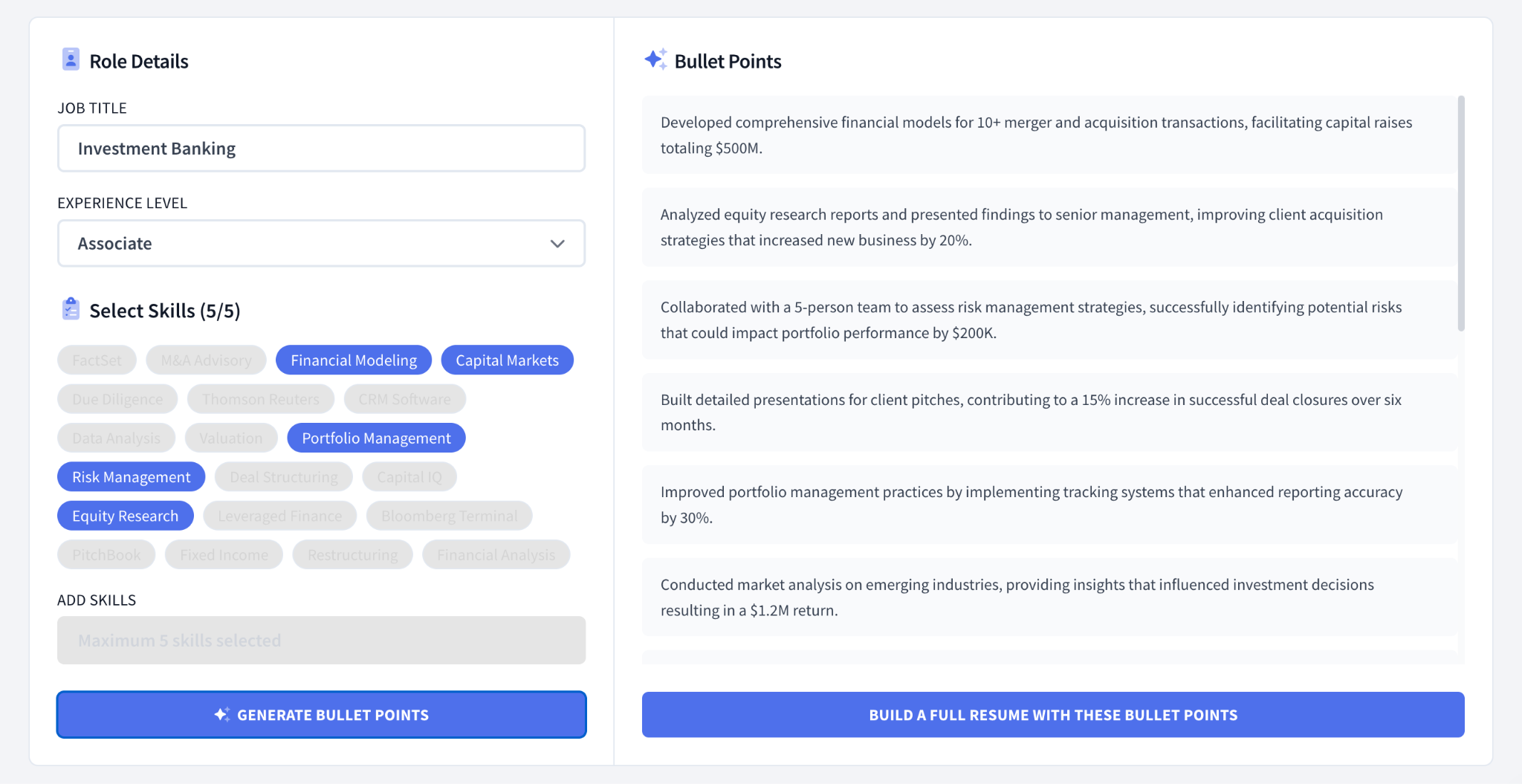
Need help writing and structuring your bullet points? Use a free resume sentence generator like ours. Simply enter your field or job title, followed by your experience level and most relevant skills. It’ll then give you a list of bullet point suggestions that you can choose and take inspiration from.
Technical skills need to be specific and provable
IB hiring managers expect proficiency in:
Financial modeling: DCF, LBO, merger/accretion-dilution, comparable company analysis, precedent transactions
PowerPoint: Pitch book creation, management presentations, board materials
Data platforms: Bloomberg Terminal, Capital IQ, FactSet, PitchBook
Accounting: Three-statement modeling, understanding of GAAP/IFRS, working capital analysis
Don't just list these in a skills section and let them collect dust. Weave them into your deal experience: "Built a 3-statement LBO model with 5 operating scenarios in Excel for a $200M sponsor-backed acquisition" proves Excel and modeling proficiency in a way that listing "Advanced Excel" never will.
Certifications that carry weight: CFA (even Level 1 passed), FMVA (from CFI), Wall Street Prep or BIWS completion, Series 79 (if applicable). Include them, especially if your educational background is less traditional.
The career ladder is baked into how your resume is read
Investment banking has one of the most rigid career progressions in any profession:
Analyst (2–3 years)
Associate (3–4 years)
VP (3–4 years)
Director/SVP (2–3 years)
Managing Director
Hiring managers are aware of this timeline. They'll map your resume against it instantly. If you've been an analyst for 5 years without any resume promotion to associate, they'll notice. If you've jumped from analyst to VP in 3 years, they'll want to understand how.
Your resume should make the progression legible. If you were promoted, say so: "Promoted from Analyst to Associate after 2 years based on deal performance and client feedback." Or make the promotion clear through your resume layout. If you left to get an MBA and came back at the associate level, show that clearly. Gaps or non-linear paths aren't automatically disqualifying, but they need to be easy to follow.
Tailor to the group and the bank
An M&A resume and a DCM resume shouldn't look the same. A resume for Goldman Sachs and a resume for a middle-market boutique shouldn't either.
Before submitting, review the job description and the bank's recent deal activity. Match your experience to their focus areas. If they've been active in healthcare M&A, highlight your healthcare deals. If they emphasize leveraged finance, lead with your LBO modeling experience.
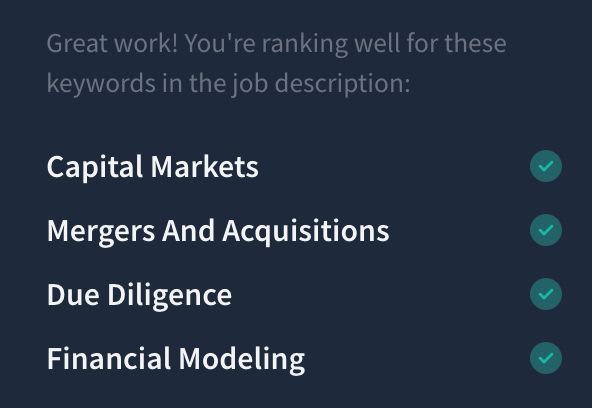
An ATS resume keyword scanner can help identify which particular words or phrases to prioritize. Paste the job description in, and it highlights what's missing from your resume. This is especially useful when tailoring across banks that emphasize different products or sectors.
Write a summary only if it adds value (but some IB resumes skip it)
This is fairly different from our other resume guides because in most professions, a summary is expected. In investment banking, it’s common for some candidates to skip it entirely, and that's fine.
If you include one, keep it to 2–3 sentences maximum. Make it concise and stick to pure facts.
Example: "Investment banking associate with 4 years of M&A execution experience across healthcare and technology sectors. $3.5B in completed transaction value. CFA Level II candidate."
If your summary would just say "Detail-oriented finance professional with strong analytical skills," delete it. That space is better used for discussing a relevant credential or experience.
What Specifically Makes Investment Banking Resumes Different
Investment banking resumes don't just follow different guidelines. They exist in a different hiring culture.
The format is standardized to the point of uniformity
In most professions, there's room for personal expression in resume formatting. In investment banking, there isn't. Recruiters expect a specific layout, and deviation reads as inexperience. One page. Conservative fonts. Dense but readable. Education and experience clearly separated. Deal list visible within the first 5 seconds of scanning.
This standardization actually works in your favor once you accept it. It means the format is settled and all your energy goes into content. The candidate who writes the sharpest deal bullets wins, not the one with the most creative layout.
Your peers all look the same on paper
Finance degrees from target schools. 3.5+ GPAs. Summer analyst internships at recognized banks. CFA in progress. When every competitive candidate has similar resume profiles, the resume becomes a precision instrument. Small differences matter: the specificity of your deal descriptions, the sophistication of your modeling experience, and whether you can articulate the "so what" behind a transaction.
This is why "Supported M&A advisory mandates" is forgettable and "Led the comparable company analysis for a $450M healthcare sell-side, identifying a 15% valuation premium versus management's initial expectations" is not. The resume with the most specific, most credible deal descriptions gets the interview.
The resume is a live document for your investment banking career
Most professionals write a resume when they're job hunting and ignore it otherwise. However, the top candidates in investment banking will update their resume after every particular deal, promotion, and exit.
Analysts preparing for PE recruiting update their resumes quarterly. Associates applying to MBA programs build their resume narrative over years.
Treat it that way. After every closed deal, write the bullet point while the details are fresh. Track your aggregate deal value. Keep a running list of the technical work you've done. When recruiting season comes, you're editing your resume and refining, not starting from scratch.
Resources for Investment Banking Professionals
Technical training and certifications
Wall Street Prep: Financial modeling, LBO modeling, and valuation training used widely in IB analyst programs.
CFA Institute: The CFA charter is the gold standard in finance credentialing. Even Level 1 passage carries weight on an IB resume.
Industry knowledge and recruiting
Mergers & Inquisitions: The most-referenced resource for IB recruiting, resume templates, and career advice.
Wall Street Oasis (WSO): Community forums, salary data, and interview prep for IB and related fields.
Wall Street Journal: Required reading for staying current on deal activity and market trends.
Summary
Here's a recap of how to write an investment banking resume:
Format. Aim for one page, no exceptions. Use conservative fonts (Times New Roman, Garamond, Calibri), 10–11pt and clean section headers. The content is everything.
Education. Place it first if you're a recent grad or if your school carries significant weight. Include GPA (3.5+), relevant coursework, honors, and finance club involvement. MBA goes at the top if you're at the associate level.
Deal experience. This is the centerpiece. Structure bullets around specific transactions: deal type, value, sector, your technical contribution, and outcome. Aggregate deal value should be easy to calculate from your resume. Confidential deals can be described without naming the company.
Technical skills. Show them in context, not just in a skills list. "Built a 3-statement LBO model" proves more than listing "Financial Modeling." Include proficiency with Bloomberg, Capital IQ, FactSet, and advanced Excel.
Certifications. CFA (any level), FMVA, Wall Street Prep, BIWS, Series 79. Include them, especially if your school pedigree or GPA is less traditional.
Summary. Optional in IB. If you include one, keep it to 2–3 factual sentences or lines. However, if it wouldn't survive in a pitch book, then it doesn't belong on your resume.
FAQs
Should I include GPA on my investment banking resume?
If it's 3.5 or above, yes. If it's between 3.2 and 3.5, it depends on the bank and how strong the rest of your resume is. Anything below 3.5, leaving it off is generally safer, though some banks will ask for it anyway. If your major GPA is significantly higher than your cumulative, you can list both. For MBA resumes, include your graduate GPA if strong. The further you get from graduation, the less GPA matters, but in IB it stays relevant longer than in most professions.
How do I list confidential deals on my resume?
Describe the deal without naming the company. Use descriptors: "$300M sell-side advisory for a specialty chemicals manufacturer" or "$150M growth equity investment in a B2B SaaS platform." Include the deal size, transaction type, sector, and your contribution. Most IB professionals do this for unannounced or confidential transactions. If the deal has been publicly announced, you can name the companies.
How important is school pedigree for investment banking resumes?
It's more important than in almost any other profession, especially at bulge bracket banks. Most large banks recruit heavily from a set of "target" schools. If you're from a non-target school, your resume needs to compensate with stronger deal experience, certifications (CFA, FMVA), relevant networking, and demonstrated technical proficiency. Boutique and middle-market banks tend to be more flexible on school background. The further you are in your career, the more your deal track record matters and the less your school does.
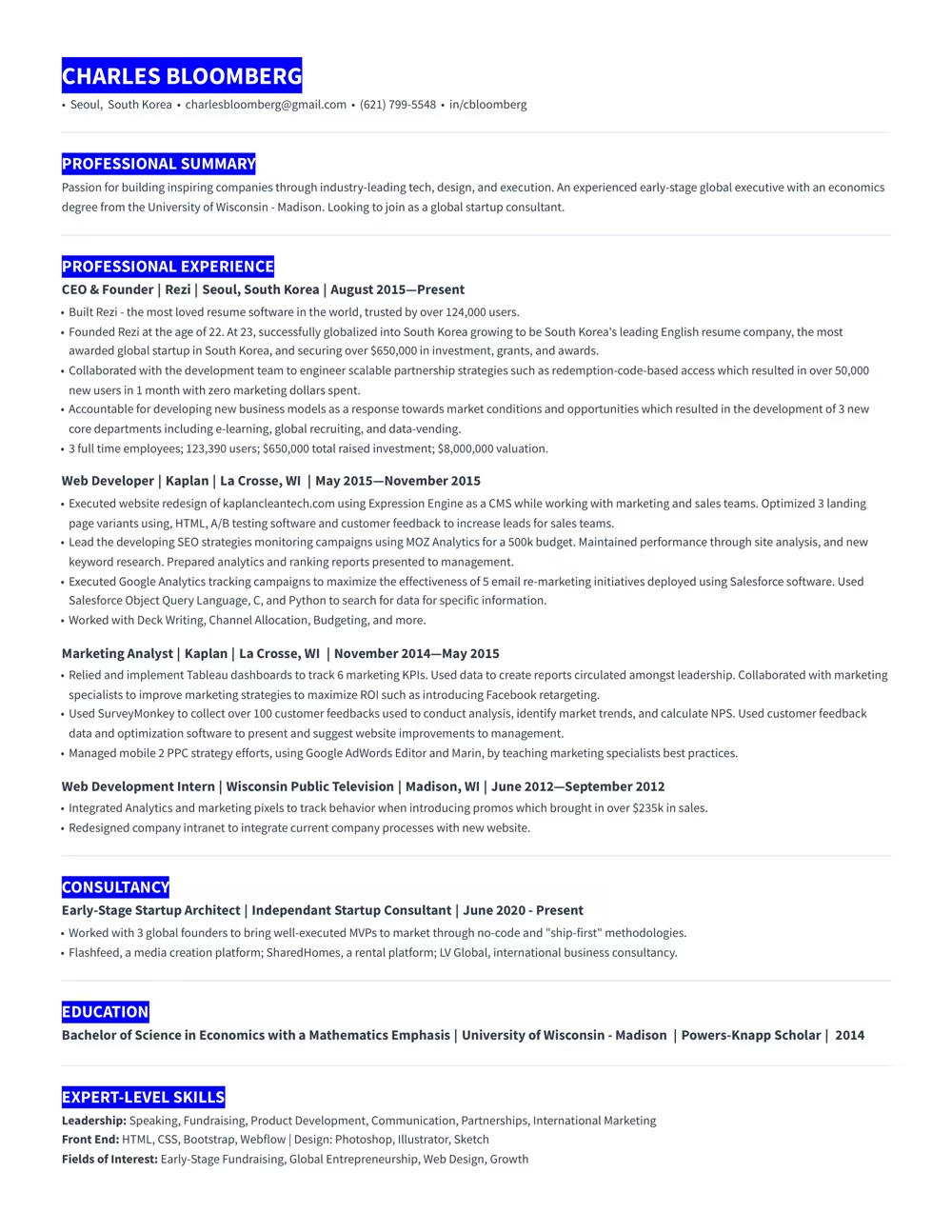
A sleek design optimized for the tech industry. This template features distinct sections for technical skills and languages, making it the top choice for developers, engineers, and IT professionals who need to showcase expertise at a glance.
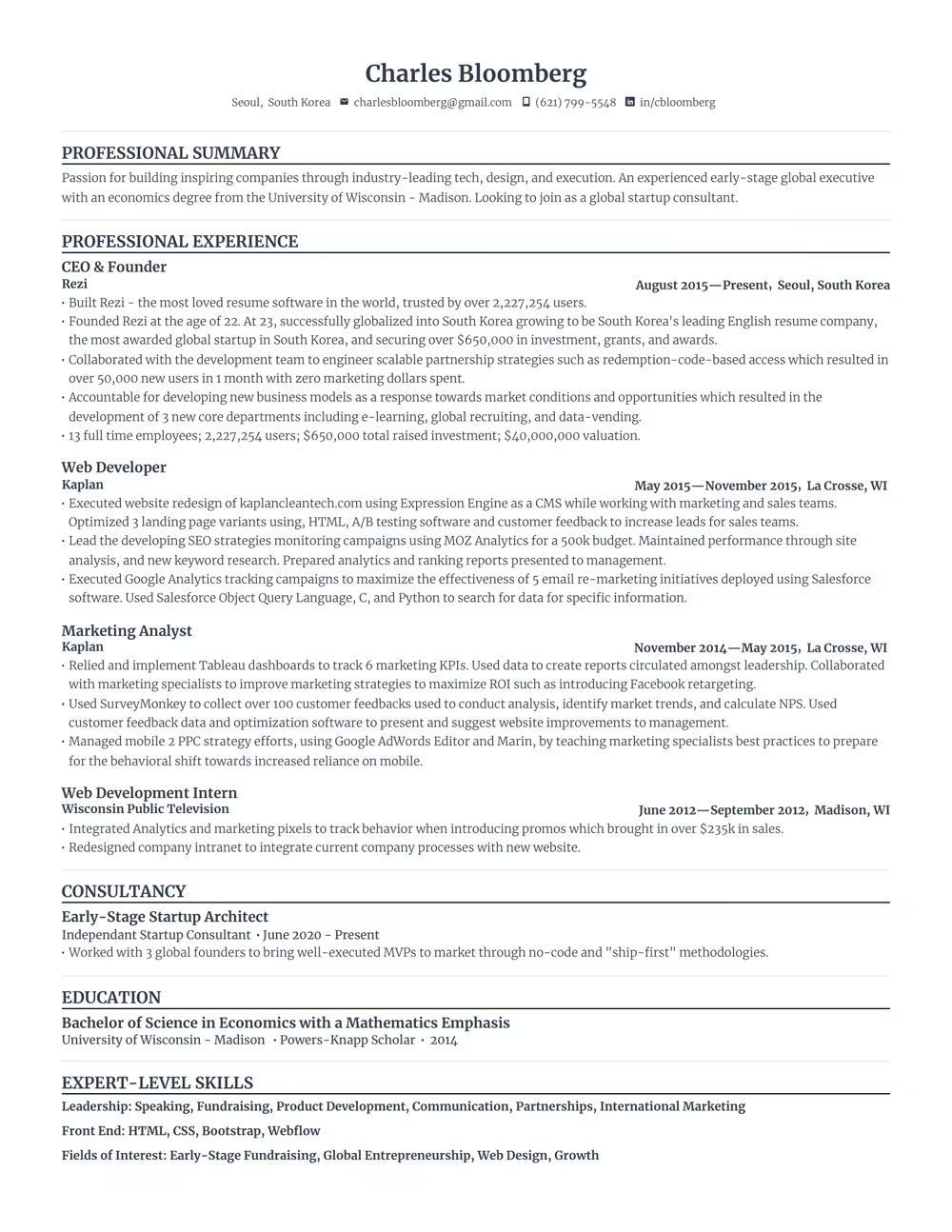
The definitive Harvard resume format, trusted by top universities and Ivy League graduates. This clean, education-first layout is ideal for students and recent graduates targeting competitive roles in finance, consulting, and academia.
Our adaptation of Jake's Resume from Overleaf, now available without LaTeX coding. This high-density, single-column layout is a standard for software engineers and developers who need to showcase skills and projects.
A professional modern resume template that uses subtle color accents to guide the recruiter's eye. Perfect for creative professionals and tech startups looking to stand out while maintaining strict ATS compatibility and high content density.
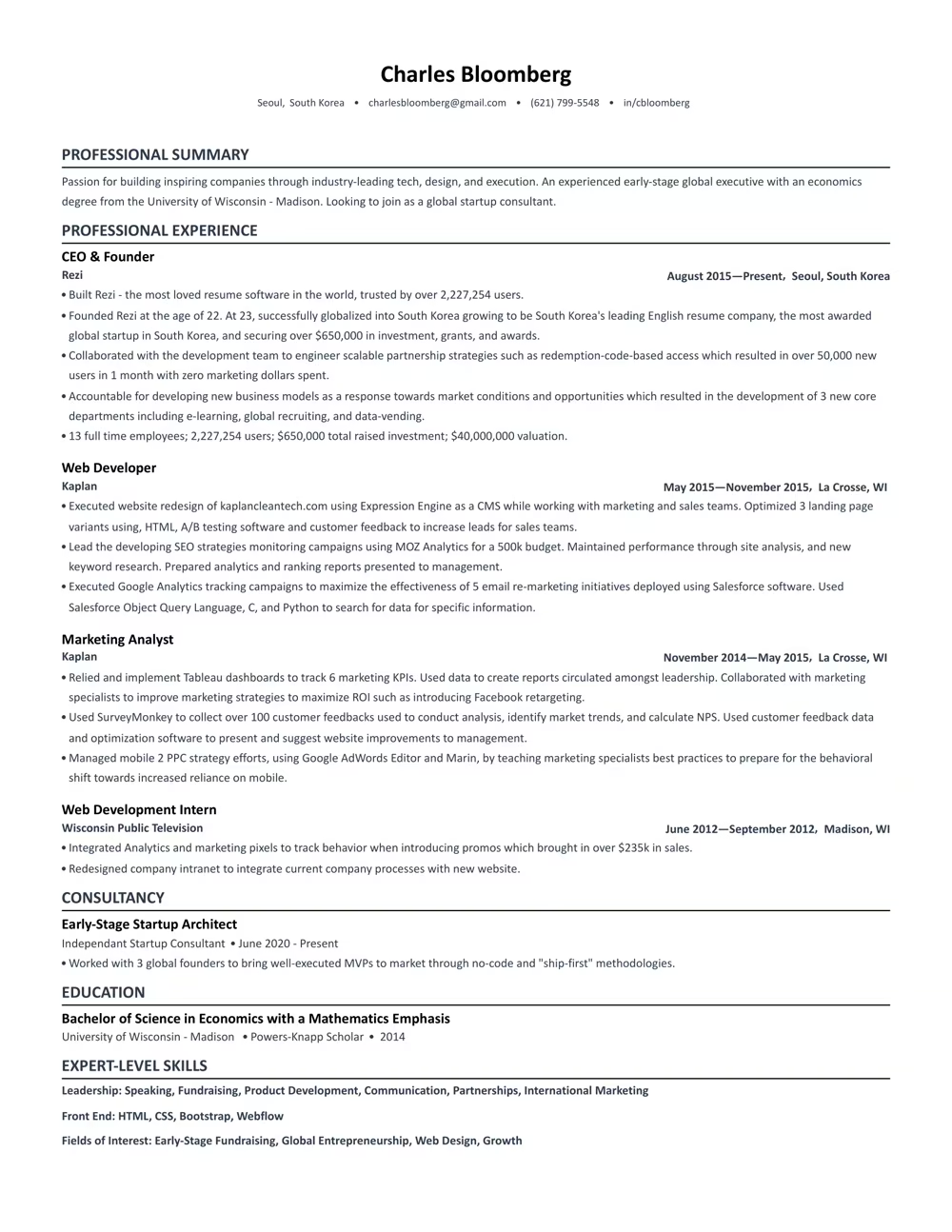
Our most popular reverse-chronological resume template. Designed for maximum readability, this standard format is the safest choice for applicants in corporate, government, and traditional sectors where clarity is king.
A minimalist resume template that uses negative space to guide the recruiter's eye. This clean, distraction-free layout is excellent for experienced professionals who want their achievements to speak for themselves without visual clutter.
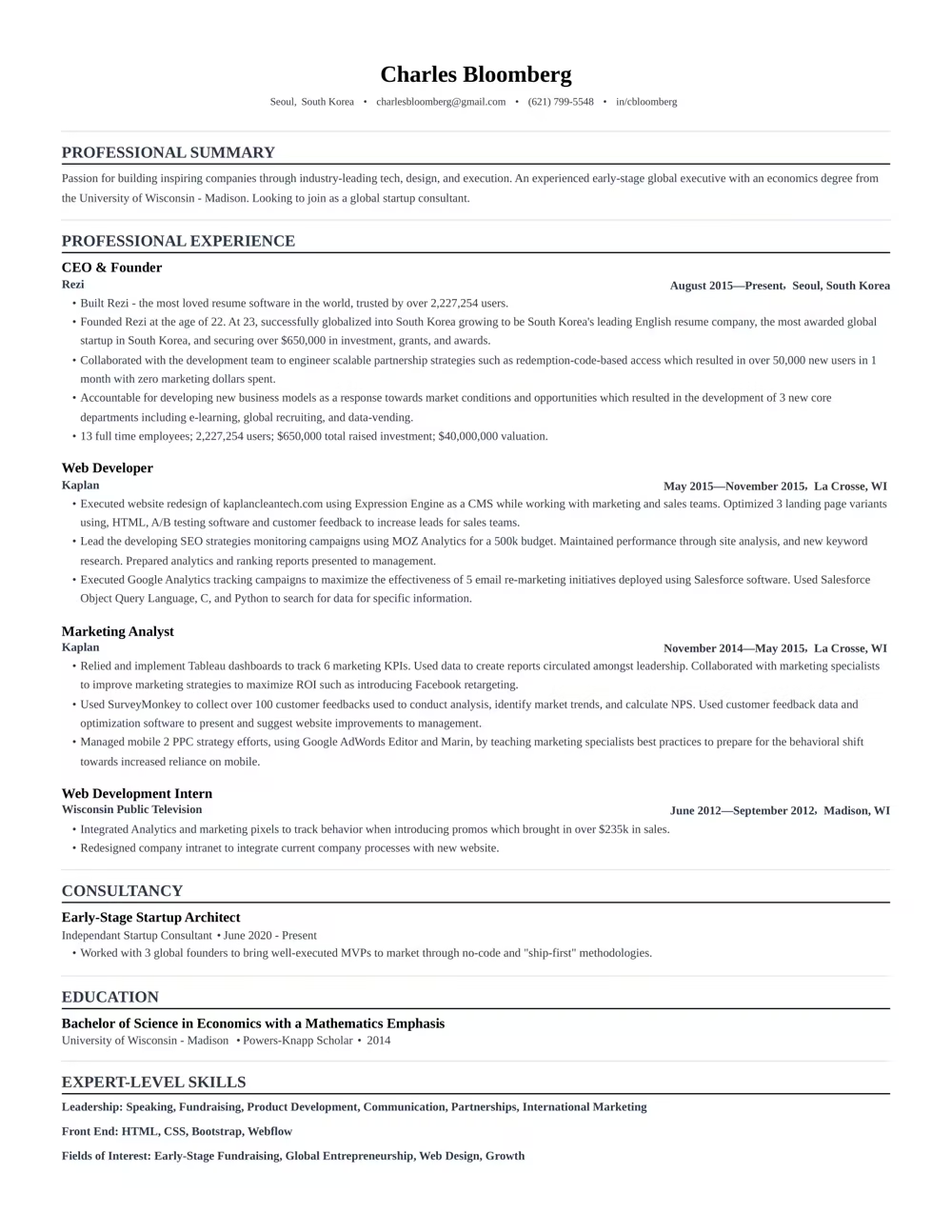
A traditional resume format that recruiters instantly recognize and trust. This no-nonsense layout is fully ATS-optimized and perfect for conservative industries like law, finance, and administration.
The definitive Harvard resume format, trusted by top universities and Ivy League graduates. This clean, education-first layout is ideal for students and recent graduates targeting competitive roles in finance, consulting, and academia.
A sleek design optimized for the tech industry. This template features distinct sections for technical skills and languages, making it the top choice for developers, engineers, and IT professionals who need to showcase expertise at a glance.
A professional layout designed to highlight linear career progression. The Smart template uses clear headers and robust spacing, making it perfect for managers and mid-level professionals demonstrating consistent growth and leadership.
A timeless, ATS-compliant resume format engineered for large organizations. This template guarantees parsing accuracy, making it the safest bet for applications to Fortune 500 companies and global enterprises.
Our adaptation of Jake's Resume from Overleaf, now available without LaTeX coding. This high-density, single-column layout is a standard for software engineers and developers who need to showcase skills and projects.
A high-impact creative resume template that commands attention. Designed for marketers, designers, and innovators, this format balances strong visual headers with professional structure to ensure your application is memorable.
A contemporary layout that helps build your personal brand. This template uses subtle color accents to highlight key sections, making it perfect for junior professionals and startup candidates who want to showcase personality without sacrificing readability.
A design-forward template tailored for fashion, media, and the arts. This aesthetic layout highlights your individual creativity while remaining fully parsable by ATS software, giving you the best of both worlds.
A professional modern resume template that uses subtle color accents to guide the recruiter's eye. Perfect for creative professionals and tech startups looking to stand out while maintaining strict ATS compatibility and high content density.
A high-density layout designed to maximize page real estate. This one-page resume template allows seasoned professionals to list extensive experience without spilling onto a second page. Ideal for lawyers, consultants, and executives with long work histories.
A sophisticated design that commands authority. This executive resume template uses elegant typography and optimal spacing to create a high-end look. Perfect for leadership roles, luxury industries, and senior management applications.
A highly organized layout defined by sleek lines and clear compartmentalization. This template projects reliability and attention to detail, making it the go-to choice for operations managers, engineers, and administrative professionals.
“Rezi is an awesome AI-based resume builder that includes templates to help you design a resume that is sure to check the boxes when it comes to applicant tracking systems. This is a great jumping off point to kickstart a new resume.”
Ashley Stahl
Career Contributor
62.18%
Success
Average is ~3%, as of 2025 data.
Interview Rate
4,510,834
Total Users
8.23 / 10
Avg. User Review
Wall of Love
Over 4 million users trust Rezi
“Resume Building felt like pulling teeth – until I found Rezi.”
Davis Allen
Software Developer
“I was blown away by Rezi. It streamlined everything...”
Celine Watko
“I needed a resume tool as smart as my work.”
Yosra Naceur
Data Scientist
“A great tool that is very helpful. I found the Rezi system easy to use and very helpful as I was working on getting my resume in shape for job applications.”
Dakota Rubin
United States
Written via
“This is actually one of the first reviews I’ve ever written for a business, and that alone says a lot. I highly recommend Rezi to anyone who’s job searching, it makes the entire process so much easier.”
Yazan Alkhatib
United States
Written via
“Reduced my time per application from 1-2 hours down to 15 minutes.”
Kixxx
Experience with Rezi
“I love how simple and convenient it is to use and been coming back to update it every time I need a fresh resume.”
Zara Wazir
U.A.E.
Written via
Frequently Asked Questions
Your questions, answered.
An AI resume maker helps you build a resume perfectly fit for the job you want. Top-notch AI resume builders are designed to speak the language hiring managers are looking for, increasing your chances of standing out in the crowd. It aligns your skills and experience with the job description effectively.
To get the most out of an AI resume builder, either start from scratch or upload your current resume. Fill in as much detail as possible about your career and skills, and upload the job description you’re targeting. This personalization allows the AI to build a unique and tailored resume that’s bound to catch potential employers' attention.
AI-generated resumes can seem similar if you're not giving personalized inputs or if you're using basic prompts. Provide specific details about your work experience and target the job you’re eyeing. Use specialized AI tools instead of general chatbots to avoid robotic-sounding resumes and to ensure individual creativity.
Employers might think you used AI, but that’s rarely an issue. What they really care about is getting a well-written resume that showcases your skills and experiences accurately. A top-notch resume tailored to their needs will speak volumes more than worrying about AI involvement.
Yes, using AI to optimize your current resume is highly effective. You just need to upload your resume, share details about your career goals and the job you want, and let the AI refine everything to elevate your resume's impact and ATS compatibility.
Rezi uses a tool called the AI Keyword Targeting. This feature scans the job description to identify crucial keywords and naturally incorporates them into your resume, giving it the right focus without keyword stuffing.
The Free plan is $0/month and allows you to create one resume, use limited AI tools (such as Keyword Targeting and Analysis), and download up to three PDFs. You can also create unlimited cover and resignation letters. No card is required to begin.
The Pro plan is $29/month and provides unlimited access to all features, including unlimited resumes, full AI capabilities, unlimited downloads, and one free monthly expert resume review (resumes are reviewed by a person).
The Lifetime plan is a $149 one-time payment. It grants permanent access to all the features of the Pro plan (unlimited resumes, full AI tools, and unlimited downloads), but it does not include the free monthly expert review (which can be purchased for an extra fee).
Rezi offers a 100% money-back guarantee on all paid plans (Pro and Lifetime). If you are unsatisfied, you can request a full refund within 30 days of your purchase.
Yes, you can easily upgrade or downgrade your plan at any time through your Rezi Account Billing dashboard. Prorated credits will apply when switching.
An AI resume maker helps you build a resume perfectly fit for the job you want. Top-notch AI resume builders are designed to speak the language hiring managers are looking for, increasing your chances of standing out in the crowd. It aligns your skills and experience with the job description effectively.