Interviews
How to Write a Follow-up Email After Interview (Examples)
Check out our post-interview email examples for different situations. Whether it’s been a week or a month, use these follow-ups to get a reply.

Published on
November 9, 2023
Updated on
October 17, 2025
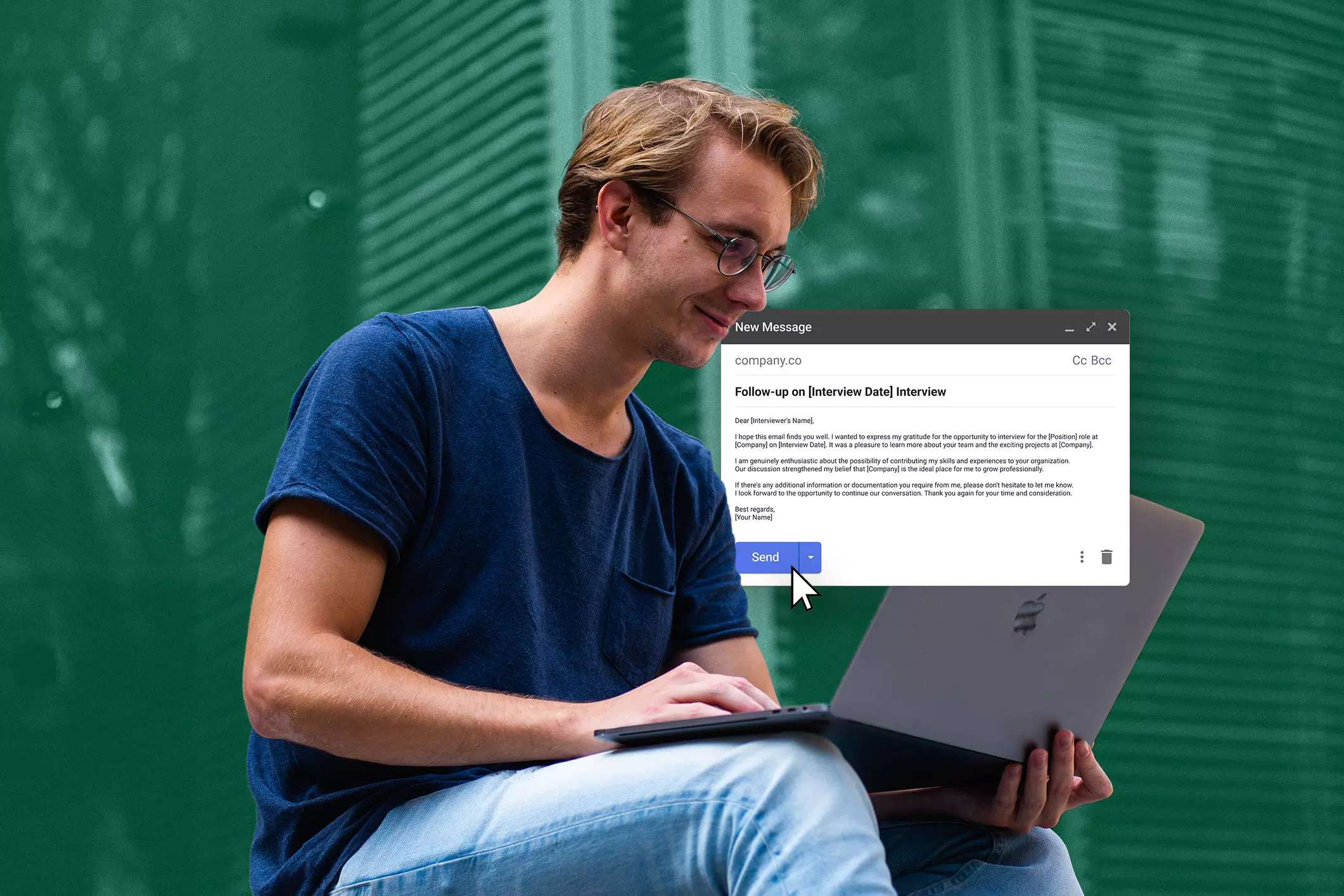
Following up within 24 hours of your job interview is standard etiquette. You should always send a thank-you email to everyone you interviewed with to show basic etiquette. Another instance when you should follow up is when the decision-making deadline has passed, and you still haven’t heard back from the company. Many employers would also expect a follow-up email if you got an offer from another company, no matter if you’re planning to accept it or want to wait for a counteroffer.
You felt confident with the interview, but as days pass without a word, that familiar uncertainty sets in. Should you follow up now, or will that make you seem too eager? We’ve all been there, staring at our inbox, refreshing it more times than we'd like to admit.
Hitting “send” on that follow-up email can feel intimidating, but it doesn’t have to be. A clear, professional follow-up can show enthusiasm while offering that all-important peace of mind.
In this guide, you’ll learn exactly how to write a follow-up email that feels genuine and confident, without overthinking every word. Plus, you’ll get 24 ready-to-use templates to make your next steps easier, no matter where you are in the waiting game.
And if you have more interviews lined up, check out these helpful articles:
- STAR Method Interview Guide
- Unique Interview Questions to Ask Employers
- Common Interview Questions and Sample Answers
- Phone Interview Questions to Prepare For (and Best Answers)
Let’s get started!
How to Write the Perfect Follow-up Email After an Interview
Here’s how to write the perfect email to follow up after the interview:
- Write a concise subject line with the role and purpose.
- Start with a polite greeting, using the recipient’s name to show respect and professionalism.
- Provide context for your email by thanking them for the interview, mentioning the role and date, or referencing a specific discussion.
- Mention the purpose of your email, such as following up for a status update or asking questions.
- Include a clear call to action to signal your enthusiasm for continuing to the next steps.
- End with a professional sign-off, such as “Best regards” or “Sincerely,” followed by your full name.
Check out my full breakdown with examples:
1. Write a concise subject line
Every morning when I open my inbox, it’s the subject line that decides whether I click immediately or leave it on “unread” for longer than I care to admit. A strong subject line for your follow-up email is often the reason it gets opened instead of ignored.
Since it’s the first thing the recipient will see, make it clear and direct. Get straight to the point by outlining what you’re after, so the hiring manager knows what it’s about.
Here are a few examples:
- Thank you for the [Job Title] interview
- About the [Job Title] interview
- The next steps for the [Job Title] interview
- Re: [Job Title] interview
- [Job Title] interview: A few questions
2. Begin with a polite greeting
There’s nothing more awkward than forgetting someone’s name after you've already met them (or if you’re like me, the third meeting). Show that you paid attention by addressing them by their name. It also helps to prove you’re just sending mass follow-up emails to every company.
Here are a few examples:
- Dear Ms. Chen
- Hello Mr. Johnson
- Dear Dr. Sànchez
And yes, even the greeting has a few unspoken rules. Using “Dear” is the go-to for most emails, as it reflects a professional attitude. But you can also use “Hello” if the company takes a more laid-back approach. And avoid using “Mrs.”; you don’t want to fumble someone’s marital status.
3. Acknowledge the context
Hiring managers may interview dozens of candidates in a week, so don’t expect them to see your name and remember exactly who you are from the get-go. Make their lives easier by mentioning one or more of the following to provide some context:
- Show gratitude by thanking the interviewer for their time
- Mention the particular role and date of the interview
- Summarize something specific you discussed in your interview
Maintain a professional tone and be sincere in your email. And always use positive language to show your interest and enthusiasm for the position.
4. Mention the purpose of your email
Let’s get to why you’re sending the email. Now, as a people-pleasing millennial, being forward and direct surprisingly doesn’t come easily to me. However, most hiring managers will appreciate the initiative and eagerness to move on to the next steps.
Here are some of the reasons you could mention for following up:
- To get a status update
- Share further resources
- Ask certain questions
- Reschedule an interview
- Leave an impression
I suggest bringing up the main purpose of your email in either the first or second paragraph to get straight to the point.
5. Have a call to action
Your call to action can be implicit or explicit. An implicit call to action is subtle and implies the next steps to the email recipient. This is the way to go if you’re less confident about moving forward and don’t want to be too presumptuous.
Here are a few examples:
- I look forward to hearing from you.
- Any updates on the hiring process would be greatly appreciated.
More optimistic about your future with the company? An explicit call to action is one that clearly outlines the next steps to the recipient. It tells them exactly what you want and can be a smart move to show confidence and commitment to the role.
Check out these examples:
- Please let me know when you'd like to schedule a time to chat next.
- When are you available to discuss?
6. Sign off
Don’t fall at the last hurdle. Finish your email with a professional sign-off followed by your full name. Here are the best ways to end an email:
- Sincerely
- Best regards
- Thanks
- All the best
How Many Follow-Up Emails to Send After an Interview?
You should send at least one follow-up email within 24 hours of the interview. In that email, express your appreciation for the interviewer’s time, thank them for the opportunity, and reiterate your interest. You should also send a follow-up email if the agreed-upon deadline for making the hiring decision has passed, and you still haven’t heard back.
After that email, you could send another email after a week, and again at the 2-week mark. But if they’re still ghosting you after a month, does it seem like the kind of workplace you’d want to be a part of?
Still on the fence about sending that email? Check out these success stories:
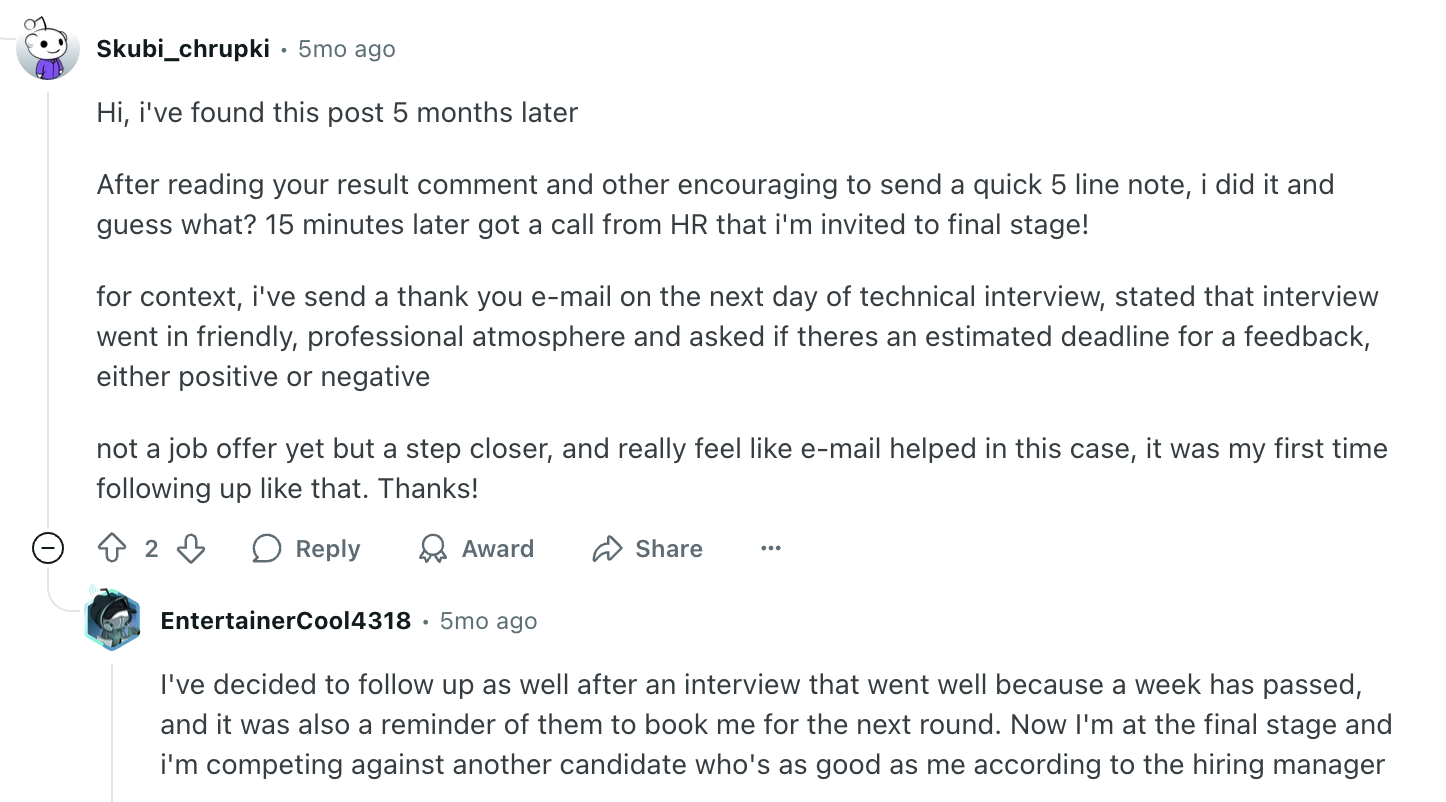
Spoiler: Both ended up getting the job.
When Should You Send a Follow-up Email After an Interview?
Here’s a quick overview of when you could send a follow-up email after the interview:
- 24 hours: You feel like the job opportunity is a perfect fit, and you want to show your appreciation for the interviewer’s time.
- 2–3 days: Express your appreciation and leave a stronger impression.
- 1 week: Send a gentle reminder that you’re still interested in the role.
- 2 weeks: Get an update on your job application and the hiring process.
- 3–4 weeks: Seek a response on whether you made the cut.
- 1+ months: Send an upfront reminder or move on.
It’s common courtesy to send the first follow-up email within 24 hours, then up to a few weeks after your interview. If you decide to send it before the one-week mark, it should be a short message that simply thanks the interviewer for their time.
After the first email, be prepared for the waiting game. You don’t want to send emails more than once a week to avoid coming across as pushy or straight-up desperate.
Tip: If you get a date for an expected response, send your first follow-up email within the first week after your interview to show gratitude or save it until after the expected reply date.
Take a look at these follow-up email examples, depending on various timelines.
24 hours after the interview
I get it, you don’t want to come across as overly eager, but it’s perfectly fine to send a follow-up email within 24 hours after a job interview. A simple thank-you note shows you’re grateful for the interviewer’s time and enthusiastic about the job opportunity.
Keep your email straight to the point. Thank the interviewer for their time and express your appreciation. You could also reiterate your interest by mentioning something specific you discussed in the interview.
Check out this example email:
2-3 Days After the Interview
Sending a follow-up email 2 to 3 days after the interview is pretty much the same as following up within 24 hours. This is probably a better option if the interview was on a Thursday or Friday (you don’t want to be sending work emails on a weekend).
When following up within the first week, send a quick note to show you’re thankful for their time and the opportunity. And if they don’t respond? Give it at least a week before sending another follow-up.
Use this example as inspiration:
1 Week After the Interview
One week after the interview or the expected reply date is the standard time to follow up with the interviewer. And I’m not just talking about the polite pre-interview, thank you. This is the time to show your interest in the next steps and reaffirm your commitment.
Take a look:
2 Weeks After the Interview
It’s been two weeks since your interview. You emailed them last week, but you still haven’t heard back. Don’t panic. It’s pretty normal for some companies to take their time, especially when interviewing multiple candidates.
That said, it doesn’t hurt to send them a quick email asking for an update on your application. You could also request a date for the next steps or the timeline of the decision-making process.
Here’s an example:
3-4 Weeks After the Interview
You might’ve sent a couple of emails already, and those doubts are probably becoming more of a reality. You tell yourself: maybe they’re close to finalizing a decision or have already made one, but haven’t gotten back to you yet. Or perhaps they’re wasting your time, and it’s worth moving on.
Here are some examples of why a company is taking longer than expected to reply:
- They’re processing a large volume of job applications
- The interviewer or hiring manager is on vacation
- The workload is heavy, so they may get back to you a bit later
- Lots of people are involved in the decision-making process
- Other unexpected circumstances
But don’t lose hope. Here’s what one Redditor said about the power of persistence:

Take a look at this email if you’re approaching the four-week mark:
Moving On: 1+ Month After the Interview
Still haven’t heard back? Hopefully, you continued applying to other companies by sending them a tailored ATS resume. After all, you don’t want to put all your eggs in one basket.
Unfortunately, it’s still quite common for some companies to ghost candidates. If it’s been over a month since the interview or the expected response date, you can expect the answer to be no.
My advice? Move on, especially when it’s been a whole month, and you haven’t heard back. There are other companies out there that would value your skills and be happy to have you on their team.
And if you're becoming unsure about the quality of your resume or cover letter, check out these resources:
Here’s an example of that final email:
Best Email Templates for Following Up After an Interview
CEOs appreciate it when candidates follow up and break the typical cycle of waiting for feedback. Well, at least that’s what our CEO at Rezi has to say.
With that said, let’s go through the best email templates to follow up after an interview (aka, the only follow-ups you’ll ever need).
Simple Follow-Up
Keep things simple with a follow-up email that gets straight to the point while showing your enthusiasm.
Appreciation
Make your appreciation loud and clear. Whether the company was a good cultural match or you had a genuinely insightful conversation, you can use this email follow-up template to emphasize your gratitude.
Status Update Email
Has it been more than one week since the interview? Send a reminder using the email template below to get a status update.
General Email Follow-up Templates
Let’s explore a few more general post-interview email templates you can use to follow up with the interviewer. You can use these for one or more of the following reasons:
- Reiterate your interest in the position
- Express your appreciation to the hiring manager
- Address any potential questions or concerns
- Provide any further information that may be helpful
That said, we encourage you to edit these general email templates with your personal touch, based on how your interview went and what you discussed.
After a Screening Interview
Screening interviews usually involve a quick phone call or video chat to ensure you’re on the same page as HR.
Although the personal connection may not be as strong as in-person interviews, you can still use this opportunity to reinforce your enthusiasm. You can also mention details you discussed with the interviewer to highlight your interest.
After an In-Person Interview
An in-person interview means you’re getting personally acquainted with your hiring manager. This means you’ve got a deeper understanding of the company and the role. Sending a follow-up email allows you to make a more lasting positive impression.
After the Second Interview
Your second interview will give you more insight into the role and company culture. You’ll also have a better sense of whether you’re a good fit for the position. My advice? Use all of this information to tailor your email.
How to Follow-up if You Find Yourself in These Other Scenarios
Have you found yourself in one of the following situations?
- You have other job offers
- Your interview was interrupted
- The interviewer hasn’t followed up on a promise
- Multiple reschedules
- No-show interviews
- Receiving feedback
- Connecting on LinkedIn
There are different ways to respond in each of these scenarios. Take a look at these general email templates and customize them to add your unique voice.
You Have Other Job Offers
Waiting for a company to reply while having other job offers on standby can be stressful. After all, you want to secure at least one job.
But you don’t want to decline a potential opportunity that might be a better fit for you because of higher pay or other reasons. Don’t worry. You can use the post-interview follow-up email template below to get your response.
Your Interview Was Interrupted
In-person and virtual interviews could get interrupted for many reasons:
- Technical issues
- Personal problems
- Emergencies
- Scheduling conflicts
- My cat deciding to attack my face mid-conversation…
Any of these can prevent you from completing the interview or performing to the best of your ability. Here’s an example of how to address any issues and save face:
The Interviewer Hasn’t Fulfilled a Promise
Some interviewers may have made a promise that they didn’t follow through on because things got busy or some other unforeseen circumstances. Don’t take it personally. Hiring managers typically have a lot on their plates, so it’s not surprising for some tasks to get lost in the shuffle.
In this case, send a gentle reminder.
Multiple Reschedules
This one’s pretty rare, but dealing with multiple rescheduled dates for your interview can hit a nerve. Being respectful of each other’s time should be the bare minimum, so I feel your pain.
However, it’s crucial to maintain professionalism even in the most frustrating situations. Here’s how to get answers while keeping a calm tone:
Late Attendance
I remember making myself look presentable, having some sticky notes nearby, and psyching myself up for another nerve-wracking interview. Only to be left staring at myself on the camera for way too long.
That time can pass slowly, but wait 5–10 minutes before sending an email reminder that you’re waiting on the interviewer. Once you send that message, wait another 5–10 minutes. If they haven’t joined or responded by then, use the next email template designed for no-show interviews.
Here’s a reminder for late interviewees:
No-Show Interviews
Waited for the hiring manager to join the Zoom call, but they never made it? Yep, very annoying, and a pretty obvious red flag. Still, it’s important not to let your emotions get in the way.
Here’s a polite yet firm email for interviewers who never showed up:
Receiving Feedback
Getting a lot of job rejections recently? There’s nothing wrong with asking to receive feedback from the company, regardless of whether you passed or failed the job interview process.
Here’s why:
- Get insight into how you can improve for future interviews
- Highlight your commitment to professional growth
If you get a response from the employer, reply in the email thread to show your appreciation.
Connecting on LinkedIn
It’s not out of the norm to want to network with the person you had an interview with. Staying in touch lets you build relationships with professionals in your field and find future opportunities.
Kindly send a request via email and share your thoughts. You could also send a connection request on LinkedIn with a personalized note. However, to maximize your chances of getting accepted, make sure you have a presentable LinkedIn profile.
If you don’t hear back from them, it’s best to move on. Check out this example:
More Email Templates to Follow Up After a Job Interview
The earlier follow-up email templates cover all questions, queries, and polite pushing. But if you need more inspiration, check out the templates listed below. You can use these to do the following:
- Clarify certain points
- Address doubts
- Highlight how you’re a good fit
- Stay on the employer’s radar
Rescheduling an interview
Life is unpredictable. I once had to reschedule an interview because my entire neighborhood experienced a random power cut (the definition of bad timing). Things can happen. Your hiring managers are human and will understand this.
With that in mind, use this template to reschedule an interview.
Additional Questions or Resources
There’s been plenty of times that I’ve held back on questions, so I don’t seem like I’m falling behind or just plain clueless. But asking questions often shows a sign of interest and your eagerness to learn more.
Customize the follow-up email template below based on your particular situation. And be sure to answer any questions the hiring manager might’ve left you.
Here’s why you might send resources or ask a couple more questions:
- Clarify specific details related to your eligibility for the role.
- Grasp a better understanding of a company department or cultural values.
- Outline your skills more comprehensively.
Here’s how you can reach out to ask some questions:
Note: Some companies may have a strict recruitment process with a set timeline to assess each candidate equally. Others simply don’t have the time or resources. For these reasons, some hiring managers might not get back to you.
Mentioning a New Skill
Learned or developed any important skills since the interview? Mention it in a follow-up email to reaffirm your interest and dedication to becoming the best fit for the role. You should also update your application to add new resume skills.
Not sure what abilities are worth highlighting? Check out our guide on the top resume skills, or use our AI Skill Explorer to find the most popular skills for your industry.
Tips When Following Up on a Job Interview
These are my top tips to keep in mind when following up with hiring managers:
- Keep your email concise (shorter is better)
- Double-check spelling, grammar, and other small details
- Don’t send too many emails (start with one and go from there)
- Reflect the tone of the company’s culture
Keep your email concise (shorter is better)
Nobody likes a rambling email, and interviewers are busy people. Show respect for their time by keeping your emails short and direct. In total, 1 to 2 paragraphs are more than enough.
Most candidates think a longer email is better because it shows commitment and enthusiasm. In reality, it’s the opposite. Many employers won’t even bother reading an overly lengthy message. It’s nothing personal. They just have a lot to get through on their to-do list, so a shorter email is appreciated.
Double-check spelling, grammar, and other small details
We all slip up from time to time (I doubt this guide is totally error-free), but when you’re applying for a job? Those mistakes could give another candidate the edge in showing more attention to detail.
Here are a few things to check:
- Spelling
- Grammar
- Email addresses
- Resources
- Names
And don’t forget to include all the necessary links and attachments.
Don’t send too many emails
If you’ve ever had to deal with the world of dating apps, I’m sure you’ve seen pushy personalities firsthand (or at least heard some horror stories). Don’t be that person.
Wait at least a week before sending your next follow-up email. Sending too many emails in a short period makes you look needy. If you’ve followed up for more than a month, and they haven’t gotten back in touch, it’s best to move on.
Reflect the tone of the company’s culture
You want to prove that you're the right fit for the company and its culture, so show them you’re on their wavelength. Do this by following the same tone of voice from the initial email the company sent you.
Whether it’s relaxed and casual or smart and formal, copy that same vibe in your email. This can make you a more memorable candidate who will blend well with the team. And when in doubt, stick to a professional tone of voice.
Avoid Follow-Up Emails by Acing Job Interviews
The best way to avoid sending follow-up emails? Nailing the interview.
Get it right, and they’ll be asking you to join the company before you even have to think about chasing them for updates. And I know, easier said than done. But there are many ways you can be proactive about perfecting your interview game.
Let’s start with the obvious: having a realistic practice partner. Give some context and notes about the company or position to a trusted friend or family member so they can come up with relevant questions and scenarios for your upcoming interview.
Can’t find a friend who won’t have you awkwardly giggling? Try our interview practice tool. With Rezi AI Interview, you’ll have a virtual partner who can help you test out your interview skills.
Here’s how it works:
- Job-specific questions: Answer auto-generated questions based on your resume and the specific job position and job description you’re applying for.
- Constructive feedback: Get feedback on your interview answers, with recommended answers for each question.
- Realistic simulation: Our AI Interview feature is based on real-life interviews. Therefore, it’ll ask you common questions for your particular role and industry.
Summary
Here’s an overview of how to write a follow-up email after the interview:
- Write a direct subject line, so your email gets opened, not ignored (e.g., “Thank you for the [Job Title] interview”).
- Start with a polite greeting using the interviewer’s name (e.g., “Dear Ms. Chen” or “Hello Mr. Johnson”) to show respect and personal attention.
- Provide context to help them remember you by thanking them for their time, mentioning the role, the interview date, or a specific topic you discussed.
- State your purpose, whether you’re requesting a status update, asking questions, sharing resources, or rescheduling.
- Show genuine enthusiasm for the role by using positive language and a sincere, professional tone.
- Include a clear call to action, either subtle (“I look forward to hearing from you”) or direct (“Please let me know when you’re available to discuss next steps”).
- End with a professional sign-off, such as “Best regards,” “Sincerely,” or “All the best,” followed by your full name.
- Send your first follow-up within 24 hours of the interview to thank them and reaffirm your interest.
- Follow up again if the decision deadline passes without a response, and if needed, send a final email a week or two later to check in without appearing pushy.
FAQ
What to say in a follow-up email after an interview?
In your follow-up email, thank the interviewer for their time and reiterate your interest in the role. Mention something specific you enjoyed about the conversation or the company to show genuine enthusiasm. Briefly restate why you believe you’re a strong fit, and if relevant, add any details you forgot to mention during the interview. End with a polite call to action, such as looking forward to the next steps.
How do you politely ask about an interview result?
You can politely reference your previous conversation by thanking them again for the interview, then directly ask if there are any updates regarding the hiring process. You could write, “I wanted to check in to see if there are any updates you could share regarding the [Job Title] role.” This approach shows interest while respecting their timeline.
How to follow up if you haven't heard back after an interview?
If the timeline they provided has passed, and you haven’t got a reply, you can send a polite follow-up. Thank them again for the opportunity, express your continued interest in the role, and ask about any updates they can share on the hiring process. Keep your tone warm and respectful to show enthusiasm without sounding impatient.
For example, you can write, “I’m excited about the possibility of joining your team and wanted to see if you had any updates on the role.”
Is it worth following up after an interview?
Yes, following up after an interview is worth it. It shows professionalism, appreciation, and continued interest in the role, helping you stand out from candidates who skip this step. A thoughtful follow-up also keeps you on the hiring manager’s radar, can prompt updates on the timeline, and allows you to reinforce your enthusiasm for the position. Even if you don’t get the role, a strong follow-up can leave a positive impression for future opportunities within the company.

Upload or drop your resume to get started
Upload your resume to get started
Score my resume

Lauren Bedford is a seasoned writer with a track record of helping thousands of readers find practical solutions over the past five years. She's tackled a range of topics, always striving to simplify complex jargon. At Rezi, Lauren crafts genuine and actionable content that guides readers in creating standout resumes to land their dream jobs.