
Career Advice
How to Become a Travel Agent and Work from Home
Learn how to become a travel agent, explore host agencies, certifications, and specialized niches, and turn your passion for travel into a rewarding career.

Published on
October 13, 2025
Updated on
October 14, 2025
Becoming a travel agent is easier than it seems, and you can start from home or through a host agency with little experience. Choose a host agency for training, tools, and accreditation, and handle the essentials like business registration and taxes. Build an online presence, market your services, and network to grow your client base. Over time, you can specialize in Disney, cruises, or luxury travel, and pursue more certifications to boost your credibility and opportunities.
So you’re thinking about becoming a travel agent. You already plan trips like a professional, finding the best deals, knowing the right times to travel, and spotting little money-saving hacks (like adding that Ryanair bag after picking your seat).
You actually enjoy building spreadsheets, mapping out cultural stops, and uncovering hidden gems in every city. So why not turn that passion into a career? Whether you want to test the waters part-time or dream of going all in, you’re in the right place.
I’ll cover:
- Tips for how to become a travel agent.
- The best host agencies to join.
- Training and certification options.
And if you’re already thinking ahead, start working on your travel agent resume with our free AI Resume Builder or check out these guides:
- Tips for Describing Remote Work on a Resume
- How to Update Your Resume & Make it Better
- 20+ Common Resume Mistakes to Avoid
- 10 Steps for Changing Careers
- How to Write SMART Goals
What Is a Travel Agent?
In short: being a travel agent is about creating stress-free, tailored experiences that clients couldn’t find on their own. Agents save time, unlock perks, and craft seamless itineraries. The role offers flexibility, travel discounts, and the joy of helping people plan their dream trips. While “agent” and “advisor” are often used interchangeably, many now prefer “advisor” since it highlights the personalized service and expertise the job has evolved into.
Being a travel agent is much more than just booking trips. You listen to a client’s needs, understand their budget, and design an itinerary that feels tailor-made. The real value is saving them time, reducing their stress, and giving them access to experiences they’d rarely discover on their own.
You also navigate flights, hotels, cruises, and tours, track deals, loyalty programs, and special perks, ensuring your clients get more value than if they booked everything themselves.
Benefits of being a travel agent
Becoming a travel agent can be rewarding on more than one level.
- Flexibility. You can choose whether you want to work in an office, join an agency, or set yourself up as an independent advisor from home.
- Perks. Travel agents can access discounted travel rates, exclusive hotel programs, and FAM (familiarization) trips, where you get to explore destinations firsthand.
- Helping people. There’s something special about being part of a client’s dream vacation. You take the stress off their shoulders, and afterward, hear about their amazing experience.
- Turning passion into a career. If travel is something you already love, becoming a travel agent lets you turn that passion into a profession.
My friend Shannon, who’s been in the industry for over six years, summed it up:
“The travel industry is a great industry to be a part of; it’s always something I find myself going back to. There’s always something new to learn or see, plus there are endless opportunities. It’s a career where you have room to grow while sharing your passion for travel with others.”
Travel agent vs. travel advisor
“Travel agent” and “travel advisor” are often used interchangeably, but there’s a subtle difference.
Traditionally, a travel agent focuses on booking flights, hotels, and ready-made packages. A travel advisor takes it further, as they offer expert guidance, design custom itineraries, tailor experiences to each client, and use industry connections for exclusive perks.
Many professionals now prefer “advisor” because it reflects the personalized service and expertise the role has evolved into. That said, the lines are blurred. Most modern travel agents provide the same consultative, hands-on support you’d expect from an advisor.
How to Become a Travel Agent
Here’s how to become a travel agent:
- Start online with a host agency like Fora or InteleTravel for booking tools, accreditation, and training.
- Learn the essentials through onboarding, webinars, and mentorship.
- Register your business, handle taxes, and make sure your paperwork is in order.
- Create a simple website, set up social media, and share content that shows off your travel expertise.
- Choose a niche (optional) like Disney, cruises, or luxury travel to stand out.
- Check state rules, as some states (like California, Florida, Hawaii, and Washington) require a Seller of Travel license, while most just need standard business registration.
Online travel agent
Becoming a travel agent from home is one of the simplest ways to start in the industry, and you don’t need prior experience to do it. The main step is choosing a reputable host agency (like Fora or InteleTravel), which gives you the support and accreditation you need.
Here’s how the process usually looks:
- Pick a host agency. They provide back-office support, booking platforms, webinars, and accreditation so you can hit the ground running.
- Go through onboarding and training. Most agencies offer short courses and even one-on-one mentorship to teach you about booking systems, customer service skills, travel law, and destination knowledge.
- Handle the business basics. Register your business (sole proprietorship or LLC), set up taxes, and get paperwork sorted so you’re operating legally and credibly.
- Build your online presence. Create a simple website and professional social media accounts (Instagram, Facebook, LinkedIn) to showcase your services and personality.
- Market and network. Post travel content, share deals, and join travel forums or Facebook groups where people are already planning trips. Many new agents land their first clients this way.
Shannon highlights the mix of qualities that make a travel agent successful:
“It all starts with a genuine passion for both travel and people. Strong customer service and communication skills really help since so much of the job is about understanding clients and finding the right experiences for them. Practical skills like GDS and sales go a long way in managing bookings and building lasting relationships. A general knowledge of geography, climates, and cultures is also a big advantage. Since travel can be so unpredictable, staying calm under pressure is key. But above all, if you’re eager to learn and bring a friendly, approachable attitude, you can thrive in this industry.”
Specialized travel agent roles
Once you’ve mastered the basics, choosing a niche is a great way to stand out. Most host agencies make it easy to specialize, and you won’t need years of experience.
Disney travel agent
Perfect for the dedicated Disney adults. You won’t work for Disney itself, but you can book trips through approved agencies like MickeyTravels or Pixie Vacations. Many require you to complete Disney’s College of Knowledge training, which unlocks booking systems and perks.
Cruise travel agent
Cruises are booming, and demand for specialists is high. Training is straightforward, and while CLIA certification isn’t required, it can boost your credibility. Most host agencies can connect you with CLIA resources if you want to take that extra step.
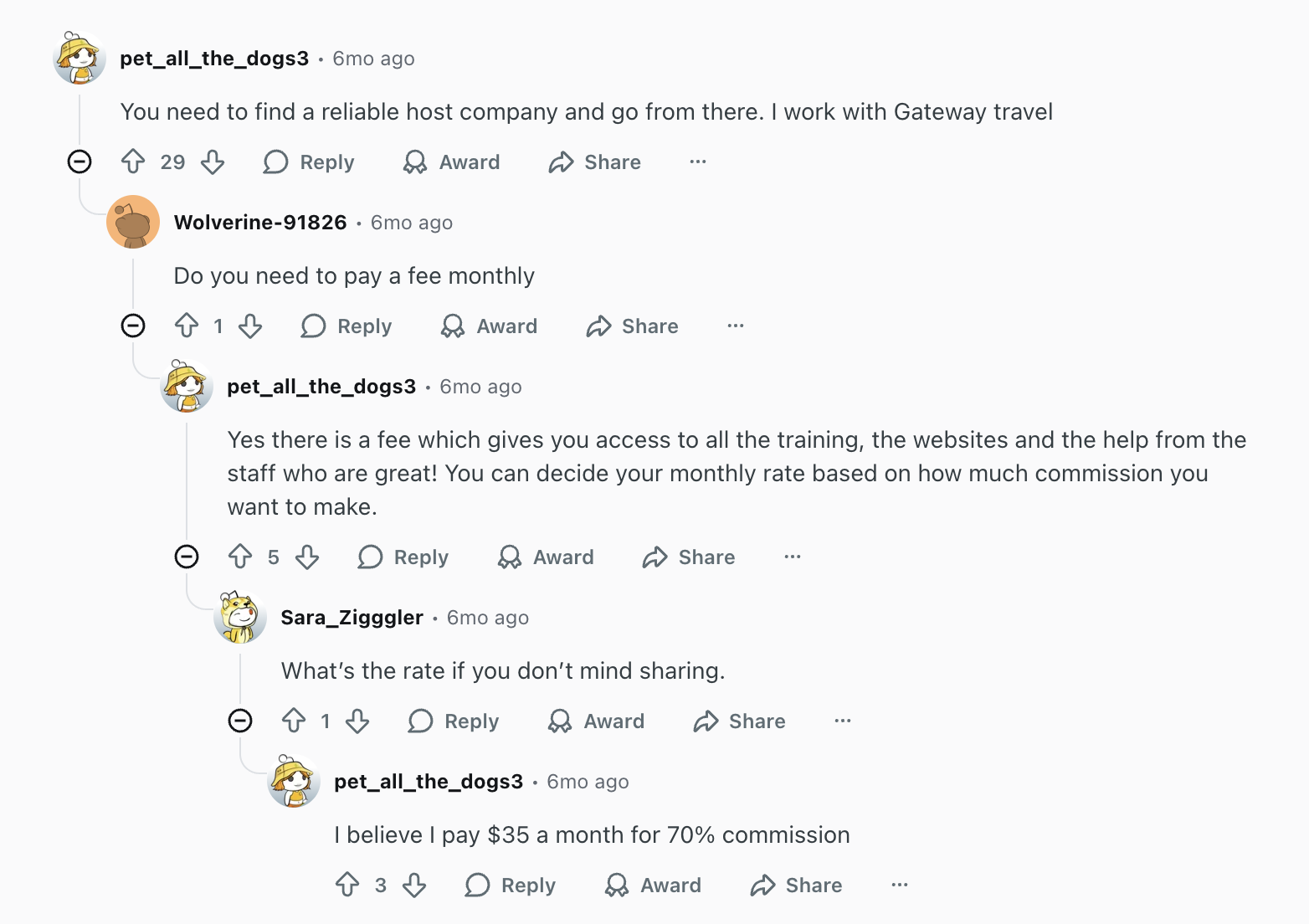
This Reddit user shared their experience as a cruise travel agent:
Luxury travel agent
Partner with agencies in networks like Virtuoso or Signature to access exclusive perks and hotel programs. Networking is huge here — industry events and supplier connections (Four Seasons, Ritz-Carlton, St. Regis) give your clients benefits they couldn’t get on their own.
State licensing and registration
The rules vary depending on where you or your clients live. Most states only require standard business registration, like forming an LLC or sole proprietorship, but a few have extra requirements for travel agents.
Here are some of the state-specific guidelines:
- California, Florida, Hawaii, & Washington. Require a Seller of Travel (SOT) license if you’re based there or selling to residents. Requirements include registration, bonding, consumer protection disclosures, with additional financial safeguards (trust accounts, restitution funds, or letters of credit) depending on how client funds are handled.
- Texas. No SOT license, but you’ll need business registration and tax compliance. Flight bookings often require IATA accreditation, which host agencies can provide.
- Delaware. Occupational license for in-state agencies; remote sales are generally exempt.
- Illinois. May require a trust account for client payments and compliance with consumer protection rules.
- Louisiana. Licensing fees apply for retail storefronts; home-based agencies are usually exempt.
- New York & Massachusetts. No formal travel agent license, but you must follow disclosure, refund, and consumer protection rules.
- Ohio, Georgia, North Carolina, South Carolina, Oklahoma, Michigan, Missouri, Pennsylvania, Alabama, Virginia, Maryland, Indiana, & New Jersey. Only standard business registration and tax compliance are required. General consumer protection laws apply.
The best approach is to register your business in your state and then check for any SOT or special licensing requirements if you plan to sell across state lines. Keeping compliance in mind from day one saves headaches later and helps you build credibility with clients.
Best Travel Agencies to Work For
In short: getting started with a host agency is the easiest way to break into travel. Agencies like Fora and InteleTravel are beginner-friendly, while BCD Travel focuses on corporate clients, and Expedia TAAP gives access to global inventory. These agencies provide training, tools, and supplier connections to help you grow.
Getting into hotel partner programs like Marriott’s PTA, Hyatt Privé, or IHG’s agent portal isn’t something you can do right out of the gate — they expect experience, credentials, and a solid track record.
Most agents kick things off with a host agency or consortium. It’s the best way to get training, tools, and supplier connections while you build your career.
Here are some of the top host agencies to get you started:
Fora Travel
Fora is one of the newer, modern host agencies that’s beginner-friendly and fully remote. They offer onboarding, coaching, and sleek booking tools, plus access to luxury hotel perks and top suppliers. Agents like them for the supportive culture, focus on education, and fair commission splits.
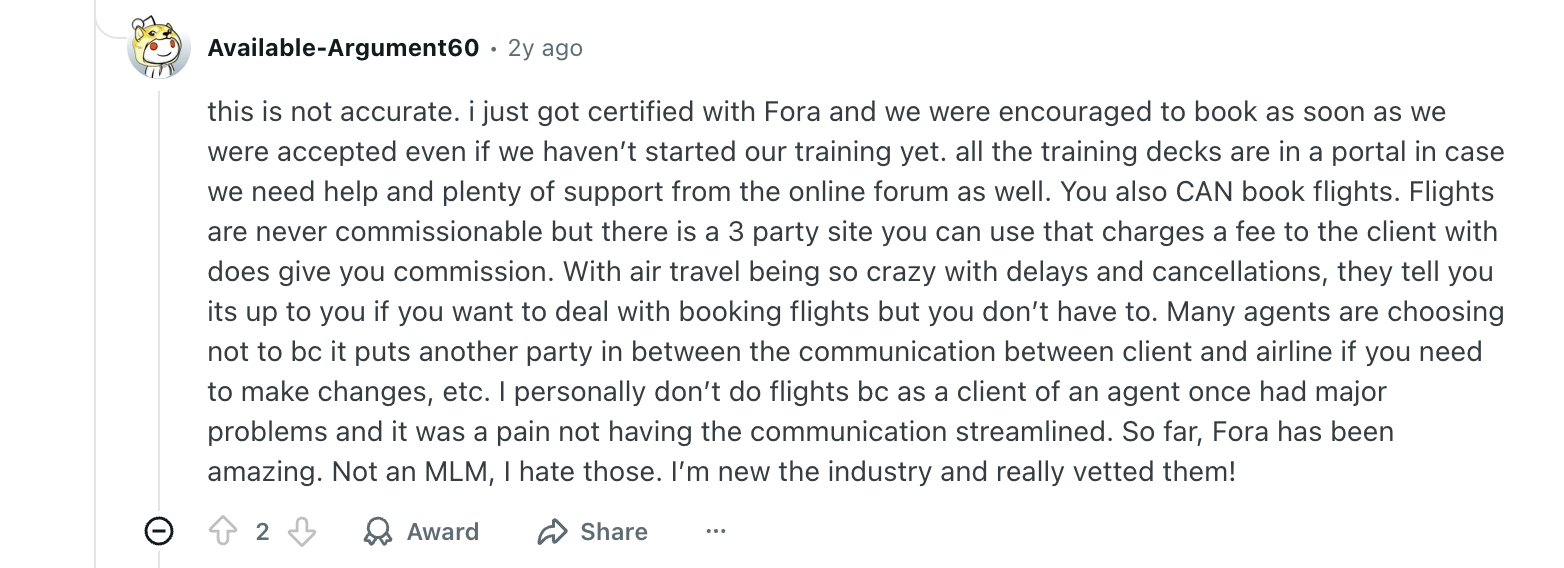
This Reddit user shares what they could do with Fora Travel:
InteleTravel
InteleTravel is one of the largest and best-known host agencies, especially for home-based agents. It’s affordable to join, flexible, and provides training, marketing tools, and full booking support with access to major suppliers.
Mary, who started with InteleTravel, shared that she earns commission on every booking and has landed some of her best deals with hotels like the H10 and Melia. To give you a sense of how approachable it is, here’s how she described her start:
“The onboarding was really simple. You just take a short course — only a few hours long — and it costs over $100. After that, you’re licensed as a travel agent through IATA and can start booking right away. At first, I mainly used it for discounts on trips for myself, friends, and family. But I know plenty of others who’ve taken it further by starting business Instagram pages, promoting themselves, and really turning it into a part-time business with even better perks.”
BCD Travel
BCD Travel focuses on corporate travel, so you’ll get experience managing trips for big clients, including Fortune 500 companies. They offer clear career paths, professional development, and access to advanced tools and resources.
Expedia TAAP
Expedia TAAP gives travel agents direct access to Expedia’s massive inventory of hotels, flights, cars, and activities at competitive rates. It’s easy to use, offers strong earning potential, and has one of the best commission structures for independent agents. Agents also appreciate the solid support and wide range of choices.
Travel Agent Training & Certifications
In short: you don’t need certifications to start as a travel agent, but they can make a big difference. They build trust with clients, unlock exclusive perks, and set you apart from casual or untrained agents. Options range from beginner programs like TRIPKIT to advanced or niche paths like CTC, VTA, DS, and CCC.
Certifications aren’t required to work as a travel agent, but they’re recommended. They boost your credibility, help you stand out, and open doors to some great industry perks. State licenses (like the SOT) only apply in certain places, and if you’re with a host agency, they’ll usually walk you through the training you need.
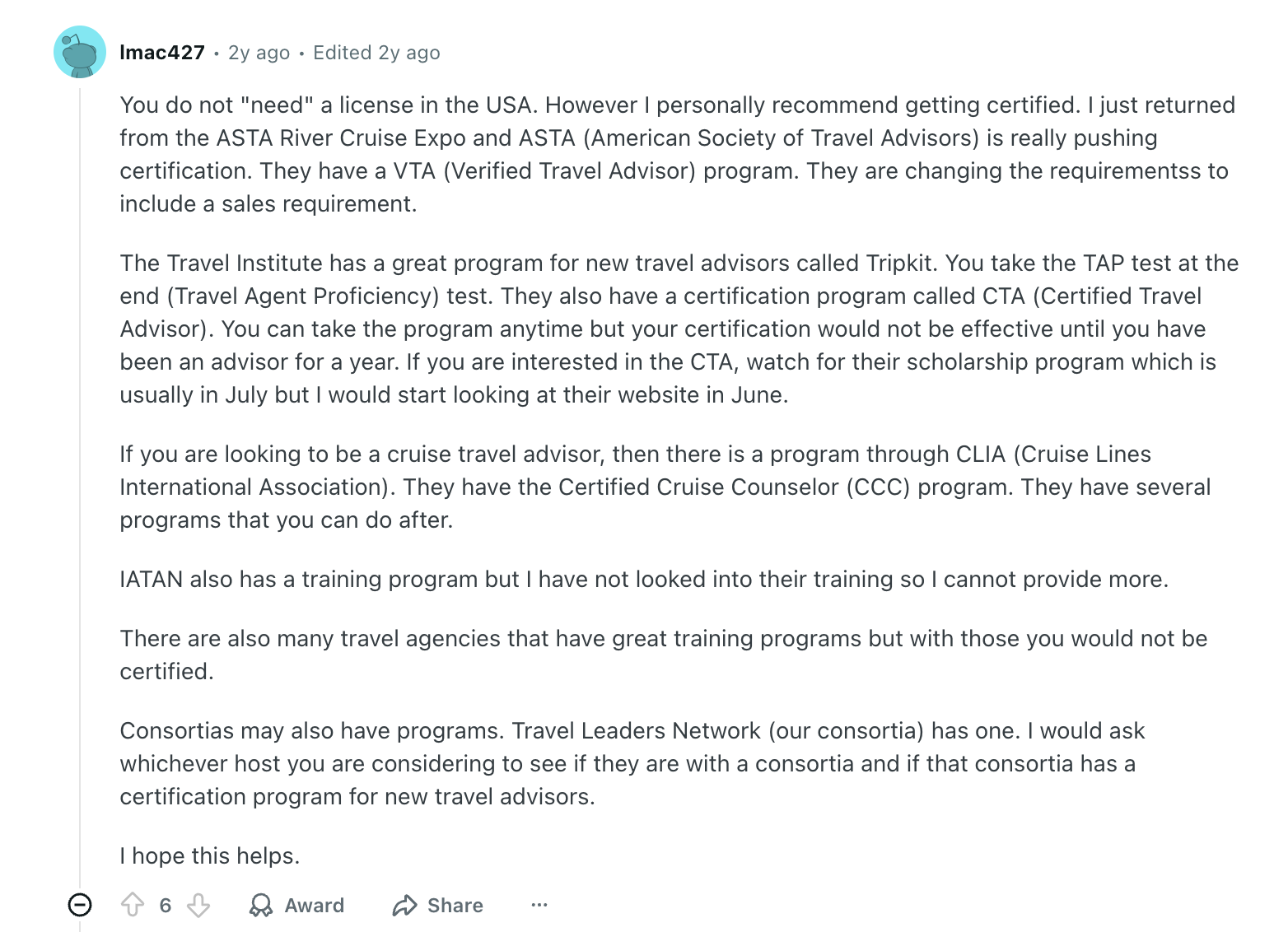
This Reddit user has some recommendations:
Here are some of the most popular training programs and certifications:
- IATA Certification | International Air Transport Association. Gold standard for agencies, giving you the ability to issue airline tickets, access top supplier rates, and use a globally recognized IATA number.
- TRIPKIT | The Travel Institute. A self-paced intro program covering travel basics, destinations, and business know-how. Pair it with the TAP test to earn an industry-recognized credential.
- Certified Travel Associate (CTA) | The Travel Institute. An entry-level certification that builds skills in sales, service, and geography. You qualify for it with one year of experience or by passing the TAP test beforehand.
- Certified Travel Counselor (CTC) | The Travel Institute. For agents with a CTA who want advanced training in management and strategy. Great if you’re aiming to run your own agency or move into a leadership role.
- Verified Travel Advisor (VTA) | ASTA. Covers ethics, legal compliance, and industry standards. Recognized by IATAN, it shows clients you’re credible, professional, and client-first.
- Destination Specialist (DS) | The Travel Institute. Specializes in regions like Europe, Asia, or the Caribbean. You’ll learn culture, geography, and insider tips so you can craft customized vacations.
- Certified Cruise Counsellor (CCC) | CLIA. The go-to starter credential for cruise sales. You’ll complete training, log real experience, and build expertise in a booming niche.
Check out How to List Certifications on Your Resume.
How to Start a Travel Agency
Here’s how to start your own travel agency:
- Pick a specialty, whether it’s family trips, luxury getaways, or cruises, to attract the clients you want.
- Register your business, choose a legal setup (like LLC or sole prop), and get a Tax ID. Some states may ask for extra licensing.
- Consider joining a host agency to tap into their booking systems, higher commissions, and supplier connections.
- Keep your finances organized with a business bank account, bookkeeping software, and clear systems for handling payments.
- Build visibility with a website, active social profiles, and directory listings to establish credibility.
- Spread the word through SEO, ads, referral programs, and networking with local groups or at travel events.
- Connect with consortia such as Virtuoso or Travel Leaders for exclusive rates and added benefits.
- Invest in ongoing education, webinars, and conferences to keep up with the industry.
Launching your own travel agency might seem intimidating/overwhelming/all of the above, but it’s definitely doable.
Here’s what to do:
1. Pick your niche. Decide what excites you — family vacations, cruises, luxury escapes, or corporate travel. A clear focus makes it easier to find and market to the right clients.
2. Handle the paperwork. Choose a legal structure (LLC, sole proprietorship, etc.), register with your state, and get an EIN/Tax ID. A few states have extra rules, but most only require basic registration.
3. Think about a host agency. They’ll give you access to booking platforms, better commission rates, and supplier connections. It’s also a great way to learn the ropes before branching out on your own.
4. Sort your finances. Open a business bank account, use accounting software, and have a plan for handling commissions and payments.
5. Build your online presence. A professional website and active social media profiles make you look professional. Adding your agency to local directories helps too.
6. Market yourself. SEO, ads, referrals, and networking at travel expos or with local businesses all help spread the word.
7. Join industry groups. Consortia like Virtuoso or Travel Leaders give you access to perks, partnerships, and exclusive rates.
8. Keep learning. The travel industry never stands still. Stay sharp with webinars, courses, and conferences.
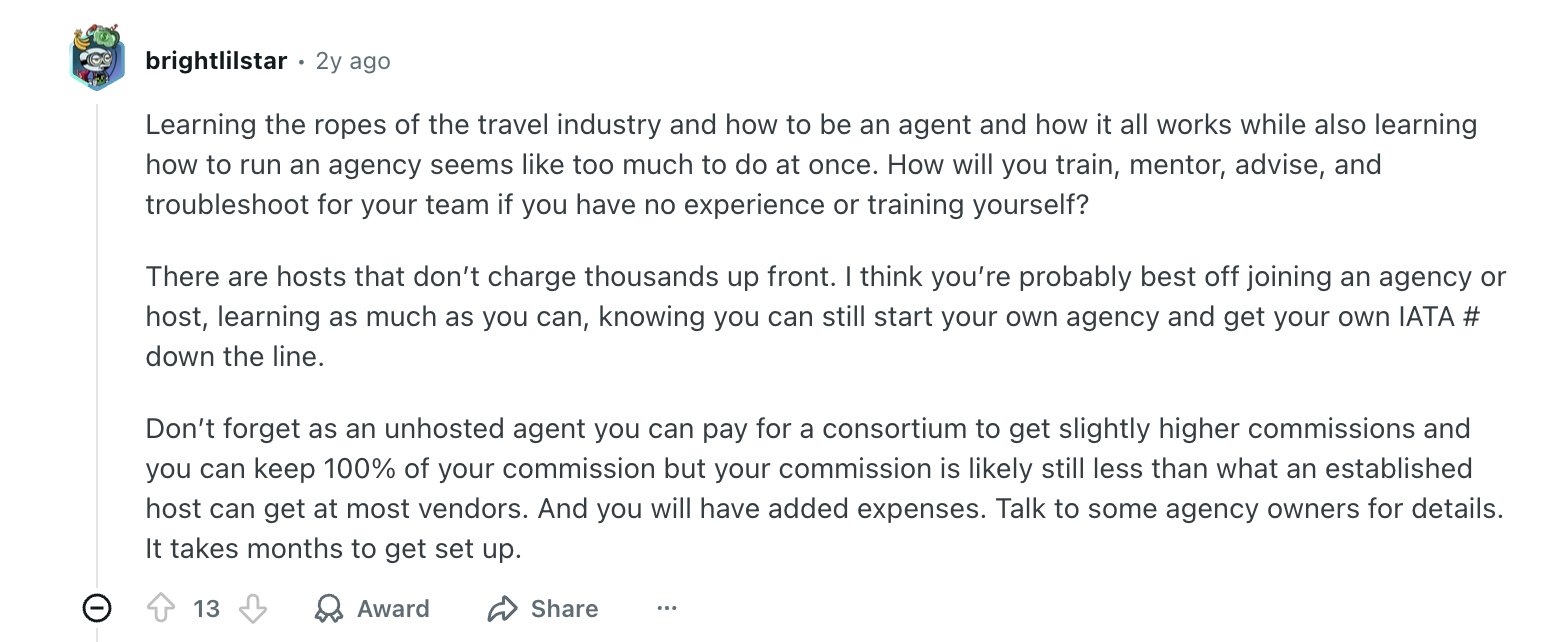
Starting a business isn’t always easy. This Reddit user shared their advice:
Summary
Here’s a recap on how to become a travel agent:
- Travel agents do more than book flights and hotels — they design personalized itineraries, save clients time, and provide access to unique experiences.
- Benefits include flexibility, travel perks, helping clients, and turning a passion for travel into a career.
- “Travel agent” and “travel advisor” overlap, but advisors typically offer more tailored, expert guidance and exclusive perks.
- Starting from home is simple with a host agency, which provides training, tools, and accreditation.
- Specializing in Disney, cruise, or luxury travel can help you stand out and attract niche clients.
- State requirements vary; some require Seller of Travel licenses, while others only need business registration and tax compliance.
- Top host agencies like Fora, InteleTravel, BCD Travel, and Expedia TAAP provide training, supplier access, and career support.
- Certifications (IATA, CTA, CTC, VTA, DS, CCC, TRIPKIT) boost credibility, expertise, and access to industry perks.
- Starting your own agency involves picking a niche, handling legal/financial setup, marketing, joining consortia, and ongoing learning.
FAQ
Is Fora Travel legit?
Fora Travel is a legitimate host agency with BBB accreditation, industry recognition, and plenty of positive reviews from travel advisors and clients. While a few negative experiences exist, most agents highlight the supportive culture, helpful training, and useful resources that make getting started much easier.
How to become a travel agent for free?
You can start for free through platforms like Travel Agent University or Travel Uni, which offer complimentary training. Many host agencies also waive startup fees, letting you access booking tools, supplier resources, and hands-on experience without upfront costs, making it possible to learn while you earn.
What is the average travel agent salary?
It varies a lot depending on experience, niche, and setup. Most agents in the US make around $35K–$50K, while seasoned advisors or those in luxury and corporate travel can earn $60K–$100K+. Commissions, perks, and bonuses often boost earnings beyond the base salary.
How do you make money as a travel agent?
Travel agents earn through commissions from airlines, hotels, cruise lines, and tour operators for bookings. Many also charge service fees for custom or complex trips. Your income grows with sales, repeat clients, and niche expertise, so building strong supplier relationships is key to maximizing earnings.
Do you need a license to be a travel agent?
It depends on your location. Most states just require basic business registration, but California, Florida, Hawaii, and Washington require a Seller of Travel (SOT) license if you operate there or sell to residents. Many agents simplify this by joining a host agency that handles licensing and compliance.
Why book with a travel agent?
A travel agent offers expertise, personalized service, and perks you can’t get online. They handle complex itineraries, emergency issues, and insider knowledge on destinations, hotels, and suppliers. Essentially, they save you time, reduce stress, and ensure your trip goes smoothly from start to finish.
How long does it take to become a travel agent?
You can get started as an online or host-agency agent in just a few weeks if you have basic tech and customer service skills. Earning certifications, specializing in niches, or launching your own agency can take several months to a year, depending on how much time and effort you invest.

Upload or drop your resume to get started
Upload your resume to get started
Score my resume

Sarah Coghlan is a writer and editor passionate about making resume and career advice clear and accessible to all. Based in Barcelona, her goal is to help job seekers create standout resumes and navigate the job search process with confidence and ease.