Resume
How to Tell if a Resume Is AI-Generated: Recruiter Red Flags
Learn how to tell if a resume is AI-generated and spot the recruiter red flags that reveal generic, robotic, or overly vague resumes.

Published on
September 30, 2025
Updated on
September 30, 2025
Job searching is already tedious enough without having to manually create resumes tailored for every single job. That’s why AI tools look so tempting. All you need to do is type in a few details, and boom, you get a professional, ATS-friendly resume in minutes.
But could using AI cost you your dream job?
AI generators aren’t flawless — mostly because they aren’t you. Don’t get me wrong, using AI to build your resume has a ton of benefits, and employers rarely care if you have some extra help. But all this can backfire if you don’t use AI the right way.
So, let’s find out what not to do when using an AI generator. This guide will cover:
- All the warning signs of an AI-generated resume.
- If you should use AI for your job application.
- How employers check for AI (and if they even care).
Looking for a resume generator you can trust? Try our free AI Resume Builder. Our expert technology creates a tailored resume in minutes, without sacrificing your voice.
How to Tell if a Resume Is AI-Generated
Here’s a quick overview of how to spot an AI-generated resume:
- Repetitive language and phrases in AI-generated resumes often repeat the same overused wording or similar ideas across multiple bullet points.
- A rehash of the job description happens when a resume mirrors the posting too closely, using keyword-heavy or copied phrases without connecting them to your achievements.
- Buzzwords and vague statements, such as “motivated team player,” provide no measurable outcomes or unique details, making your resume sound robotic.
- Lack of unique skills and achievements is common when AI misses the personal accomplishments or specific projects that differentiate you from other candidates.
- Robotic sentences with no personality appear when your resume reads overly formal, stiff, or awkward, lacking natural flow and authentic voice.
Let’s explore these warning signs and how to avoid them with examples and tips.
1. Repetitive language and phrases
One of the biggest giveaways of an AI-generated resume is when it feels like déjà vu in every bullet point. AI tools trained on piles of resume examples tend to regurgitate the same overused phrases, such as “strong communication skills” or “proven ability to…” over and over again.
And sometimes it’s just different words saying the same thing, for example:
• Collaborated with various teams to improve communication and ensure project success.
• Worked with departments to enhance teamwork and drive successful project outcomes.
You don’t have much space (or a recruiter’s time) to sell yourself, so every resume bullet point should add value. When recruiters see the same phrases recycled without variation, it can show that AI just doesn’t have much material to offer you.
And it’s not just resumes. This employer pointed out how obvious repetitive phrasing can be in your job application:

How to avoid this:
- Read through your resume and replace any repetitive words or phrases with unique descriptions that add fresh insight or value.
- Let AI suggest phrasing, but always tweak and add additional details, so it matches your own voice and experiences.
- Use action verbs with variety. Instead of always saying “led,” mix it up with “orchestrated,” “launched,” or “built” to get a better sense of your role.
If you need some inspiration, try our AI Bullet Point Writer to get professional and achievement-focused points that are tailored to the job description and your industry.
2. Rehash of the job description
If your resume looks suspiciously similar to the job posting, that’s another tell. AI tools often take the job description to help tailor your resume, which is great — if it doesn’t go overboard. When does it cross the line? Keyword stuffing, skills repeated five times, and responsibilities that don’t connect back to your actual experience.
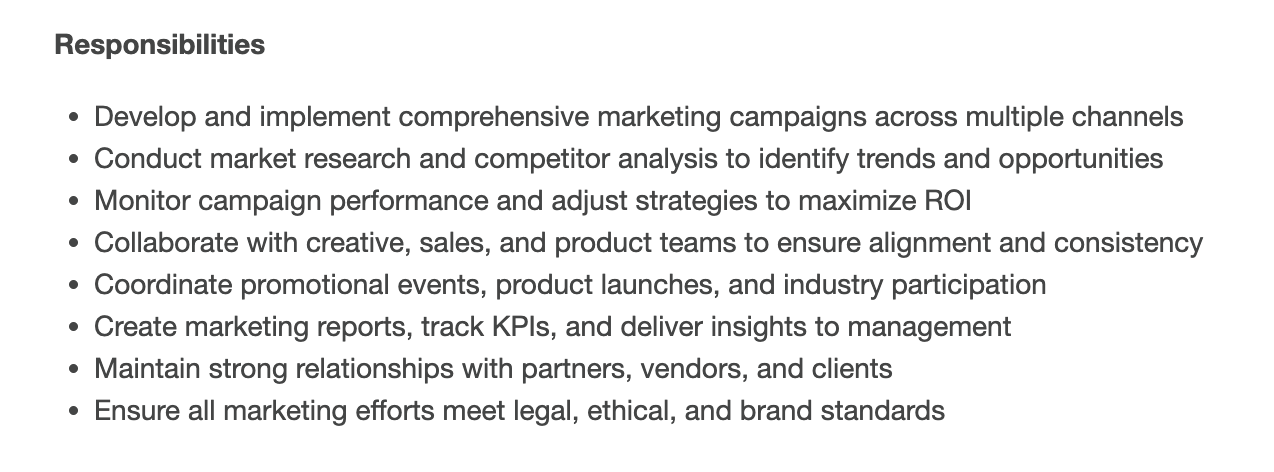
Take a look at this job description:
Now, here’s an example of copying the job ad instead of tailoring:
• Developed and implemented different marketing campaigns
• Conducted market research to find trends and opportunities.
• Monitored campaign performance and adjusted strategies to improve ROI.
These are basically copy-paste versions of the employer’s own words. They don’t show the candidate’s unique resume achievements, results, or impact, which is why they stick out as AI-generated or lazy tailoring. Plus, if you straight-up copy the job ad, it shows you don’t really understand what you’re claiming.
How to avoid this:
- Use the job description as a guide, not a script. Insert keywords, phrases, and resume skills naturally and connect them back to your own experiences with concrete examples.
- Research the company’s values and mission to show you’ve taken the time to align your own professional background instead of parroting bullet points.
- Double-check that every skill or phrase you include reflects something real from your career.
Need help tailoring your resume? Our AI Keyword Targeting feature identifies missing keywords and phrases and offers suggestions on how to naturally include them in your resume.
3. Buzzwords and vague statements
This is the classic AI lingo: “results-driven professional with a proven track record of success.” Sure, it sounds fancy, but what does it actually say about you? AI leans heavily on generic buzzwords because they feel safe and professional — but without specifics or examples, they’re meaningless.
A recruiter would rather see “increased client retention by 25% through a revamped onboarding process” than a dozen “hard worker” statements. If the resume feels like it could describe literally anyone, there’s a good chance AI had a heavy hand in writing it.
Here are some AI favorites to avoid using in your resume:
• Motivated team player with strong leadership skills and a proven track record of success.
• Results-oriented leader with strong problem-solving skills.
• Detail-oriented team player who consistently goes above and beyond.
And this is how to add your personal touch to make them more specific:
• Led a team of 6 to improve internal workflows and reduce project turnaround time.
• Launched a customer success program that cut churn by 15% in the first quarter.
• Created a reporting process that reduced weekly data errors by 40%.
How to avoid this:
- Cut vague buzzwords unless you can back them up with proof.
- Add numbers, percentages, or clear outcomes whenever possible to make your bullet points sound more credible and unique.
- When using AI, give it detailed prompts and information about your professional background, so the output is specific, not generic.
4. Lack of unique skills and achievements
AI isn’t a mind-reader. It’s easy for AI-generated resumes to miss the details that make you stand out: the certification you worked hard for, the software you mastered, or the project you pulled off under crazy deadlines — especially if you never gave it this information.
Instead of outlining measurable wins and unique success stories, AI resumes usually list vague responsibilities that sound more like job postings. And sometimes, they even make up skills or tools that you’ve never touched, which is a risky strategy if you get called out in an interview.
Look at the side-by-side example of a vague vs. a specific resume bullet point:
• Responsible for managing projects, coordinating teams, and meeting deadlines.
• Managed a small team to deliver a product launch of a new task-tracking system two weeks ahead of schedule.
How to avoid this:
- Go through each role you’ve had and pull out specific achievements — especially ones with measurable results.
- Highlight tools, systems, or industry-specific expertise that prove your credibility and align with the job description.
- Use AI as a brainstorming partner, but fact-check everything and infuse with personal touches, such as achievements, challenges, and stories that only you could tell.
5. Robotic sentences with no personality
AI-generated resumes can sound like a corporate robot; overly formal, weirdly stiff, or devoid of any personality. I’m not saying that a resume shouldn’t be formal (it should), but it needs to flow naturally and reflect who you are as a candidate.
Recruiters pick up on this because human resumes usually have subtle quirks, warmth, or energy that AI can’t fully replicate. If you read it out loud and it feels awkward, monotone, or full of complex jargon, chances are it’s more machine than human.
Here’s an example that’s better suited for the boring fine print in a manual:
• Executed effective communication strategies to enhance operational workflows in alignment with organizational objectives.
And here’s how to make your point sound formal, yet still human:
• Created a reporting system that cut weekly update meetings in half, freeing up 5 hours a week for the team to focus on client work.
How to avoid this:
- Read your resume out loud or get a second pair of eyes. If it sounds too stiff, rewrite it until it feels natural.
- Match your tone to the industry (tech resumes can be sharp and concise; creative ones can show more personality).
- Don’t let AI decide your voice — always edit to sound like you.
Is It Wrong to Use AI for a Resume?
Short answer: Using AI to build your resume isn’t wrong, but it can definitely backfire if you rely on it too much.
AI is your assistant, not a ghostwriter. It’s a great tool for fixing grammar, tailoring to the job ad, improving phrasing, or giving you fresh ideas. But I wouldn’t recommend using an AI resume generator to write your entire resume from scratch without a hint of personalization. That’s when resumes feel generic, robotic, or full of clichés.
Remember, AI doesn’t really “know” you. It can mimic professional language, but it doesn’t understand the ins and outs of your story, personality, or the impact you’ve made in past roles. If you’re not reviewing, editing, and weaving in your own voice, the AI fingerprints are all over it.
Still on the fence about AI? Here’s my honest take on the benefits and disadvantages of using AI to write your resume:
While AI can introduce some disadvantages, none of these are deal-breakers. With a little time and effort, you can edit, refine, and add your unique touches to make the resume yours. Employers generally don’t mind if AI lends a hand, as long as the final product reflects your real achievements and value.
You can also use AI for other parts of your application: How to Use AI to Write a Cover Letter
Do Employers Care if a Resume Is AI-Generated
Most employers aren’t losing sleep over whether you used AI or typed every word yourself. What they really care about is the end product: does your resume clearly highlight your skills, experiences, and accomplishments in a way that fits the role? If the answer is yes, they usually don’t mind if AI helped you get there.
But if your resume is stuffed with vague buzzwords, feels overly formal, or doesn’t have any personal touches, a hiring manager will assume you didn’t put in much effort. Employers want to see you in your resume, not just a string of generic lines AI could have written for anyone.
That said, I’m no recruiter. So, I had a look online to see what hiring managers really think about using AI to build your job applications.
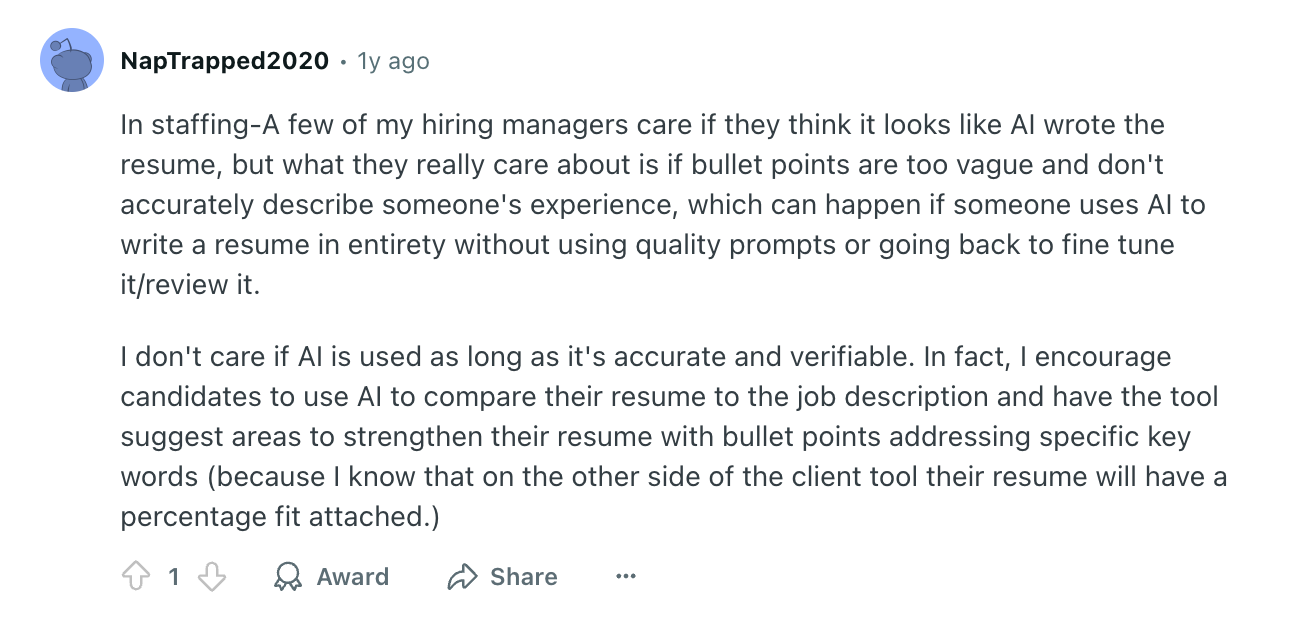
One hiring professional said it’s less about if you use AI, and more about how you use it:
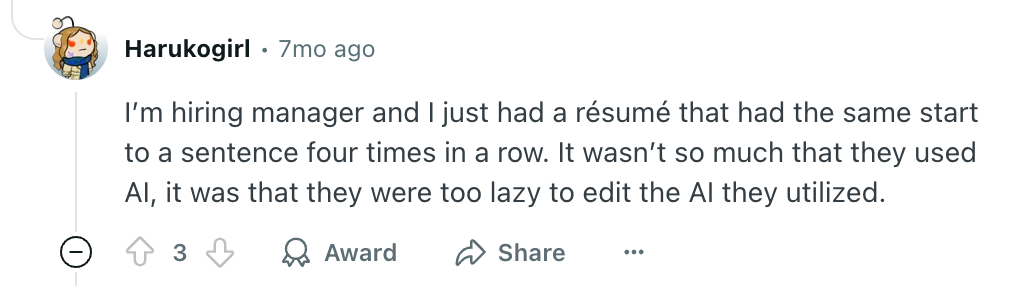
Another hiring manager also emphasized knowing how to use AI the right way:
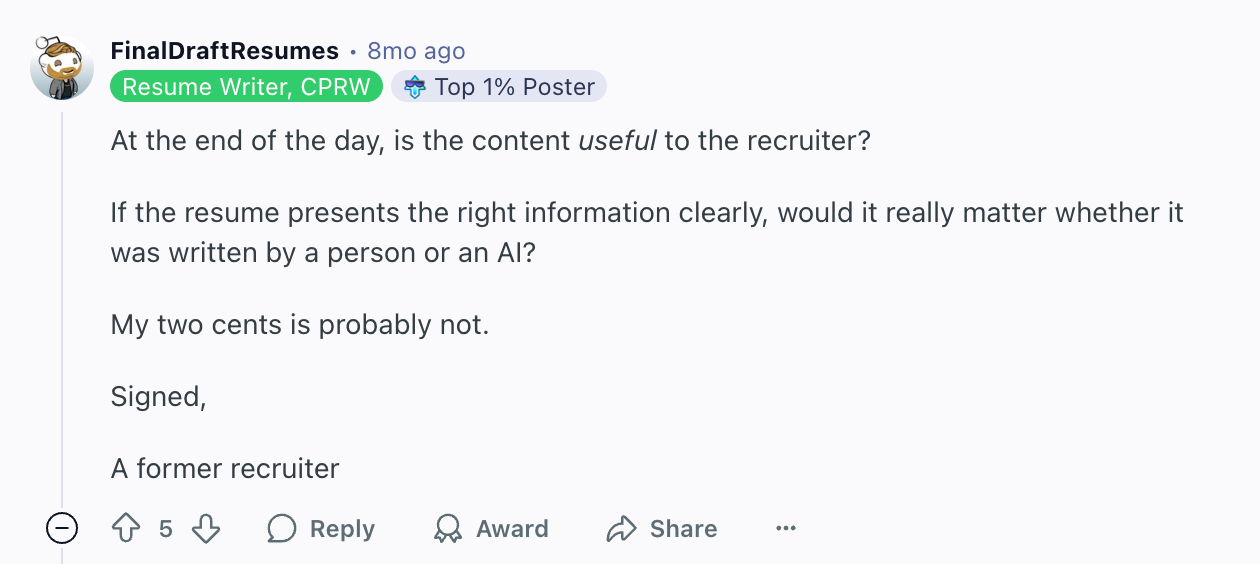
And a former recruiter summed this up by highlighting the importance of your resume content:
Moral of the story: Use AI the right way. Find out more: How to Use AI to Write a Resume
Summary
Here’s a rundown of all the resume red flags to watch out for when using AI:
- Repetitive phrasing pops up when multiple bullet points use the same wording or recycled variations, which makes the resume feel generic instead of tailored.
- Copy-and-paste job descriptions are a giveaway when bullet points mirror the posting almost word-for-word instead of showing unique achievements.
- Overuse of buzzwords like “good communication skills” or “hard-worker” without any measurable proof signals AI filler language.
- Lack of specific accomplishments shows up when the resume lists responsibilities instead of highlighting results, impact, or metrics.
- Oddly vague skills or experiences may appear if AI invents tools, systems, or tasks that the candidate didn’t actually use.
- Robotic tone makes the writing stiff, overly formal, or awkward, lacking the natural flow you’d expect from a human-written resume.
- Overloaded with keywords can happen when AI stuffs in too many job-related terms without weaving them into meaningful examples.
- Missing personal touches stand out when the resume doesn’t include certifications, side projects, or unique details that make a candidate memorable.
- Awkward sentence structure sometimes slips through when AI tries too hard to sound polished, but ends up sounding unnatural when read out loud.
FAQ
How do employers check if a resume is written by AI?
Most recruiters use their years of experience reviewing resumes to check for signs of AI. They can usually spot AI-heavy writing because it follows the same patterns: robotic tone, copy-pasted job descriptions, or vague buzzwords. If every bullet point feels generic, repetitive, or like it could belong to anyone, it sets off alarms. Some companies experiment with AI-detection tools, but more often, it’s human instinct that catches when something feels off.
Can ChatGPT generate a resume?
Yes, ChatGPT can put together a resume draft with the right prompts. It can create a solid structure, suggest strong action verbs, and highlight industry-relevant keywords to help you get through applicant tracking systems (ATS). It’s also great for formatting help or brainstorming phrasing when you’re stuck.
That said, ChatGPT doesn’t know you, and it’s not specifically designed for resume-writing. If you don’t give it specific instructions and details about your achievements, it will fill in the gaps with generic statements. That’s why it’s best to use ChatGPT for brainstorming, not as your one-stop resume writer.
Find out more: How to Write a ChatGPT Resume
Can employers tell if you use ChatGPT for a resume?
Not directly; there’s no label that says “written by ChatGPT.” But they can tell when a resume leans too heavily on AI. If it feels impersonal, lacks unique success stories, or sounds like a robot, recruiters will assume you didn’t put in the effort. That doesn’t mean AI use is a deal-breaker; most hiring managers don’t care if you had help, as long as the final product feels authentic, accurate, and unique to you.
How to personalize your resume?
Personalization means swapping out vague phrases for specific accomplishments, like “Increased client retention by 20% after redesigning onboarding materials” instead of “Improved customer experience.” It means mentioning certifications, tools, or industry knowledge that only you can claim.
You can also tailor your resume to each job by weaving in the company’s mission or values, showing you’ve done your homework. When a recruiter reads it, they should get a clear sense of what you did and how you made an impact.
How to prove your resume isn’t written by AI?
The easiest way is through details that only you know. AI can guess at generic tasks, but it can’t recreate the night you pulled off a product launch two weeks early. Numbers, percentages, and industry-specific references can help add credibility to your job application.
I also recommend reading your resume out loud. If it sounds stiff or full of empty buzzwords, you probably need to revise. Recruiters aren’t looking to “catch” you using AI; they’re looking for evidence that you’re authentic and capable.

Upload or drop your resume to get started
Upload your resume to get started
Score my resume

Lauren Bedford is a seasoned writer with a track record of helping thousands of readers find practical solutions over the past five years. She's tackled a range of topics, always striving to simplify complex jargon. At Rezi, Lauren crafts genuine and actionable content that guides readers in creating standout resumes to land their dream jobs.