
Resume
How to List Publications on a Resume (Examples)
Learn how to list publications on your resume with confidence. This guide covers what to include, how to format it, and tips to showcase your expertise effectively.
Published on
January 6, 2025
Updated on
October 23, 2025
If you have published work and you’re wondering how to include it on your resume, here’s the short answer: only list publications that are relevant, credible, and add value to the role you’re applying for. Stick to peer-reviewed articles, books, research papers, or industry reports. Skip casual blogs unless directly related to the job. Add a “Publications” section if you have three or more; otherwise, include them under your education. Use one consistent formatting style (APA, MLA, etc.), list the most recent work first, and clearly label anything that’s still in progress with “in press.” Focus on quality over quantity, and keep it clean and easy to scan.
Adding publications to your resume can feel like assembling IKEA furniture without the instructions — confusing, messy, and leaving you with extra parts. Should you include every article you’ve ever written? Leave off your best work because it’s not directly relevant? And what’s the deal with resumes and CVs, are they really that different?
Maybe you’ve been slapping a full bibliography onto your resume and wondering why recruiters ghost you. Or you’re stuck figuring out how to tailor your publications without overwhelming the reader.
This guide will answer all your burning questions and help you turn your publications into a resume highlight.
You’ll learn:
- Which publications to include and when
- How to format publications for your resume
- The difference between a resume and a CV
To get started on a new resume, try our free AI Resume Builder. And for more resume help, check out these guides:
- All 25+ Resume Sections That You Could Use
- How to Write a Career Change Resume
- Tips for Updating Your Resume & Making It Better
- How to Make Relevant Coursework on a Resume Look Good
Publications: What They Are and When to Include Them
Here’s what counts as a publication and when to include them in your resume:
- Publications are professional or academic work you’ve written or contributed to, like journal articles, books, research papers, or conference presentations.
- Peer-reviewed pieces carry extra weight since experts vet them.
- Skip personal blogs or casual writing unless they’re directly relevant to the role.
- Add publications if you’re applying for research, academic, writing, or expert-level positions, as they show credibility and communication skills.
- Academic and research-heavy roles often expect them; writing roles value them as proof of messaging ability.
- Students and recent grads can use publications to make up for limited work experience.
- Stick to the most relevant work — quality matters over quantity.
Publications are any written work you’ve created or contributed to that’s been shared with the public — usually in a professional, academic, or industry setting. They can include academic journals, books, and conference papers. Peer-reviewed works are even more impressive since experts have validated their quality and accuracy.
Examples of publications:
- Academic journal articles (Nature, The Lancet)
- Research papers in law, science, or medicine
- Books or book chapters
- Conference papers or presentations
- Peer-reviewed scholarly articles
- Industry reports (market analysis, white papers)
Avoid including casual blogs, personal websites, or articles in non-scientific or non-academic magazines, as they don’t carry the same professional weight.
When to add publications
Publications can be a game-changer for roles in writing, research, or expertise. I always recommend tailoring them to the job. Think of them as proof of your skills, credibility, and ability to communicate. Whether it’s a medical study in The Lancet, a chapter in an engineering textbook, or a tech article in the Journal of Data Science, your published work proves you can tackle real-world challenges.
In fields like academia, journalism, research, or marketing, publications are often a requirement.
Academic roles
For professor or researcher positions, publications like peer-reviewed journal articles, conference papers, or academic books are essential.
- Example: A Nature study or a keynote presentation at a major conference.
Need inspiration? Check out these resume samples:
Research-heavy jobs
Fields like biotech, psychology, or environmental science expect publications.
- Example: Articles in journals like Cell or Journal of Environmental Psychology.
Writing-focused careers
In marketing, journalism, or content creation, your published work proves your communication skills.
- Example: A HuffPost feature or a white paper on branding.
Students and recent graduates
Publications can bridge the gap if you lack work experience.
- Example: Research papers or university project articles published in academic journals.
When it’s relevant
Just remember: more isn’t always better. I’ve made the mistake of listing too much before, and it can bury your best work. Resume space is precious, as this Reddit user points out:
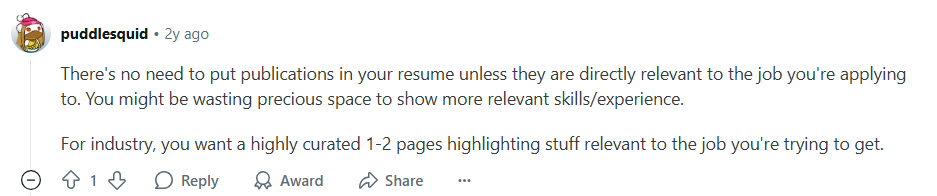
For non-academic roles, only include publications that align with the job.
- Example: A social media strategy article for a digital marketing role.
Adding the right publications to your resume shows off your expertise while keeping it sharp and to the point. Pick the best ones, and don’t overwhelm the hiring manager with too many titles.
How to Add Publications to a Resume
Here’s how to add publications to a resume:
- Create a “Publications” section if you have three or more. Place it after your education or experience, and list entries in reverse chronological order.
- If you only have one or two, tuck them under your education section.
- Pick one formatting style (like APA or MLA) and use it consistently.
- APA is common in science, psychology, and education; MLA is used in the humanities and liberal arts.
- Keep it simple if formal styles feel too academic and just include the title, publisher, and date.
- Label pending work as “in press” or “submitted” and don’t oversell something that isn’t finalized.
So you have a publication (or a few), now what? Adding them to your resume the right way can give you a serious edge, especially in research-heavy or writing-focused roles.
Create a publications section
Highlight your expertise with a “Publications” section. Depending on how many you have and their relevance, you can either create a dedicated section or work them into your education.
- Publications section: Got three or more? Create a separate section right after your education and experience. List them in reverse chronological order with titles, publication names, and dates.
- Education section: If it’s just one or two, tuck them neatly under your education section.
Follow a formatting style
Choose a formatting style and stick with it throughout your publications list. It’ll make your resume look more polished and show you’re detail-oriented. APA and MLA are the most common, but you can always keep it simple with just the title, publisher, and date.
APA style
- Used in science, engineering, education, and psychology.
- Format: Author’s Last Name, First Initial. (Year). Title of Article. Journal Name, Volume(Issue), Pages, and DOI or URL if available.
Here’s an example of an assistant psychologist’s publications list in APA style:
• Smith, J. A., & Brown, L. M. (2023). The impact of cognitive-behavioral therapy on anxiety disorders in adolescents. Journal of Clinical Psychology, 79(5), 123-136. https://doi.org/10.1234/jclp.2023.01234
• Smith, J. A. (2022). Exploring the relationship between childhood trauma and adult depression: A meta-analysis. Psychology and Mental Health Review, 15(2), 45-59. https://doi.org/10.5678/pmhr.2022.045
• Smith, J. A., & Lee, K. P. (2021). The efficacy of mindfulness-based interventions in treating PTSD: A review. Journal of Trauma Psychology, 13(4), 200-210. https://doi.org/10.4321/jtp.2021.204
MLA style
- Common in humanities and liberal arts.
- Format: Author’s Last name, First Name. “Title of Article.” Journal Name, Volume, Issue, Year, Pages.
Here’s an example of an English Literature professor’s publication list in MLA style:
• Kumar, Sanya. “Reimagining the Romantic: A Study of Wordsworth and Keats.” Journal of English Literary Studies, vol. 45, no. 2, 2021, pp. 112-130.
• Kumar, Sanya. “Narrative Voice in Modern Fiction: An Exploration of Gender and Identity.” Studies in Modern Literature, vol. 12, 2018, pp. 98-115.
• Kumar, Sanya, and Ananya Gupta. "The Metaphysical Poets and Their Legacy." Literature Today, vol. 38, no. 4, 2019, pp. 45-67.
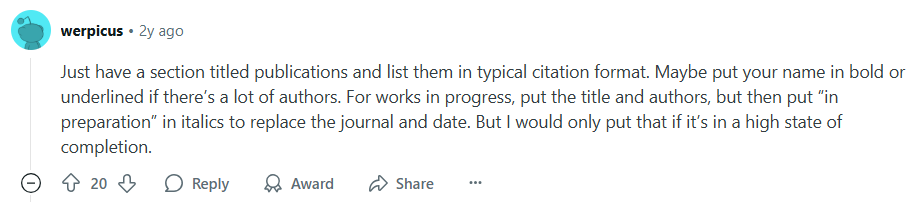
Include pending publications but label them clearly, like “submitted for publication” or “in press.” Only include them if they’re nearly published, and don’t exaggerate or list anything unverified.
Backing that up, one Redditor shared:
How to Add Publications to a CV
Here’s how to add publications to a CV:
- In academic or research-focused CVs, a full list of publications is expected.
- Use a clear section title like “Publication” or “Research and Publications.”
- List entries in reverse chronological order and stick to one citation style (APA, MLA, AMA, etc.).
- Include full details: title, co-authors (bold your name), publication name, volume/issue, year, and page numbers.
- Break your list into categories: peer-reviewed articles, books, and conference papers.
- Label works in progress as “in press” or “submitted” if they’re near publication.
- For notable work, add a short note on impact (awards, citations, recognition).
Academic CVs are typically used for academic, research, or specialized roles, where publications are expected and highly valued. Unlike resumes (which are shorter), CVs give you more space to dive into your qualifications, making a detailed “Publications” section standard practice.
Note: in places like Europe, Australia, India, and South Africa, “CV” and “resume” are used interchangeably.
Publications on a CV vs. resume
Both CVs and resumes share a few similarities when detailing publications:
- List in reverse chronological order, starting with the most recent.
- Use a consistent style for your field (e.g. ALA, MLA).
- Include the full title, authors (bold your name if co-authored), journal/book title, volume/issue number, year, and page numbers.
- For pending publications, note “in press.”
However, since CVs are longer, here are some differences:
- Always create a separate “Publications” or “Research and Publications” section.
- Include all your publications.
- Organize by type (e.g. journal articles, conference papers, books).
- Highlight major works with a brief note on impact, awards, or citations.
- If you’re in the medical or health sciences, stick to AMA style when showcasing your publications.
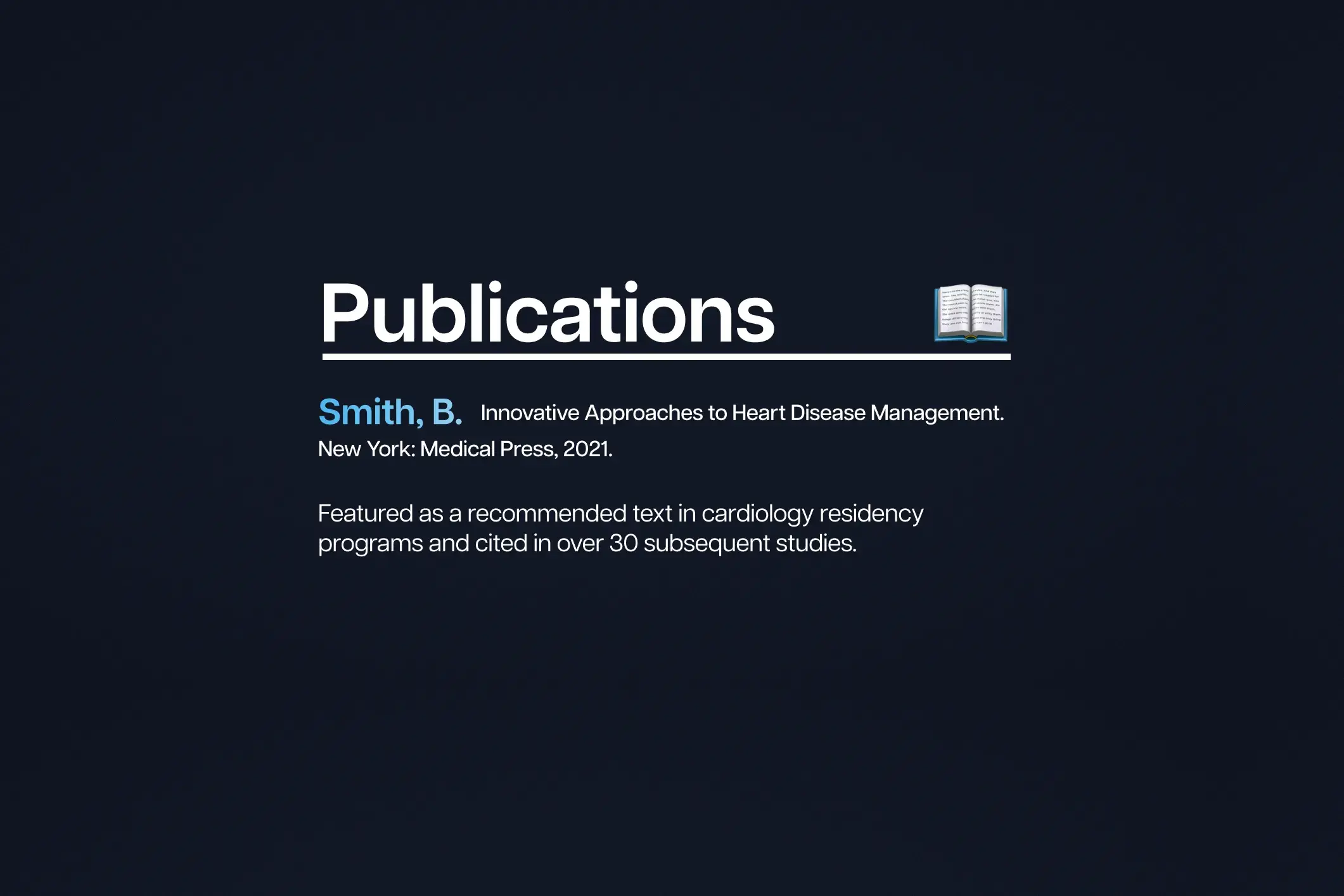
Here’s an example of a cardiologist’s CV publication section in AMA style:
Publications
Journal Articles:
• Ring, B., Anderson, R., & Clark, M. “Advances in Cardiac Surgery: A 10-Year Review.” Journal of Cardiothoracic Surgery, 45(6), 125-133. (2023)
Cited over 150 times; highly influential in shaping current surgical techniques in cardiac care.
• Ring, B., & Lee, P. “Impact of Telemedicine on Post-Surgery Recovery: A Systematic Review.” Journal of Medical Technology, 38(2), 45-58. (2022)
Winner of the 2023 Health Technology Award for Best Research Paper.
Books:
• Ring, B. Innovative Approaches to Heart Disease Management. New York: Medical Press, 2021.
Featured as a recommended text in cardiology residency programs and cited in over 30 subsequent studies.
In Press:
• Ring, B., & Thompson, A. “AI Integration in Cardiovascular Diagnostics.” Journal of Clinical Medicine, in press.
Expected to significantly influence AI-based diagnostic tools in cardiology.
Dos and Don’ts of Listing Publications
Here are the dos and don’ts of listing publications:
- Make sure each entry includes the title, co-authors, the journal or publisher, date, and a link or DOI if possible.
- Stick with one formatting style, whether it’s APA, MLA, or something else.
- Focus on your most relevant or impressive work, and don’t list everything.
- For anything not yet published, note it clearly as “in press” or “submitted.”
- If you weren’t the lead author but played a key role, briefly clarify your contribution.
- Skip pieces that are outdated or off-topic unless they still add real value.
- Avoid mixing citation styles or including work that doesn’t support your goals.
- Review everything for accuracy, clean layout, and clear organization.
You’ve put time, energy, and even some late nights into your publications, so don’t let messy formatting or poor layout hold them back. Even the most impressive work can fall flat if it’s badly organized or sloppily listed.
To help you avoid that, here’s a quick rundown on what to include (and what to leave out) when laying out your publications.
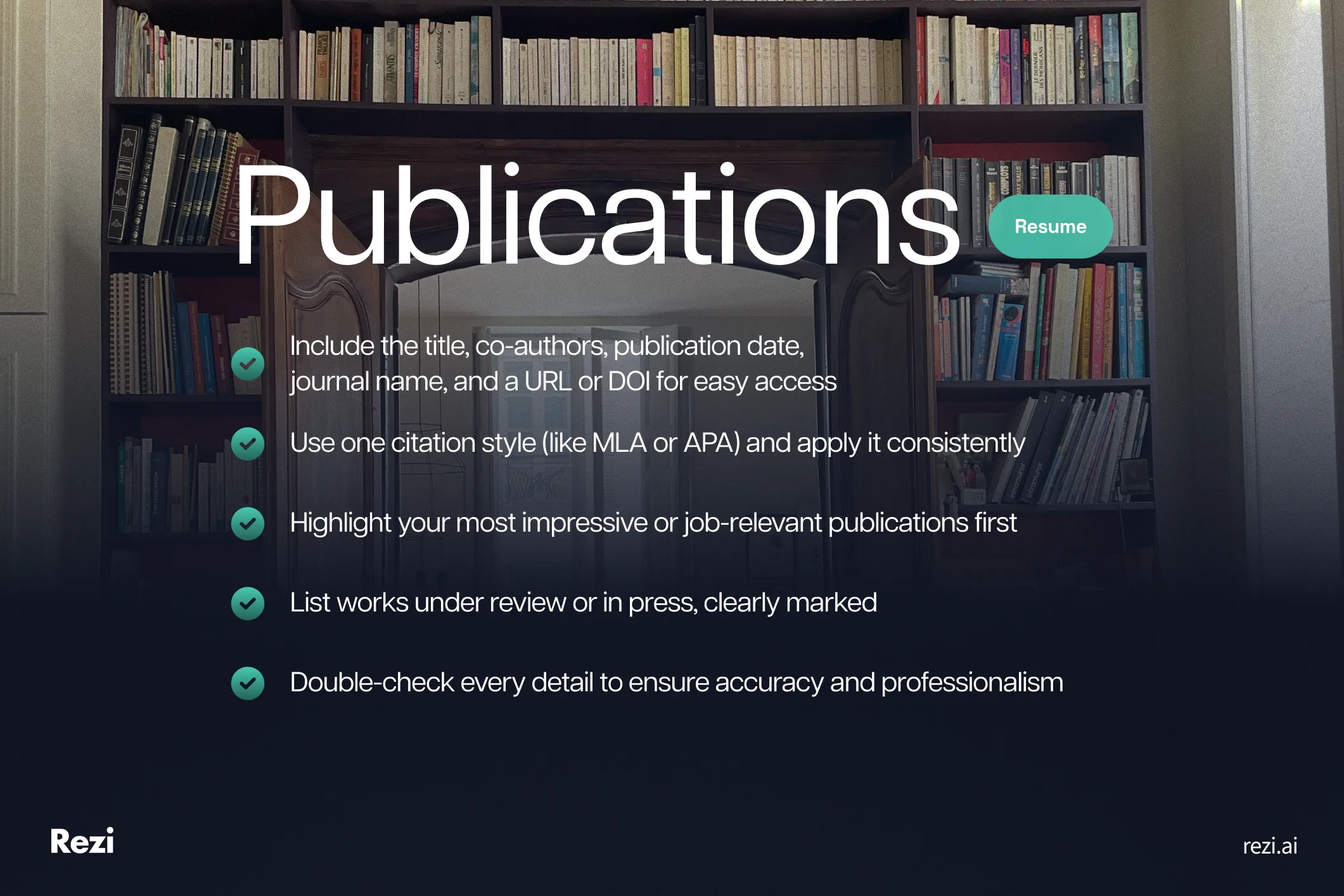
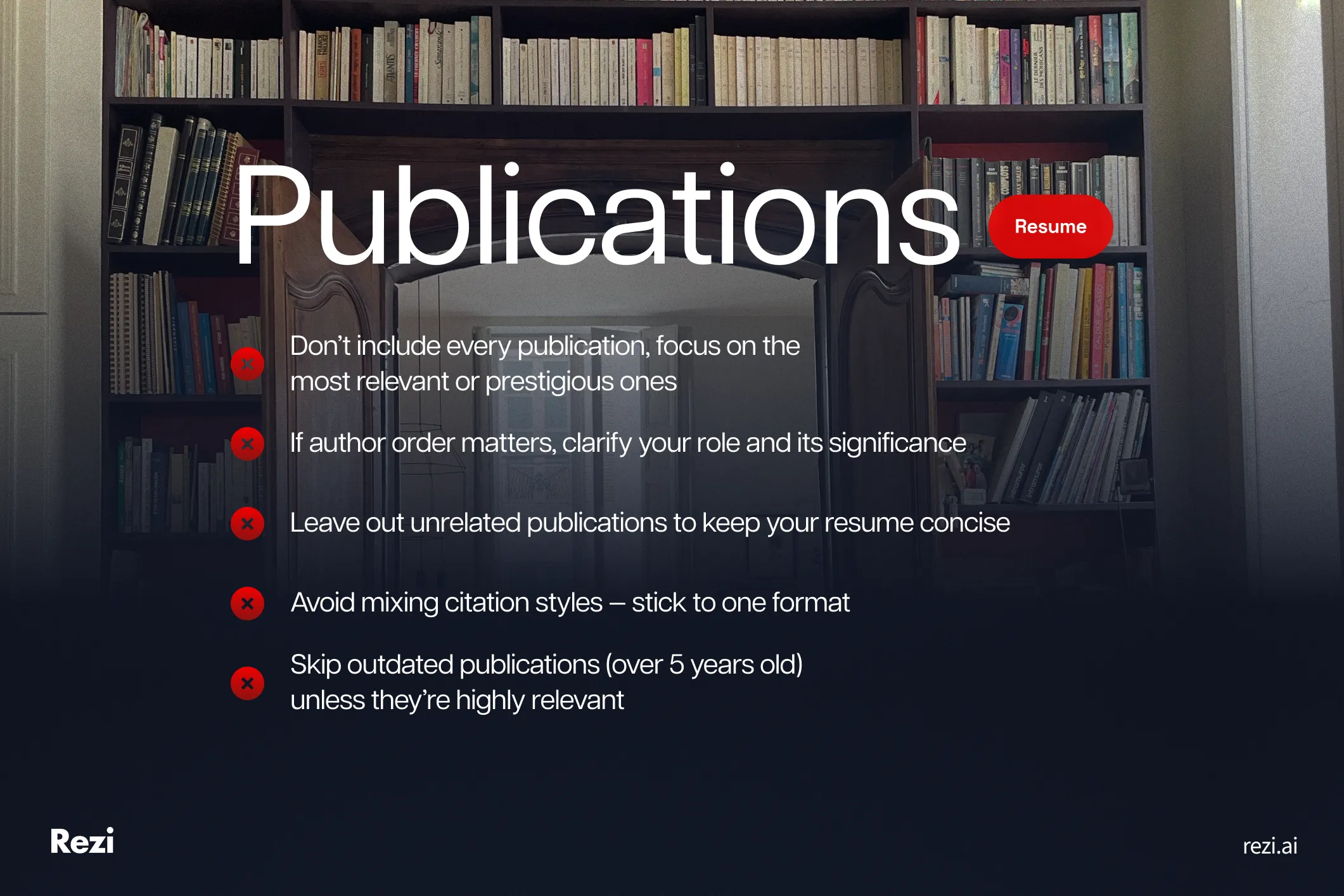
Summary
Here’s a roundup of the most important things to keep in mind when listing publications on a resume or CV:
- Include relevant publications like journal articles, books, or conference papers, especially in academic, research, or writing-heavy roles. Avoid casual blogs or non-academic articles.
- Tailor your list to the job and highlight peer-reviewed works for added credibility.
- Create a “Publications” section if you have three or more publications; otherwise, place them under your education section.
- List publications in reverse chronological order, starting with the most recent.
- Use a consistent citation style (APA for science, MLA for humanities, AMA for medical fields).
- Include the title, authors, publication name, volume/issue, date, and page numbers. Highlight your role if co-authored.
- Label pending publications clearly as “in press” or “submitted.”
- For a CV, list all relevant publications, organize by type (e.g., journal articles, conference papers), and highlight significant works.
- Don’t include irrelevant or outdated publications (over five years old unless still highly relevant).
FAQ
Should I include pending publications on my resume?
Label pending publications as “in press” or “submitted” to show they’re in progress. It emphasizes your activity in the field but avoids overstating until it’s officially published.
What publications should not be included in my resume?
Skip casual stuff like personal blogs, magazine articles, or social media posts. Unless it’s super relevant to the job or shows off key skills, stick to professional, scholarly, or industry-recognized publications to keep your resume strong.
What counts as a publication?
A publication is any written work shared with the public and holds professional or academic value. This includes peer-reviewed journal articles, books, research papers, conference papers, and industry reports. Essentially, if your work has been published in a formal setting where others can access it and it’s related to your professional field.
Should you include your publications in your professional summary on your resume?
Not typically. Your professional summary should be a quick snapshot of your skills, experience, and qualifications. If your publications are relevant and impressive, it’s better to highlight them in a separate section on your resume. You want to keep your summary focused and concise, with the publications getting the attention they deserve elsewhere on your resume.
How many publications to list on your resume?
Don’t list every single publication. Aim for the most relevant, impactful, and recent ones that match the job you’re applying for. Focus on quality over quantity — keep it impactful and don’t overwhelm the hiring manager with too many titles. But if it’s for your CV, feel free to list them all.
What is the difference between a resume and a CV?
The main difference is the length and level of detail. A resume is typically one to two pages long and focuses on a brief overview of your experience, skills, and qualifications. CVs are more detailed, often several pages long, and includes everything from publications to academic achievements, awards, and full work history. In most parts of Europe, South Africa, Australia, and New Zealand, the terms “resume" and “CV” are used interchangeably, but in the US, a CV is usually for academic, research, or specialized roles.
Should I include the article I co-authored in my resume?
Yes, especially if it relates to the role you’re applying for. Co-authoring a piece highlights your subject matter expertise, collaboration, and communication skills. If space allows, include a brief note about your contribution and put your name in bold so it’s easy to spot.

Upload or drop your resume to get started
Upload your resume to get started
Score my resume

Michael Tomaszewski, CPRW, is a resume and career advice expert with 9+ years of experience in the hiring industry. He has helped millions of readers and dozens of one-on-one clients create resumes and cover letters that *finally* do their talents and accomplishments justice.