
Resume
Resume Action Words: 700+ Best Verbs to Use for Impact
Discover the best action verbs for resumes, with skill- and industry-specific examples, plus tips to make your achievements stand out.
.webp)
Published on
October 13, 2025
Updated on
October 13, 2025
Strong action verbs are what make your resume stand out. Use resume action words that clearly show what you accomplished, such as led, launched, optimized, designed, implemented, boosted, resolved, collaborated, mentored, trained, facilitated, created, engineered, negotiated, and streamlined. Start each bullet with a verb, mirror the job posting’s language, mix up your word choice, and back it all up with numbers to prove results.
Gone are the days of saying you were “responsible for” something or that you “worked with” a tool or a team. Those weak verbs don’t do you any favors — they’re taking up space that could showcase your real achievements.
Strong, specific action verbs are what make your experience stand out and give hiring managers a clear picture of what you actually accomplished.
We’ve also covered the flip side: the overused, weak verbs that show up most often in Rezi resumes. Check out The Top 30 Weakest Action Verbs From 102,944 Resumes for a deep dive.
In this guide, you’ll find:
- Action verbs grouped by the skills they highlight.
- Action verbs organized by industry.
- Tips on how to use action verbs effectively in your resume.
Want to take it a step further? Build a professional resume with our free AI Resume Builder, or explore these handy synonym guides:
- 50 Resume Synonyms for “Collaborate”
- 30+ Resume Synonyms for “Created”
- 25+ Resume Synonyms for “Ensure”
- 30+ Resume Synonyms for “Assisted”
- 30 Resume Synonyms for “Lead”
- 30+ Resume Synonyms for “Provide”
What Are Action Verbs?
Action verbs are the “doing” words on your resume. They show you didn’t just exist in a role, you made things happen. The more specific and vivid they are, the clearer your accomplishments become.
These words shouldn’t just fill space; they should pack meaning. Words like “managed” aren’t wrong, but they’re vague. Instead of saying you “managed a team of 12 engineers,” describe what you actually did: led team meetings, set project milestones, or guided colleagues to hit tight deadlines. Concrete actions like these make your experience easy to picture and memorable.
Check out some of our top recommended resume action verbs:
.webp)
Examples of Action Verbs (By Skill Area)
Browse these curated lists of action words, organized by different skill areas.
Leadership & management
Show you can guide with a steady hand (and keep the ship afloat).
| Administered | Advanced | Advised | Advocated |
| Aided | Aligned | Analyzed | Appointed |
| Approved | Arranged | Assigned | Assisted |
| Attained | Augmented | Authorized | Centralized |
| Chaired | Championed | Charted | Coached |
| Conducted | Considered | Consolidated | Contracted |
| Contributed | Controlled | Converted | Cooperated |
| Coordinated | Counseled | Cultivated | Decided |
| Delegated | Demonstrated | Designated | Determined |
| Developed | Directed | Educated | Emphasized |
| Empowered | Enabled | Encouraged | Endorsed |
| Enforced | Enhanced | Ensured | Established |
| Evaluated | Executed | Expanded | Expedited |
| Explained | Facilitated | Familiarized | Formalized |
| Formed | Fostered | Furthered | Generated |
| Governed | Guided | Handled | Headed |
| Helped | Hired | Hosted | Implemented |
| Improved | Incorporated | Increased | Influenced |
| Initiated | Inspected | Inspired | Installed |
| Instigated | Instituted | Instructed | Integrated |
| Intervened | Judged | Launched | Lectured |
| Led | Leveraged | Listened | Lobbied |
| Maintained | Managed | Mentored | Merged |
| Mobilized | Moderated | Monitored | Motivated |
| Navigated | Negotiated | Optimized | Orchestrated |
| Organized | Originated | Overhauled | Oversaw |
| Pioneered | Planned | Predicted | Prepared |
| Presided | Prioritized | Produced | Promoted |
| Provided | Recommended | Recruited | Redirected |
| Reduced | Referred | Refocused | Regulated |
| Renovated | Reorganized | Replaced | Represented |
| Resolved | Responded | Restored | Restructured |
| Reviewed | Scheduled | Secured | Selected |
| Served as/on | Set up | Shaped | Spearheaded |
| Specified | Sponsored | Staffed | Streamlined |
| Strengthened | Supervised | Supplied | Supported |
| Sustained | Taught | Terminated | Trained |
| Validated | Volunteered | Unified | United |
Learn about the Leadership Skills for a Resume.
Teamwork & collaboration
Because teamwork really does make the dream work.
| Aided | Assisted | Bolstered | Collaborated |
| Combined | Communicated | Contributed | Cooperated |
| Coordinated | Encouraged | Facilitated | Fostered |
| Helped | Integrated | Joined | Liaised |
| Listened | Networked | Participated | Partnered |
| Represented | Shared | Supported | Unified |
| Volunteered |
Browse through our tips for How to Write Teamwork Skills on a Resume.
Customer service & support
Show you’ll go above and beyond for your customers.
| Addressed | Advised | Advocated | Assisted |
| Attended | Clarified | Coached | Communicated |
| Consulted | Counseled | Delivered | Demonstrated |
| Educated | Ensured | Explained | Facilitated |
| Fielded | Fulfilled | Guided | Handled |
| Helped | Improved | Informed | Listened |
| Recommended | Resolved | Responded | Secured |
| Served | Supplied | Supported | Trained |
Read about the Top Customer Service Skills to Put on a Resume.
Communication skills
Demonstrate how well you connect, explain, and persuade.
| Addressed | Advised | Advocated | Amplified |
| Arbitrated | Arranged | Articulated | Assessed |
| Authored | Bridged | Briefed | Broadened |
| Cautioned | Challenged | Clarified | Co-authored |
| Collaborated | Communicated | Composed | Conceptualized |
| Condensed | Conducted | Conferred | Constructed |
| Consulted | Contacted | Conveyed | Convinced |
| Corresponded | Counseled | Created | Critiqued |
| Debated | Defined | Demonstrated | Directed |
| Discussed | Documented | Drafted | Edited |
| Educated | Elicited | Explained | Expressed |
| Formulated | Framed | Generated | Illustrated |
| Influenced | Informed | Instructed | Interacted |
| Interpreted | Interviewed | Introduced | Invented |
| Involved | Joined | Launched | Lectured |
| Led | Listened | Lobbied | Mediated |
| Moderated | Motivated | Negotiated | Outlined |
| Participated | Performed | Persuaded | Presented |
| Produced | Proofread | Proposed | Publicized |
| Published | Questioned | Reasoned | Recruited |
| Referred | Reinforced | Reported | Represented |
| Resolved | Responded | Reviewed | Scheduled |
| Shaped | Solicited | Spoke | Suggested |
| Summarized | Taught | Trained | Transcribed |
| Translated | Visualized | Wrote |
Learn more about The Best Communication Skills For Your Resume.
Research skills
Give you ten minutes and Wi-Fi, and you’ll get to the bottom of anything.
| Accumulated | Acquired | Analyzed | Applied |
| Assembled | Assessed | Audited | Augmented |
| Benchmarked | Calculated | Charted | Cited |
| Clarified | Classified | Co-authored | Collected |
| Compared | Compiled | Consulted | Critiqued |
| Detected | Determined | Diagnosed | Discovered |
| Dissected | Documented | Drafted | Edited |
| Evaluated | Examined | Experimented | Explored |
| Extracted | Extrapolated | Forecasted | Formulated |
| Found | Gathered | Generated | Identified |
| Innovated | Inspected | Interpreted | Interviewed |
| Invented | Investigated | Located | Mapped |
| Measured | Observed | Obtained | Organized |
| Pinpointed | Planned | Prepared | Processed |
| Projected | Proofread | Qualified | Quantified |
| Reported | Researched | Reviewed | Screened |
| Searched | Solved | Studied | Summarized |
| Surveyed | Synthesized | Systematized | Tested |
| Tracked | Verified | Visualized | Wrote |
Creative skills
Verbs that prove the Brontë sisters and Picasso have nothing on you.
| Accentuated | Acted | Adapted | Articulated |
| Authored | Brainstormed | Built | Combined |
| Composed | Conceived | Conceptualized | Constructed |
| Crafted | Created | Curated | Customized |
| Derived | Described | Designed | Developed |
| Devised | Diagrammed | Directed | Discovered |
| Drafted | Drew | Edited | Engineered |
| Enhanced | Entertained | Exhibited | Fabricated |
| Fashioned | Generated | Illustrated | Implemented |
| Improvised | Incorporated | Influenced | Initiated |
| Innovated | Inspired | Invented | Launched |
| Modeled | Modified | Originated | Performed |
| Photographed | Pioneered | Planned | Played |
| Produced | Programmed | Published | Recorded |
| Redesigned | Remodeled | Revamped | Revised |
| Revitalized | Shaped | Sketched | Solved |
| Storyboarded | Structured | Synthesized | Transformed |
| Translated | Visualized | Wrote |
Organization & detail
Show you’re the most organized one in the room (color-coded planner optional).
| Administered | Allotted | Approved | Arranged |
| Assessed | Catalogued | Categorized | Centralized |
| Charted | Classified | Collated | Collected |
| Compared | Compiled | Consolidated | Coordinated |
| Corrected | Corresponded | Delegated | Dispatched |
| Distributed | Executed | Filed | Formalized |
| Located | Logged | Maintained | Mapped |
| Monitored | Obtained | Ordered | Organized |
| Planned | Prepared | Processed | Programmed |
| Proved | Recorded | Registered | Reorganized |
| Reserved | Retrieved | Reviewed | Routed |
| Scheduled | Screened | Settled | Specified |
| Structured | Submitted | Supplied | Standardized |
| Systematized | Tabulated | Updated | Validated |
| Verified |
Problem-solving
Choose from these verbs to demonstrate you can solve a Rubik’s Cube in seconds.
| Analyzed | Assessed | Calculated | Corrected |
| Devised | Diagnosed | Evaluated | Examined |
| Identified | Implemented | Improved | Initiated |
| Innovated | Investigated | Mediated | Optimized |
| Rectified | Reorganized | Researched | Resolved |
| Revamped | Revitalized | Streamlined | Troubleshot |
Resource building & partnerships
Emphasize that you can win funding, clients, or allies like a pro.
| Acquired | Attracted | Brokered | Built |
| Closed | Cultivated | Earned | Enlisted |
| Expanded | Forged | Garnered | Leveraged |
| Navigated | Negotiated | Onboarded | Partnered |
| Pitched | Renewed | Secured | Signed |
| Sourced | Strengthened | Upsold | Won |
Accomplishments & results
These verbs prove you’re all about achieving (and exceeding).
| Accelerated | Accomplished | Achieved | Acquired |
| Attained | Awarded | Boosted | Closed |
| Completed | Conceived | Consolidated | Converted |
| Decreased | Delivered | Demonstrated | Discovered |
| Doubled | Drove | Earned | Eliminated |
| Enhanced | Established | Exceeded | Executed |
| Expanded | Expedited | Finished | Founded |
| Fulfilled | Gained | Generated | Improved |
| Increased | Initiated | Innovated | Introduced |
| Invented | Launched | Lowered | Mastered |
| Maximized | Minimized | Obtained | Originated |
| Outpaced | Outperformed | Overcame | Overhauled |
| Pioneered | Produced | Reached | Realized |
| Recognized | Reduced | Resolved | Restored |
| Revitalized | Saved | Sharpened | Showcased |
| Solidified | Sparked | Spearheaded | Steered |
| Stimulated | Streamlined | Strengthened | Succeeded |
| Surpassed | Sustained | Transformed | Upgraded |
| Won | Yielded |
Read about How to Put Achievements on a Resume.
Industry-Specific Action Words
I’ve put together a collection of action words that are relevant to your specific industry, in case the previous broad categories weren’t doing anything for you.
General
When in doubt, these verbs work just about anywhere.
| Achieved | Built | Collaborated | Delivered |
| Developed | Enhanced | Executed | Generated |
| Implemented | Improved | Increased | Led |
| Organized | Planned | Produced | Provided |
| Resolved | Streamlined | Supported | Trained |
Sales & marketing
Prove you can pitch, persuade, and close.
| Accelerated | Advertised | Boosted | Closed |
| Convinced | Expanded | Generated | Increased |
| Influenced | Launched | Marketed | Maximized |
| Negotiated | Positioned | Promoted | Publicized |
| Secured | Targeted | Upsold |
Information technology
Show you can handle tech challenges with your eyes closed (hands untied, though).
| Adapted | Advanced | Analyzed | Applied |
| Architected | Assembled | Automated | Built |
| Calculated | Charted | Classified | Coded |
| Compiled | Computed | Conceived | Conducted |
| Configured | Constructed | Converted | Created |
| Debugged | Deployed | Designed | Detected |
| Determined | Developed | Devised | Diagnosed |
| Drafted | Engineered | Enhanced | Equalized |
| Evaluated | Expanded | Fabricated | Facilitated |
| Forecasted | Formulated | Fortified | Generated |
| Implemented | Improved | Increased | Inspected |
| Installed | Integrated | Interfaced | Launched |
| Maintained | Manufactured | Mastered | Modified |
| Molded | Networked | Operated | Overhauled |
| Packaged | Pinpointed | Pioneered | Planned |
| Prepared | Printed | Processed | Produced |
| Programmed | Reconstructed | Rectified | Reduced |
| Refined | Regulated | Remodeled | Repaired |
| Replaced | Researched | Restored | Revamped |
| Rewrote | Serviced | Solved | Specialized |
| Specified | Standardized | Streamlined | Studied |
| Supplemented | Surveyed | Systematized | Tested |
| Trained | Troubleshot | Updated | Upgraded |
| Utilized | Validated | Verified |
Browse through our top Technical Skills for a Resume.
Healthcare
Words that highlight your care, precision, and steady hands.
| Administered | Assessed | Assisted | Collaborated |
| Coordinated | Counseled | Delivered | Diagnosed |
| Dispensed | Educated | Evaluated | Facilitated |
| Guided | Instructed | Monitored | Prescribed |
| Referred | Screened | Treated |
Take a look at the Best Nursing Skills for a Resume.
Finance & accounting
The right verbs here prove you can make the numbers add up.
| Adjusted | Administered | Allocated | Analyzed |
| Appraised | Assessed | Audited | Balanced |
| Billed | Bought | Budgeted | Calculated |
| Capitalized | Checked | Closed | Compared |
| Computed | Conciliated | Conserved | Controlled |
| Corrected | Cut | Decreased | Detailed |
| Determined | Developed | Disbursed | Dispensed |
| Distinguished | Distributed | Doubled | Downsized |
| Economized | Eliminated | Estimated | Evaluated |
| Exceeded | Factored | Financed | Forecasted |
| Funded | Gained | Generated | Increased |
| Invested | Isolated | Maintained | Marketed |
| Measured | Modeled | Netted | Observed |
| Planned | Prepared | Programmed | Projected |
| Proved | Purchased | Quadrupled | Qualified |
| Reasoned | Reconciled | Reduced | Reported |
| Researched | Reshaped | Retailed | Retrieved |
| Saved | Secured | Sold | Solicited |
| Sorted | Sourced | Specified | Supplemented |
| Systematized | Tabulated | Tested | Tripled |
| Underwrote | Upgraded | Upsized |
Teaching & training
Highlight your smarts, your patience, and most importantly, that you can teach without putting anyone to sleep. Whether you’re training newbies in the office or education is your full-time gig, these verbs will come in handy.
| Accompanied | Acquainted | Advanced | Advised |
| Advocated | Aided | Amended | Approached |
| Arranged | Assessed | Assisted | Augmented |
| Balanced | Boosted | Briefed | Built |
| Certified | Clarified | Coached | Collaborated |
| Communicated | Conducted | Consulted | Contributed |
| Cooperated | Coordinated | Counseled | Critiqued |
| Cultivated | Delegated | Delivered | Demonstrated |
| Designed | Developed | Directed | Educated |
| Empowered | Enabled | Enacted | Encouraged |
| Enlarged | Enlightened | Ensured | Evaluated |
| Expanded | Expedited | Explained | Facilitated |
| Familiarized | Formulated | Fostered | Furthered |
| Generated | Graded | Grouped | Guided |
| Harmonized | Helped | Implemented | Improved |
| Individualized | Influenced | Informed | Initiated |
| Innovated | Inspired | Instilled | Instituted |
| Instructed | Integrated | Interacted | Intervened |
| Lectured | Led | Liaised | Listened |
| Mentored | Ministered | Motivated | Negotiated |
| Nurtured | Originated | Partnered | Persuaded |
| Prepared | Presented | Promoted | Provided |
| Reassured | Rectified | Redeemed | Referred |
| Reformed | Rehabilitated | Related | Repaired |
| Represented | Resolved | Responded | Served |
| Settled | Simplified | Simulated | Stabilized |
| Stimulated | Streamlined | Summarized | Supported |
| Taught | Tested | Trained | Translated |
| Tutored | Unified | Valued | Volunteered |
Find out How to Make a Teacher Resume.
How to Use Action Words in a Resume
Here’s how to use action words in a resume:
- Begin your bullet points with a strong action verb in the past tense for previous jobs, present tense for current roles.
- Leave out the pronouns and keep your bullets to one or two lines.
- Use verbs and keywords from the job posting to prove you’re exactly what they’re looking for.
- Avoid repeating the same verbs.
- Pair actions with numbers whenever possible.
1. Start bullets with an action verb
Your work experience section is a bullet-pointed list of your achievements, not just responsibilities.
For each job, aim for 3–7 bullets if you’re entry-level, and up to 10 if you’re more seasoned.
Each bullet should kick off with an action verb in the past tense. Unless it’s your current job — then use the present tense.
No pronouns. Keep it snappy and focused.
2. Match your verbs to the job description
Pay attention to the verbs and skills mentioned in the job posting — that’s the language hiring managers and Applicant Tracking Systems (ATS) are looking for.
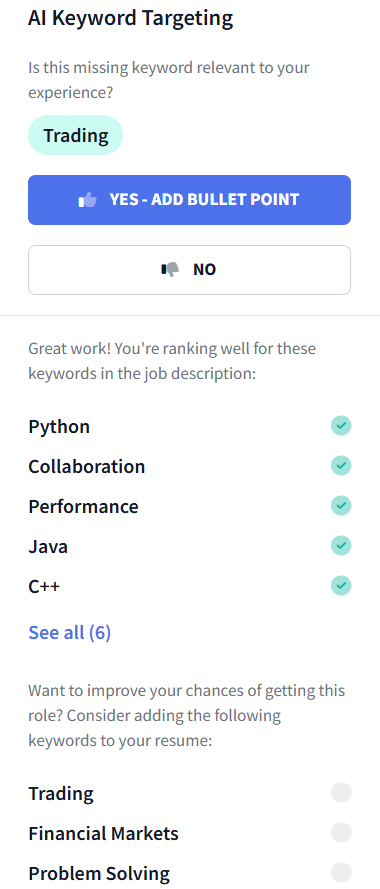
Tools like our AI Keyword Targeting tool can help. Enter the job title, company, and description, and it’ll highlight which keywords you’ve included and which you’re missing.
Here’s the AI Keyword Targeting tool:
3. Vary your verbs
Don’t use the same tired words for every bullet. Mix it up to show that you’re creative, professional, and capable of tackling whatever they throw at you.
4. Pair verbs with quantifiable results
Numbers speak louder than words. How many clients, students, or orders did you handle? How much time or money did you save? Turn your actions into tangible results.
For example, if you cut processing time from two hours to 30 minutes, you could write:
“Optimized data processing by leveraging Python scripts and SQL queries, boosting efficiency by 75%.”
5. Make it concise and readable
Keep your bullets to just one or two lines. Skip the long, winding sentences. Hiring managers skim, so make every word count.
Summary
Here’s a recap of some action words for your resume:
- Leadership, management, and teaching: led, directed, coached, mentored, delegated, facilitated, implemented, organized, empowered.
- Teamwork and collaboration: collaborated, partnered, supported, contributed, aided, integrated, unified, encouraged.
- Customer service and communication: advised, resolved, presented, articulated, persuaded, informed, guided, explained, responded.
- Research and analytical skills: analyzed, investigated, evaluated, synthesized, identified, interpreted, measured, audited.
- Technical and IT skills: developed, deployed, debugged, programmed, engineered, optimized, configured, tested.
- Creative skills: designed, created, conceptualized, authored, brainstormed, innovated, illustrated, produced.
- Organization and detail orientation: organized, coordinated, catalogued, systematized, scheduled, planned, processed, validated.
- Problem-solving and process improvement: resolved, streamlined, optimized, improved, innovated, implemented, rectified, revitalized.
- Resource building, partnerships, and sales: negotiated, secured, acquired, forged, expanded, pitched, partnered, upsold.
- Achievements and results: boosted, accelerated, achieved, exceeded, generated, maximized, attained, delivered, produced.
FAQ
Why use action words on a resume?
Action words make your resume more engaging by clarifying your contributions and impact. Instead of just listing tasks, they show results. Saying you “streamlined onboarding” feels powerful, while “responsible for training” falls flat. Strong verbs add confidence, clarity, and give hiring managers a better sense of your impact.
What are trigger words on a resume?
Trigger words are the resume keywords that hiring managers and Applicant Tracking Systems (ATS) are looking for. They’re the specific skills or tools tied to the job, like “Python,” “project management,” or “customer service.” Using the right ones tells employers you have the skills they need and helps your resume get noticed.
What is a strong opening sentence for a resume?
A great opening line of a resume summary sums up who you are and why you’re valuable. For example: “Software engineer with 5 years of experience building scalable apps and boosting system efficiency.” It’s short, specific, and shows impact.
Need help? Our AI Resume Summary Generator can craft one in seconds.
What resume mistakes should you avoid?
The biggest resume mistakes include vague wording, weak verbs, and walls of text. Keep it clear and skimmable. Don’t add personal details like a photo or social security number. And look out for typos — even one can make you look careless, so double-check everything.
How do I list skills on a resume?
Put your skills in a dedicated skills section so they’re easy to find. Focus on job-relevant hard skills like “SQL,” “Photoshop,” or “Agile project management.” Work those skills into your bullets with real results to prove you can use them.

Upload or drop your resume to get started
Upload your resume to get started
Score my resume

Sarah Coghlan is a writer and editor passionate about making resume and career advice clear and accessible to all. Based in Barcelona, her goal is to help job seekers create standout resumes and navigate the job search process with confidence and ease.