
Other
What Does Fiverr’s CEO Email Say About the Job Market?
Find out what the Fiverr CEO email reveals about the changing job market, the rise of AI, and what it means for managers, employees, and the future of work.

Published on
July 31, 2025
Updated on
July 31, 2025
As a content writer, I’d be lying if I said the thought of AI taking my job hadn’t crossed my mind. When you see tools like ChatGPT cranking out pages in seconds, it’s hard not to wonder where that leaves us. But then I read all the inaccurate ‘facts’, robotic phrases, and failed attempts at humor, and I breathe a sigh of relief.
AI doesn’t think, feel, or create like we do. Still, it can be a powerful tool. Like Fiverr’s CEO said, AI isn’t here to replace us; it’s here to change how we work. And if we’re smart, to help us do it better.
Let’s break down the controversial email and what it means for us. This guide will cover:
- How industry leaders are reacting to new technologies.
- The realities and myths of AI in the workplace.
- How you can prepare for the future of AI.
The Fiverr CEO Email That Went Viral
Fiverr’s CEO, Micha Kaufman, sent a blunt wake-up call to his team earlier this year. He declared that AI is rapidly reshaping the job market, and no role is immune, including his own.


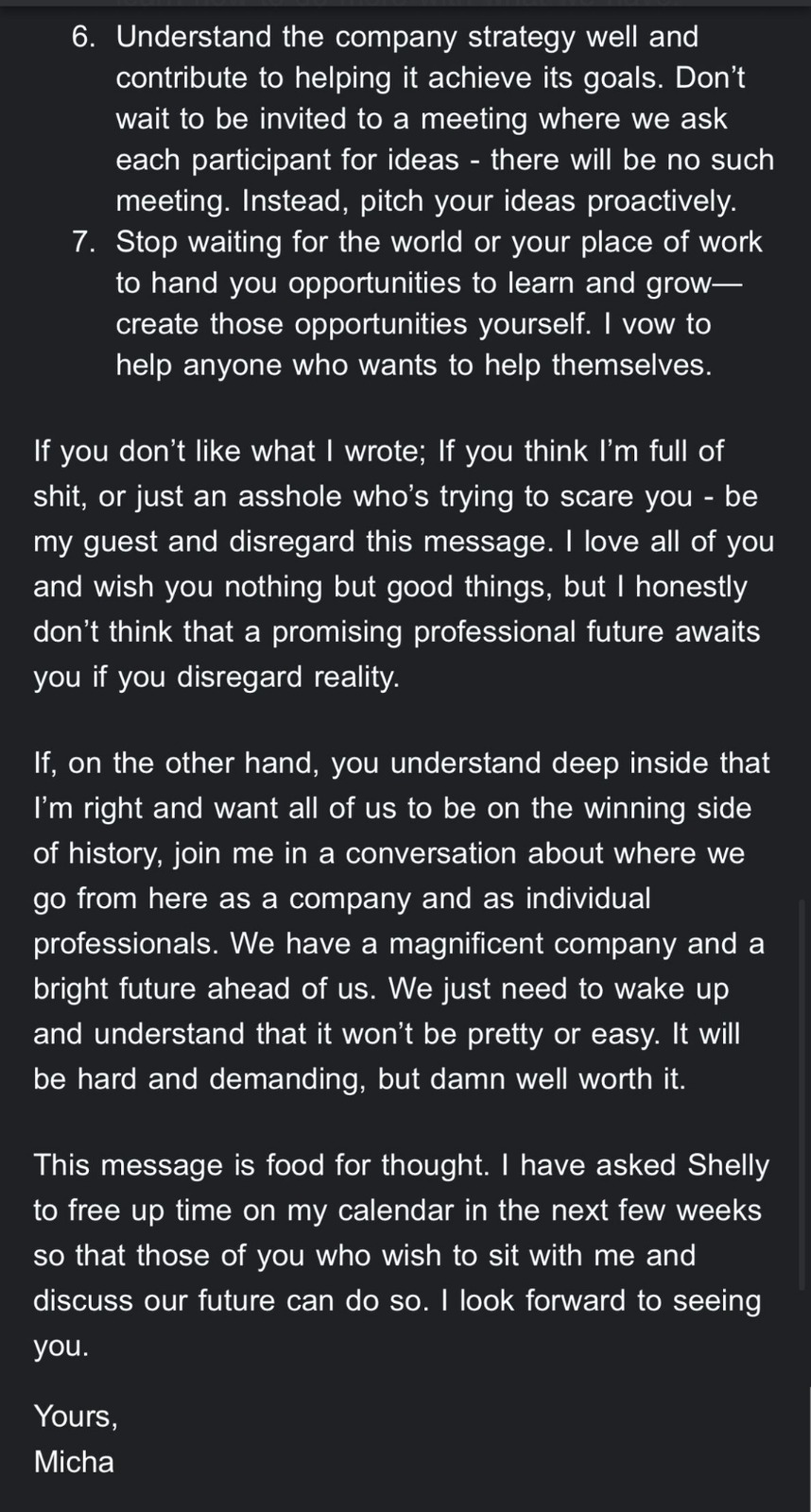
Kaufman didn’t sugarcoat his words. His post warned that the tasks we once considered “easy” will be automated, what we thought was “hard” will become the norm, and only those who really excel will remain competitive.
But it wasn’t all fear-mongering and shock value. He laid out a 7-step plan: embrace AI tools, learn fast, work smarter, become an expert at prompting AI tools, think strategically, and take charge of your own growth. The main message? Adapt or get left behind.
The email received mixed reactions…
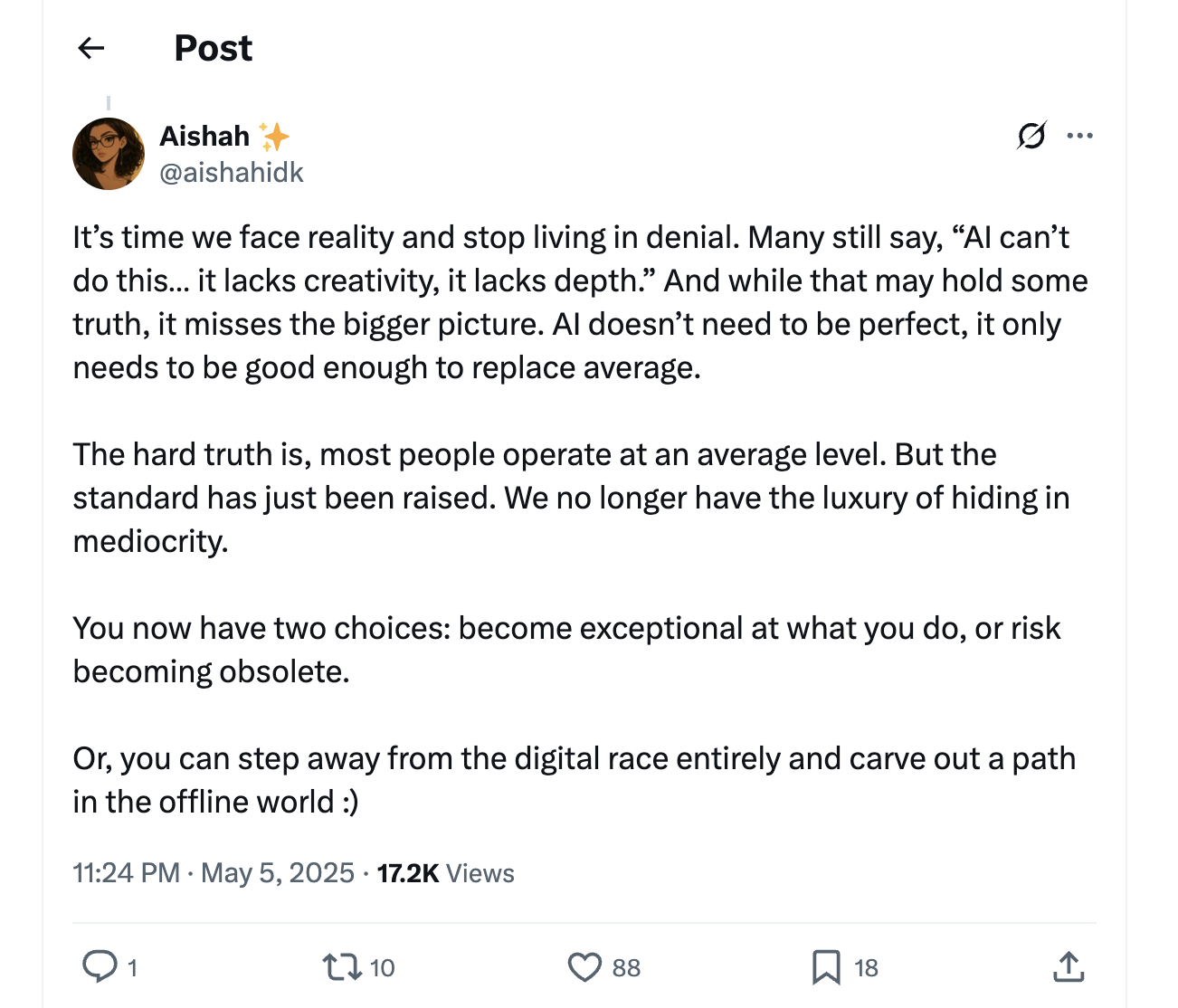
Some emphasized the importance of upskilling and staying competitive:
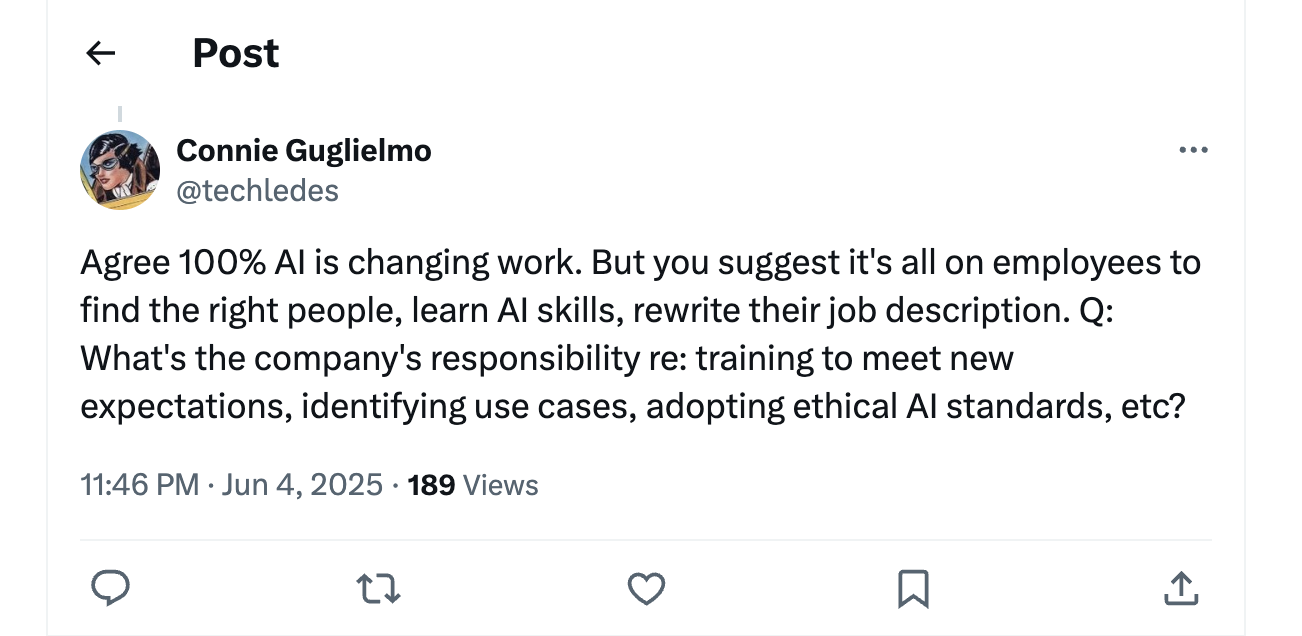
While others put the spotlight back on company leaders:
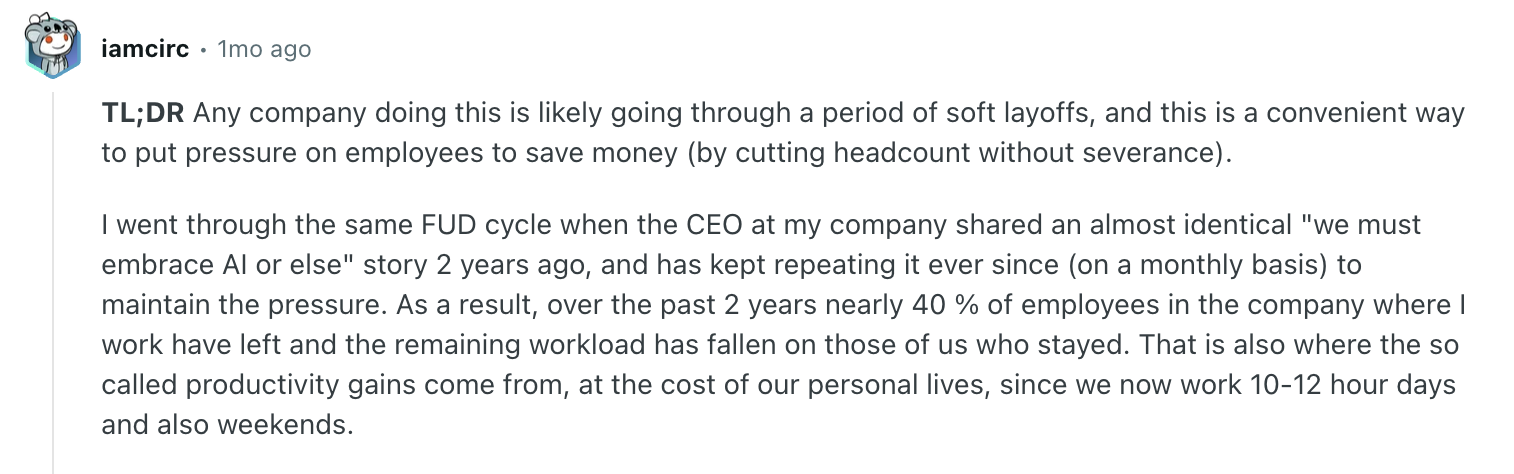
Many Reddit members called out Kaufman for hiding his intentions surrounding tech layoffs:
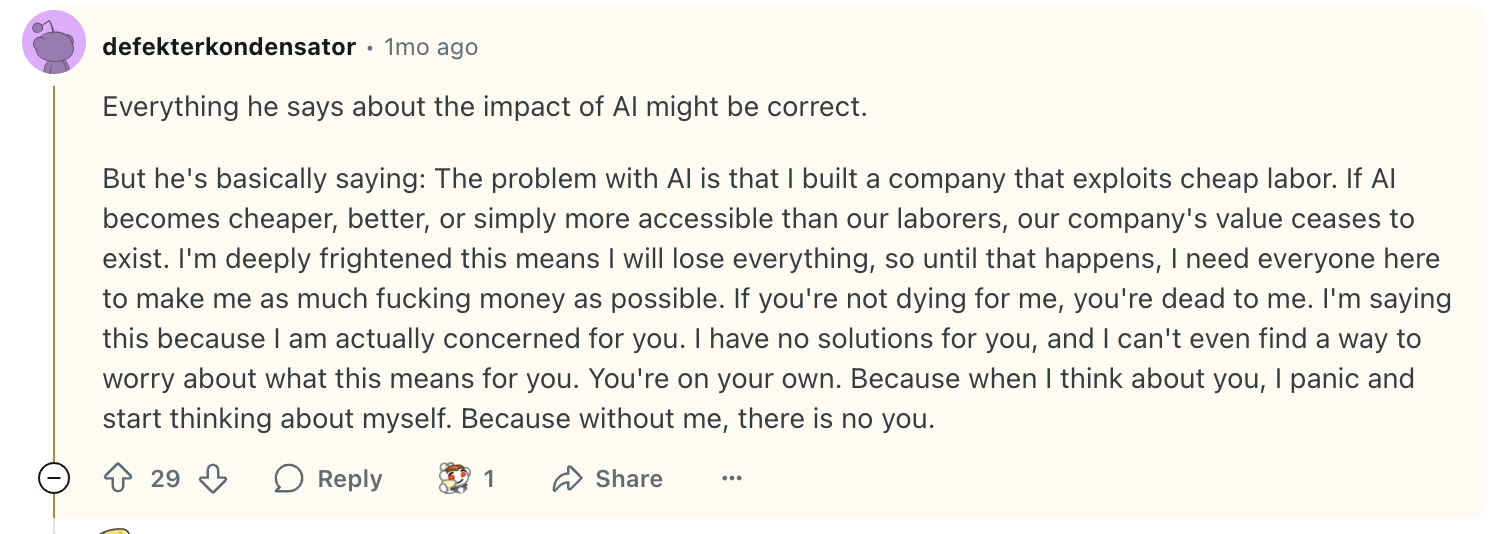
And some attempted to decode the real message behind his post:
No matter what you think about Kaufman’s intentions, his message about AI shaking up the job market isn’t exactly breaking news. We’ve seen shock-value news headlines, CEOs issuing big predictions, and most of us have already used ChatGPT to give our brains a breather.
How Are Companies Reacting to AI?
Micha Kaufman isn’t alone in speaking out (though others aren’t so blunt). More industry leaders and company executives are discussing the impact of AI, or making the necessary changes to avoid getting left behind.
In a recent interview with Joe Rogan, Mark Zuckerberg predicted AI could soon replace mid-level engineers by handling most of the routine coding work. Klarna’s CEO, Sebastian Siemiatkowsk, posted on X that AI can do anyone’s job, even his own. And he’s even putting that to the test by introducing an AI version of himself to receive customer feedback.
They aren’t the only ones recognizing this shift. The Mercer Global Talent Trends survey found that over half of executives (54%) think their businesses won’t survive beyond 2030 without fully integrating AI. It’s not “if” they should adopt AI, it’s “how fast can we do it?”
According to surveys from Forbes and McKinsey, companies are already putting AI to work in real ways:
- 56% use it for customer service (chatbots, support automation, etc.)
- 51% are using it in cybersecurity and fraud detection.
- 92% of executives plan to increase AI investment over the next three years, with over half expecting a 10%+ boost in spending.
Leaders are adapting. Companies are investing. And the message from the top is clear: AI is not optional. It’s the new norm.
Is AI Taking Our Jobs or Just Changing Them?
Nowadays, it’s hard to distinguish between clickbait articles and those with a shred of truth. It’s easy to claim robots are taking over the world when people are already anxious about the future. And it’s no surprise that 53% of people worry that using AI to do their work makes them replaceable, according to a Microsoft and LinkedIn survey.
But most of the time, it’s more nuanced than that. Jobs and tasks have always evolved with technology. And while it may be happening faster than ever, we usually find a way to evolve alongside it.
That said, some industries are more at risk than others. A Bloomberg Intelligence survey of major banks like JP Morgan and Citigroup found AI could trigger up to 200,000 job cuts in the banking sector alone over the next 3–5 years. Plus, one in four executives expect to let go of up to 10% of their workforce.
Customer service is also feeling the pressure. According to a Forbes Advisor survey, 73% of businesses are either using or planning to use AI-powered chatbots. And over half are using AI to write better emails or create personalized content for customers.
The other side of the coin
Here’s what the headlines don’t mention: AI isn’t just killing jobs, it’s creating new ones, too. And in many cases, faster than it’s replacing them.
The Future of Jobs Report 2025 estimates that AI and tech will displace about 92 million jobs globally by 2030, but it’ll also create 170 million new ones. That’s a net gain of 78 million jobs, or about 7% of today’s total employment.
Here are some of the roles expected to grow in the coming years:
- FinTech Engineers
- Big Data Specialists
- Software and App Developers
- AI and Machine Learning Experts
The report estimates that AI and information processing will create 11 million jobs on their own, despite displacing about 9 million. So yes, there’s churn, but there’s also growth.
What does this mean for us?
Think of AI as a force multiplier. It’s speeding up work, automating the boring stuff, and freeing humans to do more strategic, creative, and relationship-driven work. But it also means that the bar is rising. Going with the flow won’t cut it anymore.
The Microsoft LinkedIn survey found that 55% of leaders say they’re worried about not having enough skilled talent to fill roles in the next year, especially in cybersecurity, engineering, and design. So while AI might take your job if you ignore it, it’s way more likely to open doors if you learn to work with it.
Uncover more about the current US job market: Why Is the Job Market So Bad Right Now?
Benefits of AI in the Workplace
AI gets a lot of attention for the jobs it might eliminate, but it’s also transforming the workplace in exciting ways, especially if you’re open to change. So let’s flip the script and look at the benefits of AI at work.
Less time on mindless tasks, more time for what matters
No one gets excited about sorting emails, scheduling meetings, or manually pulling reports. AI takes the boring, repetitive tasks off your plate so you can focus on work that actually requires your brain and creativity.
Time-consuming duties, like analyzing data, organizing files, logging customer requests, and generating basic reports, can now be done in seconds. Aside from having more time not spent on mindless tasks, it also helps teams move faster, collaborate better, and focus on solving real problems.
Of course, repetitive work won’t totally disappear. In the future, we might be managing AI systems, checking the quality of AI-generated work, or organizing information in new ways. So yes, the mundane is also evolving, but it’s still giving us space to focus on the tasks that require some good old-fashioned human brain power.
More space for creativity and human-centered skills
Ironically, the rise of AI is making the workplace more human. While AI handles the mechanical tasks, people are now freed up to do what machines can’t, such as building relationships, making ethical decisions, being empathetic, and brainstorming original ideas.
A recent Workday survey found 83% of workers believe creativity and adaptability will become more important as AI becomes more common, and that same percentage believes AI can boost human creativity. Why? AI can help spark ideas, spot patterns in data that humans might miss, or even offer new ways of looking at problems.
A major boost in efficiency and decision-making
One of the biggest reasons companies are racing to implement AI? It’s a productivity powerhouse. AI can help us work faster and smarter. It can analyze huge sets of data in seconds, identify trends, and offer real-time recommendations that help businesses make better calls.
According to a McKinsey survey, almost 90% of business leaders expect AI to drive revenue growth in the next few years. It’s already happening in customer service (automating chats and support tickets), sales (helping prioritize leads), and operations (cutting down on response times and errors). And 44% of companies see AI as an asset for decision-making, with 59% expecting it to help them save money.
Smarter, fairer, and faster hiring
Waiting weeks for a reply or getting ghosted when applying for jobs isn’t new. And with mass applications (which LinkedIn so kindly reminds us of), the hiring process can take even longer.

AI is quietly revolutionizing hiring, helping HR teams screen resumes, schedule interviews, and conduct first-round assessments. That means recruiters can get to the right candidates faster, and we don’t get lost in the digital abyss.
It’s also a step forward for fairness. AI tools can help reduce bias by focusing on qualifications instead of gut instincts or unconscious prejudice. They can support more inclusive hiring by flagging biased language in job ads or ensuring consistent questions across interviews. And once you’re hired? It can guide you through onboarding with personalized training.
More personalized customer (and employee) experiences
The last time I opened Netflix, the first thing I saw was a tailored list of ‘Witchcraft Fantasy TV’ recommendations. No, they haven’t found a way to read my mind; they’re just using AI behind the scenes. The same kind of personalization is showing up in online shopping, customer support, and product development.
Businesses use AI to understand customer preferences, anticipate needs, and recommend the best products at the right time. Chatbots can answer questions instantly, but they also learn from those interactions to improve future service.
And on the backend, AI helps teams prevent issues before they happen. Ever rage-clicked because you can’t enter a page? Data from AI can use your browsing behavior to identify any frustrations or insightful patterns.
New careers and job opportunities are emerging
This one often gets lost in the doom-and-gloom narratives, but AI isn’t just eliminating roles, it’s also creating new ones. The McKinsey Global Institute estimates that AI could generate anywhere from 20 to 50 million new jobs globally by 2030. These jobs won’t just be in tech, either — they’ll stretch across sectors like healthcare, finance, education, and more.
We’re already seeing roles like AI specialists, data scientists, machine learning engineers, and prompt designers gain momentum. And as more companies integrate AI into their workflow, there’s growing demand for people who can translate between human needs and machine capabilities.
Executives also recognize the value in AI, with 56% of them seeing AI as a job creator in their organizations, according to the Global Talent Trends survey. Some even believe it’ll fundamentally reshape how their entire business model works.
Thinking about pivoting into the tech world? Find out more: Career Change at 40
How Can You Prepare for the Rise of AI?
Short answer:
To prepare for AI in the workplace, focus on staying curious and adaptable. Commit to continuous learning with online courses in AI, data, and tech trends. Learn how AI impacts your field so you can use it, not fear it. Ask for training at work or suggest programs if none exist. Most importantly, strengthen soft skills like creativity, adaptability, and leadership, as these are harder for AI to replicate and more valuable than ever. And don’t just think short-term. AI is reshaping career paths, so map out your goals and upskill accordingly.
1. Become a lifelong learner
If there’s one mindset shift that’ll serve you in the AI era, it’s that learning can’t stop after school. With technology changing fast, staying still means falling behind. But you don’t need to spend a fortune on going back to college. There are endless free or affordable ways to keep learning.
What you can do:
- Take online courses in AI-related fields like big data, cybersecurity, and machine learning. Platforms like Coursera and LinkedIn Learning offer beginner-friendly intros.
- Follow reputable sources like MIT Tech Review, podcasts like Hard Fork, or YouTube channels, such as Two Minute Papers and AI Daily Brief. You can also join online communities to help you learn through others’ experiences.
2. Understand the tech, don’t fear it
It’s easy to be intimidated by AI when you don’t know how it works. But like most things in life, it becomes much less scary once you pull back the curtain. And the more you understand it, the better you’ll be at using it to your advantage.
What you can do:
- Read up on how your industry uses AI. Are you in marketing, HR, or finance? Then ask yourself: “What could I automate?” Consider redesigning one small part of your daily workflow using AI tools like ChatGPT or Notion AI to test the waters.
- Attend webinars or conferences to learn more about real-world examples of AI in action across different job functions. Showing genuine interest through networking could also open opportunities to work with AI.
3. Push for training and support at work
If your organization hasn’t jumped on the re-skilling train yet, it might be time to give it a nudge. A Microsoft LinkedIn study found 71% of leaders would rather hire someone less experienced with AI skills than someone more experienced without them. So, speaking up about AI training is a win-win for both you and your company.
What you can do:
- Talk to your manager about AI training and focus on the benefits, such as more efficiency, smarter decisions, and future readiness. Pushing for innovation is intimidating, but showing initiative and long-term vision can also be rewarding.
- Look for internal upskilling programs or suggest setting one up. You don’t have to be the expert, but at least you can get the ball rolling.
4. Don’t neglect your soft skills
AI is smart, but it’s not winning any comedy awards or stealing hearts like Pedro Pascal. The more AI shows up in our jobs, the more companies value the things only humans can do, like empathy, creativity, leadership, and ethical decision-making.
What you can do:
- Sharpen your soft skills. A World Economic Forum survey found analytical thinking tops the list of in-demand skills, with 7 in 10 companies calling it essential. Close behind are resilience, adaptability, creativity, self-awareness, and leadership skills.
- When applying for jobs, don’t just say you’re a good talker. Prove your soft skills in your resume with concrete examples, achievements, and quantifiable results.
5. Focus on the bigger picture
The shift is already happening: by 2030, skills will have changed by 68% due to AI, according to Microsoft and LinkedIn. Your future self simply won’t thank you if you turn a blind eye to the inevitable for the sake of staying in your comfort zone.
What you can do:
- Set SMART goals. Where do you want to be in five years? Align your learning and upskilling plans with that path. You can also use AI tools in your current role to increase your value, whether it’s speeding up processes or offering smarter insights to your team.
- Explore AI-friendly degrees or certifications in areas like data science, software engineering, or digital transformation. Even if you don’t want to be an expert coder, having these skills tells employers you can handle new technologies.
Don’t wait to put your skills to good use: How to Get A Job Fast: Tips for Your Job Search
Final Thoughts
Fiverr’s CEO dropped a hard truth that many people in every industry already know. The rise of AI isn’t just some distant threat that’s been vilified in the media. It’s reshaping how we work, what’s valued, and what’s at risk. And while that can feel overwhelming, it’s also a chance to reset how we think about work.
But this moment isn’t just about growing with AI. It’s time to ask deeper questions: What do we bring to the table that AI can’t? How do we grow in ways that tech can’t replicate? Skills like empathy, curiosity, creativity, and leadership aren’t going anywhere.
The job market is evolving fast, and not everything will be in our control. But how we respond, how we choose to adapt, to learn, and to lead is still very much up to us.
FAQ
Which jobs will AI replace?
AI is most likely to replace repetitive, rule-based, and predictable tasks, such as data entry, basic customer service, telemarketing, and finance roles. It won’t wipe out entire professions overnight, but it will likely automate the parts of jobs that follow a clear script. If your role is mostly routine, it’s time to upskill and shift toward more strategic or creative work.
What are the most AI-proof jobs?
Jobs that rely on emotional intelligence, creativity, and complex problem-solving are harder for AI to replicate. Roles like therapists, teachers, healthcare workers, designers, and senior leadership positions are more AI-resistant. Essentially, it’ll be hard for AI to come after your job if your work depends on real connections, abstract thinking, or judgment calls in difficult situations.
How are companies adapting to AI?
Companies are introducing AI to cut costs, boost efficiency, and stay competitive. Many executives are using AI for customer service, cybersecurity, and personalization. Leaders like Meta’s Zuckerberg and Klarna’s CEO have been blunt: AI is reshaping how we work, and they’re redesigning teams and workflows to match, often expecting employees to learn AI tools to keep up.
What is the positive impact of AI on employment?
AI isn’t just replacing jobs, it’s also creating new ones. McKinsey estimates 20–50 million new roles could emerge by 2030, especially in areas like healthcare, tech, and AI itself. Plus, by automating mundane tasks, AI helps companies become more efficient and frees people up for more creative work. Companies increasingly see AI as a tool to unlock human potential, not just a robot takeover waiting to happen.

Lauren Bedford is a seasoned writer with a track record of helping thousands of readers find practical solutions over the past five years. She's tackled a range of topics, always striving to simplify complex jargon. At Rezi, Lauren crafts genuine and actionable content that guides readers in creating standout resumes to land their dream jobs.