“Rezi is super upfront and continues to improve over time. I've recommended Rezi to several of my friends and colleagues. I just love this product so much.”
Ricky M.
Software Engineer
“Rezi is super upfront and continues to improve over time. I've recommended Rezi to several of my friends and colleagues. I just love this product so much.”
Ricky M.
Software Engineer
Helping users land jobs at 1,000+ companies such as
Web developer resumes have a specific problem that most other professions don't face: the work is visible.
That's a huge advantage if you know how to connect your resume to your actual output. It's a missed opportunity if your resume reads like a list of technologies and your GitHub is an afterthought.
The BLS projects web developer and digital designer roles to grow 7% through 2034, with a median salary around $90,000. The market is there, but it's also competitive, especially at the junior and mid-level. You’ll be competing against developers who know how to present their work.
This guide covers 15+ web developer resume examples by specialization and career level, followed by a writing guide that addresses the specific challenges of translating code into a resume that gets callbacks.
Web Developer Resume Examples
Find the web developer resume example that closely aligns with your skills and background, then use the writing guide that follows to customize it for the role you're after.
A general web developer resume should show range across the development lifecycle: building features, debugging, optimizing performance, and collaborating with designers and product teams. Include your primary tech stack but don't just list it. Show what you built with it and what the outcome was. If you've worked across both frontend and backend, make that clear without overloading the resume with every technology you've ever touched.
Your resume is only 30 seconds away from being done.
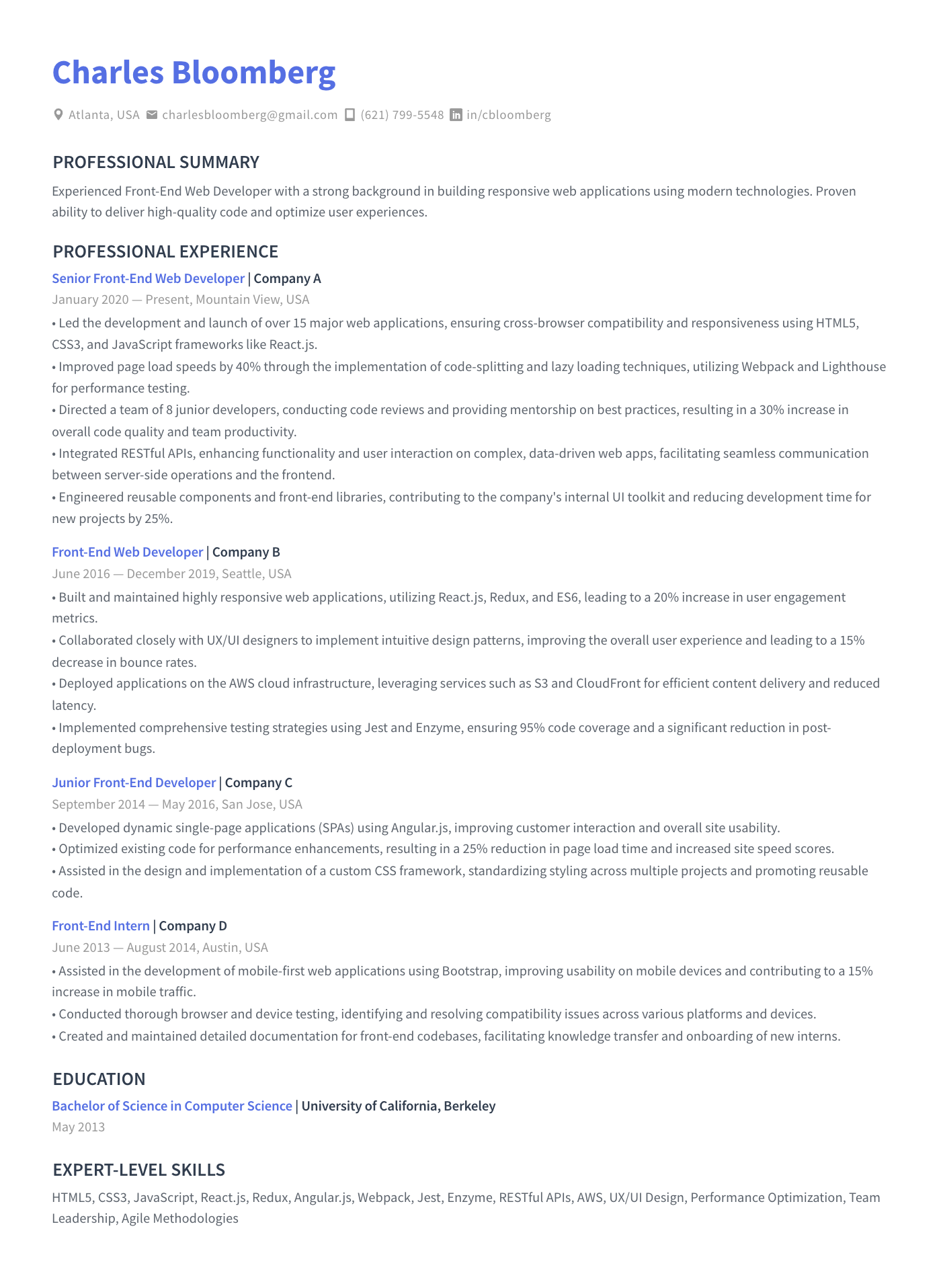
Charles Bloomberg
Austin, USA
charlesbloomberg@gmail.com
(621) 799-5548
in/cbloomberg
PROFESSIONAL SUMMARY
Proficient web developer with over 5 years of experience in creating dynamic, responsive websites and leveraging modern technologies to enhance user engagement. Expert in full-stack development, adept at collaborating with cross-functional teams to deliver high-quality web solutions.
PROFESSIONAL Experience
Web Developer | Company A
January 2021 — Present, Austin, USA
• Engineered a progressive web application using React and Node.js, resulting in a 30% increase in user engagement and improved site responsiveness by 40%.
• Led a cross-functional team of 5 in a project to revamp the company's e-commerce platform, adopting agile methodologies and reducing page load time by 60%.
• Implemented automated testing processes using Selenium, cutting down bug-logging time by 20%.
• Deployed CI/CD pipelines using Jenkins, accelerating application deployment speeds by 25%.
• Boosted website security by integrating OAuth 2.0 protocols and conducting quarterly security audits.
Front-end Developer | Company B
June 2018 — December 2020, Seattle, USA
• Developed intuitive UI components with Angular, enhancing user experience and improving navigation efficiency by 35%.
• Collaborated with UX designers to translate wireframes into fully functional web pages, achieving a 95% user satisfaction rate.
• Optimized web assets with Gulp and Webpack, reducing page load times by 15% which increased website traffic by 20%.
• Conducted usability tests to validate the design and functionality of new features, facilitating a feedback loop that reduced launch errors by 50%.
Junior Web Developer | Company C
May 2016 — May 2018, Denver, USA
• Assisted in the development of a custom CMS using PHP and MySQL, reducing operational costs by 20% and increasing content update efficiency by 50%.
• Built responsive layouts with HTML5, CSS3, and JavaScript, improving mobile user interaction scores by 30%.
• Monitored web performance and conducted bi-weekly audits using Google Analytics to boost SEO by 25%.
Web Development Intern | Company D
January 2015 — April 2016, Chicago, USA
• Created web page layouts with HTML and CSS that improved client satisfaction by streamlining load and response times by 40%.
• Assisted in debugging and testing across multiple browsers, ensuring compatibility and enhancing the user experience accessibility by 15%.
• Participated in daily scrum meetings to ensure projects stayed on schedule and met client specifications.
Education
Bachelor of Science in Computer Science | University of California, Berkeley
If you're early in your career or coming out of a bootcamp or CS program, your projects section does a lot of the heavy lifting. Hiring managers at this level want proof that you can not only build things that work, but that you can write clean code and learn fast. Include 2–3 strong projects with links to live demos and GitHub repos. List the technologies used and, more importantly, what the project does and any measurable results (users, performance improvements, features shipped). Relevant coursework and certifications (freeCodeCamp, CS50, Google Developer certifications) can fill gaps where work experience is thin.
Your resume is only 30 seconds away from being done.
Charles Bloomberg
Denver, USA
charlesbloomberg@gmail.com
(621) 799-5548
in/cbloomberg
PROFESSIONAL SUMMARY
Passionate Junior Web Developer with a strong foundation in responsive web design and modern frameworks. Eager to leverage skills to build user-centric digital solutions. Dedicated to continuous learning and collaboration in agile environments.
PROFESSIONAL Experience
Junior Web Developer | Company A
January 2022 — Present, Seattle, USA
• Developed and maintained over 15 responsive landing pages monthly using HTML, CSS, and JavaScript frameworks like React, enhancing the customer user experience by 25%.
• Collaborated with senior developers to integrate third-party APIs into existing web applications, reducing response times by 30% and increasing data processing efficiency.
• Fixed and debugged functionality issues across more than 60 web pages, successfully reducing bug reports by 40% through rigorous quality assurance processes.
• Implemented caching solutions and optimized asset loading, resulting in a 20% improvement in page load speeds across various e-commerce platforms.
• Regularly participated in agile sprints, contributing to the successful completion of 10+ project cycles, focusing on enhancing Google PageSpeed Insights scores.
Front-End Developer Intern | Company B
June 2021 — December 2021, Mountain View, USA
• Assisted development team in building a single-page application using Angular, leading to a 15% increase in user engagement metrics after implementation.
• Produced interactive UI components that improved overall user interaction on Google’s internal dashboards, collaborating with design teams to meet UX/UI guidelines.
• Conducted usability testing on various web applications, providing valuable feedback that led to a 10% improvement in user satisfaction scores.
• Enhanced accessibility features across multiple projects, ensuring adherence to WCAG standards and increasing overall accessibility compliance by 30%.
Web Developer Trainee | Company C
January 2020 — May 2021, Austin, USA
• Built and launched 5+ client websites utilizing WordPress, customizing themes and plugins to meet specific client needs.
• Streamlined the development process by implementing version control using Git, improving code collaboration and tracking for new hires in the team.
• Conducted client training sessions on CMS platforms, resulting in a 15% decrease in support requests over a six-month period.
Freelance Web Developer | Company D
June 2018 — December 2019, Remote
• Designed and implemented responsive web designs for 10+ small businesses, increasing their online visibility and traffic by an average of 20%.
• Utilized Bootstrap and other front-end frameworks to ensure all web applications were mobile-friendly and optimized for performance.
• Managed all phases of the web development lifecycle, from initial client consultation to deployment and post-launch support.
Education
Bachelor of Science in Computer Science | University of California, Berkeley
At the mid-level, your resume should prove you can work independently on most tasks and that you've shipped code that real users interact with. Show ownership: features you led from design to deployment, performance improvements you identified and fixed, and systems you maintained or refactored. Hiring managers at this tier are looking for developers who don't need their hand held. Quantify where you can: page load improvements, test coverage increases, bug reduction rates, user-facing features that moved a product metric.
Your resume is only 30 seconds away from being done.
Charles Bloomberg
Austin, USA
charlesbloomberg@gmail.com
(621) 799-5548
in/cbloomberg
PROFESSIONAL SUMMARY
Seasoned Web Developer with over 6 years of experience specializing in frontend and backend development. Expert in delivering high-quality web solutions and enhancing user engagement through responsive design and high-performance web applications.
PROFESSIONAL Experience
Web Developer | Company A
January 2021 — Present, Austin, USA
• Spearheaded development of a scalable customer-facing ecommerce application utilized by over 1 million users, increasing engagement by 30% using React.js and Node.js.
• Collaborated with UI/UX designers to ensure seamless integration and responsiveness across over 200 pages, improving user retention by 25%.
• Implemented RESTful APIs which processed over 10,000 daily requests, optimizing server response time by 40% through efficient code refactoring and load balancing.
• Led a team of 5 junior developers in Agile framework on a weekly basis, achieving 95% on-time delivery of new features and bug fixes.
• Conducted thorough cross-browser testing across Chrome, Firefox, and Safari, reducing issue backlog by 50% within three months.
Full Stack Developer | Company B
March 2018 — December 2020, Redmond, USA
• Developed an internal tool using Angular and .NET that increased department reporting efficiency by 60%, utilized by over 500 employees.
• Optimized SQL database queries, reducing data retrieval time by 35% across multiple platforms and enhancing backend performance.
• Engineered a CI/CD pipeline using Jenkins, resulting in a 40% decrease in deployment time and facilitated smoother releases.
• Assisted in migrating legacy codebase to a modern microservices architecture, improving code maintainability and fault tolerance.
Frontend Developer | Company C
May 2016 — February 2018, San Diego, USA
• Built and maintained sleek, responsive web interfaces for 20+ client projects using HTML5, CSS3, and JavaScript, enhancing overall customer satisfaction by 15%.
• Developed reusable components in React, facilitating faster development cycles and consistent UI across multiple projects.
• Conducted A/B testing on web features, helping identify best-performing designs and increasing conversion rates by 25%.
Junior Web Developer | Company D
January 2015 — April 2016, Boston, USA
• Assisted senior developers in debugging complex website issues, contributing to an average resolution time improvement of 20%.
• Handled client-side scripting tasks for over 15 small to mid-size businesses, enhancing page load efficiency by 15% on average.
• Optimized website images and assets, contributing to a 30% reduction in bandwidth usage and faster page load times.
Education
Bachelor of Science in Computer Science | University of California, Berkeley
May 2014
Expert-Level Skills
JavaScript, HTML5, CSS3, React.js, Node.js, Angular, SQL, RESTful APIs, Git, Jenkins, Agile Methodologies, Responsive Design, Problem Solving, Team Leadership
Senior Web Developer Resume
Senior web developers need to show more than strong code. Your resume should reflect architectural decisions, mentorship, technical leadership, and collaboration with product and design teams. Include examples of systems you designed, technology choices you made and why (and what the result was), code review culture you established, and junior developers you mentored. At this level, the hiring manager cares less about which framework you know and more about how you think through complex technical problems at scale.
Your resume is only 30 seconds away from being done.
Charles Bloomberg
Austin, USA
charlesbloomberg@gmail.com
(621) 799-5548
in/cbloomberg
PROFESSIONAL SUMMARY
Accomplished Senior Web Developer with over a decade of experience leading complex web development projects from conception to completion. Expert in modern frameworks and technologies, with a strong focus on enhancing website performance and user experience.
PROFESSIONAL Experience
Senior Web Developer | Company A
April 2019 — Present, Austin, USA
• Spearheaded the redesign of the e-commerce platform, reducing page load times by 30% through optimized coding in React.js and Node.js.
• Led a team of 5 developers in migrating legacy systems to microservices architecture, resulting in a 40% increase in system scalability.
• Implemented CI/CD pipelines using Jenkins, decreasing deployment time by 50% and increasing development agility.
• Improved site SEO performance by 25% through the incorporation of structured data and optimized meta tags.
• Conducted code review sessions bi-weekly, enhancing code quality and reducing error rates by 15%.
Lead Web Developer | Company B
July 2016 — March 2019, San Francisco, USA
• Developed interactive user interfaces using Angular and TypeScript, enhancing user engagement by 20%.
• Collaborated with UX designers and product managers to deliver a new social media feature that boosted user adoption by 35%.
• Engineered a robust API backend using Node.js and MongoDB, designed to handle 1 million transactions per second.
• Coordinated a team of 8 engineers on a high-impact cross-platform project, reducing cross-browser compatibility issues by 50%.
Web Developer | Company C
February 2014 — June 2016, Chicago, USA
• Implemented responsive web design techniques to increase mobile traffic by 45% for client websites.
• Managed end-to-end development of customized client portals, resulting in a 30% increase in customer satisfaction.
• Optimized SQL database queries, reducing data retrieval time by 60%.
Junior Web Developer | Company D
August 2011 — January 2014, Miami, USA
• Assisted in the development of over 20 client websites using HTML, CSS, and JavaScript, maintaining a 95% project completion rate.
• Designed UI components that enhanced overall website aesthetics, increasing user retention by 15%.
• Maintained legacy codebases, improving system reliability and reducing reported bugs by 20%.
Education
Bachelor of Science in Computer Science | Massachusetts Institute of Technology
May 2011
Expert-Level Skills
JavaScript, React.js, Node.js, Angular, TypeScript, HTML5, CSS3, MongoDB, SQL, Jenkins, Git, Agile Methodologies, Cross-Functional Collaboration, Team Leadership, Problem Solving, Attention to Detail
Frontend Developer Resume
Frontend developers are judged on what users see and experience. Your resume should emphasize UI implementation, responsive design, performance optimization (Core Web Vitals), accessibility compliance (WCAG), and cross-browser compatibility. Name your framework (React, Vue, Angular, Svelte) and show what you built with it. Metrics that matter here: page load speed improvements, conversion rate lifts from UI changes, Lighthouse score increases, reduction in user-reported UI bugs. Link to a live portfolio if you have one.
Your resume is only 30 seconds away from being done.
Charles Bloomberg
Austin, USA
charlesbloomberg@gmail.com
(621) 799-5548
in/cbloomberg
PROFESSIONAL SUMMARY
Frontend Developer with over 7 years of experience in designing and building responsive websites and applications. Extensive expertise in HTML, CSS, JavaScript, and modern frameworks to deliver high-quality user interfaces.
PROFESSIONAL Experience
Senior Frontend Developer | Company A
March 2020 — Present, Mountain View, USA
• Spearheaded the redesign of the main client dashboard, increasing user engagement by 25% through optimized layouts and interactive elements using React.js.
• Developed and maintained over 30 reusable components that increased development efficiency by 40% and ensured consistency across projects by utilizing Redux and styled-components.
• Collaborated with the UX team to conduct user testing and A/B testing, resulting in a 15% increase in user satisfaction metrics.
• Implemented CI/CD pipelines for frontend applications, reducing deployment times by 50% and ensuring seamless integration using Jenkins and Docker.
• Mentored and trained a team of 5 junior developers in best practices for agile development and modern frontend technologies.
Frontend Developer | Company B
August 2017 — February 2020, Menlo Park, USA
• Developed dynamic and interactive webpages using JavaScript, HTML5, and CSS3, leading to an 18% increase in mobile user engagement.
• Improved website load time by 30% by optimizing images and minifying JavaScript and CSS, enhancing overall performance and user experience.
• Participated in cross-functional team review sessions to ensure high code quality and adherence to project timelines and guidelines.
• Designed engaging user interfaces in collaboration with design teams, achieving consistent 95% adherence to brand and accessibility standards.
Web Developer | Company C
June 2015 — July 2017, Philadelphia, USA
• Engineered custom WordPress themes for 20 clients, tailored to specific brand requirements, increasing web traffic by an average of 200% per client.
• Enhanced website functionalities by integrating APIs, improving data retrieval efficiency by 35% and powering dynamic content delivery.
• Conducted comprehensive code reviews and troubleshooting sessions, leading to identifying and resolving 90% of bugs and performance issues within 24 hours.
Junior Frontend Developer | Company D
January 2013 — May 2015, Seattle, USA
• Assisted in the development of responsive e-commerce platforms, contributing to a 12% increase in online sales by optimizing site search functionality.
• Created and updated over 50 landing pages using jQuery and Bootstrap, achieving consistent high marks for usability and aesthetics in client feedback.
• Optimized cross-browser compatibility for multiple client websites, ensuring consistent deliverables across all major browsers and devices.
Education
Bachelor of Science in Computer Science | Massachusetts Institute of Technology
Backend resumes need to communicate reliability, scalability, and data integrity. Lead with API design, database architecture, server-side performance, and system integrations. Name your stack (Node.js, Python/Django, Ruby on Rails, Go, Java/Spring) and show outcomes: API response time reductions, database query optimization results, uptime percentages, or data processing throughput. If you've worked with cloud infrastructure (AWS, GCP, Azure), include deployment and scaling achievements, not just that you've "used" the platform.
Your resume is only 30 seconds away from being done.
Charles Bloomberg
Austin, USA
charlesbloomberg@gmail.com
(621) 799-5548
in/cbloomberg
PROFESSIONAL SUMMARY
Backend Developer with over 6 years of experience in designing and implementing high-performing, scalable, and secure backend solutions. Expertise in leveraging modern frameworks and cloud technologies to enhance system efficiency.
PROFESSIONAL Experience
Senior Backend Developer | Company A
January 2021 — Present, Sunnyvale, USA
• Led a team of 5 developers to restructure the backend architecture for a high-traffic application, reducing load times by over 30% using Python and Django.
• Managed the migration of 20+ microservices to AWS, enhancing system reliability and scalability by 25%.
• Spearheaded the integration of RESTful APIs, resulting in a 40% performance improvement in data processing.
• Orchestrated database optimization, implementing indexing and partitioning for a MySQL database handling over 10 million records, improving query speeds by 15%.
• Administered CI/CD pipelines using Jenkins, enhancing deployment frequency to twice weekly, ensuring smooth operations across the development team.
Backend Engineer | Company B
June 2017 — December 2020, Seattle, USA
• Developed and maintained backend services for a retail application, processing over 2 million transactions daily using Node.js.
• Implemented a robust logging and monitoring system with ELK stack, decreasing incident response times by 20%.
• Automated the testing framework using Mocha, increasing code coverage to 85% and reducing bugs by 30%.
• Collaborated with the frontend team to implement GraphQL, reducing data fetching time by 50% on high-demand endpoints.
Junior Backend Developer | Company C
September 2015 — May 2017, Salt Lake City, USA
• Assisted in the development of RESTful API features, contributing to a 20% improvement in client data retrieval efficiency.
• Optimized server-side scripts that reduced latency by 15% using Express.js.
• Participated in Agile scrum meetings, contributing to sprint planning and backlog refinement for 9 projects.
Backend Developer Intern | Company D
June 2014 — August 2015, Denver, USA
• Built and tested web application prototypes in PHP, decreasing development cycle time by 25%.
• Automated daily data backups with Python scripts, reducing manual effort by 40% and ensuring data integrity.
• Supported the development team in troubleshooting SQL database issues, achieving a 10% increase in system uptime.
Education
Bachelor of Science in Computer Science | Stanford University
Full-stack developers need to show depth on both sides without the resume reading like a technology dump. Pick your strongest 3–4 projects and show the full picture: "Built a SaaS dashboard from database schema through REST API to React frontend, handling 10,000+ daily active users with 99.9% uptime." That one bullet communicates full-stack capability more effectively than listing 15 technologies under Skills. Balance is key. Don't let the resume skew entirely frontend or entirely backend. Show that you can connect the pieces.
Your resume is only 30 seconds away from being done.
Charles Bloomberg
Phoenix, USA
charlesbloomberg@gmail.com
(621) 799-5548
in/cbloomberg
PROFESSIONAL SUMMARY
Experienced Full-Stack Developer with a proven track record in delivering scalable web applications using the latest technologies such as React, Node.js, and AWS. Proficient in both front-end and back-end development, with a knack for optimizing code and enhancing user experience.
PROFESSIONAL Experience
Senior Full-Stack Developer | Company A
January 2021 — Present, Phoenix, USA
• Spearheaded the development of a multi-tenant platform handling over 1 million transactions daily, optimizing performance by 25% using Node.js and MongoDB.
• Engineered a real-time notification system using AWS Lambda and SQS, enhancing user engagement by 40% across the application.
• Developed RESTful APIs consumed by mobile and web applications, resulting in a 35% increase in efficiency and consistency of data presentation.
• Improved application security by implementing OAuth 2.0 authentication, reducing unauthorized access incidents by 30%.
• Led a team of 5 developers in the successful launch of a new feature set, reducing page load times by 20% through advanced React profiling and performance techniques.
Full-Stack Developer | Company B
March 2018 — December 2020, Mountain View, USA
• Developed and maintained dynamic user interfaces using React and Redux, improving user satisfaction scores by 15% over two years.
• Collaborated with cross-functional teams to design and implement scalable microservices architecture, enhancing system reliability by 50%.
• Optimized existing codebase resulting in a 40% reduction in load time using code-splitting and lazy loading techniques.
• Conducted code reviews and mentored junior developers, contributing to a 20% increase in team productivity and collaboration.
Front-End Developer | Company C
July 2015 — February 2018, Austin, USA
• Redesigned UI components in AngularJS, resulting in a 30% improvement in responsiveness and UI load speed.
• Created reusable component libraries which standardized implementations across multiple projects, saving 10+ development hours weekly.
• Implemented unit testing and integration tests using Jasmine and Protractor, improving code coverage by 45% and ensuring quality and robustness.
Web Developer | Company D
June 2013 — June 2015, Denver, USA
• Built mobile-friendly web applications using HTML5, CSS3, and JavaScript, enhancing mobile user experience by 50%.
• Assisted in the deployment of e-commerce solutions, increasing sales conversion rates by 20% through optimized checkout processes.
• Processed bug reports and executed solutions to critical issues in under 24 hours with a 95% accuracy rate.
Education
Bachelor of Science in Computer Science | University of California, Berkeley
May 2013
Expert-Level Skills
JavaScript, React, Node.js, Express.js, MongoDB, AWS, RESTful APIs, SQL, HTML5, CSS3, Git, Agile methodologies, Cross-functional collaboration, Problem solving, Team leadership
CMS Developer Resume
CMS developers sometimes get overlooked in the "serious developer" conversation, but companies that run on WordPress, Shopify, or headless CMS platforms need people who understand both the platform and custom development. Show experience with theme development, plugin customization, performance optimization, and migration work. Quantify: site speed improvements, traffic growth after a redesign, e-commerce conversion rate changes. If you've built custom plugins or integrated third-party APIs into a CMS, highlight that to separate yourself from template installers.
Your resume is only 30 seconds away from being done.
Charles Bloomberg
Portland, USA
charlesbloomberg@gmail.com
(621) 799-5548
in/cbloomberg
PROFESSIONAL SUMMARY
Experienced CMS Developer proficient in designing and optimizing dynamic websites using cutting-edge technologies and methodologies. Adept at enhancing user experiences and increasing client engagement through innovative CMS solutions.
PROFESSIONAL Experience
CMS Developer | Company A
March 2021 — Present, Portland, USA
• Engineered over 100 dynamic website projects using WordPress, resulting in a 30% increase in customer satisfaction.
• Spearheaded a team of 6 developers in the migration of 50 websites to modern CMS platforms, reducing page load times by 50%.
• Optimized multisite networks, improving performance by implementing CDN solutions and reducing server response time by 40%.
• Developed custom plugins and themes to fulfill 95% of unique client specifications, leading to enhanced site functionality.
• Collaborated with SEO specialists to improve site traffic through CMS enhancements, resulting in a 25% improvement in organic search visibility.
Senior Web Developer | Company B
January 2018 — February 2021, Portland, USA
• Led the development of 60+ Drupal-based sites, incorporating advanced theming and module development.
• Improved website scalability by 35% through the integration of RESTful services and APIs.
• Managed a version control system for seamless updates on all projects, reducing update times by 20%.
• Achieved a 99.9% uptime by implementing robust security features and regular site audits.
Full Stack Developer | Company C
May 2015 — December 2017, Portland, USA
• Designed and implemented CMS solutions for small to medium-sized businesses that increased efficiency by 40%
• Enhanced client engagement by developing mobile-responsive design frameworks for all new projects.
• Reduced development time by 30% through the use of automated testing and deployment tools.
Web Developer | Company D
June 2013 — April 2015, Salem, USA
• Created 20+ custom CMS plugins tailored to client needs, increasing functionality by 50%.
• Directed the redesign of client websites, leading to a 15% increase in page views.
• Maintained a robust library of reusable code to expedite development processes across multiple projects.
Education
Bachelor of Science in Computer Science | Portland State University
Freelance web developers need a resume that reads like a track record of solved problems for real clients, not a list of side projects. Include client types (e-commerce, SaaS startups, agencies, local businesses), project scope, technologies used, and measurable outcomes. Show that you can manage the full client lifecycle: scoping, development, testing, deployment, and post-launch support. If you've retained clients or received repeat business, that's a strong signal worth including.
Your resume is only 30 seconds away from being done.
Charles Bloomberg
Austin, USA
charlesbloomberg@gmail.com
(621) 799-5548
in/cbloomberg
PROFESSIONAL SUMMARY
Accomplished freelance web developer with over 8 years of experience in designing, developing, and optimizing web applications. Specializes in responsive design and front-end development with a passion for delivering user-centric solutions.
PROFESSIONAL Experience
Freelance Web Developer | Company A
January 2019 — Present, Austin, USA
• Developed and launched over 50 responsive websites for diverse industries, enhancing the online presence and increasing traffic by an average of 40%.
• Utilized HTML5, CSS3, and JavaScript in over 100 projects, creating dynamic and engaging user experiences.
• Collaborated with clients to architect and implement tailored e-commerce solutions, resulting in a 25% improvement in conversion rates.
• Integrated third-party APIs in 30+ client websites, extending platform functionality and improving user engagement by 60%.
• Deployed site optimization practices, reducing page load times by an average of 35% through code minimization and efficient resource management.
Web Developer | Company B
February 2015 — December 2018, Austin, USA
• Created bespoke WordPress themes for over 20 clients, ensuring custom functionality and visual appeal using PHP and MySQL.
• Maintained and updated websites for a portfolio of 15 clients, achieving consistent client satisfaction ratings of over 95%.
• Led a team project to redesign a major client's website, resulting in a 50% increase in user retention through improved navigation and accessibility.
• Spearheaded implementation of SEO strategies across 10 projects, boosting organic search results by over 300%.
Junior Web Developer | Company C
June 2013 — January 2015, Austin, USA
• Assisted in creating user-centric web applications for 7 major clients, utilizing agile methodologies and CSS frameworks.
• Optimized backend processes, reducing server response times by 20% for high-traffic clients.
• Conducted code reviews and debugging for 25+ projects, ensuring robust application functionality and security.
Intern Web Developer | Company D
January 2012 — May 2013, Austin, USA
• Completed the full development cycle for 5 internal web applications, contributing to increased team productivity by 15%.
• Researched and proposed the adoption of new JavaScript libraries, improving UI interactions across 15 projects.
• Collaborated on database design and management, enhancing data retrieval efficiency by 25%.
Education
Bachelor of Science in Computer Science | University of Texas at Austin
May 2012
Expert-Level Skills
HTML5, CSS3, JavaScript, PHP, MySQL, WordPress Development, API Integration, Responsive Design, SEO Strategies, Agile Methodologies, Team Collaboration, Client Communication
E-Commerce Web Developer Resume
E-commerce developers work where code meets revenue. Your resume should show direct business impact: conversion rate improvements, checkout flow optimizations, page speed gains on product pages, and successful platform migrations (Shopify, Magento, WooCommerce, BigCommerce). Include experience with payment gateway integrations, inventory system connections, and A/B testing implementations. Any metric tied to sales or customer experience carries more weight here than a purely technical achievement.
Your resume is only 30 seconds away from being done.
Charles Bloomberg
Denver, USA
charlesbloomberg@gmail.com
(621) 799-5548
in/cbloomberg
PROFESSIONAL SUMMARY
Dynamic E-Commerce Web Developer with over 8 years of experience focusing on competitive shopping cart solutions and enhancing user experiences to drive sales and conversion rates. Proven track record of increasing site efficiency by 30% through optimizing code and implementing modern development frameworks.
PROFESSIONAL Experience
Senior E-Commerce Web Developer | Company A
May 2020 — Present, Denver, USA
• Spearheaded the migration of 50+ legacy systems to modern platforms, reducing loading time by 40% and increasing client satisfaction using HTML5, CSS3, and Angular.
• Implemented RESTful API integrations that increased the speed of real-time inventory updates by 45%, enhancing customer trust in product accuracy.
• Engineered reusable code libraries using JavaScript and React, accelerating the development process by 25% across multiple teams.
• Conducted thorough usability testing for over 100 web features, resulting in a demonstrated increase of a 20% click-through rate on call-to-action elements.
• Managed a team of 5 junior developers on a $500K project, delivering ahead of time by 2 months through agile methodologies and continuous integration tools.
Web Developer | Company B
June 2017 — April 2020, Seattle, USA
• Developed over 20 custom e-commerce applications using Node.js, resulting in a cumulative 30% boost in online sales within the first 6 months of deployment.
• Optimized website search functionality, achieving a 50% faster query time by deploying Elasticsearch while maintaining data integrity.
• Led a cross-functional team in implementing new payment gateway systems, reducing transaction error rates by 18% and processing time by 25%.
• Collaborated on the development of a proprietary analytics dashboard, empowering stakeholders with actionable insights and improving decision-making timelines by 30%.
Front-End Developer | Company C
March 2015 — May 2017, Atlanta, USA
• Built responsive front-end features for over 50 websites using Bootstrap and jQuery, enhancing customer engagement and access across mobile devices.
• Assisted in reducing page load times by 45% through condensed and minified CSS and JavaScript files, elevating user satisfaction scores significantly.
• Provided technical client support, achieving a 95% client retention rate by addressing and resolving all front-end related issues within 48 hours.
Junior Web Developer | Company D
July 2013 — February 2015, Austin, USA
• Built and maintained over 75 web pages, increasing site traffic by 25% using SEO and keyword strategies.
• Achieved a 20% decrease in server response times by optimizing database queries and web server configurations.
• Collaborated with design and marketing teams to create visually compelling and functional website interfaces, enhancing overall brand appeal.
Education
Bachelor of Science in Computer Science | Massachusetts Institute of Technology
May 2013
Expert-Level Skills
HTML5, CSS3, JavaScript, React, Node.js, Angular, RESTful APIs, Elasticsearch, Bootstrap, jQuery, Agile Methodologies, Usability Testing, SEO, Performance Optimization, Team Leadership, Problem Solving, Communication
React Developer Resume
React is the most in-demand frontend framework, and many companies hire specifically for it. A React developer resume should go deeper than "Built applications using React." Show experience with the React ecosystem: state management (Redux, Zustand, Context API), server-side rendering (Next.js), testing (React Testing Library, Jest), and TypeScript integration. Highlight performance work: code splitting, lazy loading, memoization strategies. If you've migrated a codebase from class components to hooks, or from another framework to React, that's a strong story. Quantify user-facing outcomes: load time improvements, interaction responsiveness, accessibility compliance.
Your resume is only 30 seconds away from being done.
Charles Bloomberg
Seattle, USA
charlesbloomberg@gmail.com
(621) 799-5548
in/cbloomberg
PROFESSIONAL SUMMARY
Experienced React Developer specializing in front-end development with a track record of delivering high-quality web applications. Proficient in JavaScript frameworks and agile methodologies.
PROFESSIONAL Experience
React Developer | Company A
May 2021 — Present, Seattle, USA
• Engineered real-time web applications using React.js, increasing user engagement by 25% over a 6-month period.
• Collaborated with cross-functional teams across Google, handling over 50 feature requests and enhancements through agile methodologies.
• Optimized components for maximum performance across a vast array of web-capable devices and browsers, reducing load times by 40%.
• Implemented responsive design for 10+ high-traffic pages, ensuring compatibility across browsers including IE, Chrome, and Firefox.
• Developed comprehensive test suites using Jest and Enzyme, achieving 95% test coverage and reducing bug incidence by 30%.
Front-End Developer | Company B
March 2018 — April 2021, Seattle, USA
• Led the migration of legacy code to React.js, facilitating a 60% improvement in codebase maintainability.
• Built reusable components and front-end libraries for future use, reducing development and testing time by 50%.
• Drove continuous improvement by integrating RESTful APIs with React, enhancing data interchange efficiency for over 100,000 daily users.
• Processed UI designs into highly interactive user-friendly screens using React.js, reducing bounce rates by 20%.
Web Developer | Company C
January 2016 — February 2018, Austin, USA
• Maintained code quality and organization in a team of 5 developers, using Git for version control and code reviews.
• Assisted with the development and deployment of 7 web applications, utilizing React, HTML, and CSS, accelerating project timelines by 15%.
• Implemented user authentication and authorization using JSON Web Tokens, securing sensitive user data for a client base of over 10,000 profiles.
Junior Web Developer | Company D
June 2014 — December 2015, Atlanta, USA
• Developed interactive web pages within a CMS-driven content strategy, leading to a 30% increase in content engagement.
• Supported senior developers in unit testing and debugging interface logic, helping to decrease reported production bugs by 25%.
• Wrote documentation for front-end code standards and best practices, improving the efficiency of the development team’s output by 10%.
Education
Bachelor of Science in Computer Science | University of Washington
May 2014
Expert-Level Skills
React.js, JavaScript, HTML5, CSS3, Node.js, RESTful APIs, Git, Agile Development, Responsive Design, Jest, Enzyme, Problem Solving, Communication
JavaScript Developer Resume
JavaScript is still the backbone of the web, and a JavaScript developer resume should show depth beyond framework proficiency. Emphasize core language skills: async/await patterns, closures, event-driven architecture, DOM manipulation when frameworks aren't the answer. Show experience across environments (browser and Node.js), and mention your familiarity with TypeScript if applicable. Include work on build tooling (Webpack, Vite), testing (Jest, Mocha, Cypress), and module systems. Companies hiring for "JavaScript Developer" often want someone who can work across the stack and isn't locked into one framework.
Your resume is only 30 seconds away from being done.
Charles Bloomberg
Denver, USA
charlesbloomberg@gmail.com
(621) 799-5548
in/cbloomberg
PROFESSIONAL SUMMARY
Seasoned JavaScript Developer with over 7 years of experience in building responsive web applications and optimizing website performance. Adept at collaborating with cross-functional teams to achieve targeted objectives. Proficient in both front-end and back-end technologies.
PROFESSIONAL Experience
Senior JavaScript Developer | Company A
May 2020 — Present, Mountain View, USA
• Spearheaded a cross-functional team of 10+ engineers in developing a real-time collaborative platform using React.js and Node.js, improving user engagement by 35%.
• Implemented a new caching strategy decreasing page load times by up to 50% using Redis and advanced caching techniques.
• Optimized existing JavaScript codebase, leading to a 25% improvement in overall application performance.
• Led the migration of legacy code to ES6 standards, enhancing system maintainability and readability across the engineering team.
• Collaborated directly with UI/UX teams to prototype and implement a new web layout, resulting in a 20% increase in user retention.
JavaScript Developer | Company B
June 2016 — April 2020, Seattle, USA
• Developed and launched over 12 interactive components using AngularJS, contributing to a 15% increase in page interaction.
• Engaged in continuous integration/continuous deployment (CI/CD) pipelines using Jenkins, reducing deployment time by 40%.
• Engineered custom API integrations facilitating real-time data exchange between various services, ensuring a seamless data flow.
• Enhanced application security layers by performing detailed code reviews, leading to a 30% reduction in security vulnerabilities.
Front-end Developer | Company C
July 2013 — May 2016, Austin, USA
• Constructed user-friendly, responsive web applications with Bootstrap and jQuery, increasing mobile traffic by 40%.
• Collaborated with graphic designers to iterate on site design, decreasing the bounce rate by 15% through improved aesthetics.
• Improved load times by 20% by optimizing images, script loading, and implementing lazy loading techniques.
Junior Web Developer | Company D
August 2011 — June 2013, Atlanta, USA
• Assisted in the development and maintenance of 8 client websites using HTML5, CSS3, and JavaScript under senior developer guidance.
• Implemented basic SEO strategies that increased site visibility by 25% in search engine rankings for corporate clients.
• Provided technical support during the launch phase of new applications, ensuring smooth deployment and client satisfaction.
Education
Bachelor of Science in Computer Science | University of Colorado Boulder
Python web developers typically work with Django, Flask, or FastAPI on the backend. Your resume should show that you can build and maintain web applications, RESTful APIs, and data-driven features. Highlight experience with ORM layers, database design (PostgreSQL, MySQL), task queues (Celery), and caching (Redis). If you've integrated machine learning models into web applications or built data pipelines that feed into user-facing dashboards, those crossover skills set you apart. Quantify: API throughput, response times, data processing volumes, or user growth supported by the systems you built.
Your resume is only 30 seconds away from being done.
Charles Bloomberg
Houston, USA
charlesbloomberg@gmail.com
(621) 799-5548
in/cbloomberg
PROFESSIONAL SUMMARY
Proficient Python Web Developer with extensive experience in building dynamic web applications using Django and Flask. Demonstrates a strong ability to optimize server and client-side performance while ensuring a seamless user experience.
PROFESSIONAL Experience
Senior Python Web Developer | Company A
February 2022 — Present, Mountain View, USA
• Spearheaded the development of a scalable web application using Django, serving over 1 million users per month, achieving a 30% increase in performance metrics.
• Led a team of 8 developers to integrate third-party APIs, reducing data retrieval times by 40% using RESTful services and asynchronous programming.
• Enhanced front-end interactivity and responsiveness by implementing React.js, decreasing page load times by 25% across the platform.
• Conducted code reviews and implemented CI/CD pipelines with Jenkins to ensure high-quality code delivery, resulting in a 15% reduction in deployment time.
• Tracked application performance using New Relic, identifying bottlenecks and optimizing server response time, resulting in a 50% improvement in speed.
Python Web Developer | Company B
May 2018 — January 2022, Los Gatos, USA
• Developed and maintained core web functionalities for high-traffic websites using Python and Flask, resulting in a 20% user engagement increase.
• Collaborated with UX/UI designers to create seamless user interfaces with HTML5, CSS3, and JavaScript, reducing bounce rate by 15%.
• Optimized backend systems for handling up to 10,000 concurrent users, ensuring 99.9% uptime and reliability.
• Executed comprehensive unit and integration testing using PyTest, achieving an outstanding 95% code coverage on major products.
Junior Web Developer | Company C
June 2015 — April 2018, Austin, USA
• Built over 20 dynamic and responsive websites formulating custom solutions with Django and integrating MySQL databases.
• Processed and analyzed large data sets using Pandas and NumPy, providing insightful data visualization for client reports.
• Assisted senior developers in migrating legacy codebases to modern frameworks, increasing application stability by 40%.
Web Developer Intern | Company D
January 2014 — May 2015, Boston, USA
• Researched and implemented innovative web technologies to enhance the company’s internal tools, reducing processing times by 30%.
• Engineered components for web applications using HTML, CSS, and basic JavaScript, contributing to numerous client projects.
• Provided technical support for ongoing projects, ensuring timely updates and modifications to meet client specifications.
Education
Bachelor of Science in Computer Science | Massachusetts Institute of Technology
UI/UX developers bridge the gap between design and code. Your resume should show you understand both disciplines: implementing pixel-perfect designs from Figma or Sketch, building accessible and responsive interfaces, and contributing to user research or usability testing. Mention design systems or component libraries you've built or maintained. Quantify with user-facing metrics: task completion rate improvements, error rate reductions, accessibility audit scores, user satisfaction improvements. If you've worked directly with designers or run A/B tests on UI changes, include those collaborative and data-informed experiences.
Your resume is only 30 seconds away from being done.
Charles Bloomberg
Miami, USA
charlesbloomberg@gmail.com
(621) 799-5548
in/cbloomberg
PROFESSIONAL SUMMARY
Expert UI/UX Developer with over 8 years of experience creating seamless user experiences and designing innovative web applications. Proven ability to leverage cutting-edge technologies to optimize user engagement and satisfaction.
PROFESSIONAL Experience
Senior UI/UX Developer | Company A
January 2021 — Present, Mountain View, USA
• Spearheaded a team of 8 developers in designing and launching a cross-platform application used by over 1 million users monthly, utilizing React.js and Adobe XD.
• Enhanced user satisfaction by 30% through iterative testing and implementation of user feedback, significantly improving site navigation and content accessibility.
• Developed a rapid prototyping workflow which decreased overall development time by 25%, optimizing resources and enhancing project delivery timelines.
• Orchestrated the A/B testing process for new design features, analyzing data which led to a 15% increase in overall user retention rates.
• Collaborated with cross-functional teams including product managers and developers to ensure cohesive brand experiences across mobile and web platforms.
UI/UX Designer | Company B
June 2018 — December 2020, Menlo Park, USA
• Designed intuitive user interfaces for core product pages, contributing to a 40% growth in page interaction through compelling UI solutions.
• Implemented responsive web designs that improved mobile user metrics by 35%, using CSS, HTML5, and Bootstrap framework.
• Conducted extensive user research and usability audits which directed redesign efforts, leading to a 20% uplift in conversion rates.
• Developed and maintained a comprehensive UI style guide to standardize design elements across 10+ product platforms, ensuring brand consistency.
Web Developer | Company C
March 2015 — May 2018, Austin, USA
• Engineered dynamic websites for over 50 clients, optimizing for speed and SEO, resulting in a 45% increase in web traffic.
• Collaborated with marketing teams to align designs with business goals, utilizing HTML5 and JavaScript to enhance digital storytelling.
• Delivered client workshops to improve understanding and implementation of UI best practices, receiving consistently high satisfaction ratings.
Junior Web Developer | Company D
July 2012 — February 2015, Seattle, USA
• Developed custom web applications using HTML, CSS, and JavaScript, contributing to a 30% increase in customer engagement.
• Assisted in the migration of over 100 web pages to a modern CMS, streamlining content updates and maintenance.
• Provided technical support for front-end development, effectively troubleshooting issues which led to a 25% reduction in bug-related downtimes.
Education
Bachelor of Science in Computer Science | University of California, Berkeley
SaaS developers build products that users interact with daily, often on subscription models where retention depends on product quality. Show experience with features that matter in SaaS: authentication systems, role-based access control, billing and subscription management, multi-tenant architecture, onboarding flows, and real-time features (WebSockets, SSE). Quantify with product metrics: user activation rates, feature adoption, churn reduction tied to UX improvements, API reliability for integrations. Show that you understand the business context and not only the technical implementation side of things.
Your resume is only 30 seconds away from being done.
Charles Bloomberg
Seattle, USA
charlesbloomberg@gmail.com
(621) 799-5548
in/cbloomberg
PROFESSIONAL SUMMARY
Experienced SaaS Web Developer with expertise in designing and implementing scalable applications using modern JavaScript frameworks. Adept at optimizing user experience and improving application performance.
PROFESSIONAL Experience
Senior Web Developer | Company A
March 2022 — Present, Seattle, USA
• Developed a scalable web application using React.js and Node.js, resulting in a 30% increase in user engagement over a period of 6 months.
• Engineered a microservices architecture that reduced server response time by 40% through efficient database querying and API design.
• Led a team of 5 developers in the migration of an existing application to a cloud-based platform, reducing infrastructure costs by 25%.
• Implemented automated testing procedures, increasing code coverage by 50% using Jest and Cypress tools.
• Spearheaded the integration of a new payment gateway, enhancing transaction security and user trust by implementing a robust authentication system.
Web Developer | Company B
January 2019 — February 2022, San Francisco, USA
• Designed and implemented user interfaces for a SaaS platform serving over 10,000 active users, improving customer satisfaction scores by 15%.
• Optimized application performance by reducing page load times by 35% through code splitting and lazy loading techniques.
• Collaborated with cross-functional teams to deploy new features that increased net promoter score (NPS) by 20% within a year.
• Managed version control and deployment pipelines using Git and Jenkins, improving release cycle efficiency by 40%.
Frontend Developer | Company C
June 2016 — December 2018, Austin, USA
• Built responsive web components using HTML5, CSS3, and AngularJS, which boosted mobile web traffic by 25%.
• Directed an initiative to refactor legacy code, improving maintainability and reducing technical debt by 30%.
• Formulated strategies for asynchronous API calls, which enhanced data retrieval efficiency by 45%.
Junior Web Developer | Company D
July 2014 — May 2016, Dallas, USA
• Assisted in the development of custom WordPress themes, which expanded SME client online presence by 20%.
• Implemented SEO best practices, leading to a 50% increase in web traffic through improved search engine rankings.
• Provided technical support and enhancements for over 30 website projects, improving client satisfaction rates.
Education
Bachelor of Science in Computer Science | University of Washington
May 2014
Expert-Level Skills
JavaScript, React.js, Node.js, HTML5, CSS3, AngularJS, RESTful APIs, Microservices, Cloud Platforms, Automated Testing, Version Control (Git), Agile Methodologies, Team Leadership, Problem Solving, Communication
Startup Web Developer Resume
Startups hire developers who can wear multiple hats and ship fast without sacrificing quality. Clarify that you can own features end to end, make technology decisions with limited guidance, and iterate quickly based on user feedback. Highlight breadth: "Built the MVP from zero, handling frontend (React), backend (Node.js/Express), database design (PostgreSQL), and deployment (AWS EC2, S3, CloudFront) as the sole developer for the first 6 months." Include velocity indicators: features shipped per sprint, time from idea to production, pivots you supported by rearchitecting systems. Comfort with ambiguity and rapid context-switching matters more here than deep specialization.
Your resume is only 30 seconds away from being done.
Charles Bloomberg
Austin, USA
charlesbloomberg@gmail.com
(621) 799-5548
in/cbloomberg
PROFESSIONAL SUMMARY
Experienced Web Developer skilled in creating high-performance web applications using various technologies, with a strong focus on user experience and performance optimization.
PROFESSIONAL Experience
Web Developer | Company A
March 2022 — Present, Austin, USA
• Spearheaded the development of a responsive web application that increased user engagement by 30% using React.js and Redux.
• Collaborated with UX/UI designers to overhaul the company website, resulting in a 20% increase in average session duration.
• Implemented a caching strategy that improved page load times by 40%, leveraging Redis and Varnish Cache.
• Engineered a microservices architecture for backend services using Node.js and Express, scaling the application to handle 1 million users monthly.
• Conducted code reviews and mentored junior developers, enhancing team's coding standards and best practices.
Front End Developer | Company B
August 2019 — February 2022, San Francisco, USA
• Developed a cross-functional component library in React, reducing development time for new features by 25%.
• Optimized the Airbnb search page, resulting in a 15% improvement in performance scores by implementing lazy loading and image optimization techniques.
• Led a task force to migrate the codebase from AngularJS to React, reducing technical debt by 60%.
• Designed RESTful APIs with Node.js to support frontend features, enhancing feature rollout efficiency.
Junior Web Developer | Company C
July 2017 — July 2019, Seattle, USA
• Built and maintained the company’s e-commerce platform using Shopify, boosting sales by 50% within a year.
• Integrated third-party APIs to extend functionality, such as payment gateways and shipping services, improving user satisfaction.
• Assisted in deploying applications using AWS services, ensuring 99.9% uptime and reliability.
Web Development Intern | Company D
June 2016 — June 2017, San Diego, USA
• Contributed to developing a corporate website using HTML, CSS, and JavaScript, leading to a successful product launch.
• Improved website accessibility and SEO, increasing organic traffic by 20% through strategic enhancements.
• Provided support in debugging and fixing front-end issues, enhancing site stability and performance.
Education
Bachelor of Science in Computer Science | University of Washington
Agency developers juggle multiple client projects with tight timelines and varying tech stacks. So, make sure to clarify that you can ramp up quickly on new codebases, meet client deadlines, and deliver polished work across different industries and platforms. Include the number of client projects you've delivered, the range of technologies you've worked across, and any client retention or satisfaction metrics. Show efficiency: "Delivered 12+ client websites annually, averaging 3-week turnaround from wireframe to launch." If you've mentored junior developers or contributed to internal tools or starter templates that improved team velocity, include that too.
Your resume is only 30 seconds away from being done.
Charles Bloomberg
Los Angeles, USA
charlesbloomberg@gmail.com
(621) 799-5548
in/cbloomberg
PROFESSIONAL SUMMARY
Experienced web developer with a track record of delivering high-quality, scalable websites and applications. Expertise in modern JavaScript frameworks, responsive design, and performance optimization.
PROFESSIONAL Experience
Senior Web Developer | Company A
January 2020 — Present, San Francisco, USA
• Designed and implemented over 45 interactive web applications using React, Angular, and Vue.js, enhancing user engagement by 35%.
• Improved page load times by 60% through strategic code optimization and the integration of lazy loading techniques across multiple projects.
• Led a team of 10 developers in adopting Agile methodologies, resulting in a 25% increase in project delivery speed without sacrificing quality standards.
• Developed and maintained RESTful APIs serving over 500,000 monthly active users, ensuring seamless integration with third-party services.
• Conducted code reviews and mentored junior developers, reducing code defects by 20% over a six-month period.
Web Developer | Company B
March 2017 — December 2019, New York, USA
• Successfully launched 30+ client projects with a 98% client satisfaction rate, utilizing HTML5, CSS3, JavaScript, and PHP to meet diverse client needs.
• Engineered custom WordPress themes for 25 clients, boosting website speed by 50% and enhancing mobile responsiveness.
• Spearheaded the development of an automated testing suite using Selenium and Mocha, reducing regression testing time by 40%.
Junior Web Developer | Company C
May 2015 — February 2017, Austin, USA
• Collaborated on a team to migrate a 200-page website to a new CMS, improving site load speed by 30% and enhancing SEO capabilities.
• Optimized existing client websites through comprehensive debugging, achieving a 20% reduction in reported bugs across supported browsers.
• Developed and implemented a mobile-friendly site architecture, increasing mobile user engagement by 22%.
Web Development Intern | Company D
June 2014 — April 2015, Raleigh, USA
• Assisted in the development of an internal tool using JavaScript and Node.js, which streamlined data processing, cutting processing time by 25%.
• Participated in user interface design and front-end development for five internal applications, employing HTML, CSS, and jQuery.
• Conducted comprehensive usability testing sessions, identifying key areas for user experience improvements utilized in future projects.
Education
Bachelor of Science in Computer Science | University of California, Berkeley
1. Explain what your code did and not just what it was written in
This is the core problem with web developer resumes, and almost everyone gets it wrong. Developers default to describing their work in terms of the technology they used:
"Built features using React and TypeScript." "Developed APIs with Node.js and Express."
"Created responsive layouts using HTML, CSS, and JavaScript."
These are technically true but they're feature descriptions, not impact statements. A hiring manager scanning hundreds of resumes for a React developer already assumes every applicant knows React. What they're filtering for is evidence that you've used it to build things that mattered.
Here's the difference:
Before: "Developed a dashboard using React, TypeScript, and Chart.js."
After: "Built an analytics dashboard in React and TypeScript that replaced a manual Excel reporting process for 40+ sales reps, reducing weekly report generation time from 3 hours to under 10 minutes."
Before: "Created REST APIs using Node.js and PostgreSQL."
After: "Designed and deployed a RESTful API handling 50,000+ daily requests with an average response time under 120ms, supporting a customer-facing mobile app with 15,000 monthly active users."
Use this formula to write bullet points for a web dev resume: Technology + What you built + Who used it + What changed.
Not every bullet needs all four elements but every bullet needs at least one of the following: scale, speed, or business outcome.
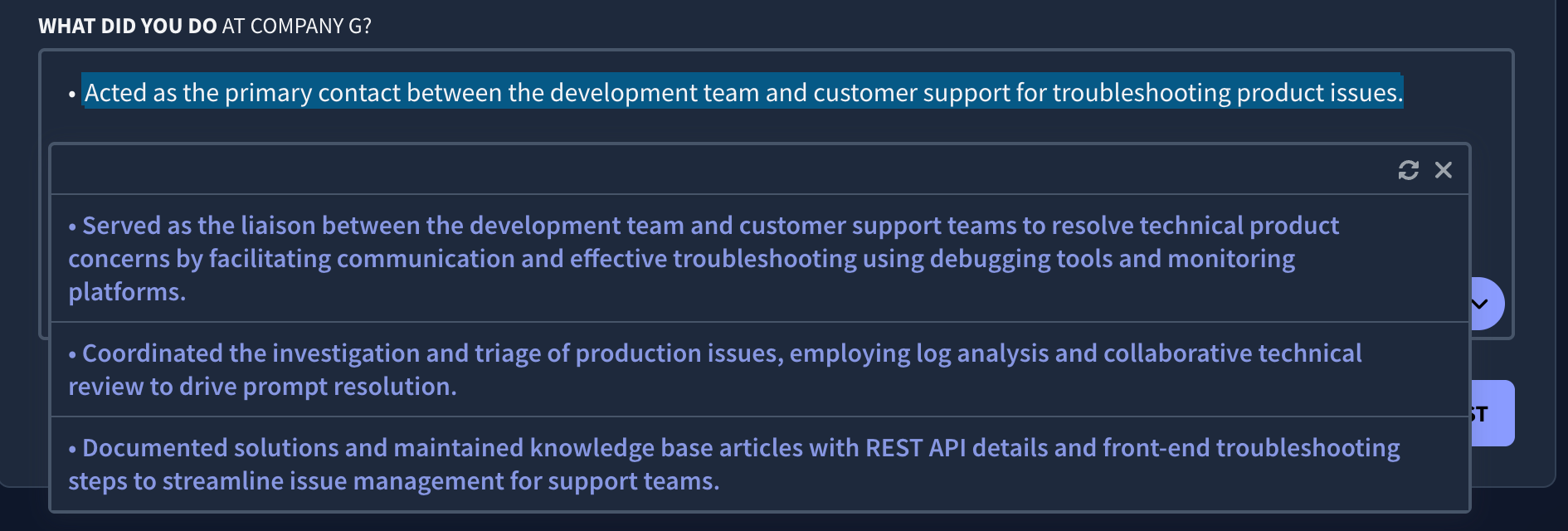
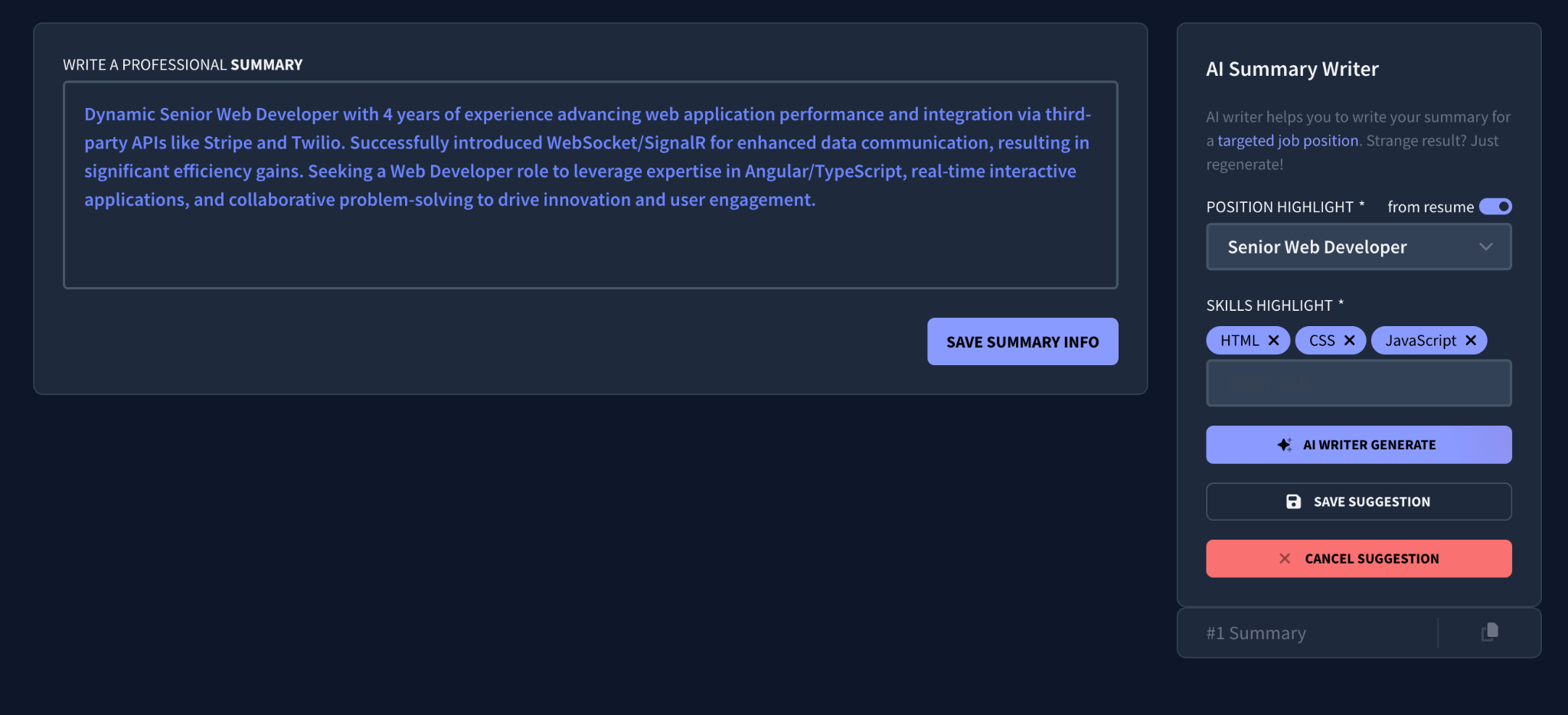
If you're having trouble translating your work into resume language (and most web developers struggle because writing about code is a completely different skill than writing code), you can use our AI resume writer. You can generate sentences from scratch, or input an existing sentence and get suggestions for rewrites.
Listing "JavaScript, TypeScript, React, Next.js, Node.js, Express, PostgreSQL, MongoDB, Redis, Docker, AWS, Git" in your skills section is fine but if that's the most informative part of your resume, then there’s a problem.
Every web developer lists their stack. It's table stakes. What separates job applications isn’t just about what you put on a resume like the tools you use, but rather, how you describe using those tools to solve problems.
Here’s what to do:
Weave technologies into your work experience bullets. "Migrated a legacy jQuery frontend to React, reducing page load time by 60% and eliminating 400+ lines of unmaintained jQuery plugins" tells the hiring manager your React proficiency and your decision-making in the same sentence.
Match your skills section to the job description. If the posting asks for React, TypeScript, and AWS, those should be the first three things in your skills section, not buried after Python and C++ from a college course five years ago. ATS filters by keyword match, and hiring managers skim top-to-bottom.
If you're applying to roles with different tech stacks (React shop vs. Vue shop, AWS vs. GCP), keep a master resume with everything and pull from it for each application.
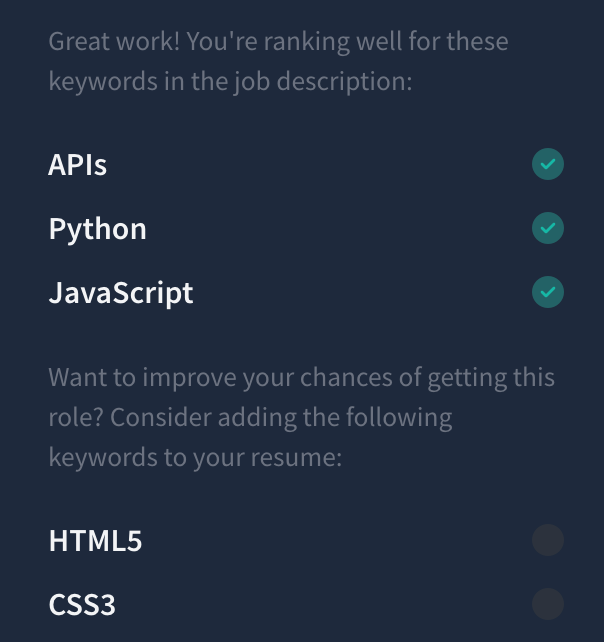
This is also where an AI resume keyword scanner helps. Simply paste the job description in, and it highlights the terms you're missing so you know what to prioritize for that specific application.
3. Use your GitHub and portfolio as resume extensions
Your resume and portfolio are not the same things. They do different jobs.
The resume's job is to get you past ATS and into the interview pile. It needs to be scannable, keyword-rich, and structured for both machines and humans who spend seconds per page.
Your GitHub and portfolio exist for the next step: proving that your resume claims are real.
A hiring manager who likes your resume will click your GitHub link. If they land on a profile with no pinned repos, no README files, and a contribution graph that's been empty for 8 months, you've just undercut your own resume.
Here's how to connect them:
In your resume header: Include a GitHub link and portfolio URL alongside your email, phone, and LinkedIn. For web developers, these are expected, not optional.
In your projects section: For each project you list on your resume, include a brief link to the live demo or repo. Keep project descriptions on the resume to 2–3 bullet points max. The repo README should carry the detail.
On GitHub: Pin your 3–5 best repos. Write proper READMEs that explain the project purpose, your technical decisions, and how to run it. Treat each pinned repo like a mini case study. Hiring managers don't dig through your entire contribution history. They look at what you've surfaced.
A common mistake is treating GitHub as a portfolio replacement and skipping the resume entirely, or treating the resume as a standalone document and not linking to proof. You need both, and they need to reinforce each other.
4. Address the AI tools question directly
This is something that wasn't relevant even two years ago.
Hiring managers are now actively wondering whether the code on your resume and GitHub was written by you or by Copilot. That skepticism isn't going away. Instead of avoiding the topic, address it.
If you use AI coding tools (and most developers do at this point), frame them as part of your workflow. A bullet like "Used GitHub Copilot to accelerate boilerplate API endpoint development, reducing feature delivery time by 20% while maintaining 85%+ test coverage" shows that you use AI as a tool.
And in your projects section, if you can point to architectural decisions, debugging stories, or refactoring work that clearly required human judgment, that's the signal hiring managers are looking for. AI can write a CRUD app. It can't explain why you chose one database schema over another or how you diagnosed a memory leak in production.
Don't pretend you don't use AI tools. In fact, AI skills are good to put on a resume. Just show that you use them the way a skilled developer would.
5. Handle the projects section like a legit web developer
This one mainly applies for junior and mid-level web developers, since candidates at this level tend to just fill the resume projects section with tutorial clones: a Netflix replica, a todo app, a weather widget.
These are great starting points but they don’t prove that you can solve problems.
Strong project entries share a few traits:
They solve a real problem. A meal planning app you actually use is more compelling than a hypothetical booking system you built for a course.
They include a live link and source code. If the hiring manager can't click through to a working demo and read your code, the project loses most of its value.
They describe the technical decisions, not just the stack. "Built with React and Firebase" is a description. "Used React with Firebase Realtime Database to handle concurrent edits from multiple users, implementing conflict resolution and optimistic UI updates" is a demonstration of thinking.
They show progression. If your first project was a static HTML/CSS site and your latest is a full-stack app with authentication, real-time features, and deployment, arrange your projects to show that growth.
Two to three strong projects with live demos, clean code, and proper documentation will outperform a list of ten tutorial repos.
6. Write a summary that signals your specialization
You can tell if a web developer resume summary is generic if any applicant could say it. For example, "Passionate web developer with X years of experience building responsive web applications."
Your summary should make the following clear: "What kind of web developer am I, and what happens to the products I work on?"
Think about all the specific tools you used and the outcomes you brought about.
And if you’re stuck, you can use an AI resume summary generator for a starting draft for your web dev resume. Personalize the output and use what’s generated as inspiration.
7. Keep the format simple and let the code do the talking
There's an ironic pattern with web developer resumes: the people who build beautiful and creative websites are usually the ones who submit resumes with complicated layouts, custom fonts, and multi-column designs that break in every ATS.
Don't do this. Your resume is not a design portfolio. It's a structured document that needs to be parsed by software and skimmed by humans.
Use a clean, single-column layout. Standard fonts. Clear section headers. No embedded graphics. No color-coded skill bars (these are meaningless and ATS-invisible). Your frontend skills should be visible in your portfolio, not in your resume formatting.
Before submitting, scan the job description for terms you might be missing. Web developer postings are specific: "React," "TypeScript," "RESTful API," "responsive design," "Git," "CI/CD," "unit testing," "accessibility." Each missing keyword is a potential ATS filter that removes you from consideration.
What Makes Web Developer Resumes Different?
This is why web developer resumes are usually described as different:
Your work is verifiable in a way most professions aren't
Your tech stack defines your candidacy more than your job title
Projects can outweigh work experience at the junior and mid-level
These differences mean web developer resumes play by slightly different rules than most other professions.
Your work is verifiable in a way most professions aren't
A marketing manager can claim they increased conversions by 30%, and a hiring manager has to take their word for it. A web developer who claims they built a full-stack application can be verified in 30 seconds. The hiring manager can click your GitHub link, read your code, run your demo, and assess your commit history. This can be a good thing and a bad thing.
If your resume says "Built a high-performance e-commerce platform" and your GitHub has three empty repos and a tutorial clone, the gap between claim and evidence works against you. But if your resume bullet aligns with a polished, well-documented repo that's actually deployed and working, you've just provided proof that no other profession can match.
Your tech stack defines your candidacy more than your job title
In most fields, your job title tells a hiring manager roughly what you do. In web development, "Web Developer" is almost meaninglessly broad.
What matters is your stack: React vs. Angular vs. Vue, Node.js vs. Python vs. Go, PostgreSQL vs. MongoDB, AWS vs. GCP.
Hiring managers filter by stack first, experience level second. A "Senior Web Developer" who has spent five years in Angular won’t always be seen as a strong fit for a React role, regardless of seniority. Your resume needs to lead with the specific technologies that match the job description, not just your title and years of experience.
This is why matching your skills section to each job posting matters more for developers than for almost any other profession. The technology keywords are the first filter, and they're binary: you either match or you don't.
Projects can outweigh work experience at the junior and mid-level
In most industries, work experience is the primary section of a resume. For web developers, especially those early in their careers, projects can carry equal or greater weight.
A junior developer with a strong portfolio of 3–5 well-built, well-documented projects, including live demos and clean code, will often get interviews over a candidate with more years of generic "web development" experience but nothing to show for it.
This is unique to development. An accountant can't show a portfolio of tax returns. A marketing manager can't link to a live campaign. But a web developer can say "here, click this, read the code, and see what it does." That changes the calculus of what belongs on the resume and how much space to give it.
Stay up-to-date and keep building your web development skills with these resources.
Learning platforms and communities
freeCodeCamp: Free, project-based curriculum covering HTML, CSS, JavaScript, React, Node.js, Python, and more. Includes certifications.
The Odin Project: Free, open-source full-stack curriculum covering Ruby on Rails and JavaScript/Node.js paths.
Frontend Masters: In-depth video courses from industry practitioners on React, TypeScript, Node.js, accessibility, and performance.
CS50 (Harvard): Free introductory CS course that's widely respected as a foundation.
Publications and thought leadership
Smashing Magazine: In-depth articles on frontend development, CSS, performance, and accessibility.
web.dev (Google): Official guides on Core Web Vitals, performance, accessibility, and modern web platform features.
Summary
Here's a recap of how to write a web developer resume:
Use reverse-chronological format: Header, Summary, Work Experience, Projects (especially important for junior/mid-level), Education, Certifications, Skills. Include GitHub and portfolio links in your header. Keep it to one page unless you're a senior with 8+ years of relevant experience.
Write 2–3 sentences that name your specialization (frontend, backend, full-stack), your primary tech stack, and one measurable achievement. Skip generic descriptors. Answer: "What kind of developer am I, and what happens to the products I work on?"
Describe what your code did, not just what it was written in. Use the formula: Technology + What you built + Who used it + What changed. Weave tech stack into bullets rather than only listing it under Skills. Include scale (users, requests, data volume) and outcomes (speed improvements, conversion lifts, reliability gains).
Include 2–3 strong projects with live demo links and GitHub repos. Describe the problem solved, your technical decisions, and the result. Skip tutorial clones unless you've extended them significantly. This section can be as important as Work Experience for junior and mid-level developers.
Match your listed skills to the job description. Lead with the technologies the job posting names. Organize by category (Languages, Frameworks, Tools, Cloud/Infrastructure). Don't include every technology you've ever used. Include the ones you can speak about confidently in an interview.
Stick to a clean, single-column layout. Standard fonts. No skill bars, no custom designs, no multi-column layouts that break ATS parsing. Your resume is a structured document, not a design showcase. Let your portfolio handle that.
FAQs
Should I include a GitHub link on my web developer resume?
Yes. For web developers, a GitHub profile is usually expected. Include it in your resume header alongside your email, phone, and LinkedIn. Pin your 3–5 best repos, write clear README files, and make sure the projects you reference on your resume match what's on your GitHub. A hiring manager who clicks through and finds clean, well-documented code that matches your resume claims has just validated your candidacy in a way that no other profession can replicate. If your GitHub is empty or disorganized, fix that before you start sending applications.
How many projects should I include on a web developer resume?
Two to three strong projects is the right range for most developers. Each project should have a live demo link (if applicable), a GitHub repo, a brief description of the problem it solves, the technologies used, and any measurable outcomes. Quality over quantity. Three projects with proper documentation, live demos, and clean code will outperform ten repos with no READMEs and no deployment. If you're a junior, the projects section can carry as much weight as Work Experience. If you're a senior with a strong work history, one or two key projects is sufficient.
Do I need a CS degree to get a web developer job?
No. Educational requirements for web developers can range from a high school diploma to a bachelor's degree, and in fact, many website developers come from bootcamps, self-taught backgrounds, or unrelated degrees. That said, your resume needs to compensate for the absence of a degree with strong evidence of capability: a polished portfolio, relevant certifications (freeCodeCamp, Google Developer certifications, AWS certifications), open source contributions, and work experience or freelance projects that show you can build production-quality software. The degree matters less than the proof.
A sleek design optimized for the tech industry. This template features distinct sections for technical skills and languages, making it the top choice for developers, engineers, and IT professionals who need to showcase expertise at a glance.
The definitive Harvard resume format, trusted by top universities and Ivy League graduates. This clean, education-first layout is ideal for students and recent graduates targeting competitive roles in finance, consulting, and academia.
Our adaptation of Jake's Resume from Overleaf, now available without LaTeX coding. This high-density, single-column layout is a standard for software engineers and developers who need to showcase skills and projects.
A professional modern resume template that uses subtle color accents to guide the recruiter's eye. Perfect for creative professionals and tech startups looking to stand out while maintaining strict ATS compatibility and high content density.
Our most popular reverse-chronological resume template. Designed for maximum readability, this standard format is the safest choice for applicants in corporate, government, and traditional sectors where clarity is king.
A minimalist resume template that uses negative space to guide the recruiter's eye. This clean, distraction-free layout is excellent for experienced professionals who want their achievements to speak for themselves without visual clutter.
A traditional resume format that recruiters instantly recognize and trust. This no-nonsense layout is fully ATS-optimized and perfect for conservative industries like law, finance, and administration.
The definitive Harvard resume format, trusted by top universities and Ivy League graduates. This clean, education-first layout is ideal for students and recent graduates targeting competitive roles in finance, consulting, and academia.
A sleek design optimized for the tech industry. This template features distinct sections for technical skills and languages, making it the top choice for developers, engineers, and IT professionals who need to showcase expertise at a glance.
A professional layout designed to highlight linear career progression. The Smart template uses clear headers and robust spacing, making it perfect for managers and mid-level professionals demonstrating consistent growth and leadership.
A timeless, ATS-compliant resume format engineered for large organizations. This template guarantees parsing accuracy, making it the safest bet for applications to Fortune 500 companies and global enterprises.
Our adaptation of Jake's Resume from Overleaf, now available without LaTeX coding. This high-density, single-column layout is a standard for software engineers and developers who need to showcase skills and projects.
A high-impact creative resume template that commands attention. Designed for marketers, designers, and innovators, this format balances strong visual headers with professional structure to ensure your application is memorable.
A contemporary layout that helps build your personal brand. This template uses subtle color accents to highlight key sections, making it perfect for junior professionals and startup candidates who want to showcase personality without sacrificing readability.
A design-forward template tailored for fashion, media, and the arts. This aesthetic layout highlights your individual creativity while remaining fully parsable by ATS software, giving you the best of both worlds.
A professional modern resume template that uses subtle color accents to guide the recruiter's eye. Perfect for creative professionals and tech startups looking to stand out while maintaining strict ATS compatibility and high content density.
A high-density layout designed to maximize page real estate. This one-page resume template allows seasoned professionals to list extensive experience without spilling onto a second page. Ideal for lawyers, consultants, and executives with long work histories.
A sophisticated design that commands authority. This executive resume template uses elegant typography and optimal spacing to create a high-end look. Perfect for leadership roles, luxury industries, and senior management applications.
A highly organized layout defined by sleek lines and clear compartmentalization. This template projects reliability and attention to detail, making it the go-to choice for operations managers, engineers, and administrative professionals.
“Rezi is an awesome AI-based resume builder that includes templates to help you design a resume that is sure to check the boxes when it comes to applicant tracking systems. This is a great jumping off point to kickstart a new resume.”
Ashley Stahl
Career Contributor
62.18%
Success
Average is ~3%, as of 2025 data.
Interview Rate
4,773,704
Total Users
8.23 / 10
Avg. User Review
Wall of Love
Over 4 million users trust Rezi
Resume Building felt like pulling teeth – until I found Rezi.
Davis Allen
Software Developer
I was blown away by Rezi. It streamlined everything...
Celine Watko
I needed a resume tool as smart as my work.
Yosra Naceur
Data Scientist
“A great tool that is very helpful. I found the Rezi system easy to use and very helpful as I was working on getting my resume in shape for job applications.”
Dakota Rubin
United States
Written via
“This is actually one of the first reviews I’ve ever written for a business, and that alone says a lot. I highly recommend Rezi to anyone who’s job searching, it makes the entire process so much easier.”
Yazan Alkhatib
United States
Written via
“Reduced my time per application from 1-2 hours down to 15 minutes.”
Kixxx
Experience with Rezi
“I love how simple and convenient it is to use and been coming back to update it every time I need a fresh resume.”
Zara Wazir
U.A.E.
Written via
Frequently Asked Questions
Your questions, answered.
An AI resume maker helps you build a resume perfectly fit for the job you want. Top-notch AI resume builders are designed to speak the language hiring managers are looking for, increasing your chances of standing out in the crowd. It aligns your skills and experience with the job description effectively.
To get the most out of an AI resume builder, either start from scratch or upload your current resume. Fill in as much detail as possible about your career and skills, and upload the job description you’re targeting. This personalization allows the AI to build a unique and tailored resume that’s bound to catch potential employers' attention.
AI-generated resumes can seem similar if you're not giving personalized inputs or if you're using basic prompts. Provide specific details about your work experience and target the job you’re eyeing. Use specialized AI tools instead of general chatbots to avoid robotic-sounding resumes and to ensure individual creativity.
Employers might think you used AI, but that’s rarely an issue. What they really care about is getting a well-written resume that showcases your skills and experiences accurately. A top-notch resume tailored to their needs will speak volumes more than worrying about AI involvement.
Yes, using AI to optimize your current resume is highly effective. You just need to upload your resume, share details about your career goals and the job you want, and let the AI refine everything to elevate your resume's impact and ATS compatibility.
Rezi uses a tool called the AI Keyword Targeting. This feature scans the job description to identify crucial keywords and naturally incorporates them into your resume, giving it the right focus without keyword stuffing.
The Free plan is $0/month and allows you to create one resume, use limited AI tools (such as Keyword Targeting and Analysis), and download up to three PDFs. You can also create unlimited cover and resignation letters. No card is required to begin.
The Pro plan is $29/month and provides unlimited access to all features, including unlimited resumes, full AI capabilities, unlimited downloads, and one free monthly expert resume review (resumes are reviewed by a person).
The Lifetime plan is a $149 one-time payment. It grants permanent access to all the features of the Pro plan (unlimited resumes, full AI tools, and unlimited downloads), but it does not include the free monthly expert review (which can be purchased for an extra fee).
Rezi offers a 100% money-back guarantee on all paid plans (Pro and Lifetime). If you are unsatisfied, you can request a full refund within 30 days of your purchase.
Yes, you can easily upgrade or downgrade your plan at any time through your Rezi Account Billing dashboard. Prorated credits will apply when switching.
An AI resume maker helps you build a resume perfectly fit for the job you want. Top-notch AI resume builders are designed to speak the language hiring managers are looking for, increasing your chances of standing out in the crowd. It aligns your skills and experience with the job description effectively.