Resume
How to Make a Resume Stand Out (Best Templates & What to Write)
I’ve been writing about resumes and job searching for 5+ years. You just need to align your skills with the job requirements to stand out. Here’s how.
Published on
March 4, 2026
Updated on
March 4, 2026
A resume that stands out is all about aligning your skills with specific job requirements and showcasing a clear narrative of your professional background. Here’s how to make a resume stand out: use a clean resume format, ask an AI resume agent to do it for you, add your relevant portfolio or social media links, personalize your summary or objective section, and clarify your individual contributions. Quantify your experience and accomplishments, mention specific deadlines, and use strong action verbs. Include related skills, projects, and qualifications. Show proof of strong soft skills and mention relevant industry trends.
I’ve been writing about resumes and job searching for 5+ years.
You don’t need to invent the next $10,000,000 company to make your resume stand out. You just need to align your skills and experience with specific job requirements.
I’ve also spoken to many job seekers and they often stress about trying to make their resume unique because they’re tired of getting ignored. Some believe it’s because their resume isn’t different enough, which makes them look too similar to other candidates.
To make your resume stand out, it’s all about putting together a clear narrative of how your professional background translates into the role you’re applying for.
What Does It Mean to Create a Resume That Stands Out?
A resume that stands out is less about being unique and more about being the most relevant candidate in the pile. It’s not about neon colors or wild layouts. In the modern job market, standing out means one thing: relevance. It’s about clearly showcasing how you solve the specific problems the company is hiring for.
Think of it as connecting the dots. Before a human recruiter ever sees your job application, you have to pass the Applicant Tracking System (ATS). These digital gatekeepers aren't looking for a "unique" resume; they are simply looking for a match. If your resume fails to mirror the job description when showcasing your skills and achievements, you won't make the cut.
Standing out starts with decoding what the company actually needs. Proving you have the “must-haves” is your entry fee. In other words, use resume keywords from the job description and then let your results and impact speak for themselves.
Learn more about the ATS:
- ATS Myths
- Tips for an ATS-Optimized Resume
- How to Create ATS Resumes
- How AI Resume Screening Works
- Why Your ATS Parse Failed
- ATS Resume Examples
- ATS Resume Formatting
How to Make a Resume Stand Out Step-by-Step
Here’s how to make a resume stand out:
- Use a clean resume format
- Ask an AI resume agent to make your resume stand out
- Add your portfolio, website, or relevant social media links
- Personalize your resume summary section
- Clarify how your individual contributions made an impact
- Quantify your experience and accomplishments
- Mention specific deadlines
- Reconsider your action words
- Include relevant skills, projects, certifications, and professional development or training
- Show proof of strong leadership skills and cross-functional collaboration
- Mention relevant industry news or trends
- Use an ATS resume checker to confirm whether your resume stands out or not
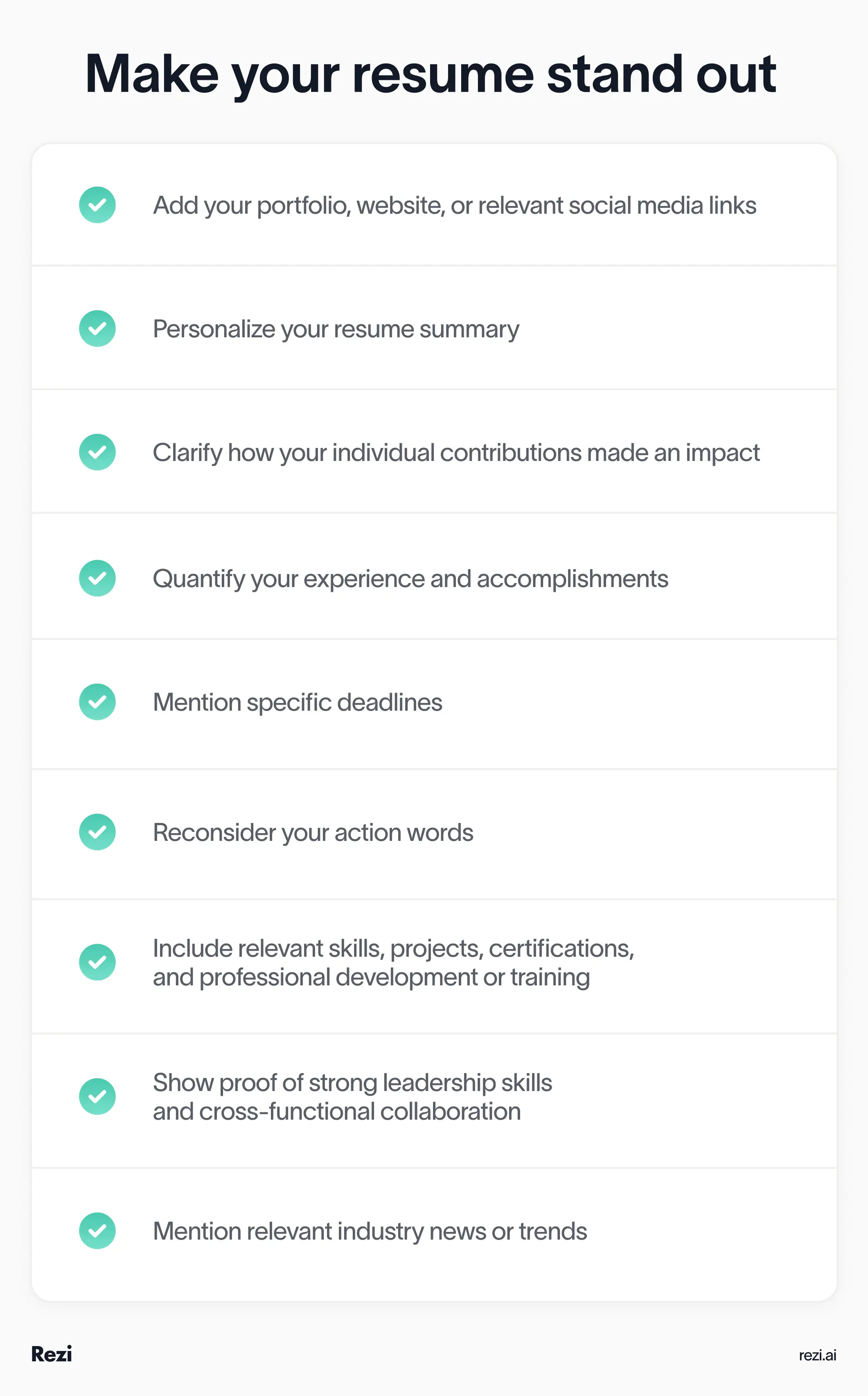
Ultimately, a resume that stands out simply aligns your skills and work history to the target company’s needs. Show that you’re interested in working specifically for them by tailoring your resume and clarifying your impact in previous roles that prove you can do your job really well.
Below, let’s go through the steps in more detail.
1. Use a clean resume format
You don’t need a unique design to stand out. In fact, many creative layouts can make your resume unreadable to the very systems you’re trying to bypass.
Your resume just needs to be clean and professional enough to be readable to both applicant tracking systems (ATS) and recruiters.
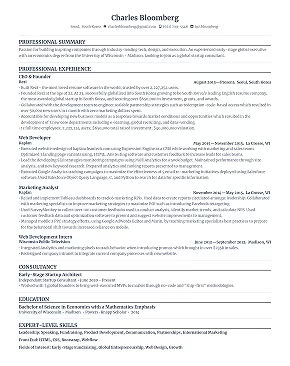
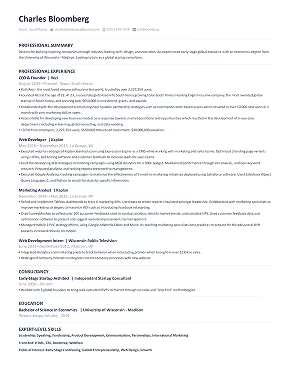
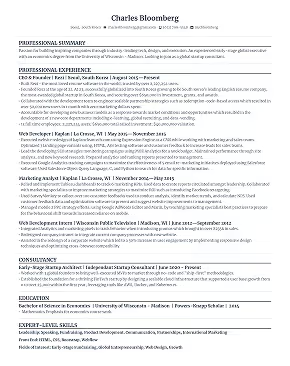
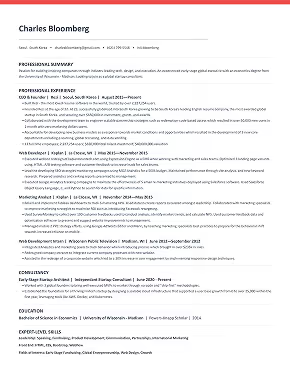
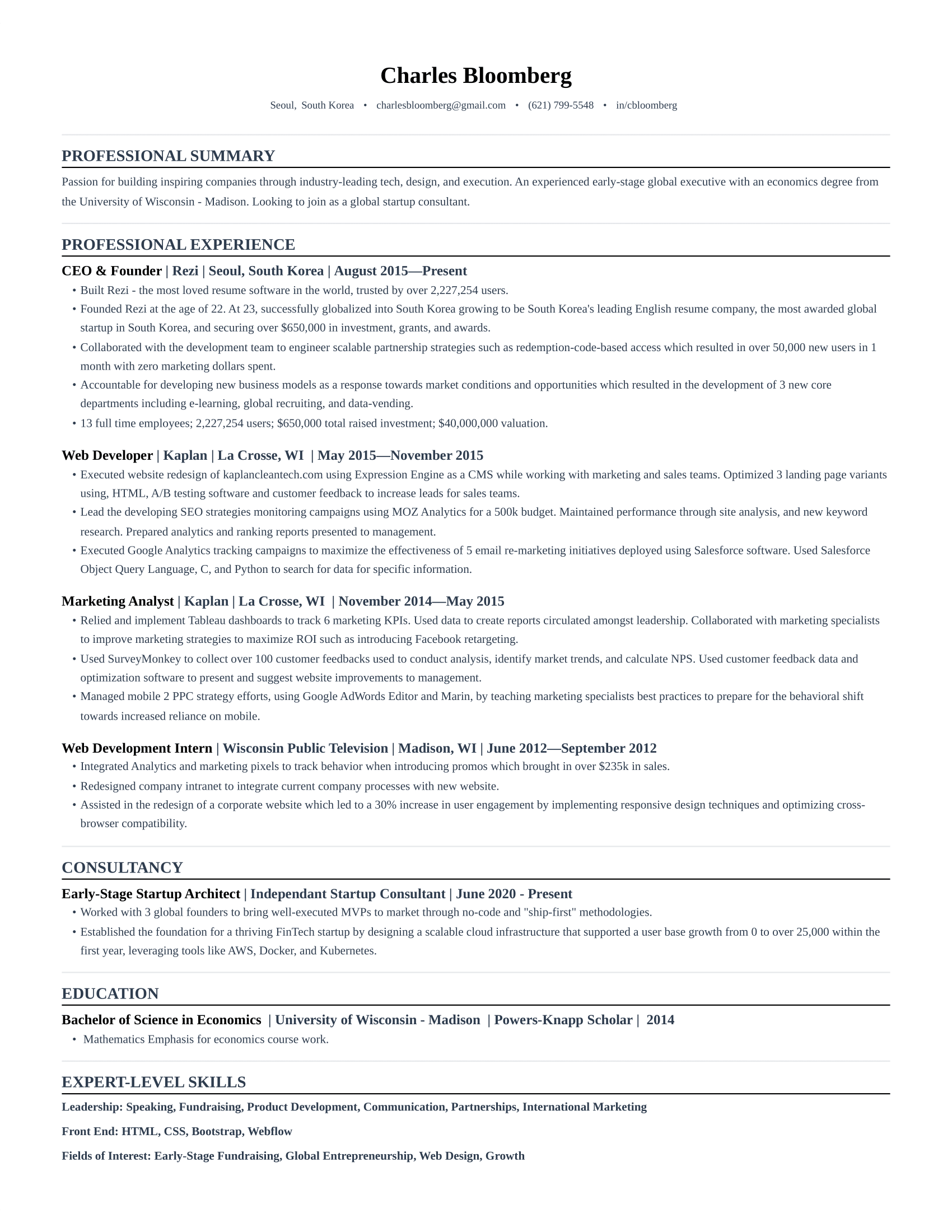
Here’s an example of a clean resume template:
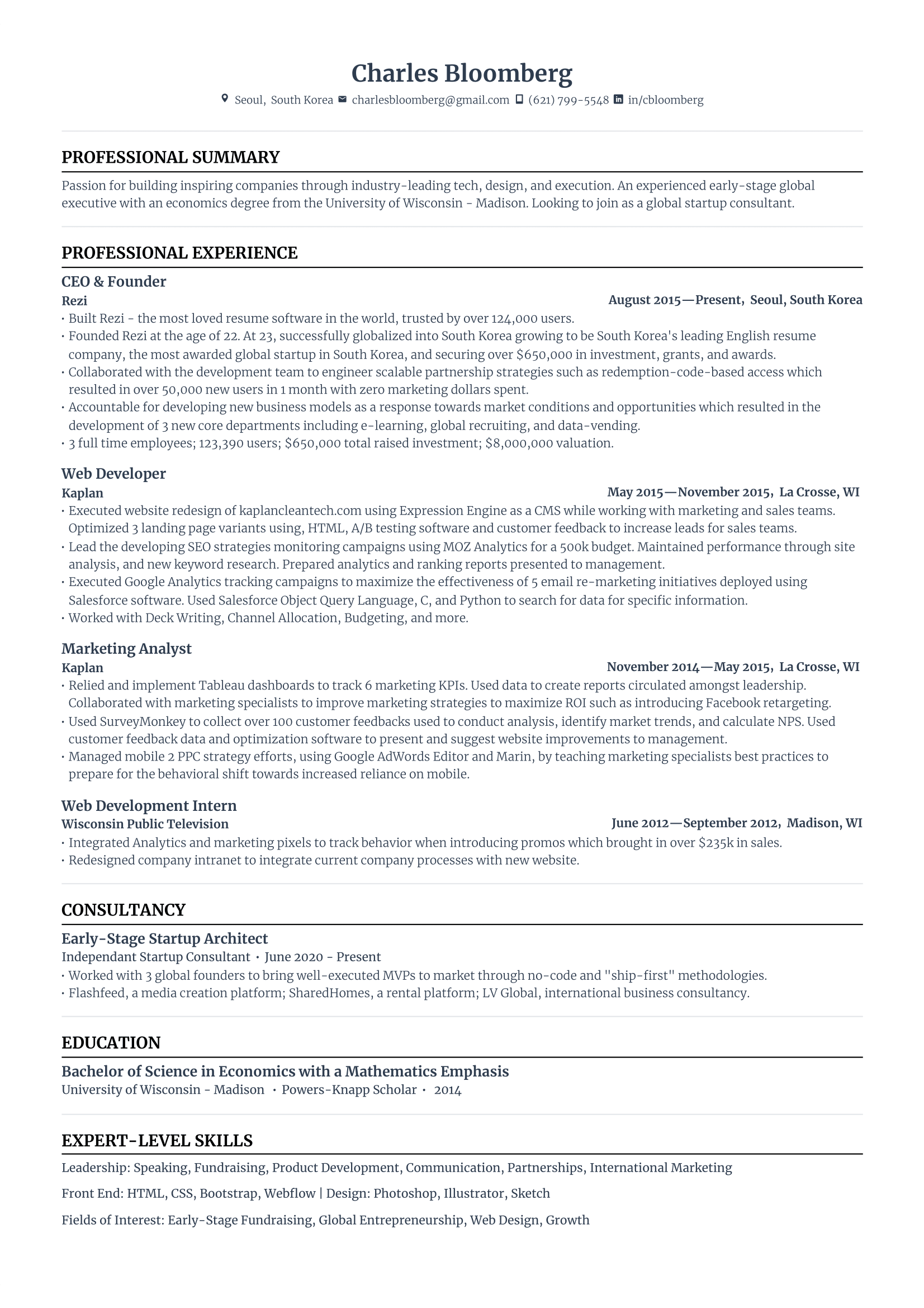
If you’re looking for a reliable format, you can start with our free resume templates. Our resume metadata standard project proved that the templates we offer at Rezi are one of the most ATS-friendly layouts available online, even though the hiring software many recruiters use are fundamentally flawed.
Whatever format you go for, make sure it allows you to clearly showcase your narrative. For example, if you significantly grew at one company, make sure your resume shows promotions and makes your trajectory obvious. Don’t let a "pretty" template bury your best work. Use a format that prioritizes your story.
Related:
- One-Page Resume Templates
- Is a Two-Page Resume Better?
- How Long Should Your Resume Be?
- Should a Resume Be One Page?
2. Ask an AI resume agent to make your resume stand out
I’ve been there, staring at a screen and wondering if my resume actually stands when applying for competitive job opportunities. Traditionally, the only way to get an expert answer was to hire a career coach, but dropping hundreds (or even thousands) of dollars on a single review is a heavy investment.
But now, you can use Rezi AI Resume Agent. It works like most LLMs such as ChatGPT, except it comes with a major advantage: it’s trained specifically on best resume and job search practices.
Using it is as simple as starting a chat. You just attach your resume and ask, "How can I make this stand out?"
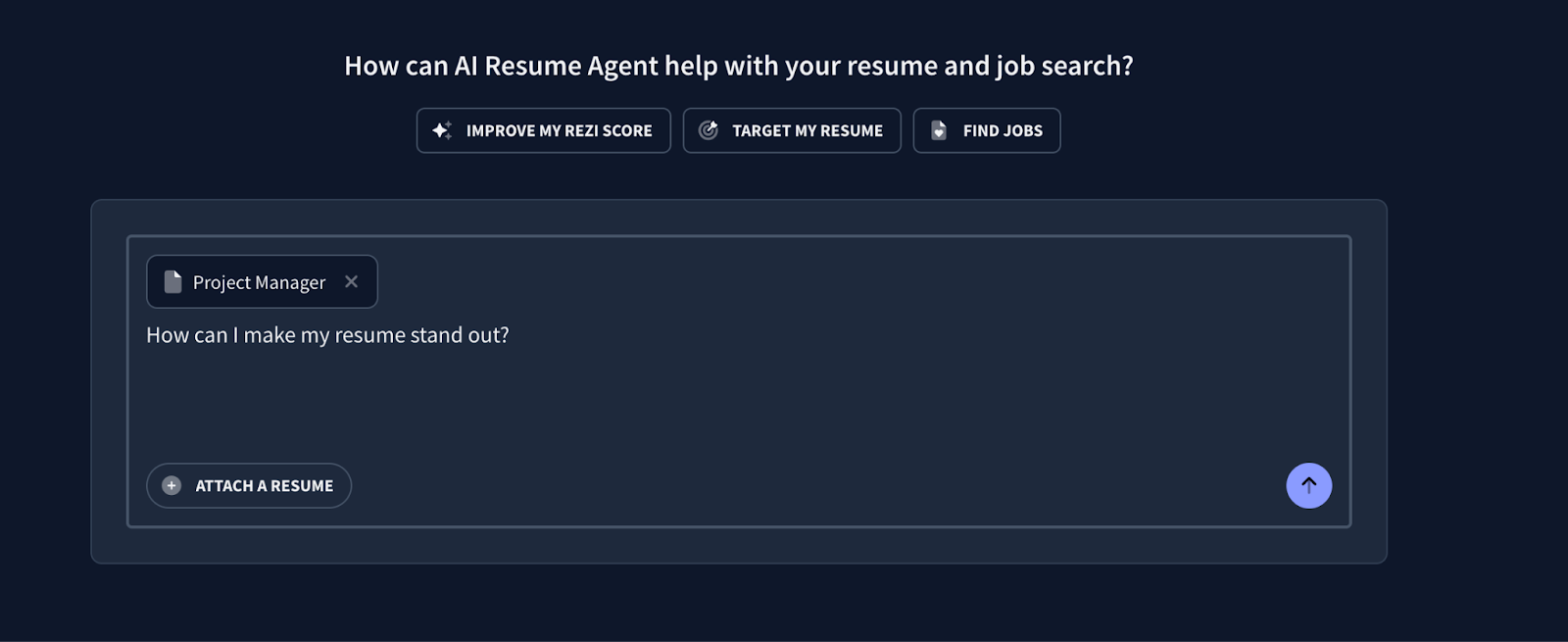
It will then provide you with expert suggestions and can even help you fix it section-by-section—from rewriting bullet points for maximum impact to naturally weaving in missing keywords.
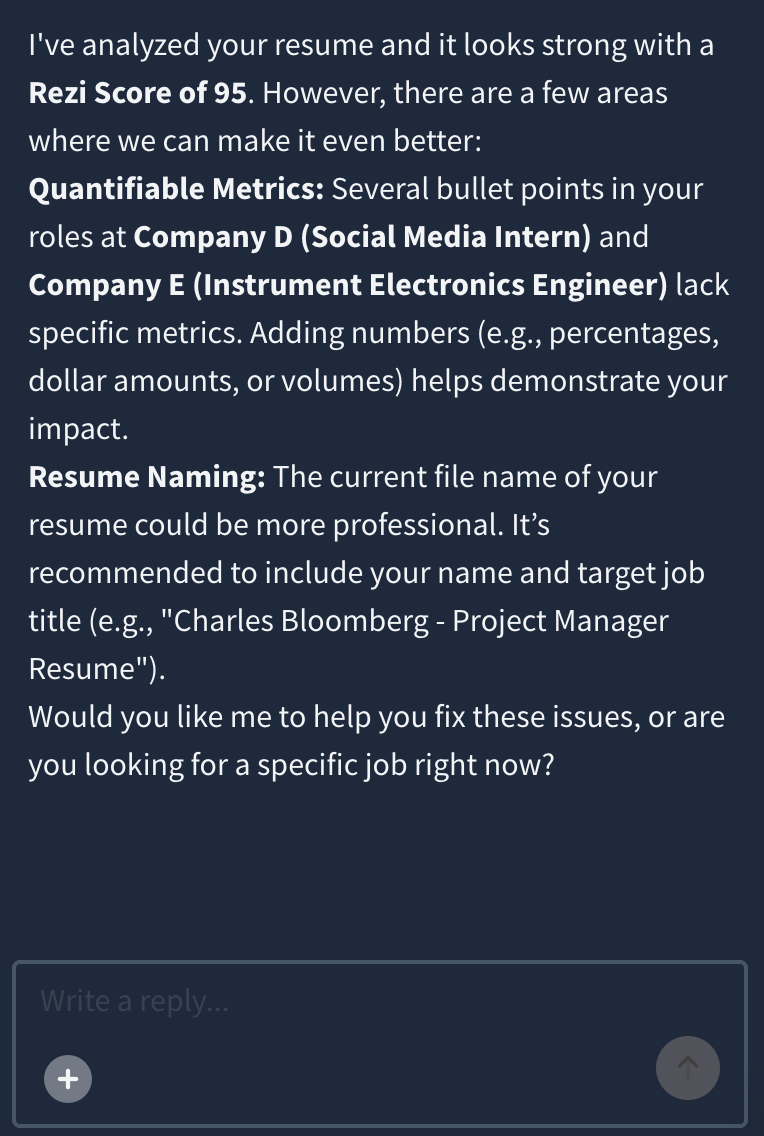
And because this AI resume agent is built directly into Rezi, you can instantly jump from a chat into our ATS Resume Checker to see your score improve in real-time. It’s like having a resume expert right by your side, minus the steep price tag.
Learn more:
- Rezi vs. ChatGPT
- Rezi vs. Gemini
- Rezi vs. Claude
- How to Use ChatGPT to Write a Resume
- Is Rezi Actually Worth It?
- Top Alternatives to Rezi
- The Best AI Resume Builders
3. Add your portfolio, website, or relevant social media links
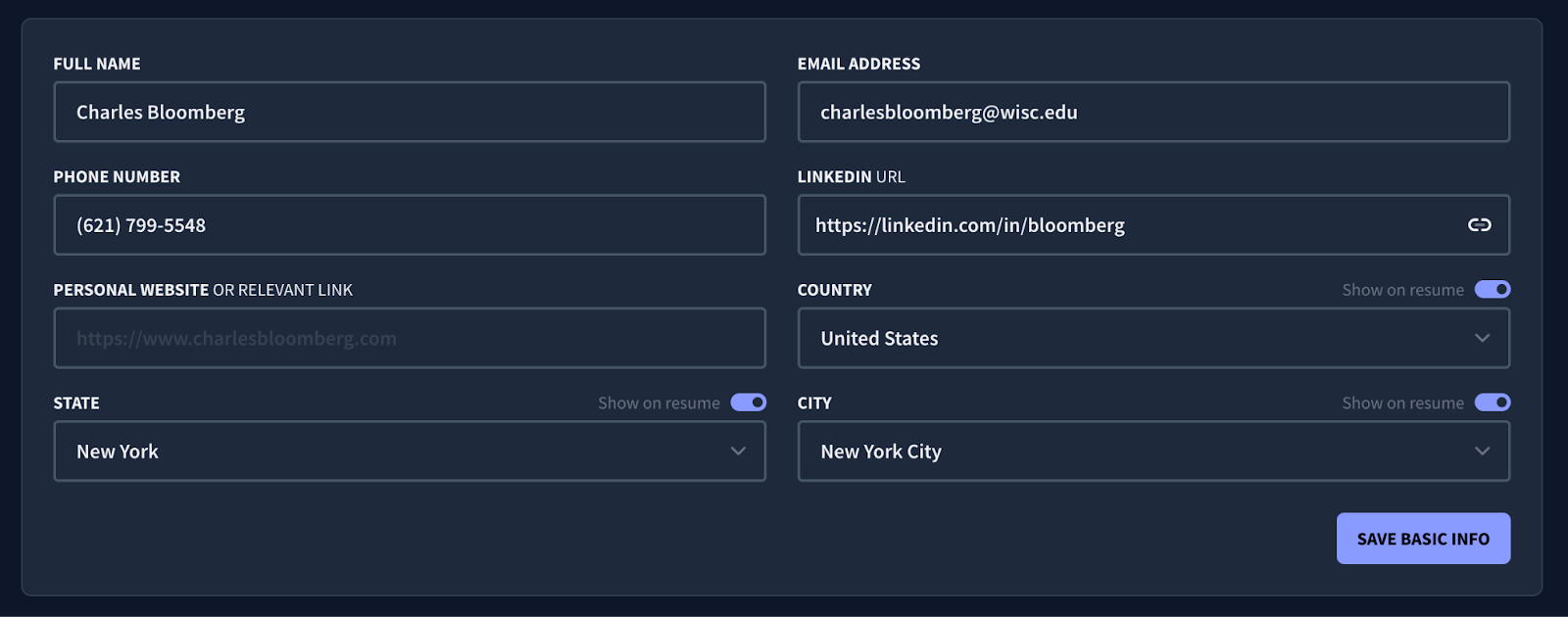
Anyone can make claims on their resume. You can add numbers to back these up (more on this later), but a link to a live portfolio or website adds more credibility to your job application. And if you have a strong LinkedIn profile or a social media account where you grew an audience, add those links next to your contact details.
These act as proof that you’re active in your field and give the hiring manager a chance to see your work in action before they even schedule an interview.
If you’re using a Rezi template, you’ll find these fields in the resume header section for you to add.
Further articles:
4. Personalize your resume summary section
Don’t treat your resume summary like a block of text. It’s one of the first things a recruiter will notice, and if you want to grab their attention immediately, make it personal.
Sell your expertise. Lead with your top accomplishments that prove you have the exact skills the company is looking for. This also shows you didn’t just “spray and pray” your resume to a hundred different places.
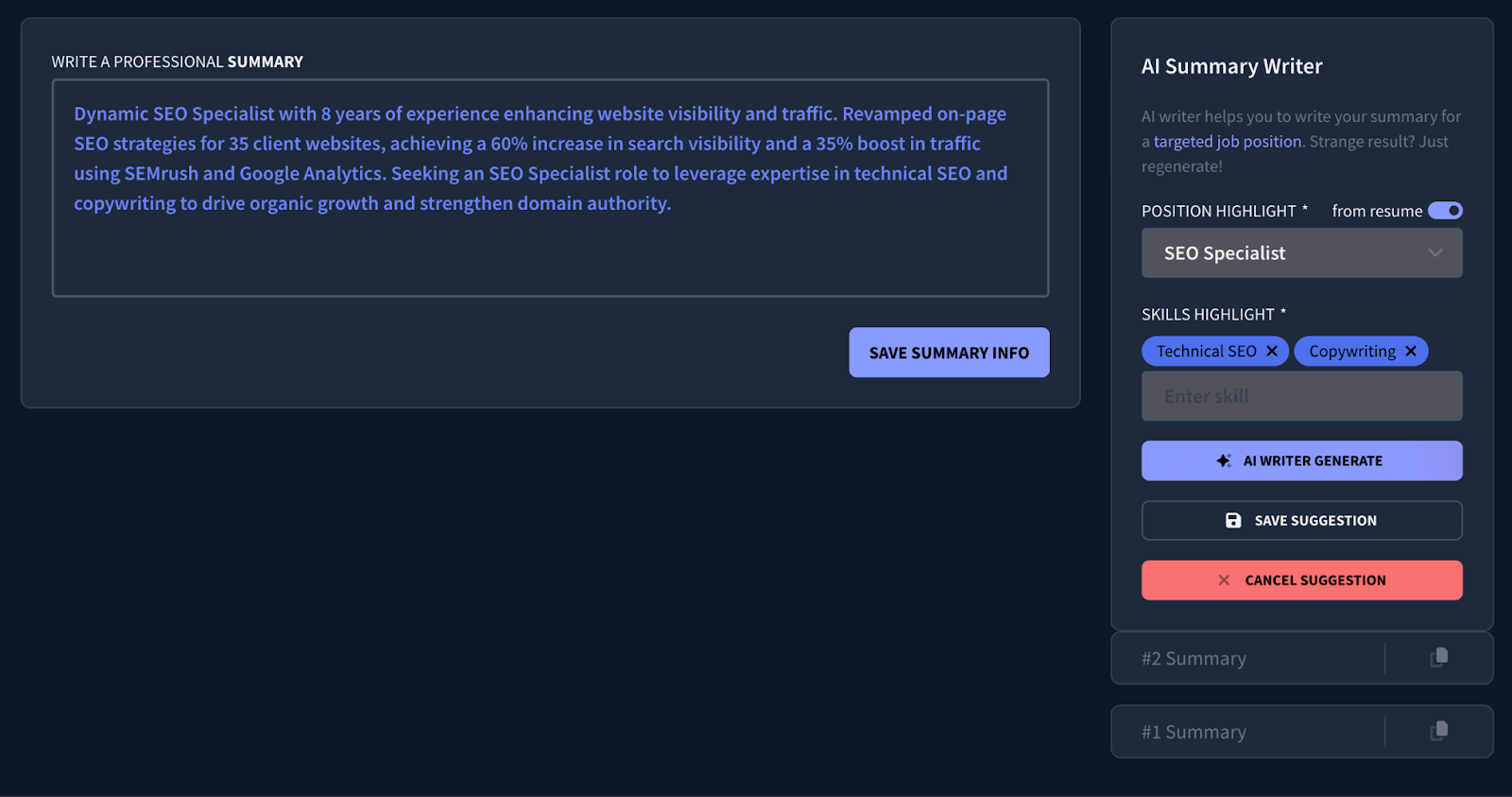
If you need help, use Rezi AI Resume Summary Generator. Enter the job position and skills you want to highlight. It’ll draft a targeted summary using points from your experience section (and the job description if you choose to add one), connecting your skills and wins to the company’s needs. It’s one of the easiest ways to turn a standard introduction into a convincing pitch.
Related: Best Resume Objective Examples
5. Clarify how your individual contributions made an impact
Even if you were part of a massive team, the recruiter needs to know exactly what you did to move the needle. Otherwise, it’s hard for them to see your specific value.
Whenever you can, isolate your personal contributions. Instead of saying "worked on a product launch," try "developed the core API architecture that allowed the product to scale to 50k users." It’s about taking ownership of your specific slice of the project.
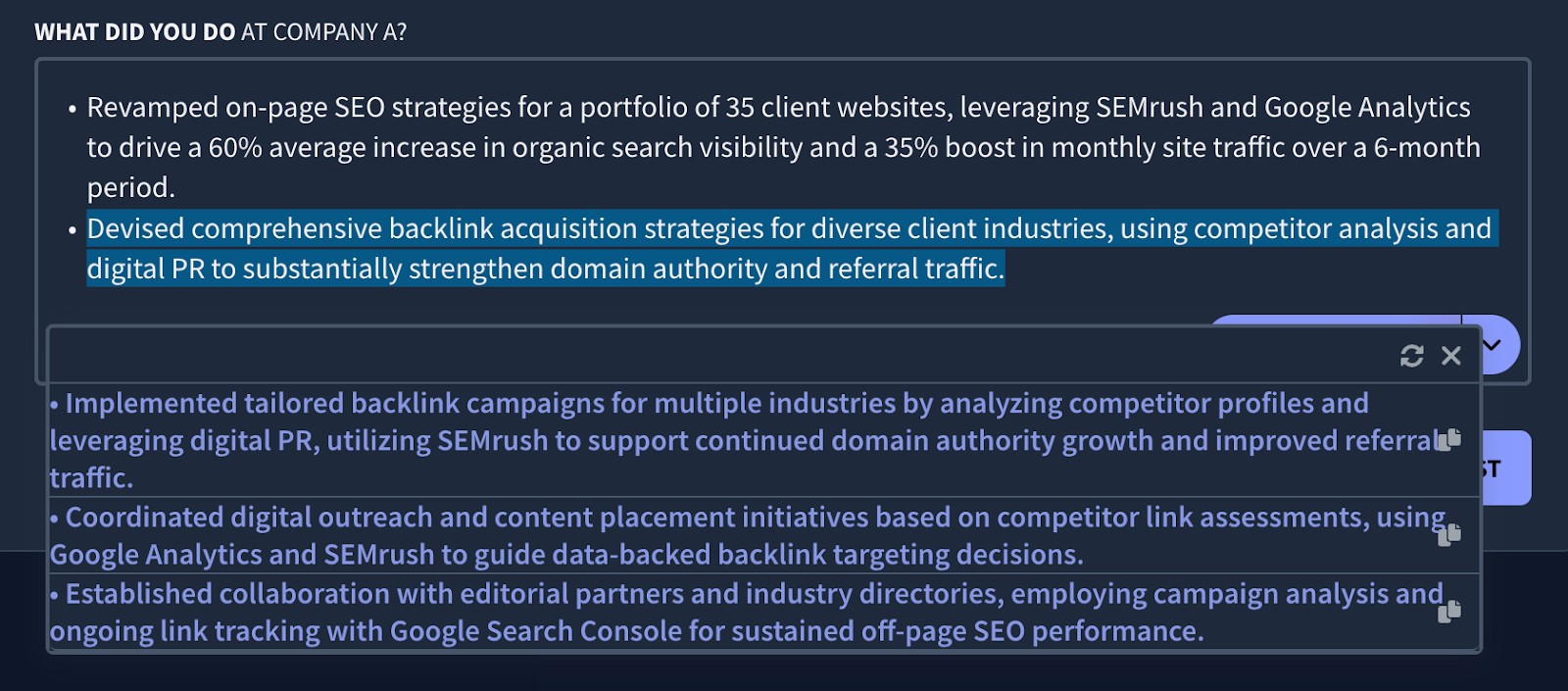
If you’re having a hard time writing this from scratch, use Rezi AI Bullet Point Writer to generate personalized sentences based on your role. And if you already have bullet points drafted, but they feel a bit vague, use Rezi AI Bullet Point Editor to suggest rewrites that highlight your individual contributions.
6. Quantify your experience and accomplishments
Speak the language of business: numbers.
Vague descriptions like "improved efficiency" or "handled a large budget" don't carry much weight because they lack scale. Recruiters want to see the "how much" and the "how many." This also indicates how well you performed in your role.
Quantifying your wins—whether it’s a 25% increase in lead generation, managing a $50,000 budget, or saving the team 10 hours a week—provides instant context. It transforms a list of chores into a proven track record of success.
And if you don’t have numbers, you can signal positive feedback. For example, “Received 12 positive customer reviews in 10 days” and “Awarded employee of the month.” Including awards on a resume can go a long way.
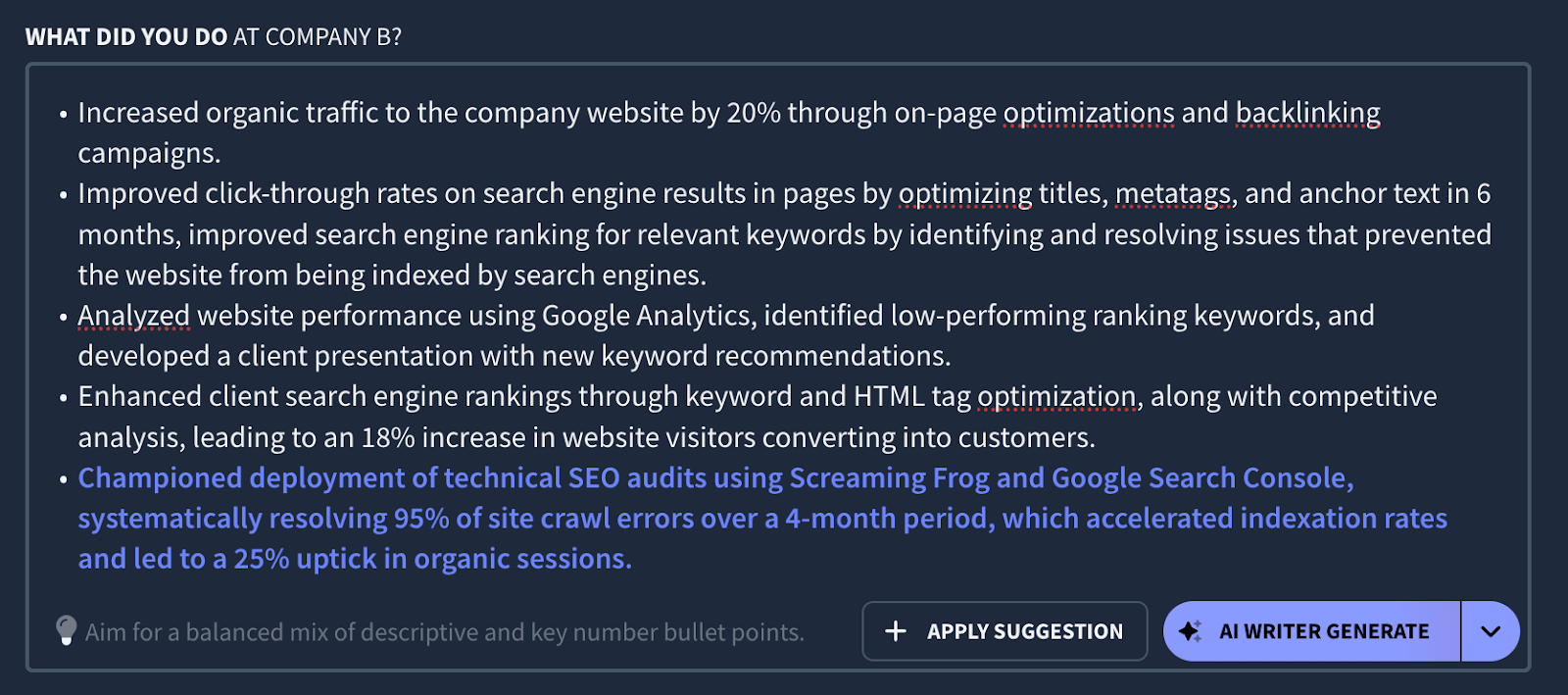
If you’re struggling to find the right words for your resume achievements, just highlight your sentence and let Rezi AI do it for you. You can click “Generate bullet with key numbers” to craft a sentence from scratch or use “Rewrite bullet with key numbers” to give your existing points a data-driven upgrade.
7. Mention specific deadlines
Anyone can say that they have good organization skills on a resume. Yet, not everyone specifies timelines or when they actually hit deadlines.
Companies love seeing that you can handle pressure and manage your time effectively, especially in fast-paced environments. It’s one thing to say you completed a project; it’s another thing entirely to say you delivered a high-stakes migration three weeks ahead of schedule or managed a daily 24-hour turnaround for client requests.
Adding specific timeframes to your achievements gives your work a sense of urgency and reliability. It proves you don't just get the job done, but you get it done when it counts.
8. Reconsider your action words
If your resume is filled with "Responsible for," "Helped with," or "Participated in," you’re doing yourself a disservice. These are passive and unclear phrases which make it sound like things happened to you rather than because of you, and this weakens your resume.
To stand out, swap those tired clichés for action verbs that actually paint you as the driver of your career.
Think of it this way: Did you "help with a project," or did you orchestrate it? Did you "change a process," or did you overhaul it? Using precise, punchy verbs like spearheaded, automated, or negotiated gives your resume an immediate sense of authority and confidence.
Relevant articles:
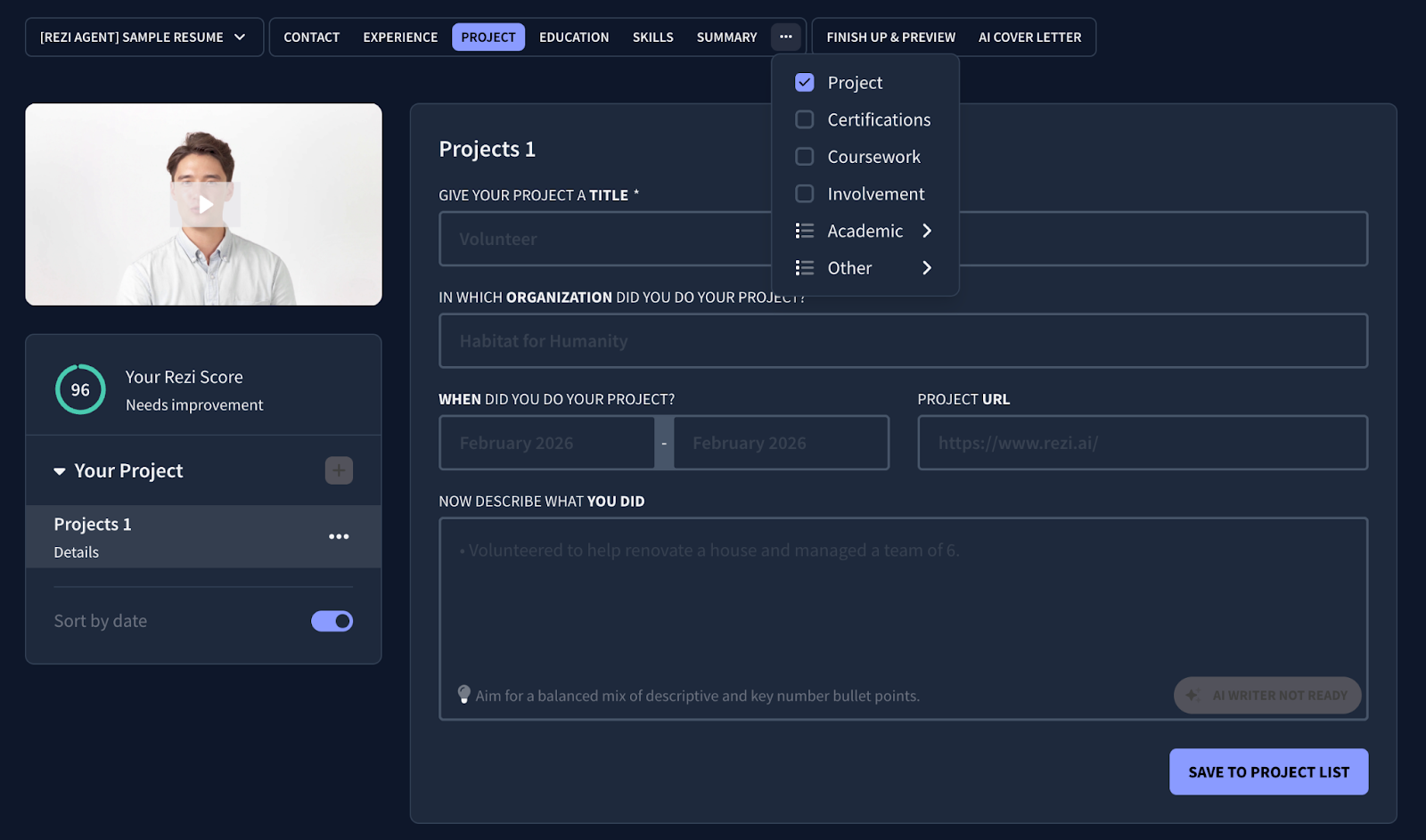
9. Include relevant skills, projects, certifications, and professional development or training
Make your resume feel more unique to hiring managers by adding custom sections or points that indicate certain skills or qualities that you have.
Did you teach yourself Python on the weekends? Build a side hustle on Shopify? Or maybe you’re proficient in a second (or third) language? These details act as "proof of character" and they signal grit, curiosity, and a proactive mindset. It shows you’re a lifelong learner who doesn't just wait for a boss to tell you what to do, and employers love candidates who can take initiative.
It’s often these "side" details that spark the most interesting conversations during an interview. These can also set you apart from other candidates.
If you want to create custom sections to showcase these extra details, you can use Rezi to sort out the formatting automatically. Our AI writer is also on standby in case you need help drafting bullet points.
Learn more:
- What Are Resume Sections?
- How to Write the Work Experience Section of a Resume
- How to List Education on a Resume
- Skills Section of a Resume
- How to List Certifications on a Resume
- How to Include Projects on a Resume
- How to Put Freelancing on a Resume
- How to Describe Remote Work Experience
- Publications on a Resume
- Extracurricular Activities to Put on a Resume
- Should You Put Hobbies on a Resume?
10. Show proof of strong leadership skills and cross-functional collaboration
Even if "Manager" isn’t in your current job title, companies are desperate for people who can lead and collaborate effectively with other departments.
Now, that doesn’t mean to just straight up write on your resume that you’re a “team player.” That’s a cringy buzzword. Instead, prove it by highlighting moments where you stepped up. For instance, mentoring a peer or coaching a new employee.
And showing that you can speak the "languages" of different teams, like translating technical requirements for a marketing team, is a huge green flag for recruiters. It signals that you’re high-potential and easy to work with. Think about times you led a cross-functional project or stepped in to coordinate a fix when things were going sideways.
Related guides:
- Best Skills for a Resume
- Leadership Skills on a Resume
- Communication Skills on a Resume
- Soft Skills to Put on a Resume
- Teamwork Skills for a Resume
- Interpersonal Skills for a Resume
- Social Work Skills to Put on a Resume
11. Mention relevant industry news or trends
Show that you’re proactive in your field by making it clear that you’re paying attention to where your industry is headed.
Let’s use AI as an example.
AI is disrupting basically every industry right now. If you add a bullet point showing exactly how you built an AI workflow to skyrocket your efficiency, you’re going to look more valuable. It proves you aren't just watching the future happen; you're actually using it to do your job better and get better results.
But a word of warning: don't just "name-drop" trends to look cool. To make it count, you have to bridge the gap between theory and practice. Show how you applied a new best practice or tool to solve a real problem.
12. Use an ATS resume checker to confirm whether your resume stands out or not
Most companies use scanners to filter out resumes that don't match the job description, so if your resume isn't optimized for the software, it’ll never even reach a human's desk. You can’t stand out if you’re invisible.
So, use an ATS resume checker to understand the likelihood of your resume being filtered out.
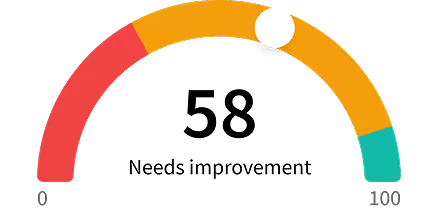
With the Rezi Score for instance, your resume will receive a score out of 100 based on the five things that actually matter: content, formatting, optimization, best practices, and application-readiness.
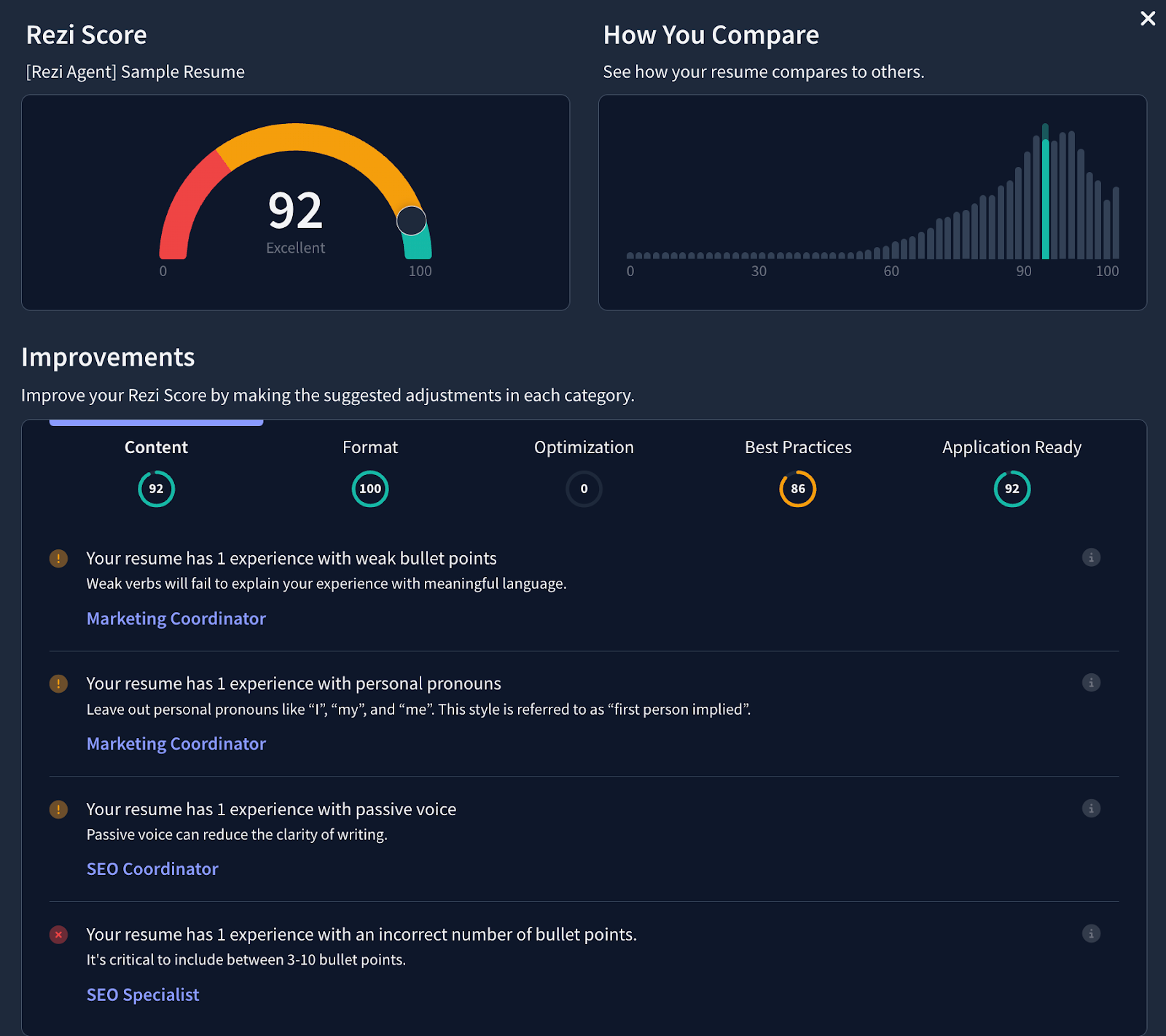
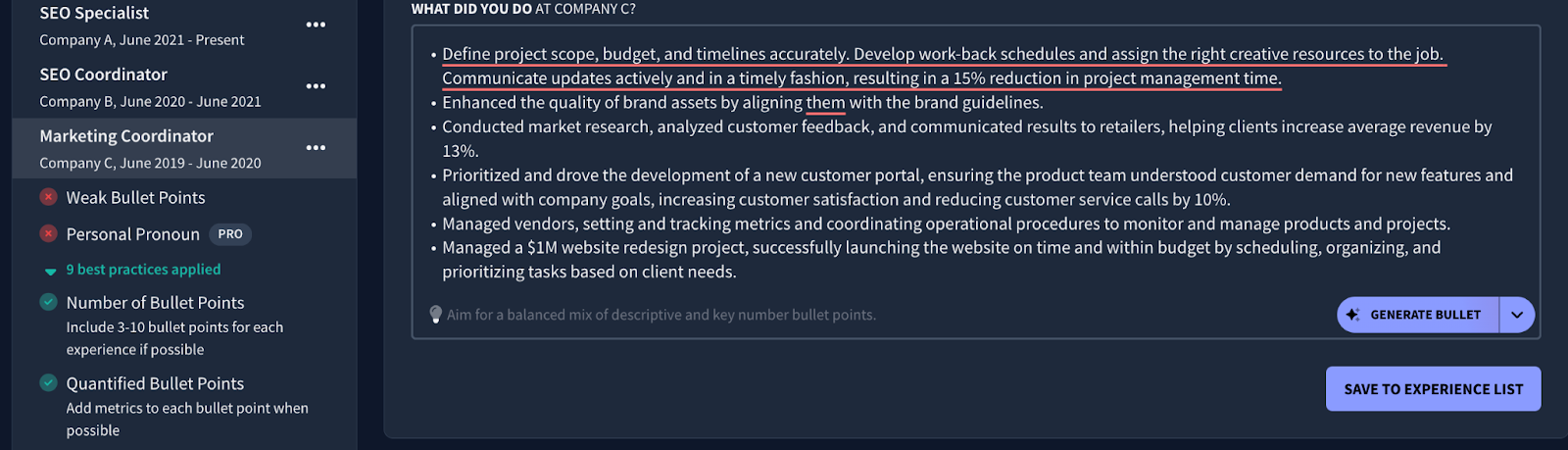
If you're already building your resume in Rezi, this feedback happens in real-time. As you type, our content analysis tool flags errors and gives you actionable tips on the spot.
Use These Resume Templates to Stand Out
If your layout is a mess, an impressive career won't even matter. Your resume has to get past the hiring software first. And if you can’t clear that hurdle, there’s no point in worrying about how well you match the job requirements, let alone how to make your resume stand out to a human.
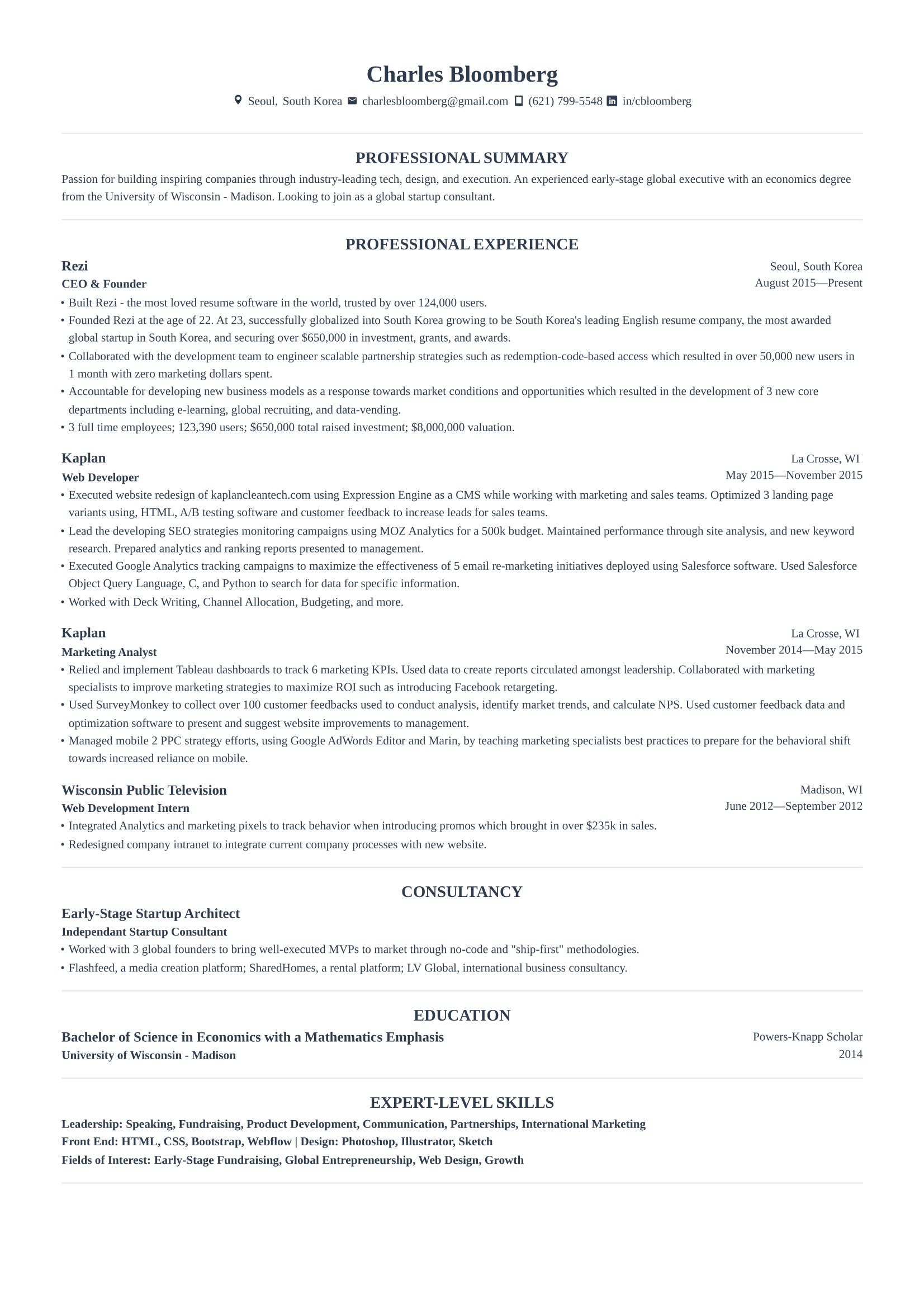
See below for resume templates you can start using.
Or if you’d like to explore more options, check out these resources:
- ATS Resume Templates Library
- Professional Resume Examples Library
- How to Pick the Right Resume Template
- Top ATS Resume Examples
- Canva Resume Templates Explained
Jake’s resume template
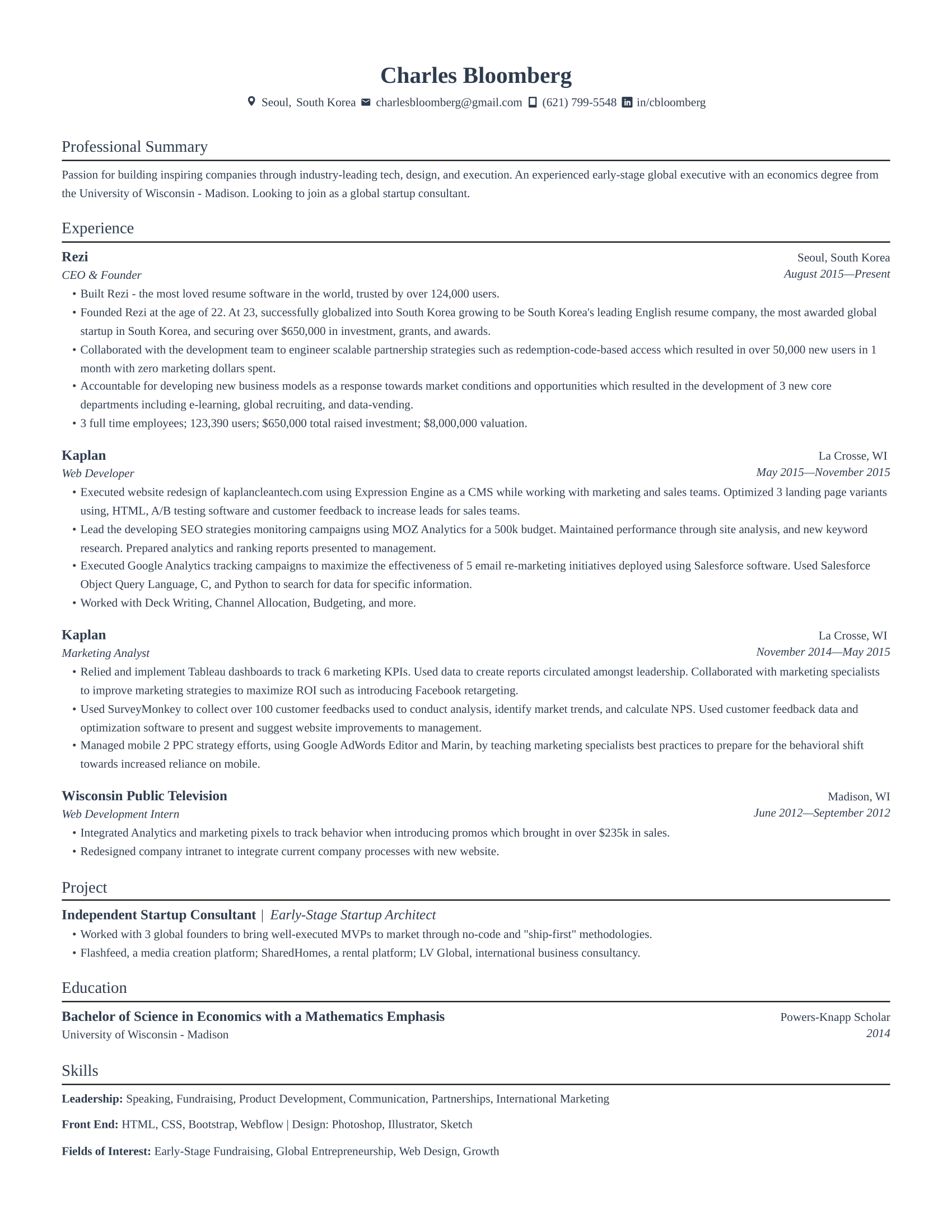
Structured resume template
Harvard resume template
Learn how to use Rezi for different scenarios:
- Rezi for Tech Jobs
- Rezi for Changing Careers
- Rezi for Project Management Jobs
- Rezi for Students and Graduates
- Rezi for Senior Job Applications
Summary
Let’s recap on how to make a resume stand out:
- Make sure your resume layout is professional and clean
- Use an AI resume agent for expert feedback on ways to make your resume better and more unique
- Include relevant links in your resume header section next to your contact details
- Emphasize key career accomplishments, relevant objectives, and unique skills or experience in your summary section
- Highlight contributions and outcomes that make your individual contributions clear
- Quantify where possible using numbers and statistics for tasks, responsibilities, and outcomes
- Add specific deadlines to further illustrate your skills and reliability to employers
- Get rid of buzzwords like “hard worker” and replace vague action words like “worked” with clear verbs like “coordinated”
- List further credentials or projects that showcase relevant skills and experience
- Clarify related leadership responsibilities and how you collaborated with other departments, as strong soft skills are valuable
- If applicable, mention industry trends
- Get a resume score report to know how well your resume stands out and if it’s ready for job applications
Now you know how to make a resume stand out. Use resume keywords and showcase how your specific background translates into the role you’re applying for. Do that, and you’ll have a resume that’s difficult to overlook.
FAQs
How to make my resume more noticeable?
To make your resume more noticeable, focus on relevance over aesthetics by tailoring your content to the specific keywords and desired skills highlighted in the job description. Start by using a clean, ATS-optimized layout that allows both bots and humans to scan your information, then swap passive language for strong action verbs and quantifiable achievements (like percentages or dollar amounts) to prove your impact. Include a personalized summary that mentions the company by name and provides links to a portfolio or LinkedIn profile to build immediate credibility and show the person behind the paper. Mention experiences, accomplishments, or projects that demonstrate desirable qualities. Quantify your responsibilities and achievements where possible, and emphasize how your individual contributions made an impact.
How should I format my resume to make it stand out?
Use a clean, professional format for your resume. Keep it simple and minimal. Make sure the content is readable and parsable by hiring software by using an ATS-friendly resume template. If you’re applying for a job in the creative field, you could consider creative resumes but try not to go overboard because it may not be parsable by applicant tracking systems (ATS). In terms of structure, stick to the reverse chronological approach. This makes your work history easy to skim and prioritizes the most recent and relevant information, which is what hiring managers want to see.
How to write my resume so that it stands out?
Quantify your impact with hard data. Use percentages and numbers, focusing on key outcomes like revenue and time saved. Include timeframes to clarify a key task, project, or accomplishment. And when writing bullet points, use strong action verbs. In your resume header, include relevant social media and website links, as your online presence can reinforce your job application. Use your summary section to highlight your key strengths, experiences, and unique skills that set you apart from other candidates. Include additional sections to showcase any relevant credentials, qualifications, and achievements. Ultimately, however, a resume that stands out is all about putting together a targeted pitch that proves you’re a specific solution to the problems that the company is trying to solve.
How do I make my resume stand out for my first job?
Shift the focus from what you’ve done to what you’re capable of doing. Lead with a strong professional layout that highlights academic achievements, relevant coursework, and extracurricular leadership or volunteer work. Don’t underestimate "informal" experience too; that high-stakes club treasury role or the summer you spent managing a lawn care side-hustle counts as project management and reliability. Use a clean, one-page template that is easy for both humans and AI scanners to read, and always include a summary or objective section that emphasizes your "hunger to learn" and how your specific background makes you the right person to hire.
Related: How to Write a Resume With No Work Experience
What should I put on my resume to make it more unique?
To make your resume truly unique, move beyond the standard "Work Experience" section. Consider custom sections based on your specific background, like “Consultancy” when you have consulting experience from relevant projects. Emphasize tangible evidence of your skills and passion, such as a personal blog, a coding project, or a successful fundraise you organized. One effective way to make yourself stand out is to use your online presence to your advantage. This includes adding a link to your portfolio, website, or social media.
Read more: What to Put on a Resume
Is using keywords enough to make my resume stand out?
Keywords on their own aren't enough to stand out. Think of keywords as your “entry fee” for getting past applicant tracking systems (ATS). However, keywords alone won’t win over a human hiring manager. You also need context and proof. So, quantify your skills in your work experience section. Showcase relevant achievements, qualifications, and certifications. For instance, show how you used “project management” to increase efficiency for 20%. Embed keywords, but don’t forget to make it clear throughout your resume that you’re a high-performer.

Upload or drop your resume to get started
Upload your resume to get started
Score my resume

Astley Cervania is a career writer and editor who has been sharing resume and job search insights for 5+ years. He shapes the direction of the Rezi blog, providing practical answers for important career-related questions and helping hundreds of thousands of people navigate the job market and build resumes that land interviews.