Resume
How to List Hobbies and Interests on a Resume (50+ Examples)
Learn how to list hobbies in a resume effectively, with expert tips and examples that add value, show personality, and help your resume stand out.
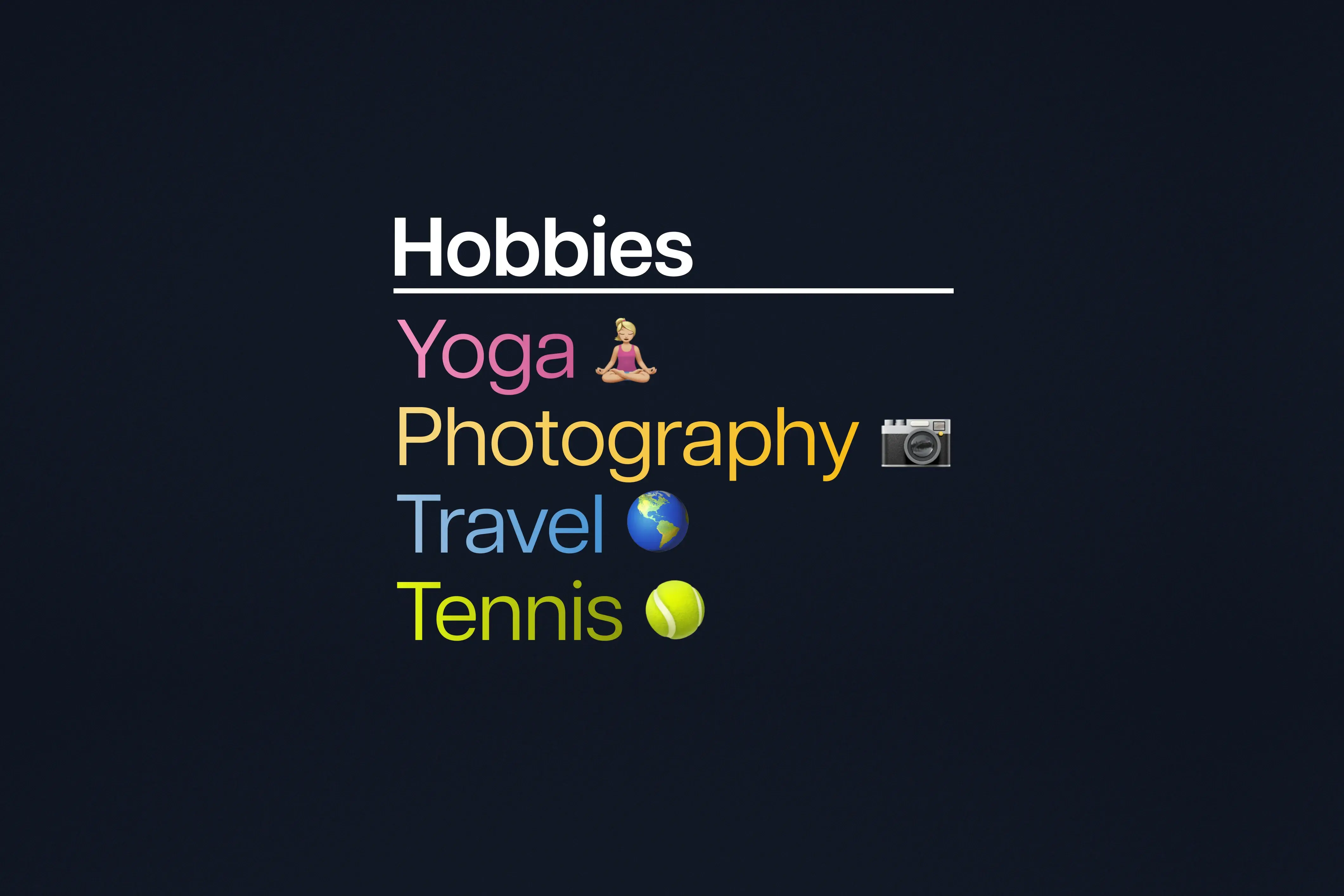
Published on
November 27, 2024
Updated on
January 14, 2026
When listing hobbies and interests on a resume, focus on relevance and impact. Choose activities that reveal transferable skills and align with the job or company culture. Keep the section short, around three to five items, and place it at the bottom so it complements your professional experience without taking focus away. Avoid controversial, risky, or polarizing activities, and never sacrifice skills or professional achievements for hobbies. Use them to enhance, not overshadow, your qualifications.
Your resume should stay professional, but that doesn’t mean it has to feel robotic or boring. Adding hobbies can give it a human touch, but how do you know when to include them? Will your love of fire-eating wow a future boss enough to land an interview?
Probably not.
Unless your dream job involves circus skills, it’s just taking up space and raising eyebrows for the wrong reasons. It’s all about keeping things relevant. Highlight hobbies that genuinely support your skills and fit for the role, rather than random or quirky pastimes.
So, how do you know what’s relevant? This guide will tell you:
- Whether you should include hobbies and interests on your resume.
- What are good hobbies to put on your resume.
- Tips on how to stay professional while adding personality.
Need help adding hobbies and interests? Try our AI Resume Builder. We’ll guide you through the whole process section-by-section, with expert tips and feedback.
And for more resume tips, check out these helpful guides:
- What Awards To Put On A Resume
- How to List Your Best Projects on a Resume
- How to Add Volunteer Experience to a Resume
- How to List Extracurricular Activities on a Resume
What Are Hobbies on a Resume?
Hobbies are activities that help you unwind, stay curious, or challenge yourself. When you include hobbies in your resume, they give a hiring manager a clearer idea of who you are beyond your resume bullet points.
Think of hobbies as the “human” side of your application and an insight into who you are outside the office. Maybe that means playing an instrument, training for a sports event, or learning new languages. These say something about how you spend your downtime and the strengths you naturally bring to the table.
Of course, not every hobby belongs on every resume. The best ones are those that subtly reinforce the qualities the employer is looking for. For example, if you’re applying for a role in finance, your time spent creating budgeting methods for friends proves your passion and skills beyond the traditional office.
List of resume hobbies
Check out this list of hobbies for different industries to help your resume stay relevant to the job:
What Are Interests on a Resume?
Interests on a resume give employers a glimpse into the ideas and topics that spark your curiosity. Unlike hobbies (which are usually hands-on activities), interests tend to be broader. They cover the subjects you enjoy learning about, the areas you follow closely, or the things you hope to dive deeper into down the road.
Your interests help paint a picture of how your mind works and what genuinely captures your attention. Plus, choosing interests that reflect who you are can open doors to meaningful connections with hiring managers during the interview stages.
For example, if you mention your love for visiting new countries, that detail might resonate with a company that values cultural awareness or global thinking. When chosen thoughtfully, your interests help add a much-needed human touch to your list of resume achievements.
List of resume interests
Need some inspiration? Here’s a list of interests for various career paths to put on your resume:
When to Include Interests and Hobbies on Your Resume?
Let’s start with the obvious question: Should hobbies and interests even be on a resume?
Well, it depends. Your experience level, the role you’re applying for, and even the company’s culture all matter here. Done well, hobbies can add personality and context. Done poorly, they are simply unnecessary filler.
We ran a LinkedIn poll that found 56% of respondents play it safe and leave hobbies off entirely to keep things strictly professional. Others were more selective: 11% said they list creative hobbies, 7% add sports or fitness interests, and 25% only include hobbies if they’re relevant to the job. That alone tells you the rule of thumb: relevance is everything.
Here are some general rules when adding hobbies and interests to your resume:
- When they support relevant or transferable skills. If your hobbies naturally reinforce skills the role requires, they can be useful for students, recent graduates, or career changers who lack a strong professional background. Well-chosen interests show passion for the field and hint at how you might contribute.
- When they reveal strengths not shown in your work history. Not every valuable trait shows up in job titles or bullet points. Hobbies can add depth to your story, highlighting creativity, discipline, or initiative. Unique or unexpected interests can also make your resume more memorable and give interviewers an easy way to start a conversation.
- When soft skills matter more than technical depth. Creative pursuits, team-based activities, or adaptable interests often reveal strong soft skills. If you’re early in your career or applying to a people-focused role, these details can help employers understand your character, work ethic, and potential cultural fit.
- When you have limited experience. If you’re light on professional experience, hobbies and interests can help balance the page and show that you’re proactive, engaged, and developing skills outside of formal work settings.
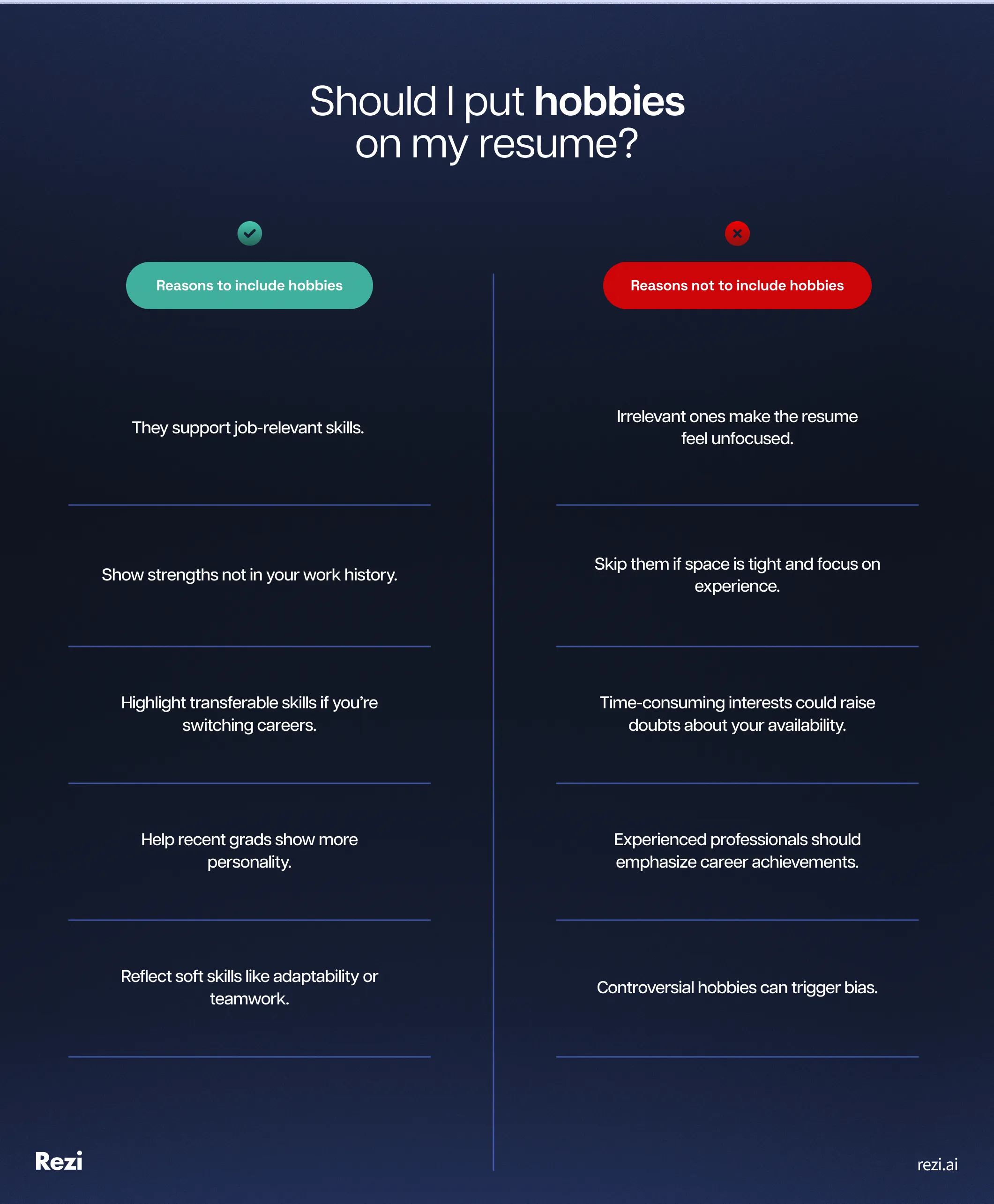
- When they won’t distract from your core qualifications. Irrelevant or overly personal hobbies can seem unprofessional. If space is tight, your experience and achievements should always come first. Avoid anything controversial or time-consuming that could raise unnecessary questions or bias.
Here’s a quick overview of when adding hobbies work in your favor — and when it’s better to keep them out:
Best Types of Hobbies and Interests: Examples & Tips
The “best” types of hobbies and interests hint at the skills, mindset, and personality traits employers care about. They are the supporting snippets that make your main qualifications more believable, human, and sometimes more memorable.
Below are some of the strongest hobbies and interests to consider, along with examples you can adapt for your own resume.
Creative Arts
Creativity doesn’t simply mean having an eye for design or being the friend who takes the most flattering photos. Creative hobbies show imagination, focus, and the ability to see things from a different perspective. Even outside creative industries, these pursuits can prove your ability to think outside the box and come up with unique solutions.
Check out these creative hobbies and interests:
- Drawing or illustration
- Photography
- Digital design projects
- Painting or mixed media art
- DIY creative projects
Writing and Blogging
Writing and blogging can point to more than just stringing a sentence together. Writing-based hobbies prove you can organize thoughts, explain ideas clearly, and pay attention to detail; skills that are useful in almost every role. Blogging also shows initiative and confidence in sharing your message and ideas.
Here are some hobbies and interests to show your inner wordsmith:
- Personal blogging
- Creative writing or short stories
- Copywriting or content creation
- Journaling or reflective writing
- Contributing to online publications
Playing Musical Instruments
As someone who’s tried (and failed) to master a musical instrument, I know it isn’t easy. Learning an instrument takes patience, consistency, and a willingness to practice when progress feels slow. Add in band or ensemble work, and you’ve got collaboration and feedback skills wrapped into one neat hobby.
Here are some musical hobbies to include on your resume:
- Playing guitar or piano
- Performing in a band or ensemble
- Music composition
- Learning new instruments
- Participating in open mic events
Cooking and Culinary Exploration
Knowing how to cook more than just pasta can blend well with roles in the food service or hospitality industry. Cooking mixes creativity with precision, while experimenting with new recipes shows curiosity and problem-solving in action. It’s also a subtle nod to organization, planning, and follow-through, especially when things don’t go exactly as planned.
Take a look at these culinary hobbies for your resume:
- Recipe development
- Exploring global cuisines
- Baking or pastry-making
- Meal prepping
- Food presentation and plating
Learning Languages
I’ve been trying to improve my Spanish for years, so I can vouch for how many soft skills it takes to simply master basic conversation. It shows persistence, cultural awareness, and a genuine interest in connecting with people beyond your own bubble. For roles with international exposure or diverse communities, this interest can be a serious asset.
Check out these language skills to add to your resume:
- Self-studying a foreign language
- Language exchange groups
- Cultural immersion learning
- Travel-based language practice
- Language-learning apps or courses
Find out more: How to List Resume Language Skills?
Technology and Gaming
Gaming often gets a bad rap, but if used for the right industry, these interests can be surprisingly valuable for your resume. They show comfort with digital tools, fast learning, and strategic thinking. Team-based games also mirror real-world collaboration and communication — just with more explosions.
Here are some technology-savvy interests for your tech resume:
- PC or hardware building
- Strategy-based gaming
- Learning new software tools
- Exploring emerging technology
- Coding or automation experiments
Here’s what a hiring manager said about including tech-related hobbies:

In the tech industry? Take a look: Best Technical Skills for a Resume
Travel and Cultural Exploration
Travel interests tell employers you’re comfortable with the unfamiliar. Whether it’s finding your way around new cities or understanding different customs, travel points to adaptability, curiosity, and interpersonal skills. It also suggests you’re not afraid to step outside your comfort zone, which often comes in handy in the workplace.
Here are some travel-related hobbies and interests:
- Cultural travel experiences
- International travel planning
- Exploring local traditions
- Travel writing or journaling
- Learning about global customs
Outdoor Recreation
Outdoor hobbies quietly communicate resilience and a proactive nature. Hiking a trail or climbing a mountain requires planning, endurance, and the ability to problem-solve and adapt. These activities also show that you value balance and well-being, important traits in high-pressure work environments.
Consider these outdoor activities for your resume:
- Hiking
- Camping
- Rock climbing
- Trail exploration
- Nature photography
Sports and Fitness
Sports are a resume classic for a reason. They show discipline, goal-setting, and commitment, whether you’re training solo or working with a team. Depending on the activity, they can also highlight leadership, teamwork, and perseverance under pressure.
Check out these athletic hobbies and interests:
- Team sports (soccer, basketball)
- Individual training (running, swimming)
- Yoga or pilates
- Strength training
- Competitive leagues or events
Volunteer and Community Engagement
Volunteering says a lot about who you are without saying much at all. It reflects empathy, initiative, and the ability to work toward something bigger than yourself. It’s especially impactful for organizations that value community, ethics, or social responsibility. Just make sure you don’t list anything too controversial or divisive.
Here’s how to show your passion for making an impact:
- Community volunteering
- Environmental initiatives
- Nonprofit event support
- Mentoring or tutoring
- Fundraising activities
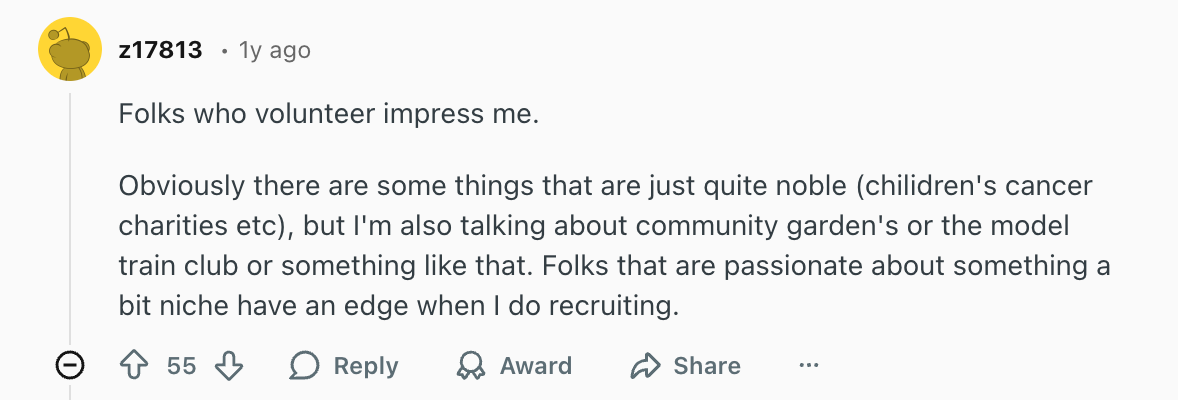
Check out what this recruiter shared about volunteer work on a resume:
Leadership Development
Leadership doesn’t always require a fancy title or decades of work experience. Organizing, mentoring, or launching side projects all show initiative and confidence. These hobbies tell employers you’re comfortable taking responsibility and guiding others when needed.
Check out these hobbies and interests that show off your leadership skills:
- Leading student or community groups
- Event organization
- Entrepreneurship projects
- Team coordination roles
- Peer mentoring
What kind of leader are you? Find out: Leadership Styles and How to Choose the Best One
Personal Growth and Self-Improvement
Employers won’t always be there to hold your hand, so they naturally appreciate people who keep learning, especially on their own time. Interests focused on growth show curiosity, self-awareness, and a drive to improve. They also show that you won’t just stagnate once you’re hired.
Here are some hobbies that prove you’re willing to learn and grow:
- Online courses or certifications
- Skill-building challenges
- Personal development reading
- Goal-setting practices
- Learning new tools or systems
Communication-Focused Activities
Saying you’re a “good communicator” is easy. Proving it is better. Activities that involve speaking, persuasion, or discussion give employers tangible evidence that you can express ideas clearly and connect with others.
Here are some activities that show you have more than a gift of the gab:
- Public speaking
- Debate or discussion groups
- Toastmasters participation
- Workshop facilitation
- Storytelling or presentations
Learn how to include communication skills throughout your resume: Best Communication Skills
Analytical and Technical Projects
Liking technology isn’t the same as knowing how to use it in the workplace. Enjoying hands-on technical projects bridges that gap. These interests show logical thinking and comfort navigating modern tools, which is increasingly valuable across most industries. In fact, according to the National Skills Coalition, 92% of U.S. workers are expected to have technical skills on a resume.
Here are some tech-related hobbies that indicate you’re ready for the future:
- Data analysis side projects
- Learning programming languages
- Software experimentation
- Technical problem-solving
- Building digital tools
Problem-Solving Activities
Problem-solving hobbies reveal how your brain works when things get tricky. You never know when the printer will break down before a meeting or an important client shows up out of the blue. Knowing how to problem solve shows critical thinking, patience, and curiosity — all traits employers rely on when real-world challenges take you by surprise.
Check out these problem-solving hobbies and activities:
- Logic puzzles
- Strategy games
- Escape rooms
- Brain-training challenges
- Analytical competitions
How to List Hobbies and Interests on a Resume?
Here’s a quick overview of how to list hobbies and interests on your resume:
- Review the job description carefully to identify the desired skills and traits you want to highlight through hobbies.
- Consider whether your hobbies and interests are relevant to the role and your career stage before including them.
- Create a dedicated hobbies and interests section at the end of your resume to maintain clarity and organization.
- Include hobbies in your education or work experience section when they demonstrate real responsibility or achievements.
- Ensure your hobbies add genuine value and strengthen your resume rather than fill space.
- Update, refine, and remove your hobbies section as you gain professional experience.
1. Review the job description for desired skills
Before you think about listing random hobbies, focus on the job posting. Employers are telling you exactly what they care about; you just have to read between the lines. Skills, traits, and buzzwords in the description can guide which hobbies actually strengthen your application.
What you can do:
- Look closely at required and preferred skills, especially soft skills like communication, creativity, or leadership. Highlight keywords and ask yourself which hobbies naturally demonstrate those traits through real actions or outcomes.
- Choose hobbies that subtly reinforce the job’s priorities. For example, improvisational theater can point to public speaking and adaptability, while DIY projects or creative writing can support problem-solving and creativity.
Want a quick list of skills to include? Try our AI Keyword Targeting tool. It scans the job description, pulls out the keywords, and even writes bullet points that naturally fit them into your resume.
2. Consider if your hobbies are relevant
Your career stage matters. If you’re early in your career or changing industries, hobbies help show what you can do beyond the workplace. While if you’re senior-level with years of experience, it’s best to prioritize professional achievements. Relevance, not enthusiasm, should drive your decision on what to include in your resume.
What you can do:
- Consider how much value your hobbies bring to your resume. If your experience section is strong, hobbies may not be necessary. But if you’re a student, recent graduate, or career switcher, hobbies can help showcase transferable skills and fill in gaps.
- Don’t just name the activity; add context and connect your hobbies to in-demand skills. “Volunteering at a local shelter” becomes more powerful when you briefly note teamwork, organization, or time management gained from the experience.
New to the workforce? Find out more: How to Write a Resume With No Experience
3. Create a hobbies and interests section
If you decide hobbies belong on your resume, give them a clear home at the end of the page. A dedicated section keeps things organized and prevents it from competing with your professional experience. Think of this resume section as supporting space, not the star of the show.
What you can do:
- Add a short “Hobbies and Interests” section near the bottom of your resume, so recruiters see it after your skills and experience. This keeps the focus on your qualifications while still adding personality.
- Aim for no more than five well-chosen hobbies. Each one should reinforce a skill, value, or trait relevant to the role, rather than serving as a personal fun fact.
4. Include hobbies in your education or work experience
Sometimes hobbies aren’t really hobbies; they’re unpaid work, leadership roles, or structured commitments. When that’s the case, they can carry more weight by being integrated into your education or experience sections, as long as they’re presented honestly and professionally.
What you can do:
- Treat substantial commitments like real experience: Volunteer work, charity projects, or community leadership roles can live under work experience if you clearly state they were unpaid and focus on outcomes, responsibilities, and impact.
- For students and recent grads, clubs, sports teams, and student organizations can fit naturally under education. This shows initiative, teamwork skills, and development beyond coursework.
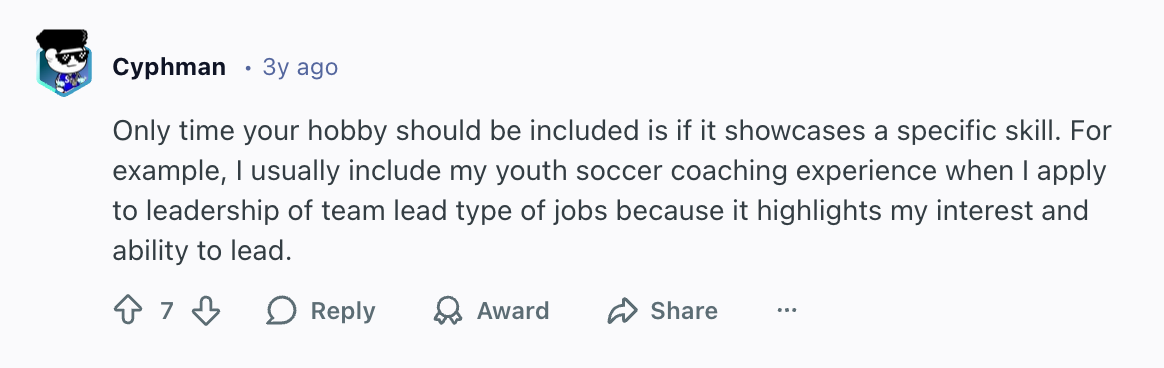
Here’s another example of using hobbies and interests to show off your skills:
5. Check your hobbies add value to your resume
Just because your pottery hobby takes time and effort doesn’t mean it belongs on your resume. The real question is whether it helps an employer understand why you’d be good at the job. If it doesn’t strengthen your case or show your skills, it’s probably better left out.
What you can do:
- Ask the employer’s question: Would this hobby help someone hiring for this role trust your abilities more? If the answer is no (or requires a rambling explanation), it’s likely not pulling its weight.
- Choose hobbies that align with the industry. For example, tech roles pair well with coding or robotics interests, creative roles benefit from writing or design projects, and people-facing roles shine with volunteering or team-based activities.
Here’s some straightforward advice from a career coach:

6. Update your resume as you gain experience
Hobbies are most helpful early on, when your professional story is still taking shape, and you need to fill the gaps. As your career grows, your work experience should naturally take center stage (save your hobbies as a conversation starter in the interview).
What you can do:
- Phase hobbies out as experience grows. Once you’ve built a solid work history with measurable achievements, hobbies often become less necessary on a resume and more useful as interview (or Christmas party) talking points.
- Each time you update your resume, ask whether your hobbies still add value. If not, trim them back or remove them entirely to keep your resume focused and professional.
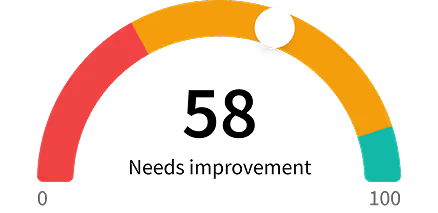
Need help improving your resume? Find out your Rezi Score and get expert feedback and suggestions on how to update your job application according to best practices.
Hobbies and Interests on a Resume: Do’s and Don’ts
Every word matters on your resume. Luckily, you’ve got the internet on your side. Use it to dig into the job posting, the company’s goals, and get a feel for their work culture to tailor your application. Remember, your hobbies are all about you until they hit your resume. Once they’re there, it’s about how they fit the job.
Here’s a roundup of the must-haves and red flags when listing hobbies and interests on your resume:
Best practices
- Do your homework on the role and company: Are your hobbies aligned with the job and the company? Scan the company website, social channels, and employee profiles to get an idea of their values. When your interests mirror their culture, it subtly signals that you’d fit right in.
- Be honest and specific: Stretching the truth might get you an interview, but it won’t survive a proper conversation. Stick to hobbies you genuinely enjoy and can talk about comfortably. Specifics also help; “reading leadership psychology” says far more than “reading” and gives employers a clearer sense of your interests.
- Highlight involvement, not just participation: Simply naming a hobby is fine, but adding outcomes or achievements makes it more meaningful. Employers care about impact, so show commitment where you can. Mentioning competitions, leadership skills, or milestones turns a casual interest into proof of transferable skills.
Common mistakes
- Avoid controversial or polarizing hobbies: Your resume isn’t the place for topics that could trigger bias or distraction. Political, religious, risky, or extreme activities (no matter how important to you) can raise unnecessary questions. The goal is to look capable and reliable, not to start a debate before you even get the job.
- Don’t overload the hobbies section: Your experience and skills should always take priority. Listing too many hobbies can make your resume feel unfocused or like you’re trying to make up for what you’re lacking. Stick to a short, curated list (around five max) that supports your application.
- Don’t sacrifice valuable resume space: If adding hobbies means cutting out key skills, accomplishments, or experience, don’t do it. Hobbies should enhance your resume, not crowd it. If space is tight, consider leaving them out or briefly weaving them into a cover letter where you can add more context.
Summary
Here’s a reminder of what to know when adding hobbies and interests to your resume:
- Only include hobbies and interests if they add value, reinforcing skills, traits, or experiences relevant to the role. If they don’t strengthen your application, they’re better left off your resume.
- Review the job description and company values to decide which interests to include. Well-matched hobbies show you understand what the employer cares about.
- Highlight transferable skills, not just activities. The best hobbies demonstrate qualities like teamwork, leadership, creativity, discipline, or problem-solving. Make it easy for hiring managers to connect your interests to workplace strengths.
- Use hobbies to support early or changing careers. Hobbies are most useful for students, recent graduates, or career changers who need to show skills and initiative beyond limited or unrelated work experience.
- Limit your list to three to five relevant items and place it near the bottom of your resume so it complements (rather than competes with) your professional experience.
- Skip hobbies tied to politics, religion, extreme risk, or polarizing issues. These can introduce bias or distraction instead of highlighting your suitability for the role.
- Never remove important skills, achievements, or experience to make room for hobbies. If space is tight, prioritize professional qualifications and save personal interests for interviews.
FAQ
What are professional hobbies and interests?
Professional hobbies and interests are activities that reflect skills, qualities, or traits relevant to your career. They go beyond casual pastimes and show initiative, discipline, or creativity, like coding side projects, volunteering, and public speaking.
These hobbies help employers see you as a well-rounded candidate, highlight transferable skills, and suggest cultural fit. Unlike purely personal hobbies, professional interests subtly reinforce your capabilities in ways that matter to the job, showing that your growth and curiosity extend outside the workplace while staying relevant to your field.
What’s the difference between hobbies and interests on a resume?
Hobbies are activities you actively do for fun, relaxation, or skill-building, such as painting, playing sports, or cooking. Interests are broader, reflecting subjects or ideas you’re curious about, like emerging technology, sustainability, or global cultures. On a resume, hobbies show hands-on engagement and transferable skills, while interests reveal your intellectual curiosity, adaptability, or alignment with the company’s values.
How to include hobbies and interests on a CV?
Include hobbies and interests only when they add value or reinforce relevant skills. Create a short, dedicated section at the end of your CV, ideally listing three to five activities. Be specific and show achievements or responsibilities where possible, for example, “captain of local soccer team” instead of just “soccer.”
Focus on activities that show transferable skills, like leadership, teamwork, creativity, or problem-solving, and align them with the company’s culture or job description. Avoid controversial or overly personal hobbies. For limited experience, integrate hobbies into your volunteer or education resume section to show initiative and active engagement.
How to list activities on a resume?
List activities clearly and concisely, ideally under a dedicated section such as “Hobbies and Interests” or within your education or volunteer experience. Use action-oriented phrasing, specify leadership roles, and mention transferable skills like teamwork, creativity, or problem-solving.
Limit to a few items that complement your professional profile and keep descriptions brief. Activities should reinforce your qualifications, demonstrate initiative, or provide conversation starters without taking attention away from your core experience.
What are resume interests examples for students and freshers?
Students and freshers can include hobbies and interests that demonstrate initiative, transferable skills, or personal growth. Examples include:
- Volunteering in community projects
- Participating in sports or debate clubs
- Blogging or creative writing
- Learning new languages
- Coding or tech projects, public speaking
- Organizing college events
Even small achievements, like coordinating a student club or contributing to a charity drive, can be framed to highlight qualities employers value. For limited work experience, these interests help round out a CV and show a proactive, well-rounded candidate.
Learn more about what to avoid on a resume: Common Resume Mistakes Among Students

Upload or drop your resume to get started
Upload your resume to get started
Score my resume

Lauren Bedford is a seasoned writer with a track record of helping thousands of readers find practical solutions over the past five years. She's tackled a range of topics, always striving to simplify complex jargon. At Rezi, Lauren crafts genuine and actionable content that guides readers in creating standout resumes to land their dream jobs.