
Resume
How to List Awards on a Resume (Achievements & Examples)
Learn how to list awards on a resume to highlight your achievements, boost credibility, and impress hiring managers with relevant recognitions.

Published on
January 3, 2025
Updated on
March 11, 2026
Awards on a resume are proof that others have acknowledged your work, adding weight to your qualifications. To make them count, they should clearly align with the role you’re pursuing and highlight skills or results that matter to the employer. Awards work best as supporting evidence, so your experience and abilities stay front and center. List professional awards within the job where you earned them, academic distinctions in the education section, or create a standalone awards section when you have multiple strong recognitions. Be sure to include the award name, issuing organization, and date, and boost their impact with job-related keywords and measurable outcomes.
I’ll never forget standing in front of those judges, reciting a chapter from The Indian in the Cupboard after hours of practice. The result? A shiny “Best Speech” award that had teenage me beaming with pride. But here’s the thing: I was 15.
15 years later, and that award means little in today’s professional world. Outdated or irrelevant honors don’t impress employers — they only distract from your current qualifications and work history. The key is to select awards emphasizing skills directly tied to the job you want.
Keep reading to refine your approach to resume-worthy awards. This guide will show you:
- Why you should (or shouldn’t) include awards on your resume.
- The best types of resume awards and achievements.
- Where your awards belong on your job application.
Not sure where to start? Use our free AI Resume Builder to build your resume step-by-step, with tailored suggestions and expert feedback.
And learn more about adding other sections to your resume:
- Hobbies to Put On a Resume
- How to Show Achievements on a Resume
- How to List Certifications on Your Resume
- How to List Extracurricular Activities on a Resume
What Are Awards on a Resume?
Awards on a resume are recognitions you’ve earned for strong performance, achievement, or contribution, helping to show hiring managers how others have validated your abilities.
Resume awards quietly communicate abilities that are harder to show on paper, like leadership, creativity, or problem-solving skills. This can be helpful if you’re early in your career or changing fields, since those qualities help show your drive and potential, despite a lack of experience.
That said, awards shouldn’t be the focus of your resume. Recruiters still care most about what you can do and what you’ve done in your professional roles, so awards should support your story, not replace it.
And if you lack work experience, be careful not to overcompensate. Listing awards isn’t about dumping everything you’ve ever won onto the page. It’s about choosing recognitions that reinforce the kind of professional you’re presenting and that align with the role you want next.
Why Should You Put Awards on Your Resume?
You should include awards on your resume if they validate your skills and accomplishments and add credibility to your application. When chosen carefully, awards help strengthen your overall qualifications and give hiring managers a better idea of what you can contribute.
Ask yourself: Does your award support the role you’re targeting and reinforce the skills for that position? If the answer is yes, you’re on the right track. Awards make a better impression when they’re recent enough to align naturally with your experience and career progression.
Here’s when adding awards can strengthen your resume:
- Early career or entry-level roles: If you don’t have much professional experience yet, academic honors, scholarships, dean’s list recognition, or competitive awards help demonstrate strong performance, discipline, and potential.
- Awards that highlight job-related skills: Recognition tied to leadership, innovation, technical ability, sales performance, or teamwork skills helps employers see how you’ve applied your skills and been recognized in real situations.
- Demonstrating commitment and growth: Professional awards show that you consistently strive to improve, take initiative, and deliver results, offering proof of your work ethic and dedication to your field.
- Reinforcing cultural fit: Awards connected to values, such as innovation, collaboration, customer service, or community involvement, can show alignment with a company’s culture and priorities.
- Differentiating yourself from similar candidates: When multiple applicants have similar experience, awards can serve as a tie-breaker by showing that your contributions stood out enough to be formally recognized.
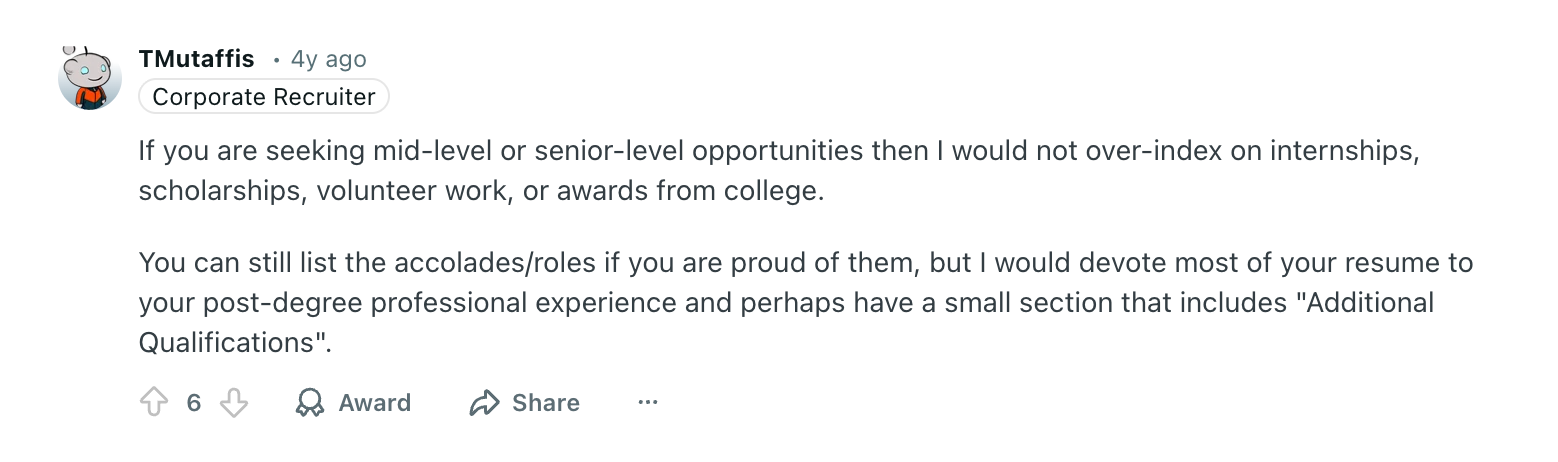
Here’s some smart advice about including awards from a recruiter:
When to avoid listing awards on your resume
You should avoid listing awards on your resume when they don’t add real value or connect clearly to the role. If an award doesn’t strengthen your case as a candidate, it’s better left off so your resume stays focused and relevant.
One mistake I see all the time? Overcrowding the page with irrelevant filler. It only distracts from your valuable skills and experience. Yes, awards are impressive, but don’t let them overshadow your actual qualifications. Hiring managers want a clear picture of what you can do, and too many unrelated honors can blur that message.
So yes, please resist the urge to include every award you’ve ever earned.
A long list can be overwhelming and take attention away from even your strongest achievements. Think of it this way: the recruiter only had ten seconds to scan your resume, so make sure they only focus on the best bits.
Types of Awards to Put on a Resume for Students
Here’s a list of the best types of awards for students on a resume:
- High school awards
- Valedictorian
- College honors and academic awards
- Scholarships and grants
- Sports and athletic awards
- Academic research awards
The best awards for students are the ones that show effort, ability, and potential, especially when you don’t yet have much work experience. But timing is everything. Once you’re in college, it’s time to remove those high school awards. And after getting some work experience? Consider replacing college honors with professional accolades.
Let’s look closer at what to include, along with examples, and how they might look on a resume.
High School Awards
High school awards are useful if you’re still in school or don’t yet have any college-level achievements. They show early leadership, a strong work ethic, and valuable soft skills. That said, I recommend cutting your high school awards as you gain more college credentials or professional experience, so your resume reflects who you are now.
Examples:
- Honor Roll
- Perfect Attendance
- Student Leadership Award
- Academic Excellence Award
- National Honor Society
Resume example:
Honor Roll Student, Lincoln High School — June 2022
Recognized for maintaining a 3.8+ GPA across four academic years.
Applying for jobs with no experience? Learn more: How to Write a Resume With No Experience
Valedictorian
Being named valedictorian is a standout academic achievement and worth listing if you’re looking for a job straight out of high school. It shows discipline, intelligence, and long-term consistency. However, once you’ve completed college or built stronger academic or professional credentials, it’s best to replace this award with more current achievements.
Examples:
- Valedictorian
- Salutatorian
- Top Graduate Award
Resume example:
Valedictorian, Class of 2024, Firewood High School
College Honors and Academic Awards
College honors are especially valuable on student and entry-level resumes because they show sustained academic excellence. Awards like Latin honors or Dean’s List recognition show focus, reliability, and strong performance over time, which employers appreciate when you don’t have as much professional experience.
Examples:
- Dean’s List
- Cum Laude
- Magna Cum Laude
- Summa Cum Laude
Resume example:
Magna Cum Laude Graduate, Bachelor of Economics, Ohio University — May 2024
Check out more resume tips and guides for students:
- How to List Relevant Coursework on Your Resume
- How to Use Rezi for Student and Graduate Job Applications
- Common Resume Mistakes Among Students & Fresh Grads
Scholarships and Grants
Well-known or competitive scholarships can strengthen your resume by showing that you stood out among other applicants. These awards often reflect leadership, academic ability, or specialized skills. That said, I only suggest including them when they’re selective, prestigious, or directly related to your field of interest.
Examples:
- Fulbright Grant
- National Merit Scholarship
- STEM Research Scholarship
- Honors College Scholarship
Resume example:
National Merit Scholarship Recipient, National Merit Scholarship Corporation — August 2025
Awarded based on academic achievement and standardized test performance.
Sports and Athletic Awards
Athletic awards work well on a resume for entry-level roles because they highlight teamwork, perseverance, and leadership. But know your audience. Winning MVP for your weekend soccer league? Great for bragging rights, but it won’t wow a corporate recruiter. Stick to notable or career-relevant sporting achievements.
Examples:
- Most Valuable Player (MVP)
- Team Captain
- All-Conference Selection
- Athletic Leadership Award
Resume example:
Team Captain & MVP, University Women’s Soccer Team — October 2024
Academic Research Awards
Research awards are essential if you’re applying for graduate school, academic roles, or research-focused positions. They show off your subject-matter expertise and how faculty or institutions have recognized your work. And yes, you can include grants you were offered but declined (nothing wrong with being in demand).
Examples:
- Undergraduate Research Grant
- Best Research Paper Award
- Academic Conference Scholarship
- Faculty Research Fellowship
Resume example:
Research Grant Recipient, Department of Biology, California University — March 2024
Awarded funding for independent research on cellular regeneration.
Applying for a research role? Find out more: Academic CV: How to Write a Curriculum Vitae
Examples of Professional Awards for a Resume
Here are some professional award examples to list on your resume:
- Performance awards
- Industry awards
- Employee of the Month
- Community service awards
- Military awards
- Competition awards
- Certifications
Once you’re established in your career, start including professional recognitions that clearly connect to your work and results. These awards impress when they’re tied directly to your roles; either listed under the relevant job in your experience section or grouped into a dedicated “Awards and Achievements” section if you have several worth highlighting.
Now, let’s see how you can add these accomplishments to your resume:
Performance Awards
Performance awards, like “Salesperson of the Year,” are proof of your ability to deliver results. They tell recruiters you’re a valuable contributor who drives success. For more impact, pair them with specific accomplishments. Did you beat sales records or offer top customer service? Highlight measurable outcomes to really show off your abilities.
Examples:
- Employee of the Year
- Salesperson of the Year
- Top Performer Award
- Customer Excellence Award
Resume example:
Salesperson of the Year, ABC Technologies — December 2025
Recognized for exceeding annual sales targets by 35%.
Industry Awards
Industry awards prove that your work goes beyond your own boss giving you a pat on the back. These are gold for credibility because they show third-party validation from respected associations or publications. Keep them recent and well-known, especially if you’re competing for senior or high-visibility roles.
Examples:
- Top 30 Under 30
- Entrepreneur of the Year
- Industry Excellence Award
- Innovation Leader Award
Resume example:
Top 30 Under 30, Marketing Professionals Association — June 2024
Employee of the Month
While fairly common, Employee of the Month can still be a nice addition when it’s earned for a specific achievement or consistently recognized over time. It helps show consistency, reliability, and leadership. Just be selective — recent recognition or multiple wins carry far more weight than a single mention from years ago.
Examples:
- Employee of the Month
- Outstanding Team Member Award
- Leadership Spotlight Award
Resume example:
Employee of the Month, Horizon Retail Group — September 2024
Recognized for leading a high-performing customer service initiative.
Community Service Awards
Community service and volunteer awards prove you’re someone who uses your skills to make an impact (and you’re a pretty decent human, too). Have you been rewarded for your work with nonprofits, education, or roles that value social responsibility? Recruiters will see you genuinely care about making a difference, not just clocking in hours.
Examples:
- Volunteer of the Year
- Community Impact Award
- Humanitarian Service Award
Resume example:
Volunteer of the Year, City Youth Outreach Program — November 2023
Find out more: How to Add Volunteer Experience to a Resume
Military Awards
Military honor awards are proof that you’ve gone above and beyond under pressure. You can include these awards for military roles and in civilian positions where employers value transferable skills, such as conflict resolution, teamwork, or technical expertise. Just make sure you keep these skills and accomplishments relevant to the position and company.
Examples:
- Army Achievement Medal
- Navy Commendation Medal
- Service Excellence Award
Resume example:
Army Achievement Medal, United States Army — August 2024
Awarded for leadership and operational excellence during active deployment.
Competition Awards
Awards from professional or industry competitions show commitment, expertise, and high standards. They’re especially useful when they align closely with your field, whether that’s design, tech, strategy, or business. When chosen carefully, they reinforce your focus and ability to stand out from the pack.
Examples:
- Hackathon Winner
- Case Competition Finalist
- Design Challenge Champion
Resume example:
1st Place, National UX Design Challenge — April 2024
Certifications
Certifications validate your technical skills and show intentional career development, especially if you don’t have a strong professional background (bonus points for taking initiative). You should include certifications that clearly support the role you want and communicate immediate value to the employer.
Examples:
- AWS Certified Solutions Architect
- Google Data Analytics Certificate
- PMP Certification
Resume example:
Project Management Professional (PMP), Project Management Institute — January 2025
How to List Awards on a Resume
Here’s how to list awards on a resume:
- Consider awards relevant to the job by choosing those that directly support the skills, expertise, and results required for the role.
- Include the correct information by clearly listing the award’s official name, the organization that granted it, and the date received.
- Mention details for context by briefly explaining what the award was for, what you did to earn it, and the impact of your contribution.
- Quantify your awards and achievements when possible by adding numbers, percentages, rankings, or timeframes.
- Weave in key phrases and action words from the job description that highlight the skills you used to get your award.
- Avoid listing controversial or irrelevant awards by cutting anything that doesn’t support the job.
Keep reading for more examples of how to include your awards throughout your resume.
1. Consider awards relevant to the job
If there’s one rule to take from this, let it be relevance. Your resume isn’t the place for nostalgia, no matter how proud your parents are of that high school drama trophy. Awards should earn their spot by reinforcing why you’re a strong candidate for this specific role.
Here’s some solid advice from a Redditor that reinforces this point:
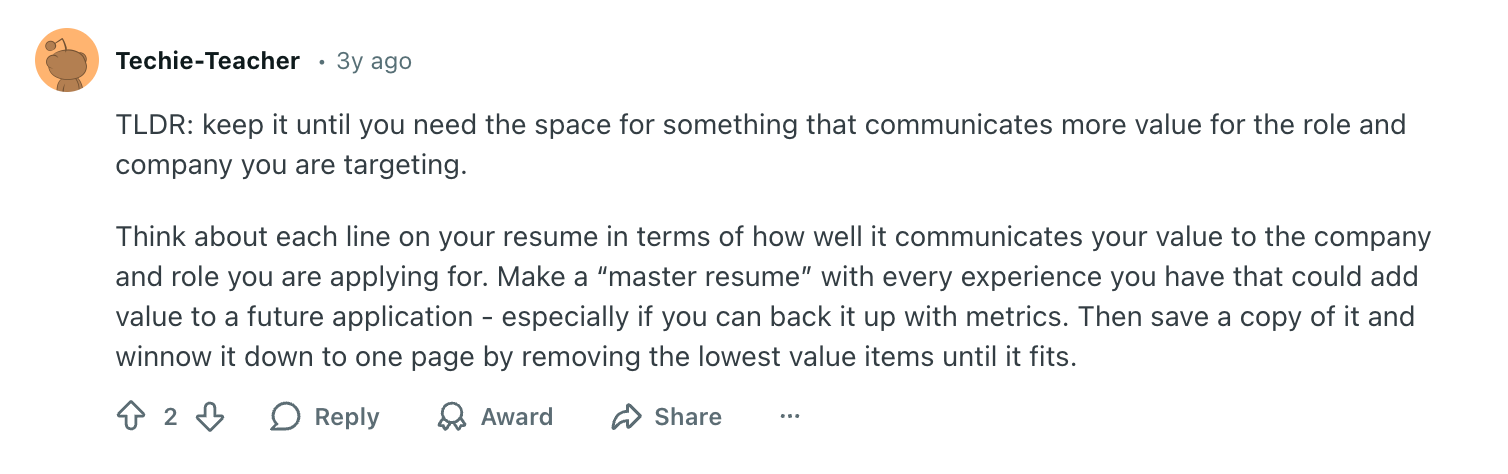
Ask yourself whether the award highlights skills, expertise, or outcomes that matter in the job you’re applying for. If it doesn’t, it’s clutter, and clutter weakens impact.
Awards that work best usually show things employers value, like:
- Demonstrated expertise in your field
- Consistent high performance
- Leadership, initiative, or measurable results
Is your award relevant to the position? The easiest way to find out is to look at the job description. If the skills and qualifications align with the abilities you used to get the award, it’s probably worth including in your resume.
Speed up the process with our AI Keyword Targeting tool. Simply enter the job description and get a list of key skills and phrases to add to your resume.
2. Include the correct information
Every award on your resume should clearly answer what, who, and when. At a minimum, include:
- Name of the award
- Organization or institution that granted it
- Date or year you received it
Be as accurate as possible. Dates help recruiters understand how recent (and relevant) your achievement is and how it fits into your career timeline. Just remember: an impressive award from ten years ago might quietly go against you unless it’s truly notable.
3. Mention details for context
Recruiters won’t always know what an award represents, especially if it’s niche or internal. You shouldn’t just assume the IT recruiter knows about your Minecraft scholarship (yes, that’s a thing). A short line or two can provide just enough explanation to describe the purpose of the award.
If the award was tied to a specific contribution, briefly highlight:
- What you did
- Why it mattered
- The outcome or impact
Focus on the impact of your actions. Did you exceed goals or contribute to a major success? By linking the award to your contributions, you prove your work delivers tangible results. Just don’t overdo it with a paragraph-long explanation (not even close). Just give enough insight to show your award reflects real value.
4. Quantify your awards and achievements
“Won Employee of the Month” is fine. But saying, “Won Employee of the Month five times for exceeding sales goals”? Much more memorable. Numbers bring credibility, help recruiters quickly see the scope of your impact, and just sound way more impressive.
When possible, add:
- Percentages or dollar amounts
- Rankings or frequency (e.g., top 5%, awarded 3x)
- Timeframes that show speed or consistency
Quantifying your awards transforms them from passive recognition into proof of performance.
But don’t worry if you don’t have any metrics. The most important thing is that your award points to the same skills or expertise tied to the job.
Learn more about aligning your awards with the job: How to Tailor a Resume to a Job Posting
5. Weave in key phrases and action words
If you’re determined to get the job, every inch of your resume should create impact — don’t be afraid to sell yourself. Even in the awards section, you can use strong resume action verbs when adding context to your accomplishments.
Here are some popular choices:
- Earned
- Recognized
- Awarded
- Accomplished
- Achieved
- Honored
- Distinguished
- Acknowledged
- Granted
- Celebrated
And there’s always an opportunity to tailor your resume, even in the small sections. Scan the job ad for keywords such as leadership, collaboration, innovation, or technical expertise.
If an award demonstrates one of those qualities, say it directly. This helps with applicant tracking systems (ATS) and makes it easier for recruiters to see a potential connection.
Learn more about the ins and outs of ATS: How to Beat Applicant Tracking Systems
6. Avoid listing controversial or irrelevant awards
Not every award deserves a spot on your resume. If you wouldn’t bring it up during a Thanksgiving meal, a first date, or in front of your entire friendship group, think twice about sharing it with a hiring manager.
Anything controversial, polarizing, or unrelated to the role can introduce bias or distract from your qualifications. Likewise, easy or unimpressive achievements don’t add value — save that space for stronger evidence of your abilities.
If an award doesn’t:
- Support the job you’re applying for
- Highlight relevant skills or results
- Strengthen your professional story
…it’s probably better left off. A shorter, sharper awards section will always do more for you than a long, unfocused one.
Here are some more resume red flags:
Where Do You Put Awards on a Resume?
Here’s where to include awards on your resume:
- Work experience section: Add professional accolades to your work experience by listing awards under the relevant job.
- Education section: Include academic awards in your education section to highlight dedication, discipline, and skills, especially if you’re an entry-level candidate.
- Awards section: Create a separate awards section if you have multiple significant recognitions, keeping it focused, relevant, and recent.
- Summary or objective: Mention achievements in your summary by mentioning one standout award to immediately demonstrate expertise and high performance.
Let’s see how you can tweak your awards depending on the resume section:
Add professional accolades to your work experience
You can add professional awards to your resume work experience bullet points if they’re directly tied to something you accomplished on the job. Mentioning awards under the relevant role shows hiring managers exactly how your work led to success.
Use a short bullet under the job title to explain why you earned the award, ideally with numbers to back it up. This works well for performance-based recognition, like sales, leadership, or productivity awards.
And if you need some inspiration, check out our free AI Resume Bullet Point Generator. Just enter some professional details and key skills to get a list of tailored bullet point suggestions to strengthen your application and add context to your accomplishments.
Here are some examples of professional awards to include:
- Employee of the Month
- Best Team Collaboration
- Safety Excellence Award
- Innovative Solutions Award
- Top Customer Service Performer
And this is how you can weave an award into your work experience section:
• Earned the “Top Salesperson of the Year” award for exceeding annual revenue targets by 35% while managing a portfolio of 50+ accounts.
• Honored with the “Innovation Award” for designing an automated reporting system that cut manual processing time by 40%.
• Named “Top Performer” company-wide for closing the highest number of enterprise deals in Q3, generating $1.1M in new revenue.
Include academic awards in your education section
If you’re fresh out of school and lacking work experience, academic awards can fill in those gaps. Academic awards show your dedication and highlight skills, such as discipline, work ethic, and specialized knowledge. All this is handy for entry-level job seekers or those looking to emphasize their academic background.
Check out these examples of educational awards:
- Dean’s List
- Valedictorian
- Student of the Year
- Best Research Paper
- Scholarship Recipient
Here’s how to include awards in your education section:
Bachelor of Science in Computer Science, State University
• Dean’s List (4 semesters) — State University, 2022–2024
And remember: while beefing up your education section can work when you’re just out of college, you should start cutting this down the longer you’re in the workforce.
Create a separate awards section
If you’ve collected multiple meaningful awards (congrats), a dedicated “Awards” section makes sense. This approach keeps things tidy and gives your recognitions the spotlight without cluttering your experience or education sections.
Just don’t go overboard. Every award should earn its place by being relevant, recent, or impressive enough to strengthen your application. Skip anything outdated or unrelated (your resume isn’t your mom’s trophy shelf).
Here’s how to add your accolades to your awards section:
• Community Leadership Award — City of Springfield (2024)
• Volunteer Excellence Award — Habitat for Humanity (2023)
Honored for organizing and leading a team of 50+ volunteers in building housing for underserved communities.
Mention achievements in your summary or objective
Your resume summary or objective is often the first thing a recruiter reads, so a smart award mention can help catch their attention and reel them in. And no, this isn’t the place to list multiple awards; it’s where you name-drop one standout recognition to set the stage.
Awards here work best when they reinforce your expertise or position you as a proven high performer at first glance.
See how this resume summary mentions an award to make a solid first impression:
Results-driven Sales Manager with 4+ years of experience and recipient of the 2025 Salesperson of the Year Award for exceeding revenue targets by 40%.
Summary
Here’s a recap of everything you need to know about including awards on a resume:
- Awards on a resume provide third-party validation by showing that others have recognized your work and abilities (not just you).
- Include only awards that relate directly to the job you’re applying for and reinforce the skills, expertise, or results the employer values.
- Use awards to support your resume, not overpower it; your skills and work experience should always lead the story.
- Place professional awards within the work experience section under the role where you earned them, and list academic awards in the education section.
- Create a separate “Awards” section only if you have multiple strong recognitions that clearly add value.
- List essential details for every award, including the award name, issuing organization, and date received, and add a brief explanation only when needed.
- Strengthen your awards by quantifying results with numbers, percentages, rankings, or timeframes whenever possible.
- Choose strong action verbs and job-specific keywords to clearly connect each award to the skills required for the role.
- Remove outdated, irrelevant, controversial, or low-impact awards to keep your resume focused.
FAQ
How to put honors on a resume?
Academic honors, like Dean’s List or Cum Laude, usually belong in the education section, especially if you’re early in your career. Professional honors, like Employee of the Year, fit nicely under the job where you earned them. Always include the official name of the honor, the organization that granted it, and the date received. If the title doesn’t fully explain the significance, add a brief one-line context.
Should you put scholarships on a resume?
Yes, but selectively. Scholarships show that others recognized your ability, dedication, or potential. They’re handy for students, recent graduates, or career changers with limited work experience. But it’s best to only include notable or competitive scholarships, making it clear why you received them. For example, “National Merit Scholarship: Awarded to the top 1% of students nationwide for academic excellence.” Skip small or local awards that don’t carry weight in a professional context.
How to format awards on a resume?
Keep your resume awards format simple and concise. You can list awards under the relevant job, in the education section, or in a separate “Awards” section. Include:
- Award name
- Organization or institution
- Date received
- Optionally, include a short line explaining the award or your contribution.
For example:
Top Salesperson of the Year — Wave Solutions, 2025
Recognized for exceeding annual sales targets by 35%.
Learn more about how to format your resume:
What to put instead of awards on a resume?
If you don’t have formal awards, you can highlight achievements in other ways:
- Key accomplishments: Quantifiable results in your work experience, like exceeding sales targets or leading a successful project.
- Certifications: Technical or professional credentials that prove expertise.
- Publications or presentations: For academic or research-focused roles.
- Volunteer or leadership achievements: Demonstrates soft skills like initiative, teamwork, or community impact.
Overall, include anything that shows measurable success, skill, or recognition, and is also related to the job you want.
How to list awards on a CV?
CVs, especially academic or research-focused ones, leave you more room to add details. Create a section titled “Awards and Honors” or “Recognition” and include:
- Award name
- Issuing organization
- Date
- Brief context or contribution (if relevant)
For example:
Undergraduate Research Grant — State University, 2024
Awarded funding to conduct a six-month study on cellular regeneration.
You can also integrate awards into education or work experience entries, especially if they strengthen your expertise or achievements.

Upload or drop your resume to get started
Upload your resume to get started
Score my resume

Lauren Bedford is a seasoned writer with a track record of helping thousands of readers find practical solutions over the past five years. She's tackled a range of topics, always striving to simplify complex jargon. At Rezi, Lauren crafts genuine and actionable content that guides readers in creating standout resumes to land their dream jobs.