Resume
7 ATS Myths: What People Get Wrong & What Our Experiment Proved
The first myth is that all resume builders offer ATS-friendly resume templates. Our ATS experiment proved otherwise. This guide debunks the main ATS myths.
Published on
January 7, 2026
Updated on
January 7, 2026
There are plenty of misconceptions about applicant tracking systems (ATS). Some believe all resume builders create ATS-friendly templates, or that ATS can’t read PDFs or certain designs. Others think stuffing in keywords guarantees an interview, or that you need a perfect ATS score just to be considered. Many assume it’s fine to use the same resume for every application and that ATS is only used by big companies.
Most people begin their job search not knowing about applicant tracking systems (ATS).
When they finally hear about them, the picture in their mind is usually some kind of robot out to reject their resume before a human ever sees it.
Sure, there’s some truth to that, but it’s really misunderstood, and candidates tend to start thinking that they need to “beat the system” with tricks, perfect scores, or keyword stuffing just to land an interview.
The ATS isn’t an enemy you need to outsmart. It’s simply software recruiters use to store, search, and filter resumes.
The real problem is that resume parsing systems are far from perfect.
At Rezi, we’ve tested resumes across different builders and ATS platforms, and we’ve seen just how easily important content gets lost in the process. That’s why we launched an open-source Resume Metadata Standard to help bridge the gap between resumes and parsing systems.
In this article, we’ll cut through the myths and misconceptions about ATS and show you what really matters when creating a resume that both humans and machines can read.
What Applicant Tracking Systems (ATS) Are and Are Not
An applicant tracking system (ATS) is basically a database that hiring managers and recruiters use to organize job applications. Try think of it as a giant digital filing cabinet that stores resumes. It helps recruiters sort, rank, and manage large volumes of job applications without drowning in email attachments.
What an ATS is not is an evil robot that’s out there to instantly reject you. It doesn’t usually make hiring decisions on its own. It simply applies the filters and criteria set by the company to highlight candidates who appear to match the job description.
That said, ATS is far from perfect. They often misread resumes or drop important details like job titles or even contact information, which can make your application harder to find. That’s why creating an ATS-friendly resume matters. It’s not to “beat the system,” but to make sure your resume shows up the way you intended when a recruiter searches for candidates.
More ATS guides here:
- How to Create ATS Resumes (With Templates)
- How to Get Past Applicant Tracking Systems
- ATS Resume Formatting
- Best ATS Resume Examples
7 ATS Myths Debunked & What Our Research Shows
These are some of the most common ATS myths:
- All resume builders produce ATS-friendly templates.
- ATS can’t read PDFs.
- ATS can’t read resume designs.
- Keywords alone will guarantee you a job interview.
- Resumes need a perfect ATS score to be considered.
- Using the same resume for similar jobs is fine.
- ATS is only used by big companies.
And here’s a summary of the top ATS myths debunked by the facts:
Our research revealed that ATS myths aren’t just harmless misconceptions, they can affect whether your resume actually gets seen.
In our experiments, many resumes built with other platforms and labeled “ATS-friendly” still failed parsing checks. But, to be fair, this isn’t only on the resume builders — many modern ATS systems are flawed to begin with. For now, our best advice to get around it is to:
- Use a clean, minimal, and professional resume layout.
- Make sure all information in your resume is correct and not missing anything.
- Include the same keywords from the target job description in good context.
With that in mind, let’s dive into the most common ATS myths and break down what’s really true.
ATS Myth 1: All resume builders produce ATS-friendly templates
Just because a resume platform labels its templates “ATS-friendly” doesn’t mean your resume will actually survive the parsing process.
How do we know this?
Because we tested it.
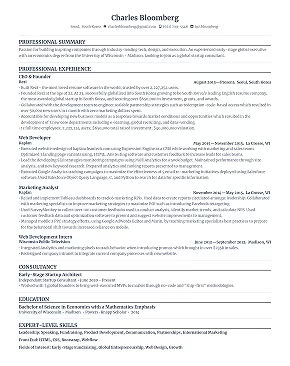
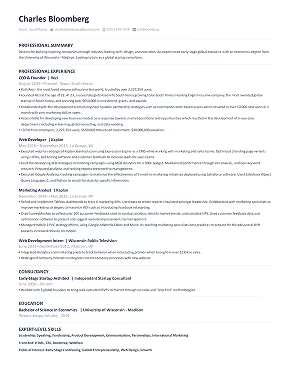
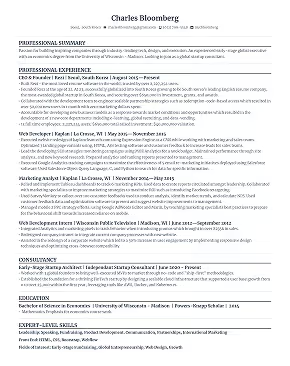
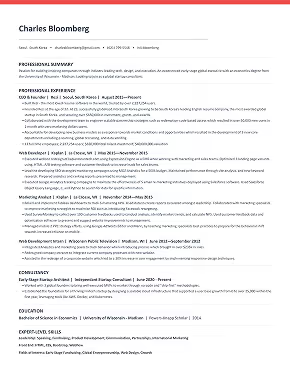
As part of our open-source Resume Metadata Standard project, we ran resumes from different builders through real ATS platforms like Workday.
The results were devastating.
It proved that many modern resume scanners don’t work as reliably as they should.
Rezi’s templates performed the best, with over 50% of resume data carrying through. Most other builders didn’t even hit that mark — some lost way more than half of the content outright.
In other words, critical sections like work history, education, or even contact details can vanish when parsed by resume scanners. If the “best” result is only just above 50%, that still means nearly half of a candidate’s resume can go missing.
Is this a resume builder problem? Partly. There’s always room to improve. Even many of the resume builders that are supposed to be professional had a low score.
But the bigger issue is that many ATS scanners are fundamentally flawed.
A resume can be well written and properly formatted, yet if the system can’t interpret it, a recruiter may never get to see all of your key skills or achievements.
That’s what makes this myth so dangerous.
Many candidates trust that “ATS-friendly” means safe, when in reality, our research shows otherwise. The safest option is to use a clean, minimal template that’s been tested to parse correctly — not just one that looks good in your browser.
Relevant resources:
- Professional Resume Templates
- Canva Resume Templates
- MS Word Resume Templates
- Google Docs Resume Templates
- Harvard Resume Templates
- Etsy Resume Templates
- LaTeX Resume Templates
- Adobe Illustrator Resume Templates
ATS Myth 2: ATS can’t read PDFs
First, let me clarify this: PDF resumes are not parsable by nature.
PDFs are a visual format. It’s designed to show how something looks, not quite exactly to store structured data. That’s why parsing PDFs into an ATS can be hit or miss. Our lead developer, Luc Lemerez, says it best in his article on LinkedIn:
“PDFs, the universal resume format, were built for printing, not structured data, and ATS stumble without it.”
In our research, we found that while most modern ATS platforms accept PDFs, they don’t always interpret them reliably, especially when you try to get creative with the formatting.
Again, this shows the limitations of how ATS scanners work today.
Now let’s get back to the main question — can ATS read PDFs? Well, yes. PDFs can still work. As our lead developer, Luc Lemerez, pointed out:
“Don’t write off PDFs yet. They’re stable, they lock in your design, and they don’t spill your editing history like a Word doc might. A resume isn’t just a document. It’s a concise story of your past, tailored to the gig. PDFs nail that, if only ATS could keep up.”
See how our resume builder compares to other resume tools:
- The Best AI Resume Builders
- Rezi vs. ChatGPT
- Rezi vs. Enhancv
- Rezi vs. Kickresume
- Rezi vs. Jobscan
- Rezi vs. Teal
- Rezi vs. Resume Worded
- Rezi vs Novoresume
- Rezi vs Sheets Resume
ATS Myth 3: ATS can’t read resume designs
I’m not saying that ATS can’t read resume designs at all — they can.
However, our experiment indicates that design-heavy resumes can get lost in translation when parsed by resume scanners. For instance, some well-known tools like Enhancv and Canva offer highly designed templates, but in our tests, they didn’t perform the best in ATS parsing.
Enhancv’s template barely cracked 18% parsing accuracy, and Canva’s results were similarly low. In other words, it can mean that most of your resume never even shows up in the recruiter’s database.
The takeaway here isn’t that all design is bad, it’s just that it has to work for both humans and machines.
A resume can look polished and still be ATS-compatible, but only if it’s genuinely been built with parsing in mind. Still, we recommend always aiming for a sleek, professional format with a single column layout.
Further resources:
- A Career Expert’s Honest Review on Canva’s Resume Builder
- Resume Formats Explained
- How to Pick the Right Resume Template
- Tips for an ATS-Optimized Resume
ATS Myth 4: Keywords alone will guarantee you a job interview
This is probably the most common myth, and one of the most misleading.
Yes, resume keywords matter. Recruiters typically use ATS to search and filter resumes by specific terms in the job description. So if your resume doesn’t include them, you may not even show up in the results.
With that in mind, just dropping in keywords isn’t enough to land you an interview.
We’ve seen countless resumes filled with the “right” keywords that still failed to get interviews.
Why? Because recruiters don’t just look for the presence of resume skills — they look for proof.
An ATS might highlight your resume in a search, but a human recruiter will still quickly scan to see whether you’ve actually successfully applied those skills through your work experience and achievements.
Keywords are important, but they’re not magic. A resume that gets interviews combines the right language with evidence that you can actually do the job. That’s what convinces recruiters to pick up the phone.
ATS Myth 5: Resumes need a perfect ATS score to be considered
This myth usually comes from resume optimization tools that give your resume a score against a job description. It’s easy to assume that unless you hit 100%, your resume will be automatically rejected.
However, that’s not how ATS works. It doesn’t just hand out universal scores.
Recruiters set filters and search criteria, typically based on must-have skills or experience. If your resume includes those, you’ll show up in their search whether you scored 60% or 90% on some third-party tool. In fact, most recruiters never even see the “scores” candidates obsess over.
Also, even “high-scoring” resumes can get ignored because the content isn’t convincing. A perfect score might look good on paper, but it doesn’t guarantee that a recruiter will call you. What matters most is relevance, clarity, and proof of your qualifications.
Relevant articles:
- How to Describe Your Work Experience on a Resume
- How to Write the Resume Skills Section
- How to List Education on a Resume
ATS Myth 6: Using the same resume for similar jobs is fine
It’s tempting to think that if two job postings look similar, the same resume will work for both. After all, why rewrite the same experience over and over again?
This is where many candidates miss out on interviews.
Using the same generic resume reduces your chances of being found in ATS and standing out to recruiters. Tailoring your resume ensures it speaks directly to the role — and that’s what gets you noticed.
Even jobs with nearly identical titles often emphasize different skills or priorities in the description. For example, one marketing manager role might highlight “SEO strategy,” while another focuses on “social media.” If your resume doesn’t reflect those exact terms in context, you might not appear in the recruiter’s ATS search even if you’re qualified.
Now, this doesn’t mean it’s mandatory to rewrite your resume from scratch every time. Small adjustments go a long way. Swap in the keywords the employer uses, reorganize your bullet points to put the most relevant experience first, and make sure your resume achievements match what the role is asking for.
ATS Myth 7: ATS is only used by big companies
Some candidates assume ATS is something only Fortune 500 companies use. The reality? That hasn’t been true for years.
Today, ATS software is used by companies of every size, from global corporations to small startups and even local businesses. It simply makes hiring easier for employers.
An ATS helps employers post jobs, collect applications, and search resumes without getting buried in email attachments. And with affordable, cloud-based systems like Lever, Greenhouse, and BambooHR, even a 10-person company can set one up in a matter of hours.
More articles:
- How AI is Reshaping Work & Why Skills-Based Hiring Matters
- Navigating the ‘A.I. Sludge’ Era
- Rezi and the New Frontier of Resume Writing
Are Resumes Always Going to Be Read by a Human Recruiter?
It really depends, but the short answer is not always.
Recruiters usually strive to read every resume they receive. However, that doesn’t mean they’ll check it thoroughly. It’s usually for less than 10 seconds. ATS filters help them determine who makes it past the first round.
That being said, there are some instances where your resume may never reach a human recruiter. Whether it gets read by a human or not can come down to the role and the number of applicants.
One employer replied to a Reddit thread about whether resumes still get read and shared their experience:
“My client once posted a job offer for a position that did not [require] much. He had like 400 CVs. It was impossible to go through them without a small army. So sadly for those people the way he handled that was rather simple. They started from the oldest one, found first 5 people who were good enough. Invited them. Nobody managed to catch his interest. He [then] invited another group of 5 people. So he was like 30 CVs in that pile. And that was it. So you see... if you were late to the party nobody would even look at your CV because it's impossible to go through 400 of them in a reasonable amount of time. But [again] that depends on the position.”
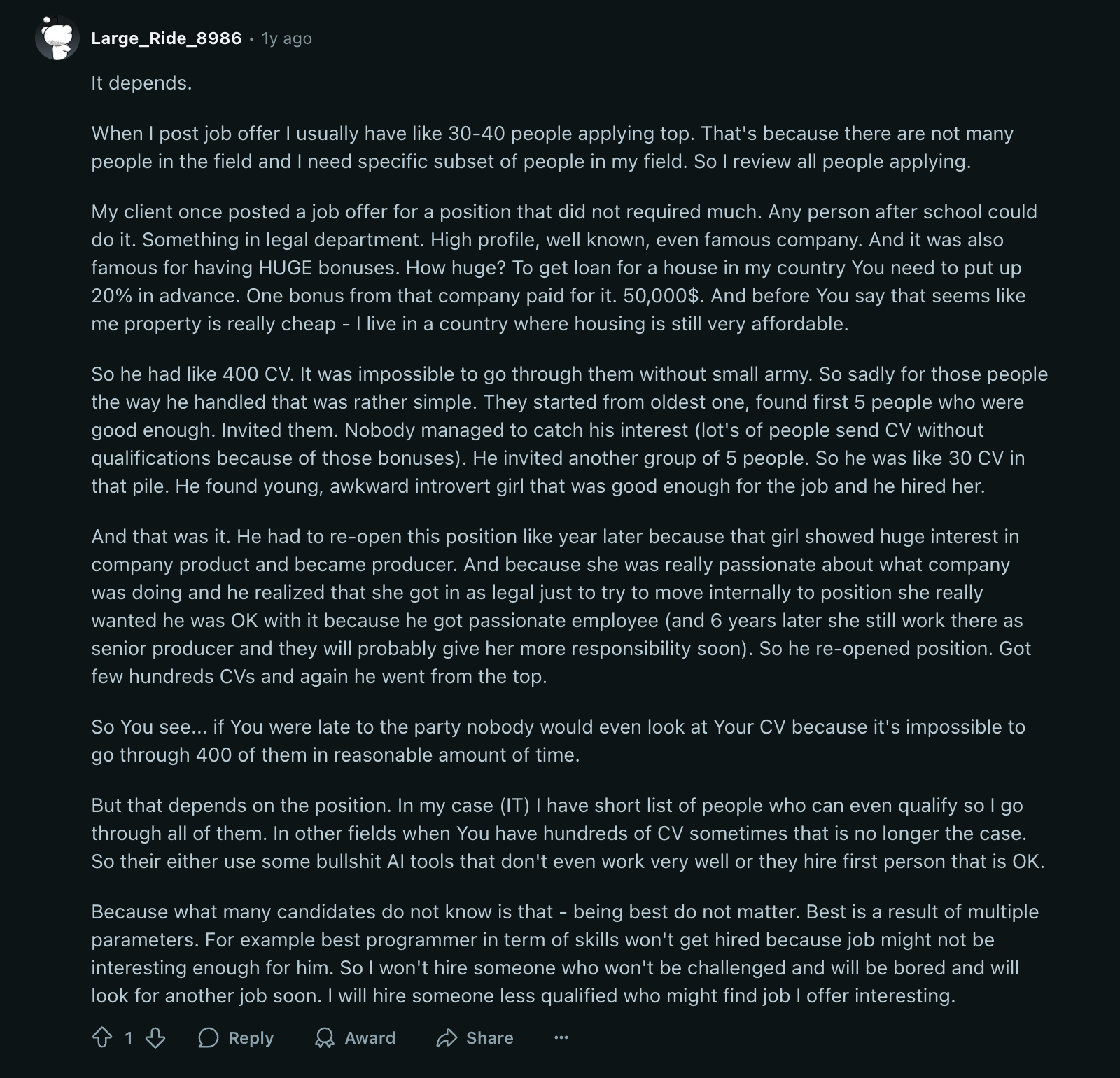
In this example, it shows that when a company receives far more applications than they can realistically review, some resumes will either get filtered out by the ATS or skipped altogether because of time constraints. But remember, this isn’t always the case for every job you might apply for.
And it doesn’t mean recruiters don’t care, it’s simply a matter of practicality.
The best way to improve your chances is to apply early, use an ATS-friendly format, and make your most relevant skills and achievements clear.
Your resume won’t always be read by someone who understands the technical details of your role
When you apply for competitive jobs, the first person to see your resume is typically a recruiter or HR coordinator, not the hiring manager.
And while they play a critical role in the process, they usually don’t have the technical background to fully grasp the nuances of your role.
At this stage, their focus is on filtering applications: scanning for required skills, relevant experience, and keywords that match the job description. So if your resume isn’t clear, well-structured, and easy to interpret, it may be skipped before it ever reaches someone who understands the technical side of the work.
This doesn’t mean you should oversimplify or downplay your expertise. It means presenting your skills and achievements in a way that’s also accessible to both non-technical recruiters and ATS systems so that your qualifications make it through to the right people.
Summary
Let’s recap the most common ATS myths:
- Myth: All resume templates labeled online as ATS-friendly are ATS-friendly. Fact: Many designs break when parsed and can cause missing content.
- Myth: ATS can’t read PDFs. Fact: Most ATS can read PDFs. Clean Word (DOCX) files work too.
- Myth: Resume designs with charts, icons, or graphics always work. Fact: Some of these elements can get lost in translation.
- Myth: Keywords alone will guarantee you an interview. Fact: Just because you included keywords doesn’t necessarily mean you’ll land an interview. You need to prove you’re a qualified candidate.
- Myth: You need a perfect ATS score to be considered. Fact: Scores are optimization tools, and not all recruiters use them to auto-reject candidates.
- Myth: One resume works best for every similar job posting. Fact: Tailoring your resume to each job description will produce better results.
- Myth: ATS is only used by big companies. Fact: Small and mid-sized businesses also rely on ATS to manage applications.
Remember, ATS isn’t something you necessarily need to “beat.” It’s just software recruiters use to filter applications, and make no mistake, they’re nowhere near perfect. The key takeaway here is to use a resume that’s clean, structured, and easy to read for both machines and humans.
And if you want the resume builder that gives you the strongest ATS compatibility, you can get started with Rezi AI Resume Builder for free.
FAQs
What’s a good ATS resume score?
A “good” ATS score is usually one that shows your resume matches the key requirements of the job description, often in the 70–80% range or higher. But there’s no universal score that guarantees success. Different systems and recruiters weigh criteria differently. Instead of chasing a perfect number, focus on tailoring your resume with the right skills, experiences, and keywords that reflect the role.
How can I outsmart the ATS?
You can’t really “outsmart” an ATS, and you shouldn’t try. ATS aren’t designed to trick candidates; they’re databases recruiters use to search and filter resumes. The best approach is to work with the system: use a clean, ATS-friendly format, align your resume with the job description, and write clear bullet points that show real impact. That way, both the ATS and the human recruiter reviewing your application will see your qualifications.
Are ATS systems fair and unbiased?
Not always. ATS can unintentionally create bias because they rely on how recruiters set filters and how well the software parses resumes. If key details get lost due to formatting, or if filters are too rigid, even the most qualified candidates could get overlooked. While ATS help manage large applicant pools, they’re only as fair as the data entered and the way recruiters use them. This is why having a clear, ATS-optimized resume matters so much.

Upload or drop your resume to get started
Upload your resume to get started
Score my resume

Astley Cervania is a career writer and editor who has been sharing resume and job search insights for 5+ years. He shapes the direction of the Rezi blog, providing practical answers for important career-related questions and helping hundreds of thousands of people navigate the job market and build resumes that land interviews.

.webp)