
Resume
45 Social Work Skills and Qualifications for Your Resume
Discover the best social work skills to highlight on your resume. Learn how to prove your empathy, communication, and advocacy abilities to impress employers.


Published on
November 20, 2025
Updated on
November 20, 2025
Social work skills involve understanding people, building trust, and guiding them through life’s challenging moments. On a resume, these skills should reflect both compassion and competence. Highlight your interpersonal strengths, such as empathy, communication, and cultural awareness, alongside technical abilities, including case management or policy knowledge. Use specific examples and measurable results to show your impact, and include relevant training to strengthen your credibility. Emphasize your adaptability, professionalism, and commitment to helping others to set you apart.
Figuring out an exact set of skills isn’t so easy when the work can span across schools, hospitals, advocacy organizations, and family homes. And even then, each day can look different. You might spend one morning calming a crisis and the next buried in case notes.
But if you strip everything back, the skills you need to succeed are simple: communication, empathy, understanding, and a desire to help others. The real challenge is showing those skills in action; turning them from words on a resume into proof of impact.
Let’s break down the most in-demand social work skills for your resume. This guide will cover:
- The key duties and characteristics of a social worker.
- Top qualifications and skills needed for social work.
- How to improve your skills and reach your goals.
Need help proving your social worker skills on a resume? Get guidance and inspiration with our AI Resume Builder to generate a tailored and customized resume in minutes.
And check out these social work resume examples alongside other related fields:
- Mental Health Therapist Resume
- Rehabilitation Counselor Resume
- Mental Health Counselor Resume
- Licensed Clinical Social Worker (LCSW) Resume
What Are Social Work Skills and Why Are They Important?
Social work is all about people; understanding, advocating, and helping them uncover the tools they need to move forward. It’s a mix of communication, empathy, and emotional intelligence to help you connect with others and make a difference.
Once you master these skills, you can earn a client’s confidence, work with different teams, and resolve conflicts in healthy, solution-focused ways. In many cases, it’s these “soft skills” that lead to genuine breakthroughs.
Think active listening, patience, cultural sensitivity, and adaptability. Sound familiar? That’s because you don’t have to be a social worker to have them. Maybe you’ve supported a friend through a tough time, managed conflicts at work, or led a diverse team? Those experiences all build the foundation for social work practice.
I spoke with a social worker with 12 years of experience about the key skills in social work. Here’s what she shared:
I work with children who’ve faced abuse/harm and need support to deal with their experiences and trauma. The most important skill is good communication; you need to build a good rapport with kids, often in very tricky situations. You also need to work with parents to support their involvement, even when they’re angry with the court system and your profession.
You’re the child’s “corporate parent,” so you need to speak up on their behalf and advocate for them. Another important skill is being confident in your knowledge and assessment skills. We do a lot of assessments and need to evidence critical reflection and analysis.
The job is so varied, I could be in court in the morning, supporting a stressed foster carer at lunchtime, and then playing in the park with a child in the afternoon. Not forgetting all the recording and paperwork when I get home. Never a dull moment!
Let’s explore those skills in more detail and how to include them on your resume.
45 Social Work Skills Examples
Social work is a people-centered profession, and your soft skills aren’t just “nice to have”; they’re the foundation of everything you do. While the work may not always involve technical tools or data, it’s every bit as complex and demanding. You’re using empathy, communication, and patience to guide people through some of the toughest moments of their lives.
Below, I’ve gathered the most essential social work skills to help you grow in your career, along with synonyms and examples of how to show them on your resume.
Communication
Strong communication skills in social work involve expressing yourself clearly, writing effectively, and understanding how to convey complex ideas to clients. You’ll use it to collaborate with colleagues, report case details, and guide clients toward goals. Good communication keeps everyone informed and prevents misunderstandings that could harm progress.
Resume example: “Communicated clearly with clients and colleagues to develop personalized support plans.”
Synonyms
- Consultation
- Social relations
- Correspondence
Active listening
Active listening means giving your full attention (not just nodding along and thinking about your next meal). It’s about understanding emotions and the intent behind them. You can use this skill to show clients you value their voice, which helps you build trust and guide them. Social work relies on active listening to uncover root issues and build meaningful connections.
Resume example: “Applied active listening techniques to assess client needs and strengthen rapport.”
Synonyms
- Mindful hearing
- Receptive listening
- Being attentive
Interpersonal skills
Social work isn’t just about building relationships with clients; you also have to work with families and colleagues. Strong interpersonal skills help you connect authentically, navigate sensitive conversations, and create strong support systems. These skills also make teamwork smoother, such as leading meetings or coordinating care across agencies.
Resume example: “Built collaborative relationships with over 20 clients and multidisciplinary teams to deliver holistic support.”
Synonyms
- Relationship-building
- Social awareness
- People skills
Objectivity
Objectivity means balancing empathy with impartiality. As a social worker, you’ll often encounter emotional situations close to your heart — but your decisions must be fair and based on facts, not feelings. Yes, you can still show compassion, but maintaining objectivity helps you protect your clients’ best interests and ensure well-informed choices.
Resume example: “Maintained objectivity when handling over 50 case assessments, ensuring unbiased and ethical decision-making.”
Synonyms
- Impartiality
- Fairness
- Neutrality
Patience
Patience is essential when progress takes time — and in social work, that progress isn’t always linear. Clients may resist help, systems can move slowly, and change doesn’t happen overnight. Staying patient keeps you calm and consistent, showing clients you’re dependable and understanding, no matter how tough things get.
Resume example: “Demonstrated patience and persistence when supporting clients through complex emotional and behavioral challenges.”
Synonyms
- Tolerance
- Perseverance
- Composure
Intervention skills
Intervention skills are about stepping in at the right moment to guide clients toward stability during a crisis, conflict, or a moment of need. It’s about empowering people rather than rescuing them, helping them recognize and use their own strengths to overcome challenges.
Resume example: “Implemented strength-based interventions to help clients resolve conflicts and build long-term coping strategies.”
Synonyms
- Mediation
- Crisis management
- Support facilitation
Advocacy
Advocacy is at the heart of social work and is about standing up for people who can’t always stand up for themselves. You help clients access resources, services, and fair treatment by representing their needs in a respectful, yet assertive way. Advocacy promotes equality and ultimately drives systemic change.
Resume example: “Advocated for clients’ access to community resources and social justice initiatives.”
Synonyms
- Representation
- Empowerment
- Support
Critical thinking
Critical thinking means analyzing complex information and making smart decisions, sometimes in challenging situations. Social workers need to look beyond surface issues, question assumptions, and find creative solutions that best serve their clients. It’s also a key skill to have when assessing risks and developing case plans.
Resume example: “Used critical thinking to evaluate case details and design five new evidence-based support strategies.”
Synonyms
- Analytical reasoning
- Problem-solving
- Judgment
Empathy
Empathy in social work extends beyond feeling sympathetic towards your clients. It’s about putting yourself in someone else’s shoes, understanding their feelings, and responding with compassion. Clients often face trauma or hardship, so genuine empathy helps them feel heard and supported, which helps build trust and heal relationships.
Resume example: “Applied empathy and emotional intelligence to encourage trust and understanding with diverse clients.”
Synonyms
- Compassion
- Understanding
- Sensitivity
Professionalism
Professionalism in social work involves maintaining ethical standards, continuous learning, and respect for boundaries. It’s about knowing your role and being there to guide, not to judge or control. Staying committed to the industry’s best practices will help you earn respect from both clients and colleagues.
Resume example: “Demonstrated professionalism by adhering to ethical guidelines and pursuing ongoing professional development.”
Synonyms
- Integrity
- Accountability
- Ethical conduct
Organization
Organization is a priority in any industry, but in social work, it can involve juggling several complex cases at once. Good organization helps you manage files, meet deadlines, and prioritize the clients who need you most. It also keeps stress levels in check, so you can focus on what really matters: helping people.
Resume example: “Maintained organized case files and prioritized client needs across 30+ ongoing cases.”
Synonyms
- Coordination
- Management
- Structure
Boundary setting
Boundary setting is tricky when clients are relying on you, but it’s often a necessary step to prevent stress and burnout. Knowing when to step back, say “no,” or define limits keeps things balanced and professional. Healthy boundaries protect both you and your clients while maintaining respectful and productive relationships.
Resume example: “Established and maintained healthy professional boundaries to ensure ethical practice and prevent burnout.”
Synonyms
- Self-care
- Self-regulation
- Emotional discipline
Open-mindedness
Being open-minded means approaching people and situations without bias or prejudice. In social work, it’s essential to understand diverse backgrounds, respect cultural differences, and promote social justice. Open-mindedness lets you see beyond assumptions and truly meet clients where they are.
Resume example: “Demonstrated cultural competence and open-mindedness when supporting clients from diverse backgrounds.”
Synonyms
- Acceptance
- Unbiased
- Cultural awareness
Time management
Time management is a lifesaver in a career where every minute counts. Social workers balance meetings, home visits, and documentation — often all in the same day. Managing time effectively ensures every client gets proper attention while keeping your workload sustainable.
Resume example: “Applied strong time management to balance client sessions, administrative duties, and crisis response efficiently.”
Synonyms
- Scheduling
- Prioritization
- Efficiency
Administrative skills
Behind every successful social worker is a mountain of paperwork. Administrative skills help you track progress, document interventions, and communicate with other professionals. When your documentation is strong, your cases move smoothly, and your clients benefit from better coordination of care.
Resume example: “Prepared thorough, clear, and timely documentation to support case coordination and treatment planning.”
Synonyms
- Record-keeping
- Documentation
- Case management support
How to Add Social Work Skills to a Resume
Here’s a quick overview of how to add social worker skills to your resume:
- Identify keywords for your social work resume by scanning the job description for repeated terms and weaving those keywords naturally into your resume.
- Emphasize social work abilities in your work experience by going beyond task lists with measurable results and real impact.
- Outline your social worker qualifications clearly by listing your education, licenses, and certifications in reverse order.
- List the soft and hard skills for social workers. Pair technical strengths like assessment tools with interpersonal abilities such as empathy and resilience.
- Weave your social worker skills into your summary by creating a brief paragraph that captures your experience, specialties, and passion for helping others.
Let’s see how you can put these tips into practice in your job application.
1. Identify keywords for your social work resume
You want to include all those impressive skills on your resume without reading like an over-the-top sales pitch. Rather than adding every social worker skill under the sun, your job application will have way more impact if you focus on what’s most relevant to the job.
Lucky for you, the job ad usually spells out exactly what to include. Scan the job description and highlight the repeated or emphasized terms (for example, crisis intervention, advocacy, or client assessment). Then weave them into your resume to help your application pass both human and ATS (Applicant Tracking System) screenings.
Think of it as tailoring, not copying (or outright lying). Use the employer’s phrasing, but reflect your own actual skills and experiences. There’s nothing worse than feeling like a fraud on the first day of the job.
Find out more:
2. Emphasize social work abilities in your work experience
Your work history section is where you can prove your social work skills with concrete examples. Instead of just listing what you did, show how you did it and what positive changes happened because of your work. Even better if you can include numbers or percentages for credibility.
Take a look at the difference between these two work experience examples:
- Managed client cases.
- Managed a caseload of 25 clients, developing individualized treatment plans that improved housing stability by 40%.
Don’t have paid social work experience? Focus on volunteer work, internships, or community involvement. Anything that involves communication and helping others counts, especially in human services.
Here’s how to weave your skills into your work experience section:

3. Outline your social worker qualifications
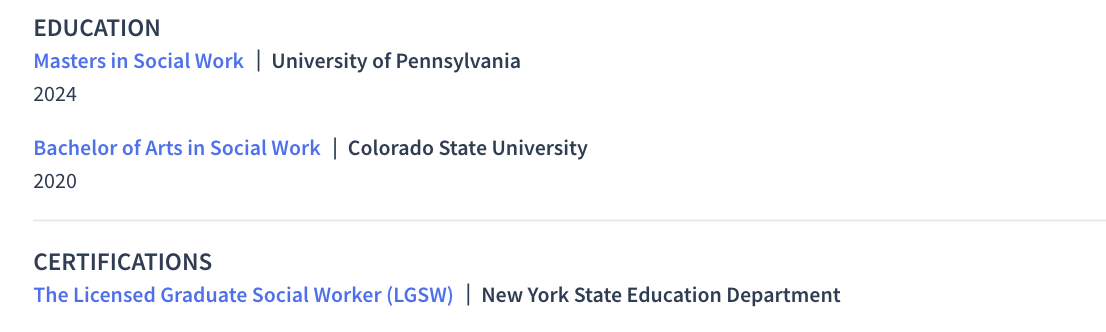
Education and credentials automatically shine a light on your social work skills, proving that you’re academically prepared and licensed to practice. And if you’re totally new to the field, you can place your education section above your work experience to give it some extra attention.
List your degrees in reverse chronological order, starting with your most recent qualification. If you’re a recent graduate, you can also include relevant coursework, field placements, or committee involvement.
If you want to bulk up your education and training even more, you can also highlight your licenses and certifications on your resume. This could include your LCSW, LMSW, or specialized training in areas like trauma-informed care or addiction recovery.
Here’s what your education and training section could look like:
4. List the soft and hard skills for social workers
Your resume skills section should be a mix of hard (technical) and soft skills. That said, the ones you include entirely depend on the job description and your experience level, with most of the focus going on your technical abilities.
Hard skills include case management, data entry, assessment tools, and policy knowledge. Soft skills cover empathy, communication, and resilience (aka, the heart of social work). The problem is, I could claim to have all these soft skills, and I’ve never worked a day as a social worker.
To make this section stronger, avoid generic buzzwords, like the simple “communication”. Instead, use specific job-relevant terms or more technical skills that match the posting. Yes, you can still include soft skills if the job ad emphasizes them, but you’re more likely to stand out if you prove these skills with actual examples in your work experience section.
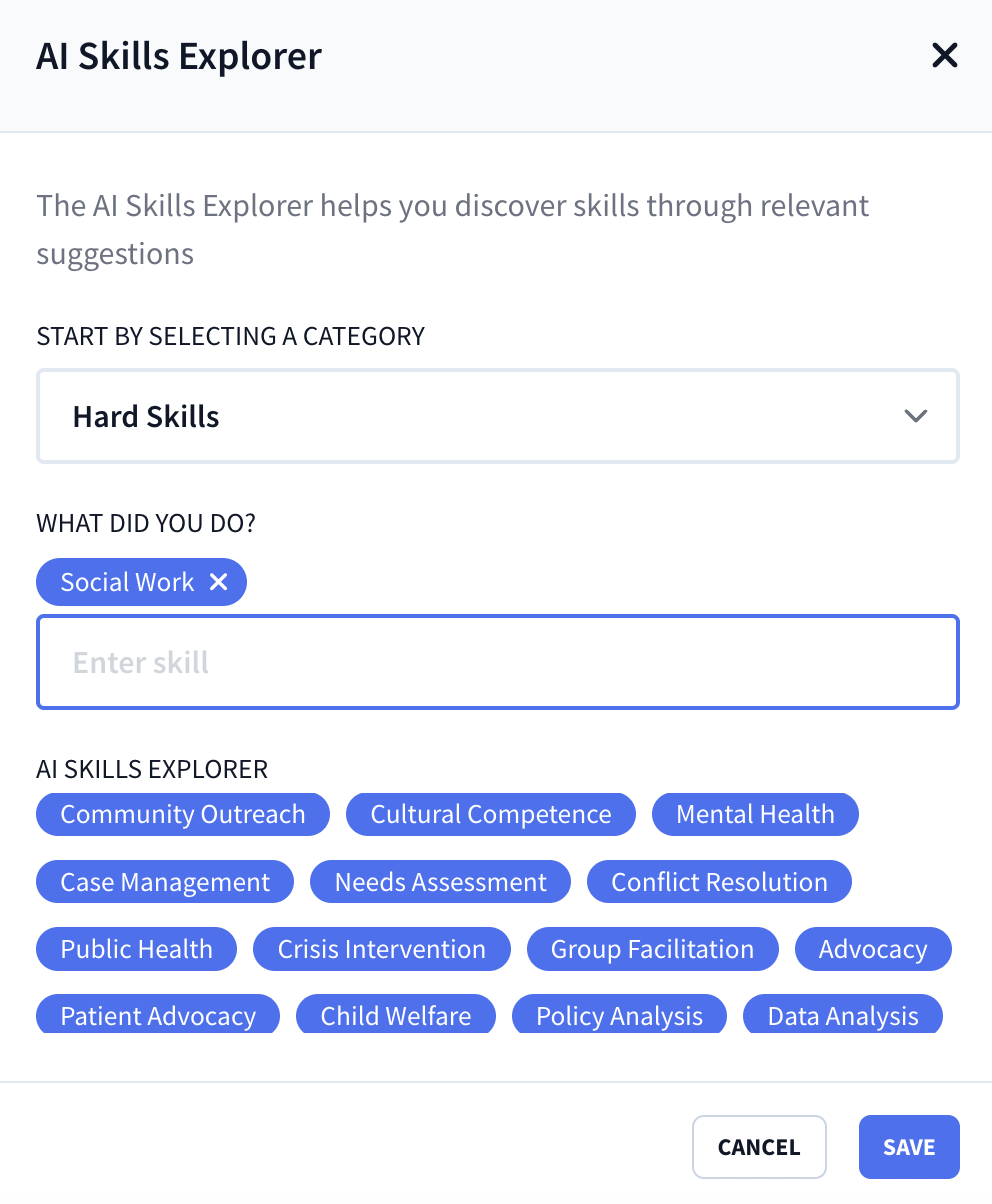
You can also use our AI Skills Explorer to find social worker skills and get inspiration. Simply type in a skill or job role, and our expert technology provides a list of the most relevant skills.
Here’s what the tool looks like:
5. Weave your social worker skills into your summary
Your resume summary (or objective) is a 3–4 line paragraph that sits right at the top. It’s that all-important first impression, which I suggest writing at the end to make it easier to pull the most impressive and relevant bits from your resume.
You can use this space to express your professional identity, passion, and what you bring to the table. Highlight your experience level, specialty, and a few of your strongest social work skills. For example, mention your background in community outreach, your advocacy for underrepresented groups, or your ability to handle crises.
Here’s how to show off your social work capabilities in your summary:

I generated this example using the AI Resume Summary Writer. Just submit the skills you want to highlight, and our technology pulls details from your resume to create a tailored summary.
How to Improve Your Social Work Skills and Techniques
Short answer: Invest in your growth through advanced training, certifications, or volunteer opportunities. Seek feedback from supervisors, peers, or clients to refine your approach and stay self-aware. Keep your passion alive by reading books that inspire empathy and resilience. Most importantly, practice radical acceptance to manage frustration and maintain compassion, and don’t forget to care for yourself.
Improving your social work skills is as much about developing strategies with others as it is about taking care of yourself. Here’s how to get started.
Pursue further training and certifications
Let’s begin with the most obvious one: keep learning. Advanced training, specialized certifications, and further education can take your skills from solid to exceptional. Yes, this can cost money, but view it as a long-term investment in your growth. Plus, it tells employers you’re serious about your practice and development.
What you can do:
- Go for that license. An LCSW (Licensed Clinical Social Worker) opens doors for promotions and higher-level roles. You should also check your state’s licensing requirements.
- Volunteer for growth opportunities. Take on projects at work or in your community, like joining policy committees or advocacy groups. This can help you build confidence and pick up different techniques along the way.
Ask questions and get feedback
Nobody masters social work in isolation; the best practitioners are lifelong learners who ask questions and welcome feedback. Don’t be afraid to reach out to supervisors, peers, or clients (people are often happy to help). These insights can help refine your techniques and improve your approach.
What you can do:
- Use supervision wisely. Bring real challenges to your next supervision or team meeting. Ask for input on your methods, communication, or case strategy. Listen with an open mind and consider how you can use these suggestions to improve.
- Invite client feedback. After sessions, ask gentle, simple questions like, “Was this helpful for you today?” or “Is there something I could have done differently?” You could even use feedback forms if you think it would make your client feel more comfortable.
Find out how I learned to accept feedback: Not Taking Professional Feedback Personally
Get inspired by popular social work books
Sometimes, improving your skills starts with getting inspired, and a good book can do just that. I’ve gathered some of the top suggestions from social workers online to find books that blend heart, science, and storytelling to remind you why you chose this field in the first place.
Here’s a quick rundown:
- The Boy Who Was Raised as a Dog by Bruce Perry: Powerful stories of trauma and healing that show how compassion and neuroscience intersect in child development.
- What My Bones Know by Stephanie Foo: A deeply personal journey through complex trauma and recovery, with valuable insights for culturally competent practice.
- The Four Agreements by Don Miguel Ruiz: A practical guide for personal growth and self-awareness, crucial for maintaining integrity and presence in social work.
- The Art of Communicating by Thich Nhat Hanh: Teaches mindful communication techniques that strengthen client relationships and reduce workplace stress.
- The Body Keeps the Score by Bessel van der Kolk, M.D.: Groundbreaking work on trauma and the body, offering new perspectives on treatment and empathy.
Practice radical acceptance
Here’s a tough truth: you can’t save everyone. Radical acceptance is a tough but necessary skill to master. The goal is to recognize that some things are out of your control — and that’s okay. It’s about meeting clients where they are, without judgment, and freeing yourself from the frustration of trying to “fix” everything.
What you can do:
- Focus on the process, not the outcome. Celebrate small wins and progress, even if change feels slow. Acceptance helps you stay grounded and open-minded.
- Drop the judgment. Clients have a right to make their own choices, even “bad” ones. Respecting their autonomy protects your energy and builds trust.
Take time for yourself
Let’s be honest, social work can be emotionally heavy. That’s why caring for yourself is part of caring for others. Reflecting on your own beliefs and limits helps you grow professionally and personally, while self-care keeps burnout at bay.
What you can do:
- Make reflection a routine. Journal after tough cases or talk through experiences with a trusted friend. Reflection deepens your awareness and helps you show up fully for clients.
- Prioritize genuine self-care. Whether it’s yoga, therapy, or just unplugging for a weekend, find what refuels you. You’ll be better at your job if you show up feeling balanced and rested.
Summary
Here’s a breakdown of all the best social work skills and how to add them to your resume.
- Social work skills combine empathy, communication, and problem-solving abilities that help you build trust, navigate sensitive situations, and empower clients.
- Tailor your resume to the specific job by identifying and using keywords from the job description to describe your experiences.
- Don’t overlook transferable skills or advocacy gained from volunteer work, teaching, or management to strengthen your resume for social work roles.
- Highlight soft skills such as empathy, active listening, and cultural awareness; these show your ability to connect with diverse populations and manage complex situations.
- Balance your resume with hard and soft skills — include both technical expertise, like documentation and policy knowledge, alongside traits like patience and collaboration.
- Use measurable results to prove your effectiveness, such as “coordinated interventions for 20+ families to access housing and healthcare support.”
- Include relevant certifications and credentials, like LCSW or LMSW licenses, and specialized training to demonstrate professional credibility.
- Write a strong summary section that highlights your top social work skills, experience, and passion for helping others.
- Above all, make your resume feel human. Social work is people-centered, so let your empathy, authenticity, and commitment to making a difference shine through every line.
FAQ
What is the most used skill in social work?
The most used skill in social work is communication. Every part of the job, such as assessing a client’s needs, collaborating with agencies, or advocating for resources, depends on clear, compassionate communication. It involves listening actively, reading nonverbal cues, and creating a safe space for others to express themselves.
Strong communication helps build trust and ensures clients feel heard and respected, which is essential when working through sensitive or emotional issues.
What are micro and macro social work skills?
Micro social work skills are the one-on-one, people-centered abilities used to support individuals, families, or small groups. This includes active listening, empathy, crisis intervention, counseling, and advocacy. A social worker at this level might help a child in foster care, guide a veteran through PTSD recovery, or assist someone experiencing homelessness.
Macro social work skills focus more on large-scale change. They’re about using leadership, research, and organizational abilities to influence systems and policies. Professionals in this area may work in government agencies, nonprofits, or advocacy groups to develop community programs, lead campaigns, conduct policy analysis, or push for legislative reforms.
How to be a social worker?
Here’s a quick step-by-step guide on how to become a social worker:
- Start with a Bachelor’s in Social Work (BSW) to qualify for entry-level positions. If you want to work in clinical or specialized areas, pursue a Master’s in Social Work (MSW).
- Gain hands-on experience through supervised placements. This is where you apply what you’ve learned, build confidence, and develop core skills.
- Most states require licensure to practice. The type (like LSW, LMSW, or LCSW) depends on your education level and career goals.
- Choose your speciality in areas such as child welfare, healthcare, mental health, or school social work. Pick one that aligns with your passion and strengths.
- Start in entry-level roles to build your expertise. Every case you manage and every client you help will strengthen your skills and techniques.
- The best social workers never stop learning. Stay current with new research and pursue advanced certifications.
Find out how to break into this related field: How to Become a Therapist
What makes a good social worker?
A good social worker balances compassion with critical thinking. They care deeply for others but also know how to set healthy boundaries to avoid burnout. They’re active listeners, creative problem-solvers, and advocates for justice.
Equally important, they understand that culture, environment, and systems shape every client’s experience, and they approach each situation with respect and curiosity. The best social workers empower people to find their own strength, providing both guidance and hope along the way.
What are the main characteristics of a social worker?
Great social workers share a common set of core traits: empathy, patience, cultural sensitivity, and emotional resilience. They stay calm under pressure, communicate with compassion, and handle difficult situations with professionalism. They’re also adaptable, shifting gears quickly when new challenges arise.
But perhaps most importantly, they’re driven by a genuine desire to make a difference. Whether they’re supporting one person or advocating for systemic change, their work is rooted in understanding, connection, and the belief that everyone deserves dignity and opportunity

Lauren Bedford is a seasoned writer with a track record of helping thousands of readers find practical solutions over the past five years. She's tackled a range of topics, always striving to simplify complex jargon. At Rezi, Lauren crafts genuine and actionable content that guides readers in creating standout resumes to land their dream jobs.