
Resume
How to Put Your GPA on a Resume
Learn when to include your GPA on a resume, how to write it correctly, and the simple rules for rounding, placement, and showcasing your academic strengths.


Published on
December 19, 2025
Updated on
December 19, 2025
Mention your GPA on your resume if it’s 3.5 or higher, you’re a recent grad, or you need a strong academic highlight. Add it to your education section, right under your degree, and place that section higher on your resume if academics are your biggest strength. You can show your overall GPA, your major GPA, or both, using a simple format like “GPA: 3.6” or just “3.6.” If relevant, you can also include coursework, awards, projects, extracurriculars, or test scores to showcase your achievements. Rounding your GPA to the nearest tenth is fine, as long as it stays accurate.
You don’t always have to put your GPA on your resume. Sometimes it strengthens your application, and sometimes it’s better to leave it out (you don’t need to share every detail; omitting something isn’t the same as lying).
In this guide, you’ll learn:
- When you should or shouldn’t include your GPA.
- How to format it and where to place it.
- How to convert your GPA to a percentage.
Create a brand-new resume with our AI Resume Builder (it’s free). Or check out these guides:
- How to Write a Student Resume
- Common Resume Mistakes For Students & Grads
- How to Use Rezi for Student and Graduate Job Applications
- Tips for Creating an ATS Resume That Passes Filters
Should You Put Your GPA on Your Resume?
Including your GPA can be beneficial in certain situations. It gives hiring managers a quick sense of your work ethic and consistency.
Highlight your GPA if:
- It’s 3.5 or higher.
- You graduated within the last 10 years, or you’re still in school.
- You lack relevant experience and need something academic to show off.
Some people skip it if they list “magna cum laude” or “summa cum laude,” but honestly, doubling up your accomplishments never hurts.
Don’t mention your GPA if:
- It’s below 3.5 (you can impress employers in other ways).
- You graduated over 10 years ago.
- You already have enough experience to let your career speak for itself.
This Reddit user sums it up:

Some people say to drop it once you have real experience behind you, but it doesn’t exactly take up much space, so include it when it helps and skip it when it doesn’t.
Overall GPA vs. major GPA
You have two GPAs: overall and major. Include both only if they’re strong and relevant. If your major GPA is higher and directly relates to the job, feel free to highlight it and leave out the overall GPA. Choose whichever option presents you in the best light.
Where to Put Your GPA on a Resume
Place your GPA in the education section, right under your degree. If your academics are the strongest part of your application, move the education section above your work history section so it gets noticed first.
You can place the GPA on the same line as the school and graduation date for a clean look.
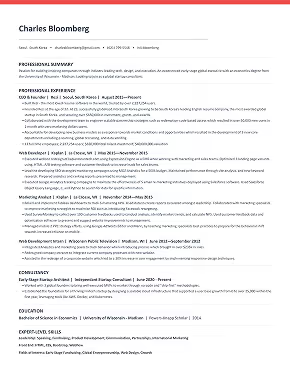
Here’s an example of how a GPA can appear on a resume:

How to List Your GPA on a Resume
No matter your career stage, your education section should include the degree, school, and location, plus the graduation year if it’s within the last decade. Add your GPA on the same line or as a bullet underneath, as “GPA: 3.6” or simply “3.6.” Easy.
After your GPA, highlight other academic achievements with bullets, such as:
- Relevant coursework. Feature classes that align with the job or demonstrate skills the role requires, like Financial Accounting or UX Research Methods.
- Extracurriculars. Showcase activities that prove valuable skills, like team captain (leadership), Art Club (creativity), and Debate Club (critical thinking).
- Awards. List notable honors like President’s List, Valedictorian, or Science Olympiad Medalist.
- Projects. Mention your thesis, research study, capstone project, app development, business case study, or anything that highlights hands-on experience.
- Standardized test scores. If you’re fresh out of high school, include your ACT or SAT scores; especially helpful if you’re applying for tutoring or education roles.
GPA to Percentage Conversion
In the US and Canada, GPAs are standard. In countries like India or much of Europe, percentages are more common.
If you want, you can use a GPA to Percentage Converter. Or do it yourself with this simple formula: Percentage = (GPA/4) × 100
For example, a 3.8 GPA would be: (3.8/4) × 100 = 95%
Can You Round up Your GPA?
Opinions vary, but here’s a practical rule: rounding to the nearest tenth is generally fine. For example:
- 3.67 → 3.7 ✅
- 3.46 → 3.5 ✅
- 3.95 → 4.0 ❌ (a bit of a stretch)
Leaving it at two decimals works too. Just remember, if an employer asks for transcripts, you don’t want any surprises. Overall, rounding within reason is a minor detail, and the achievements on your resume will speak far louder than a tiny decimal difference.
This Reddit user makes some great points:

Examples of GPAs on Resumes
To see how a GPA looks in real education sections, here are some ready-to-use examples:
Example 1:
Lincoln High School | Springfield, IL | May 2025 | 3.8
• ACT: 31
• Relevant coursework: AP Biology, Honors English, Computer Science Principles
• Extracurriculars: Soccer Team Captain, Debate Club
• Awards: Honor Roll, Science Fair 1st Place
Example 2:
BBA in Marketing | University of Texas, TX | May 2023 | 3.6
• Relevant coursework: Digital Marketing Strategy, Consumer Behavior, Financial Accounting
• Projects: Capstone project on brand strategy for a local startup; improved social engagement by 25%.
• Extracurriculars: Marketing Club, Volunteer Coordinator for Campus Fundraisers
• Awards: Dean’s List (2021–2023)
Example 3:
B.S. in Computer Science | Boston University, MA | May 2022 | 3.9
• Major GPA: 4.0
• Relevant coursework: Data Structures & Algorithms, Machine Learning, Mobile App Development
• Projects: Built a campus navigation app, earning 500+ student downloads.
• Awards: Undergraduate Research Grant Recipient, Hackathon Winner
Example 4:
M.S. Mechanical Engineering | Georgia Institute of Technology, GA | May 2024 | 3.7
• Projects: Designed and prototyped a low-cost prosthetic hand that improved grip stability by 30%.
• Extracurriculars: Graduate Engineering Society, Robotics Club
• Awards: Graduate Fellowship, Best Project Presentation
Example 5:
Bachelor of Science in Nursing | University of Michigan, MI | May 2024 | 3.7
• Certifications: BLS (AHA), ACLS, CPR
• Clinical rotations: Pediatrics, Emergency Care, Medical-Surgical, Geriatrics
• Honors: Dean’s List (2022–2024)
Summary
Here’s a recap on putting a GPA on your resume:
- Include your GPA if it’s 3.5+, you’re a recent grad or student, or you need academics to strengthen your resume.
- Skip your GPA if it’s below 3.5, you graduated 10+ years ago, or you already have strong experience.
- List your overall GPA, major GPA, or both; choose whichever best supports the role you’re targeting.
- Place your GPA in the education section, along with your degree details and graduation date.
- If academics are your strongest asset, move the education section above work experience.
- Format it simply as “GPA: 3.8” or just “3.8,” either on the same line or as a bullet underneath.
- Add related academic highlights like coursework, awards, projects, extracurriculars, or test scores to reinforce your strengths.
- To convert GPA to a percentage, use the formula (GPA/4) × 100.
- Rounding to the nearest tenth is generally acceptable (e.g., 3.67 to 3.7), but avoid rounding up too aggressively.
FAQ
Is 3.3 a good GPA?
A 3.3 GPA is quite good, as it shows above-average performance and your consistent effort. But for competitive jobs or internships, it mightn’t stand out as much, since many employers look for 3.5 or higher.
Do jobs look at college GPA?
Some employers do check GPA, especially if you’re a recent graduate and applying for internships, finance, engineering, or other competitive roles. Once you’ve gained a few years of professional experience, though, GPA doesn’t really matter. At that point, employers care much more about your skills, results, and work achievements.
What grade is a 3.6 GPA?
A 3.6 GPA translates to an A- or high B+, depending on the school. It’s an impressive GPA, and including it on your resume signals to employers that you performed well across your courses, which is great if you don’t have a lot of job experience yet.
Can I lie about my GPA on a job application?
It’s really not worth it. Rounding up generously might feel harmless, but employers can ask for transcripts. If they notice the numbers don’t match, it can instantly break trust, and that’s much harder to recover from than a less-than-perfect GPA. Stick with the real number and let your projects, skills, and extracurriculars do the heavy lifting instead.
Check out Why You Shouldn’t Lie on Your Resume.
Do you put your weighted or unweighted GPA on a resume?
If you’re in high school, you can list either one; just be clear about which system you’re using. A weighted GPA can show off the rigor of your classes, while an unweighted GPA is easier for everyone to interpret. Once you’re in college or further along, you don’t have to think about this at all. College GPAs are already standardized, so just list the GPA your school provides.
What does grade average mean?
Your grade average is the overall summary of how you performed across all your classes. It combines your individual grades into one cumulative score, giving a clear picture of your general academic performance over time.

Upload or drop your resume to get started
Upload your resume to get started
Score my resume

Sarah Coghlan is a writer and editor passionate about making resume and career advice clear and accessible to all. Based in Barcelona, her goal is to help job seekers create standout resumes and navigate the job search process with confidence and ease.


.webp)