
Career Advice
14 High-Income Skills to Make More Money and Get Higher Paying Jobs
Learn these high-income skills to increase earning potential and land higher paying jobs: AI, cybersecurity, software development, cloud computing, data…

Published on
November 14, 2025
Updated on
April 14, 2026
The best high-income skills include artificial intelligence and machine learning, data science, cybersecurity, software development, web development, cloud computing, and UX/UI design. Digital marketing, content creation, sales, business development, product management, strategic finance, and leadership alongside people management are also high-income skills. Many of these will enable you to make more money and increase your earning potential.
When I got my first job in sales, I didn’t exactly know what high-income skills were. I just knew I needed to make money doing something I was good at.
I tried a few things before I found out about copywriting back in late 2019. What drew me in was that you could make a living writing words that sell, and that aligned with my own personal passions and interests.
Since then, I’ve seen how mastering the right skill can completely change your career.
The world’s changed fast, especially with how easily people can now use AI to work smarter, automate tasks, and earn more.
In this guide, I’ll share the best high-income skills to learn — the ones that are in demand, AI-resistant, and proven to create real opportunities that can advance your career.
What Are High-Income Skills?
High-income skills are abilities that can make you serious money because they solve valuable problems people or businesses are willing to pay a premium for.
What makes a high-income skill different from any other kind of skill is leverage. It can scale your income beyond your time and create value that multiplies.
Most high-income skills share a few key traits. They help businesses increase revenue, save time, or make smarter decisions. Take sales, for example: if you’re great at it, you can work fewer hours than most people and still earn more because your performance directly drives profit. Companies are also willing to pay top dollar for a skilled salesperson because their success directly benefits the business.
On the flip side, skills that are routine, low-demand, or easily automated aren’t high-income because they’re easy to replace.
Relevant articles:
- The Best Skills to Put on a Resume
- Top AI Skills for a Resume
- The Best Hard Skills to Show on a Resume
- The Best Soft Skills to Show on a Resume
- Technical Skills for a Resume
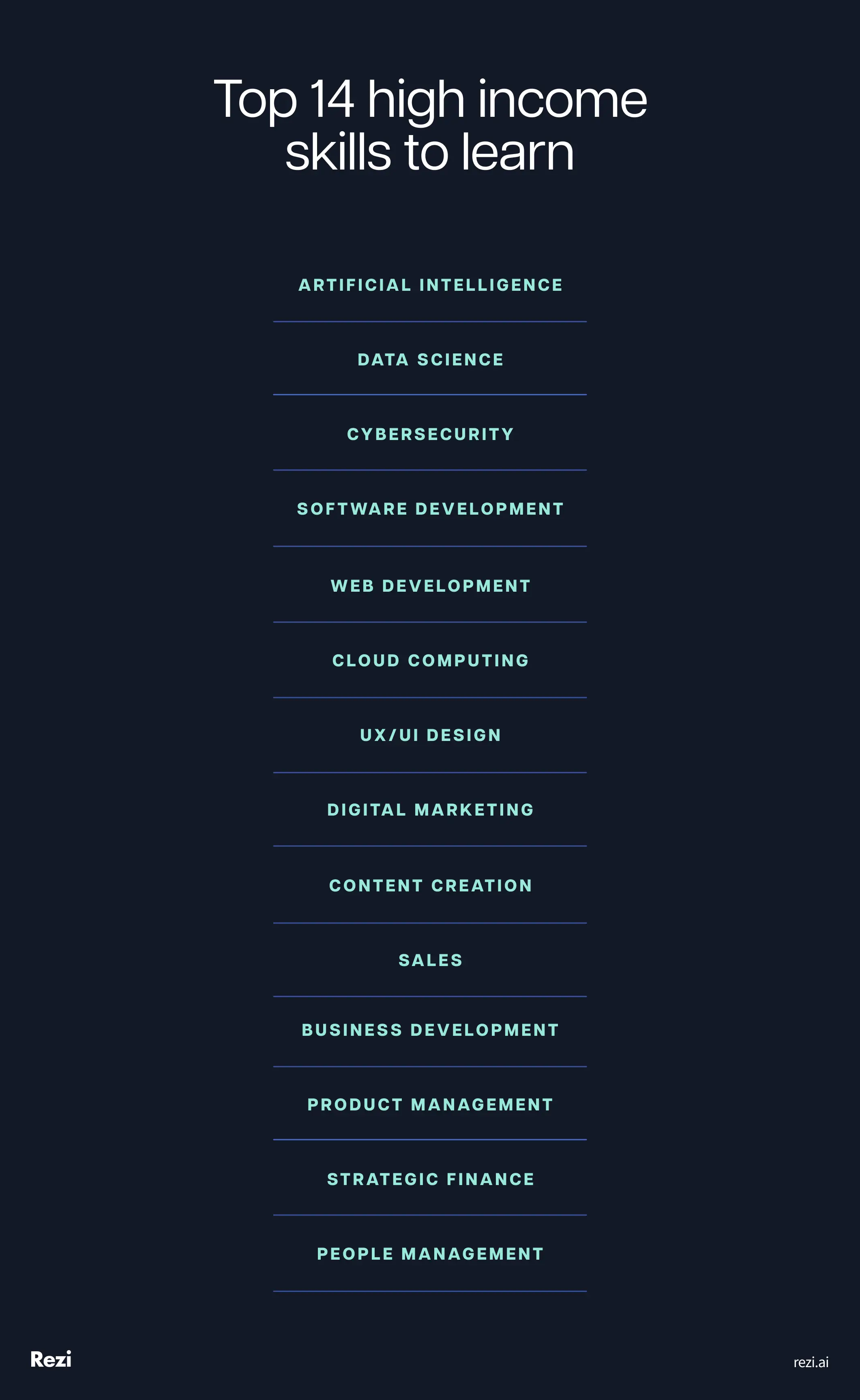
Top 14 High-Income Skills to Learn to Make More Money
Here are the best high-income skills to learn to make more money:
- Artificial intelligence and machine learning
- Data science and visualization
- Cybersecurity
- Software development
- Web development
- Cloud computing
- UX/UI design
- Digital marketing
- Personal branding and content creation
- Sales
- Business development
- Product management and strategy
- Strategic finance
- Leadership and people management
Many of these skills will also allow you to be able to make money from home. Anyhow, we’ll go through each of these high-income skills in more detail below.
Further guides:
1. Artificial intelligence (AI) and machine learning (ML)
Relevant Job Titles: AI Engineer, Machine Learning Engineer, Data Scientist, Prompt Engineer, AI Product Manager.
Difficulty to Learn: Hard.
Chance AI Could Replace It: Low.
The pay range for AI Engineers is between $110K–$176K per year, according to Glassdoor.
And according to the Bureau of Labor Statistics (BLS), the median annual wage for Computer and Information Research Scientists—a category that includes many AI/ML specialists—was $140,910 in 2024.
AI and machine learning involve building systems that learn from data, make predictions, automate decisions and power innovations like recommendation engines, chatbots and autonomous tools.
More companies are adopting AI to cut costs and boost revenue and efficiency. That creates demand for professionals who understand how to develop, deploy, and manage AI systems.
Begin by mastering Python, basic statistics and data manipulation. Then move to frameworks like TensorFlow or PyTorch, explore machine learning algorithms, and work on real-world projects—data cleaning through model deployment. Follow that with exposure to MLOps, model evaluation and building production-ready systems.
2. Data science and visualization
Relevant Job Titles: Data Scientist, Business Intelligence Analyst, Data Visualization Developer, Analytics Manager, Data Engineer
Difficulty to Learn: Hard.
Chance AI Could Replace It: Medium.
Data science roles are projected to grow much faster than average. The median pay in 2024 for data science professionals was $112,590 per year.
Data science and visualization involve gathering, analyzing, and presenting data to uncover insights that help businesses make smarter decisions. It blends technical skills with communication — turning raw numbers into stories that drive strategy. Visualization tools like Tableau, Power BI, and Looker make complex data easy to understand for teams and executives.
This is a high-income skill because every industry now relies on data to optimize operations, marketing, and product performance.
To build this skill, start by learning Python or R for data analysis, plus SQL for querying databases. Then get comfortable with data cleaning, visualization, and basic machine learning techniques. Practice by creating dashboards or case studies using real datasets from platforms like Kaggle.
As you grow, focus on data storytelling: the ability to explain insights clearly to non-technical audiences.
3. Cybersecurity
Relevant Job Titles: Cybersecurity Analyst, Security Engineer, Security Architect, Chief Information Security Officer (CISO)
Difficulty to Learn: Hard
Chance AI Could Replace It: Low
The reported median annual pay for information security analysts was $124,910 in 2024.
Cybersecurity is all about protecting systems, networks, and data from attacks, breaches, and threats from hackers, insiders, or rogue software. You’ll be monitoring systems, closing vulnerabilities, responding to incidents, and building defenses that keep companies safe and compliant.
The world is only continuing to become more digital, especially with the rise of AI. In other words, the risk of cyberattacks will likely increase, as highlighted in the Global Cybersecurity Outlook 2025 report:
“In 2024 there was a sharp increase in phishing and social engineering attacks, with 42% of organizations reporting such incidents.”
This is a high-income skill because cyber-risk is only getting bigger, and organizations are willing to pay serious money for experts who can guard their assets.
To build this skill, start with networking fundamentals, operating system/security basics, and get hands-on with tools like SIEM, IDS/IPS, and cloud security. Learn programming or scripting (e.g., Python, Bash), then pick an area to specialize in such as incident response, threat hunting, or cloud security. Certifications like CISSP, CEH, or AWS Security Specialty help validate expertise.
4. Software development
Relevant Job Titles: Software Developer, Software Engineer, Full-Stack Developer, Backend Engineer, DevOps Engineer
Difficulty to Learn: Medium–Hard
Chance AI Could Replace It: Medium
Software developers had a median pay of $131,450 per year in 2024.
Software development involves designing, writing, testing, and maintaining software applications from web and mobile apps to large-scale backend systems. You’ll be the one to turn ideas into working code that people use.
To build this skill, start with programming fundamentals. Learn a language like JavaScript, Python, or Java, and then understand data structures and algorithms. Next, practice building real projects: websites, mobile apps, or backend services. Then move into version control (Git), testing, deployment, and explore frameworks like React, Node.js, or Spring Boot.
And to make more money or increase earning potential, specialize in high-demand niches such as cloud-native development, AI-integrated applications, DevOps/SRE. Alternatively, focus on landing senior engineering or engineering manager positions. These roles typically earn more because they combine technical depth with business impact.
5. Web development
Relevant Job Titles: Web Designer, Web Developer
Difficulty to Learn: Medium
Chance AI Could Replace It: Medium
Web developers had a median pay of $95,380 per year in 2024.
Web development focuses on creating and maintaining websites that are fast, responsive, visually appealing, and user-friendly. To ensure this user-friendliness extends to all visitors, developers often utilize an image description generator to automatically create accurate alt text for visual assets. It blends design and technical execution, using languages like HTML, CSS, and JavaScript to bring online experiences to life. Many web developers also work with tools such as Webflow, WordPress, or frameworks like React and Next.js to streamline the process.
To get started, learn the core building blocks (HTML, CSS, and JavaScript) before exploring front-end frameworks or CMS platforms. Next, build hands-on projects that demonstrate both creativity and performance, like landing pages, portfolios, or client websites.
To further increase your earning potential, focus on specialized areas like website optimization and industries such as e-commerce.
6. Cloud computing
Relevant Job Titles: Cloud Engineer, Cloud Architect, DevOps Engineer, Cloud Security Specialist, Solutions Architect
Difficulty to Learn: Hard
Chance AI Could Replace It: Low
The median annual wage for computer network architects, a related role often involved in cloud infrastructure design, was $130,390 in 2024.
Cloud computing focuses on managing and delivering computing services—such as servers, storage, and databases—over the internet rather than relying on local hardware. It’s the backbone of most modern infrastructure, powering everything from streaming platforms to enterprise AI systems.
Companies that migrate to the cloud will need experts who can design, secure, and optimize these systems. Cloud computing professionals can get paid top dollar for keeping operations running, warning off threats, and scaling infrastructure effectively.
To build this skill, start by understanding networking fundamentals, Linux, and virtualization. Then dive into one of the main cloud platforms: Amazon Web Services (AWS), Microsoft Azure, or Google Cloud Platform (GCP). Next, earn certifications like the AWS Certified Solutions Architect or Google’s Associate Cloud Engineer.
After, focus more on high-leverage areas like cloud security and DevOps automation. These are the kinds of sectors that directly impact a company’s bottom line, which can therefore enable you to command higher pay.
7. UX/UI design
Relevant Job Titles: UX Designer, UI Designer, Product Designer, Interaction Designer, UX Researcher
Difficulty to Learn: Medium
Chance AI Could Replace It: Medium
The median annual wage for digital designers, a role that includes UX/UI design, was $98,090 in 2024.
UX/UI design is about creating digital experiences that look great and feel intuitive to use. UX (User Experience) focuses on how users interact with a product, whereas UI (User Interface) deals with how it looks visually. Together, they shape how people experience websites, apps, and digital products.
To get started, learn design fundamentals: layout, color theory, and typography. Next, move on to tools like Figma, Adobe XD, or Sketch. Study user research methods, wireframing, and usability testing to understand how people actually use digital products.
Once you’ve built the foundations, choose an area to double down in, like product design. You can also learn how to integrate AI-assisted design tools into your workflow to improve speed and creativity, which can enable you to increase both your productivity and earnings.
8. Digital marketing
Relevant Job Titles: Digital Marketing Manager, SEO Manager, Growth Marketing Manager, Chief Marketing Officer (CMO)
Difficulty to Learn: Medium
Chance AI Could Replace It: Medium
The annual mean wage for marketing managers was $171,520 in 2024.
Digital marketing is all about attracting, engaging, and converting audiences online through channels like search, social media, email, and paid ads — and it just so happens to be the field I work in, too.
Good marketing requires a mix of creativity and analytics. It’ll be your job to put together messages that connect with the right people while optimizing performance through data.
To learn digital marketing, here’s where I would begin: start by understanding digital psychology and copywriting. Next, move into specific channels like PPC advertising, social media, email marketing, and SEO (search engine optimization). Then, dive into tools like Ahrefs, Google Analytics, and Amplitude to measure results. Certifications such as Google Ads and HubSpot Inbound Marketing can also help validate your expertise.
To earn more, focus on being able to prove clear ROI with your marketing efforts. You can also specialize in a specific marketing field or channel, like performance marketing or CRO (conversion rate optimization). Combining marketing strategy with AI-driven analytics or automation can also give you a competitive edge and help scale your income faster.
Learn how I progressed in my own marketing career: How I Went From a Freelancer to an In-House Manager
9. Personal branding and content creation
Relevant Job Titles: Content Creator, Personal Brand Strategist, Ghostwriter, Social Media Manager
Difficulty to Learn: Easy–Medium
Chance AI Could Replace It: Low–Medium
According to Glassdoor, the pay range for personal branding is around $80K–$149K per year.
People connect with people, not faceless brands.
If you know how to tell stories, record short videos, or write content that resonates, you can build your own personal brand that opens doors, or help others do the same.
Personal branding and content creation are all about showing up online as you, and doing it in a way that builds trust, attention, and opportunity. In 2025 and beyond, this has become one of the most valuable skills to have.
Founders and professionals are now building audiences on LinkedIn, X, and YouTube to grow their businesses, which has created demand for founder-led ghostwriters, video editors, and brand storytellers.
To get started, focus on learning the essentials: copywriting, storytelling, and video editing (tools like CapCut help make it easy). Then, pick a niche you care about and start posting content that encourages engagement. Be consistent, let your personality shine through, and remember: in today’s economy, your name is your business card.
10. Sales
Relevant Job Titles: Sales Representative, Account Executive, Sales Consultant, Sales Director
Difficulty to Learn: Medium
Chance AI Could Replace It: Low
The reported median annual wage for sales managers was $138,060 in 2024.
Sales hinges on good communication and problem-solving skills. IT’s all about helping people or businesses find the right solution to their problems.
This is one of the most timeless high-income skills because it directly drives revenue. It also offers uncapped earning potential. The better you are, the more you could earn. Those who are good at it can get paid massively based on performance and not just hours worked. Top performers in tech and B2B sales can earn six-figure incomes with commissions and bonuses.
To get started, focus on learning sales fundamentals: prospecting, negotiation, and relationship-building. Study how to ask the right questions, handle objections, and communicate value clearly. You can study and read books, but at the same time, the best way to learn in this field is to go out there and get experience.
To earn more, specialize in high-ticket B2B sales or SaaS sales, where you’re selling complex, expensive solutions to businesses. These roles reward performance over time and often lead to lucrative leadership or partnership opportunities.
Check out our other articles:
11. Business development
Relevant Job Titles: Business Development Representative (BDR), Partnerships Manager, Strategic Alliances Manager, Head of Growth, Business Development Director
Difficulty to Learn: Medium
Chance AI Could Replace It: Medium
According to the U.S. Bureau of Labor Statistics, business development roles—typically classified under management or sales management occupations—have a median annual wage between $122,000 and $138,000 as of 2024.
Business development is about creating long-term value for a company through partnerships, new markets, and strategic opportunities. It’s a mix of sales, strategy, and relationship-building. It’s on you to identify where a business can grow and make it happen through collaborations or deals.
To build this skill, focus on learning strategic communication, negotiation, and market research. Understanding how to identify win-win opportunities is also key. Learn how to form partnerships, expand distribution, and launch into new regions.
If you’d like to further boost your earning potential, consider becoming a specialist in B2B or enterprise partnerships, SaaS growth, or international expansion. These areas usually come with performance-based pay and open doors to leadership roles like head of growth or VP of business development.
12. Product management and strategy
Relevant Job Titles: Product Manager, Product Strategist, Product Owner, Director of Product, Head of Product
Difficulty to Learn: Medium–Hard
Chance AI Could Replace It: Medium
The median total pay for product managers in the United States is around $148K per year.
Product management and strategy sit at the intersection of business, technology, and user experience. You decide what to build, why it matters, and how it fits into a company’s long-term goals.
To get started, learn the fundamentals of product thinking, user research, and roadmapping. Familiarize yourself with tools like Jira, Figma, and Notion, and study frameworks such as Agile, Lean, or Jobs-to-be-Done (JTBD). Gaining hands-on experience by managing a side project or MVP is one of the fastest ways to learn.
To increase your earning potential, specialize in AI or SaaS product management, where understanding both technology and user behavior gives you a competitive edge. Over time, strong PMs can often move into executive roles.
13. Strategic finance
Relevant Job Titles: CFO (Chief Financial Officer), Financial Manager, Wealth Management Advisor
Difficulty to Learn: Hard
Chance AI Could Replace It: Medium
The median annual wage for financial managers was $161,700 in 2024.
First, let me clarify that strategic finance isn’t about bookkeeping or basic accounting. It’s about understanding the bigger financial picture and using data to drive financial business decisions.
Although AI has already started automating repetitive tasks like bookkeeping, expense tracking, and financial reporting, strategic finance focuses on analysis, forecasting, and decision-making — areas that still rely heavily on human judgment and context. Good finance strategy skills means being able to determine where money should go and why, which requires a blend of technical knowledge and business intuition.
Every business needs people who can interpret numbers and turn them into strategy. Financial professionals who can advise leadership on cash flow, investments, pricing, and long-term growth are essential to profitability.
To develop this skill, start by learning financial modeling, budgeting, and forecasting, along with tools like Excel, Power BI, and SQL for analysis. Understanding key business metrics such as EBITDA, ROI, and runway will help you connect finance to strategy.
14. Leadership and people management
Relevant Job Titles: : Chief Executive Officer (CEO), Director, Team Lead, Operations Manager, Department Head
Difficulty to Learn: Hard
Chance AI Could Replace It: Low
The annual mean wage for management occupations was $137,750 as of 2023.
Leadership and people management are about guiding teams, setting vision, and bringing out the best in others. These are skills that no algorithm can truly replicate. Great leadership multiplies impact, and therefore, it’s all about inspiring trust, motivating people, and aligning teams toward a shared goal.
This is one of the most valuable high-income skills because every business runs on people. Strong leaders drive growth, reduce turnover, and build company culture — all of which directly affect the bottom line.
To build this skill, focus on emotional intelligence (EQ), communication, and decision-making under pressure. Learn how to give feedback effectively, resolve conflict, and coach others to perform at their best.
To increase your earning potential, combine leadership with another specialized skill such as marketing, product strategy, or finance. The ability to lead teams and understand the technical or strategic side of a business is what separates good managers from truly high-earning executives.
Relevant articles:
- Leadership Skills for a Resume
- Podcast Skills on a Resume
- How to Choose the Best Leadership Style for You
- How Personality Type Influences Your Work Style
Other High-Income Skills (But Here’s Why They Didn’t Make the List)
Here are some skills people often consider high-income (and here’s why they didn’t make our main list):
- Customer Service: Can offer good pay in leadership roles, but AI chatbots and automation are rapidly affecting many frontline positions.
- Project Management: Still valuable, but many tasks like scheduling, reporting, and resource tracking are being automated by AI tools, which may limit leverage.
- Human Resources & Recruitment: Pays well at the executive level, yet much of the screening and hiring process is increasingly automated, reducing scalability.
- Accounting & Bookkeeping: Reliable but time-based work. AI and automation tools are becoming more capable for handling repetitive tasks faster and cheaper.
- Administrative & Operations Management: Essential to business operations but not always directly tied to revenue generation, so pay growth tends to plateau.
- Graphic Design: Still creative and in demand, but oversaturation and AI design tools have lowered entry barriers and profit margins.
These skills aren’t “bad” by any means. They’re still important and valuable in many industries.
And more often than not, if you’re exceptional in any particular field, you can absolutely turn it into a high-income opportunity. The key is to focus on the level of impact and leverage your skill provides. The more your work drives measurable results, innovation, or revenue, the higher your earning potential.
How to Determine Which High-Income Skill Is Best to Pursue
The best high-income skill to pursue is the one that fits your interests, strengths, and long-term goals. Go for the one that aligns with your current skills and passions, not just the one with the biggest paycheck. You’ll make more money (and stay motivated) doing something you enjoy and can stick with long enough to get really good at.
If you’re unsure where to start, experiment. Take a short course, freelance on the side, or build a small project. You don’t have to find the “perfect” skill overnight. Just get started and pick a skill to master, then turn into leverage.
Read further:
- How to Choose a Career
- The Best Job Search Engines
- Company Layoffs in 2025
- What to Do If You’re Unemployed
- How to Move Forward When You Feel Stuck in Life
- I Can’t Get a Job, What Now?
- What to Do If You Hate Your Job
Summary
Let’s recap what we’ve covered about high-income skills:
- High-income skills solve problems that businesses are willing to pay a premium for.
- Focus on skills that are in demand and resistant to AI. Or, depending on the skill, learn how to use AI to do your job better.
- The best skills combine creativity, strategy, and technology, giving you leverage that scales beyond your time.
- You don’t need a degree to earn more. You need expertise that drives measurable results and makes a direct impact on revenue.
- Learn the fundamentals, build projects or portfolios that prove your skill, and specialize to stand out.
- Keep adapting. The highest earners don’t just master one skill, they keep learning and reinventing as industries evolve.
If you follow the steps in this guide and focus on developing — or stacking — one high-income skill at a time, you’ll set yourself up for long-term career success even in an AI-driven world.
And if you’re ready to start applying to higher-paying jobs and want to showcase your most valuable skills in the smartest way, you can start building your resume for free with our Rezi AI Resume Builder.
FAQs
What are the fastest skills to learn to make more money?
Some of the fastest high-income skills to learn are digital marketing, personal branding and content creation, and sales. They require little to no technical background, have quick feedback loops, and can start generating income within a few months through freelancing, commissions, or social media. Learning AI-related tools and automation (like ChatGPT, prompt engineering, and workflow automation) on the go can also give you leverage by helping you boost productivity and earning potential.
What are the best high-income skills that don’t require a degree?
Digital marketing, sales, copywriting, UX/UI design, web or app development, personal branding, content creation, and product management are all high-income skills that don’t typically require a degree. These skills rely more on practical ability and results than formal education. You can learn these through online courses, certifications, or hands-on projects. There are many six-figure professionals in these fields that are self-taught, especially those who also understand how to leverage AI tools to work faster and deliver higher-quality results.
What are the most profitable skills to learn?
The most profitable skills to learn in 2025 are those that blend technology, strategy, and human judgment. As AI becomes more widespread, leadership skills, creativity, and empathy will grow in value. Examples of profitable skills include AI and automation, product management, financial strategy, sales and business development, and software or web development—all of which can directly drive revenue or innovation. Learning to use AI tools effectively in your workflow, whether for coding, marketing, or decision-making, can boost profitability by increasing output and reducing costs.
What skills will give me access to the most powerful jobs in the world?
Some of the most powerful and influential jobs in the world combine strategic thinking, leadership, and technological literacy. Skills like AI and data mastery, product management, financial strategy, and business development can open doors to executive and founder-level positions because they involve making high-impact decisions that shape companies and industries. Pairing these with communication, negotiation, and leadership skills is what ultimately leads to influence, as power in business often comes from the ability to direct people, capital, and technology toward a clear vision.
What skills will always be in high demand that will make me the most money?
Skills that combine problem-solving, communication, and innovation will always be in high demand and command the highest pay. These include sales and negotiation, AI and automation, software and app development, product management, financial strategy, and marketing and storytelling. They’re valuable because they either generate revenue, reduce costs, or build products that people depend on. As technology evolves, the ability to think strategically, lead people, and use AI effectively will remain timeless drivers of long-term wealth.
Are there any jobs that will make me rich fast?
Unfortunately, there’s no instant path to becoming rich. However, you can build wealth faster by focusing on performance-based roles and profitable industries. Look for jobs where income can scale with results and not just hours, such as sales, business development, AI or software engineering, and digital marketing. High-ticket B2B sales, for instance, can be extremely lucrative because you can earn good commissions from selling expensive products or solutions to other businesses.

Upload or drop your resume to get started
Upload your resume to get started
Score my resume

Astley Cervania is a career writer and editor who has been sharing resume and job search insights for 5+ years. He shapes the direction of the Rezi blog, providing practical answers for important career-related questions and helping hundreds of thousands of people navigate the job market and build resumes that land interviews.

.webp)