
Resume
How to Put Expected Graduation Date on a Resume
Learn how to list your expected graduation date on a resume, highlight academic achievements, and show relevant coursework even before you’ve graduated.

Published on
December 18, 2025
Updated on
March 11, 2026
If you haven’t graduated yet, still list your degree on your resume, including the school, location, and expected graduation date, using formats like “Expected May 2026” or “2026 (Expected).” Place your education section above work experience while you’re a student, and move it later once your professional experience grows. Emphasize academic achievements such as GPA, relevant projects, awards, extracurriculars, and coursework to fill gaps. Skip high school once you have a degree, and list certifications as “In Progress” if unfinished.
Graduation might feel far away, but employers still want to know when you’ll be officially done. You’re giving them a heads-up; something honest, helpful, and saves everyone a little guesswork.
And by the way, you don’t have to wait until you’re wearing the cap and gown to start applying for jobs. Get the ball rolling now. The hiring process takes longer than most people think.
In this guide, you’ll learn:
- How to write your expected graduation date on your resume.
- Tips for making your education section impressive.
- Examples of how to list unfinished degrees.
Create a professional resume with our free AI Resume Builder or check out these guides:
- How to Write the Perfect Student Resume
- Common Resume Mistakes Among Students & Fresh Grads
- Tips for Writing a Resume With No Experience
- Resumes to Land Your Dream Internship
- How to Write a Cover Letter for an Internship
How to List Your Degree When You Haven’t Graduated Yet
Here’s how to list your degree when you haven’t graduated yet:
- Put your education section above work experience if you’re still a student. Include your degree, school, and location.
- Add your expected graduation date, even if most classes are done. Use formats like “Expected May 2026” or “2026 (Expected).”
- Emphasize your GPA (if 3.5+), relevant projects, awards, and extracurriculars that show skills or leadership.
- List coursework only if it relates to the job.
- Leave out high school; your college credentials matter more.
- Include certifications, noting “In Progress” with expected completion if unfinished.
You might be wondering, “Do I still list my education like everyone else, even if I haven’t graduated yet?” Well, yes. Employers expect to see it.
1. Add your education section
Place your education section above your work history if you don’t have much experience yet. Once your experience becomes the star of the show, you can swap the order.
List your degree, school, and location. Add your major (and a relevant minor) if you have one.
Read more about Where Should Education Go on a Resume?
2. Write your expected graduation date
If you’re unsure exactly when you’ll finish, just list the date you expect. That’s all anyone knows until the school makes it official.
You can include the month too, since it helps employers see when you’ll be fully available.
A few easy formats:
- Expected Graduation: 2027
- June 2027 (Expected)
- Expected 2027
- 2027 (Expected Graduation)
Your expected date is still your expected date, even if you’ve finished most of your classes. For example, a Reddit user had this question:
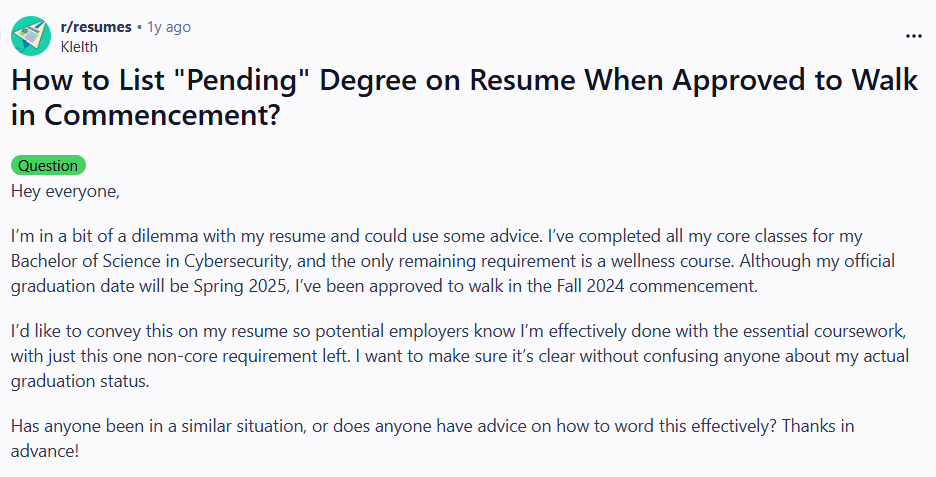
Even if they only have one module left, the degree isn’t official until 2025, so that’s the date they should list. They can still apply for full-time jobs, include the expected date, and explain the situation in a cover letter or interview if needed.
3. Show off academic achievements
If you don’t have much work experience (completely normal as a student), your academic achievements help fill the gap:
- GPA. Flex if it’s 3.5 or higher. If it’s lower, it’s fine to leave it off.
- Academic projects. Include projects that overlap with the role. Bonus points if the grade was impressive.
- Awards. Dean’s List, Magna Cum Laude, and scholarships all look great on your resume.
- Extracurriculars. Not exactly achievements, but they highlight teamwork, leadership, problem-solving, or your overall work ethic.
Here’s a sample education section:
Bachelor of Science in Computer Science | University of New York, NY | Expected May 2026
• GPA: 3.8/4.0
• Project: Built a full-stack e-commerce web app using React and Node.js (Grade: A)
• Award: Dean’s List, 2023–2025
• Extracurricular: President, Coding Club; organized hackathons and peer mentoring.
Once you gain real-world experience, you can scale back to just the essentials: degree, university, location, and graduation date.
And remember: don’t lie on your resume. Fewer lies, fewer fake stories to remember later.
Need more ways to highlight your achievements? Try our free AI Resume Bullet Point Generator. Just enter your role details and skills to get a customized list of bullet point suggestions you can add straight to your application for more impact.
4. Highlight relevant coursework
Add relevant coursework if it genuinely connects to the job you’re applying for. It shows you’ve already built some of the skills the role requires, even if you learned them in a classroom instead of an office.
Here’s an example of relevant coursework:
B.S. in Computer Science | University of New York, NY | Expected May 2026
• Relevant Coursework: Data Structures & Algorithms, Software Engineering, Database Systems, UX Design
5. Leave out high school if you have a degree
Once you’ve earned a degree, high school can gracefully exit the stage. No matter how much you peaked there, your college credentials are what matter now.
6. Apply similar rules to certifications
If your certifications are part of your degree, list them alongside it. If they’re separate, give them their own section.
If you’re still working on a certification, simply add “In Progress” with the expected completion date. Don’t hide a certification that could help you; employers care about what you’re working toward just as much as what you’ve already finished.
Should I Put My Expected Graduation Date on My Resume?
Yes. Include it, no matter how far you are from graduating. Even if you’re taking a break from college, list your expected date. You can explain the break briefly in your resume objective or cover letter.
The one exception: If it’s the summer before you start college, skip it. You’re not officially a student yet.
Employers want to see it, whether you’re applying for internships, part-time jobs, master’s programs, or your first full-time role. It tells them:
- When you’ll be fully available.
- How close you are to meeting your qualifications.
- Why your work experience is still developing.
Date Conferred vs. Expected Meaning
The date conferred is the official date your school awards your degree. That’s the one on your transcript and diploma. You don’t need to write “conferred” on your resume; just list the month and year (or just the year).
Your expected graduation date is when you plan to finish, so employers know when you’ll be free.
Always make sure the graduation date on your resume matches whatever’s officially recorded.
Examples of Unfinished Degrees on a Resume
Still wondering what your complete education section could look like? Check out these examples:
Example 1:
Bachelor of Arts in English | University of Chicago, IL | Expected Graduation: June 2027
• GPA: 3.9/4.0
• Relevant Coursework: Modern Literature, Creative Writing, Literary Analysis
• Awards: Dean’s List 2023–2025
• Extracurriculars: Editor, University Literary Magazine; Member, Creative Writing Club
Example 2:
Associate in Business Administration | Miami Dade College, FL | Expected May 2026
• GPA: 3.7/4.0
• Relevant Coursework: Principles of Marketing, Accounting, Business Law
• Extracurriculars: Vice President, Student Business Association; Organized student networking events
Example 3:
Bachelor of Science in Biology | University of Wisconsin, WI | May 2028 (EGD)
• GPA: 3.8/4.0
• Relevant Coursework: Genetics, Organic Chemistry, Microbiology, Ecology
• Project: Designed a microbial growth experiment analyzing antibiotic resistance patterns (Grade: A).
• Awards: Dean’s List 2024–2025
• Extracurriculars: Member, Biology Research Society; Volunteer, Campus Sustainability Initiative
Example 4:
Bachelor of Arts in Psychology | New York University, NY | Anticipated May 2027
• GPA: 3.6/4.0
• Relevant Coursework: Cognitive Psychology, Research Methods, Abnormal Psychology
• Project: Conducted a research study on memory retention techniques.
• Awards: Dean’s List 2024–2025
• Extracurriculars: Volunteer, Peer Counseling Program; President, Psychology Club
In Rezi, when filling out your education section, you can’t add notes like “Expected Graduation.” You can only enter the year, and I’m sure employers will get the gist. Or, in the Finish Up & Preview section, you can type in that it’s anticipated, like this:

Summary
Here’s a recap on putting your expected graduation date on your resume:
- Always list your degree on your resume, even if you haven’t graduated yet.
- Put the education section above work experience if you’re still a student and you don’t have relevant work experience.
- List your degree, school, location, and the expected graduation date, using formats like “Expected May 2026” or “Anticipated 2026.”
- Highlight academic achievements, like GPA (3.5+), relevant projects, awards, and extracurriculars.
- Add coursework that aligns with the job to showcase skills you’ve already developed.
- Include certifications, noting “In Progress” if you haven’t finished them.
- If you’re taking a break from college, still include your expected date and clarify in your resume objective or cover letter.
FAQ
Should I include the start date of my degree?
No need to include your start date. Employers care more about when you’ll graduate and what skills you’ve developed. Listing the start date usually just clutters your education section.
How long before graduation should I apply for jobs?
Start applying for jobs about three months before graduation, or even earlier. For typical entry‑level roles, starting around the beginning of your final semester gives employers enough time to interview you and line up a start date after you finish. For competitive programs in fields like consulting, banking, and accounting, applications can open from November to January of your final year, so research timelines for your target field and start earlier if needed.
Is it okay not to include dates on your resume?
Leaving dates off your resume is a gray area. If you remove them from your work history, hiring managers may assume you’re hiding gaps or issues. A safer approach is to list only the years (not months) and focus on the last 10–15 years of experience. For education, if your degree is over 10 years old, you don’t need to include the graduation year because employers typically don’t care at that point.
What is the abbreviation for expected graduation date?
Common abbreviations include “Exp. 2027” or “EGD 2027.” Use them if you need to save space or prevent the line from running too long. Keep it clear that this is a future date, not a completed degree.
Do you include your high school graduation date on your resume?
Once you’ve started or completed college, you don’t need to include your high school details. Employers care about your most recent education. Only include high school if it’s your highest level of education.
What to do if you have an unfinished degree and you’re not going to complete it?
If your degree won’t be finished, only mention it if it’s relevant. You can list the years attended, credit hours completed, or notable projects. Otherwise, skip it and focus on certifications, skills, or courses that show your qualifications and are directly relevant to the job.

Upload or drop your resume to get started
Upload your resume to get started
Score my resume

Sarah Coghlan is a writer and editor passionate about making resume and career advice clear and accessible to all. Based in Barcelona, her goal is to help job seekers create standout resumes and navigate the job search process with confidence and ease.
%2520(1).webp)

.webp)